18.1 Purpose-specific foreign-trade intermediaries
Making foreign transactions simple and tax-correct
Citizens should not need to understand wholesale currency markets, foreign settlement systems, Product Category compatibility, tax routing, custody, or the records required to support every kind of foreign transaction. Competitive purpose-specific intermediaries handle these details through ordinary retail services.
A Citizen selects a service appropriate to the intended activity. The intermediary receives Central Bank currency through the correct account, arranges any required currency conversion, completes the foreign payment or settlement, and retains an audit trail connecting the domestic and foreign parts of the transaction. The service makes the compliant route convenient without becoming a discretionary authority that approves how a Citizen may trade, travel, invest, or transfer money.
Why personal-funds B-accounts cannot use wholesale exchanges
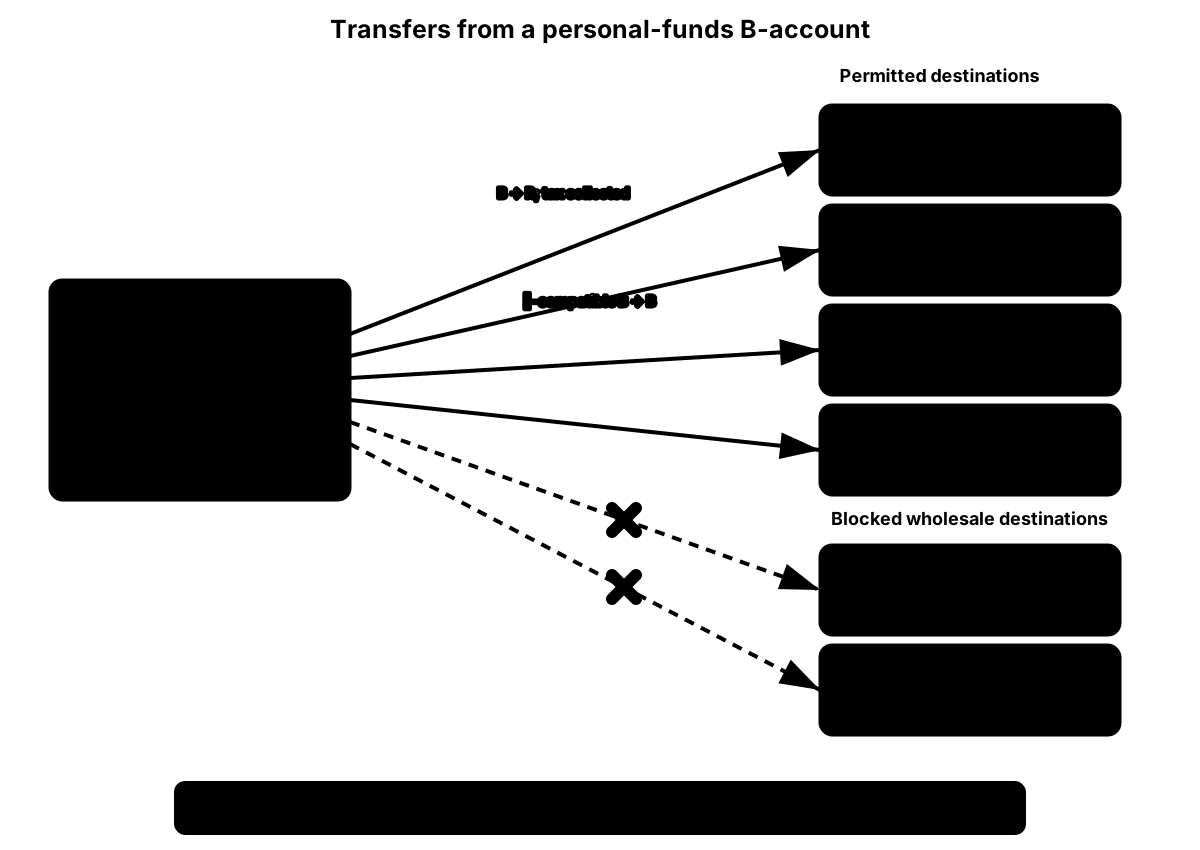
Citizens generally receive and hold their labour income, UBI, investment income, inheritance, and other personal
receipts in a personal-funds B-account. The Compatibility Relation prevents that account from making
B → B payments for consumable Products or obtaining wholesale inputs such as foreign currency. Personal
consumption is instead paid into R-accounts, where the CBPS collects consumption tax automatically.
Wholesale exchanges therefore receive Central Bank currency through B-accounts with the Product Category
foreign-currency. A personal-funds B-account is not compatible with that category, but it
is compatible with foreign-travel, foreign-investment, and
foreign-remittance B-accounts. Purpose-specific intermediaries obtain wholesale conversion through
accounts whose activities legitimately use foreign currency as an input.
The common intermediary pattern
The first transfer records the Citizen's economic purpose. Taxable domestic consumption is paid into an R-account, where the CBPS collects consumption tax automatically. A constitutionally recognised activity that is not taxable consumption is paid into an appropriately categorised B-account where the Compatibility Relation permits the transfer. The intermediary can then make a compatible B → B payment to a wholesale exchange or another producer.
The intermediary connects the Central Bank transaction to the external transaction. It may convert currency, pay a foreign provider, arrange delivery, issue a travel payment instrument, acquire and hold an investment, send a remittance, receive foreign proceeds, or convert unused foreign currency back into Central Bank currency.
| Citizen's purpose | Intermediary account | Consumption-tax treatment |
|---|---|---|
| Imported Product for domestic consumption | import-retail R-account |
Tax collected automatically |
| Foreign travel | foreign-travel B-account |
No consumption tax |
| Foreign investment | foreign-investment B-account |
No consumption tax |
| Foreign remittance | foreign-remittance B-account |
No consumption tax |
Tax is paid only when required
The architecture protects both sides of tax correctness. A foreign seller or foreign currency does not make domestic consumption exempt from tax. Conversely, travel outside the State Territory, acquisition of an asset, or transfer of money does not become taxable consumption merely because Central Bank currency funds it.
The intermediary does not choose a tax rate or grant an exemption. It submits each Central Bank transfer through the predefined account route corresponding to the transaction. The CBPS taxes every payment into an R-account, permits compatible B-account transfers, and rejects transfers that do not satisfy those rules.
Account ownership is independent of citizenship
Central Bank account ownership is largely independent of citizenship and residency. A non-citizen or non-resident Person may own any account type by accepting the Central Bank account owner contract.
Currency exchanges, import retailers, and export intermediaries may therefore be foreign-owned and operated. They may use B-accounts and R-accounts without becoming Citizens or Residents.
Transfers into their R-accounts are processed like transfers into any other R-account. The CBPS automatically collects and distributes the consumption tax. If tax choice is permitted, the CBPS uses it to allocate the tax.
The same principle applies to travel, investment, remittance, custody, and settlement services. Account rules and contractual responsibility attach to the Person owning the account rather than to nationality or place of residence. A foreign producer that receives foreign currency through an intermediary need not hold a Central Bank account at all.
Structured audit trail
The CBPS records the owner, type, and Product Category of each account together with the source, destination, amount, compatibility decision, and tax treatment of each Central Bank transfer. The intermediary's structured records connect that transfer to the relevant foreign conversion, provider, recipient, journey, asset, custodian, shipment, or settlement.
This permits routine tax auditing to be largely automatic. Software can check that a required R-account payment occurred, B-account relationships are compatible, amounts reconcile with foreign settlements, and refunds or reversals follow the expected route. Missing records, inconsistent amounts, repeated reversals, and unusual transaction patterns can be identified for further examination without manually reading every account statement.
Reducing tax evasion
Purpose-specific routes remove the easiest form of foreign-currency tax evasion: direct conversion from an
ordinary personal-funds B-account followed by an untaxed foreign purchase. They also make deliberate
evasion more difficult
because the participants must create a false purpose, false external transaction, or collusive arrangement that
is inconsistent with the intermediary's records.
The system does not claim to infer every use of foreign cash, detect every false declaration, or prove what a Citizen ultimately consumes. Collusion, disguised merchants, false travel, mixed-use assets, and foreign funds obtained outside the CBPS may require external evidence. Automatic enforcement handles ordinary transactions and creates the audit trail on which investigation of exceptional cases can rely.
Open entry and competition
An intermediary is not a government-appointed gatekeeper. Any Person may offer a foreign-trade service by accepting the Central Bank account owner contract, opening accounts with the correct Product Categories, and accepting responsibility for the transactions and records produced through those accounts. No special licence, citizenship, residency, or political approval is required.
Intermediaries compete over prices, exchange rates, fees, privacy, convenience, supported currencies, settlement methods, custody, delivery, reliability, refunds, warranties, fraud protection, and customer service. Citizens may change providers or establish competing services on the same terms.
The following examples
The following subchapters apply this common architecture to imported Products consumed within the State Territory, foreign travel, foreign investment, and foreign remittances. Each case has different tax treatment and external records, but all use intermediaries to connect an easy retail transaction with wholesale currency conversion and tax-correct Central Bank transfers.