17.13 Consumption tax is not regressive
A common argument says that consumption tax favours the wealthy because poorer households spend almost all their income, whereas wealthy households save and invest a substantial share. Dividing consumption tax paid this year by income received this year therefore produces a lower percentage for the saver.
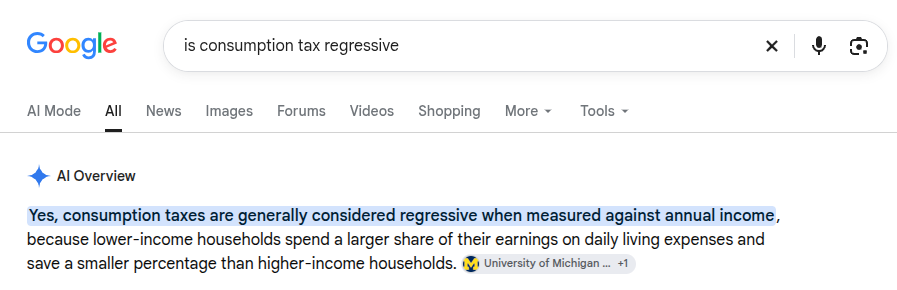
Unsurprisingly, Google's AI says consumption tax is regressive:
Richard J Murphy uses this argument in his YouTube video Why the wealthy pay less tax than you – and how to fix it:
Step 4 involves VAT. This is a complex area, but one worth paying attention to because this mundane tax is heavily biased against ordinary people. Remember, VAT is a tax on your spending, and by definition, those who are wealthy or those who are saving spend less than all their income. Now, most of us spend all our income or almost all our income every week or month. But the fact is that means we pay VAT on a great deal of our income. So, after we have paid income tax and National Insurance, then we pay VAT, on quite a lot of the rest of what we spend. But the wealthy do not spend all of their income. They spend a much smaller share of their income and therefore do not pay VAT on it. By definition therefore the wealthy pay less VAT than do ordinary households. This is what is called a regressive tax. The lower your income, the higher your likely tax rate is going to be. And that is a problem built into the VAT system in itself.
The error is treating a delay in consumption as though it were consumption escaping tax. Saving and investment preserve purchasing power for later use. When that purchasing power is eventually exercised on consumption, consumption tax applies. A lower tax-to-income ratio during the saving period does not establish a lower lifetime consumption-tax burden.
What the annual comparison actually measures
Annual income and consumption need not coincide. A worker saving for retirement can appear lightly taxed, while a retiree spending accumulated savings can appear heavily taxed relative to current income. These may be the same person at different ages. The Institute for Fiscal Studies likewise explains that assessing indirect taxes against expenditure rather than income changes the distributional picture substantially.
An annual income comparison can describe current household cash-flow pressures. It cannot, by itself, establish that savers obtain a permanently lower consumption-tax rate. Under a uniform flat consumption tax, the same fraction of spending is collected whenever consumption occurs.
Equal treatment can produce progressive net taxation
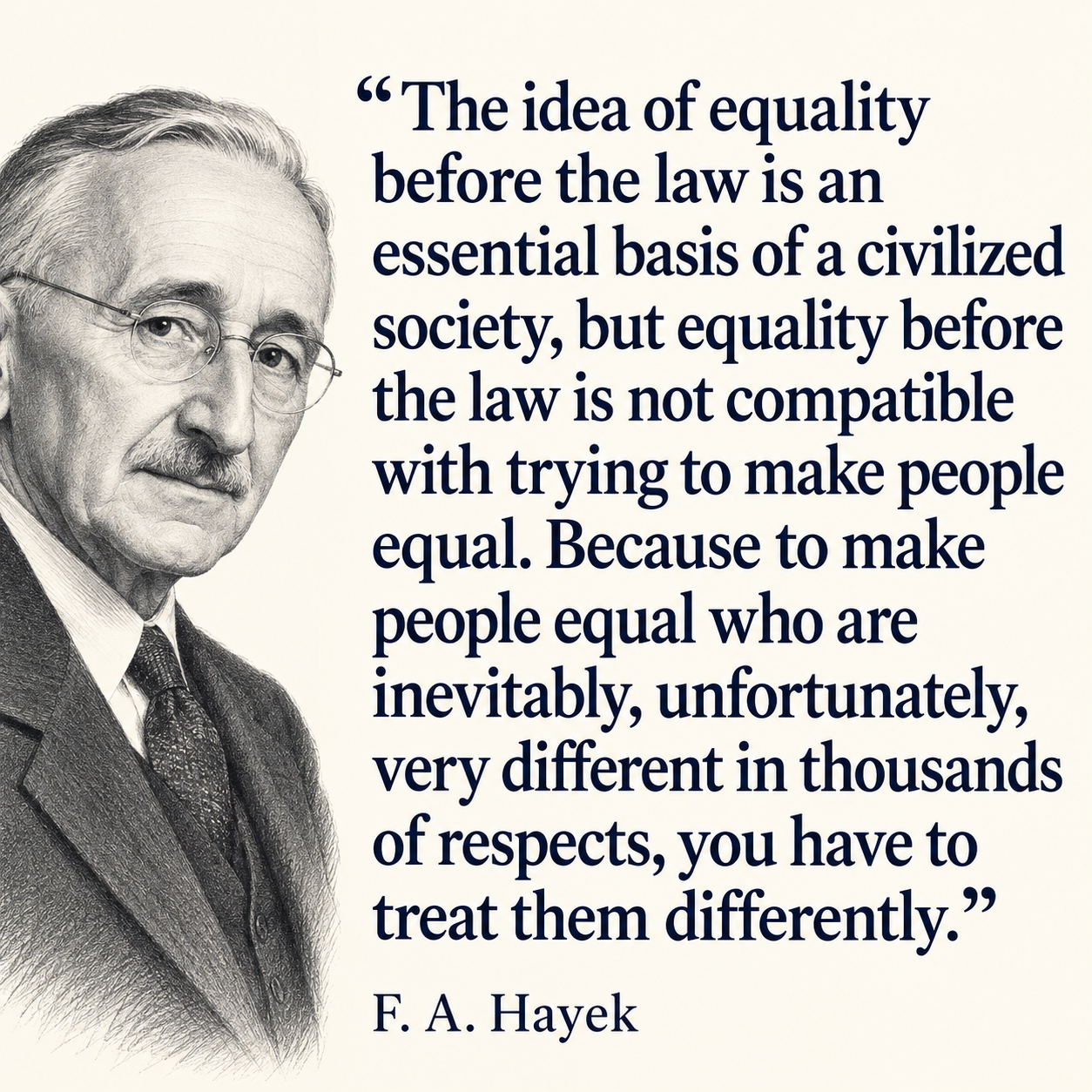
In an interview preserved in UCLA's oral history collection, Hayek argues that equality before the law is incompatible with trying to make people equal:
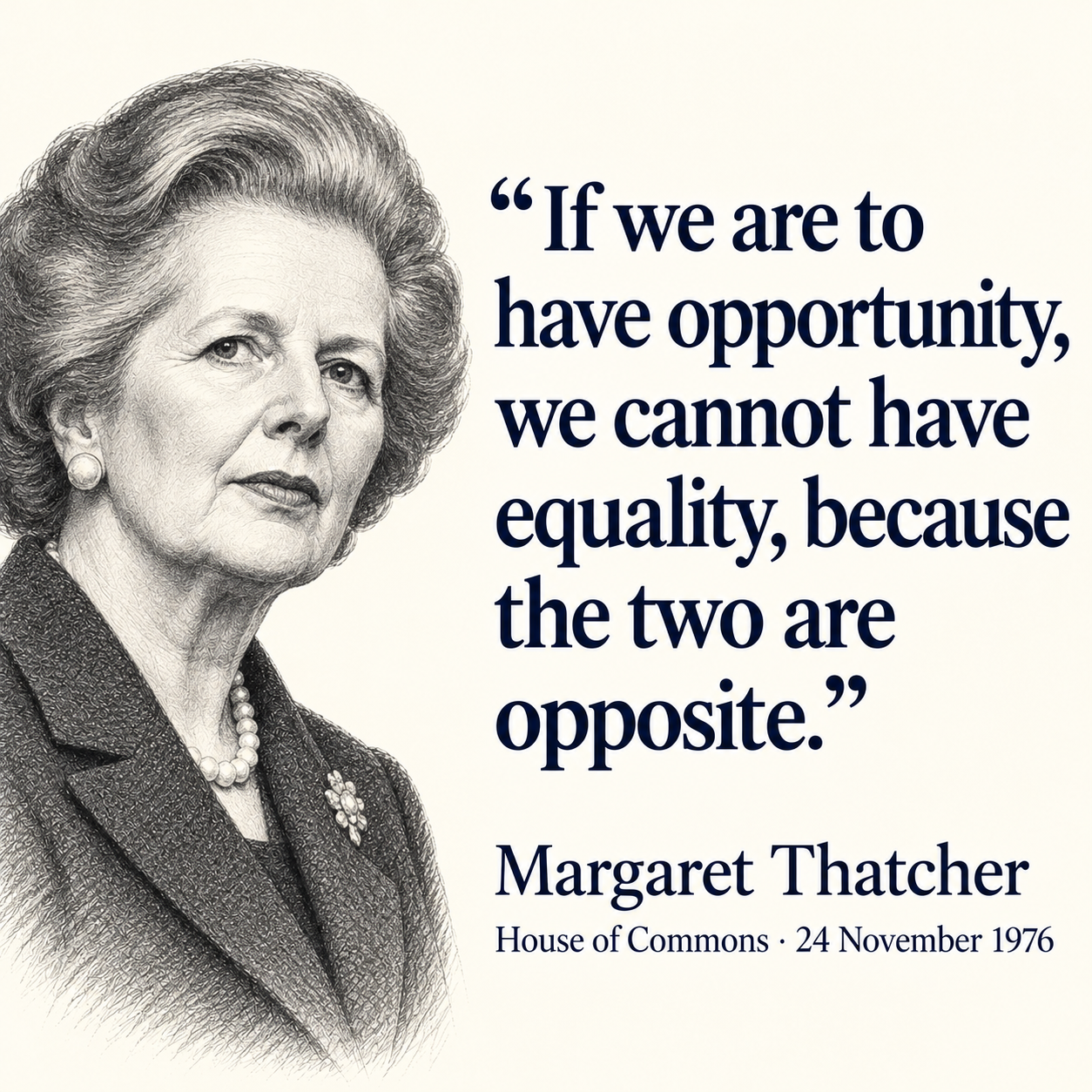
Margaret Thatcher expressed a similar opposition between opportunity and equality when discussing incomes and earnings in the House of Commons on 24 November 1976:
If we are to have opportunity, we cannot have equality, because the two are opposite.
These arguments identify a real danger in enforcing equal outcomes, which can undermine incentives to work. Nevertheless, it is incorrect to claim equal treatment is incompatible with reducing inequality. A flat consumption tax used to fund UBI illustrates the point: everyone is taxed at the same rate, everyone receives the same UBI, yet in combination they reduce inequality.
The combined effect is progressive relative to spending. The same UBI offsets a larger share of the tax paid by someone who spends less, and a smaller share of the tax paid by someone who spends more. Those whose consumption tax is less than their UBI are net recipients; those whose tax exceeds their UBI are net taxpayers. Equal treatment under the rules therefore produces different net contributions without different tax rates or means-tested benefits.
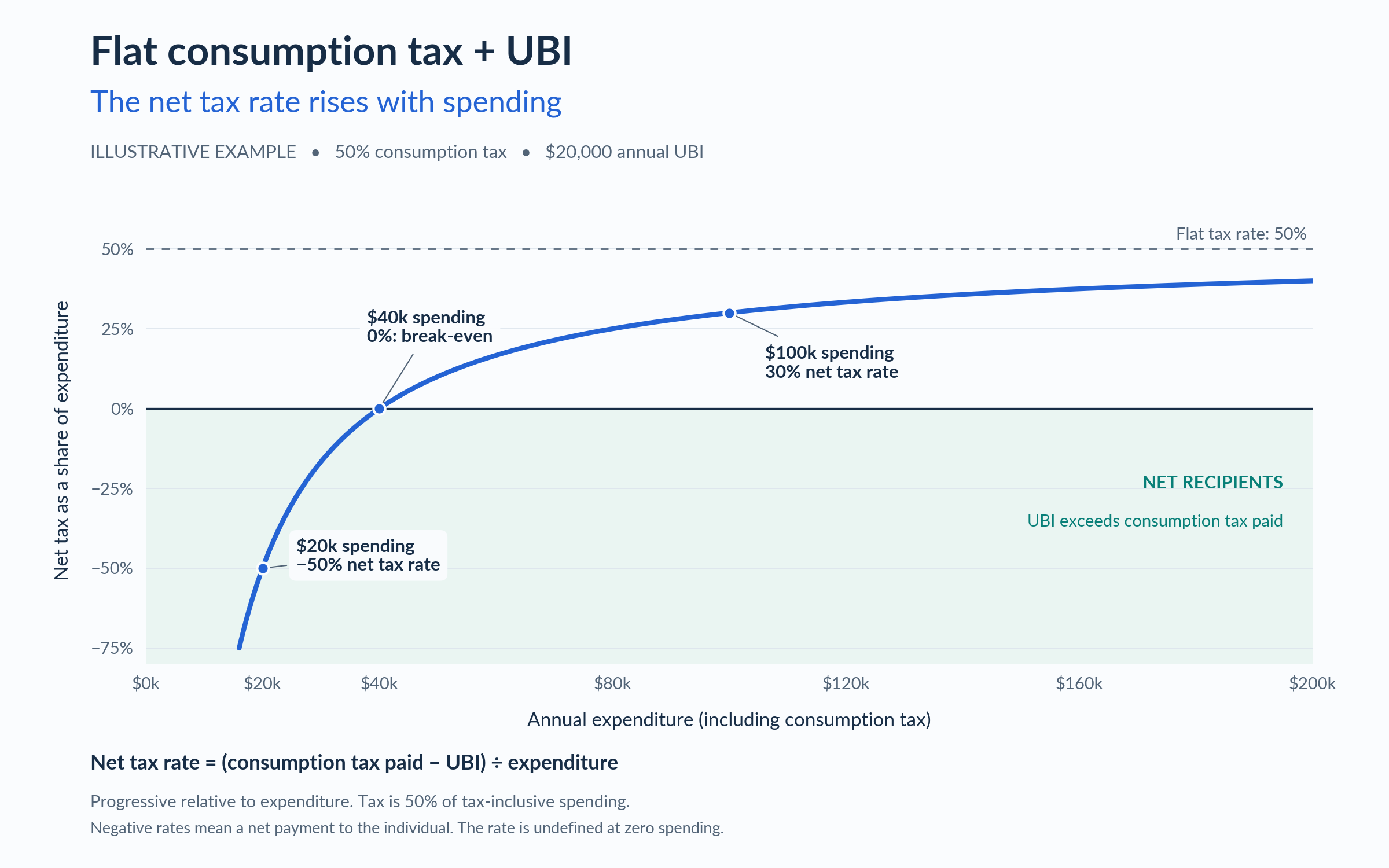
For annual spending C, a flat tax rate t and annual UBI U, net tax is tC − U, and the net tax rate is t − U/C. For positive spending and a positive UBI, this rate increases with spending, while the marginal tax rate remains flat. In the example shown, tax is measured as a fraction of tax-inclusive spending.
People remain free to earn, spend and accumulate different amounts. The system does not target a particular final distribution of resources. A uniform consumption tax and UBI therefore combine non-discriminatory treatment with progressive net taxation, without requiring the state to enforce equal outcomes.