18.4 Foreign investment
Investment is not consumption
A Citizen may use savings held in a B-account to acquire foreign shares, bonds, fund units, deposits, business interests, loans, and other investments. Exchanging currency for an asset is not consumption and does not incur consumption tax. The fact that the asset, issuer, seller, or custodian is outside the State Territory does not alter that treatment.
Foreign investment commonly requires foreign currency. The Citizen therefore needs a route from an ordinary B-account to a foreign investment without turning every ordinary B-account into an unrestricted source of foreign currency that could be used for untaxed consumption.
Direct access to wholesale currency exchange is blocked
A wholesale currency exchange receives Central Bank currency through a B-account with the Product Category
foreign-currency. A direct transfer from a Citizen's ordinary B-account is rejected because the
categories of the two accounts do not describe a realistic production relationship.
For example, a transfer from a labour B-account to a foreign-currency B-account would
require 𝜥(foreign-currency, labour) to be true. It is false because foreign currency is
not an input into supplying labour. The CBPS cannot determine from the transfer alone whether the currency would
fund an investment, foreign consumption, or an untaxed Product intended for consumption at home.
Competitive foreign-investment services
Competitive foreign-investment services provide the legitimate route between a Citizen's B-account and foreign assets. These services may include brokers, investment platforms, custodians, foreign fund services, foreign deposit services, international lending services, and services for acquiring interests in foreign businesses. Any Person may provide such a service by accepting the Central Bank account owner contract and using accounts with the required Product Categories.
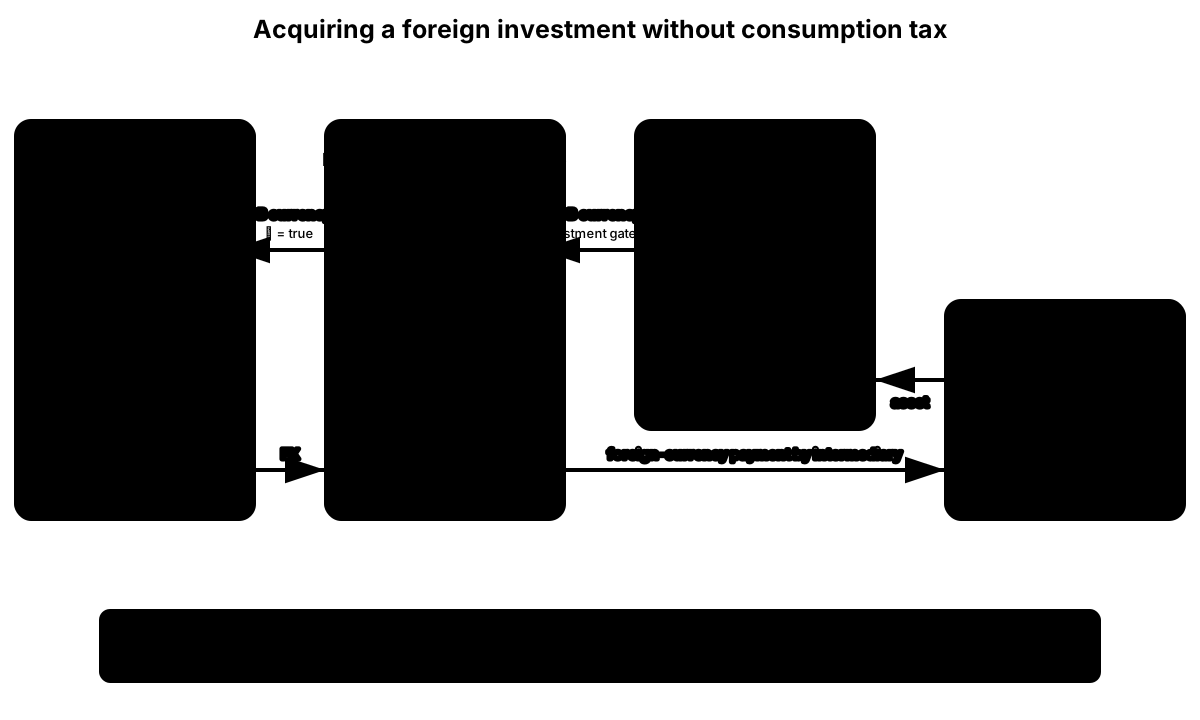
A Citizen transfers Central Bank currency from an ordinary B-account to the investment service's
foreign-investment B-account. A purpose-recorded foreign-investment gateway permits the transfer
without collecting consumption tax. The service then obtains foreign currency from a wholesale exchange and
uses it to acquire the specified foreign asset.
The investment service can pay the exchange's foreign-currency B-account because foreign currency is
an input into foreign investment: 𝜥(foreign-currency, foreign-investment) is true. The
wholesale exchange performs currency conversion without investigating the Citizen, assessing the investment, or
deciding whether it is prudent.
The foreign-investment gateway
The Citizen's payment to the investment service is a purpose-recorded gateway transfer. It is not an ordinary
B → B production transfer and does not assert that foreign investment is an input into the activity
represented by the Citizen's B-account. It is a constitutionally permitted transfer from a Citizen's balance
into a foreign-investment account for the acquisition of an asset rather than consumption.
The gateway does not make an ordinary B-account compatible with a foreign-currency account. The
investment service remains between the Citizen and the wholesale exchange and is responsible for ensuring that
its foreign-investment account is used to acquire, hold, manage, or dispose of investments.
Purchasing and holding foreign assets
The investment service connects the untaxed transfer to an identifiable asset transaction. It may register an asset directly in the Citizen's name, arrange custody, acquire units in a fund, place money in a foreign deposit, purchase shares or bonds, lend to a foreign Person, or acquire an ownership interest on the Citizen's behalf.
Its records may identify the investor, asset, quantity, price, currency, issuer, seller, broker, custodian, and settlement transaction. These records establish that the foreign currency purchased with Central Bank currency was exchanged for an asset rather than released for unrelated consumption. The service does not determine whether the investment represents good value or an acceptable risk.
An investment service may offer direct registration, pooled custody, nominee custody, or another contractual holding arrangement. In every case the Citizen owns the resulting property or enforceable beneficial interest. Failure of the intermediary remains governed by its contracts, custody arrangements, property rights, and ordinary liability law.
Foreign-currency balances and custody
An investment service may retain foreign currency temporarily for settlement, reinvestment, fees, or expected asset purchases. It may also provide a foreign-currency balance within an investment account. The balance must remain connected to investment activity rather than becoming an unrestricted substitute for direct wholesale conversion.
The service may therefore pay an asset seller or custodian directly, restrict outgoing payments to investment counterparties, or return the value to the Citizen by selling the foreign currency and crediting Central Bank currency to a B-account. Simply handing unrestricted foreign currency to the Citizen would remove the connection between the gateway transfer and its investment purpose.
Dividends, interest, and sale proceeds
Foreign investments may produce dividends, interest, rent, repayments, distributions, or sale proceeds in foreign currency. These receipts are returns on property rather than consumption. The investment service may reinvest them, retain them within the foreign investment account, use them to meet investment expenses, or sell them through a wholesale exchange.
When foreign currency is sold, the exchange transfers Central Bank currency to the investment service's
foreign-investment B-account. The service may then transfer the proceeds to the Citizen's B-account.
Neither the return of capital nor investment income incurs consumption tax. Consumption tax applies only if the
Citizen later uses the resulting purchasing power for taxable consumption.
Investment services remain competitive
Foreign-investment services compete over exchange rates, brokerage and custody fees, supported markets and assets, execution quality, privacy, reporting, risk controls, insurance, and contractual protection. No political authority approves investments, selects providers, limits entry, guarantees returns, or protects favoured domestic industries from foreign competition for capital.
A Citizen bears the gains and losses arising from the investment and the chosen contractual arrangements. Fraud, misappropriation, false statements, breach of custody obligations, and unauthorised use of assets remain subject to ordinary law.
Investment is not a route to untaxed consumption
The exemption follows the economic use of the transaction, not the word investment. Shares, bonds, business loans, and fund units are ordinarily clear examples of assets. Other Products may serve both as assets and as objects of personal use or enjoyment, including foreign homes, vehicles, boats, jewellery, art, collectables, and wine.
A foreign property rented to others may be an investment, while accommodation used personally by the Citizen is consumption outside the State Territory. A vehicle bought abroad and brought home for private use is domestic consumption. An object acquired as an investment and later used or enjoyed within the State Territory may require tax settlement before that domestic consumption begins.
A Citizen breaches the citizenship contract by falsely presenting consumption as foreign investment. An investment service or exchange breaches the Central Bank account owner contract if it knowingly participates in that arrangement. The CBPS blocks direct access to wholesale conversion, while the investment service's asset and settlement records provide evidence where evasion requires a false transaction or collusion.