Chapter 1: Introduction
The purpose of the VoTa constitution is to promote peace, freedom, and prosperity in a human community.
Property rights are protected without exception, supporting free markets, voluntary exchange, and market prices that enable economic calculation and guide capital allocation. Property includes your own body and the factors of production. Property may have only one owner. A property right is the right to exclude others from using a resource, resolving conflicts. All rights are property rights. Creations of the mind are not property because their use is not mutually exclusive.
Aggression is defined as initiating or threatening to initiate significant interference with a person’s property rights or agreements, such as through force, fraud, or negligence. The law is framed in terms of violations of the Non-Aggression Principle (NAP). Every person has the right to use proportionate force in self‑defence or in defence of others, and to seek restitution for violations of their rights.
There is no political government. In that sense, VoTa is anarcho-capitalism. However, that by itself leaves a troubling question: even if a society begins with people committed to free markets and respecting property rights, will that endure in future generations? It is unclear whether anarcho-capitalism alone can ensure long-term stability, and there are reasons for doubt. Human history provides strong evidence for expecting that deterioration. Archaeologists document prehistoric exchange networks long before the emergence of states. Exchange therefore predates states, yet coercive territorial monopolies emerged, spread, and persisted throughout the world. There is no known year in recorded human history in which the entire planet was completely free of war or major armed conflict. It therefore seems likely that competing private defence agencies won't always peacefully cooperate; they may fight, form cartels, or consolidate into regional monopolies. The argument that they will avoid war because war is expensive cuts both ways. A neighbouring defence agency may prefer accommodation to the immediate cost of resistance, allowing an aggressor to take territory one threat at a time.
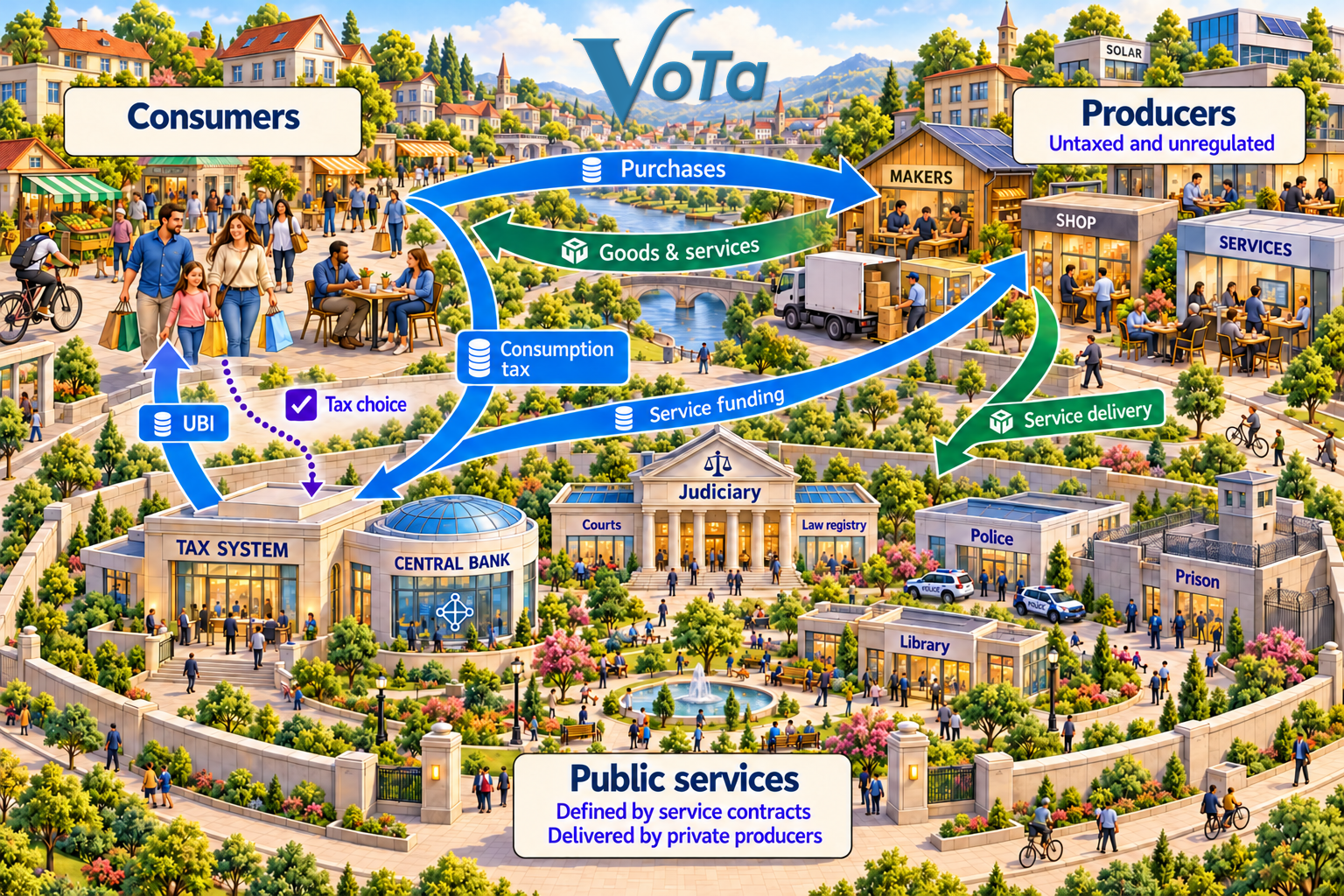
The proposed structure appears to use familiar institutions that are contrary to anarcho-capitalism: a democratic state with a rule of law, police, judiciary, prisons, a central bank, and a tax imposed on the people to fund redistribution and public services, which may include gas, water, electricity, waste management, roads, parks, schools, hospitals, etc.
However, the way it works is radical. Despite appearances, these institutions operate consistently with anarcho-capitalism. This may initially seem unbelievable. These institutions can be said to constitute a "state", but not a state in the way Max Weber defined it (a monopoly of the legitimate use of physical force). Taxation is achieved without violating property rights or the NAP, yet nearly everyone pays significant tax. This outcome arises from people acting in their own self-interest, without relying on altruism or compulsion.
VoTa uses the most extreme form of democracy: direct rather than representative democracy. Voting on initiatives to change laws and services is online and optional, with robust biometric identity checking. People can concentrate on issues they understand and care about. Most people may vote only occasionally, and some may never vote.
Democracy is constrained by a constitution that protects freedom and individual rights through simple, powerful principles applied consistently. In particular, the constitution states:
- Amendments to the constitution require an overwhelming supermajority.
- There is only one tax, a flat consumption tax at a rate fixed by the constitution.
- Anyone can propose initiatives to change laws and services. To be registered, they must be accepted as coherent, unambiguous and constitutional by the judiciary.
- Property rights are protected under the NAP.
- Production is untaxed, and producers are regulated only by the NAP.
- Laws and services which depend on any characteristic of a person (apart from a small explicit list of exceptions) are taken to be discriminatory and unconstitutional. This is called the Non-Discrimination Principle (NDP).
The key is the NDP because it is very simple, unambiguous and violations are obvious, and yet it eliminates virtually every way in which the state can overreach or treat people unfairly. For example, the following are unconstitutional because they violate the NDP: a minimum wage, rent controls, taxation brackets, income taxes, wealth taxes, targeted welfare, means-tested welfare, targeted penalties or subsidies, certification requirements, R&D grants, asset tests, taxi medallions, import quotas, laws against free speech or free association, laws restricting trade unions, DEI hiring quotas, laws restricting opening hours for businesses or whom they may do business with.
This avoids the problems normally associated with democracy. There cannot be a tyranny of the majority. There cannot be a steady slide into higher taxes, more spending and welfare, and advantages granted to special interest groups, leading to what Hayek called the road to serfdom.
The VoTa Constitution is not abstract; it is a precise legal document. It gives legal effect to shared values in which people can recognise their own convictions about freedom, justice, and how to live together. Its provisions impose explicit duties on the judiciary and require constitutional obligations and guarantees to be incorporated into the contracts binding service operators and citizens.
There is no public sector. This upholds an anarchical society and, together with the NDP, eliminates cronyism. All public services are contracted to private operators that compete for funding and operate under profit and loss. There is no political government that determines how much tax is collected, from whom, and how it is allocated. Rather, there is just a flat consumption tax collected automatically when consumers pay electronically, and the revenue is automatically allocated to services using a water-filling algorithm that respects the service tax budgets (to avoid underfunding or overfunding) and the individual tax choice of each taxpayer.
Allowing each taxpayer to choose which services receive their tax flips the normal logic that public services are inferior to a free market. It means there are many thousands of public services that mirror a competitive free market. Taxpayers exercise consumer power, funding only the best services, pressuring private operators to innovate and provide better services at lower cost.
Taxation is normally despised because it involves somebody spending other people's money on somebody else. Tax choice flips that logic too. In VoTa, a taxpayer normally directs their tax to exactly the services they like and use. They are in effect spending their own money on themselves and will consider the taxation to be consistent with their own self-interest. If anything, the taxpayer will see taxation as strengthening their power as a consumer. For example, they can direct their tax to a new service being developed, while continuing to use the old one they dislike! Taxpayers can unionise and fund new services that compete with the largest corporations. Service contracts can be tailored to protect consumers, for example protecting their data, avoiding advertisements, or requiring fine-grained modular services to promote competition. That is extraordinary consumer power over producers.
Like workers organising through unions, consumers can organise through tax choice to increase their bargaining power. The prospect of competition from tax-funded services can influence entire industries, including software platforms, social media, streaming services, web search, online news, and online shopping.
Tax choice simultaneously satisfies objectives of the right and left that are normally regarded as incompatible:
- The right: Tax choice is individual consumer choice and the free market applied to public services.
- The left: Tax choice is collective funding of public services. It addresses the free-rider problem. People in need are looked after, resources are shared, the environment is protected, and citizens exercise direct influence over society’s priorities.
A service contract may fund the creation of freely copyable works, such as software, music, movies, books, mathematics, and the results of scientific or engineering research and development. VoTa recognises no intellectual property rights. Instead, taxpayers can collectively commission new works, funding their creation rather than paying for permission to copy or use them.
Anyone can own central bank accounts. The central bank protects people's privacy and autonomy. Money exists as nonnegative balances in central bank accounts. Money can be transferred between accounts but cannot be created or destroyed. Private banks cannot create money when they extend credit; they are just unregulated financial intermediaries. The state cannot borrow, lend, print money, or buy and sell assets to manipulate the economy. Interest rates are determined by the free market.
Central bank accounts are classified as consumption, wholesale, or retail accounts. This allows for consumption tax to be collected automatically. Also, business accounts have product categories, and transfers which aren't consistent with a realistic supply chain are blocked, eliminating most ways of evading tax. For example, a coffee shop can buy coffee beans wholesale, but a clothing store cannot.
Citizenship is voluntary. It is an agreement with the state, but not an agreement to pay tax! All resident citizens receive a Universal Basic Income (UBI). The UBI represents security for the people, gives poor people more power to negotiate pay for their labour, makes the effective tax progressive, and is crucial to making significant taxation possible without compulsion. It encourages a large fraction of the public, particularly employees, to choose citizenship.
Citizens may work for or supply only tax-compliant businesses. Firms therefore tend to benefit from tax compliance because it allows them to hire citizens. This condition extends through supply chains to retail businesses. They choose to use the payment system and retail business accounts which automatically collect consumption tax as consumers make purchases, regardless of the consumer's citizenship. Even wealthy people who own no business, such as retirees or those with inherited wealth, cannot avoid consumption tax when spending within the state.
The VoTa constitution is unusually detailed, technical, and precise. Yet beneath that detail lies a small set of principles applied without compromise, foremost among them the Non-Aggression Principle and the Non-Discrimination Principle. Much of what appears radical follows from applying these principles consistently.
VoTa’s claim to long-term stability rests on these constitutional principles, particularly the NDP, which guards against differential treatment by the state and prevents any group from capturing it, including through incremental change.