17.12 Allocation of tax to public services
Avoiding underfunding or overfunding of services
The tax budget of each registered public service is defined in advance. It comes from the service contract and customer usage data, representing the price taxpayers must pay.
Consumers don’t allocate their tax directly. Instead, they give ratings on services: negative to vote against, zero for neutral, and positive to vote in favour.
If individuals allocated tax themselves, the result would be chaos: some services underfunded, others overfunded. Most people only rate a handful of initiatives, leaving the majority of scores at neutral.
To solve this, an allocation algorithm runs at the end of each day. It processes the services in decreasing order of popularity, according to their total score. Allocations respect consumer ratings while also preventing underfunding or overfunding. Underfunding is largely avoided because tax can be directed to services where consumers gave a neutral score.
Without this algorithm, managing millions of individual allocation choices would be an administrative nightmare.
You may worry that essential but unpopular services could be starved of funds. Yet if an essential service underperforms, taxpayers will notice quickly. And if the problem is underfunding, they will shift their ratings to prioritise it. This feedback loop is highly responsive because tax allocations are performed daily.
The water-filling algorithm
Imagine that every public service has a bucket whose capacity is its tax budget for the day. The tax available from each consumer is the water, and the consumer's ratings indicate which service buckets they most want their tax to fill.
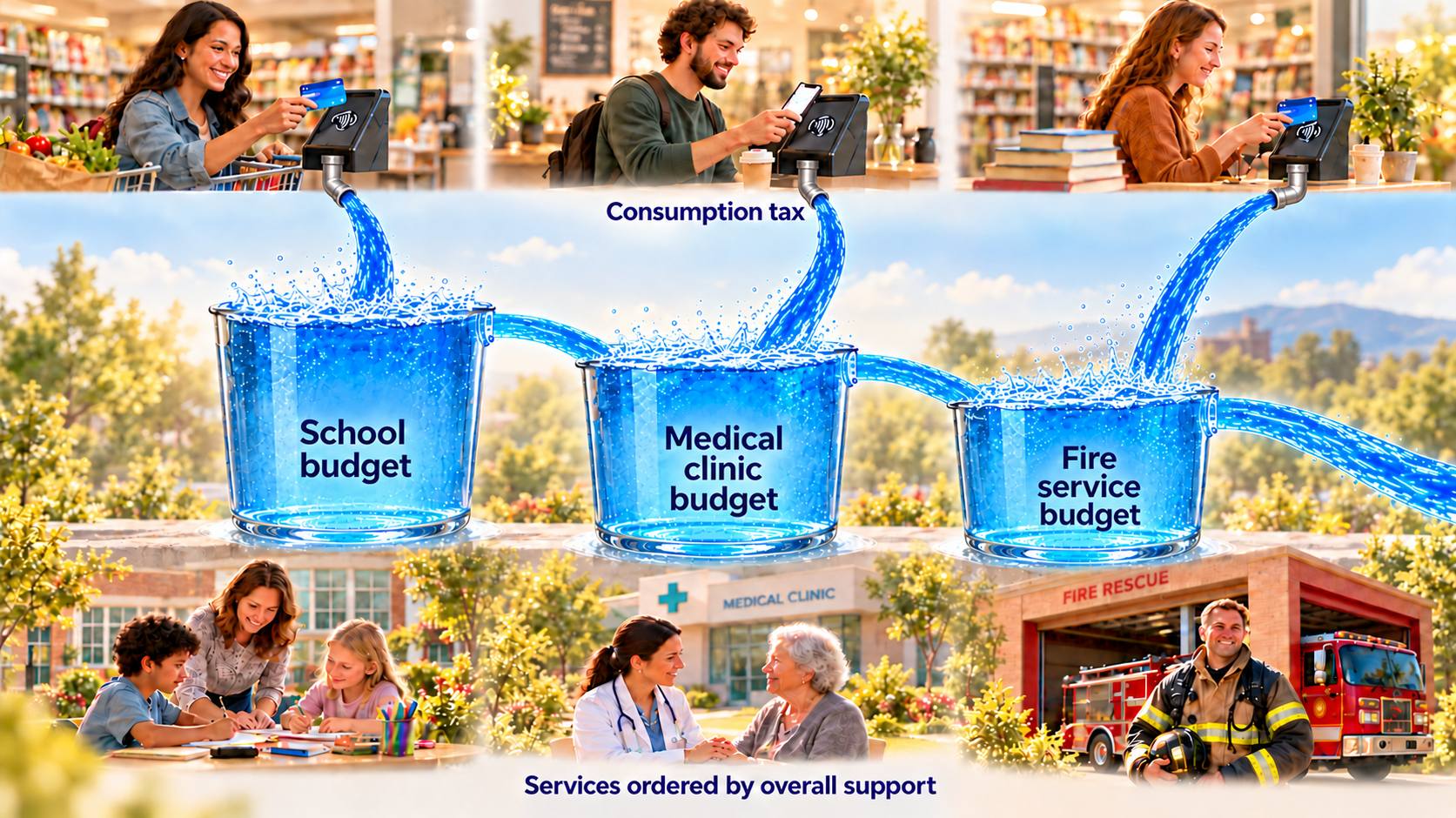
The services are considered in order of their overall support. For each service, tax associated with positive ratings is used first. Depending on the configured form of the algorithm, stronger positive ratings either contribute before weaker ones or receive greater weight. As soon as the service reaches its budget, its bucket is full and receives no more tax. If the next group of consumers could overfill it, only the proportion needed to reach the budget is used.
A negative rating contributes nothing to that service. A neutral rating contributes only when the positively rated tax is insufficient to fill the service's budget. This allows neutral tax to prevent a shortfall without letting it alter the relative support expressed by positive ratings.
When a consumer's tax has been allocated to one service, it is no longer available to later services. The algorithm continues through the remaining services using each consumer's unallocated tax. Any tax left after all services have been considered is allocated to UBI. In this way, the system follows consumer preferences, avoids substantially overfunding services, reduces underfunding, and never allocates the same tax twice.
Consumption tax on major purchases
In this constitution, consumption tax is paid once, at the moment you buy something. But what happens when the thing you buy isn’t small… but enormous? A house. A car.
If we taxed those the same way we tax a cup of coffee, something strange would happen. The tax would hit all at once: a massive spike, and then… nothing. Public services would get a surge of funding, followed by years of silence.
Yes. The tax on an expensive final product is paid upfront. But the allocations from that tax are released gradually, over the lifetime of the product… as if the product were generating small, recurring tax payments from each successive owner. This means a house doesn’t just create a one‑time burst of funding. It creates a steady stream. Predictable. Fair. Linked to real consumption over time.
But here’s the clever part. To avoid shrinking the money supply, the upfront tax doesn’t sit idle. It goes straight into the UBI pool, the most liquid, continuously circulating part of the entire system. And as the years pass, the scheduled allocations to public services are drawn from that same pool.
The result is a beautifully balanced mechanism. The tax is simple. The money supply stays stable. Public services receive smooth, predictable funding. And the burden of consumption is shared fairly across everyone who uses the product, not just the first buyer.