18.5 Foreign remittances
A remittance is not consumption
A Citizen may transfer money to a Person outside the State Territory without acquiring a Product or asset in return. The transfer may be a gift, family support, a charitable contribution, repayment of a private debt, or a movement of money between accounts owned by the same Person. Transferring money is not consumption and does not incur consumption tax.
The foreign recipient may later use the money for consumption, saving, investment, or another purpose. That later decision does not transform the Citizen's remittance into consumption within the State Territory.
Direct access to wholesale currency exchange is blocked
A wholesale currency exchange receives Central Bank currency through a B-account with the Product Category
foreign-currency. A direct transfer from a Citizen's ordinary B-account is rejected because the
categories of the two accounts do not describe a realistic production relationship.
For example, a transfer from a labour B-account to a foreign-currency B-account would
require 𝜥(foreign-currency, labour) to be true. It is false because foreign currency is
not an input into supplying labour. The CBPS cannot determine from the transfer alone whether the foreign
currency would fund a genuine remittance or an untaxed purchase from a foreign seller.
Competitive foreign-remittance services
Competitive foreign-remittance services provide the legitimate route between a Citizen's B-account and a foreign recipient. They may deposit money into a foreign account, credit a mobile wallet, arrange cash collection, use a foreign remittance network, or transfer money to an account owned by the Citizen abroad. Any Person may provide such a service by accepting the Central Bank account owner contract and using accounts with the required Product Categories.
A Citizen transfers Central Bank currency from an ordinary B-account to the remittance service's
foreign-remittance B-account. A purpose-recorded foreign-remittance gateway permits the transfer
without collecting consumption tax. The service obtains foreign currency from a wholesale exchange and sends
the foreign value to the identified recipient.
The remittance service can pay the exchange's foreign-currency B-account because foreign currency is
an input into its service: 𝜥(foreign-currency, foreign-remittance) is true. The wholesale
exchange performs currency conversion without investigating the relationship between the sender and recipient
or deciding whether the transfer is worthwhile.
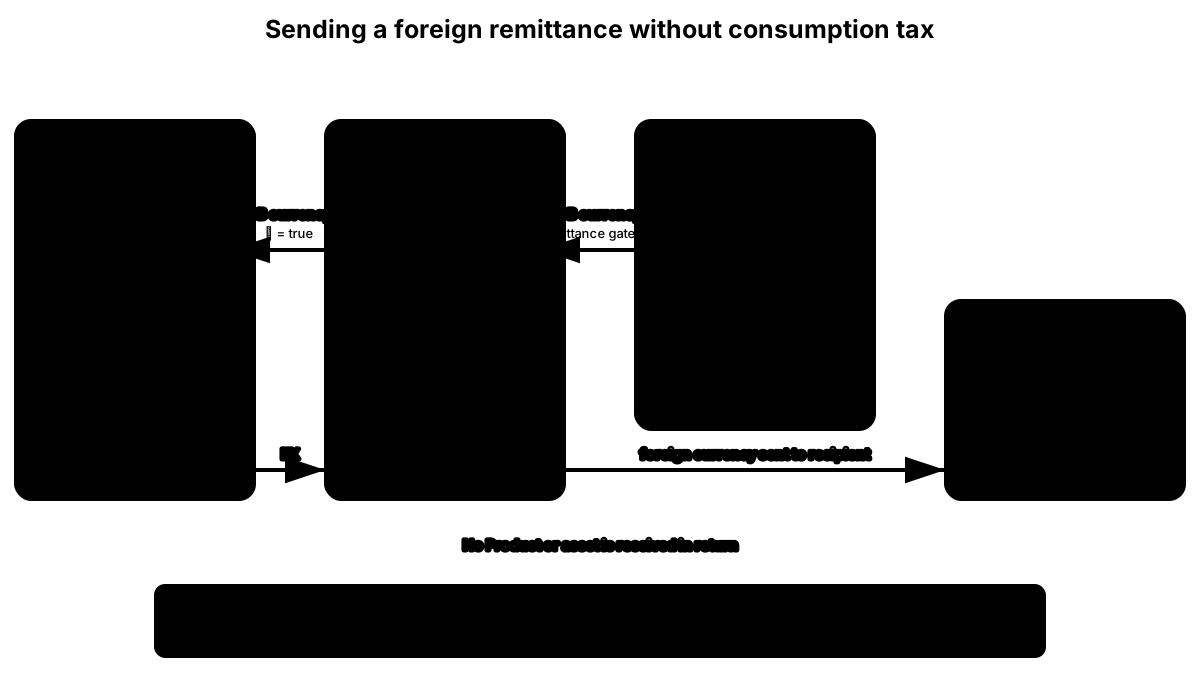
The foreign-remittance gateway
The Citizen's payment to the remittance service is a purpose-recorded gateway transfer. It is not an ordinary
B → B production transfer and does not assert that a remittance is an input into the activity represented by
the Citizen's B-account. It is a constitutionally permitted transfer from a Citizen's balance into a
foreign-remittance account for transferring value rather than acquiring consumption.
The gateway does not make an ordinary B-account compatible with a foreign-currency account. The
remittance service remains between the Citizen and the wholesale exchange and is responsible for ensuring that
its foreign-remittance account is used to transfer money to identifiable foreign recipients.
Outgoing remittances
The remittance service connects the untaxed gateway transfer to a foreign settlement. Its records may identify the sender, recipient, destination, amount, currency, receiving account or wallet, cash-collection service, and the corresponding foreign settlement transaction. These records establish that the service transferred value to a recipient rather than paying an undisclosed merchant on the Citizen's behalf.
The recipient does not need a Central Bank account or a contractual relationship with the State. The remittance service may use foreign banks, payment systems, agents, wallets, or cash networks according to its own contracts and the service selected by the Citizen.
Incoming remittances
A foreign Person may likewise send money to a Citizen. A remittance service receives the foreign currency and
may sell it through a wholesale exchange. The exchange transfers Central Bank currency to the service's
foreign-remittance B-account, from which the service credits the Citizen's B-account.
Receiving a gift, repayment, family transfer, or movement of the Citizen's own money is not consumption and does not incur consumption tax. Once credited, the balance is ordinary Central Bank currency. If the Citizen later uses it for consumption within the State Territory, that later purchase follows the ordinary consumption-tax rules.
Transfers to the Citizen's own foreign account
A Citizen may remit money to an account, wallet, or custody arrangement that the Citizen owns outside the State Territory. Changing the location or currency in which property is held is not consumption. The remittance service records the foreign destination in the same way as it records a transfer to another recipient.
Money held abroad may subsequently fund travel, investment, gifts, or consumption. If the Citizen instead uses it to acquire a Product for consumption within the State Territory while bypassing the required taxable payment route, the original legitimacy of the remittance does not excuse that later breach.
Remittance is not a route to untaxed consumption
The absence of consumption tax follows the economic arrangement, not the payment description. Sending money to a relative abroad is a remittance. Paying a foreign merchant for a Product intended for consumption within the State Territory is a purchase, even if the Citizen describes the payment as a remittance.
A nominal recipient may also act as the Citizen's purchasing agent by receiving money, buying a Product, and sending it home. The CBPS cannot infer that wider arrangement from the currency transfer alone. Evidence from the recipient, merchant, shipping service, communications, or repeated transaction pattern may establish false declarations or collusion.
A Citizen breaches the citizenship contract by falsely presenting a purchase as a remittance. A remittance service or exchange breaches the Central Bank account owner contract if it knowingly participates in that arrangement. The service is not responsible merely because a recipient independently decides how to use money after a genuine transfer.
Remittance services remain competitive
Foreign-remittance services compete over exchange rates, fees, transfer speed, supported destinations and currencies, bank deposits, wallets, cash collection, privacy, refunds, fraud protection, and customer service. No political authority approves personal transfers, selects providers, fixes exchange rates, or grants a limited number of remittance licences.