Chapter 5: Consequences of the NDP
The NDP is a structural constraint, not a moral one. But ask yourself: what does a state look like when it is forbidden from treating people differently? The answer is startling: it loses most of the powers we currently associate with government.
As a clause in the constitution the NDP appears harmless, even obvious: a simple fairness rule. But once applied, it behaves like a wrecking ball. It does not merely prohibit a few objectionable practices; it dismantles the architecture of modern governance.
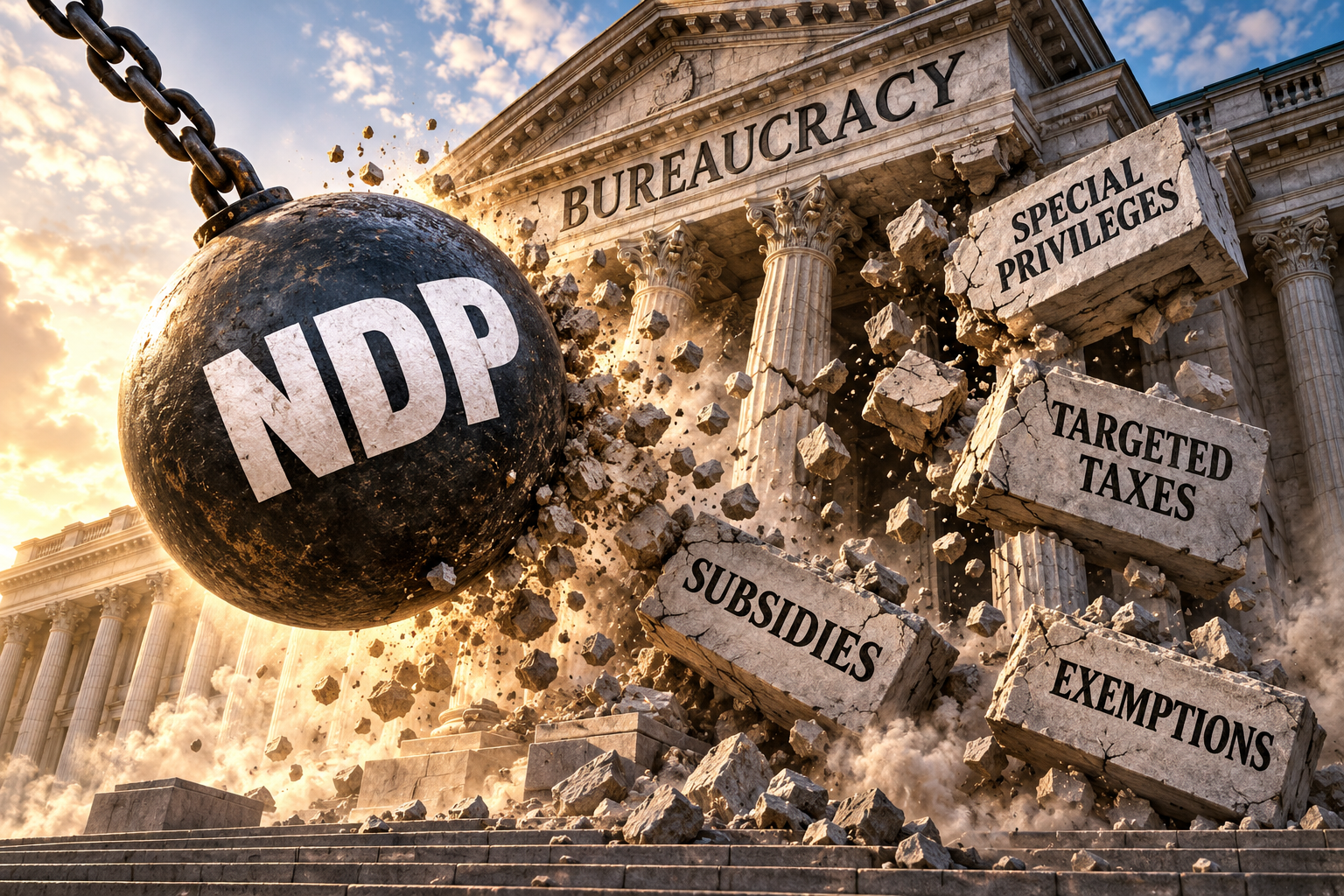
- exposing contradictions in contemporary policy
- revealing hidden coercion embedded in bureaucratic rules
- collapsing layers of administrative complexity
- forcing universal, non‑discretionary mechanisms
- eliminating targeted benefits and burdens
- aligning incentives with voluntary cooperation
- protecting free exchange and property rights
- reducing the state to mechanism rather than policy
It is a tiny clause with enormous philosophical and structural implications. The moment the state loses the ability to discriminate, the entire logic of political governance changes.
Flipping the usual logic
The NDP is radical because it imposes a mechanical constraint rather than a moral aspiration. It does not say, “The state should be nice”; it says, “The state must operate only on variables that apply to everyone.”
VoTa therefore flips the usual logic:
- Instead of banning private discrimination, VoTa bans state discrimination.
- Instead of regulating voluntary trade, VoTa protects it.
- Instead of creating categories, VoTa eliminates them.
This produces a striking inversion of the status quo. In most modern societies, private discrimination is prohibited while state discrimination is pervasive. A shop owner may not choose whom to serve, a landlord may not choose whom to rent to, and an employer may not choose whom to hire, yet the state routinely divides citizens into categories and treats them differently on a scale no private actor could ever match. The NDP reverses this asymmetry by placing the prohibition where it matters: on the state itself.
A state that cannot discriminate must govern through general rules that apply uniformly to all individuals. It cannot create privileged groups, targeted benefits, selective burdens, or favour one industry, region, or demographic over another. Equality before the law thus becomes a structural necessity rather than merely an aspiration. The NDP is not a minor refinement to existing practice; it reshapes the entire architecture of the state.