18.3 Foreign travel
Consumption outside the State Territory is not taxed
A Citizen travelling abroad needs foreign currency to pay for accommodation, meals, transport, entertainment, and other Products consumed during the journey. Consumption tax does not apply because these Products are consumed outside the State Territory. The source of the money and the citizenship of the traveller do not change the place of consumption.
The foreign-travel category also covers education and medical services consumed while the Citizen is
physically outside the State Territory. A travel service may therefore arrange or pay for tuition for a course
attended abroad, treatment provided by a foreign hospital or practitioner, and accommodation or transport
associated with either purpose. Education delivered online or medical services delivered remotely to a Citizen
inside the State Territory are instead domestic consumption and must be paid for through an R-account.
The Citizen therefore needs a way to transfer Central Bank currency from an ordinary B-account to a travel service's B-account without incurring consumption tax. Allowing unrestricted access to wholesale currency exchanges, however, would also allow a Citizen to obtain foreign currency and use it to buy Products for consumption within the State Territory without paying consumption tax.
Direct access to wholesale currency exchange is blocked
A wholesale currency exchange receives Central Bank currency through a B-account with the Product Category
foreign-currency. A Citizen normally holds income, including labour income and UBI, in an ordinary
B-account. A direct transfer from that account to the exchange is rejected because the categories of the two
accounts do not describe a realistic production relationship.
For example, a transfer from a labour B-account to a foreign-currency B-account would
require 𝜥(foreign-currency, labour) to be true. It is false because foreign currency is
not an input into supplying labour. The CBPS cannot determine from the attempted transfer whether the foreign
currency would fund travel abroad or an untaxed Product consumed at home, so it does not permit the transfer.
Competitive retail travel services
Competitive retail travel services provide the legitimate route between a Citizen's Central Bank currency and foreign expenditure. These services may include travel agencies, airlines, tour operators, accommodation and transport booking services, travel-card providers, foreign-currency wallets, and suppliers of foreign cash. Any Person may provide such a service by accepting the Central Bank account owner contract and using accounts with the required Product Categories.
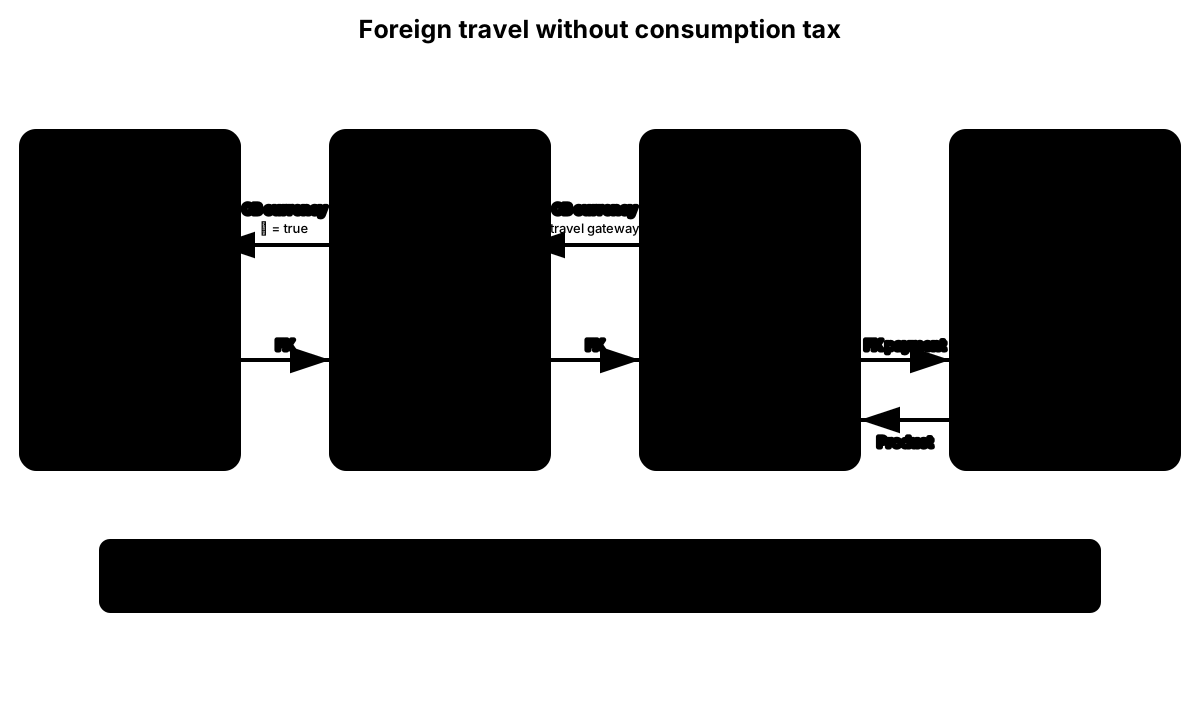
A Citizen making travel arrangements transfers Central Bank currency from an ordinary B-account to the retail
travel service's foreign-travel B-account. The purpose-recorded gateway permits this transfer without
collecting consumption tax. The travel service obtains foreign currency from a wholesale exchange and uses or
supplies it for the journey. It may pay foreign providers directly, issue a payment card or wallet for use
abroad, reimburse expenditure made abroad, or provide foreign cash.
The travel service uses a B-account with the Product Category foreign-travel. It can pay the
exchange's foreign-currency B-account because foreign currency is an input into the travel service:
𝜥(foreign-currency, foreign-travel) is true. The wholesale exchange performs currency
conversion without deciding whether an individual customer's journey or expenditure is legitimate.
The foreign-travel gateway
The Citizen's payment to the travel service is a purpose-recorded gateway transfer. It is not an ordinary
B → B production transfer and does not assert that travel is an input into the activity represented by the
Citizen's B-account. It is a constitutionally permitted transfer from a Citizen's balance into a
foreign-travel account for consumption outside the State Territory.
The gateway is limited to the stated foreign purpose. It does not make an ordinary B-account compatible with a
foreign-currency account and does not give the Citizen direct access to wholesale conversion. The
retail travel service remains between the Citizen and the exchange and is responsible for ensuring that its
accounts are used for foreign travel.
Connecting the currency to travel
The travel service connects the untaxed transfer to an identifiable journey. Depending on the service being provided, its records may include the traveller, destination, travel dates, tickets, bookings, foreign providers, currencies supplied, and transactions made using a travel card or wallet. The service need collect only the information reasonably required for the arrangement it offers.
Direct payment to a foreign airline, hotel, railway, or vehicle-hire provider creates a particularly clear connection with travel. A travel card limited by location or travel dates also provides evidence of its foreign use. Foreign cash is less traceable but remains legitimate because travellers may need cash where electronic payments are unavailable or undesirable.
Retail travel services compete over exchange rates, fees, convenience, privacy, supported currencies, payment methods, insurance, refunds, customer service, and the amount of evidence they require. No political authority sets exchange rates, selects providers, or grants a limited number of travel-service licences.
Travel is not a route to untaxed domestic consumption
The exemption follows the place of consumption, not the description attached to the payment. A meal eaten abroad, a foreign hotel room, and transport used during the journey are not taxed. A Product bought from a foreign seller for consumption within the State Territory must still be paid for through an R-account.
The same rule applies when a Citizen buys a Product while travelling. A Product consumed during the journey is outside the tax base. A Product bought with the intention of bringing or sending it home for consumption within the State Territory requires an R-account payment. If the intended use changes only after purchase, the Citizen must use the tax-settlement procedure before domestic consumption.
A Citizen breaches the citizenship contract by falsely presenting domestic consumption as foreign travel. A travel service or exchange breaches the Central Bank account owner contract if it knowingly participates in that arrangement. The CBPS blocks the simple direct route, while records held by the retail service provide evidence where evasion requires false declarations or collusion.
Unused foreign currency
A traveller may retain unused foreign currency for a later journey or sell it through a travel service. Merely holding foreign currency is not consumption and creates no tax liability. If it is later used to acquire a Product for consumption within the State Territory, the ordinary R-account and tax-settlement rules apply.