18.2 Ensuring consumption tax is paid
Spending C-account value on foreign Products
A Person may use value held in a C-account to buy a foreign Product for consumption. This chapter describes how the system ensures that they pay consumption tax. It covers domestic consumers buying imported Products, consumers travelling outside the State for a holiday or business, and Citizens who choose to live abroad indefinitely.
Consumption tax is collected when that value passes through one of the taxed routes available from a C-account.
Imported Products used as productive inputs or acquired for resale are not consumption. Businesses acquire them through appropriately categorised B-accounts and the untaxed supply-chain routes described below. Value held in a C-account, however, cannot enter those wholesale routes without first passing through a taxable event.
Facts that do not affect the tax
The account route determines the tax. Citizenship and the locations of the purchaser, consumer, seller, and Product do not affect it. Nor does it matter whether the purchaser and consumer are the same Person, or whether the Product is delivered, shipped elsewhere, carried in luggage, or consumed while travelling.
Blocked access to wholesale foreign currency
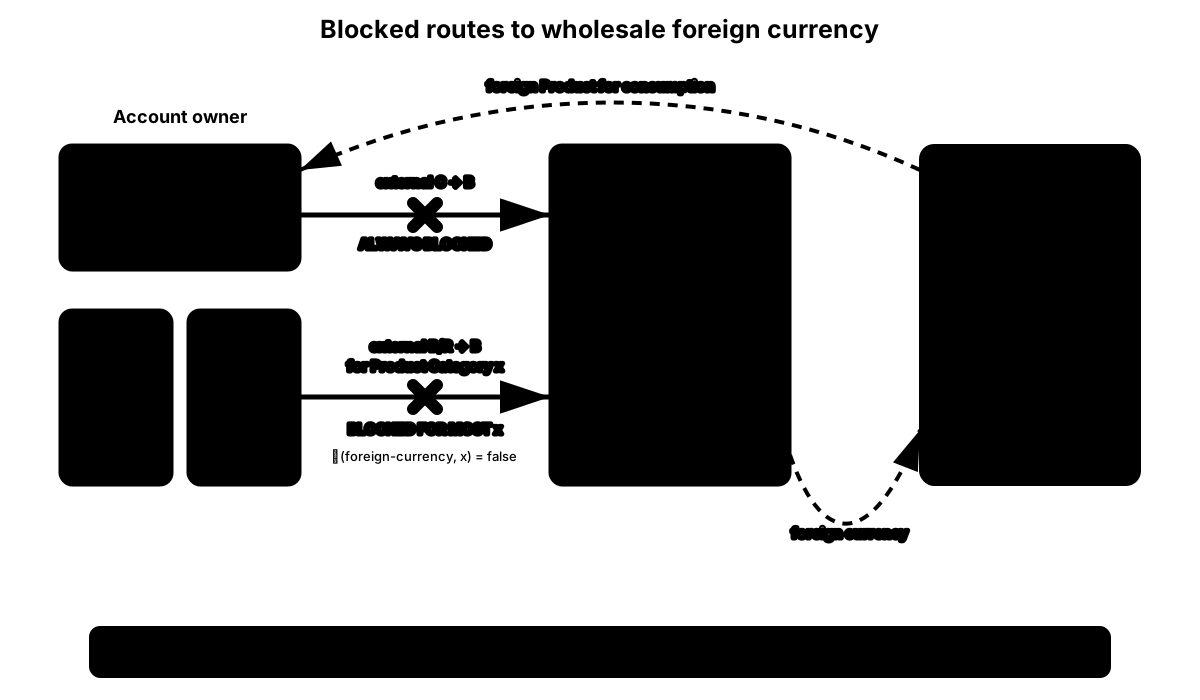
A currency exchange receives Central Bank currency for wholesale conversion through a B-account with the
foreign-currency Product Category. An external C → B transfer to that account is always blocked, so
a C-account owner cannot obtain foreign currency through an untaxed wholesale payment.
Using a B-account or R-account does not generally provide an alternative. An external payment from an account with
Product Category x into the exchange's foreign-currency B-account is permitted only when
𝜥(foreign-currency, x) is true. It is false for most Product Categories. The true relationships
are those in which foreign currency is a realistic input to the payer's declared productive activity, such as
importing, exporting, or providing a purpose-specific foreign service.
Taxed routes for foreign consumption
A C-account owner has three routes for funding foreign consumption:
- Import retailer: The purchaser makes an external C → R payment to an
import-retailR-account. The CBPS collects consumption tax, and the retailer arranges the foreign-currency conversion and payment of the foreign producer. - Retail currency exchange: The purchaser makes an external C → R payment to a
foreign-currency-retailR-account. The entire amount converted, rather than merely the exchange's fee or spread, is subject to consumption tax. The purchaser can then use the resulting foreign currency for consumption. - G-account commerce: The purchaser makes a taxed internal or external C → G transfer. The recipient can then use the Central Bank currency in unrestricted G-account commerce, including foreign exchange or direct payment of a G-account supplier.
Each route collects consumption tax before C-account value becomes available for foreign consumption. The CBPS therefore does not need to investigate where the subsequent purchase, delivery, or consumption occurs.
Competition among foreign-trade intermediaries
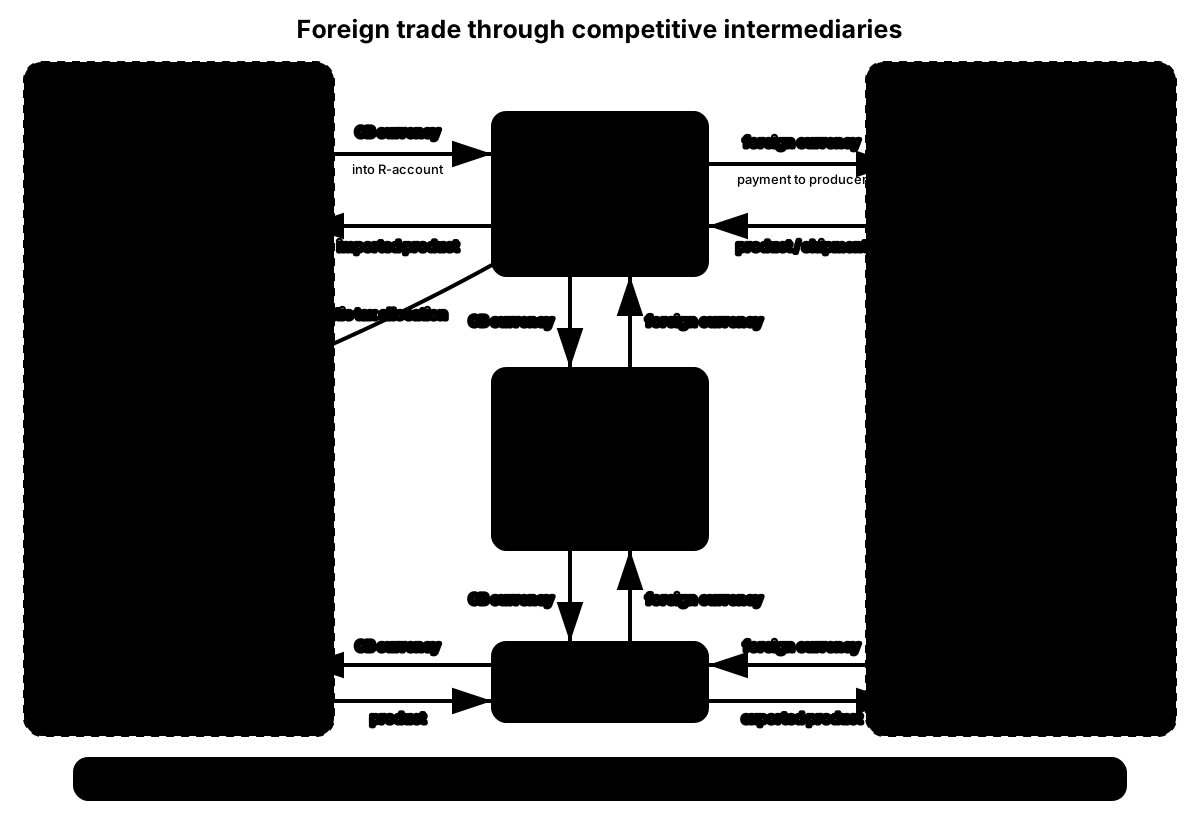
Import retailing, exporting, and currency exchange are competitive services, not State-appointed gateways. Any Person may offer one or more of these services by using accounts with the required Product Categories. A provider may specialise in one function or combine several, and importers, exporters, foreign producers, and purchasers may choose among competing providers. No intermediary receives an exclusive franchise or privileged position.
An import retailer connects a C-account purchaser to a foreign producer. It quotes a price in Central Bank currency, receives the purchaser's taxed external C → R payment, obtains foreign currency, and pays the foreign producer. Import retailers may compete on prices, margins, exchange rates, Product range, reliability, international payment, shipping, warehousing, delivery, warranties, returns, and customer support. A retailer need not hold inventory: it may arrange for the foreign producer to ship the Product directly to its destination. A foreign producer may supply or partner with any number of competing retailers. The retailer connects the two payment systems, so the foreign producer does not need to hold a Central Bank account or comply with VoTa account rules.
C-account purchasers can therefore encounter imported Products much like Products supplied within the VoTa economy. They see a price in Central Bank currency and make an ordinary C → R payment without having to arrange foreign-currency conversion, international payment, shipping, customs handling, or other logistics themselves. The import retailer handles whichever of those services the purchase requires while the CBPS collects consumption tax in the ordinary way.
An import retailer may instead acquire inventory before receiving a customer's payment. It uses an appropriately categorised B-account, funded with business capital or credit, to acquire foreign currency and buy Products for resale. Those purchases are untaxed productive transactions. Consumption tax is collected later when a purchaser buys the inventory through an external C → R payment.
Export intermediaries are also optional and competitive. A producer may export directly where the account rules permit or use an intermediary for access to foreign markets, marketing, sales, payment collection, currency conversion, shipping, logistics, warranties, returns, or customer support. Export intermediaries compete on their fees, exchange rates, market access, reliability, settlement speed, and the services they provide.
Currency exchanges supply foreign currency to importers and buy foreign-currency receipts from exporters. They may maintain foreign accounts, reserves, and counterparties in multiple currency markets, and pool transactions across many importers and exporters rather than matching each import to a particular export. The exchanges, rather than the Central Bank, are the foreign-currency counterparties. They earn revenue through fees or spreads and compete on rates, spreads, supported currencies, liquidity, settlement speed, reliability, and related services. Exchange rates emerge from competing bids, offers, and completed exchanges rather than being set by the Central Bank.
Central Bank accounts and Product Categories
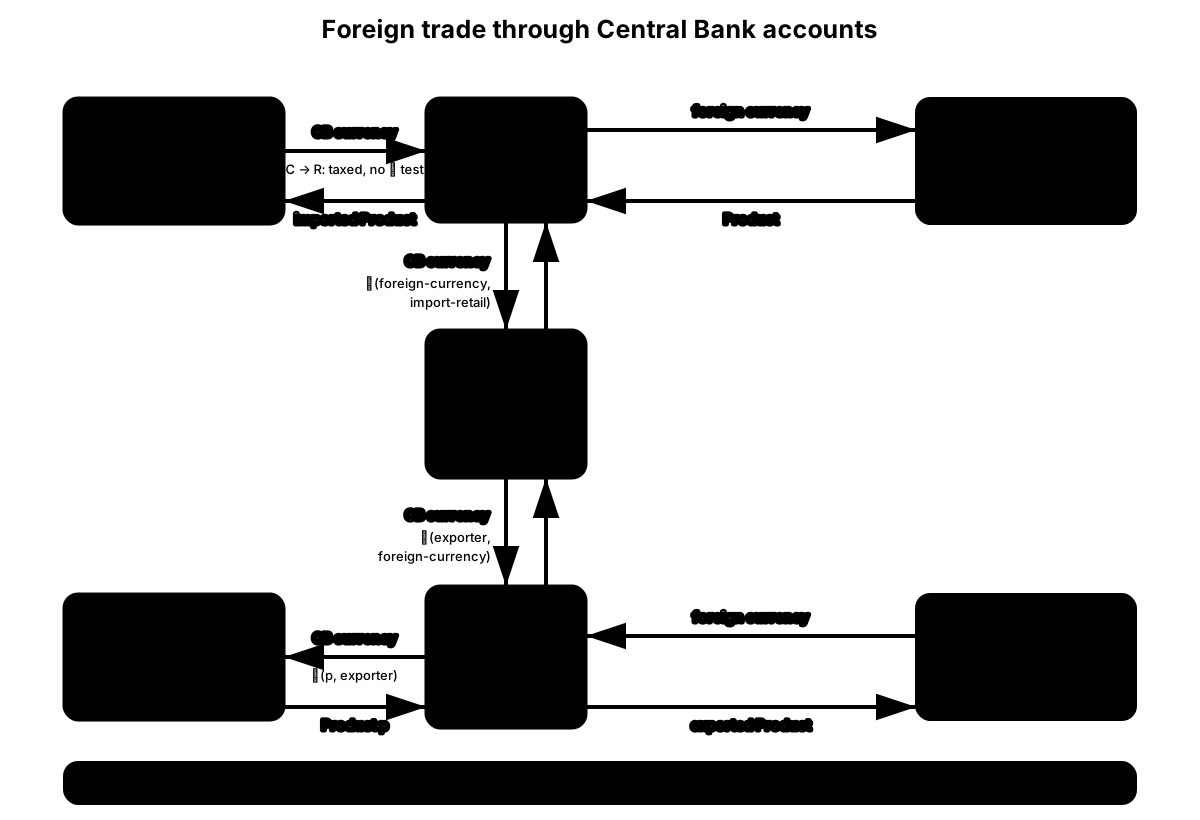
The same import and the corresponding productive foreign-trade flows can be described as four transfers of Central Bank currency. The yellow box is a C-account, blue boxes are B-accounts, and the red box is an R-account. Each B-account and R-account states its Product Category; the C-account has none. Green arrows show Central Bank currency, blue arrows show Products, and purple arrows show foreign currency.
- The purchaser pays from their C-account into the import retailer's
import-retailR-account. The external C → R transfer is permitted without a 𝜥 test, and the CBPS collects consumption tax. - The retailer pays from its
import-retailR-account into the exchange'sforeign-currencyB-account. This is permitted by 𝜥(foreign-currency,import-retail). - The exchange pays the export intermediary's
exporterB-account. This is permitted by 𝜥(exporter,foreign-currency). - The export intermediary pays the producer's B-account. If p is the Product Category of the
exported Product, this is permitted by 𝜥(p,
exporter).
In every 𝜥 expression, Products flow from the first category to the second. The corresponding Central Bank currency flows in the opposite direction. These compatible business transfers are untaxed because they keep value within production and trade; consumption tax has already been collected on the purchaser's C → R payment.
Auditable reconciliation of import payments
All payments into a currency exchange's foreign-currency B-account through this route come from an
import-retail R-account. Internal transfers into R-accounts are blocked, and every ordinary external
transfer into an R-account is a taxable event. The retailer's R-account therefore holds only money received through
payments on which consumption tax has been collected.
That fact alone does not prevent tax evasion. The tax collected on a purchaser's C → R payment is the tax on the purchaser's consumption of the imported Product. The payment may include both the retailer's foreign acquisition cost and its markup. If the retailer may send the whole payment to a currency exchange, its owner can convert the markup into foreign currency and use it for their own consumption without first making the taxed payment required for that separate consumption. Repeated sales allow the retailer to accumulate and convert profits in this way.
Each import retailer must therefore maintain an auditable database reconciling every payment to a
foreign-currency B-account with both the taxed receipts from purchasers and purchases of foreign
Products.
For each payment from an import-retail R-account A to a currency exchange B-account B,
the database must identify the transaction, or the itemised parts of a batched transaction, being reconciled. Each
item must identify a backing external C → A transaction. A backing transaction may be used only once,
and the amount sent for conversion must not exceed the amount of the backing transaction. Distinct exchange-payment
items must not be backed by the same purchaser transaction.
The database must also record the foreign-Product purchases made with the foreign currency obtained. The whole foreign-currency amount must be matched to receipts, or itemised parts of receipts, for purchases from foreign producers. No receipt or part of a receipt may be counted more than once. Payments to an exchange and payments to foreign producers may be batched, provided that every component is itemised and the itemised amounts reconcile with the totals recorded for the corresponding transactions.
On request, the importer must submit the database and supporting receipts to the public service responsible for tax audits. The auditors may compare it with the CBPS transaction history for A, B, the backing C-accounts, and any other relevant Central Bank accounts. The CBPS records establish whether the referenced transactions occurred and confirm their account categories, parties, amounts, and times. The database and supporting receipts establish how the batched monetary transactions correspond to particular foreign Products.
Formal reconciliation requirements
Let \(A\) be an import-retail R-account and let \(B\) denote a
foreign-currency B-account. Define:
- \(C_A\) as the set of external C → \(A\) transactions recorded by the CBPS;
- \(E_A\) as the set of itemised \(A\) → \(B\) currency-exchange payments recorded in the importer's database;
- \(P_A\) as the set of documented purchases of foreign Products recorded in the database;
- \(a(t)\) as the amount of Central Bank currency transferred by transaction or item \(t\);
- \(q(e)\) as the amount of foreign currency obtained through exchange-payment item \(e\); and
- \(v(p)\) as the foreign-currency value shown on foreign-purchase receipt \(p\).
The database must define a function mapping every exchange-payment item to the taxed purchaser transaction that backs it:
\[ f:E_A\rightarrow C_A. \]
The amount sent for conversion must not exceed the amount of its backing transaction:
\[ \forall e\in E_A,\qquad a(e)\leq a\bigl(f(e)\bigr). \]
The function \(f\) must be injective:
\[ \forall e_1,e_2\in E_A,\qquad f(e_1)=f(e_2)\ \Longrightarrow\ e_1=e_2. \]
Consequently, a C → \(A\) transaction can back no more than one exchange-payment item. Once it has been used, no unused difference between \(a(f(e))\) and \(a(e)\) may back another payment to a currency exchange.
To reconcile the resulting foreign currency with purchases, the database must define:
\[ r:E_A\times P_A\rightarrow\mathbb{R}_{\geq 0}, \]
where \(r(e,p)\) is the amount of foreign currency obtained through exchange-payment item \(e\) and attributed to foreign purchase \(p\). The entire amount obtained through every exchange-payment item must be attributed to documented foreign purchases:
\[ \forall e\in E_A,\qquad \sum_{p\in P_A}r(e,p)=q(e). \]
No foreign receipt may be attributed beyond its recorded value:
\[ \forall p\in P_A,\qquad \sum_{e\in E_A}r(e,p)\leq v(p). \]
Every positive attribution must refer to a valid purchase of a foreign Product:
\[ r(e,p)>0\ \Longrightarrow\ \operatorname{ValidForeignProductPurchase}(p). \]
The validity record must identify the receipt, foreign producer, Product, amount, currency, and time, and provide the evidence required to establish that the transaction purchased a foreign Product through the import business rather than foreign currency or a Product for the retailer's own consumption.
Batched transfers are permitted. If an exchange transaction \(t\) contains the finite set \(I_t\) of itemised exchange payments, the database and CBPS totals must satisfy:
\[ a(t)=\sum_{e\in I_t}a(e). \]
If a payment to one or more foreign producers is represented by a batch \(u\) containing the finite set \(I_u\) of itemised foreign purchases, its total must likewise satisfy:
\[ v(u)=\sum_{p\in I_u}v(p). \]
Let \(D_A\) denote the database submitted by the importer and let \(H_A\) denote the relevant CBPS transaction history. The account complies with these reconciliation requirements exactly when the database agrees with that history, \(f\) is injective, and all the amount, purchase, and batching constraints above hold:
\[ \begin{aligned} \operatorname{Compliant}(A)\ \Longleftrightarrow\ {}& \operatorname{Consistent}(D_A,H_A)\\ &{}\land \operatorname{Injective}(f)\\ &{}\land \operatorname{AmountConstraints}(D_A)\\ &{}\land \operatorname{PurchaseConstraints}(D_A)\\ &{}\land \operatorname{BatchConstraints}(D_A,H_A). \end{aligned} \]
The database supplies \(f\), \(r\), the batch itemisation, and the evidence for the foreign purchases. The CBPS history independently establishes the existence, direction, accounts, amounts, and times of the Central Bank currency transactions. The database is therefore a collection of claims that can be checked against the authoritative monetary record rather than a replacement for that record.
This reconciliation makes each purchaser receipt available to support no more than one foreign-currency payment item and requires all foreign currency obtained through the route to be spent on recorded foreign Products. Once a purchaser receipt has backed an import payment, any difference between that receipt and the smaller import payment cannot back another conversion. The difference remains in the retailer's R-account as its margin and must pass through the ordinary taxed route if the owner later uses it for consumption.
Tax evasion under transaction-only reconciliation
Import retailers can perform substantial and valuable work. They may arrange international shipping, insurance, currency conversion, customs handling, warehousing, local delivery, warranties, returns, and dealings with foreign producers. The risks, capital, and services involved can reasonably produce a significant markup over the foreign acquisition cost of a Product.
The resulting margins can be very large in aggregate. An importer operating at the scale of a company such as Amazon may receive enormous retail revenue and earn vast profits even where its percentage margin is modest. The tax system must not allow such an importer to convert the markup into foreign currency and make it available for the owners' consumption without the separate consumption-tax payment that would apply if the profit passed through a C-account and was spent in the ordinary way.
A simpler system could omit foreign-Product receipts and product records entirely. The CBPS could enforce it
automatically by requiring every transaction \(t_1\) from an importer's import-retail R-account \(A\) to
a currency exchange's foreign-currency B-account \(B\) to be backed by a single external transaction
\(t_2\) from a consumer C-account into \(A\). If \(E_A\) is the set of \(A\) → \(B\) transactions and \(C_A\)
is the set of external C → \(A\) transactions, the importer must supply an injective function
\[ f:E_A\rightarrow C_A \]
satisfying
\[ \forall t_1\in E_A,\qquad a(t_1)\leq a\bigl(f(t_1)\bigr). \]
Because \(f\) is injective, two exchange transactions cannot use the same consumer transaction. It follows that
\[ \sum_{t_1\in E_A}a(t_1) \leq \sum_{t_2\in f(E_A)}a(t_2) \leq \sum_{t_2\in C_A}a(t_2). \]
The rule therefore prevents the importer from sending more Central Bank currency to exchanges than it has received through distinct taxed consumer transactions. It does not establish that the amount converted was required to buy the Products sold to those consumers. The following opportunities for tax evasion remain.
- Conversion of markup: This allows the importer to accumulate profits in foreign currency and appears very easy to do. A consumer pays $100 for a Product that costs the importer $60. The importer sends $100 to an exchange and maps that transaction to the $100 consumer payment. The amount rule is satisfied, although $40 of the conversion represents the retailer's margin rather than the Product's foreign acquisition cost. By doing the same thing after each sale, the importer can accumulate its margins outside the CBPS as foreign currency without any false CBPS transaction or reuse of a backing payment.
- Conversion of accumulated margins: Ten consumers each pay $100 and the Products have a combined foreign cost of $600. The importer can make ten exchange transactions of $100, map each one to a different consumer payment, use $600 for its suppliers, and retain $400 in foreign currency. Every mapping is injective and every amount constraint is satisfied.
- Transaction restructuring: The importer can split or combine its payments to the exchange to fit the amounts of available consumer transactions. Injectivity limits the reuse of transaction identifiers, but does not stop the importer choosing transaction boundaries that allow the greatest amount of its revenue to be converted.
- Unrestricted use of the foreign currency: The CBPS observes the payment to the exchange but does not observe whether the resulting foreign currency pays a producer, is transferred to an account controlled by the retailer, or is spent on the retailer's personal consumption.
- Use of old consumer transactions: Unless backing transactions expire, an importer can retain unused consumer transactions and use them to support conversions long after the corresponding Products were supplied. A time limit reduces this stock of unused authority but does not distinguish acquisition costs from margins.
- Refunds and reversals: A consumer payment could back a completed exchange transaction and subsequently be refunded or reversed. Unless the CBPS cancels the backing relationship and requires the corresponding foreign-currency value to be returned, the exchange transaction would remain supported by a consumer payment that no longer exists as a completed taxable sale.
Transaction-only reconciliation is fully automatable and provides an aggregate limit on an importer's access to wholesale foreign currency. It cannot distinguish the foreign cost of a Product from the retailer's markup and cannot determine how the foreign currency is ultimately used. It therefore reduces the amount available for evasion but does not close the profit-conversion loophole.