Chapter 15: Monetary system
Fiat currency
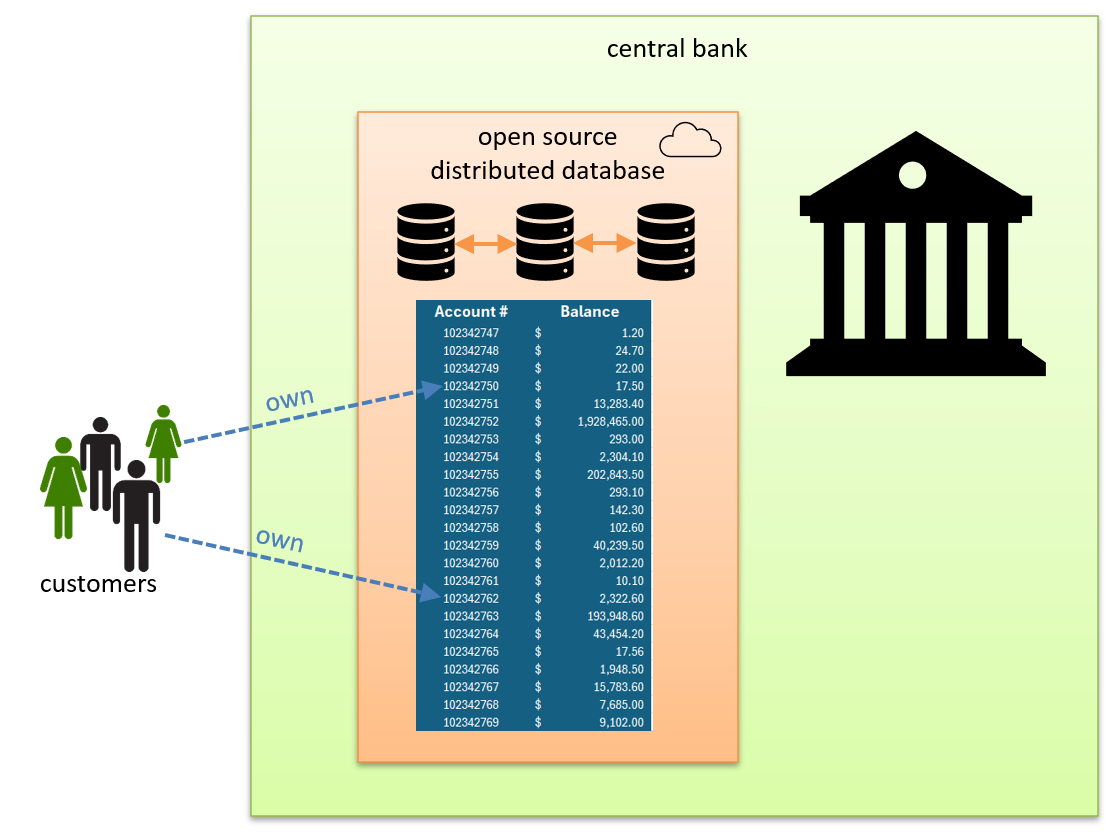
The monetary system is implemented through a public service called the Central Bank. It records money electronically in a single fiat currency, as non‑negative balances on accounts. This currency exists only as account balances in the Central Bank. Each balance represents money owned by the customer who holds that account: money that is free from debt. This is very different from deposit accounts in today's commercial banks, which record amounts owed by the bank to its creditors.
For convenience, the constitution calls the single, indivisible currency unit the Rune. Central Bank currency should be represented as integers: account balances and transfers contain whole numbers of Runes rather than binary floating-point or indefinitely precise decimal quantities. Integer accounting makes conservation exact: every unit debited from one account is credited to another, without currency appearing or disappearing through numerical approximation.
Account balances and transfer amounts would probably be recorded as 64-bit integers. One Rune would initially be of the order of one-thousandth of a US dollar, giving the currency high resolution for small payments and calculations. This indicates the intended scale of the unit, not a fixed exchange rate.
Floats against every other currency
Central Bank currency has a floating exchange rate with every other currency. This includes foreign currencies, currencies issued by other States, privately issued currencies, commercial-bank liabilities, commodity money, and any legacy currency that continues to circulate. There is no official parity, peg, fixed conversion rate, or promise that one Central Bank currency unit can be redeemed for a specified amount of anything else.
People may exchange Central Bank currency and other currencies voluntarily at rates acceptable to them. Those rates reflect changing supply, demand, confidence, convenience, risk, and expectations. The Central Bank does not buy or sell currencies, hold foreign-exchange reserves, create currency to defend a rate, or require private parties to exchange different currencies at a legally prescribed value.
The conserved number of Central Bank currency units therefore does not guarantee a fixed purchasing power or foreign-exchange value. Its value can rise or fall relative to goods, services, and other currencies. What the constitution guarantees is the integrity of the unit: its supply cannot be debased, a valid balance is not another institution's debt, and every transfer conserves the total number of units.
No reserves
Because the fiat currency is defined as what is held in Central Bank accounts, it cannot be withdrawn from the Central Bank itself. That means there is no need for reserves, and no possibility of a run on Central Bank currency. Account holders already own final currency and do not need to redeem it from an issuer. Runs on private bank liabilities remain possible, but they cannot remove currency from other people's Central Bank accounts or disable the Central Bank Payment System. Everyone is assumed to have an account with the Central Bank, and money can move freely between accounts, allowing anyone to make payments to anyone else. The Central Bank does not own money. It cannot borrow or lend. It cannot go bankrupt, and it cannot lose the money of its customers.
Behaves like gold
Even though the currency is recorded electronically, it behaves in some respects like money based on a physical commodity such as gold or silver which can be owned and exchanged. Just as you cannot possess a negative amount of gold, account balances cannot be negative. Just as you cannot give someone a negative amount of gold, negative transfers between accounts are impossible. Just as gold cannot be created or destroyed, customers cannot cause the currency to be created or destroyed. Transactions always involve moving a positive amount of money from a sender account to a receiver account, and must be authorised by the sender, and there must be funds available in the sender account, so it does not go negative. Money cannot be created or destroyed.

Free to use
The Central Bank is available to all citizens for free. Accounts have no fees, no interest, and cannot be frozen. Everyone is free to move any amount of money from any account they own to any other account.
Supports commerce
The Central Bank enables everyday commerce. Citizens can make payments with debit cards and point‑of‑sale devices. They can view their transaction history and make payments online. Because these systems are not run by commercial banks, failures in the private banking sector do not affect them.

Trust
The Central Bank operates under deterministic mechanical rules mandated by the constitution. Its purpose is to protect privacy, freedom, and the essential properties of money: fungibility, durability, portability, and stability. Its implementation is bound by the rule of law. All software must be open source, fully disclosed, and open to independent verification. Privacy is safeguarded with state‑of‑the‑art security and cryptographic encryption. Only the owner of an account can view its transaction history.

Conserved money supply
Under the constitution, the total amount of money in the Central Bank is conserved. It never changes. Inflation from money-printing is impossible. Hidden taxation is prevented. The Central Bank cannot “stimulate” the economy by creating money. Citizens know the supply cannot be manipulated. That builds trust in the currency.
With a fixed supply, the value of money floats entirely on demand. When demand rises through trade or trust, the currency appreciates. When demand falls, it depreciates.
In wars, pandemics, or disasters, the state cannot expand money supply to fund urgent needs. Citizens must voluntarily allocate tax to services. The system is designed to be responsive, but always through choice.
In his work Human Action, published in 1949, the Austrian economist Ludwig von Mises explained that inflating or deflating the money supply does not promote the common good. It simply benefits some groups at the expense of others, and the outcomes of such policies are largely unpredictable.
In a growing economy, with more people, more productivity, and more goods, a fixed money supply means prices fall over time. Each unit of currency gains purchasing power. This is secular deflation: a long‑term decline in prices.
Secular deflation encourages saving and capital accumulation, which supports long‑term growth. It discourages reckless borrowing and reduces malinvestment, the single greatest source of waste in the world. For example, hundreds of thousands of businesses go bust globally each year.
Debts do become harder to repay as money gains value while wages and prices fall. Lenders respond by tightening credit standards, demanding collateral, and charging higher real interest rates. This makes borrowing more conservative, and the financial system less leveraged in the long run.
By forbidding central bank manipulation of the money supply, uncertainty and artificial signals in the market are removed. Entrepreneurs can make better long-term investment decisions based on real supply and demand rather than trying to guess future central bank policy.
Amount of credit
A conserved money supply does not impose a fixed limit on the amount of credit. If Alice lends Bob $100, Bob lends it to Carol, Carol to Dan, and Dan to Ethan there are $400 of outstanding loans but only $100 of currency. Further lending can increase credit without increasing the currency supply.
In practice, lending is constrained by people's willingness to part with their currency and accept the risk of non-repayment. Most people retain savings and money for expenses rather than repeatedly committing everything they receive to risky investments. This provides stronger restraint than a banking system in which banks can expand circulating deposits through lending during a boom. Credit remains available, but its expansion depends on willing funders rather than newly created currency.
The familiar textbook story of 10% fractional-reserve banking turns $100 of reserves into $1,000 of deposits through successive rounds of lending and redepositing. That pattern does not describe ordinary spending in an economy where banks act only as financial intermediaries. People receiving money do not, on average, immediately lend 90% of it for another speculative asset purchase: they retain savings and pay for housing, food, wages, services, and other expenses. Each further loan requires someone to surrender existing currency and accept a risky claim in return.
Avoiding bank-driven booms and busts
In today's banking system, banks create deposits to finance asset purchases, adding purchasing power that bids up asset prices. Rising prices increase collateral values, supporting further lending and further price increases. Funds can cycle through banks, speculative borrowers, and asset sellers, with each new loan creating spendable deposits, bypassing savers. Banks therefore actively fuel the bubble through a self-reinforcing cycle of money creation, lending, and asset appreciation.

VoTa removes this mechanism by conserving the supply of Central Bank currency. Banks cannot create it when extending credit; they must obtain existing currency from willing funders. As Central Bank currency displaces bank deposits in commerce, banks lose their ability to fuel asset bubbles by expanding circulating deposit money. This restrains speculative lending and reduces the booms and busts driven by bank money creation and contraction.