21.9 Control algorithm with transient HB-suffix
Transient per session state:
|
vr |
A vector time describing what the sender thread has already sent to the remote site. |
|
suffix |
A composite operation equal to an Rfactor of the working set hb with respect to some vector time. |
struct WorkingSet
{
    // Persistent state
    SiteId s;
    int t;
    Operation hb;

    // Transient state
    set<Session*> sessions; // The current set of active sessions
};

struct Session
{
    VectorTime vr;
    Operation suffix;
};

void DoOperation(WorkingSet* w, Session* y, Operation o)
{
    w->hb ⊕= o;
    o.Execute();
    for each x ∈ w->sessions such that x ≠ y
    {
        x->suffix ⊕= o;
    }
}

void DoLocalOperation(WorkingSet* w,Operation o)
{
    o.Init(w->s, w->t++);       // Set (s,t) in all intervals
    DoOperation(w,NULL,o);
}

void RunSession(WorkingSet* w,Session* y)
{
    os << vout(w->hb); // Send vector time describing content of local HB
    is >> y->vr;      // Receive vector time describing content of remote HB
    y->suffix = Rf2(w->hb,y->vr);
    async repeat      // Separate thread to send operations
    {
        os << Rf2(y->suffix, y->vr);
        y->vr ↑= vout(y->suffix);
    }
    async repeat      // Separate thread to receive operations
    {
        Operation o;
        is >> o;
        o = Rf2(o,vout(w->hb));
        y->suffix = Rf2(y->suffix, vin(o));
        DualIT(o,y->suffix);
        DoOperation(w,y,o);
    }
}
Notes:
- When the vector time describing the context of the remote HB is received, a session is able to calculate the initial value of its suffix which is a composite operation that is an RFactor of the site’s HB.
- For simplicity we have ignored showing where mutexes are required. Each session needs a mutex to protect access to its suffix by its sender and receiver threads. A working set needs a mutex to protect the database objects and its hb.
- A received operation o must be transformed against all the local atomic operations that are outside its execution context. This is basically the session's transient suffix. However it is first necessary to take the RFactor of the suffix to exclude any atomic operations that are already in vin(o) which is the execution context of o. Note that the assertion in the call to Rf2 won’t fail – i.e. vin (suffix) ≤ vin(o).
By induction over the sequence of operations received from the remote site.
Initial case:
When two sites first connect they exchange values of vout(hb) and compute initial suffixes as follows:
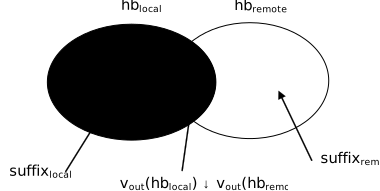
Initially vin(suffixlocal) = vin(suffixremote) = vout(hblocal) ↓ vout (hbremote). When a remote site subsequently sends the first operation o, it is calculated as an RFactor from suffixremote and therefore vin(suffixremote) ≤ vin(o). It follows therefore that vin(suffixlocal) ≤ vin(o).
Inductive step:
We have shown that the execution context of sent operations can only increase. i.e. if O1 is sent before O2 then vin(O1) ≤ vin(O2). Therefore if vin(suffixlocal) ≤ vin(O1) then for the same suffix it must follow that vin(suffixlocal) ≤ vin(O2).
The only way that vin(suffixlocal) may change is by assigning it to vin(O) for some received operation O. Of course this also preserves vin(suffixlocal) ≤ vin (O).