CEDA
CEDA is a high performance cross-platform embedded in-process multi-master replicated database technology using a Log Structured Store.
Data is replicated meaning each site has its own copy of the data stored in its own local database. Operations (updates to the database) are exchanged between sites over the network in order to synchronise the databases.
Applications that view and edit the data only access the local database. The local access is high bandwidth, low latency and always available. Even though applications are multi-user they feel as responsive as single user applications.

There can be thousands of participating databases connected in arbitrary topologies.

Multi-master data replication using Operational Transformation is key to the impressive characteristics of CEDA. It allows operations to be applied in different orders at different sites. In the following picture site A generates an operation O1 and concurrently site B generates an operation O2. These operations are applied immediately on the database where they are generated.
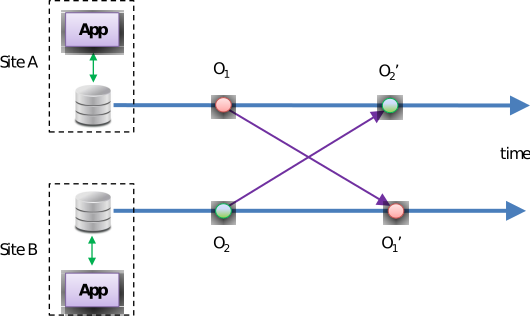
Each site transforms the operation received from the other site so that, despite applying the concurrent operations in different orders, both databases reach the same final state.
CEDA can scale from one user to many thousands of users which interactively edit very complex and large amounts of data in applications that feel as responsive as single user applications. The data is replicated and synchronised efficiently, and users are able to view and edit their local copy of the data independently of network latency and network failures. The unique and revolutionary algorithms in CEDA typically merge hours of off-line data entry in a fraction of a second.
The underlying transactional storage engine has state of the art performance, it can readily achieve data ingestion rates at the sustained write rates of the secondary storage devices - even exceeding a gigabyte per second on a single machine. For example, in one comparison it took only 5 seconds to write a million (key,value) pairs totalling 4GB of data on a laptop with a pair of SSDs in RAID0. On the same machine BerkeleyDB took 2 minutes 20 seconds.