 v0.1
v0.1
This part introduces the philosophical and structural principles that underpin the VoTa system. It explains the nature of the state, the role of law, and the foundational commitments that shape every institution that follows.
The purpose of the VoTa constitution is to place clear constraints on the state so that society can flourish when those constraints are upheld. It is more than a set of rules. It is a safeguard for liberty and a foundation for prosperity.
For a constitution it is unusually detailed, technical, and precise. This level of specificity is necessary because the approach is radical, and its justification requires a deep, carefully reasoned solution.
Yet beneath that detail lies a small set of principles, applied without compromise. Much of what appears radical follows directly from adhering to these principles consistently.
Foremost among them are the Non‑Aggression Principle (NAP) and the Non‑Discrimination Principle (NDP). The latter, in particular, has far‑reaching and often surprising consequences.
A state is commonly taken to mean an institution claiming territorial monopolies over coercion and taxation, implying that by definition a state violates the NAP. We instead define a state more widely, so as to include an institution in which the majority of the residents in a territory are citizens of the state, and the state imposes the NAP on itself and the people through property rights, a rule of law, a judiciary, and police. This raises the question of how such a state can exist without the ability to impose coercive taxation. VoTa nevertheless claims to make paying taxes the rational choice!
The German sociologist Max Weber defined the state as:
A human community that (successfully) claims the monopoly of the legitimate use of physical force within a given territory.
This is a definition of institutionalised aggression. If legitimacy comes from respecting rights, then no one can have a monopoly on force. If legitimacy comes from a monopoly, then it is not legitimate.
In this constitution, the state is understood differently. Rather than a monopoly on force, the state is defined as the set of institutions that regulate the human community within a territory. It consists only of laws and public services: mechanisms, not rulers.
VoTa can be understood only by holding together two radical features: the extraordinary power of its State and the still more extraordinary constraints on every use of that power. The State has capabilities extending far beyond those of a conventional liberal State. It provides comprehensive shared infrastructure for identity, property, agreements, money, payments, and voluntary exchange. This pervasive capacity gives it powerful means to protect property rights.
In an ordinary political system, such power would create an equally radical danger of surveillance, control, and capture. However, VoTa constrains its use more radically still: no government, official, political faction, majority, or private party may direct it towards their own purposes.
VoTa is a State but has no political government. There are no politicians with authority to command public institutions, distribute privileges, change how the law applies to selected Persons, or decide how people should live, what they may produce, with whom they may trade, or which lawful purposes deserve support.
The State is a set of public services. The public services are defined through direct democracy, subject to the Non-Discrimination Principle, which forces the services to treat people equally and eliminates a majority exercising power over a minority, special-interest groups gaining special treatment, discretionary power for bureaucrats, and cronyism.
The State protects property rights, and all protected rights are property rights. A Person's body, liberty, privacy, and lawfully held property are not resources available for another Person's objectives.
To protect property rights effectively, the State provides neutral infrastructure for managing property ownership, contracts, money, commerce, custody, and lending. Records of ownership, custody, consent, and payment help distinguish voluntary exchange from theft or fraud and establish responsibility and remedy. The State can provide this infrastructure without acquiring beneficial ownership of the property or authority to direct its use.
The Non-Discrimination Principle in Chapter 4: The Non‑Discrimination Principle (NDP) prevents the State from imposing a benefit or burden according to the identity of a Person or group. No faction can lawfully capture the State to grant itself subsidies, exemptions, exclusive access, favourable regulation, selective enforcement, or other advantages at another Person's expense. The same rules and public services must remain available on the same terms to everyone in the same legally relevant circumstances.
Removing political offices also removes the principal mechanism by which organised interests normally obtain such advantages. There is no government to win, minister to influence, legislative majority to assemble, or general regulatory discretion to redirect. Automatic and publicly specified rules further reduce the decisions through which favouritism could be exercised.
VoTa distinguishes the ability to verify a necessary fact from authority to inspect a Person's life. A system may prove that a Person owns an asset, consented to a transfer, possesses sufficient funds, or satisfied an agreement without revealing their other property, purchases, relationships, or activities. Information is disclosed only to the parties and public services authorised for the particular transaction, claim, or dispute.
This principle is especially important for systems such as the CBPS and the product and property ledger described in Chapter 16: Commerce Account and Transaction System (CATS). Their records can protect ownership and automate voluntary exchange without becoming public databases of personal behaviour. Privacy must arise from access controls, separation of information, selective disclosure, cryptographic proof, and automatic enforcement rather than reliance on officials choosing not to misuse available information.
VoTa does not discuss every area of public policy directly. Instead, many such questions are governed by the Constitution's more general prescriptions and proscriptions, including the NAP, the NDP, property rights, liberty, and the free market. The absence of a provision directed specifically at a subject does not place that subject outside the Constitution or necessarily leave it to the State to decide.
VoTa does not prescribe whether, or under what circumstances, a Person may be prevented from entering or leaving the State Territory. Where the border lies on the commons, the Constitution can nevertheless reasonably be taken to imply an open border. A Person may lawfully do as they choose unless they violate the NAP, and merely entering or leaving the State Territory does not do so. This does not confer a right to enter another Person's property without consent or otherwise violate the rights of others.
VoTa does not prescribe a general policy for protecting the environment. The Constitution applies, however, to the extent that environmental damage violates the rights of others. Such damage is subject to the NAP and the same protection of property rights as any other harmful act. It also allows a tax for an objectively determined externality cost, such as pollution, as described in 19.2 UBI determination and formulas.
VoTa does not prescribe globalisation or nationalism as a political, cultural, or economic objective. It neither requires integration with other States nor promotes national self-sufficiency, national identity, or national power. Its constitutional principles continue to apply to voluntary exchange across borders, but they do not otherwise determine how internationally integrated or culturally distinct a society should become.
VoTa does not prescribe preferred cultures, religions, identities, social norms, or demographic outcomes. People remain free to form, express, preserve, reject, or change their beliefs, identities, and cultural or religious associations, subject to the rights of others. The constitutional constraint is the NDP: laws and public services may not discriminate on the basis of culture, religion, gender, race, identity, or any other characteristic of a Person.
VoTa does not prescribe a specific policy for worker unions. Under the NAP, workers are free to associate voluntarily and bargain collectively for better terms. Voluntary worker unions are therefore legitimate and acceptable, but neither a union nor an employer may coerce another Person or violate their property rights or voluntary agreements.
This section is by no means a complete list of what VoTa opposes. It discusses selected positions and practices that are controversial or are associated, rightly or wrongly, with capitalism or socialism. These associations can obscure where VoTa stands, making it useful to explain its position on each topic and the reasons behind it.
Some people on the left criticise capitalism for being associated with, or exacerbating, imperialism and colonialism. Some claim capitalism promoted or grew out of the exploitation of foreign nations or people.
VoTa opposes imperialism and colonial domination because they violate the property rights of the people subjected to them. These rights are protected equally for all people. VoTa stands for free markets and voluntary exchanges rather than coercion or domination.
VoTa opposes slavery as a violation of a person's rights over their own body and liberty.
Historical economies commonly described as capitalist included slavery, and acknowledging this does not require defending or minimising it. But that history does not establish an argument against free markets based on voluntary exchange and equal protection of individual rights.
Capitalism is commonly defined as involving property rights (in particular, the private ownership of the means of production) and voluntary exchange. Slavery is involuntary and represents the exact opposite. The critics who associate capitalism with slavery in order to criticise it are presenting a strawman. Of course, this is a matter of how the word capitalism is defined, but not agreeing on definitions doesn't help resolve differences of opinion.
In a Majority Report interview with historian Caitlin Rosenthal, Sam Seder connects plantation slavery to contemporary business practices. Describing slavery as part of a continuing tradition, he says:
So the shocking part is there's some type of presumption that exists among some people that slavery was somehow, I guess, an aberration in some way, and it was a function of the people who would have slaves were not business people, there was something anomalous about it, but in fact it's really part of a tradition and almost in some respects sort of seamlessly slides into an era where people aren't slaves. Right? How much of our business practices that we have today in terms of management techniques and control of workers is, if not a descendant of those practices, but at the very least looks very similar to those practices?
Similarly, in his interview with Clara Mattei, David McNally in effect claims capitalism encompasses slavery:
I'm challenging the myth that throughout the Caribbean, throughout Brazil, and the southern United States, there was a system called slavery, and later it got replaced by capitalism, and I'm saying no, that's not how the story works. The reality is, that the slave plantations of the Atlantic world were among the most prosperous and profitable business enterprises in the world. Hundreds of enslaved people, the vast majority in the first 100 years kidnapped from Africa, and sold into bondage, produced global commodities: sugar, coffee, cotton, tobacco, indigo, and more, and all of the wealth flowed into the hands of the owning class, and then through their hands big chunks flowed back to Europe, and fueled things like the rise of industrial capitalism in Europe. And when you tell the story truthfully, it says to us, capitalism always involves different forms of coercion. The most blatant and the most brutal is childhood slavery.
It is also argued that slavery provided an enormous economic advantage to the slave owners, even to the point of suggesting that modern capitalism would never have developed the way it has without slavery. That counterfactual cannot be established merely by showing that slave owners profited from slavery.
A relevant question is how slavery came to an end. In his interview with Clara Mattei, David McNally emphasises the role of enslaved people in bringing about their own emancipation:
They were producing the wealth of their masters. Now think about that for a minute. because if you produce wealth for others, you have an often unseen power, and that's the power to stop working for them. That's the power to withdraw your labor. And contrary to what so many of the older histories thought, enslaved people withdrew their labor all the time. One of the great revelations in this regard is to read the actual diaries that the master class kept. They are constantly complaining about the enslaved people slowing down in the fields, about a bunch of them running off to the forest, and so on. They were engaged in a constant battle, and at the heart of that battle, of every freedom struggle, by enslaved people and by oppressed people is to reclaim time for themselves. Because the claim of power over you by any oppressing class, is the claim to be able to control your time, to own your time. Enslaved people regularly fought and organised for fewer hours per day in the field, for more days away from the field.
He goes on to say:
Lincoln was driven forward to take actions he had opposed because enslaved people were freeing themselves.
His argument is that resistance and self-emancipation forced political action, rather than freedom simply being bestowed by political leaders on moral grounds. He cited economic reasons, such as slaves going on strike or tending to have low output, and costs such as those of feeding them or those arising from frequent escapes. Slaveholders must therefore devote resources to supervision and coercion, and such costs erode the apparent advantage of labour obtained without paying wages.
Ludwig von Mises developed an economic argument against slavery in Human Action, chapter XXI, section 9, under “The Work of Animals and of Slaves”. He argued that coercion could not elicit the diligence, skill, and initiative encouraged by working for one's own benefit. Even slaveholders seeking better performance had to offer incentives beyond the threat of punishment. In his account, enterprises using slave labour could not withstand unrestricted competition from those employing free workers. He attributed slavery's persistence to institutions that sheltered it from that competition: in the plantation colonies, high immigration costs and inadequate legal protection against officials and planters obstructed the growth of a free workforce and independent farming; in Eastern Europe, caste restrictions reserved large-scale agriculture for the nobility. Mises therefore did not claim that market forces alone had abolished these protected systems. He expressly credited political action inspired by laissez-faire ideas with abolishing slavery and serfdom. His argument presents free labour and voluntary exchange as forces undermining bondage, giving reason to distinguish them from the coercive practices associated with capitalism.
Some people on the left use the term "fascist" to refer to people they regard as authoritarian and against socialism. The term fascism is associated with ultranationalism and authoritarianism. VoTa opposes ultranationalism when it would violate the property rights of foreign people. It also strongly opposes authoritarianism.
The left often blame cronyism on corporations, and the right tend to blame it on government. Both are correct. It is a systemic issue that inevitably arises when government has discretionary powers to grant privileges, leading bad actors in industry to lobby government for special privileges. VoTa opposes political government, not because it regards government as the main bad actor, but simply because removing it leads to a better outcome: cronyism is eliminated, and there is more democracy.
VoTa opposes state ownership of the means of production. The factors of production need to be privately owned in order to be traded. They need to be traded in order to have market prices. They need prices in order for producers to allocate resources efficiently.
Some critics on the left associate the right's defence of free markets with opposition to worker unions. Yet support for freedom of association and voluntary organisation also supports workers' right to unionise. VoTa recognises workers' freedom to form and join unions, bargain collectively, and coordinate their bargaining power. Employers' preference for negotiating with workers individually does not override workers' freedom to organise.
Some people on the right believe that democracy works against free markets, presumably because the majority of people are poor and tend to prefer bigger government that taxes the rich heavily and provides better social programs like welfare and free healthcare. VoTa opposes the view that democracy is something that should be curtailed, including through representative institutions that leave most people with little effective influence over the decisions made in their name.
Discussing the United States in a 2013 interview, Noam Chomsky described this exclusion from effective political influence:
“The lower 70 percent of wealth and income — their attitudes have no influence on policy.”
— Noam Chomsky, interview with Edward Radzivilovskiy, 27 February 2013.
Chomsky's claim concerns effective disenfranchisement: people retain the legal right to vote, yet their preferences have little independent influence on public policy. His approximate 70 percent figure summarises his reading of research by Martin Gilens, Larry Bartels, and others; it is not a count of people legally excluded from elections. He attributes the gap between voting rights and political influence in part to representatives' dependence on wealthy campaign donors. Citizens can choose candidates while the officials elected remain more responsive to those who finance their campaigns.
The distinction between agreement and influence is essential to understanding the research. In Gilens's explanation of his findings, the stark inequality appears when affluent Americans prefer different policies from those preferred by middle- and low-income Americans. In those cases, he finds substantial policy responsiveness to the affluent and essentially none to the less affluent. This does not mean that ordinary citizens never obtain policies they favour: different income groups often agree. It means that agreement with an outcome does not establish that their preferences helped determine it. These findings concern the United States and do not establish that every representative system necessarily produces the same degree of exclusion.
VoTa opposes treating the periodic selection of representatives as sufficient democratic control. Its response is to give citizens direct authority over permissible laws and services, and taxpayers direct control over their tax allocations. It has no political government or governing political parties, and services are supplied by competing private providers rather than a state-owned public sector. Citizens need not persuade elected officeholders to turn their preferences into decisions. This removes the intermediary through which campaign donors can obtain privileged access to political decision-making, although it does not imply that wealth can have no influence on public debate.
VoTa is in favour of radically more democracy, not less. Democracy is seen as key to a fair, just and equitable society. VoTa uses an extreme form of direct democracy to allow the people to define laws and services.
VoTa upholds classical liberalism without compromise. Individual liberty is the default: people control their bodies, labour, property, associations, beliefs, and peaceful dealings with others. The State exists to protect that liberty through universal laws, not to direct peaceful lives or grant officials discretionary power over them.
The essential mechanism is that citizenship is a voluntary contract. A person chooses whether to become a citizen and, by doing so, accepts the constitution together with its rights, taxes, public services, benefits, and obligations. These arrangements are not imposed merely because someone lives within the territory. A person who does not accept the contract may remain a non-citizen while retaining the property rights, personal liberty, and protection of universal law owed to every person.
Consent must be genuine and informed, and a citizen may leave subject only to obligations already undertaken voluntarily. The State remains bound by the constitution when dealing with citizens and non-citizens alike. Neither consent to citizenship nor receipt of a public service gives it an open-ended authority to impose terms which the constitution does not permit.
VoTa can therefore retain a State, taxation, public services, and a UBI without compromising its classical-liberal foundation. Citizens have consented to that institutional package rather than having it imposed upon them, while the Non-Aggression Principle constrains what the State may do and the Non-Discrimination Principle prevents it from granting privileges or imposing targeted burdens. VoTa combines collective institutions with individual consent instead of treating one as a reason to abandon the other.
Neoliberalism is an approach which favours private ownership, competitive markets, free trade, reduced regulation, and private provision in place of direct State production. It is particularly associated with the governments of Margaret Thatcher in the United Kingdom and Ronald Reagan in the United States during the 1980s.
Social liberals and other critics on the political left, including Noam Chomsky, have been strongly antagonistic towards neoliberalism. They argue that it produces an enormous loss of democracy and of people's ability to have a meaningful say in the decisions which shape their lives, widens the gap between rich and poor, and empowers corporations and the very rich at the expense of the wider population. Chomsky goes further, arguing that neoliberal methods created the Third World and that their modern application has produced disasters in developing countries which followed them most rigorously.
Critics frequently associate neoliberalism with Margaret Thatcher's statement that “there is no such thing as society,” interpreting it as the elevation of individual interests over collective responsibility. In context, however, Thatcher also emphasised personal obligations towards families and neighbours. The quotation should therefore not be treated as proof that neoliberalism recognises no collective responsibility. It nevertheless captures the individualistic image against which many critics define neoliberalism.
The word neoliberalism did not originally denote a single settled doctrine or simply a return to nineteenth-century laissez-faire. It emerged as a name for attempts to reconstruct liberalism after the political and economic crises of the interwar period. The decisive early gathering was the 1938 Walter Lippmann Colloquium in Paris, convened by Louis Rougier to discuss Walter Lippmann's An Inquiry into the Principles of the Good Society (1937). Its participants included Alexander Rüstow, Wilhelm Röpke, Friedrich Hayek, Ludwig von Mises, Jacques Rueff, Raymond Aron, Michael Polanyi, and other liberal intellectuals. They agreed on the importance of private property, market prices, competition, and the rule of law, but disagreed substantially about the State's proper role and the defects of classical liberalism.
Rüstow, Röpke, and the German ordoliberals most clearly represented the new departure. They argued that a competitive market is not a natural condition which the State can merely leave alone: it requires a legal and institutional order capable of restraining cartels, monopolies, private concentrations of power, and political privilege. Rüstow's later Freedom and Domination, a condensed translation of his three-volume Ortsbestimmung der Gegenwart, placed the market within a much wider historical and social critique. Röpke's The Social Crisis of Our Time (1942), Civitas Humana (1944), and A Humane Economy (1958) defended markets while stressing decentralisation, social cohesion, widely dispersed property, and moral limits on economic life. Walter Eucken's posthumous Principles of Economic Policy (1952) supplied the most systematic ordoliberal account of the rules and institutions required to preserve a competitive order.
Mises and Hayek shared the defence of markets but occupied different positions within this coalition. Mises's Liberalism (1927), Socialism (1922), and Human Action (1949) presented the strongest case for classical liberalism, private ownership, and market coordination, and he resisted proposals which he thought conceded too much to interventionism. Hayek's The Road to Serfdom (1944), Individualism and Economic Order (1948), and The Constitution of Liberty (1960) developed the case for dispersed knowledge, general rules, limited government, and a competitive order. The differences among these writers matter: the original movement contained laissez-faire liberals, ordoliberals, and socially oriented liberals rather than a uniform programme.
The movement was renewed after the Second World War when Hayek brought many of these thinkers together in the Mont Pèlerin Society. Its 1947 Statement of Aims is the clearest short collective text, although it records broad common concerns rather than a detailed policy platform. Milton Friedman's Neo-Liberalism and Its Prospects (1951) is also notable because it explicitly used the label for a position between collectivism and old laissez-faire. Friedman's later Capitalism and Freedom (1962) and Hayek's later works helped shape the more market-radical meaning commonly attached to neoliberalism from the 1970s onward. Consequently, claims about “what neoliberalism says” should identify the author, period, and branch of the tradition rather than treating the modern label as though it described every participant at the movement's origin.
Modern critics sometimes say that neoliberalism is inherently opposed to democracy because it places property, markets, central banks, and other economic institutions beyond popular control. This criticism identifies a real tension in neoliberal thought, but it becomes misleading when it treats opposition to unlimited majority rule as opposition to every form of democracy. The original neoliberals did not hold a common position. Most defended representative government while insisting that a democratic majority, like every other holder of State power, must be constrained by constitutional rights and general laws. Some, however, were markedly distrustful of mass politics and assigned the protection of the market order a higher priority than democratic control of economic policy.
Mises gave democracy a clear and important place in liberalism. In Liberalism, he defended majority government principally as a means by which rulers can be replaced peacefully when public opinion changes. Without that mechanism, a government which loses the support of the governed can ultimately be removed only through revolution or civil war. Elsewhere he demanded freedom of political expression, representative government, and a State constituted according to the will of the majority. This was not a claim that a majority may do anything: majority rule selected the government, while liberal principles limited what any government could rightfully do.
Hayek drew the distinction even more explicitly. In The Constitution of Liberty, he described democracy as a method for deciding who governs, whereas liberalism concerns the limits upon the government's coercive power. He regarded democracy as the best available method of peaceful political change and an important safeguard for liberty, but not as an unlimited or ultimate value. A democratic government could still act illiberally by discriminating against minorities, confiscating property, granting privileges, or exercising arbitrary power. Hayek therefore favoured constitutional restraints, separation of powers, the rule of law, and rules applying generally to majorities and minorities alike. Critics reasonably reply that removing important economic questions from electoral decision also restricts democratic self-government; Hayek regarded that restriction as one of the purposes of a liberal constitution.
Rüstow and Röpke were more suspicious of mass democracy. Rüstow argued that the parliamentary State had become the prey of organised interests. Political parties increasingly acted as agents of industries, cartels, unions, and other pressure groups, exchanging interventions and privileges for political support. His proposed “strong State” was not intended to direct production, but to stand above these groups, resist their demands, and enforce the competitive order. His central fear was therefore not simply a numerical majority oppressing a minority; it was the capture and fragmentation of democratic government by organised minorities claiming to represent parts of the electorate.
Röpke's criticism went further. He feared that mass parties, welfare competition, organised interests, and the psychology of mass society could allow democracy to consume the liberal order which made it possible. He accepted democracy only when bounded by constitutional safeguards, decentralisation, federalism, secure property rights, and institutions insulated from immediate political pressure. His language about the “tyranny of the masses” and his reliance upon responsible social elites reveal a genuinely elitist strand. His later defence of white-minority rule in apartheid South Africa cannot be reconciled with equal democratic citizenship and provides strong evidence for critics who identify illiberal implications in his thought.
Friedman likewise presented competitive capitalism as a restraint upon political power and as a necessary, though not sufficient, condition for political freedom. Dispersed private ownership allowed people to work, publish, associate, and finance opposition without depending entirely upon the government. He favoured constitutional democracy, but wanted many decisions removed from collective political choice and left to voluntary individual choice in markets. The democratic objection is that market outcomes also distribute power unequally and that constitutional protection of those outcomes can prevent citizens from collectively changing the conditions under which they live.
It is therefore inaccurate to say simply that the original neoliberals were enemies of democracy. Mises, Hayek, and Friedman expressly defended democratic institutions, while Rüstow and Röpke also distinguished their preferred limited democracy from dictatorship. It is accurate to say that they rejected the principle that an electoral majority should possess unlimited authority over economic life. Their project sought to place private property, competition, monetary stability, and general market rules outside ordinary bargaining among parties and interest groups. Whether that arrangement protects democracy from arbitrary majority power or subordinates democracy to a market constitution is the genuine disagreement between neoliberals and their critics.
George Monbiot's film The Secret History of Neoliberalism presents a false and materially misleading history of neoliberalism. The film says that neoliberalism cannot be understood without first understanding the “true nature” of capitalism. It then locates the beginning of capitalism in the Portuguese colonisation of Madeira, where slave labour was used to produce sugar and natural resources were exhausted before production moved to new colonial frontiers. It presents colonial seizure, slavery, imperial extraction, and ecological destruction as intrinsic to capitalism rather than violations of a free market.
After this extended account, the film introduces the 1938 Walter Lippmann Colloquium in Paris, notes that Ludwig von Mises and Friedrich Hayek attended, and describes them as two of the people who came to define neoliberalism. It later describes the policies of Thatcher and Reagan as the application of a doctrine created by Mises, Hayek, Friedman, and others. This sequence constructs an apparent lineage from slavery and colonial seizure, through capitalism, to neoliberalism and its leading liberal thinkers.
The historical facts do not establish that lineage. Colonial enterprises employed capital and pursued profit, and Mises and Hayek attended the Paris meeting. It does not follow that their liberalism endorsed colonialism, slavery, or imperialism. Their political economy was founded upon private property and voluntary exchange. Slavery is the antithesis of voluntary exchange, colonial seizure violates property rights, and imperialism substitutes conquest and political privilege for free trade.
Mises was explicit about this distinction. In Liberalism, he described the subjugation of peoples, robbery of their property, and their enslavement under colonial policy as being in the sharpest contrast to liberal principles. He associated modern imperialism with European States abandoning free trade in favour of politically controlled colonial markets. Hayek likewise made limitations on coercion, general rules, competition, and individual choice central to his liberalism, and opposed privileged or monopolistic organisations using coercion to prevent competition.
Mises also argued that liberalism demands:
The film could reasonably argue that particular fortunes and businesses accumulated wealth through slavery, conquest, and State privilege, or that later policies promoted in the name of liberalism produced consequences which Mises and Hayek did not intend. It does not make that narrower argument. By defining capitalism through colonial coercion and then presenting Mises and Hayek as creators of the same ideological tradition, while omitting their opposition to coercion, colonialism, and imperial privilege, it reverses their stated principles. It teaches an association which its own account does not demonstrate and which the primary sources contradict.
The film is similarly misleading about trade unions. Monbiot says that neoliberalism requires trade unions and collective bargaining to be swept away, and later claims that the unions were crushed. Mises expressly allowed workers to form voluntary unions. In Human Action, he wrote that “the issue is not the right to form associations,” but whether an association should be privileged to use violence or intimidation with impunity. He distinguished the freedom to organise, bargain collectively, and withhold labour from compulsory membership, violence against non-participants, and preventing willing workers from accepting employment. Removing coercive privileges from a union is not the same as crushing voluntary unionism; voluntary collective bargaining is itself an exercise of free association and exchange.
The film is also self-contradictory when it associates neoliberalism with government bailouts following market failures. Mises and Hayek treated losses and business failure as indispensable parts of market competition: they remove resources from unsuccessful owners and make those owners bear the consequences of their decisions. A government bailout does the opposite. It protects selected businesses or creditors from loss, transfers the cost to taxpayers, creates moral hazard, and substitutes political selection for market selection.
On a superficial reading, VoTa may appear neoliberal because it shares several of these features. It protects private property, leaves production to privately owned businesses, makes profit and loss the fundamental discipline governing producers, and eliminates direct taxation of producers. It also rejects every law and regulation which cannot be justified by the Non-Aggression Principle. The State cannot interfere with the free market through tariffs, subsidies, or licences.
VoTa cannot be characterised as a system concerned only with the individual at the expense of the collective. The Constitution imposes a 50 per cent tax on every tax-inclusive taxable payment. It allocates 30 per cent to taxpayer-directed public services and 20 per cent to the Universal Basic Income. The collective therefore has control of 50 per cent of GDP, constitutionally dedicated to public services and redistribution. This is not a minor qualification to an otherwise individualist system. It is half of the economy.
Government expenditure as a share of GDP provides the most useful comparison with existing States. Tax receipts understate their effective claim on the economy when expenditure is financed through borrowing or money creation, since those costs must still be borne through future taxation, reduced future spending, or inflation. General government expenditure across the OECD averaged 42.6 per cent of GDP in 2023, while OECD countries which are also members of the European Union averaged 49.3 per cent in 2024. VoTa's 50 per cent collective share is therefore larger than that of the average OECD State and approximately equal to that of a European welfare State. VoTa is not a small-State system in economic scale.
Nor does VoTa transfer power from democratic government to corporations or the very rich. It abolishes politicians and places State power directly in the hands of the people through direct democracy. Citizens determine collective decisions themselves and direct public-service funding through tax choice. Private businesses may compete to provide services, but they do not acquire the State's authority or control its budget.
This directly answers the central criticism made by Chomsky and other opponents of neoliberalism. VoTa preserves private production and free exchange without sacrificing democracy, collective power, or universal redistribution. It gives individuals control of their peaceful private activity while giving the people collectively control of the State and half of the economy.
Neoliberalism does not provide a single clear position on monetary policy. States associated with neoliberal policies have retained central banks, interest-rate policy, and control over the money supply. Milton Friedman, one of neoliberalism's most influential economists, opposed discretionary monetary fine-tuning but advocated a rule under which the central bank would expand the money supply at a fixed annual rate. He and Anna Schwartz also argued that the Federal Reserve turned the recession of the early 1930s into the Great Depression by allowing the money supply to collapse, and that it should instead have expanded reserves and prevented that contraction. Friedman's free-market philosophy was therefore compatible with deliberate State control and expansion of the money supply.
VoTa takes a definite position which does not depend upon classifying monetary management as neoliberal or otherwise. The State cannot manipulate interest rates or the money supply. The supply of Central Bank currency is fixed, there is no central-bank policy rate, and lending transfers existing currency from a lender to a borrower. VoTa therefore rejects both responsive and rule-based monetary expansion.
VoTa is consequently better understood as a distinct constitutional architecture. It shares neoliberalism's confidence in private ownership, voluntary exchange, competition, and market discovery, but rejects the continuing discretionary political authority with which neoliberalism ordinarily coexists. At the same time, it entrenches UBI and extensive taxpayer-directed collective funding more deeply than neoliberalism generally does. The resemblance lies principally in the organisation of production; the decisive differences lie in taxation, redistribution, public choice, money, and the structure of the State itself.
In the 20th century, far more people were killed by their own governments than by foreign armies. According to political scientist R.J. Rummel, an estimated 170–200 million people were killed by their own governments during that century, while roughly 35–40 million died in interstate wars. The pattern is clear: throughout modern history, governments have often been more dangerous to their own populations than external enemies.
There has been violence caused by war and conflict in every year of the 20th century.

Beyond the extreme cases of democide, governments across the world have a long record of causing harm through structural, economic, and political failures:

In Common Sense (1776), Thomas Paine wrote:
Government, even in its best state, is but a necessary evil; in its worst state, an intolerable one.
Paine’s argument was that society itself is natural and beneficial, while government exists only to restrain wrongdoing. Even then, it tends to become oppressive.
This raises a fundamental question: is it possible to have a state without a government, one that still protects property rights and ensures the essential public services we rely on are provided?
Vota challenges the assumption that government, understood as a ruling class with discretionary power, is necessary. Under VoTa there are no politicians and no political parties forming a government. This is stated explicitly in the constitution:
- The State consists of laws and public services, and exercises authority only within the State Territory.
- No politicians or political parties shall constitute a government.
The constitution provides a blueprint for organising a society without a controlling body. It is, in a literal sense, democratic: rule by the people, not rule over the people. But this immediately raises legitimate concerns. Traditional democratic systems can be unstable, can produce tyranny against minorities, and can fail to fund essential public services such as roads. Vota addresses these challenges by redesigning the state so that power is decentralised, mechanised, and insulated from political capture.
Replacing government with a system of direct, decentralised self‑governance may seem daunting, because modern governments are vast and complex. Yet much of that complexity is unnecessary, counterproductive, and often harmful. Once the layers of political hierarchy and discretionary power are removed, the underlying functions of a state become far simpler than they appear.
The implementation of such a system requires novel solutions to a set of deep and long‑standing challenges:
With no politicians and no political parties forming a government, there are no elections, no electoral districts, and no gerrymandering. The cost and complexity of electoral politics disappear entirely.
There are also no bureaucrats spending other people's money on other people, and no unelected officials deciding who receives welfare or which services are funded. All allocation is driven directly by citizens rather than by administrative discretion.
And because no political class controls budgets or regulations, cronyism disappears. There is no central authority for businesses to lobby, no subsidies to pursue, no preferential tax breaks to negotiate, and no market protections granted to the powerful.
Another immediate benefit is that, without a government or a political class, no individual or institution holds the discretionary power to override, suspend, or reinterpret the constitution. Avoiding concentrations of power makes the system resilient to individuals who attempt to gain influence, because no one begins with significant power in the first place. With authority decentralised and tightly constrained by uniform rules, there is simply no position from which an ambitious actor can dominate others or override the constitutional framework.
Anarcho‑capitalism is a political philosophy that rejects the state entirely and holds that all legitimate social order can arise from voluntary interactions, private property, and free markets. It argues that every function typically performed by government, including law, security, courts, and infrastructure, can be provided by competing private agencies operating under contract rather than coercion. In this view, the Non‑Aggression Principle is the core rule of social conduct, and markets, not political authority, coordinate human activity. The result is a vision of society where all services are voluntary, all exchanges are consensual, and no institution holds a monopoly on force.
Whether anarcho‑capitalism could emerge or remain stable is contested. The main criticisms include:
These concerns raise two central questions:
A private protector can provide excellent service to its customers while using threats or violence to exclude competing protectors. Suppose protector A declares a region to be its territory and threatens to attack protector B if B insures or protects anyone there. A can continue protecting its own customers effectively, charging attractive prices, and enjoying their loyalty. Its aggression is directed at competitors, while its good service helps it accumulate the revenue, support, and armed strength needed to enforce territorial exclusivity. Customer satisfaction therefore does not establish that competition remains free.
This process need not begin with a large war. A small threat may be enough to persuade B that serving a particular street or district is not worth the risk. B might decline new customers, withdraw when contracts expire, or concede a boundary rather than fight. Each concession can increase A's customer base and resources while reducing the alternatives available locally. Repeated over decades or generations, these gains could leave A so powerful that reversing its expansion becomes prohibitively costly. The process does not require a single founder to complete it; successive owners can inherit both the organisation and its territorial gains.
The argument that commercial protectors will avoid war because war is expensive cuts both ways. A neighbouring protector may prefer accommodation to the immediate expense of resisting an aggressor. Others may wait for someone else to bear that expense. A can exploit this reluctance by making demands small enough that each concession appears cheaper than a fight, even though their cumulative effect is the destruction of competition. Alternatively, protectors may agree to divide territories and refrain from competing within one another's areas. Where territorial claims clash, the same incentives can produce wars over territory. Profit seeking alone does not establish which of these outcomes will prevail. Tyler Cowen examines a related danger in Law as a Public Good: The Economics of Anarchy (1992): cooperation among protection agencies can enable collusion and the exclusion of competitors. David Friedman disputes Cowen's argument in Law as a Private Good: A Response to Tyler Cowen on the Economics of Anarchy (1994).
Consolidation can also become self-reinforcing. Customers who expect smaller protectors to lose confrontations may move to larger providers, depriving smaller agencies of the revenue needed to remain effective. Better service or lower prices may not compensate for doubts about an agency's ability to survive. Smaller protectors then face pressure to merge or submit to a larger organisation, helping fulfil the expectation that independent small providers cannot endure.
One consolidation can trigger others by changing the balance of armed power. If A absorbs B, neighbouring protectors C and D may combine because neither expects to withstand the enlarged A alone. Their consolidation can in turn pressure further agencies to merge. Even providers whose purpose is purely defensive can participate in this process, reducing the number of independent alternatives as each seeks enough strength to survive. The credible prospect of conflict can therefore drive successive rounds of consolidation without actual fighting at every stage. Such consolidation need not immediately produce territorial monopoly, but it can concentrate the means to impose one. Robert Nozick's Anarchy, State, and Utopia (1974), Part I, offers a related account of the emergence of a dominant protective association. His argument explores whether a state could emerge without violating rights; the mechanism considered here additionally involves threats against competitors.
Residents might retain a formal right to refuse A's services, yet have no effective alternative to paying A or facing criminals without adequate protection. They need not be dissatisfied with A for this dependence to arise. Territorial control can become entrenched while A continues to serve its customers well. The institutional problem is the loss of a practical choice of protector and the resulting concentration of coercive power. For a historical analysis of the relationship between protecting clients, eliminating rivals, and concentrating coercive power, see Charles Tilly's War Making and State Making as Organized Crime (1985). Tilly examines European state formation; this provides historical context rather than a direct test of Hoppe's proposed system.
In The Private Production of Defense, Hans-Hermann Hoppe expects insurers' financial interests, mutual assistance, reinsurance, and arbitration to support peaceful protection. He also identifies the forcible exclusion of competing protectors as the decisive step towards a state in Protection and the State. The objection here concerns how that exclusion is prevented from succeeding: an account of stable competition must explain why protectors would organise effective resistance early enough, rather than repeatedly accommodate an expanding rival. Classifying the eventual monopolist as a state does not explain how its emergence would be prevented.
The Vota constitution embraces the core libertarian ideals on which anarcho‑capitalism is built: and it does so without compromise. The Non‑Aggression Principle (NAP) is applied universally and without exception.
The radical departure is this: Vota retains a state that enforces property rights and the NAP through a centralised rule of law, funds public services through taxation, and even redistributes wealth from rich to poor, all without violating the NAP.
Most people assume taxation requires coercion. Yet this framework proposes something extraordinary: a system where taxation remains voluntary and still makes rational economic sense for everyone, including the wealthiest citizens.
In doing so, it directly addresses the major critiques of anarcho‑capitalism.
It is normally assumed there is an impossible ideological divide between capitalists and socialists. One side prizes freedom, competition, and private ownership. The other emphasizes collective responsibility, fairness, and public accountability.
For more than two centuries, the divide between the political left and right has remained the dominant fault line in politics. Parties, institutions, and individual issues have changed, but this underlying conflict has endured. It remains by far the most significant source of political division today.
Tax choice bridges the ideological divide:
Both see their values reflected in the same system. Capitalists find freedom and competition. Socialists find solidarity and fairness. Tax choice becomes the bridge. It aligns two opposing philosophies in a single framework. It turns taxation into consumer power, and consumer power into democracy.
Tax funding of public services is simply a way for taxpayers to purchase services for society within a free market. The entire economy operates as an unregulated free market, with private ownership and no tax on production. Yet heavy consumption taxes may still fund public services. Citizenship and hence tax is voluntary, which makes the system appealing to libertarians. Public services are implemented by the private sector, under profit and loss, competing for funding from taxpayers. Taxpayers act as consumers, buying services by allocating their tax to them. If we set aside the redistributive element of taxation, the system is essentially a way to unionise consumers: giving them collective power to direct resources toward the services they value most.
VoTa presents an apparent paradox. Its State has powers and technical capabilities extending well beyond those of any existing State, yet its authority over peaceful people is more restricted than that of any existing State. It combines an extraordinarily capable collective system with extraordinarily limited power to direct an individual's life.
The State establishes biometric identity checking and implements the monetary system down to the accounts people use in daily life. The CBPS carries commerce payments, enforces account-transfer rules, collects consumption tax automatically, and allocates tax revenue to public services. The product and property ledger can record ownership, custody, inventory, delivery, and exchanges of property, while linking monetary settlement with the transfer of Products. UBI redistributes part of the proceeds of taxation, and taxpayers collectively possess tremendous power to fund services for the community.
Taken alone, that concentration of identity, monetary, commercial, property, and taxation infrastructure could appear more powerful and intrusive than the machinery of existing governments. In an ordinary political system, whoever captured it could use it to monitor people, control exchange, favour allies, punish opponents, or direct production. VoTa therefore cannot be understood merely by listing what its institutions are technically capable of doing. It must also be understood through the exceptional restrictions placed upon their use.
The State imposes the Non-Aggression Principle and Non-Discrimination Principle upon itself. It may protect privacy, freedom, autonomy, and property rights, but may not violate those rights to pursue political objectives. It cannot grant selected people advantages at the expense of others. There is no political government with general authority over the system, no politicians who can redirect it, and no ruling group entitled to use its records or powers for its own purposes. Public decisions are made through direct democracy rather than representatives exercising power on behalf of citizens.
These restrictions are so extreme that they remove even an incremental path to capture. Political capture normally begins with a small exception, appointment, subsidy, licence, identity-based classification, discretionary enforcement power, or temporary emergency authority. The beneficiary then uses that foothold to obtain further powers and advantages. VoTa provides no political office to capture, no general discretionary authority to expand, and no constitutional means to grant the first selective advantage. Each incremental step would already violate the NAP or NDP. Capturing the system would therefore require an open repudiation of its constitutional foundation rather than a gradual accumulation of power through its lawful institutions.
The result is a State that is extraordinarily powerful in its capacity to protect rights, operate common infrastructure, collect revenue, redistribute income through UBI, and fund collective services, while being extraordinarily restricted in what it may do to any Person. It is difficult to imagine a State with greater technical and collective capacity, but also difficult to imagine one more tightly prevented from governing the peaceful choices of individuals.
This paradox provides another bridge between capitalists and socialists. Capitalists obtain free markets, private property, freedom for producers, minimal regulation, individual autonomy, and a State unable to direct peaceful economic activity. Socialists obtain effective taxation, redistribution through UBI, powerful collective institutions, and substantial taxpayer funding for services that benefit the community. These are not balanced by giving each side partial control. VoTa instead maximises collective capacity while minimising collective control over the individual.

A central design choice in this constitution is the decision to socialise consumption rather than production. This stands in contrast to socialist and Marxist traditions, which focus on collective ownership or control of the means of production. Understanding this distinction clarifies the philosophical foundations of the system.
Of course, socialising consumption significantly affects demand for goods and services and therefore affects producers. This is not incidental: it provides a way to regulate producers indirectly through the choices available to consumers. For example, ensuring that everyone can meet their basic needs for food and shelter, whether through public services or a UBI, would greatly reduce the pressure to accept very low-paid work. Employers would then need to offer better pay and conditions to attract workers, without the State directly regulating producers through minimum wages or mandatory annual, sick, maternity, or long-service leave entitlements.
Traditional labour unionism seeks to correct an imbalance of power between workers and employers. By bargaining collectively, and ultimately by withholding their labour collectively, workers may obtain better pay and conditions than they could negotiate individually. VoTa permits peaceful unions and recognises the additional bargaining power they can give workers. Revolutionary Marxist and Marxist–Leninist traditions take the conflict between labour and capital much further, seeking through revolution to transfer control of production to workers, the collective, or the State.

VoTa does not, however, treat the relationship between workers and employers as the fundamental division of the economy. They occupy different positions within production: workers supply labour, while employers combine and use labour, capital, knowledge, and risk to produce goods and services. Their interests can conflict, but both are producers, and both ultimately depend on meeting the demands of consumers.
VoTa places its distinctive collective mechanism on the other side of the exchange. Tax choice pools part of consumers' purchasing power while allowing each taxpayer to direct their own share. In this limited sense, it unionises consumers: just as a labour union gives workers more leverage than they possess separately, tax choice gives consumers greater power to direct funding, set expectations, and choose among competing producers than they possess through isolated purchases.

The analogy extends beyond merely aggregating isolated choices. Taxpayers can organise in online forums, examine public-service contracts, share evidence about which services perform well or poorly, and coordinate their funding decisions. They therefore possess genuinely organised collective power while each taxpayer retains control of their own allocation. With \(R_{\mathrm{svc}}=0.30\), taxpayers could direct some of that immense purchasing power towards a new tax-funded competitor to even the largest corporation, allowing the competitor to displace it if it provides greater public value. Workers remain free to organise in relation to employers, while consumers organise their purchasing power in relation to producers. VoTa's emphasis is on strengthening the latter relationship without placing production under collective ownership or direct State control.
It is difficult to know the extent to which wealth would concentrate under VoTa given its unconventional nature. Many of its features would increase competition among producers, making it harder for a small number of firms to dominate markets and their owners to earn extraordinary incomes. Others would broaden opportunities for people starting with little wealth to build wealth of their own. These features include:
Any person is free to leave the State Territory.
Citizenship is membership in an association, whose existing members may set admission conditions subject to the constitution. The State provides UBI and services to citizens, but this does not oblige the association to accept everyone who wishes to join. Freedom of association permits the State to deny citizenship, subject to the constitution and in particular the Non-Discrimination Principle (NDP).
The NDP permits admission criteria based on:
Citizens are assumed to constitute by far the majority of people within the State Territory. On that basis, their association collectively owns the territory. Disputes concerning the exercise of that collective ownership, including the laws governing the territory, are resolved through direct democracy, subject to the constitution. Where non-citizens own parcels of land within the territory, it may be appropriate to give them voting rights.
Collective ownership carries the right to exclude. Citizens may therefore determine immigration rates and conditions of entry and residence through direct democracy. Permission to visit or reside does not itself confer citizenship, and non-citizens may be required to leave when their permission to remain expires.
Unauthorised entry or remaining after visiting rights have elapsed violates the collective property right and therefore the NAP. Citizens may defend that right by using force to prevent entry or enforce removal. As required by the constitution, defensive or retaliatory force must be proportionate.
Hans-Hermann Hoppe likewise grounds admission in property rights and freedom of association. His account includes communities whose owners establish contractual conditions for entry and membership, and distinguishes permission to work or reside from citizenship and access to publicly funded benefits. He also requires hosts or immigrants to bear the costs of admission rather than impose them on others. These principles support selective admission, although they do not establish his agreement with VoTa's provision of UBI to citizens. See his extended interview.
The justification for territorial ownership differs. VoTa grounds citizens' collective ownership in their overwhelming majority within the territory. Hoppe grounds ownership in property acquisition and contract; for existing public property, he treats officials as trustees acting on behalf of the taxpayers who funded it. His account does not establish territorial ownership merely from citizenship or numerical majority.
This difference matters where a landowner wishes to admit someone whom the territorial association excludes. In Natural Order, the State, and the Immigration Problem, Hoppe describes state interference with an owner's properly arranged invitation as forced exclusion. The closest counterpart to VoTa's territorial admission rules would be a community covenant under which individual properties are already subject to common entry conditions.
Hoppe's opposition to political majority rule does not necessarily exclude voting within a voluntary association. He allows community covenants to change through procedures established in their bylaws. VoTa's direct democracy could resemble such an arrangement where its authority follows from the owners' agreement, although this would not supply Hoppe's justification for VoTa's majority-based ownership premise. See his interview on the private-property order.
The NDP also makes VoTa's admission rules more restrictive on the association itself. Hoppe permits owners and contractual communities to select entrants on broader grounds, including culture and religion. VoTa instead binds the State to the constitution's specified exceptions. Allegiance to the constitution resembles acceptance of a community covenant, while first-come, first-served priority up to a quota is a particular allocation rule rather than a requirement of Hoppe's theory.
The idea that free markets can be beneficial to humanity first became a globally important philosophy during the mid-to-late eighteenth century, culminating in the 1776 publication of Adam Smith's seminal work, The Wealth of Nations.
Smith wrote about mutually advantageous exchange:
It is not from the benevolence of the butcher, the brewer, or the baker that we expect our dinner, but from their regard to their own interest.
The word democracy comes from the Greek word demokratia, combining demos (meaning "the people") and kratos (meaning "power" or "rule"). It means "rule by the people".
The idea of democracy first became a prominent concept in ancient Athens during the sixth century BCE. Unlike modern nations, Athens used a direct democracy. Citizens gathered in assemblies to debate and vote on laws themselves rather than electing representatives to do so.
Free markets can produce great material benefits while also producing outcomes that a majority regards as harmful. When market arrangements impose costs on a large part of the population, citizens may use their democratic power to regulate or restrain them. Economic freedom in the market can therefore conflict with majority opinion expressed through democracy.
Already in ancient Greece, it was recognised that democracy allowed for a tyranny of the majority. Plato and Aristotle discussed how unrestrained popular rule or mob rule could oppress individuals or minorities. John Adams spoke of it in his 1788 work A Defence of the Constitutions of Government of the United States of America. In the 1787 Federalist Papers, James Madison warned against "the superior force of an interested and overbearing majority" trampling the rights of minority groups.
Free markets and democracy are often treated as being in conflict. This can seem counterintuitive because both emphasise freedom from a separate ruling class: free markets leave economic decisions to individuals, while democracy places political power in the hands of the people themselves.
Six aspects of this apparent conflict are examined in the following subchapters: the human effects of the division of labour; the democratic pressure for redistribution created by unequal market incomes; the potential for successive interventions to expand political control over the market; the disputed relationship between democracy and the gold standard; the tension between global property rights and domestic democratic majorities; and cronyism, the mechanism through which concentrated private interests capture coercive public power and convert it into selective privilege.
Other potential conflicts, not examined in detail here, include:
The apparent conflict between free markets and democracy was one of the concerns which prompted neoliberal thought.
Neoliberals treated the conflict as real and gave priority to private property and competitive markets over democracy. They retained democratic institutions but placed the market order beyond democratic control when the two came into conflict.
For this reason there is tremendous antagonism towards the neoliberals by the left. There has been a century of conflict between the defenders of democracy (on the left) and the defenders of free markets (the neoliberals).
The end of the Cold War did not end this perceived threat to the market order. Historian and critic of neoliberalism Quinn Slobodian argues that some neoliberals and libertarians came to see egalitarian collectivism reappearing in environmentalism, feminism, anti-racism, gay rights, and multiculturalism. In his account, communism had been defeated as an organised economic system, but democratic movements could still demand environmental restrictions, redistribution, and State action against social inequalities. One strand of market radicalism consequently formed alliances with cultural nationalists and the populist right, treating these movements as new threats to property, markets, and inherited social order. This development did not represent neoliberal or market-liberal thought as a whole.
Quinn Slobodian, “The Method in the Far Right’s Madness”.
VoTa reveals there is no need for the conflict. VoTa is both more extreme in supporting democracy than most people that consider themselves to be on the left, and more extreme in supporting free markets than most people that consider themselves to be on the right.
The final subchapter explains how VoTa protects economic freedom without weakening democratic control of the State.
Adam Smith identified the division of labour as a principal source of increasing productivity. When production is divided into specialised tasks, workers improve their dexterity, avoid the time lost switching between tasks, and develop machinery that reduces labour. Exchange allows each person to specialise while obtaining the products of other people's specialised work. The resulting increase in output is central to Smith's account of the material benefits of commercial society.
The greatest improvements in the productive powers of labour, and the greater part of the skill, dexterity, and judgment, with which it is anywhere directed, or applied, seem to have been the effects of the division of labour.
Smith also warned that the same process could damage the people performing the work. A person whose life is spent carrying out a few simple operations has little opportunity to exercise broader intellectual capacities and may lose the ability to exercise judgement or invention.
The man whose whole life is spent in performing a few simple operations, of which the effects, too, are perhaps always the same, or very nearly the same, has no occasion to exert his understanding, or to exercise his invention, in finding out expedients for removing difficulties which never occur. He naturally loses, therefore, the habit of such exertion, and generally becomes as stupid and ignorant as it is possible for a human creature to become.
Smith argued that government action, including support for education, was necessary to prevent this degradation among the great body of the population.
This creates a conflict that cannot be reduced to income. Division of labour may increase total production and make goods more abundant while leaving workers with repetitive work, little autonomy, and limited opportunity to develop their abilities. Workers may object to these conditions even when their material standard of living has improved.
In a democracy, those workers are also citizens. A majority may use political power to regulate working hours, safety, employment conditions, education, or the organisation of production. Such measures may protect human development and workplace autonomy, but they also restrict how owners organise their property and production. The productive benefits of the market can therefore come into conflict with the majority's judgement about what constitutes an acceptable working life.
This problem creates a particularly deep conflict within Objectivism. Followers of Ayn Rand are among the strongest defenders of free markets, but Objectivist ethics does not treat the accumulation of goods as the end of human life. It places rational self-interest, individual happiness, purposeful productive achievement, and the full use of one's mind at the centre of human flourishing. Rand described productive work as the central purpose of a rational life and warned against uncritically repeating a routine or settling into work that requires less than the full use of one's mind.
Ayn Rand, “Productiveness”, The Ayn Rand Lexicon.
The modern division of labour leaves vast numbers of people doing precisely the repetitive, narrowly constrained work that Smith and Rand both regarded as destructive of human potential. That work may take place through formally voluntary employment contracts and contribute efficiently to production, yet still leave workers with little autonomy, creativity, intellectual development, or meaning in much of their waking life. The market's success in producing material abundance does not by itself establish that it enables the people doing the work to flourish.
Pointing to the worker's formal freedom to accept or reject a job does not resolve this conflict when rejecting such work may mean losing access to food, clothing, and shelter. Objectivists who defend the market while ignoring the enormous prevalence of work that suppresses the exercise of reason fail to confront the market by the standard of human life and happiness that their own philosophy establishes.
The conflict arises when one considers the typical distribution of incomes in any free market. It does not follow a symmetric normal distribution. In a theoretical, perfectly frictionless free market, the expected distribution of incomes is typically modelled as a log-normal distribution for the vast majority of the population, which transitions into a Pareto distribution (power law) for the highest income earners. The bottom 90%–95% follows a log-normal distribution that is driven by proportional random growth. Income changes are usually percentage-based (e.g., a 3% raise), which naturally creates a right-skewed curve where most people sit near the average, but a significant number earn well above it. The top 1–5% follows a Pareto distribution, driven by preferential attachment ("the rich get richer") and scalability. At this level, returns on capital and global market reach allow a tiny fraction of the population to accumulate a massive share of the total wealth. For example, there is the "superstar" effect: modern technology and globalisation allow the top performers in a field (e.g., software engineers, CEOs, entertainers) to serve a global market. A slightly better product or service can capture 100% of the market, leading to massive income disparities between the best and the second-best.
A right-skewed distribution means that the mean income is somewhat larger than the median. This means that, even with a flat tax rate and universal benefits, far more than 50% of the population are net beneficiaries. Progressive taxes and targeted benefits for the poor only increase this effect.
This mechanism was formalised by Allan Meltzer and Scott Richard in their 1981 paper A Rational Theory of the Size of Government. Their median-voter model predicts that demand for taxation and redistribution increases as mean income rises relative to the income of the decisive voter.
This is not merely a theoretical result. The following latest available figures from the OECD show that mean annual equivalised household disposable income exceeds median income across a diverse group of countries. Because disposable income is measured after taxes and transfers, the skew remains even after existing redistribution.
| Country | Year | Mean income | Median income | Mean / median |
|---|---|---|---|---|
| Germany | 2023 | EUR 33,622 | EUR 30,237 | 1.11 |
| Sweden | 2024 | SEK 433,694 | SEK 381,157 | 1.14 |
| Australia | 2020 | AUD 64,923 | AUD 55,919 | 1.16 |
| United Kingdom | 2023 | GBP 29,429 | GBP 23,669 | 1.24 |
| United States | 2023 | USD 62,186 | USD 49,885 | 1.25 |
| Mexico | 2022 | MXN 121,813 | MXN 92,274 | 1.32 |
Source: OECD Income Distribution Database. Figures are in current national currencies per equivalised household. Currency conversion is unnecessary for the mean-to-median ratios.
The ratio of mean to median income does not by itself show how much of the population earns less than the mean. The World Bank's Poverty and Inequality Platform makes it possible to calculate that proportion directly from household survey income distributions. Across the same group of countries, approximately 60%–68% of the population has an income below the national mean:
| Country | Survey year | Mean / median | Population below mean |
|---|---|---|---|
| Sweden | 2023 | 1.13 | 59.6% |
| United Kingdom | 2021 | 1.18 | 61.9% |
| Germany | 2022 | 1.18 | 62.3% |
| Australia | 2020 | 1.22 | 63.2% |
| United States | 2024 | 1.33 | 64.6% |
| Mexico | 2024 | 1.40 | 68.1% |
Source: calculations using household survey data from the World Bank Poverty and Inequality Platform. For each country, its mean income was used as the income threshold and the platform's resulting poverty headcount was recorded as the proportion of the population below the mean. The years shown are the latest survey years available from the platform.
The following plot illustrates the Australian household income distribution. The curve is a stylised log-normal distribution calibrated to the mean-to-median ratio in the World Bank survey data. The empirical mean, median, and proportion of the population below the mean are taken from the same 2020 survey:
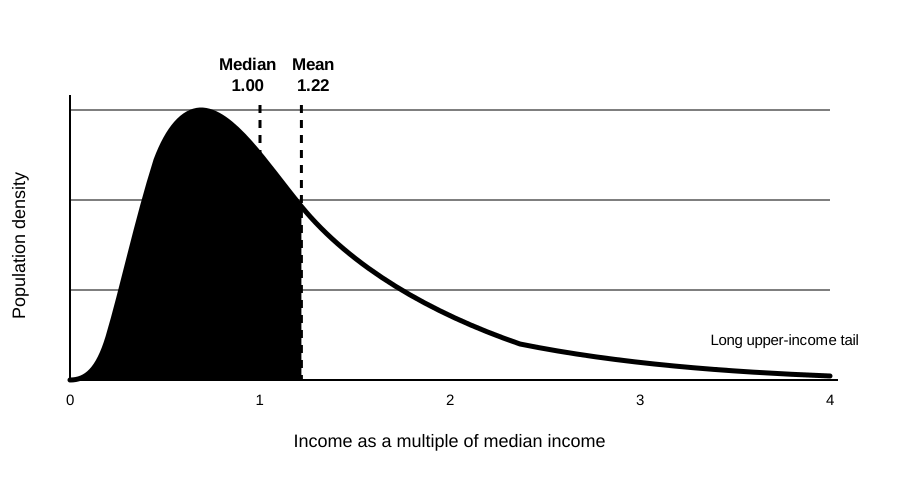
The data therefore confirm that the difference between mean and median income is substantial in practice. In these countries, the proportion below the mean is not merely greater than half, but greater by approximately 10–18 percentage points.
This creates a fundamental problem. Democracy gives each citizen an equal vote, while market incomes are distributed unevenly. When 60 per cent or more of the population can gain materially by taxing and redistributing income from a wealthier minority, democratic politics creates powerful and persistent pressure for greater taxation and redistribution. Progressive taxation and benefits targeted towards lower-income groups intensify that pressure. The natural tendency is therefore for democratic control of the State to expand at the expense of the free market.
Ludwig von Mises argued that interventionism, the supposed middle road between capitalism and socialism, is inherently unstable. Price controls, minimum wages, subsidies, and other interventions alter market coordination and may produce shortages, surpluses, unemployment, or other unintended effects.
When an intervention produces such effects, the State must choose whether to repeal it or introduce further controls. For example, a price ceiling that creates a shortage may lead to rationing, production subsidies, or government direction of supply. Each additional measure can interfere with other market relationships and create pressure for still more intervention. In Mises's account, repeatedly choosing further controls causes political direction progressively to replace the market and may ultimately culminate in central planning.
Democracy can reinforce this process because voters may support a measure for its immediate intended benefit while opposing the costs or shortages that follow. When those consequences appear, the politically attractive response may be another measure promising to correct them rather than repeal of the original intervention. A succession of individually popular decisions can therefore produce a cumulative economic order that no majority chose at the outset.
This is Mises's argument, not an uncontested economic law. An intervention may achieve its purpose without producing an escalating sequence of controls, and democratic governments can revise or repeal unsuccessful policies. Nevertheless, the argument identifies another possible conflict between democracy and a free market: political pressure to correct particular outcomes may expand State control one decision at a time.
A gold standard makes each unit of currency convertible into a specified quantity of gold. Its advocates value this arrangement partly because it prevents governments and privileged banks from creating money without limit. It does not prevent a democratic government from providing social programs. It requires the government to finance them through explicit taxation, genuine borrowing, contributions, or reductions in other expenditure rather than by issuing unbacked money.
Historian Quinn Slobodian presents gold as a constraint upon democracy. He argues that finite gold reserves can lock in austerity by restricting the expansion of credit and State spending, including spending intended to reduce inequality. He also associates hard-money politics with opposition to socialism and organised labour. This identifies government monetary discretion with democracy, but provides no justification for doing so.
Quinn Slobodian, “Central banks have pumped money into the economy, but it’s no substitute for democracy”.
The Austrian and classical-liberal argument is the reverse. Creating money enables a government to obtain real resources without levying an explicit tax. As the additional money reduces the purchasing power of existing money, citizens pay through higher prices and the erosion of wages, savings, pensions, and other fixed nominal incomes. The burden is difficult to identify, arrives unevenly, and is not presented to each citizen as a tax bill. Government can blame the resulting price increases on businesses, unions, foreigners, or other events.
This makes monetary financing a particularly opaque form of taxation. If citizens were shown the full tax required to finance a program, they might reject the program or remove the government responsible for it. Financing it through monetary depreciation can conceal that cost and evade informed democratic consent. Hard money can therefore protect democracy by forcing the State to present the cost of its policies openly. A government may provide the programs voters authorize, but it cannot disguise part of their cost by manufacturing purchasing power.
On this reasoning, hard money and democracy reinforce one another as restraints upon government. Hard money forces officials to disclose expenditure through taxes or genuine borrowing; democracy allows citizens to reject the cost, demand lower spending, or remove the officials responsible. Mises and Hayek did not assume that voters would always choose sound economic policy, but their case does not require treating democracy as the enemy of hard money. Where citizens oppose inflation and excessive State expenditure, democratic accountability helps enforce the same discipline as hard money. Slobodian overlooks this possibility and assumes instead that additional government spending power is itself an increase in democracy. He describes a government's power to subvert democracy as an increase in democracy.
Creating money does not create the doctors, medicines, buildings, food, energy, or labour consumed by a social program. It changes how those real resources are transferred and who bears the cost. A floating fiat currency can give government useful short-term flexibility during a monetary crisis or a collapse in private spending, and an increase in money need not cause an immediate rise in prices when the demand to hold money is also increasing. Neither qualification makes permanent social provision costless or establishes that monetary finance is democratic.
Slobodian's description of governments being prepared to weaken unions or "liquidate workers" also reverses the Austrian account of responsibility. Mises and Hayek did not advocate creating inflation and then using State-induced unemployment to suppress it. Their theory blamed an earlier artificial expansion of money and bank credit for distorting interest rates and financing investments unsupported by real saving. When those errors became apparent, they opposed another round of monetary or fiscal manipulation intended to preserve the resulting pattern of production.
Their reply would be that investments, not workers, had proved unsustainable. Ending artificial credit would expose malinvestments and require labour and capital to move into uses supported by voluntary saving and consumer demand. Unemployment could accompany that correction, especially where wages could not adjust, but unemployment was neither the object of the policy nor an instrument which government should deliberately create. The object was to stop the monetary intervention which had caused the unsustainable boom.
Ludwig von Mises, The Theory of Money and Credit; Friedrich Hayek, Monetary Theory and the Trade Cycle.
The same distinction applies to trade unions. Mises accepted the right of workers to associate voluntarily, bargain collectively, and withhold their labour. He objected to violence, intimidation, compulsory membership, and State privileges that prevented employers and other workers from contracting voluntarily. Removing coercive privileges is not the same as dismantling a voluntary union. To attribute a desire to crush worker organisation to Mises or Hayek requires direct evidence; it cannot be inferred from their support for flexible prices or opposition to inflationary credit.
Ludwig von Mises, Human Action, especially his discussion of union coercion and the right of association.
Fixing a currency's price in gold did not make every historical gold-standard arrangement self-enforcing. The official parity fixed the price of gold in that currency, but not the domestic prices of other goods, services, and labour. If a central bank or fractional-reserve banking system expanded credit and domestic prices rose relative to those abroad, holders of the currency could redeem it at the official rate and send the gold abroad. An issuer which had created more redeemable claims than it could honour was then at risk of exhausting its reserves.
Historically, a central bank could respond by raising its discount rate and contracting credit. Falling spending, prices, and wages could reduce imports and make exports more competitive, but could also cause business failures and unemployment. Resistance to nominal wage reductions could prolong that adjustment. This describes how a centrally managed gold peg might be defended after excessive credit had already been created. It does not show that advocates of free markets wanted government to manipulate the economy, manufacture unemployment, or dismantle voluntary worker associations.
One cross-country study reports a relationship between political institutions and the gold standard. In a sample of thirty countries between 1860 and 1913, its measures of democracy were negatively associated with adoption of and continued adherence to the gold standard after controlling for several observable economic and political factors. A one-standard-deviation increase in its broad democracy measure was associated with an approximately seven percent reduction in the probability of adherence. The estimate survived several alternative specifications, but was driven mainly by political competition in peripheral countries and was statistically stronger for adoption than suspension.
This correlation does not establish Slobodian's attribution of motive and may exist for other reasons. Democratisation occurred alongside changes in economic development, State capacity, political stability, access to foreign credit, exposure to war, and integration into international trade. Historical measures may not capture all of these influences adequately. Causation might also run in the other direction if monetary institutions or the economic interests supporting them affected political reform. Because the study is an observational comparison rather than a natural experiment, it cannot isolate democracy as the cause or identify what voters wanted. Still less does it show that democratic populations favour inflation or monetary debasement, or that Mises, Hayek, and other advocates of sound money feared democracy because workers would vote for such policies.
Bert S. Kramer and Petros Milionis, “Democratic constraints and adherence to the classical gold standard”, Explorations in Economic History, 2022.
Slobodian shows that hard money constrains the State. He does not show that constraining the State constrains democracy. His argument assumes that government monetary discretion represents the wishes of the people, whereas the advocate of hard money argues that this discretion permits governments and privileged banks to act against the public through a concealed tax and the socialisation of eventual losses.
Slobodian may criticise Austrian monetary theory or argue that its proposed correction would have harmful consequences. He cannot fairly replace that theory with the accusation that its purpose was to liquidate workers. To establish his claim about motive, he would need evidence that the particular gold advocates he names sought unemployment in order to weaken workers, opposed voluntary unions as such, or supported gold because they feared democratic voters. A history of central banks contracting credit, a correlation between democracy and gold-standard adherence, and the fact that hard money constrains government do not establish those propositions. Without that evidence, the accusation confuses opposition to government monetary manipulation with opposition to democracy itself.
Globalisation creates a further conflict because markets and ownership extend across national borders, while democratic authority remains primarily national. Citizens may vote to nationalise foreign-owned resources, redistribute land, increase taxes or royalties, regulate working conditions, or restrict the removal of profits and capital. Such measures may express the will of the domestic majority while reducing the value of property owned by people who have no vote in that democracy.
Internationally mobile capital can constrain these choices even without a formal legal prohibition. Investors can move capital elsewhere, and governments anticipating lost investment, employment, tax revenue, or access to credit may avoid policies that voters would otherwise support. International investment agreements add a legal constraint. They protect foreign investors against actions such as uncompensated expropriation and may allow them to seek compensation from states through investor-state dispute settlement. These protections can defend property against arbitrary seizure, but they can also make democratic regulation or nationalisation costly.
Historian Quinn Slobodian uses the term encasement for this use of international economic law. Describing the legal order created by the 1990s, he said its effect was to:
... encase the market rather than liberate or unfetter the market.
Quinn Slobodian, "Capitalism, Democracy, and the Politics of Zones".
One important strand of neoliberal thought sought to place these protections beyond changing national majorities. Rather than eliminating the State, it favoured international rules and institutions that protected private property, contracts, trade, and capital movements from domestic political change. The dispute is therefore not whether democracy is constrained, but whether the constraint is a legitimate protection of property rights or an illegitimate restriction on democratic self-government.
The true common enemy of principled thinkers on the left and right is cronyism: the capture of coercive public power for selective private advantage. Organised interests within some corporations, industries, unions, and other groups seek subsidies, protection, monopolies, favourable regulation, bailouts, contracts, tax concessions, and barriers against competitors. A political government possesses the power to grant them. Cronyism joins the two when officials use that power to confer selective advantage.
The left sees organised interests within some corporations acquiring political power and blames corporate power. The right sees some government officials selling political power to organised interests and blames government. Both are right about the part they see and wrong when they treat it as the sole cause. Private influence becomes tyrannical when it captures coercive power; coercive power becomes cronyism when officials use it to confer selective private advantage.
This is not the free market defended by Ludwig von Mises or Friedrich Hayek. Their case for limited government was directed against arbitrary power, monopoly, protectionism, pressure groups, and special privilege.
Mises described the political pursuit of tariffs, subsidies, and barriers against competitors in terms that closely match cronyism in “Politics and Ideas”, the sixth lecture of Economic Policy: Thoughts for Today and Tomorrow. Such benefits were not features of a free market but privileges sought through government:
“[Pressure groups] want to attain for themselves a special privilege at the expense of the rest of the nation.”
In the foreword to the 1956 American paperback edition of The Road to Serfdom, Hayek defined privilege as the State granting and protecting rights for some that were not available on equal terms to others:
“The essence of the liberal position, however, is the denial of all privilege.”
In their “Statement of Aims” of 8 April 1947, the founders of the Mont Pelerin Society did not treat threats to freedom as coming from government alone. While defending private property and competitive markets, they warned against both “extensions of arbitrary power” and private rights becoming instruments of domination:
“[P]rivate rights are not allowed to become a basis of predatory power.”
Market competition disperses economic power; cronyism suppresses competition by converting political connections into legal advantage.
Critics of neoliberalism often identify real cases in which particular corporations benefit from laws and international institutions, then describe the result as the triumph of free markets. That reverses the meaning of a free market. A rule protecting every person's property against confiscation is a general protection of liberty. A rule giving particular corporations protection, access, subsidies, or remedies unavailable to everyone else is cronyism. The decisive question is not whether a business benefits, but whether the law protects a universal right or creates a selective privilege.
In an interview about Globalists, Quinn Slobodian explicitly attributes legal encasement to neoliberalism:
“Neoliberal institutions are designed to insulate market processes from individual influence and use the apparatus of law to preserve [...] ‘encasement’.”
Slobodian blames neoliberalism when he should blame cronyism: organised interests have captured coercive institutions and used them to secure selective privileges.
Richard Murphy goes further. In “Neoliberalism was designed to fail ordinary people”, he assigns an intention to the founders that contradicts their own statements:
“[Neoliberalism] was created in 1947 by Milton Friedman and Friedrich Hayek to literally destroy the social safety nets.”
Murphy replaces the founders' stated opposition to arbitrary power and special privilege with an intention of his own invention. He blames neoliberalism for the consequences of cronyism.
Noam Chomsky has been one of the most influential left-wing critics of neoliberalism. Unlike critics who concentrate upon particular policies, he attacks corporate capitalism as a system of private tyranny. Yet when asked whether a different society should dispense with money, he identified the more fundamental question in “Getting Rid of Private Tyranny”:
“Getting rid of money is one part of it, which I don't think is the crucial part. The crucial part is getting rid of tyranny.”
Chomsky is right that money, prices, and markets are secondary to the question of tyranny. He then directs that principle against corporations generally, describing them as totalitarian institutions that should be dismantled.
That confuses hierarchy with tyranny. A voluntarily joined organisation does not exercise political authority over everyone merely because decisions within it are hierarchical. The tyranny arises when organised interests capture coercive institutions and obtain powers or privileges that bind people who never consented to them. Chomsky identifies the right enemy but draws its boundaries incorrectly: the common enemy is cronyism, not markets or corporations as such.
Yanis Varoufakis describes the treatment of Greece after its insolvency as a rescue of politically protected creditors rather than of the Greek people. In an interview about his experience as Greek finance minister, he said:
“It was a bailout of the French and the German banks that was disguised as a bailout for Greece.”
Varoufakis's account is that private banks made loans carrying risks they had voluntarily accepted; European institutions protected them from the resulting losses; and those losses were transferred to taxpayers. Greece was then required to accept further loans and austerity that reduced the income from which its debts could be repaid. In a 2015 interview, he also described the programme as political discipline imposed despite knowledge that it would fail.
Varoufakis has recognised the conflict between this conduct and neoliberal principles. In “The curious bargain of Greece's Hayekian neoliberals”, he called their support for taxpayer-funded loans to insolvent states a “Neoliberal Anomaly” and observed:
“[T]here is nothing in the neoliberal manual that can explain their total silence on the national [...] banks.”
He concluded that their unwillingness to let the banks bear their losses arose from their close relationship with the bankers. Varoufakis therefore saw the distinction clearly as early as 2012, but his terminology obscures it: he nevertheless called the participants Hayekian neoliberals while showing that their conduct violated Hayekian market discipline. The issue in his story is cronyism. Politically connected creditors were protected from the market while coercive institutions transferred their losses to people with less political power.
Cronyism is not confined to national legislatures and agencies. National governments negotiate treaties, appoint international officials, fund international organisations, and carry the priorities of their most powerful constituencies into global institutions. Capture at the national level can therefore be reproduced in the rules of the International Monetary Fund (IMF), World Trade Organization (WTO), World Intellectual Property Organization (WIPO), Organisation for Economic Co-operation and Development (OECD), International Trade Centre (ITC), and other institutions that govern or shape participation in the global economy.
The channels of influence are visible. IMF voting power is weighted by financial quotas rather than distributed equally among countries. The WTO maintains a Business Advisory Group and describes business as an important interlocutor. WIPO formally includes industry groups and other interests as observers in its consultations. The OECD gives Business at OECD a formal role as its institutional private-sector stakeholder, representing business federations covering millions of companies. These arrangements give organised economic interests direct access to institutions whose rules influence national democratic choices.
Sources: IMF quotas and voting power; business and the WTO; WIPO observers; and Business at OECD.
Business participation is not itself cronyism. Cronyism exists when influence produces selective coercive advantages: stronger rights for incumbent investors than for ordinary owners, intellectual-property monopolies, barriers to new competitors, public guarantees for private losses, or treaty obligations that preserve privilege against domestic reform. The institutions differ in their purposes, governance, and degree of capture; each rule must be judged by whether it protects equal rights or entrenches favoured interests.
The tyranny lies in the captured political machinery. It is neither voluntary commerce nor collective action as such. It is the power to impose rules upon others combined with the ability of organised minorities to purchase, threaten, or otherwise control the exercise of that power. Some corporations can be beneficiaries and active agents of the tyranny, while some public officials use the coercive powers of political government to make those privileges binding upon everyone.
This diagnosis creates common ground. The principled left is right to oppose private wealth controlling public power. Neoliberals and the principled right are right to oppose the discretionary government power that can be captured. Removing either participant from a single transaction is insufficient while the machinery remains. Preventing cronyism requires removing the State's capacity to grant selective privilege, so there is nothing for organised interests within corporations, unions, industries, professions, or ideological organisations to capture.
VoTa provides extreme protection for property rights and voluntary exchange. Production is private, untaxed, and unregulated except where it violates property rights. The State cannot direct production or interfere with the market through tariffs, subsidies, licences, or privileges. Laws cannot extend beyond the protection of property rights under the Non-Aggression Principle.
VoTa is also extremely democratic. Citizens define public services through direct democracy and direct their own share of public-service funding through tax choice. There are no politicians exercising power on their behalf. The 50 per cent tax on tax-inclusive consumption directs 30 per cent of each taxable payment to public services and 20 per cent to UBI. Democracy therefore controls immense collective resources rather than being confined to a minimal State.
As discussed in Cronyism: the common enemy, cronyism depends upon organised interests capturing discretionary State power and converting it into selective privilege. VoTa removes that machinery rather than trusting different political or economic groups to control it responsibly.
VoTa resolves the conflict by combining three extremes rather than compromising between competing principles:
The third extreme makes the first two compatible. Democracy gives citizens complete control of the State, while the Non-Discrimination Principle prevents the State from becoming an instrument through which one group rules another. A poorer majority cannot impose selective taxes or confiscation upon a wealthier minority. The Non-Aggression Principle prevents it from violating their property rights directly.
Nor can a majority increase the general tax burden. As explained in Tax rates, the statewide public-service and UBI tax rates are fixed by the Constitution and are not subject to ordinary democratic variation. Democracy determines how the fixed public-service pool is allocated, but it cannot enlarge that pool. Changing either tax rate requires a constitutional amendment rather than an ordinary democratic initiative.
The same constraints operate in the other direction. Wealthy people, corporations, and organised interests cannot obtain subsidies, protective regulation, exclusive access, favourable taxation, or other privileges. There is no political government for them to capture and no discretionary authority through which special treatment can be granted.
Extreme democracy therefore governs the State, not the private lives or productive activity of its citizens. Within its constitutional domain the State is controlled directly by everyone; outside that domain, neither a majority nor a minority can use it to rule others.
VoTa does not reconcile free markets and democracy by compromising between them. It gives individuals control of property, production, and voluntary exchange while giving citizens direct control of public services and collective funding. Democracy determines what the State does within its constitutional domain, but cannot be used by a majority or minority to exercise power over everyone else.
As discussed in Division of labour, specialised production can increase material abundance while making work repetitive, narrowly constrained, and intellectually degrading. VoTa addresses this problem through UBI rather than State regulation of production.
This is not a marginal welfare payment comparable to existing systems. The Constitution directs 20 per cent of every tax-inclusive taxable payment to UBI. As explained in UBI, this is approximately 25 per cent of basic-price GDP under simple accounting assumptions. Basic-price GDP provides the meaningful comparison with countries that raise most government revenue through income taxes rather than taxes on consumption.
Because every person receives an income independently of employment, workers are not compelled by destitution to accept dehumanising work. They can refuse a job, reduce their working hours, retrain, become self-employed, or wait for better conditions. Employers remain free to organise production, but must offer sufficient pay, conditions, autonomy, or other benefits to attract workers voluntarily.
The tax applies automatically to taxable consumption, regardless of the consumer's income or wealth. Wealthy people cannot avoid it through income structuring, deductions, or favourable treatment: whenever they use their wealth for taxable consumption, they pay the same rate as everyone else. Saving and investment can delay when the tax is paid, but this is a second-order timing effect rather than avoidance: the tax applies when the accumulated value is eventually consumed. VoTa can therefore fund a substantial UBI without selectively taxing or confiscating accumulated wealth.
UBI does not guarantee that every necessary job will be pleasant or meaningful. It changes the bargaining relationship by giving workers a viable alternative to accepting whatever employment is available. Repetitive or unpleasant work must therefore be automated, reorganised, or made sufficiently rewarding for people to choose it.
The following appears in the constitution in the section on discrimination:
- Discrimination means selective treatment whether favourable or unfavourable, based on any characteristic of a person, including, but not limited to, race, ethnicity, culture, religion, sex, genetic traits, age, wealth, income, land ownership, appearance, beliefs, preferences, circumstances, or possessions.
- The Non‑Discrimination Principle (NDP): The State shall not discriminate, including through its laws, policies, procurement, pricing, fees, charges, or access to services, except in cases involving:
- Merit‑based suitability for a task
- First-come, first-served priority up to a quota
- Allegiance to the constitution
- Citizenship
- Whether a person resides inside or outside the State Territory
- Violations of the Non‑Aggression Principle (NAP)
- Separate facilities for men and women
- Protection of minors
- Minimum age requirements
- Services and facilities for those who are pregnant, recovering from childbirth, or have physical or mental illnesses, injuries, infirmities, or disabilities
The Non‑Discrimination Principle begins from a premise that appears almost self‑evident: the state should not discriminate.
Few would object to this idea. It feels fair, foundational, and widely shared. It seems like a point of agreement across political, cultural, and moral divides. One might even call it intuitive. Yet its consequences are shocking.
Modern governments routinely do the opposite. People think discrimination means racism, sexism and religious bias. But governments discriminate constantly in ways that are so routine they’ve become invisible:
These distinctions are so familiar that they are rarely recognised as discrimination at all. Every one of these is a form of differential treatment based on group membership. If a private company behaved this way, people would call it discriminatory. But when the state does it, people call it “policy”.
Ironically, people think non‑discrimination is uncontroversial until you apply it. People don't tend to agree with the consequences, such as no progressive tax, no targeted welfare, or no special subsidies.
The discrimination is justified through “public interest” language and normalized through decades of political practice.
The reason people don’t notice is because the discrimination is bureaucratic, not emotional. It’s not driven by hatred or prejudice. The discrimination is procedural, not personal and it’s driven by political incentives, administrative convenience, legacy systems, lobbying, and targeted vote‑buying.
So people don’t feel discriminated against. They just experience: forms, thresholds, eligibility rules, exceptions and penalties.
A discriminatory law reveals itself instantly. If a law mentions any characteristic of a person, such as income, assets, employment status, or nationality, it is discriminatory by definition.
The moment a law says “people with X must do Y,” it has created a category. Categories are discrimination. This is why the NDP is so powerful: you don’t need a court to interpret it. You can see the violation in the text.
The NDP prohibits such distinctions in all cases except a very narrow set of cases listed explicitly in the constitution.
This exposes how deeply discriminatory modern states are. Look at almost any law today:
People don’t notice because it’s everywhere.
Political power depends on the ability to treat people differently.
Every familiar tool of politics, including vote‑buying, targeted subsidies, targeted taxes, regulatory carve‑outs, special exemptions, and bureaucratic discretion, relies on discrimination. These mechanisms only work because the state can divide people into categories and reward some while burdening others.
Without the power to discriminate, these political tools disappear.
Ideas like “equality,” “equity,” and “fairness” sound appealing, but they are vague, subjective, and endlessly contested. Different people mean different things by them, and political actors routinely reinterpret these terms to justify opposite policies. As a result, appeals to equality often become tools for expanding discretionary power rather than limiting it.
The Non‑Discrimination Principle is fundamentally different. It does not rely on interpretations, intentions, or moral judgments. It is objective, mechanical, and text‑based: if a law depends on a personal characteristic, it violates the NDP unless it falls within the constitution’s narrow list of exceptions. There is no room for creative reinterpretation or shifting political fashions.
This makes the NDP far stronger than traditional equality doctrines. Where equality can be stretched, redefined, or selectively applied, the NDP is rigid and non‑negotiable. It prevents the state from creating categories, thresholds, or special rules, and it blocks the political incentives that drive targeted benefits and burdens.
In short, equality is an aspiration; the NDP is an enforceable constraint.
The NDP belongs to a long tradition which opposes legal privilege, but it is not simply another name for equality before the law. Equality before the law is an ideal with several related meanings and considerable room for interpretation. The NDP takes one part of that ideal—non-discriminatory State treatment—and expresses it as a much more restrictive constitutional rule. Understanding both the continuity and the difference requires first considering how the older doctrine developed.
Equality before the law did not arise at a single identifiable moment. The ancient Greek idea of isonomia, or equality under law, associated political freedom with equal civic standing rather than rule by the arbitrary will of one person. Greek citizenship was nevertheless confined to a minority of the population; women, slaves, and foreigners were excluded. The principle therefore appeared long before it was applied universally. Aristotle also distinguished numerical equality from proportional equality: justice might require like cases to be treated alike while permitting different treatment where a relevant difference existed. That formula became important, but it left the decisive question—what differences are relevant?—to political and legal judgment.
Stoic accounts of a common human rational nature, Roman ideas of general law, and the Christian belief in equality before God contributed further elements, although the societies adopting them continued to maintain slavery, hereditary rank, and unequal legal status. Medieval instruments such as Magna Carta restrained arbitrary power and required lawful judgment, but did not establish equal citizenship in the modern sense. These sources are better understood as stages in the development of the rule of law than as complete statements of the contemporary doctrine.
The early-modern natural-rights tradition made the principle more universal. In the Second Treatise of Government (1689), John Locke began from a natural condition of equal power and jurisdiction in which no person was born entitled to rule another. Political authority required consent and was to operate through standing laws rather than personal commands. Locke demanded one rule for rich and poor, for the court favourite and the ordinary person. Equality here meant the rejection of inherited political subordination and arbitrary government, not an attempt to equalise possessions or outcomes.
The principle received a particularly clear public formulation in Article 6 of the 1789 Declaration of the Rights of Man and of the Citizen. It declared that law must be the same for all, whether protecting or punishing, and that public positions should be open according to ability rather than inherited rank. The declaration abolished the justification for separate legal orders based upon estate and birth, even though France did not immediately or consistently extend its proclaimed equality to women, enslaved people, or colonial subjects.
The American formulation developed through the Fourteenth Amendment (1868), adopted after slavery and the Civil War. It prohibited a State from denying any person within its jurisdiction the equal protection of the laws. Equal protection was therefore not merely a command to administer an existing law consistently; it also became a means of challenging laws which created unjustifiable classifications. Courts nevertheless had to decide which classifications were permissible and how closely to examine the government's stated reasons for them.
A. V. Dicey incorporated equality before the law into his influential account of the rule of law in Introduction to the Study of the Law of the Constitution (1885). For Dicey, officials and ordinary citizens were subject to the ordinary law administered by the ordinary courts. Public office did not place a person above the law or create a separate system of official justice. His emphasis was therefore equal legal subjection and accountability, rather than a prohibition upon every legislative classification.
After the legal atrocities and racial classifications of the first half of the twentieth century, Article 7 of the Universal Declaration of Human Rights (1948) joined three ideas: equality before the law, equal protection of the law, and protection against discrimination. Modern constitutional equality provisions commonly combine these ideas, but their application still depends upon courts deciding whether differently situated people are comparable, whether a classification has a legitimate purpose, and whether the distinction is sufficiently connected to that purpose.
The history left several propositions under the same expression:
None of these propositions requires equal wealth, ability, possessions, or outcomes. Nor do they literally require the State to treat every person identically. A court treats a convicted offender differently from a person not proved to have committed an offence; a public employer may select an applicant for relevant competence; and a hospital responds differently to patients with different medical needs. Every workable legal system must identify some differences while ignoring others. The central difficulty in conventional equality doctrine is determining which differences may lawfully matter.
Ludwig von Mises treated equality before the law as the equality demanded by classical liberalism. In Liberalism (1927), he rejected the claim that people are naturally identical or that government should give them equal incomes. His argument for legal equality was practical. Free workers are more productive than people held in servitude, and lasting social peace is impossible where classes possess different legal rights and duties. The disenfranchised will struggle against the privileged; abolishing class privilege removes that source of conflict.
For Mises, equality before the law consequently meant equal legal rights, the abolition of distinctions based on birth and rank, and the removal of privileges created by tariffs, subsidies, monopolies, or political favour. It did not mean equal market results. Nor did he reduce the principle to a mechanical inspection of statutory words. Whether an institution was a privilege depended in his account upon its place in the wider liberal order and whether it served peaceful social cooperation.
Friedrich Hayek developed the idea as equality under general and abstract rules. The State should announce rules in advance, apply them to unknown people and future situations, and avoid directing particular persons toward particular outcomes. Equal rules would predictably produce unequal results because people have different abilities, knowledge, circumstances, and choices. Hayek therefore regarded equality before the law and government production of material equality as competing projects: producing equal positions would require officials to treat people differently and exercise continuing discretion. His formulation strongly opposed legal privilege, but still permitted abstract classifications whenever specified conditions occurred.
A law may be general in form and still divide people into favoured and burdened classes. A progressive tax applies the same schedule to everyone, but imposes different rates according to income. Means-tested welfare is equally available to everyone who satisfies its conditions, but gives different entitlements according to income and assets. A subsidy may be open to every business in a named industry while excluding all other industries. Zoning, licensing, employment law, and regional funding can likewise be expressed as general rules which classify people by circumstances, occupation, relationship, or location.
Conventional equality doctrine asks whether the classified people are similarly situated, whether the State has a permissible objective, and whether the classification is adequately related to that objective. The strength of that review varies with the jurisdiction and the characteristic involved. This approach can invalidate racial or religious discrimination while readily accepting classifications based on income, occupation, business size, marital status, age, or location. It also gives legislators and judges considerable authority to decide which purposes and distinctions are reasonable.
The NDP replaces that open-ended inquiry with a presumption and an express list of exceptions. If State treatment depends upon a characteristic of a person—including income, wealth, beliefs, preferences, circumstances, or possessions—it is discriminatory and prohibited unless a constitutional exception applies. Majority approval, a claimed public benefit, administrative convenience, or the fact that the same classification is available to everyone does not supply an additional justification.
This makes the NDP stronger than conventional equality before the law in several respects:
The NDP does not demand identical treatment or equal outcomes. Its exceptions permit distinctions based on such matters as merit for a task, chronological priority, citizenship, territorial residence, violations of the NAP, the protection of minors, and specified health conditions. Distinctions inherent in providing a service, such as medical triage by urgency, are also possible. The difference is that the permitted grounds are constitutionally specified and confined to their stated purposes rather than left to ordinary political balancing.
The NDP is also narrower than the complete doctrine of the rule of law. It does not by itself require laws to be public, prospective, intelligible, stable, or adjudicated by independent courts. It does not state the procedures required for a fair trial or determine whether the substance of a universally applicable law is compatible with the NAP. VoTa therefore needs both principles: the rule of law controls the form, administration, and adjudication of legal power, while the NDP controls the personal characteristics upon which State treatment may depend.
The NDP is best understood as a strict constitutional development of equality before the law, not a rejection of it. It accepts the classical opposition to caste, privilege, arbitrary power, and equalisation of outcomes. It then addresses a weakness exposed by the modern administrative State: almost any targeted policy can be written as a general rule applying equally to everyone who falls within a politically selected category.
Mises and Hayek asked government to act through equal general rules. The NDP adds a prior question: may the State use this characteristic to define the rule at all? Its answer is no unless the Constitution expressly permits the distinction. Equality before the law remains the broad ideal; the NDP supplies a more determinate restriction on how the State may classify the people subject to it.
The NDP binds the State, not private people and organisations. A private person remains free to choose whom to associate with, employ, trade with, support, or avoid, provided that choice does not violate the NAP. The State, by contrast, may treat people differently only under an express constitutional exception.
The rule applies throughout the State's activity, including laws, policies, procurement, pricing, fees, charges, and access to services. A distinction does not cease to be discriminatory merely because it is implemented through a contract, an automated system, an eligibility rule, or an intermediary rather than stated as a direct command. Conversely, the NDP does not require equal outcomes. People may make different choices, provide different value, and receive different results under the same non-discriminatory rules.
The Constitution recognises a small set of distinctions which are sometimes indispensable:
An exception permits the stated basis for distinction; it is not a general permission to discriminate by unrelated characteristics. Merit for a task, for example, does not permit selection by race or political belief, and the residency exception does not permit different rules for different neighbourhoods.
Public services may also make distinctions necessary to provide the service they are contracted to provide. This is an operational rule rather than a power to pursue unrelated social policy. An ambulance service may prioritise patients by medical urgency, an emergency service may respond according to the immediacy and severity of danger, scarce opportunities may be allocated by a fair lottery, and transport or dispatch services may operate according to proximity and route.
The distinction must arise from providing the service itself. Writing a discriminatory preference into a contract does not make it necessary. A service contract cannot be used to recreate targeted privileges, penalties, or eligibility categories which the State would otherwise be forbidden to create.
A public school, for example, has a physical location and therefore inherently favours families who happen to live closer to it: reaching the school is easier for them. That practical advantage is not discrimination by the State, because the school applies no different rule to those living farther away. Denying an otherwise eligible applicant admission because of their address, distance from the school, suburb, or local catchment would be different. It would make access depend explicitly on location and would violate the NDP.
A public school for children may also impose a maximum age where the curriculum, teaching methods, facilities, or safeguarding arrangements are designed for that age group. This is covered by the protection of minors and by the distinctions necessary to provide the contracted service; it does not require a separate exception. The minimum-age exception alone would not authorise a maximum age. Nor could a school impose an arbitrary maximum age unrelated to the service it provides.
Selecting one service operator necessarily treats that operator differently from unsuccessful candidates. The NDP allows the selection to be based on merit for the task. The tender must therefore define the task and the relevant criteria by which competing operators will be compared. Price, demonstrated capability, reliability, safety, and relevant previous performance may all constitute merit; identity, political influence, personal connections, and criteria contrived to favour a preferred operator do not.
Unless one of these exceptions applies, the State cannot make a person's treatment depend on a personal characteristic. It cannot impose different taxes according to income or wealth, provide benefits according to an asset test, grant privileges to selected industries, set different rules by race or religion, restrict occupations to politically approved groups, or vary ordinary legal rights by postcode. Administrative convenience, majority support, good intentions, and an asserted public interest do not create further exceptions.
Every political system must confront the tendency of power to become concentrated. History does not suggest that power remains dispersed merely because no state has been formally established. Where there is no institution capable of maintaining a common legal order, powerful organisations have an incentive to fill the gap.
Anarcho‑capitalism relies on competing private institutions to provide policing, arbitration, and defence. But competition does not guarantee that these institutions will remain small or evenly matched. They may merge, form cartels, absorb rivals, or become dominant within a territory. A dominant security or arbitration network can then set rules, enforce its decisions, and exclude competitors. It has become a de facto state, but without constitutional limits established in advance.
This can happen even when these institutions are sincerely committed to the NAP. The NAP prohibits aggression, but it does not require private organisations to be non‑discriminatory. People naturally have preferences, and the businesses they operate do too. A security firm may prefer some clients, contracts, rules, partners, or outcomes over others. While it remains an ordinary business, those preferences are legitimate private choices.
The problem arises when such an institution becomes powerful enough for its preferences to shape the legal order of a territory. Its preferred rules become general rules, its arbitration system becomes the dominant system, and people who never chose it become subject to its decisions. Private discrimination has then become public power. The institution may still consider itself committed to the NAP, but it now exercises state‑like authority without being bound by the NDP.
This is not necessarily the result of bad intentions. Human societies have repeatedly produced states, including states governing enormous territories. Any system that proposes to do without a state must therefore explain how concentrations of private power will be prevented from creating one.
VoTa does not leave this role vacant. It begins with a democratic state that maintains a common rule of law and has the power to enforce it. The state itself is bound by the Non‑Aggression Principle and the Non‑Discrimination Principle. There is no unoccupied position for a private police force, arbitration network, or other organisation gradually to assume. An organisation seeking political power must operate within the constitutional order or attempt to overthrow it.
The existence of a state does not, by itself, solve the problem of concentrated power. A powerful state is also valuable to anyone who can capture it. The central question is therefore how a special interest can turn private influence into lasting power over the wider population.
In a conventional state, a minority can seek favourable treatment through subsidies, exclusive contracts, licensing barriers, tax concessions, regulatory protection, special exemptions, or selective enforcement. The benefit is concentrated on the favoured group while the cost is spread across the rest of society, so the group has a stronger incentive to lobby for the privilege than each individual citizen has to oppose it.
This process is cumulative. Preferential treatment gives a group more money, protection, or market power. Those advantages can then be used to obtain further preferential treatment. Political power creates economic power, and economic power is used to acquire still more political power. This is the mechanism by which lobbying develops into cronyism and cronyism becomes entrenched.
Under VoTa, a group remains free to organise, advocate, and persuade. What it cannot receive is a law, payment, exemption, penalty, or public service that favours its members as a category. The NDP prevents the state from granting the initial privilege from which entrenched power would grow. A proposal that gives special treatment to a minority can be rejected directly by the citizens and, more fundamentally, is prohibited by the constitution.
The same restriction applies to the majority. Democratic support cannot make discriminatory state action constitutional. The NDP therefore protects against both capture by organised minorities and tyranny by the majority.
The NDP does not make abuse of power impossible. A faction might still use deception, corruption, violence, or an attempt to subvert the institutions that enforce the constitution. The NAP, the rule of law, and the other safeguards in the VoTa constitution remain necessary. What the NDP removes is the ordinary legal route by which special interests acquire privileges, convert those privileges into power, and use that power to demand more.
The state prevents a power vacuum from emerging. The NDP then prevents organised minorities from converting special treatment into accumulating political power. Together, these features make VoTa resistant to the process by which states are normally captured. The NDP is the stabilising constraint at the centre of that resistance: it prevents cronyism at its starting point.
The NDP is a structural constraint, not a moral one. But ask yourself: what does a state look like when it is forbidden from treating people differently? The answer is startling: it loses most of the powers we currently associate with government.
As a clause in the constitution the NDP appears harmless, even obvious: a simple fairness rule. But once applied, it behaves like a wrecking ball. It does not merely prohibit a few objectionable practices; it dismantles the architecture of modern governance.

It is a tiny clause with enormous philosophical and structural implications. The moment the state loses the ability to discriminate, the entire logic of political governance changes.
The NDP is radical because it imposes a mechanical constraint rather than a moral aspiration. It does not say, “The state should be nice”; it says, “The state must operate only on variables that apply to everyone.”
VoTa therefore flips the usual logic:
This produces a striking inversion of the status quo. In most modern societies, private discrimination is prohibited while state discrimination is pervasive. A shop owner may not choose whom to serve, a landlord may not choose whom to rent to, and an employer may not choose whom to hire, yet the state routinely divides citizens into categories and treats them differently on a scale no private actor could ever match. The NDP reverses this asymmetry by placing the prohibition where it matters: on the state itself.
A state that cannot discriminate must govern through general rules that apply uniformly to all individuals. It cannot create privileged groups, targeted benefits, selective burdens, or favour one industry, region, or demographic over another. Equality before the law thus becomes a structural necessity rather than merely an aspiration. The NDP is not a minor refinement to existing practice; it reshapes the entire architecture of the state.
There is a famous quote saying democracy is two wolves and a lamb voting on what they are going to have for lunch. The NDP makes such tyranny of the majority impossible, because discrimination in any initiative, whether in favor of or against any group, is prohibited.

The mechanism is straightforward: a stable majority can use its votes to give itself benefits while concentrating the cost on a minority, for example through selective taxes, restrictions, exclusions, or confiscation. Because the majority receives the benefit and the minority lacks the votes to stop it, the same group may lose repeatedly. Majority rule then gives every citizen an equal vote without giving every group an equal prospect of influencing political outcomes.
In Federalist No. 10 (1787), James Madison proposed representative government and a large republic as safeguards against this danger. Representatives were expected to refine public judgement, while a larger political community would contain more competing interests.
Extend the sphere, and you take in a greater variety of parties and interests.
Madison believed this diversity would make it harder for one faction to form a durable majority united by a common motive to violate the rights of others.
Paradoxically, representative government suppresses the very variety of parties and interests that Madison sought to preserve. One need not extend the republic or travel to another region to encounter different interests; it is enough to ask another person. Individuals living in the same electorate may agree on one issue and disagree completely on the next. Yet representative government compresses all of those changing combinations into one representative and one bundled platform. Direct voting preserves the underlying diversity by allowing every person to take an independent position on every initiative.
Neither safeguard can be relied upon in general. If representatives act in their rational self-interest, their overriding incentive is to win elections, which may require serving the majority at the expense of a minority rather than protecting it. A large republic is no guarantee either, because a durable majority can still form across a large territory.
For centuries, democracies have tried to restrain majorities with constitutions, courts, upper houses, federalism, proportional representation, and supermajority rules. Each places another obstacle in the path of an oppressive majority. None removes its power to oppress.
A majority can win both houses, appoint the judges, dominate every level of government, or reach the required supermajority. Two‑thirds tyranny is still tyranny. These safeguards may slow a majority down, but the safety of the minority still depends on institutions choosing to protect it.
By contrast, the NDP is the ultimate safeguard: it prohibits the majority from using the state to treat a minority differently and thereby makes tyranny of the majority impossible.
The NDP makes state-enforced segregation impossible—i.e. the enforced separation of groups in public spaces.
In the U.S., the legally mandated version was called Jim Crow laws. These laws required separate facilities for Black and white people: drinking fountains, schools, buses, toilets, restaurants, even hospital wards.
It was a state‑enforced racial discrimination, a caste system based on race. It wasn’t just social custom. It was written into law, enforced by police, courts, and local governments.
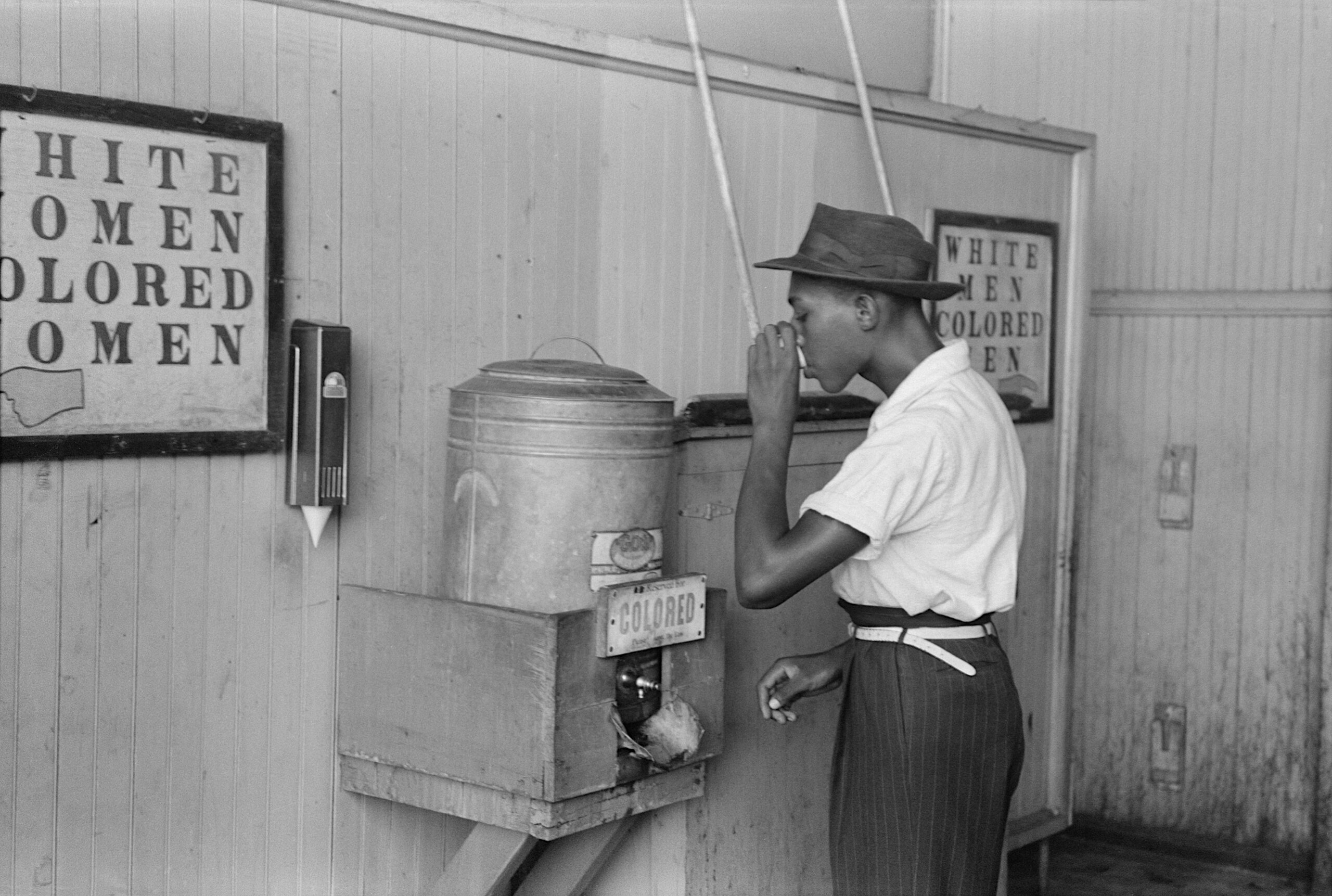
State discrimination isn’t just “unfair,” it actively warps incentives. When the state violates the NDP, it inevitably creates different rules for different people, and that always distorts behaviour.
Every one of these examples shares the same structural flaw: When the state treats people differently based on personal characteristics, it creates behavioural distortions that reduce work, saving, investment, and productivity. Discrimination isn’t just morally questionable. It’s economically destructive.
One of the most surprising consequences of the NDP is that it guarantees every person the freedom to do the exact opposite: to discriminate. The state cannot discriminate against people because of their preferences or the voluntary choices they make on the basis of those preferences. Under VoTa, every person has the right to act on their preferences, whatever they may be, provided they do not violate anyone else’s property rights. This includes the freedom to choose one’s trading partners, tenants, employees, customers, collaborators, and associates.
The freedom for people to discriminate is therefore a corollary of the NDP rather than an independent constitutional principle.
Seen through the NDP, preventing people from being discriminatory is not non-discrimination. It is yet another form of discrimination by a political government: the State restricts people because of preferences it disapproves of. This is particularly ironic because governments discriminate on a scale no private actor could ever match, while prohibiting choices such as these:
These rules interfere with voluntary choice, distort markets, and undermine basic freedoms of association and exchange. They also produce economic distortions, such as minimum wages, rent controls, and price regulations, that suppress information, misallocate resources, and harm the very people they claim to protect.
The deeper contradiction is this: people want non‑discrimination in principle, but discrimination in practice, as long as it benefits their group. They want freedom for themselves, but equality of outcomes for others. So they support freedom in private life (in theory) and equality enforced by the state (in practice).
But enforcing equality requires coercion: restrictions on voluntary trade, bans on differential pricing, and bans on selective association. This is why the state ends up violating the very freedoms it claims to defend. The NDP exposes this contradiction and resolves it by prohibiting state discrimination while protecting individual choice.
Violating the NDP is one of the most reliable ways for a state to manufacture monopolies, even in industries that would otherwise be competitive. Once you see the pattern, it becomes obvious: discrimination by the state creates artificial winners and losers, and the winners inevitably consolidate into monopolies or oligopolies.
How NDP violations create monopolies:
A large market share is not, by itself, a monopoly. A firm may supply most of a market and still be disciplined by competition if customers can leave, substitutes can emerge, and new competitors can enter. A real monopoly exists only where a supplier can raise prices, reduce quality, restrict output, or stop improving without facing effective competitive pressure.
That kind of monopoly is almost never a purely natural phenomenon. It usually requires the state to block entry, restrict substitutes, grant exclusive rights, impose licensing barriers, protect incumbents, or otherwise prevent customers and competitors from disciplining the firm.
The NDP prevents this by forcing the state to treat all firms identically. No special deals. No favoured industries. No protected incumbents. No regulatory moats. Under strict NDP, monopolies can only arise if they are voluntary, non‑coercive and constantly contestable. This means they are not really monopolies at all, just temporary market leaders.
Most of the complexity in modern states comes from differential treatment: different tax brackets, welfare categories, eligibility tests, subsidies, exemptions, compliance rules, and enforcement pathways. Once a government begins dividing people into categories, the machinery required to administer those distinctions grows without limit. A state bound by the NDP would look nothing like the systems we are accustomed to. The intricate architecture of categories, thresholds, special cases, targeted programs, and administrative carve‑outs would disappear. In their place would stand simple, universal rules that apply to everyone. Flat or continuous functions would replace cliffs and brackets; transparent incentives would replace opaque bureaucratic discretion.
Every time the state treats one group differently from another, it must:
This is where bureaucratic sprawl comes from. Discrimination requires categories; categories require administration; administration requires bureaucracy. Remove the ability to discriminate and you remove the need for categories, thresholds, exceptions, and special cases. The entire structure collapses into something far simpler.
If the state can discriminate, it will, because political incentives reward targeted benefits and selective burdens. But if the state cannot discriminate, those incentives vanish. The only viable tools left are universal mechanisms, and universal mechanisms are inherently simpler, more transparent, and more stable.
Economic systems today tend to be extremely complex. For example, the tax systems in many countries are only understood by tax professionals.
The proposed system is extremely simple in many ways:
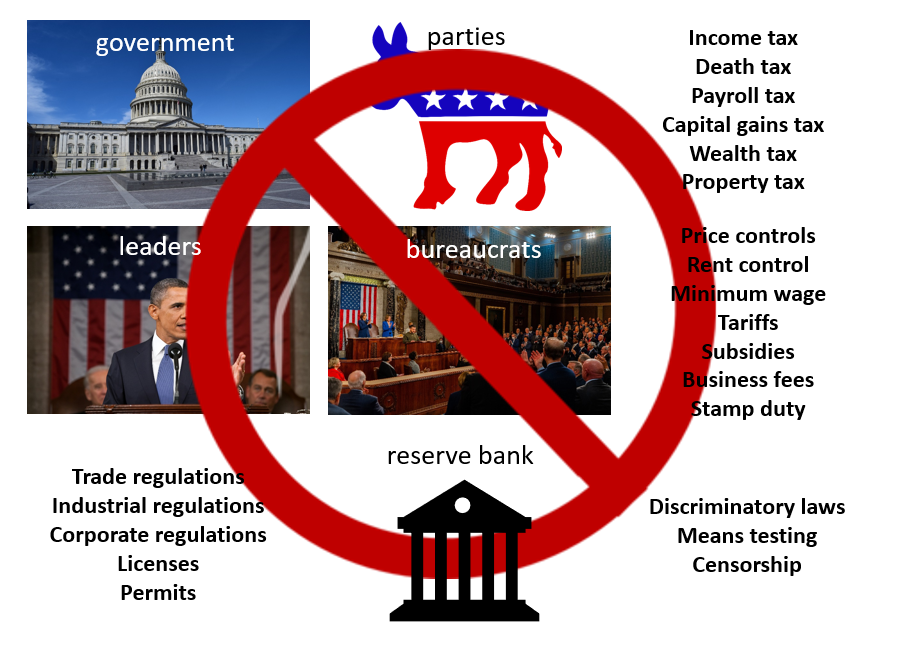
This makes the economy easy to understand and predictable, people can make rational choices, and the public can rule themselves effectively with direct democracy.
The system is radical in many ways. One of the most striking is its radical simplicity. This simplicity makes the economy easy to understand, and, just as importantly, predictable. When citizens can clearly see how the system works, they gain confidence in its fairness and stability. Complexity breeds confusion and mistrust. Simplicity breeds transparency and trust.
If the state cannot discriminate between people, then it cannot choose which services get more funding, choose which industries get support, choose which regions get infrastructure, or choose which priorities matter more. All of those decisions privilege some people’s preferences over others.
So the NDP implies:
That is, the state cannot choose between citizens’ competing priorities without privileging some preferences over others. Because public-service funding is preference-sensitive, the only non-discriminatory source of those preferences is the citizens themselves.
Tax choice isn’t a design preference. It’s a theorem of the NDP.
If the state chooses how tax is allocated, it is privileging some preferences over others. That is discrimination. Therefore the state cannot choose the allocation.
This kills a core function of:
Once tax choice exists, the main purpose of representative government collapses.
Since the state cannot be discriminate whereas the people can, discretionary decisions necessarily fall on the people, not the state. So the NDP is a sledgehammer for reducing the power of the collective in favour of power of the individual.
A startling implication of the NDP is that it leaves no room for government in the ordinary political sense: politicians, parties, platforms, budgets, and discretionary rule by representatives. State representatives cannot choose among citizens’ competing priorities without privileging some over others. Choosing how tax is spent is therefore discriminatory allocation. Since political government consists largely of discretionary choices made on behalf of the public, the NDP eliminates political discretion and leaves only rule-bound mechanisms acting under the Constitution.
Once the state cannot discriminate:
because all of those activities involve choosing winners and losers. The NDP makes political discretion impossible.
What remains is a neutral administrative layer, universal mechanisms, enforcement of NAP + NDP, and a self‑allocating public service marketplace.
A politician or party deciding:
is always discriminating between people, because different people value different services, industries, regions, and priorities. Even if the intention is noble, the effect is discriminatory. So under the NDP: no representative may make decisions that differentially affect people.
That wipes out:
Surprisingly few, and they are all mechanical, not political. A non‑discriminatory state can only do things that apply identically to all humans, do not create categories, do not allocate resources differently and do not impose differential burdens.
This leaves only:
These are administrative, not political.
They don’t require:
They require:
Not politicians.
Most modern enforcement relies on selective attention: police prioritise some groups, regulators target some industries, and tax authorities audit some categories of people more than others.
Under the NDP, enforcement must be rule‑driven rather than strategy‑driven. The State may respond to evidence of specific rights violations, objective risk, urgency, and severity, but it may not choose enforcement targets according to political priorities, demographics, industry identity, wealth, status, location, or administrative preference.
This forces a shift from enforcement as strategy to enforcement as mechanism.
The NDP forbids:
This collapses the entire architecture of “policy levers” governments currently use. Only universal mechanisms remain.
Modern law is built on categories: tenants vs landlords, employees vs contractors, small business vs large business, married vs unmarried, homeowners vs renters, etc.
Under the NDP:
This radically simplifies the legal landscape.
Licensing regimes discriminate by:
Under the NDP:
This dramatically increases competition and lowers costs.
The NDP implies:
Taxation becomes either flat, continuous, or voluntary, but never discriminatory.
Zoning is inherently discriminatory: it treats landowners differently based on location, use, or classification.
Under the NDP:
This collapses the modern planning system into a simple nuisance‑based framework.
Means‑testing, age‑testing, and circumstance‑testing are all discriminatory.
Under the NDP:
This is one of the most politically radical implications.
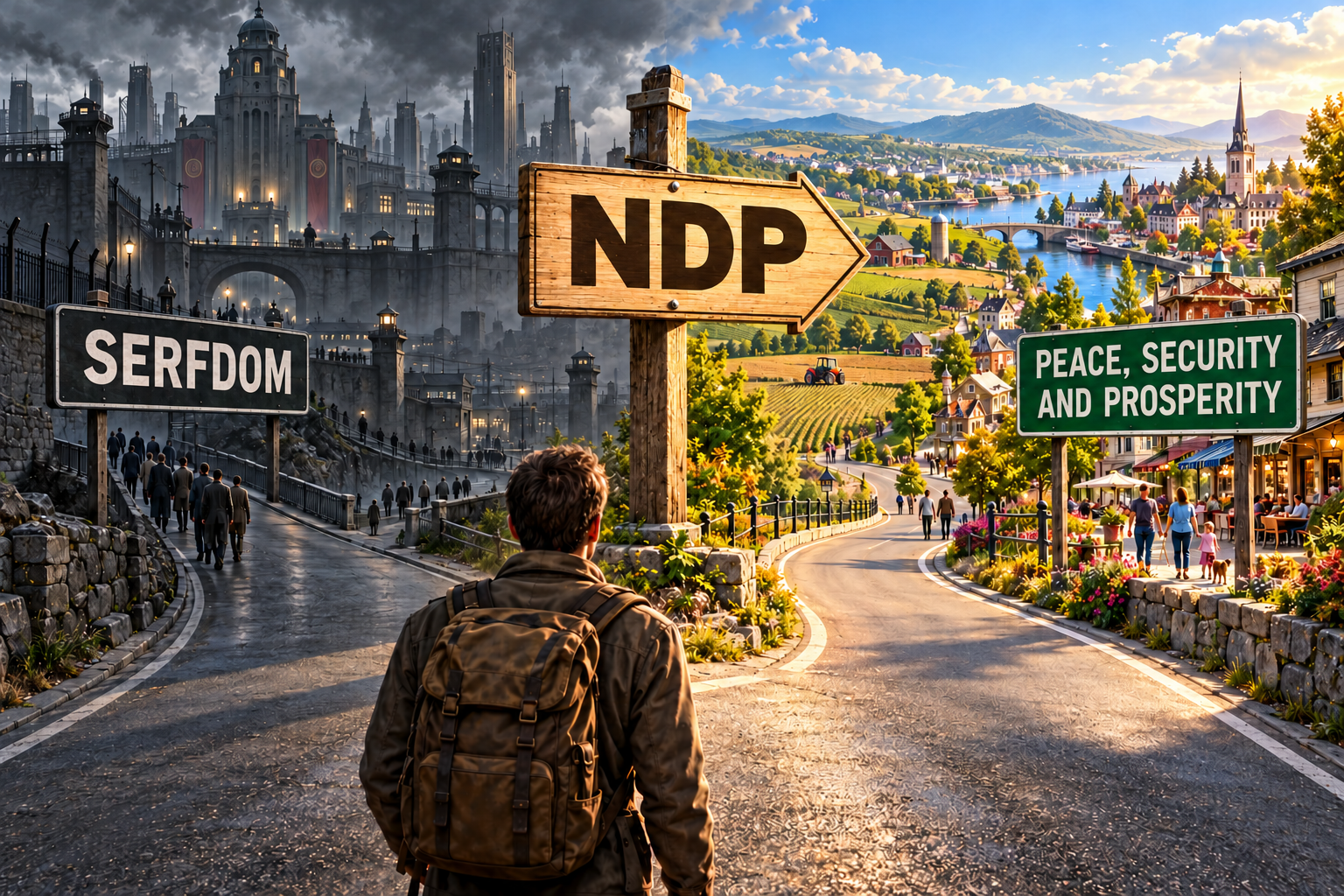
If the state cannot discriminate:
This shifts politics away from coalition‑building and toward mechanism design.
Emergency powers often discriminate:
Under the NDP, emergency powers must be universal, minimal, and non‑discretionary.
Courts often treat cases differently based on:
Under the NDP:
No cronyism is one of the most direct and powerful consequences of the NDP. Cronyism is structurally impossible in a system where the state is forbidden from treating people differently.
Cronyism depends on three ingredients:
The NDP removes all three. Because the state cannot discriminate on the basis of identity, status, wealth, industry, connections, or circumstances, it loses the ability to:
Every mechanism must apply universally, automatically, and without discretion. This collapses the entire logic of political favour‑trading.
What disappears when cronyism becomes unconstitutional? A non‑discriminatory state cannot support:
These are all forms of discrimination by another name.
Cronyism is not an aberration of modern governance. It is a predictable outcome of discretionary, identity‑based state power. Once the NDP removes the ability to discriminate, the incentive structure that produces cronyism collapses. This is why the NDP is not merely a fairness clause. It is a structural redesign of governance. It replaces political allocation with universal mechanisms, favour‑trading with rule‑based processes, and bureaucratic discretion with automatic enforcement. Cronyism becomes not just discouraged, but impossible.
Crony capitalism is an economic system characterized by a close, mutually advantageous relationship between business leaders and government officials.
In a system of pure capitalism, success is determined by competition in the free market. In crony capitalism, success is determined by the favor shown by government bureaucrats to favored businesses, such as tax breaks, government grants, and regulatory advantages.
Cronyism has occurred throughout history and around the world, manifesting as political appointments, favorable regulations, and rigged contracts benefiting friends or associates of those in power.
Crony capitalism often leads to economic inefficiency, reduced innovation, corruption, market distortions, and increased income inequality. Resources are allocated based on political influence rather than market signals, which can harm long-term economic growth.
Cronyism is a primary mechanism by which monopolies are created and sustained. When businesses have close ties to government officials, they can influence the creation of rules, regulations, and laws that deliberately suppress competition and grant them exclusive market power.
Intentionally ambiguous laws and regulations give power to political officials to choose which businesses are impacted with barriers, fines or even jail time.
Why crony capitalism happens in traditional systems: Politicians control budgets and regulations so businesses lobby them for subsidies, tax breaks, or protection. There are state monopolies, so favoured firms get contracts without competition. There is borrowing and money creation so governments funnel cheap credit to insiders. There is opaque decision-making so corruption thrives in hidden deals.
The lobbying effort by H.J. Heinz to make the preservative sodium benzoate illegal is a classic historical example of crony capitalism, where a business used political influence and regulation to gain a competitive advantage and create a de facto monopoly in a specific product segment.
At the turn of the 20th century, many food manufacturers used cheap preservatives like sodium benzoate to mask the use of low-quality or spoiled ingredients, as there were few food purity standards.
Henry Heinz invested in more expensive processes using high-quality tomatoes and a high vinegar content to create a stable, preservative-free ketchup recipe.
Instead of just competing in the marketplace by offering a premium product, Heinz actively lobbied U.S. government officials, including President Theodore Roosevelt and chemist Harvey Washington Wiley (who led "poison squad" human trials on preservatives), to pass the Pure Food and Drug Act of 1906.
By advocating for strict purity laws that effectively outlawed or heavily restricted the use of common, cheap preservatives like sodium benzoate, Heinz aimed to make his competitors' production methods illegal.
Smaller firms or those relying on cheaper ingredients could not afford to quickly re-engineer their products to match Heinz's quality and process standards. This regulatory change acted as an artificial barrier to entry, protecting Heinz's market share.
Heinz launched national advertising campaigns touting his products as "free of benzoate of soda" and pure. He could justify a premium price for his ketchup because the new regulations had effectively removed his low-cost competition.
The medallion system is a prime example of how government regulation, when influenced by private interests, can morph into cronyism: an alliance where the government uses its power to create a cartel, which then uses its profits and influence to ensure the political system sustains its artificial advantages.
In 1937, the city of New York passed the Haas Act, which capped the number of taxi medallions (licenses required to operate a yellow cab) at around 13,500. This number remained fixed for over 60 years, despite significant population growth in NYC. This intentional constraint on supply created an artificial scarcity.
By limiting competition through legislation, the city effectively granted a monopoly to existing medallion holders. This allowed them to charge higher prices than a free market would bear, extract "monopoly rents," and avoid meaningful competition.
As the value of medallions soared (peaking at over $1 million), medallion owners became a wealthy, well-organized, and politically powerful group. They intensely lobbied city governments and the Taxi and Limousine Commission (TLC) to maintain their protected status and prevent new medallions from being issued.
This political influence was evident in their sustained efforts to block or heavily regulate potential competitors like ridesharing services (Uber and Lyft). They argued for legislation that would force new entrants to abide by the same restrictive rules, effectively trying to use government power to protect their business model rather than competing through innovation or efficiency.
The close relationship between medallion owners and politicians often involved campaign contributions, which helped ensure the continuation of policies favoring the taxi cartel.
The high value of medallions meant that most individual drivers could not afford to buy one. They had to lease the medallions from large fleet owners, working long shifts for low net income, trapped in a cycle of debt.
Consumers faced higher taxi fares and often poorer service because the lack of competition meant less incentive for innovation or improved quality. In areas underserved by yellow cabs, black markets of "gypsy cabs" emerged to meet demand because the legal system failed to provide adequate service.
Under the constitution special interest groups cannot lobby a government to get favours at the expense of the rest of the community. Instead, under voluntary direct democracy a majority will vote against such initiatives.
The system avoids crony capitalism because it removes the mechanisms that enable it: politicians, subsidies, borrowing, opaque contracts, and coercive regulation. Instead, funding and survival depend entirely on citizen choice and transparent competition.
How the constitution blocks it:
Practical Outcome: No lobbying leverage: With no politicians, lobbying is meaningless. No subsidies or bailouts: Funding comes only from citizen demand. No hidden deals: Transparency ensures accountability. Merit-based competition: Firms thrive only if they deliver value to citizens.
The NDP implies a free market, but not because it asserts free‑market ideology. It implies a free market because once the state is forbidden from treating people differently, almost every mechanism used to control, steer, or distort markets becomes unconstitutional. What remains is voluntary exchange under universal, non‑discretionary rules. That is the essence of a free market.
The NDP structurally produces a free market. There are no selective privileges or burdens. Markets become free when the state cannot subsidise some industries, impose special taxes on others, grant exclusive licences, create protected classes of firms, and negotiate exemptions or special deals. These are all forms of discrimination. Once removed, competition becomes open and contestable.
The NDP implies there are no barriers to entry based on identity or status. Most modern barriers to entry are discriminatory through occupational licensing, zoning approvals, residency requirements, “strategic industry” designations, and minimum capital requirements for some businesses. Under the NDP, the state may regulate actions (e.g., safety standards) but not people. This collapses protectionism and opens markets to anyone who can meet universal rules.
It prevents targeted regulation. Regulation must be universal, harm‑based, and non‑discretionary. It cannot apply only to certain industries, impose different rules on small vs large firms, treat gig workers differently from employees, or create special compliance regimes. When regulation becomes universal and mechanical, it stops being a tool of industrial policy and becomes a neutral framework for voluntary exchange.
The NDP doesn't allow discriminatory taxation. A free market requires neutral taxation. The NDP forbids progressive tax brackets, industry‑specific taxes, wealth taxes, payroll taxes that treat employment differently from contracting, and targeted tax incentives. Taxation becomes flat, uniform, or voluntary. This removes the state’s ability to shape economic behaviour through fiscal discrimination.
Selective enforcement is one of the most powerful tools for distorting markets. Under the NDP enforcement must be uniform, regulators cannot “focus on” particular firms, audits cannot target specific groups, and compliance cannot be used as a weapon. This eliminates the informal, political, and bureaucratic levers that create unfree markets.
Cronyism is discrimination disguised as policy. Without the ability to discriminate, the state cannot reward allies, punish competitors, grant special access or create insider advantages. A free market emerges because the state cannot tilt the playing field.
What remains is voluntary exchange under universal rules. Once all discriminatory mechanisms are removed, the only legitimate state functions are protecting property, enforcing contracts, preventing aggression, and maintaining universal safety standards. These are the classical foundations of a free market. The NDP does not advocate for a free market. It forces one by eliminating every alternative.
The NDP does not say “markets should be free.” It says “the state may not discriminate.” But because almost every form of economic control relies on discrimination, the result is a system where:
This is a free market in the strict, structural sense.
There are two essential requirements for the rule of law under this constitution.
There are two essential requirements for the rule of law under this constitution.
The NAP is not a moral code. It is a legal boundary. The law does not cover every moral obligation or cultural norm. In other words, the legal system is only a subset of ethics. Many things may be unethical, yet still legal: bullying, lying to a friend, cheating on a spouse, or neglecting family responsibilities.
At the foundation of this constitution lies the Non‑Aggression Principle, or NAP. It is the bedrock of the entire legal structure, binding both residents and the state itself.
Aggression is defined as the initiation of significant interference with someone’s property rights or voluntary agreements. That interference may come through direct force, through fraud, or through negligence.
The principle guarantees that everyone retains the fundamental right to use force in self‑defense, whether defending themselves or others, and the right to seek just restitution for any damages they suffer.
Violations include attempts to control property you do not own, such as blocking someone from retrieving their belongings or preventing access to unowned land. Breaking a contract is also a violation, because it amounts to fraud.
Creating significant risk is prohibited, for example, driving while intoxicated. And unjustified searches of private property are forbidden, even in the name of criminal investigation.
Free expression is protected to the fullest extent. Only speech that directly incites immediate violence, violence that would itself violate the NAP, is prohibited. All other forms of speech remain protected.
The Non‑Aggression Principle is the objective standard by which all interactions and conflicts in this society are judged.
Homesteading is the default means of acquiring an unowned resource through first use. However, Article VI: Laws, Section 2: Property rights allows laws to prohibit homesteading of particular land within the State Territory. Through direct democracy, the people can therefore decide that defined areas should remain in the commons.
For example, the people could vote for a law protecting an unowned area from homesteading as a national park. They could also prohibit homesteading within 200 metres of a river or within a defined distance of the ocean, keeping riverbanks or coastal areas in the commons. Such laws concern characteristics and boundaries of land, rather than characteristics of the people who might wish to homestead it. The same prohibition applies to everyone, subject to the NDP.
To make these laws objective, their boundaries and criteria must be clearly defined. A river-distance rule, for example, should specify the river boundary from which the distance is measured and how changes in its course affect the protected area. People should be able to determine whether land is available for homesteading before attempting to acquire it.
These restrictions apply only to land that is unowned when they take effect. A vote to protect an area cannot revoke existing legitimate ownership, seize someone's land, or return privately owned land to the commons. For example, a new prohibition on homesteading within 200 metres of a river would not remove ownership of land already legitimately acquired within that distance. The power concerns whether new ownership may arise through homesteading, not whether existing ownership may be taken away.
Land protected from homesteading remains in the commons; it does not become the state's property. Keeping an area in the commons also does not, by itself, prohibit every activity within it. Any further restriction must have its own basis in the Constitution. This illustrates how direct democracy can exercise an expressly granted power while remaining within the constitutional limits of the NAP and NDP.
Extending the State Territory does not make land already owned or used by its inhabitants available for appropriation as unowned commons. Indigenous people's existing use of land must be recognised under the same homesteading rules that apply to everyone else. Their use cannot be disregarded because of their ancestry or culture, or merely because they lack a title issued by the incoming state. Where that use has established legitimate property rights, incorporating the land into the State Territory does not extinguish those rights. The state cannot use colonisation as a justification for forcing the owners off their land or granting it to newcomers.
Labour spent improving land can make evidence of homesteading clearer. Dwellings, cultivated areas, wells, and maintained irrigation provide tangible evidence of use and can help establish the extent of a claim. Such improvements can also support recognition of continuing ownership during an absence. They are evidence of homesteading, rather than a requirement replacing the constitutional principle of first use.
Nomadic and seasonal use raises the question of when property has been abandoned. Absence must be distinguished from relinquishing ownership: people must be able to take extended trips, use land seasonally, or own more than one home without losing property merely because they are not continuously present. Abandonment rules should require clear evidence that ownership has been relinquished, rather than treating non-use alone as sufficient. Laws adopted through direct democracy must define the conditions under which property is considered abandoned as objectively and clearly as reasonably possible. Under the NDP, those conditions must apply universally: the same pattern of use or absence must be assessed by the same rules, regardless of the person's ancestry, culture, or identity.
Protection of access also matters for nomadic use. The Constitution prohibits homesteading that blocks access between resources not owned by the homesteader. This can protect established routes connecting land used by nomadic people: a later homesteader cannot acquire a right to exclude others in a way that cuts off that access. Protecting passage need not require ownership of the entire route. The same access rule applies to everyone under the NDP.
Any finding that land has returned to the commons must therefore follow the generally applicable abandonment rules. The state cannot simply declare indigenous land abandoned to make it available for settlement. The protection follows from equal recognition of existing property rights and equal application of the law.
This clause defines the limits of an individual’s responsibility for the property of others.
In general, residents are not responsible for the misfortunes of others. A legal duty to act only arises in specific circumstances:
The law makes a clear distinction: actively causing harm, known as misfeasance, usually brings legal liability. But simply allowing harm to occur through inaction, called nonfeasance, generally does not.
Forcing someone by law to intervene physically or spend resources to help a stranger is seen as a serious intrusion on liberty and bodily autonomy. And if such a general duty were imposed, its limits would be impossible to define. Who would be required to act: those present, or anyone aware of the situation? And how far must they go, even at risk to themselves?
Even if a person knows of a high risk of serious harm to another’s property, they are not legally required to act, even if preventing that harm would take little effort or pose little risk. That does not make their choice moral. Society may condemn and shun them for failing in a duty of care, even if the law does not.
For several reasons the state holds a monopoly on the punishment of crime:
This is a philosophical position grounded in the Person as the locus of action and responsibility for those actions. Organisations act only through Persons.
Article VI: Laws, Section 2: Property rights states:
Every property right shall have exactly one owner. A purported property right shared by two or more Persons has no legal meaning and shall not be recognised or protected by the State.
A property right is the right to exclude others from using a resource. For a property right to exist, it must have a single owner. If one Person decides to exclude someone and another Person, claiming the same right, decides not to exclude them, both decisions cannot prevail. Without a single owner there is no property right to settle the conflicting claims.
Voting, arbitration, a casting vote, or any other decision procedure does not make ownership shared. It determines which decision prevails. A Person whose decision can be defeated does not possess the property right over that decision. A requirement for unanimity does not produce a decision when the Persons disagree; it gives each Person a veto and leaves the use of the property determined by a default rule.
Shared property rights are not recognised as having any legal meaning in VoTa. Each property right belongs to exactly one Person, so the authority to decide and the responsibility for the decision remain identifiable. Several Persons may hold different rights concerning the same property. A Person may have permission to use it, a contractual right to receive income from it, or authority delegated by its owner. Those rights do not make that Person a co-owner. A transfer replaces the owner; it does not add another owner.
Persons who attempt to create a shared property right risk the State not protecting any of their purported rights. Because the State does not recognise the property as having an owner, it does not recognise a property right for any of the participants to enforce.
Nor can property be owned by a company, association, or other collective. A collective has no will apart from the Persons who act for it. Describing the collective as the owner obscures who has authority and who bears responsibility. VoTa instead requires ownership and related contractual rights to be assigned to identifiable Persons. Consistently with this principle, every Central Bank account has exactly one owner.
VoTa does not abolish shares or the share market. It recognises a share as a transferable contractual right to receive an agreed portion of the profits of a business, rather than as an ownership interest in a company. A business owner can sell profit shares to raise capital while remaining the single owner of the property used by the business.
Profit shares preserve the economic purposes served by equity shares. Investors may buy them to receive profit distributions, conventionally called dividends. They may also buy them in the expectation that the shares will increase in value. When a business is expected to earn greater profits, the anticipated stream of dividends is more valuable and investors may pay more for the corresponding profit shares. An investor can realise that increase in value by selling the shares on the share market.
This simplifies and clarifies the legal relationships without preventing companies from raising investment or investors from earning returns. The business owner owns the property, makes decisions about its use, and bears the associated responsibility. Each investor owns a defined financial right. Trading a profit share changes the Person entitled to the associated payments; it does not transfer or divide ownership of the business. If the owner wishes to give up control, the owner may instead sell the property right to a single new owner.
A profit-share agreement must define the profits to which it applies, the proportion payable, its duration, its transferability, and what happens when ownership of the business property changes. Standardised profit shares can be listed and traded on exchanges in the same way as equity shares. Companies therefore retain access to a share market, but that market trades financial rights rather than purported fractions of a shared property right.
Modern legal systems generally take the opposite practical route: they create corporate persons and impose civil or criminal entity liability. Corporate personhood is explicitly recognised as a legal fiction used so corporations can sue and be sued.
Review these areas of the Constitution:
A business is an arrangement through which Persons act; it is not itself a Person. It cannot own property, make decisions, commit an offence, or bear responsibility. However large a business becomes, its property has one legal owner. That Person holds the full property right and has final authority over how the property is used, subject to the rights of others and the general law.
This prevents responsibility from being attributed to a corporation while the Persons behind it remain unnamed or avoid responsibility. A corporation cannot pollute the environment, deceive a customer, or decide to pursue a harmful policy. Persons perform those actions and make those decisions. When the conduct results from the way a business is owned and operated, the chain of authority leads to one identifiable Person: its legal owner. The owner cannot answer that the corporation was responsible, because VoTa does not recognise the corporation as a legal Person capable of bearing that responsibility.
The owner may employ directors, managers, and workers and may delegate authority to them, but delegation does not divide the property right. The owner remains responsible for choosing the purposes of the business, its organisation, its policies, and the Persons entrusted with authority. Each director, manager, or worker also remains responsible for that Person's own conduct. An organisation therefore cannot be used either to conceal the owner who has final authority or to excuse a Person who personally commits an offence.
Profit-share holders are investors, not owners. Their contractual rights to dividends do not give them authority over the business property and do not disperse the owner's responsibility. Trading profit shares changes who is entitled to payments, not who owns the business. If the owner wishes to surrender control, the owner may sell the property right to one new owner.
The owner of any business may establish a binding constitution governing how the business will operate. The constitution may impose continuing requirements concerning its purpose, governance, use of property, financial rights, appointment of directors, or succession. It may be intended to operate perpetually rather than ending when the original owner dies or transfers ownership.
Because a business is not a Person, it does not impose obligations upon itself. The owner accepts the obligations and agrees that the complete property right may be transferred only to a successor who accepts the same constitution. Each successor becomes the single owner and the identifiable Person responsible for performing the obligations. In this way the constitution remains binding through a succession of owners without making the business an immortal legal Person.
This serves the same legitimate function as a constitution or articles of association under conventional company law: it gives a lasting structure to an enterprise. VoTa represents that structure directly as enforceable contracts accepted by identifiable Persons. Corporate personhood and shared ownership are not required for a business to bind its future operation to durable rules.
VoTa does not need special laws requiring directors to act in the interests of a company or its shareholders. There is no corporate Person whose interests must be inferred and no collection of shareholders who jointly own the business. The single owner decides what the director is required to do and may record those requirements in an employment or agency contract. It is for the owner to appoint, supervise, reward, and dismiss a director who will act as the owner intends.
The owner may appoint a director with instructions to expand the business, change its purpose, reduce its operations, or wind it down. Winding down a business is lawful even when it remains a going concern. Neither a director nor a profit-share holder has an independent right to require the owner to continue operating the business or to maximise its profits. Winding it down does not, however, extinguish the owner's existing contracts, debts, or other legal obligations.
If a director breaches that contract, ordinary contract law provides the remedy. If a director violates another Person's rights or commits an offence, the director is personally responsible under the ordinary law. There is no need for separate duties owed to an artificial company, special rules about acting in shareholders' interests, or a corporate veil that courts must pierce to identify the Persons responsible.
The same clarity removes the need for many other rules created to manage purportedly shared corporate ownership. There are no controlling and minority owners, shareholder votes, proxy contests, minority oppression claims, or derivative actions brought on behalf of an artificial Person. Financial rights are enforced as contracts, property rights are exercised by the single owner, and responsibility is borne by the Persons who act.
Under this constitution, regulations exist only to codify the Non‑Aggression Principle. The constitution states this explicitly in Article VI: Laws:
- The State shall not impose safety, economic, moral, environmental, technological, or administrative regulations except where failure to comply constitutes harm or negligence rising to the level of violating the Non‑Aggression Principle. Any such regulation shall be narrowly tailored to preventing that harm and shall not restrict voluntary behaviour, exchange, or land use beyond what is necessary to prevent demonstrable aggression or negligence.
Safety standards can certainly be proposed in industries like aviation, housing, or pharmaceuticals, but they are not automatically mandated by law. Instead, the law is grounded in the NAP and applied according to the particulars of each case.
In arbitration, adherence to widely accepted safety standards may be considered. But the decisive question is always this: does the negligence rise to the level of violating the NAP?
Importantly, the NAP is understood to be violated not only when actual harm occurs, but also when actions clearly and seriously place people at risk. That’s why, for example, nuclear power plants face strict safety requirements. The potential to contaminate vast areas and endanger thousands of lives demands precaution, even before any accident has taken place.
The following are examples where someone, through negligence, puts others at serious risk of harm and therefore is taken to violate the NAP:
For the most part, the rule of law does not attempt to codify every possible case of negligence. Doing so would create too much complexity in the law.
In Australia: The World’s Most Bloated Bureaucracy, John Anderson and former New South Wales Senior Trade and Investment Commissioner Mike Newman argue that Australia's public service has become bloated, self-serving, and hostile to the productive economy. They point to the extraordinary share of newly created jobs absorbed by government, the proliferation of highly paid bureaucratic positions, and the red, green, and black tape that deters businesses from investing in Australia. Cost blowouts and failed projects are presented not as isolated mistakes but as symptoms of institutions that face weak consequences for failure and acquire a vested interest in expanding their own power. Their central criticism is that the bureaucracy no longer confines itself to serving the public: it consumes resources created elsewhere, obstructs those who create wealth, and seeks ever more authority over the people whose liberty it ought to protect.
Newman states that his company was considering 62 jurisdictions for future investment and made approximately 40% of its profits in Australia. He says that the company was finding it increasingly difficult to justify further investment in Australia because of red, green, and black tape.
The interview cites 128,000 people experiencing homelessness in Australia. Newman contrasts this figure with a social-media video in which Minister for Housing and Homelessness Clare O'Neil and Murray Watt discussed their preferences among a börek, a jam doughnut and a cinnamon roll. He describes the video as social-media virtue signalling and questions what public value it produced while Australia faced record homelessness. He then contrasts the scale of the public service with its results and says that government should be concerned with good government, changing the culture of the public service and measuring actual outcomes. Interview excerpt and transcript
Research reported by the Australian Institute of Health and Welfare estimated that between 15,000 and 19,000 homeless people aged 12 to 24 were in Australia in May 1991. The estimate used Victorian Supported Accommodation Assistance Program data, other service records and national population data. AIHW source
The 1996 Census was the first Australian Census to use a special strategy targeting the homeless population. An analysis published by the ABS estimated 105,304 homeless people on Census night in 1996, equivalent to approximately 59 per 10,000 population. That estimate used the earlier cultural definition of primary, secondary and tertiary homelessness. The ABS developed its current statistical definition in 2012 and produced the series beginning in 2001 shown below. ABS 1996 estimate ABS history and definitions
The Australian Bureau of Statistics estimates homelessness from each five-yearly Census. The national estimates and rates in its current series were:
Between 2001 and 2021, the estimated number increased by 27,180 people, or 28.5%, while the rate declined from 50.8 to 48.2 per 10,000 population. Over the decade from 2011 to 2021, the number increased by 20,055, or 19.6%, and the rate increased from 47.6 to 48.2 per 10,000. Between 2016 and 2021, the number increased by 6,067, or 5.2%, while the rate declined from 49.8 to 48.2 per 10,000.
The 2021 Census was conducted on 10 August 2021 while COVID-19 restrictions and emergency-accommodation programs were operating. The ABS states that the 2021 estimates are not directly comparable with earlier Censuses because greater use of administrative data improved data quality. The categories above are mutually exclusive and the ABS applies small random adjustments to cells to protect confidentiality. ABS Census source AIHW trend summary
The Australian Law Reform Commission's DataHub reported the following figures as at 12 December 2022:
These are Commonwealth figures and do not include the statute books of the six states and two self-governing territories. Source
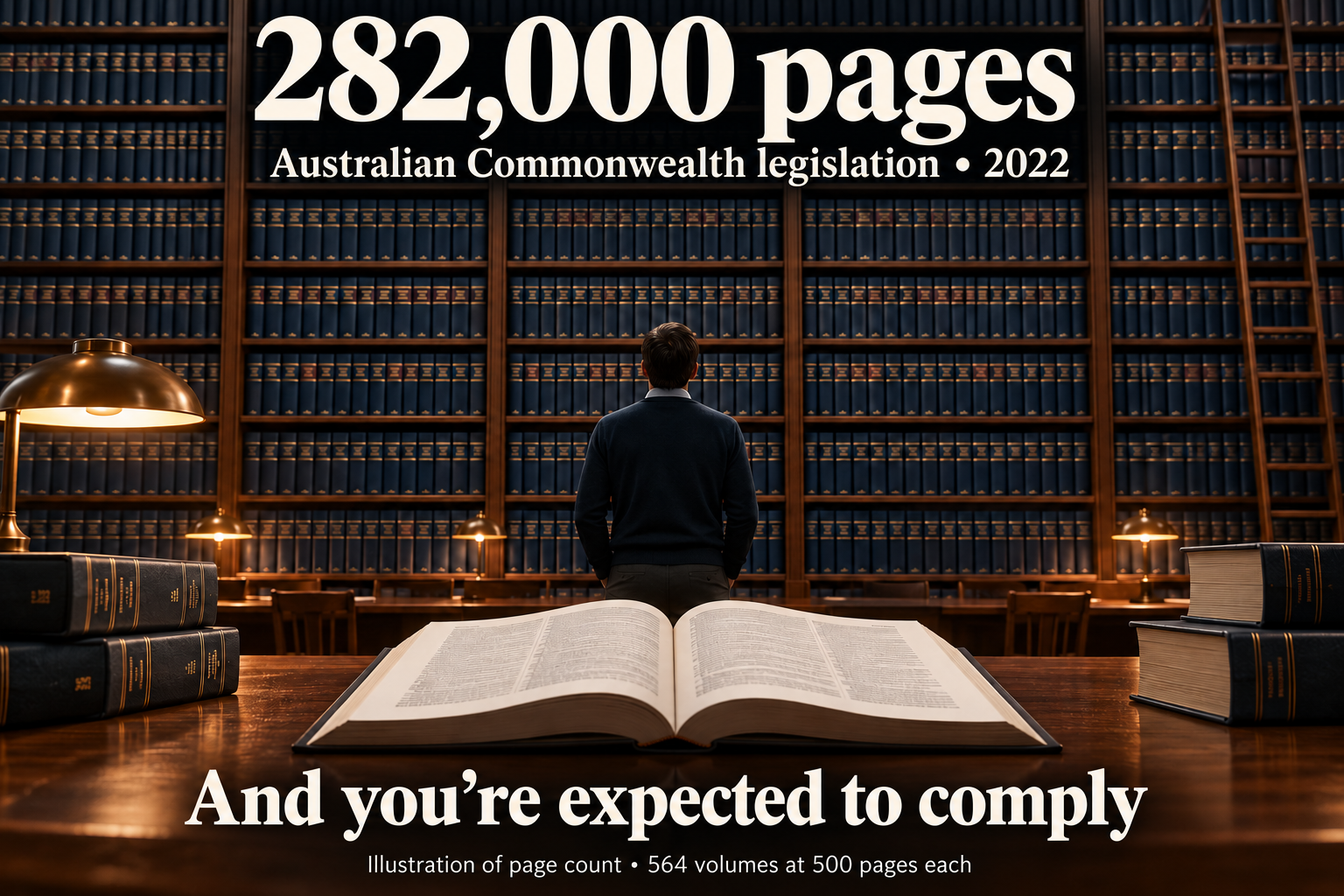
The ALRC figures are organised by parliamentary term. Separately, the Parliamentary Education Office states that usually 100 to 200 bills are introduced each year and approximately 90% are passed. The House of Representatives' annual series records 145 bills introduced and 140 assented to in 2024; 167 introduced and 121 assented to in 2023; and 169 introduced and 96 assented to in the 2022 election year. ALRC source Parliamentary Education Office source House of Representatives annual series
Historical volume source Corporations Act source Corporations and financial-services complexity source
Australia has nine legislative jurisdictions: the Commonwealth, six states and two self-governing territories. In 2016, the commercial LawOne research service reported that its national collection contained more than 65,000 legislative items across all nine jurisdictions. Its collection included current, amending, subordinate and repealed legislation as well as bills, explanatory memoranda and second-reading speeches, so 65,000 was a database-coverage figure rather than a count of legislation then in force. No authoritative aggregate page count or digital file-size measure covering the laws in force in all nine jurisdictions was identified. Source
The real economic cost of laws and regulations is a counterfactual: it depends on what households, businesses and institutions would have done if thousands of pages of regulations had not existed. That alternative is unknown and cannot be observed. Economy-wide figures are therefore modelled scenarios with very little confidence in their accuracy.
Studies of regulation generally use the term compliance costs for the time and money spent understanding, documenting and demonstrating conformity with legal requirements. These costs include paperwork, record keeping, reporting, applications, professional advice and changes to business processes. These visible costs omit regulation's unknown wider effects on business formation, entrepreneurship, investment, competition, innovation, productivity and economic progress. They also do not subtract any benefits produced by regulation.
The Senate Select Committee on Red Tape reported in 2018 that there was no comprehensive independent study of the productivity and economic effects of the Commonwealth Deregulation Agenda. It distinguished necessary regulation from red tape, which it described as the part of regulation that imposes an unnecessary burden. The committee also noted that direct compliance costs are easier to quantify than wider effects such as delayed or abandoned investment. Source
The Australian Government reported that more than 1,500 decisions implemented from September 2013 had produced an estimated $5.2 billion in net annual regulatory-cost reductions by 2017. A further approximately 190 reported decisions with estimated net savings of $710 million had not then been implemented. These figures were estimates made under the government's Regulatory Burden Measurement Framework; they measure changes in compliance costs attributed to specified decisions rather than the total effect of regulation on economic output. Source
Real GDP per capita measures inflation-adjusted economic output per person. The Australian Bureau of Statistics' chain-volume series shows that it increased from $59,714 in 1989–90 to $99,150 in 2024–25. This was an increase of 66.0% over 35 years, equivalent to compound growth of approximately 1.5% a year.
The average annual rate of increase slowed across these periods: approximately 2.2% from 1989–90 to 1999–2000, 1.6% from 1999–2000 to 2009–10, 1.1% from 2009–10 to 2018–19, and 0.6% from 2018–19 to 2024–25.
Real GDP per capita therefore declined for two consecutive financial years after reaching its highest level in the series in 2022–23. By 2024–25 it was 1.3% below that peak. Total real GDP nevertheless increased by 1.4% in both 2023–24 and 2024–25 because total output grew while output per person declined. The national-accounts series records these changes but does not assign them to regulation or to any other particular cause. ABS source
The conventional economy-wide measure is total taxation revenue as a percentage of GDP. Because GDP includes public expenditure, an alternative measure compares tax revenue with expenditure outside the public sector. The calculation used here is:
Adjusted tax burden = total taxation revenue / (GDP − general-government final consumption − public gross fixed capital formation).
This denominator approximates C + private I + X − M. Public gross fixed capital formation includes investment by general government and public corporations. The resulting percentage is an economy-wide ratio, not the effective tax rate faced by a particular household or business.
| Financial year | Tax / GDP | Government consumption and public investment / GDP | Tax / non-government expenditure | General-government net debt / GDP |
|---|---|---|---|---|
| 1968–69 | 21.8% | 21.6% | 27.8% | — |
| 1978–79 | 26.0% | 24.6% | 34.5% | — |
| 1988–89 | 29.6% | 23.7% | 38.7% | — |
| 1998–99 | 30.1% | 23.5% | 39.4% | 13.8% |
| 2000–01 | 31.9% | 22.7% | 41.3% | 6.0% |
| 2001–02 | 30.4% | 22.7% | 39.3% | 4.6% |
| 2007–08 | 29.5% | 23.1% | 38.3% | −6.4% |
| 2013–14 | 27.1% | 23.3% | 35.3% | 17.6% |
| 2015–16 | 27.9% | 24.5% | 37.0% | 23.4% |
| 2019–20 | 27.7% | 26.9% | 37.9% | 31.9% |
| 2020–21 | 28.4% | 27.4% | 39.1% | 37.7% |
| 2021–22 | 29.2% | 27.0% | 40.0% | 33.3% |
| 2022–23 | 29.3% | 26.4% | 39.8% | 30.4% |
| 2023–24 | 29.9% | 27.7% | 41.4% | 31.6% |
| 2024–25 | 30.2% | 28.8% | 42.4% | 34.4% |
The adjusted ratio increased from 27.8% in 1968–69 to 38.7% in 1988–89 and 42.4% in 2024–25. From 2015–16 to 2024–25 it increased by 5.4 percentage points, while tax revenue as a share of GDP increased by 2.3 percentage points. Over the same period, general-government consumption and public investment increased from 24.5% to 28.8% of GDP.
General-government net debt moved from −6.4% of GDP in 2007–08, when the financial assets counted in the measure exceeded its debt liabilities, to 17.6% in 2013–14 and 23.4% in 2015–16. It therefore increased by 29.8 percentage points of GDP between 2007–08 and 2015–16, before increasing by a further 11.0 percentage points to 34.4% in 2024–25.
The figures combine the ABS total-taxation series with current-price national-accounts series. Tax data through 1988–89 were recorded on a cash basis, while the 1998–99 and later figures use accrual accounting, creating a break in the historical tax series. The adjusted percentages are calculations from ABS data rather than a separately published ABS indicator. The debt column is the ABS all-Australia general-government net-debt measure, covering the Commonwealth, state and local levels. Net debt subtracts selected financial assets from debt liabilities; it is a stock measured at the end of each financial year, rather than expenditure during that year. Historical taxation source 2000–01 and 2001–02 taxation source Recent taxation source National accounts source Historical debt source Recent debt source
The following calculation represents a single Australian resident adult earning the ABS median weekly earnings of full-time employees, annualised over 52 weeks. It applies the resident income-tax schedule, the low-income tax offsets available at that income and the standard Medicare levy for the corresponding financial year. It assumes no dependants, deductions, HELP debt, private-health-insurance surcharge or other offsets.
| Financial year | Median full-time earnings | Income tax | Medicare levy | Modelled consumption tax | Combined tax / gross earnings |
|---|---|---|---|---|---|
| 1988–89 | $20,800 | $4,321 | $260 | $438 WST | 24.1% |
| 1998–99 | $31,200 | $6,630 | $468 | $651 WST | 24.8% |
| 2004–05 | $41,600 | $8,652 | $624 | $1,587 | 26.1% |
| 2008–09 | $51,769 | $9,202 | $777 | $2,052 | 23.2% |
| 2010–11 | $54,600 | $9,414 | $819 | $2,177 | 22.7% |
| 2013–14 | $59,904 | $10,914 | $899 | $2,361 | 23.7% |
| 2015–16 | $63,960 | $12,293 | $1,279 | $2,474 | 25.1% |
| 2018–19 | $69,784 | $13,179 | $1,396 | $2,710 | 24.8% |
| 2020–21 | $74,620 | $13,433 | $1,492 | $2,930 | 23.9% |
| 2024–25 | $88,400 | $17,308 | $1,768 | $3,403 | 25.4% |
For 2000–01 onward, the consumption-tax model assumes that the earner spends 90% of income remaining after income tax and the Medicare levy, and that 60% of that spending is on supplies subject to 10% GST. Because prices include GST, the GST component is one-eleventh of taxable spending. For 1988–89 and 1998–99, before the GST commenced, the model applies a 3% effective wholesale-sales-tax burden to 90% of income remaining after direct tax. Wholesale sales tax had multiple rates and exemptions and was imposed earlier in the supply chain, so this is a standardised effective rate rather than the statutory rate on every purchase. The model excludes excise, customs duties, stamp duty, council rates, taxes embedded in business costs other than the modelled WST, and compulsory superannuation.
On these assumptions, the combined rate was 24.1% in 1988–89, 24.8% in 1998–99 and 26.1% in 2004–05. It declined to 22.7% in 2010–11 and then ranged between 23.7% and 25.4% at the selected benchmarks through 2024–25. The 2018–19 and 2020–21 calculations include the low and middle income tax offset then available; the 2024–25 calculation applies the resident rates commencing on 1 July 2024. 2013 earnings source 2015 earnings source 2004–20 earnings table Recent and historical earnings source Historical income-tax schedules 2024–25 income-tax schedule Wholesale sales-tax source
Housing affordability cannot be represented by real GDP per capita. Measures relevant to a prospective buyer include the dwelling-price-to-income ratio, the deposit required, interest rates and mortgage repayments. For existing owners and renters, the share of household income spent on mortgage or rent payments is also relevant.
The Reserve Bank's historical series shows that dwelling-price-to-income ratios were comparatively stable in the early and mid-1980s, increased in the late 1980s, the 1990s and the early 2000s, and reached a record level in the series in 2017. The later income and dwelling-price figures show that prices again grew substantially faster than household income between 2011 and 2024. A deposit calculated as a fixed percentage of the purchase price rises with the dwelling price, irrespective of the interest rate subsequently charged on a mortgage. RBA long-term series RBA 1990s and 2003 comparison AIHW 2011–2024 comparison
The overall ownership rate remained between 67% and 70% from the early 1970s to 2021, while ownership fell markedly within younger age groups. The age-specific figures distinguish changes in access to ownership from the effect of an ageing population on the national total. AIHW source
Payment-to-income averages describe households that already have a mortgage or tenancy. They do not measure the dwelling price or deposit confronting a prospective first-home buyer, and the national averages combine households with different incomes, loan ages, locations and housing costs. ABS 1999–2000 to 2019–20 source ABS and HILDA 2003–2023 series
Australian Election Study surveys show that government employees gave a larger combined share of their first-preference votes to Labor and the Greens than those parties received nationally in the 2010, 2013 and 2016 federal elections:
The government-employee figures are self-reported votes from post-election sample surveys, whereas the national figures are the election results. The association was present in all three elections but narrowed across the period. It establishes that the government employees surveyed voted more heavily for Labor and the Greens; it does not by itself establish that public agencies acted with partisan bias. 2010 Australian Election Study analysis 2013 Australian Election Study analysis 2016 Australian Election Study analysis 2010 AEC results 2013 AEC results 2016 AEC results
Newman describes a draft proposal prepared within his former department for a Net Zero Economy Office. He says that the proposal comprised 50 pages and requested $49.9 million over four years. Approximately 30 pages supported proposed salaries accounting for about $27 million of the total. The section addressing the commercial work that the proposed centre of excellence would perform occupied less than half a page and contained no numerical measures. Newman also says that four or five groups across New South Wales government departments and agencies were working on hydrogen, while only one of those groups was speaking with customers and facilitating investment. The draft proposal is not publicly available, so these details are Newman's account of the document he reviewed. Interview at 35:05
The Australian Bureau of Statistics recorded 2,597,300 public-sector employee jobs in June 2025. Of these, 385,900 were Commonwealth government jobs, including defence personnel; 1,993,400 were state government jobs; and 218,000 were local government jobs. Source
Australia had 15,971,100 filled jobs in the June quarter of 2025. The 2,597,300 public-sector employee jobs recorded for June were equivalent to approximately 16.3% of that total. State governments accounted for 76.7% of public-sector jobs, the Commonwealth for 14.9%, and local governments for 8.4%. Source
Newman compares Australia's 2.6 million public-sector jobs and approximately $250 billion annual public-sector wage bill with Japan's approximately 3.4 million public employees. He describes the Japanese payroll as costing roughly the same amount and notes that Japan has approximately five times Australia's population. On that basis, he says Japan operates with approximately 40% as many public employees per resident as Australia. Interview at 5:48
The ABS recorded 2,597,300 Australian public-sector employee jobs in June 2025 and $249.5 billion in cash wages and salaries during 2024–25. Japan's National Personnel Authority recorded approximately 3.407 million public employees: 593,000 national and 2.814 million local employees. Japan therefore had approximately 31% more public employees, despite having approximately 4.5 times Australia's population. Australian source Japanese employment source Australian population source Japanese population source
Japan's Ministry of Finance uses a narrower workforce of 2.912 million when reporting its FY2025 personnel budget: 585,000 national and 2.327 million local public employees. It budgeted ¥5.5 trillion for national personnel and ¥21.0 trillion for local personnel, a combined ¥26.5 trillion. At the Reserve Bank of Australia's exchange rate of ¥94.42 per Australian dollar on 20 June 2025, this was equivalent to approximately A$280.7 billion. The Australian and Japanese totals are similar in scale, but they are not directly equivalent: Australia counts employee jobs and includes public corporations, while the Japanese employment and personnel-expense publications use different scopes. Japanese personnel-cost source Exchange-rate source
A chart published by The Economist in April 2025, using ILOSTAT data, placed Australia at the top of its international comparison with approximately 143 public-sector employees per 1,000 residents. This was equivalent to approximately 14.3% of the population and 29% of employed people. The observations used in the underlying international dataset were the latest available for each country and did not necessarily relate to the same year. Source
The ILO public-sector definition covers government institutions, enterprises at least 50% owned by the state, and government-controlled non-profit institutions. The ABS figure above counts employee jobs attributed to Commonwealth, state and local public-sector employers using Australian payroll and business-register data. The ILO figure counts employed people, while the ABS publication counts employee jobs; a person may hold more than one job. Differences in institutional classification, collection methods, reference periods and whether people or jobs are counted affect the comparison between the figures. ILO definition ABS methodology
For measuring how much employment depends on government expenditure, government-funded employment is a more useful definition than classification by ownership of the employer. It includes direct government employees and the share of jobs in private businesses and non-profit organisations financed through government contracts, grants and payments for services. Australia does not publish a comprehensive count on this basis. Direct public-sector employment is equivalent to approximately 18% of the labour force, while the broader ILO estimate is approximately 29% of employed people. A reasonable estimate of government-funded employment is therefore around 25% to 30% of employment, but this is not an official statistic.
In the 2024–25 financial year, government final consumption expenditure was $643.3 billion and public gross fixed capital formation was $157.8 billion, giving total public final expenditure of $801.1 billion. Household final consumption expenditure was $1.441 trillion and private gross fixed capital formation was $518.2 billion, giving total private final expenditure of $1.959 trillion. Public expenditure therefore represented approximately 29.0% of the $2.760 trillion combined domestic final expenditure represented by these categories. This expenditure share supports the plausibility of a government-funded employment estimate in the 25% to 30% range, but does not determine it: public and private expenditure can have different labour intensities, purchases can include imported goods, and transfer payments are recorded when their recipients spend them rather than as government final consumption. Source
For comparison, Statistics Norway recorded NOK 1.187 trillion of general-government final consumption and NOK 282.7 billion of general-government fixed investment in calendar 2024. These amounted to NOK 1.470 trillion, or approximately 31.7% of the NOK 4.634 trillion total formed by household and non-profit consumption, government consumption and gross fixed capital formation. Australia's comparable public share was approximately 29.0% in the 2024–25 financial year. The periods differ by six months, and the Norwegian investment figure covers general government rather than every government-owned corporation. The comparison shows a larger government share of domestic final expenditure in Norway, but a difference of approximately three percentage points rather than the much larger difference suggested by OECD general-government employment data. Source
Public-sector employee jobs increased by 82,000, or 3.3%, from June 2024 to June 2025. Source
Over the year to June 2025, private-sector filled jobs increased by 205,300 and public-sector filled jobs increased by 66,600. Public-sector jobs therefore accounted for approximately 24.5% of the combined increase. The three non-market industries—health care and social assistance, education and training, and public administration and safety—accounted for 62% of filled-job growth over the same year; these industries include both public- and private-sector jobs. Source
Victoria had 606,100 public-sector employee jobs in June 2024 and 616,900 in June 2025, an increase of 10,800 or 1.8%. Within that total, Victorian state-government jobs increased from 485,900 to 493,200, an increase of 7,300 or 1.5%. Source
Hong Kong after the Second World War is one of the closest historical examples of a lightly regulated market economy producing exceptional long-term growth. It was not an unregulated economy. Its government enforced property and contracts, administered a currency, owned the land, regulated particular industries, built infrastructure and operated large education, health and housing programs. Its economic policy nevertheless combined free trade, low and relatively simple taxation, unrestricted movement of capital and little government direction of private production or investment.
World Bank data show that Hong Kong's real GDP per person, expressed in constant 2015 US dollars, increased from $3,956 in 1961 to $6,783 in 1970, $12,553 in 1980, $21,357 in 1990 and $26,632 in 1997. The 1961–97 increase was a factor of 6.7, equivalent to compound growth of approximately 5.4% per person per year over 36 years. Source
A World Bank review reported that Hong Kong's real GDP expanded by approximately 12% per year from 1961 to 1965. It identified Hong Kong as one of the five fastest-growing developing economies of the period and reported that its real GDP per person had increased by approximately 140% to 150% since 1960 by the time of the study. In 1997, the final year of British administration, Hong Kong's real GDP grew by 5.3% and nominal GDP per person was approximately US$27,000. World Bank historical study 1997 source
Hong Kong developed as a free port and did not use tariffs or import quotas to protect domestic manufacturers. The government did not select industries for production subsidies or direct private capital through an industrial plan. Businesses decided what to produce and could move money into and out of the territory. Government expenditure and taxation remained low relative to most developed economies, and budgets were generally constrained by the objective of maintaining fiscal reserves and avoiding persistent deficits.
The approach became known as positive non-interventionism. The term did not mean that the government never intervened. It meant that intervention required a conscious justification, while officials ordinarily left production, prices and investment to businesses and consumers. Academic comparisons describe Hong Kong as following a laissez-faire approach while Singapore achieved comparable growth with extensive state ownership, directed investment and industrial policy. Hong Kong government explanation Hong Kong and Singapore comparison
The Hong Kong government owned almost all land and controlled the quantity and timing of land released under leases. Land premiums and lease revenue allowed the government to collect revenue while keeping conventional tax rates low, but made the state a major participant in the property market. Restrictions on the supply and use of land also contributed to land scarcity and high property costs.
The government began a large public-housing program in 1954. The public-estate population reached one million in 1965 and two million in 1981. In 1972 the government announced a ten-year program intended to provide improved housing for 1.8 million people. It also established the Home Ownership Scheme in 1976 to sell subsidised homes to lower- and middle-income households and public-housing tenants. Hong Kong Housing Authority history
Hong Kong therefore does not show how a market without government or regulation would perform. It provides evidence about a narrower institutional combination: secure property and contracts, open international trade, freely moving capital, low taxes and limited discretionary interference in private enterprise, alongside extensive government control of land and substantial public provision of housing and infrastructure. Its growth record can establish that this combination coincided with rapid development; it cannot isolate the effect of low economic regulation from migration, geography, access to international markets, institutional inheritance, education and capital accumulation.
There is no single measure of how much regulation a government imposes. Regulations differ enormously in length, scope, complexity, and effect. Researchers and governments therefore use several measures, each describing a different aspect of the regulatory system.
The Code of Federal Regulations (CFR) codifies the general and permanent rules issued by United States federal agencies. It is divided into 50 titles covering broad subject areas. In 2025 the United States government stated that the CFR contained more than 48,000 sections extending over 175,000 pages. The annual editions are published by the United States Government Publishing Office.
The Federal Register records the annual flow of material published by federal agencies. Its page count is often used to indicate the rate of federal regulatory activity. It includes final rules, however, alongside proposed rules, notices, corrections, and other material. It therefore does not measure either the number of regulations taking effect or the stock of regulations remaining in force. The Office of the Federal Register publishes annual page statistics. From 2014 through 2023, the Federal Register averaged 78,350 pages a year, documenting proposed and final regulatory changes, notices and other agency actions.
The RegData project analyses regulatory text and counts words and phrases associated with binding commands, including shall, must, may not, required, and prohibited. It reported approximately 1.13 million restrictions in United States federal regulations in 2025. RegData also estimates which industries are affected, allowing regulation to be compared across industries and over time.
Restriction counts are generally more informative than page counts because they attempt to count obligations and prohibitions rather than text. They remain a proxy: the occurrence of a restrictive term does not reveal the cost, importance, justification, or practical effect of the requirement.
The CFR, Federal Register, and federal RegData figures describe federal regulation only. Businesses and individuals are also subject to state regulations, local ordinances, licensing rules, zoning and land-use controls, building codes, and requirements imposed by other subnational authorities. These overlapping systems add further layers of regulation which are not included in the federal totals. Consequently, even the very large federal page and restriction counts understate the full body of government-imposed regulation operating across the United States.
This volume of regulation is excessive. Article VI: Laws, Section 5: Regulations is intended to reduce this complexity greatly. It permits regulation only where failure to comply would constitute harm or negligence rising to the level of violating the NAP, and requires every such regulation to be narrowly tailored to preventing that harm.
A commercial jet engine is a useful narrow example for examining regulation. Its compressor, combustor, turbine, nozzle, control systems, and supporting structures must work as an integrated system. Manufacturers balance thrust, fuel efficiency, weight, manufacturing cost, durability, maintainability, and reliability while protecting against fire, component failure, lightning, ice, hail, rain, dust, and bird ingestion.
Failure of a commercial jet engine can have dire consequences, most obviously for the passengers and flight crew. It is therefore exactly the kind of case in which government regulation might appear critical. At the same time, the consequences do not fall only on those aboard the aircraft. If an engine is shown to have been poorly designed or manufactured from a safety perspective, its manufacturer may face deaths and injuries attributed to its product, liability, loss of reputation and future sales, customer inspections, fleet groundings, and the cost of repairing or replacing engines already in service. Even without regulation, a jet-engine manufacturer therefore has exceptionally strong reasons to treat safety as essential.
In the United States, aircraft engines are type-certified principally under 14 CFR Part 33. The European Union uses the corresponding CS-E certification specifications. Other rules apply to installation of the engine in an aircraft, production, maintenance, and continued airworthiness.
These requirements generally establish safety outcomes and demonstrations rather than prescribe a complete engine design. They address matters including structural integrity, vibration, overspeed, rotor containment, fire, endurance, icing, rain and hail, bird ingestion, control-system failure, and hazardous effects following component failure. For example, bird-ingestion requirements prescribe bird masses, impact conditions, engine power, and acceptable consequences. They do not prescribe the geometry of the compressor, the material used for every blade, or the control logic by which the manufacturer achieves the required result.
Certification therefore samples particular points in a much larger design and operating space. A successful test does not demonstrate safety under every combination of age, manufacturing variation, maintenance condition, atmospheric conditions, impact location, electrical failure, software state, and simultaneous fault. Some requirements also permit loss of engine thrust provided that the failure does not produce a hazardous engine effect. Safety of the aircraft may depend on containment, redundancy, the remaining engine, aircraft systems, and crew response rather than on every engine continuing to operate after every event.
The evidence required for certification does not prove that the manufacturer would have designed a less safe engine without the rule. Establishing that causal claim requires comparison with a credible unregulated alternative.
Accidents followed by new regulations are not sufficient evidence. An accident before a requirement existed shows that the previous combination of engineering, knowledge, incentives, and voluntary standards did not prevent that particular failure. It does not show that industry would have left the problem unresolved, nor that the later rule caused the solution. Likewise, an accident involving a certified engine does not show what the outcome would have been without certification.
Bird-ingestion data show an association, but do not provide evidence that regulation caused the improvement. Following accidents and analysis of events in commercial service, the FAA progressively increased the severity and scope of its bird-ingestion requirements. The accidents and service evidence were available to manufacturers independently of the later regulations. A later FAA and industry study compared engines certified under successive amendments and found that engines certified under more recent requirements had a lower proportion of ingestion events resulting in power loss than engines certified under the earliest requirements. The report itself notes the limited period of service data. Newer engines also differ in technology, materials, manufacturing, maintenance, and accumulated industry knowledge. Because regulatory amendments and those other changes occurred together, the comparison does not identify which of them caused the improvement.
Causal evidence could come from a comparison with otherwise similar engines or manufacturers exposed to the same safety information but not to the regulatory requirement. It could also come from an engineer or manufacturer identifying a specific safety improvement which was made because of a regulation and which would not otherwise have been made. Such testimony would be stronger if supported by contemporaneous design records, cost decisions, or internal analysis. It would also need to distinguish an improvement to the engine's safety from additional testing or documentation performed only to demonstrate conformance.
There is direct evidence that manufacturers sometimes test beyond an applicable minimum. The CFM56-5B used on US Airways Flight 1549 passed its applicable bird-ingestion certification tests, and the manufacturer also performed additional testing required by the French authority. The actual encounter involved birds larger and more numerous than the certification standard. This is evidence that its testing exceeded the applicable FAA minimum. Because the additional testing was required by another government authority, it is not evidence of action beyond government regulation generally. FAA analysis of US Airways Flight 1549.
Before the TACA Flight 110 event, the CFM56 had demonstrated approximately four times the water quantity required by the certification rule. The test method nevertheless failed to reproduce the critical way in which hail and water could concentrate in the engine core. The large nominal margin did not cover the relevant physical condition. Manufacturer and industry investigation produced design changes and revised test methods. Manufacturers began using the revised standard from approximately 1989, whereas the corresponding rule was issued in 1998. FAA analysis of TACA Flight 110.
The nine-year interval is evidence that manufacturers responded without waiting for formal enactment. The FAA account does not establish when manufacturers first anticipated the revised certification requirement or when certification authorities began applying it informally. The interval therefore does not establish that the response was independent of regulatory influence. These examples show conduct beyond some formally applicable written requirements, but do not show that regulation had no effect on the design decisions.
For the proposed rain-and-hail ingestion requirements that became part of § 33.78, the FAA recorded historical industry estimates of incremental certification costs ranging from approximately $250,000 to more than $500,000 for a new engine model. One manufacturer estimated approximately $50,000 for a derivative engine. These figures are not estimates of the total cost of certifying an engine. The rule allowed multiple means of compliance, including analysis where appropriate, rather than requiring physical ingestion testing in every case. The FAA cost analysis attributes the estimated cost to compliance work such as engineering, analysis, test facilities, and physical testing. FAA inclement-weather rulemaking analysis.
For scale, the principal airplane rain-and-hail provision in § 33.78, together with the atmospheric specifications in Appendix B, accounts for only about 2% of Part 33 by word count.
In a separate production-certification rulemaking, industry participants objected to mandatory marking of individual parts on the ground that it would impose high costs without a verifiable safety benefit. The FAA revised its proposal to permit more flexible methods of identification. This does not measure the net overhead of engine certification, but it is a concrete example in which a proposed form of conformance was challenged for lacking a verifiable safety benefit and was changed before being imposed in that form. FAA production-certification rulemaking record.
A search of FAA engine-certification rulemaking records and aviation-safety reports from GAO, the Department of Transportation Inspector General, and NTSB found no analysis demonstrating that an existing jet-engine conformance requirement imposes costs without materially improving safety assurance.
In 1993, the United States General Accounting Office reported that manufacturers' commitment to safety and technical expertise had kept design-related safety problems to a minimum, while the FAA could not effectively oversee the certification process because its certification workforce had limited technical expertise, high turnover, and insufficient guidance, technical assistance, and training. GAO aircraft-certification review.
A 2005 GAO survey found that only about half of FAA safety inspectors believed, to a great or very great extent, that their technical knowledge was sufficient to perform their jobs properly. The corresponding estimate among aircraft-certification inspectors was 68%, with a 95% confidence interval from 51% to 85%. GAO technical-training review.
In 2020, GAO found that the FAA Office of Aviation Safety did not assess organisation-wide competency gaps among its inspectors and engineers on a recurring basis. GAO reported that this prevented the agency from obtaining an organisation-wide view of whether its workforce and training covered the competencies needed for safety oversight and new aviation technologies. GAO aviation-safety workforce review.
GAO has also reported that inconsistent interpretation was considered one of the most significant problems affecting aircraft certification. An FAA and industry committee identified unclear regulatory requirements and inadequate, nonstandard training in developing regulations, applying standards, and resolving disputes among the causes. GAO review of certification and approval processes.
The Department of Transportation Inspector General found that FAA guidance did not adequately address the integration of new technology into an existing aircraft model during certification of the Boeing 737 MAX. It also found that the FAA did not have a complete understanding of Boeing's MCAS safety assessments before the first accident and identified needs for additional expertise in systems engineering, human factors, and software. This finding concerns aircraft certification rather than jet-engine design, but demonstrates that the certification authority has not always possessed the knowledge or guidance needed to assess a manufacturer's technology. DOT Inspector General certification review.
There is also propulsion-specific evidence. Following US Airways Flight 1549, the National Transportation Safety Board concluded that the bird-ingestion certification requirements then in effect did not provide adequate safeguards against the ingestion threats faced by future large turbofan engines. NTSB accident report. More recently, GAO reported that representatives of electric-aircraft manufacturers and an aviation engineering firm encountered limited numbers of FAA staff with expertise in electric propulsion, limited standardisation in the certification process, and gaps in the standards applicable to novel engines. GAO electric-aircraft certification review.
These findings do not establish that every regulator lacks expertise or that every engine requirement is technically defective. They do provide independent evidence of insufficient specialist knowledge, outdated or incomplete guidance, unclear requirements, and inconsistent application within the institution responsible for certification.
The available evidence provides little basis for concluding either that regulation improves jet-engine safety beyond what manufacturers would otherwise achieve or that it has no safety benefit. Conformance costs are observable, while an incremental safety effect is not.
Resources in the physical world are scarce. Scarcity creates the possibility of conflict, because two or more people may wish to use the same resource at the same time. Property rights exist precisely to prevent and resolve such conflicts.
The constitution states:
- Because physical resources are scarce, conflicts may arise when individuals attempt mutually exclusive uses of the same resource. Property rights exist to prevent and resolve such conflicts.
- All rights are property rights.
- A property right is the right to exclude others from using a resource.
The idea of private property is ancient. It appears in the earliest human societies because it has always been the most effective mechanism for reducing conflict and enabling peaceful cooperation.
Accordingly, the constitution declares that all rights are, at their core, property rights. Private ownership of a physical object gives the right to exclude everyone else from using that object.
Philosophically, property rights can be justified through rational discourse without contradiction.
The constitution makes explicit that every person holds property rights in their own body: without exception or qualification. This foundational principle is stated unambiguously:
Every person has an inalienable property right in their own body.
Although this may appear self‑evident, history shows that many societies have denied individuals control over their own bodies. Even today, in some parts of the world, practices resembling slavery or forced labour still occur. The constitution therefore states the principle explicitly: self‑ownership is absolute and non‑negotiable. Because each individual owns their own body, they alone control their actions, labour, and choices. All further rights, including ownership of land, creation, production, and voluntary exchange, flow from this initial fact of self‑ownership.
The constitution specifies the categories of things that may be owned:
Individuals may hold property rights over:
- Physical objects
- Digital keys, currency, or tokens stored in computing systems that enforce mutual exclusion
- Areas of land defined by clear boundaries
Ownership extends to physical objects, defined areas of land, and digital assets that enforce secure, mutually exclusive control. Importantly, this does not include ordinary data. Information that does not itself implement mutual exclusion, such as text, images, documents, databases, or creative works, is not property in the constitutional sense. Data can be copied without depriving anyone else of its use, and therefore does not meet the scarcity requirement that underlies all property rights.
Access to data may be controlled through hardware, encryption, authentication, or through voluntary agreements between individuals. However, these mechanisms do not convert the data itself into property. They merely regulate who may read or use the information. Only digital artefacts that inherently enforce exclusive control, such as private cryptographic keys or tokens, qualify as property.
The constitution recognises only three legitimate methods of acquiring property:
Legitimate acquisition of property rights occurs through:
- Homesteading: first use of an unowned resource in the commons
- Production: creating new goods by transforming owned resources
- Voluntary transfer: receiving property by consent (e.g., trade, gift, inheritance)
Production creates new property only when the inputs used in the production process are themselves legitimately owned. Transforming resources that belong to someone else, or that remain unowned in the commons, does not grant ownership of the resulting product. One cannot acquire property rights in an output unless one already holds property rights in the inputs that were transformed to create it.
This principle ensures that production does not become a backdoor method of appropriating the property of others or claiming unowned resources without homesteading them. All legitimate ownership therefore traces back to homesteading, production using owned inputs, or voluntary transfer.
Land cannot be claimed by decree alone; it must be used:
A resource in the commons cannot be claimed merely by decree; it must be appropriated through actual use.
This requirement rules out attempts to seize large areas by symbolic gestures alone. For example, a person cannot mark the boundary of an extensive region with posts, fences, flags, or signs and thereby assert ownership without actually putting the land to productive use. Mere declaration, surveying, or boundary‑marking does not establish a property right. Only genuine, ongoing use of the resource, use that would be recognisable to others as appropriation, can remove it from the commons.
This principle ensures that no one may monopolise vast unused areas, obstruct access to unowned land, or prevent others from homesteading resources they are willing to use. Property rights arise from use, not from assertion.
Ownership cannot be exercised in a way that blocks access to unowned areas:
Homesteading that blocks access between resources not owned by the homesteader (e.g., claiming “donut‑shaped” land) is prohibited.
Ownership cannot be exercised in a way that blocks access to unowned areas:
Homesteading that blocks access between resources not owned by the homesteader (e.g., claiming “donut‑shaped” land) is prohibited.
This principle implies that easements may arise as a matter of necessity. If a person’s homesteading would otherwise isolate or cut off access to land that remains in the commons, the law recognises a right of passage across the homesteaded land to reach the unowned area. Such an easement is not a separate property right created by decree; it is a limitation on the scope of the homesteader’s claim, ensuring that no one may use their ownership to monopolise or obstruct access to resources they have not themselves appropriated.
When property is abandoned, it returns to the commons and becomes available for homesteading once again.
Abandoned property returns to the commons and may be homesteaded by others.
The constitution establishes the principle that abandoned property does not remain indefinitely under someone’s exclusive control. However, determining whether property has in fact been abandoned requires clear, objective criteria. The constitution therefore leaves the precise tests and evidentiary standards for abandonment to the rule of law. These rules must be applied consistently and without discretion, ensuring that property is not deemed abandoned merely because it is unused, nor retained indefinitely when the owner has clearly relinquished all claim to it.
Once property is formally recognised as abandoned under these legal standards, it re-enters the commons and becomes available for homesteading by anyone who puts it to actual use.
Property rights persist after death to honour agreements and personal wishes.
Property rights may continue after death to respect mortal remains and uphold agreements such as wills, life insurance, or business contracts.
Although a person can no longer exercise control over their property after death, the effects of their choices do not disappear. Many agreements, such as wills, insurance policies, long‑term contracts, or business arrangements, depend on the assumption that a person’s property rights do not vanish the moment they die. If death automatically extinguished all rights, these agreements would collapse, and others would be harmed despite having acted in good faith.
For this reason, the constitution recognises that certain property rights continue beyond death. These post‑mortem rights are not new rights created for the deceased; rather, they are the continuation of obligations and permissions that were valid while the person was alive. They ensure that the deceased’s property is transferred, distributed, or protected according to their voluntary decisions.
This principle also protects the dignity of mortal remains. A person’s body does not become an unowned resource upon death. The right to determine how their remains are treated, whether through burial, cremation, donation, or other instructions, continues to be respected.
Once all obligations have been fulfilled and no valid claims remain, any unclaimed or abandoned property returns to the commons and may be homesteaded by others.
An agreement is not itself property. It is not a physical object, nor a body, nor a scarce resource that can be exclusively controlled. Therefore, it cannot be property in the literal sense. One cannot “own” an agreement in the way one owns a house or one’s own body.
However, agreements generate property rights. When individuals voluntarily commit to terms, they create new rights and duties that attach to their existing property. Examples include:
These are property‑relevant claims, not property objects. Agreements do not constitute property, but they structure how property may be used, transferred, or accessed.
The constitutional framework for property rights presented here is closely aligned with the tradition developed by Rothbard, Hoppe, and Kinsella. All three emphasise that property rights arise from the need to allocate control over scarce resources in a way that prevents conflict. This constitution adopts the same foundational structure.
Like Rothbard, the constitution begins with the principle of self‑ownership: each person has an exclusive property right in their own body. From this starting point, external property rights are acquired only through homesteading, production using owned inputs, or voluntary transfer. These are the same mechanisms recognised in the classical libertarian treatment of property.
Following Hoppe, the constitution grounds property rights in the logic of conflict avoidance. Scarcity makes conflict possible; property rights resolve it by assigning exclusive control. The prohibition on claiming unused land by mere declaration, and the requirement that homesteading must involve actual use, reflect this same argumentation‑ethics foundation.
The treatment of information mirrors the analysis developed by Kinsella. Because information is non‑scarce and can be copied without depriving others of its use, it cannot be property in the constitutional sense. Only digital artefacts that enforce mutual exclusion, such as private cryptographic keys or tokens, qualify as property. This maintains a strict scarcity‑based ontology and avoids the contradictions associated with intellectual property.
Thus, while the constitution is written independently and in a formal legal style, its structure and principles are consistent with the property‑rights framework articulated by Rothbard, Hoppe, and Kinsella. It adopts their core insights while expressing them in a precise, rule‑based constitutional form.
The constitution states:
There shall be no property rights over creations of the mind, as they are non‑scarce and do not inherently give rise to conflicts. Intellectual property rights such as trademarks, patents, or copyrights shall not exist.
Under this constitution, intellectual property does not exist. There are no patents, no copyrights, and no trademarks. Ideas are non‑scarce: one person’s use of an idea does not prevent anyone else from using it. Because ideas can be copied without depriving others of their use, they do not create the kind of conflicts that property rights are designed to resolve.
Traditional IP laws grant artificial monopolies to creators and inventors. That’s their purpose. In a genuinely competitive market, such monopolies wouldn’t exist. New ideas could be copied, improved, and reused immediately, accelerating innovation rather than slowing it. In practice, IP protections are frequently used by powerful corporations to suppress competition, entrench incumbents, and extract rents, turning IP into a tool of crony capitalism rather than a mechanism for public benefit.
This constitution adopts a different approach. Cultural, scientific, and engineering projects are financed before the intellectual output is created. Funding may come from crowdfunding or from tax‑funded public services, allowing society to support valuable work without granting monopolies over the resulting ideas.
Examples of initiatives that may be funded include:
Because anyone may propose an initiative, and because tax revenue represents a significant share of GDP, trillions of dollars in the case of the United States, this system is expected to unleash an unprecedented level of creativity and innovation. Without artificial monopolies, ideas can circulate freely, competition can flourish, and the benefits of new knowledge can be shared by all.
The main justification for IP protection is that it benefits society as a whole by promoting innovation and creativity.
The relationship between cronyism and intellectual property (IP) rights is a subject of significant debate. While IP is designed to promote innovation, critics argue that the system can be manipulated by powerful corporate interests to create a form of crony capitalism that stifles competition and harms the public interest.
How cronyism can manifest in IP:
There are substantial disadvantages to IP protection, and it is claimed these outweigh the purported benefits. The justification for this claim hinges on an explanation of how cultural, scientific and engineering projects with substantial innovation and creativity would be financed in a society where the IP is not protected.
Under the constitution these are financed before rather than after the IP is generated. This can be achieved with crowdfunding or using tax funded public services. For example there can be public services for developing a new:
The fact that anyone can write an initiative, together with the fact that (depending on the tax rate) a reasonable percentage of GDP is available to fund them, it is expected there will be an explosion of creativity and innovation under the constitution.
Note that there can easily be funding for projects costing billions of dollars.
The removal of intellectual property does not slow innovation; it accelerates it. Patents and copyrights restrict the use of ideas by granting exclusive control to a single party. This slows the spread of knowledge, delays follow‑on improvements, and raises the cost of entry for new innovators. When these monopolies are removed, ideas circulate freely, and innovation becomes faster, cheaper, and more collaborative.
In a no‑patent environment, every new discovery or design becomes available to all producers immediately. Competitors can build upon each other’s work without waiting decades for legal restrictions to expire. Incremental improvements, alternative designs, and new applications emerge far more rapidly. Innovation becomes cumulative rather than sequential, with many independent contributors advancing the state of the art at the same time.
The pharmaceutical industry provides a clear illustration. Under patent protection, only the patent holder may manufacture a new drug, even if others could produce it more efficiently or improve its formulation. Without patents, any capable manufacturer may produce the drug immediately, and any researcher may refine or extend the underlying science. Competition drives rapid improvements in manufacturing processes, delivery mechanisms, and therapeutic effectiveness. The pace of medical progress increases, not decreases.
The same dynamic applies to software, engineering, entertainment, and scientific research. When ideas are not locked behind legal barriers, developers can reuse existing components, artists can build upon prior works, and scientists can replicate and extend experiments without restriction. The cost of innovation falls dramatically because innovators no longer need to license ideas, navigate patent thickets, or fear litigation. Resources that would have been spent on legal compliance and defensive patenting are instead directed toward productive research and development.
By eliminating artificial monopolies, the constitution creates an environment in which innovation is driven by competition, collaboration, and open access to knowledge. The result is a faster rate of technological progress, broader participation in creative and scientific work, and a more dynamic and responsive innovation ecosystem.
The abolition of intellectual property has profound consequences for consumers. When ideas, designs, and creative works are not subject to artificial monopolies, the cost of accessing them falls dramatically. Because information is non‑scarce and can be copied without depriving anyone else of its use, the natural price of cultural and scientific output in a competitive market is effectively zero.
This means that every film, television series, book, song, or computer game ever produced would be freely available to everyone. Even the latest blockbuster movie, released moments ago, could be copied and shared at no cost. The same applies to software, educational materials, scientific papers, and engineering designs. Consumers gain immediate, universal access to the full library of human creativity and knowledge.
The effect is equally dramatic in pharmaceuticals and medical technology. Patents currently allow manufacturers to charge monopoly prices for medicines, often many times higher than the cost of production. Without patents, any capable manufacturer may produce a drug as soon as it is developed. Entry and competition place downward pressure on prices and margins. In practice, this means that medicines which today cost hundreds or thousands of dollars per dose would fall in price by orders of magnitude, becoming affordable to all.
The combined impact on consumers is transformative. Cultural works become universally accessible, education becomes radically cheaper, and life‑saving medicines become widely affordable. The removal of intellectual property eliminates artificial scarcity, unleashes competition, and ensures that the benefits of human creativity and scientific progress are shared by everyone.
Cultural Benefits:
Innovation Benefits:
The best empirical proxy for a “no‑patent world” is what happens when patents expire. That’s the moment when monopoly protection ends and competition becomes legally possible.
The evidence is extremely consistent: Prices fall sharply when patents expire. When a drug loses patent protection and generics enter, competition drives prices down.
The literature overwhelmingly finds that patents, not production costs, are the primary driver of high pharmaceutical prices. The following studies show that when patents expire and generics enter, prices fall dramatically typically 80–95%:
This is the closest real‑world analogue to the proposed system: No monopoly → many producers → prices collapse.
The more competitors, the lower the price. The magnitude of the price drop depends on how many firms enter the market. More competitors mean faster and deeper price reductions. In a world with no patents at all, entry would be immediate and global, so competition would be even stronger.
Patents keep prices high by blocking competition. Patents give drug companies the legal right to exclude competitors, allowing them to set high prices. Misuse of patents, such as filing dozens of overlapping patents to extend exclusivity, keeps prices high for decades.
Without patents, entry and competition would tend to reduce prices and margins. Pharmaceutical manufacturing costs are often tiny compared to monopoly prices. Examples in the real world: A pill that costs $1 to manufacture may sell for $100 under patent protection. After patent expiry, generics often sell for a few dollars. Competition gives producers reason to reduce prices and production costs.
Even pro‑patent sources acknowledge that patents allow companies to charge premium prices during exclusivity. They simply argue that this is necessary for R&D, but the price effect is not disputed.
So what happens in a system where patents are removed entirely? That means immediate competition from any capable manufacturer. No monopoly pricing window, no evergreening, no patent thickets, and no regulatory barriers tied to IP.
The result is straightforward: Drug prices would fall dramatically, likely by 80–95%, and remain low permanently. This is not speculation; it is exactly what happens every time a drug loses patent protection in the real world.
Creativity can thrive in a system without copyright.
Art as a Public Service: Citizens can propose initiatives to fund cultural services, e.g., film production, publishing, music creation. These initiatives become service contracts with private operators (studios, publishers, collectives) who produce works under profit-and-loss discipline. Funding comes from voluntary tax allocations, just like for other services.
Citizen-Driven Demand: People value movies, books, and music, so they allocate part of their consumption tax to cultural services. The more popular a service, the more funding it receives. This ensures art is created in line with what society actually wants, rather than what monopolies or gatekeepers decide.
Open Access Model: Since copyright doesn’t exist, works are non-scarce and freely shareable. Artists are compensated through the tax-funded service contract, not through exclusive rights. This means creators are paid upfront or through ongoing support, while audiences enjoy unrestricted access.
Competition Among Operators: Different operators (film studios, publishing houses, art collectives) compete for citizen allocations. Those who produce higher-quality or more appealing works attract more funding. This mirrors the free market, but without copyright monopolies.
Consequences: More art, more accessible: Works are freely available to everyone, reducing barriers to culture. Reduced litigation: No copyright disputes or piracy issues. Citizen-driven priorities: Funding flows to the kinds of art people want most. Stable income for creators: Artists are paid through service contracts rather than uncertain royalties.
Art thrives because creators are funded upfront through tax-supported service contracts, while audiences enjoy unrestricted access. The incentive shifts from restricting access to delivering value that citizens want to support.
In today’s copyright system: A studio invests millions to produce a film. It relies on copyright to prevent duplication and piracy. Revenue comes from ticket sales, streaming rights, and merchandise, all protected by exclusive rights. If piracy spreads, profits collapse, so the studio spends heavily on enforcement.
Under the constitution: Citizens propose a Film Production Service initiative. If enough people value new movies, they allocate part of their consumption tax to this service. The operator (a studio) receives funding directly from tax allocations, based on popularity and citizen ratings. The movie is released freely. Anyone can watch, share, or remix it. The studio earns revenue through the service contract, not through restricting access. Competition arises: studios must produce films people actually want, or they lose funding.
Artists have more say because funding bypasses publishers and flows directly from citizens. Publishers can no longer dictate terms through copyright monopolies or advertising. they must compete to support artists rather than control them.
In today's system publishers decide what gets produced, often prioritizing marketability, profit, or risk avoidance. Artists must conform to publisher demands to get funding and distribution.
Under the constitution: Citizens directly fund art through tax allocations. Publishers become facilitators, not gatekeepers. Artists have more freedom to pursue their vision, knowing their audience can support them directly.
Artists gain autonomy: They can create based on their vision and audience demand, not publisher mandates. Publishers lose control: They shift from gatekeepers to service providers, competing to support artists effectively. Citizens shape culture: Funding flows to the art people value most, ensuring cultural output reflects society’s preferences.
Funding Comes Directly From Citizens, Not Publishers. Under the constitution, artists are funded through tax allocations to cultural public services. Citizens decide which services (and therefore which artists) receive funding. This bypasses publishers as gatekeepers. Artists don’t need to convince a publisher to invest; they need to convince the public their work is valuable.
No Copyright Monopoly Publishers today rely on copyright to control distribution and profits. Without copyright, publishers lose their monopoly power over works. Artists are paid through service contracts, so they don’t depend on publishers to enforce exclusivity.
Profit-and-Loss Discipline Applies to Operators. Operators (publishers, studios, collectives) succeed only if citizens allocate tax to them. If publishers try to dictate content that doesn’t resonate, citizens can redirect funding to other operators or directly to artists. This forces publishers to follow artistic demand rather than control it.
Direct Democracy in Culture. Citizens vote and allocate tax continuously. If an artist’s vision is popular, funding flows to them regardless of publisher preferences. This democratizes cultural production, giving artists more autonomy.
Reduced Dependence on Commercial Advertising. Since funding comes from tax allocations, artists don’t need to tailor content to advertisers or publishers seeking profit margins. They can focus on producing art that resonates with audiences.
The constitution states:
Voluntary agreements that restrict the disclosure or use of information, such as non‑disclosure agreements (NDAs), are valid and enforceable, provided they do not impose obligations on non‑parties.
Tax-funded public services allow research to thrive even without IP protection because:
The following is a proposal for dealing with the issue of illicit drugs.
It is legal to possess drugs and to use them (while not being a public nuisance). This is important for helping people that have a drug addiction, so they can get help, without fear of being criminalised. People with a drug addiction are mostly victims of the illicit drug industry. Addiction may not be curable, but effective treatment can reduce dependence and harm.
Making drugs legal to possess and use presupposes that adequate treatment services, including sufficient capacity, are already in place.
Public consumption, intoxicated behaviour, unsafe disposal of needles and drug-related disorder are all illegal.

If illicit drugs were legal and easy to obtain, some people would try them to cope with difficult times, such as depression. Different drugs present very different risks. Some are extremely addictive, some are particularly likely to cause overdose, and others are less dangerous. The restrictions and treatment must reflect the nature of each drug.
Making illicit drugs legal to sell would allow the unrestricted sale of potentially hazardous products. Individual freedom stops where that individual harms others. It makes sense to restrict the sale of products capable of causing addiction, overdose or other serious harm.
There is a black market for the supply of drugs, driven by high street prices and high demand, and this provides tremendous funding for criminal activity.

Using law enforcement such as the DEA (the Drug Enforcement Administration) to try to stamp out drug trafficking is difficult, dangerous and expensive. Mexico has recorded more than 463,000 homicides since declaring war on the drug cartels in 2006. Not all of those deaths can be attributed directly to the drug war, but the scale of violence is staggering. By early 2026, more than 130,000 people were also officially registered as missing. Source.

Although drugs are illegal to sell in the free market, consider that public health system services exist that make drugs available to addicted drug users for free, but subject to acceptance of medical treatment. People who are not addicted are turned away. Addicted patients do not need to be ready to reduce their consumption immediately: treatment may begin by stabilising them and reducing harm until they are ready.
Whether consumption must be supervised depends on the nature of the drug. Heroin, for example, is consumed under medical supervision.

Performance of these public services is based on how well they reduce each patient's drug use. It is important that these public services are funded with tax on the basis of positive outcomes—that is, using quantifiable measures of how much they are reducing drug use in each individual. Independent third-party monitoring verifies the outcomes while protecting medical privacy. Medical personnel must also be incentivised to achieve successful outcomes, particularly the actual reduction of drug use. The drugs must be manufactured to strict pharmaceutical quality and safety standards. Within those standards, the operator profits by producing them efficiently. The operator is incentivised to use the free drugs to bring in people with an addiction, stabilise them and reduce their dependence when medically appropriate.
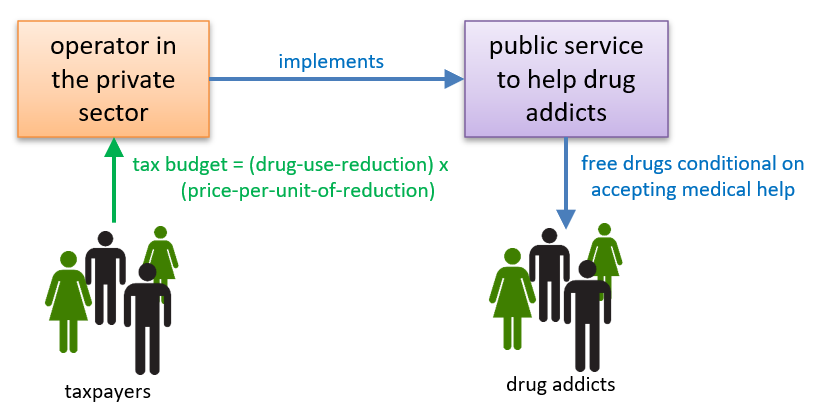
By meeting much of the demand from people with an addiction, these services can undercut part of the illegal market, reduce street prices and deprive drug cartels of revenue. They will not eliminate trafficking, because demand outside the treatment system remains, but they can reduce its scale and profitability.
 |
 |
 |
 |
In cases where a fine is payable, the existence of the UBI makes it easy to automatically take money from one person and distribute it to others (to the victim(s) or perhaps to everyone in the nation).
For example, if someone is fined $10000 then it doesn't matter whether they currently have that money available, rather the fine can be automatically taken from future UBI payments.
This won't be sufficient for very large fines on rich people. Another option is to automatically take money directly from their bank accounts or take money (in addition to tax) as they make purchases.

The judiciary is the system that adjudicates legal disputes/disagreements and interprets, defends, and applies the law in legal cases.
Arbitration over cases is a service provided by the private sector. Judges compete in a free market and are subject to online feedback. Feedback is quantified so it is possible to rank the judges by how well they do.
Anyone can apply to be a judge. Judges are tested regularly on random samples of the test cases to prove they can adjudicate the law correctly. Test results are public. Judges are registered and deregistered through voluntary direct democracy.
Assuming that the state's laws and services are constrained by the NAP and NDP and governed through direct democracy, it is credible that people could have sufficient trust in the state to permit radical forms of surveillance, provided that surveillance is used only for the good of the people. Its purposes would include enabling a fast response to people in trouble, detecting crimes and identifying their perpetrators, and protecting people from false accusations by providing evidence that they were not involved in a crime.
Such surveillance could be radical in its scope. Possibilities could include extremely high-resolution video surveillance throughout cities and even suburban areas, surgically implanted devices for identification, health monitoring and GPS tracking, and GPS tracking of vehicles.
Radical surveillance could enable a radical reduction in crime if potential perpetrators expect that being identified and held responsible is virtually inevitable. This deterrent does not depend on a rapid response: the expectation that evidence will establish responsibility afterwards could be enough to deter an offence. Combined video, location, and other evidence could make crimes that previously appeared easy to commit without consequence appear impossible to get away with. A reduction on this scale could transform everyday life: people could have less need to lock their vehicles and homes, install defensive barriers and alarm systems, or pay for private security. The benefit would extend beyond fewer losses to greater freedom from fear and less time and money spent protecting people and possessions. The extent of that transformation would depend on the effectiveness of the evidence in establishing responsibility and the enforcement of the law.
Health monitoring combined with rapid assistance could also save lives. Where monitoring can reliably detect signs of a medical emergency, such as a heart attack, stroke, or seizure, it could alert emergency services and provide the person's location even if they are alone, unconscious, or unable to call for help. In this setting, rapid response is a distinct benefit: it could bring assistance sooner and reduce the chance that a person in trouble goes unnoticed.
Location tracking and distress alerts could also help protect people travelling in remote areas, including those exploring wilderness or boating offshore. Where communications are available, a transmitted location could guide rescuers to someone who is lost, injured, stranded, or unable to return safely. Even if contact is lost, a recorded route and last known position could help narrow the search area. These services could make it easier to seek help and reduce the difficulty of finding people far from ordinary assistance.
Article XIII: Public services, Section 5: Privacy of the Constitution helps protect people whose information is collected through surveillance. It restricts both public and private disclosure without consent to the cases specified in that Section, including controlled access required to operate, secure, or independently audit a service. Collecting information for a public service does not give its operator permission to sell it to an advertiser, pass it to an insurer, or let staff use it for personal purposes. Access is limited to identified duties, and service contracts must provide independently verifiable safeguards and procedures for investigating and remedying breaches. These obligations continue when an operator is replaced, giving people constitutional protection beyond an assurance that surveillance will be used for their benefit.
Under this constitution, the private sector is regulated only by the rule of law derived from the Non‑Aggression Principle. This ensures a truly free market for labor, goods, and services.
The state cannot interfere with the free market or manipulate the economy.
As Milton Friedman said: A free market is all about freedom from coercion. There is only joint action where people have been persuaded to act together. A free market is great because it is based on voluntary cooperation. The free market has the enormous virtue of achieving voluntary cooperation without conformity. Everyone can do their own thing.
Consumers are free to purchase any products they like, from anyone they like. Likewise, producers are free to produce any good or service they like, sell it to anyone they like, for any price that they like. The state cannot impose price controls, such as rent caps. The private sector is free to compete directly with public services offered by the state.
Workers are free to choose who they work for. Likewise, employers can employ who they like and offer as much pay as they like. There are no diversity, equity, and inclusion mandates, and no anti‑discrimination laws imposed on businesses The state cannot enforce minimum wages. Worker entitlements such as for leave are part of voluntary contracts. There are no regulations that mandate entitlements.
Producers are free to organize however they wish. There are no antitrust laws. Companies may merge, split, form cartels, fix prices, hike prices when there is increased demand, or lower prices to drive out competitors.
The state cannot interfere with labor unions or worker cooperatives. Workers are free to form collectives, to strike, and to exercise power over companies. Membership in unions remains voluntary, consistent with the NAP.
Finally, the state cannot impose fees on producers: no registration fees, no license fees, and no income taxes.
The monetary system is implemented through a public service called the Central Bank. It records money electronically in a single fiat currency, as non‑negative balances on accounts. This currency exists only as account balances in the Central Bank. Each balance represents money owned by the customer who holds that account: money that is free from debt. This is very different from deposit accounts in today's commercial banks, which record amounts owed by the bank to its creditors.
For convenience, the constitution calls the single, indivisible currency unit the Rune. Central Bank currency should be represented as integers: account balances and transfers contain whole numbers of Runes rather than binary floating-point or indefinitely precise decimal quantities. Integer accounting makes conservation exact: every unit debited from one account is credited to another, without currency appearing or disappearing through numerical approximation.
Account balances and transfer amounts would probably be recorded as 64-bit integers. One Rune would initially be of the order of one-thousandth of a US dollar, giving the currency high resolution for small payments and calculations. This indicates the intended scale of the unit, not a fixed exchange rate.
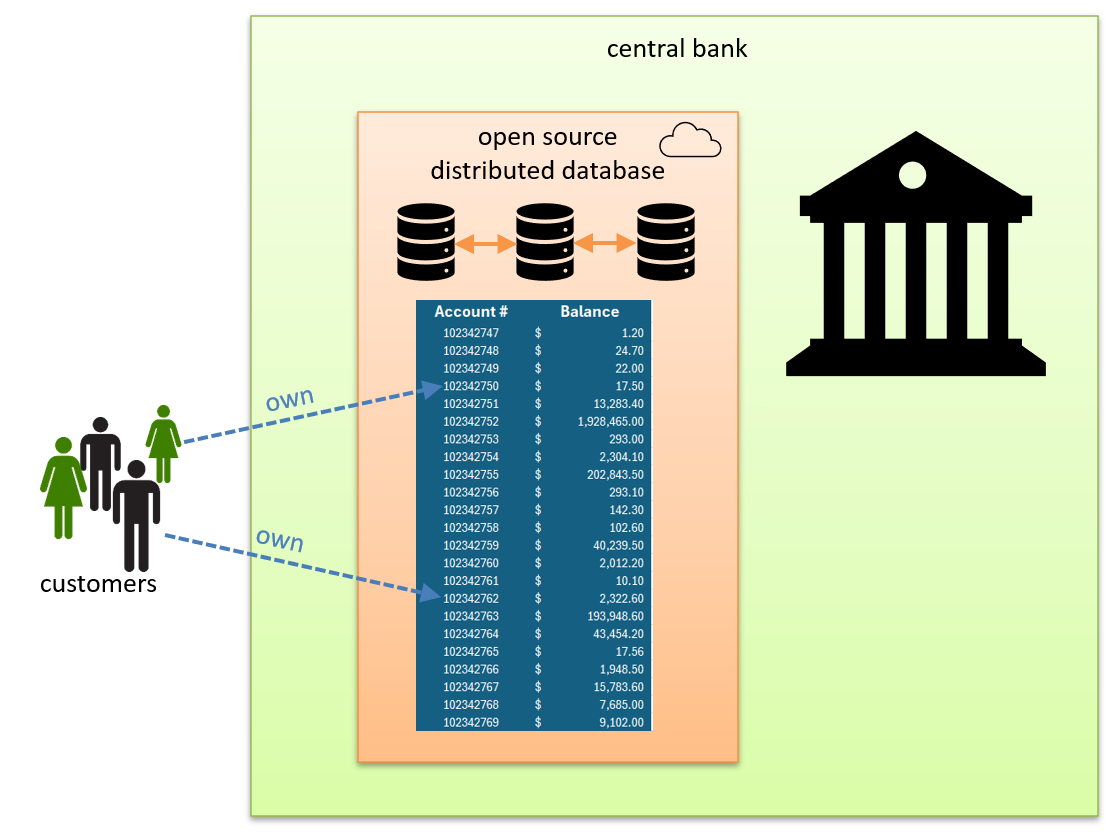
Central Bank currency has a floating exchange rate with every other currency. This includes foreign currencies, currencies issued by other States, privately issued currencies, commercial-bank liabilities, commodity money, and any legacy currency that continues to circulate. There is no official parity, peg, fixed conversion rate, or promise that one Central Bank currency unit can be redeemed for a specified amount of anything else.
People may exchange Central Bank currency and other currencies voluntarily at rates acceptable to them. Those rates reflect changing supply, demand, confidence, convenience, risk, and expectations. The Central Bank does not buy or sell currencies, hold foreign-exchange reserves, create currency to defend a rate, or require private parties to exchange different currencies at a legally prescribed value.
The conserved number of Central Bank currency units therefore does not guarantee a fixed purchasing power or foreign-exchange value. Its value can rise or fall relative to goods, services, and other currencies. What the constitution guarantees is the integrity of the unit: its supply cannot be debased, a valid balance is not another institution's debt, and every transfer conserves the total number of units.
Because the fiat currency is defined as what is held in Central Bank accounts, it cannot be withdrawn from the Central Bank itself. That means there is no need for reserves, and no possibility of a run on Central Bank currency. Account holders already own final currency and do not need to redeem it from an issuer. Runs on private bank liabilities remain possible, but they cannot remove currency from other people's Central Bank accounts or disable the Central Bank Payment System. Everyone is assumed to have an account with the Central Bank, and money can move freely between accounts, allowing anyone to make payments to anyone else. The Central Bank does not own money. It cannot borrow or lend. It cannot go bankrupt, and it cannot lose the money of its customers.
Even though the currency is recorded electronically, it behaves in some respects like money based on a physical commodity such as gold or silver which can be owned and exchanged. Just as you cannot possess a negative amount of gold, account balances cannot be negative. Just as you cannot give someone a negative amount of gold, negative transfers between accounts are impossible. Just as gold cannot be created or destroyed, customers cannot cause the currency to be created or destroyed. Transactions always involve moving a positive amount of money from a sender account to a receiver account, and must be authorised by the sender, and there must be funds available in the sender account, so it does not go negative. Money cannot be created or destroyed.

The Central Bank is available to all citizens for free. Accounts have no fees, no interest, and cannot be frozen. Everyone is free to move any amount of money from any account they own to any other account.
The Central Bank enables everyday commerce. Citizens can make payments with debit cards and point‑of‑sale devices. They can view their transaction history and make payments online. Because these systems are not run by commercial banks, failures in the private banking sector do not affect them.

The Central Bank operates under deterministic mechanical rules mandated by the constitution. Its purpose is to protect privacy, freedom, and the essential properties of money: fungibility, durability, portability, and stability. Its implementation is bound by the rule of law. All software must be open source, fully disclosed, and open to independent verification. Privacy is safeguarded with state‑of‑the‑art security and cryptographic encryption. Only the owner of an account can view its transaction history.

Under the constitution, the total amount of money in the Central Bank is conserved. It never changes. Inflation from money-printing is impossible. Hidden taxation is prevented. The Central Bank cannot “stimulate” the economy by creating money. Citizens know the supply cannot be manipulated. That builds trust in the currency.
With a fixed supply, the value of money floats entirely on demand. When demand rises through trade or trust, the currency appreciates. When demand falls, it depreciates.
In wars, pandemics, or disasters, the state cannot expand money supply to fund urgent needs. Citizens must voluntarily allocate tax to services. The system is designed to be responsive, but always through choice.
In his work Human Action, published in 1949, the Austrian economist Ludwig von Mises explained that inflating or deflating the money supply does not promote the common good. It simply benefits some groups at the expense of others, and the outcomes of such policies are largely unpredictable.
In a growing economy, with more people, more productivity, and more goods, a fixed money supply means prices fall over time. Each unit of currency gains purchasing power. This is secular deflation: a long‑term decline in prices.
Secular deflation encourages saving and capital accumulation, which supports long‑term growth. It discourages reckless borrowing and reduces malinvestment, the single greatest source of waste in the world. For example, hundreds of thousands of businesses go bust globally each year.
Debts do become harder to repay as money gains value while wages and prices fall. Lenders respond by tightening credit standards, demanding collateral, and charging higher real interest rates. This makes borrowing more conservative, and the financial system less leveraged in the long run.
By forbidding central bank manipulation of the money supply, uncertainty and artificial signals in the market are removed. Entrepreneurs can make better long-term investment decisions based on real supply and demand rather than trying to guess future central bank policy.
A conserved money supply does not impose a fixed limit on the amount of credit. If Alice lends Bob $100, Bob lends it to Carol, Carol to Dan, and Dan to Ethan there are $400 of outstanding loans but only $100 of currency. Further lending can increase credit without increasing the currency supply.
In practice, lending is constrained by people's willingness to part with their currency and accept the risk of non-repayment. Most people retain savings and money for expenses rather than repeatedly committing everything they receive to risky investments. This provides stronger restraint than a banking system in which banks can expand circulating deposits through lending during a boom. Credit remains available, but its expansion depends on willing funders rather than newly created currency.
The familiar textbook story of 10% fractional-reserve banking turns $100 of reserves into $1,000 of deposits through successive rounds of lending and redepositing. That pattern does not describe ordinary spending in an economy where banks act only as financial intermediaries. People receiving money do not, on average, immediately lend 90% of it for another speculative asset purchase: they retain savings and pay for housing, food, wages, services, and other expenses. Each further loan requires someone to surrender existing currency and accept a risky claim in return.
In today's banking system, banks create deposits to finance asset purchases, adding purchasing power that bids up asset prices. Rising prices increase collateral values, supporting further lending and further price increases. Funds can cycle through banks, speculative borrowers, and asset sellers, with each new loan creating spendable deposits, bypassing savers. Banks therefore actively fuel the bubble through a self-reinforcing cycle of money creation, lending, and asset appreciation.

VoTa removes this mechanism by conserving the supply of Central Bank currency. Banks cannot create it when extending credit; they must obtain existing currency from willing funders. As Central Bank currency displaces bank deposits in commerce, banks lose their ability to fuel asset bubbles by expanding circulating deposit money. This restrains speculative lending and reduces the booms and busts driven by bank money creation and contraction.
Under VoTa, a commercial bank is simply a private business. The Non-Discrimination Principle (NDP) does not permit the State to create a special legal category for banks or to treat people differently because they provide banking services. Banks are governed by the same universal laws as every other person and business, including the provisions implementing the Non-Aggression Principle (NAP) and the ordinary rules governing property, fraud, contracts, and breaches of contract.
Consequently, the State cannot impose capital or reserve requirements specifically on banks, insure their deposits, provide emergency liquidity or a lender-of-last-resort facility, rescue them when they fail, or manipulate interest rates through a conventional central bank. Nor can it license banking as a privileged occupation or restrict entry into the market. Anyone may offer banking services to the public on any terms to which the parties voluntarily agree, subject only to the same universal laws that apply to everyone else.

Central Bank currency exists only as balances in accounts at the Central Bank. Lending or borrowing that currency therefore necessarily involves transferring it between Central Bank accounts. A commercial bank may maintain records which it calls bank accounts on its own computer systems, but those records do not hold Central Bank currency. They record private claims against the commercial bank.
A commercial bank dealing in Central Bank currency can only transfer currency that already exists. It may act as an intermediary by connecting people who make existing currency available with people who wish to borrow it. It may assess borrowers, arrange loans, pool funds, manage repayments, and bear or distribute credit risk according to its contracts. When it makes a loan of Central Bank currency, existing currency is transferred to the borrower's Central Bank account. The commercial bank cannot issue Central Bank currency or increase its total quantity when it extends credit. What the borrower must provide in repayment is determined by the loan contract and need not be Central Bank currency.
This form of intermediation may involve what is commonly called fractional-reserve banking. The term applies when an intermediary's private claims are redeemable in Central Bank currency but it keeps less Central Bank currency immediately available than the total face value of those claims. In this context, a reserve is simply Central Bank currency held against the intermediary's private redemption promises, not a separate settlement asset. A person who lends Central Bank currency to an intermediary normally expects interest in return for accepting the risk that the intermediary will invest the currency and may suffer losses. The arrangement is not fraud when that use and risk are disclosed, but the intermediary commits fraud if it represents itself as merely holding the currency in custody while using it for investment. Lenders are largely responsible for deciding which intermediaries they trust. Anyone unwilling to accept that risk can simply retain Central Bank currency in an account at the Central Bank. Because Central Bank currency is not diluted by monetary inflation, leaving it there does not expose the holder to a continuing loss of purchasing power caused by expansion of its supply.
Anyone can lend money under any terms they choose. Market competition is unfettered. Interest rates are set by competition and reflect the risk perceived by lenders, based on collateral and the likelihood of default.
Interest rates are price signals which help investors compare opportunities and make sound decisions about how capital should be used. When those signals reflect the actual supply of funds, demand for credit, and risk of loss, they help investors avoid malinvestment. It is therefore important that interest rates are determined by the market rather than manipulated by a central bank.
Commercial banks and other private businesses may provide commerce services such as point-of-sale devices and payment applications. When a consumer makes a purchase, these services must produce a transfer of Central Bank currency between Central Bank accounts, as required by the constitution. They do not operate a separate settlement system or substitute their own liabilities for the currency used in commerce.
The Central Bank implements much of the underlying payment process because it must implement tax choice. Point-of-sale systems are service layers built on top of that infrastructure. The Central Bank exposes a standard interface through which competing providers can initiate the required transfers and supply devices, software, merchant services, and other conveniences.
This open and standardised interface permits fierce competition among banks and other private providers. They may also compete with publicly provided commerce services, funded through tax choice, which could include point-of-sale devices. Competition should make these systems cheap and robust, while the presence of many interchangeable providers makes it unlikely that the failure of any single entity would cause a major disruption to commerce.
A bank or other private business may offer to hold Central Bank currency in custody for a customer. Under such a contract, the customer retains ownership of the currency and the custodian is required to keep it continuously available for transfer on demand. The custodian may safeguard the currency and transfer it according to the customer's instructions, but may not lend, pledge, invest, or otherwise use it for its own benefit.
This is 100% reserve banking: the full amount of Central Bank currency held in custody must remain available on demand. If a custodian promises to retain the currency on demand but secretly uses it or does not hold the required reserve, it has misrepresented the service and dealt with the customer's property without authority. That is fraud as well as a breach of contract. This corresponds to Murray Rothbard's argument that lending currency represented as a demand deposit is fraudulent when the representation means that the currency remains the customer's property and is available in full on demand (see Anatomy of a Bank Run).
Under VoTa, there is little reason to purchase this service. The Central Bank already holds Central Bank currency for account holders free of charge and provides robust, convenient access to it. A private custodian would duplicate that service while adding its own operating and fraud risks, and would ordinarily need to charge a fee. Specialist uses may include escrow, trusts, estate administration, and other arrangements in which an independent custodian releases currency only when agreed conditions are satisfied. Their value lies in conditional or fiduciary control rather than ordinary safekeeping. Outside such cases, money custodian services are likely to be extremely rare.
A private bank claim is not Central Bank currency. If its contract promises redemption in Central Bank currency, simultaneous redemption requests may exceed the amount the bank has immediately available. This is a run on those redeemable private liabilities. Direct access to safe Central Bank accounts does not entitle claim holders to better terms than the contracts they accepted.
The outcome depends on those contracts. Maturity dates, notice periods, queues, liquidity suspensions, proportional reductions, collateral rights, creditor priorities, or insolvency procedures may apply. If the bank fails to perform an unconditional promise, it is in breach and may be insolvent. If it applies a clearly disclosed contingency exactly as agreed, the delay or loss is part of the risk accepted by the customer rather than a failure of Central Bank currency.
Losses fall on the bank, its owners, investors, and contractual creditors according to their agreed priority. A run may destroy the market value of private claims and cause the bank to fail, but it cannot destroy Central Bank currency, reduce balances owned by unrelated account holders, or interrupt commerce conducted through the Central Bank Payment System.
If it is unclear whether an arrangement is custody or credit, the dispute is resolved under the ordinary law of contracts. A court determines the meaning a reasonable party would have understood from the agreement, account description, payment of interest or custody fees, advertising, customary usage, transaction records, and other representations. Material redemption conditions cannot be hidden and invented only after customers request payment. Calling an account a deposit does not override clear terms showing that it is a loan or private investment claim.
Any person or organisation is free to issue a private currency. The issuer need not be a commercial bank and does not require a State licence, statutory charter, or permission from the Central Bank. Individuals, companies, cooperatives, associations, investment funds, foreign organisations, and automated systems may all offer monetary instruments on whatever terms willing participants accept.
The currency might consist of transferable contractual claims, physical tokens, cryptographic units, commodity certificates, service credits, or another scarce and recognisable instrument. Its issuer may choose a fixed or variable supply, discretionary or algorithmic issuance, and centralised or distributed record keeping. VoTa does not prescribe the form that privately issued money must take.
A private currency may promise redemption in Central Bank currency, gold, commodities, securities, foreign currency, goods, or services. Redemption may occur on demand, after notice, on a maturity date, in proportion to available assets, or only when specified conditions are satisfied. The issuer may instead offer a non-redeemable currency whose value depends entirely on scarcity, usefulness, and voluntary acceptance.
No particular redemption design is required. A fixed-rate promise, a floating asset value, and an instrument with no redemption promise are all legitimate when described honestly. A contractual promise by a private issuer is not an official peg and does not bind the constitutional Central Bank. If an issuer promises more than it can deliver, the consequences are determined by the contract and the ordinary law governing breach, fraud, property, and insolvency.
There are no currency-specific capital requirements, reserve requirements, issuance limits, portfolio restrictions, licensing rules, or State-approved business models. The same NAP-based law that applies to every person and enterprise applies to a currency issuer. It must obtain property by consent, represent material terms honestly, refrain from fraud, and perform valid contracts.
General law does not guarantee commercial success. A court may determine ownership, interpret a redemption promise, enforce a valid obligation, remedy fraud, or distribute an insolvent issuer's assets according to contractual priority. It does not preserve the market price of the currency, replace an investment loss, or convert an unsuccessful instrument into Central Bank currency.
The issuer and its users bear the risks they voluntarily accept. These may include loss of market value, failed redemption, illiquidity, insolvency, theft, defective software, loss of confidence, failure of collateral, or collapse of the supporting payment network. Participants must assess the issuer, code, assets, governance, accounts, and contractual protections for themselves or employ private experts and insurers to do so.
The State provides no deposit insurance, minimum price, conversion guarantee, lender-of-last-resort facility, or bailout. The Central Bank does not create currency, lend currency, acquire the private instrument, or spend public funds to protect its users. The failure of a large or widely used issuer does not make it too big to fail; size increases the importance of understanding the exposure but does not transfer its losses to people who did not accept it.
A private instrument does not need to qualify as money in order to be legitimate. It may be a redeemable claim, investment asset, commodity certificate, service credit, cryptographic token, or unit of account. Its owners may value and transfer it under its terms even if they cannot use it as the medium of exchange for ordinary commerce.
Whether it is economically described as money depends on how and where people can use it. It may function as money in a foreign economy, an external community, or another setting in which people can lawfully accept it in commerce. Within the VoTa constitutional economy, however, citizens must use Central Bank B-accounts and R-accounts for commerce. A private instrument cannot replace that settlement and therefore does not function as the money used in commerce by VoTa citizens. For them, it will normally remain a private financial asset or contractual claim.
Austrian economists use the term fiduciary media for claims to an underlying currency that are accepted in exchange as substitutes for that currency but are not fully backed by it. A bank liability is therefore not fiduciary media merely because it is redeemable in Central Bank currency or because the bank holds less currency than the face value of its claims. The claim must also circulate as a medium of exchange. An ordinary loan, bond, investment balance, or other IOU is not fiduciary media merely because it creates an obligation to pay currency later.
Lawful fiduciary media cannot exist within commerce between VoTa citizens. The Constitution requires citizens to use Central Bank currency through B-accounts and R-accounts, so a private claim cannot lawfully circulate as a substitute payment medium. Banks may still issue callable claims, investment balances, bonds, and other IOUs, but these remain financial assets rather than transaction money. Fiduciary media could exist outside the VoTa constitutional economy, or through unlawful evasion of its commerce rules, but not as part of lawful domestic commerce between citizens.
The instrument must remain clearly distinguishable from Central Bank currency. An issuer may not falsely claim that its units are Central Bank balances, carry a State guarantee, or possess constitutional properties they do not have. A redeemable token is a claim against its issuer; a non-redeemable token may have no debtor at all. Neither becomes Central Bank currency merely because its issuer calls it a currency.
This substantially limits the usefulness of private currency in ordinary domestic commerce between citizens. It may still be held as savings or an investment, traded against other currencies, used as a unit of account, represent a claim within a fund, support transactions outside the scope of the constitutional commerce rules, or be used by people who are not bound by the citizenship contract, subject to the rules applying when they transact with compliant citizens and businesses.
Citizens cannot evade consumption tax by describing a sale as barter, settling an invoice in private tokens, exchanging reciprocal gifts, or placing a private-currency transfer beside an artificially small Central Bank payment. Where an exchange constitutes commerce for which B-accounts and R-accounts are required, its proper commercial value must be processed through the Central Bank Payment System under the constitutional tax rules. The detailed valuation and boundary rules must be general and currency-neutral so they do not privilege or prohibit a particular private currency.
Private currencies float against Central Bank currency and against one another. Their exchange rates can reflect supply, demand, confidence, redemption terms, asset backing, convenience, liquidity, technical reliability, and the issuer's solvency. People may trade at any mutually acceptable rate.
An issuer may contractually offer redemption at a stated rate, but the issuer alone must honour that promise from its own assets. The State does not compel others to accept the stated value or require Central Bank currency to trade at parity with the private unit. If confidence falls, the market rate may diverge from the promised redemption rate before insolvency or formal default occurs.
A private currency or redeemable claim may expand purchasing power within the network that accepts it. An issuer might create units and lend them into circulation without first receiving an equal amount of Central Bank currency from savers. If recipients treat the new claims as money, they can use them to bid for assets, finance investment, or support leverage within that network.
Rapid issuance can lower lending rates expressed in the private currency, raise the prices of assets for which it is accepted, and encourage projects that depend on continued issuance and confidence. Maturity mismatch or a promise of redemption can add liquidity risk. If acceptance later declines or holders seek redemption together, credit can contract, asset prices can fall, and the issuer and its users can suffer a private boom and bust.
VoTa does not make speculation, poor investment, private monetary expansion, or private financial failure impossible. It confines their consequences. The quantity of Central Bank currency does not change; its accounts and payment system continue operating; no public institution guarantees conversion; and losses remain with the issuer, investors, creditors, and users who accepted the instrument. The constitutional currency need not be contracted or manipulated to rescue a failing private system.
Private currencies are not prohibited merely because they may be less safe than Central Bank currency. Nor are they protected merely because an issuer describes them as innovative. Their continued use depends on voluntary acceptance. A well-designed instrument may offer privacy, international reach, specialised contractual features, or exposure to an asset that users value. A poorly designed or dishonest one may trade at a discount, lose acceptance, or fail.
Central Bank currency has powerful advantages for lawful citizens: direct ownership without issuer default risk, a constitutionally conserved supply, free accounts, and required use in constitutional commerce. Those advantages do not make competing currencies illegitimate. They explain why a private currency must provide some additional benefit if people are to accept its additional risks and limited domestic commercial use.
The Commerce Account and Transaction System (\(M_{\text{CATS}}\)) is a tax-funded public service that records ownership to support property rights which are protected by law under the Non-Aggression Principle (NAP). It is available to businesses and individuals for commercial and private use.
\(M_{\text{CATS}}\) encompasses:
As a rules-based, fully mechanical and open-source software system, \(M_{\text{CATS}}\) would greatly strengthen the protection of property rights. By recording ownership, validating transactions, and preserving reliable evidence, it would help prevent disputes, make fraud and other forms of cheating more difficult, and reduce the cost and risk of commerce. It would be particularly beneficial to small businesses because it is provided as a public service without transaction fees.
\(M_{\text{CATS}}\) records property ownership information in accounts.
An account is owned by a single person, and protected by secure login using the Identity System \(M_{\text{IS}}\).
There are accounts for different kinds of property. Every account has a unit defined at the time the account is created, and cannot be changed. For example a unit could be one milligram of gold, or one Rune (the unit of Central Bank currency), or 1 cent USD.
Accounts always record balances using non-negative integers. In other words they record a whole number of the account unit.
There are three account roles:
The following properties of an account cannot change:
Rune is the name used in the constitution for the smallest indivisible unit of Central Bank currency.
A state adopting the constitution can substitute any name for Rune.
A transfer means a move of a positve amount between accounts such that no account ends up with a negative balance. The accounts must be compatible:
In general transfers must record:
There are rules that must be met for a transfer to be permitted.
In most cases accounts record a full history of all transfers into or out of the account. Only C-accounts flagged as private allow for this information to be purged from \(M_{\text{CATS}}\).
An account transfer moves units between two compatible accounts. A CATS transaction may contain or link several account transfers and obligation operations. A purchase, for example, may transfer Runes, transfer ownership of property, and create a matched delivery claim and liability.
A loan has a broader technical meaning in CATS than in ordinary financial usage. In CATS, a loan exists whenever one Person owes another Person a quantity of property. The Person entitled to receive the property is the lender, and the Person required to provide it is the borrower. A loan is recorded by matching Claim and Liability accounts.
The lender owns the Claim account. The borrower owns the matching Liability account. Loan creation increases both balances equally. Loan repayment or discharge decreases both equally. A claim transfer changes the lender. A liability transfer changes the borrower. The underlying unit may be Runes, gold, products or an identified item.
Delayed delivery is treated as a temporary loan: after payment, the consumer is the lender, the seller is the borrower, and the purchased product is owed. If a courier assumes delivery responsibility, the borrower changes from seller to courier. Receipt by the consumer discharges the loan.
A loan is created as a Claim/Liability pair with the same account unit. The transaction to create a loan must:
There is an operation provided by \(M_{\text{CATS}}\) for repayment of loans which are in Rune units. This must be issued by the borrower and involves:
A loan repayment cannot exceed the remaining balance of the loan, and it cannot be blocked by the lender.
If the balance of the loan falls to zero after a loan repayment then the loan is discharged.
\(M_{\text{CATS}}\) supports a variety of schedules and mechanisms for allowing interest to be changed on a loan. Interest causes an increase in the balance of both the Claim and Liability accounts associated with the loan.
In cases where the interest schedule is unsupported then it must be issued by the owner of the Liability account. If they do not do where required by the loan contract then that may represent a breach of contract.
For a Claim/Liability on property which is not in Rune units, there is an operation to increase the claim. This can only be issued by the owner of the Liability account. It causes a increase in the balances of both the Claim and Liability accounts by the same number of units.
The owner of a Claim account can issue a transfer of a positive number of units to any other Claim account of the same unit. This works for account with both Rune and non-Rune units.
The owner of a Liability account can issue a transfer of a positive number of units into their account from any other Liability account of the same unit. This works for account with both Rune and non-Rune units.
For a Claim/Liability on property which is not in Rune units, there is an operation to discharge the claim. This can only be issued by the owner of the Claim account. It causes a decrease in the balances of both the Claim and Liability accounts by the same number of units.
A producer may provide a warranty on a product they sold to a consumer against defects for some period of time. A warranty is a voluntrary contract entered into at the time of purchase. CATS supports the recording of warranty contracts on purchased items. For this purpose it records:
For delayed delivery, the purchaser may either pay the seller immediately, creating an outstanding product loan, or commit the purchase price to a CATS escrow account. Escrowed property remains owned by the purchaser until the agreed release condition is satisfied, but cannot otherwise be transferred or spent.
When the agreed release condition is satisfied, CATS transfers the escrowed Runes from the purchaser to the seller and transfers ownership of the purchased product from the seller to the purchaser. If the purchaser does not yet have custody of the product, the same transaction creates a product loan in which the purchaser is the lender and the Person responsible for delivery is the borrower.
If the release condition is the purchaser’s confirmation of physical receipt, ownership and custody pass together, so ordinarily no product loan remains to be created or discharged. If release occurs on dispatch or verified courier handover, ownership passes before receipt and the product loan exists from release until delivery.
The purchaser places the agreed Runes into a locked escrow account. The seller receives proof that the full payment is committed and cannot be spent by the purchaser. The seller or courier delivers the product. The purchaser confirms receipt. CATS releases the Runes to the seller and discharges the product loan. If delivery fails under the agreed conditions, CATS returns the Runes to the purchaser.
An important parameter is the maximum delivery time.
The contract must specify what happens when the purchaser refuses or fails to acknowledge receipt. Otherwise a purchaser could receive the product and indefinitely block payment. CATS could accept verified courier delivery, allow an automatic release after a defined period, or route a disputed transaction to adjudication.
The Central Bank remains the specialised monetary authority responsible for the fixed supply of Runes. Monetary accounts use CATS rather than a separate transaction system built solely for money.
Every account has exactly one owner, one role, and one kind of quantity. Its role is property, claim, or liability; its kind specifies what is counted. The two classifications are independent: a claim or liability may be measured in Runes, grams of gold, units of a Product, or an identified item. All accounts belonging to a Person are held on the same node. A Person may own many accounts, including multiple accounts representing the same kind. Let \(A\) be the set of accounts, \(P\) the set of Persons, \(N\) the set of nodes, and \(K\) the set of kinds represented by accounts. Define
\[ \begin{aligned} \operatorname{owner}&:A\rightarrow P, &\operatorname{node}&:P\rightarrow N,\\ \kappa&:A\rightarrow K, &b&:A\rightarrow\mathbb{N}_0,\\ \rho&:A\rightarrow \{\mathrm{property},\mathrm{claim},\mathrm{liability}\}. \end{aligned} \]
Here \(\operatorname{owner}(a)\) is the unique owner of account \(a\), \(\kappa(a)\) is its kind, \(\rho(a)\) is its role, and \(b(a)\) is its non-negative integer balance. The distinguished kind \(k_{\mathrm{Rune}}\in K\) represents Runes. A Central Bank currency account is a property account of that kind; a Rune-denominated claim or liability is not a currency balance. All quantities use integers. A divisible commodity is represented in a sufficiently small indivisible unit, just as Central Bank currency is represented in Runes.
A property account records what its owner owns, whether or not the owner has physical custody. A claim account records what another Person owes its owner. A liability account records what its owner owes another Person. A claim against a borrower is distinct from ownership of any particular property of that borrower unless the agreement also grants a security interest. Custody and possession are recorded separately; custody never changes ownership by itself. Each claim and its matching liability refer to the same obligation identifier, creditor, debtor, kind, quantity, and terms. A Person cannot spend a Rune claim as though it were Runes in a currency account.
Property is either identifiable or non-identifiable. Non-identifiable property consists of interchangeable units of a defined kind, such as litres of fuel or kilograms of a commodity. Identifiable property is a specific item or interest with a unique identifier, such as a vehicle, vessel, building, parcel of land, machine, share, or serialized consumer Product.
The custody records for an identifiable item form a single chain of committed handovers. Each handover names the item's identifier, its previous handover, its previous custodian, and its new custodian. Only one successor to the current final handover is valid. The new custodian named by that successor becomes the recorded custodian when the handover commits:
\[ \operatorname{custodian}(v) =\operatorname{recipient}\!\left(\operatorname{head}(v)\right). \]
A receiving node may not yet have received the latest proof, but this does not create a second valid custodian. The committed handover chain determines custody; the property account and ownership transfer records determine ownership. These may name different Persons.
The system records ownership, custody, possession, and security interests through distinct records and account roles. A Product is property offered or transferred in commerce, not a separate ledger category. A warehouse or courier holds custody of property without owning it. A lender has a claim against a borrower and holds a security interest in particular property only when the loan terms grant one.
An atomic transaction changes accounts belonging to one Person. Different kinds may appear together: a purchase can debit the buyer's Rune property account, add the purchased quantity to the buyer's property account, and create a claim for its delivery. The seller's matching liability is recorded on the seller's node from the purchase proof. These linked local entries do not form one atomic transaction across both Persons.
The sender authorises a transfer out of a property or claim account. The Person who takes on a liability initiates its acceptance, or has authorised its creation under an earlier agreement. A liability cannot be assigned to an unwilling Person. Creation of credit adds a linked claim and liability; fulfilment, forgiveness, or other authorised discharge reduces both. Changing the debtor requires the incoming debtor's acceptance and the creditor's agreement, which may already be part of the original terms. Claims and liabilities are not new units of the underlying property.
Every quantity added to or subtracted from an account is a positive integer, and no resulting balance may be negative. An internal transfer between two accounts representing the same kind conserves that kind:
\[ b'(s)=b(s)-n, \qquad b'(d)=b(d)+n, \qquad n\in\mathbb{N}_{>0}. \]
A commercial transaction may pair changes of different kinds. The external credit of Runes is accepted only from proof of the corresponding committed debit. This preserves the fixed supply of Runes without requiring accounts owned by different Persons to change atomically. Interest and other changes to an obligation follow its accepted terms and use integer arithmetic and specified rounding rules.
All accounts use the distributed implementation specified in Appendix D: Central Bank Implementation. Its algorithms are not intrinsically monetary: they maintain account balances and propagate committed records and proofs between nodes. Applying them to every kind of account provides the same horizontal scaling across many nodes and the capacity for millions of transactions per second.
Each Person is assigned to one node, which holds all of that Person's accounts. Each node serves many Persons and kinds. Product descriptions, receipts, shipment information, and other large evidence are stored separately from balance entries. A transaction identifies that evidence using a permanent identifier and cryptographic digest while the high-volume transaction path operates on compact integer balances and references.
Atomicity is local to a node and to the accounts of one Person. A local transaction contains multiple monetary, property, claim, or custody entries and either appends all of them or none of them. It does not atomically alter the accounts of another Person or accounts held on another node. Messages and proofs propagate between nodes through the distributed mechanism in Appendix D, but they are not distributed transactions.
For a finite set of local entries \(T=\{e_1,e_2,\ldots,e_n\}\), the node commits \(T\) only if every entry is valid:
\[ \operatorname{Commit}(T) \Longleftrightarrow \bigwedge_{i=1}^{n}\operatorname{Valid}(e_i). \]
For example, a purchaser's node atomically debits the purchaser's Rune account, adds the purchased property, and, where delivery is later, adds a claim for delivery. The committed debit proves payment. Crediting the seller and recording the seller's matching delivery liability are subsequent local changes on the seller's node.
Commerce between Persons is represented by linked local records. No transaction atomically debits an account owned by one Person and credits an account owned by another. A committed outgoing payment, its later receipt by the seller, and the transfer of property refer to the same unique purchase identifier \(x\).
When purchaser \(C\) accepts seller \(P\)'s authorised offer and pays an amount \(m\) for later delivery of quantity \(q\) of property \(u\), the purchase transfers ownership to \(C\), although \(P\) still has custody. The purchaser's node atomically records:
\[ \left\{ \operatorname{DebitRunes}(x,C,P,m), \operatorname{AddProperty}(x,C,u,q), \operatorname{AddDeliveryClaim}(x,C,P,u,q) \right\}. \]
The Runes are no longer available to the purchaser. CATS returns proof of the committed debit to the seller. The seller can rely on that proof without waiting for the seller's account to be credited. CATS subsequently and atomically credits the seller's Rune account, removes the sold quantity from the seller's property account, and records its delivery liability. The linked purchase proof prevents either side from recording the same transfer twice. For fungible property such as gold, the buyer owns the specified integer quantity and grade; a custodian's holdings must reconcile with the quantities it holds for owners, so the same gold cannot also remain the seller's available stock.
The monetary records and property records are linked by \(x\), but each Person's accounts are changed only by a local transaction on that Person's node. No global transaction or global atomic state change is required.
The transaction history is append-only. Payments, receipts, shipments, deliveries, acknowledgements, returns, refunds, losses, and corrections are new transactions referring to earlier transactions. They do not erase or alter the earlier records. If \(t_n\) is the next valid transaction, the derived state is
\[ S_n=\operatorname{apply}(S_{n-1},t_n). \]
A refund is a new monetary transfer in the opposite direction. A Product return is a new Product transfer. The original purchase and delivery remain visible in the history, and the net position is calculated from the original and compensating transactions:
\[ \operatorname{NetPayment}(x) =\operatorname{Payments}(x)-\operatorname{Refunds}(x), \] \[ \operatorname{NetProductReceived}(x,p) =\operatorname{ProductsReceived}(x,p)-\operatorname{ProductsReturned}(x,p). \]
Alice buys two tins of tomatoes from a supermarket for 10 Runes, ignoring tax. The tins are non-identifiable units of the supermarket's recorded tomato stock. Alice has Rune account \(A.m\) and property account \(A.p\). The supermarket has Rune account \(S.m\) and stock account \(S.p\).
The cashier scans the two tins on the supermarket's checkout terminal. The terminal creates purchase \(x\), stating the stock kind, quantity two, price 10 Runes, the supermarket's receiving account, and the supermarket's signed promise to hand over the tins. Alice sees those details on the checkout display or her telephone and authorises the purchase with her payment device.
Alice performs no separate receipt confirmation. Her single authorisation approves the displayed purchase, including both payment and immediate acquisition of the two tins. The cashier's ordinary act of handing over the goods follows the payment-accepted indication on the checkout terminal.
Every database transaction above is local to one node and changes only accounts belonging to one Person. Purchase identifier \(x\) and signed commit proofs connect the local transactions. There is no database transaction spanning Alice's node and the supermarket's node.
Ben pays for a television identified by serial number \(v\). The purchase record \(y\) identifies Ben, the retailer, the model and serial number, the price, the delivery address, and the terms of delivery. Ben's property account records ownership of \(v\), and his claim account records the retailer's obligation to deliver it. The retailer initially retains custody, not ownership.
At the retailer's warehouse, a worker scans the serial number and the courier scans the parcel label with a handheld terminal. The courier sees the item, destination, declared replacement value, and delivery terms. By accepting the handover, the courier initiates its own liability to deliver \(v\) or, if it is lost, pay its full replacement cost. The courier's commitment is the value it provides in exchange for custody; it is not a payment for or purchase of the television. The retailer releases custody only against proof of that commitment. The linked local records move custody and, under the purchase's default delivery terms, substitute the courier for the retailer as the debtor of Ben's delivery claim. Ben's ownership remains unchanged. The signed handover is the predecessor of any later custody transfer involving \(v\). Other agreed terms can allocate the risk differently.
At Ben's address, the courier scans the parcel again. Ben's telephone displays the retailer, purchase number, Product, serial number, and courier. Ben compares those details with the parcel and takes physical delivery while authorising receipt on his telephone. Ben's node verifies his ownership, the delivery claim, and the courier's current custody proof. It then records receipt and discharges the delivery claim in one local transaction. His property balance does not change because he already owned the television.
CATS returns signed proof of Ben's committed receipt to the courier's handheld terminal. The terminal displays that delivery has been accepted. Using that proof, the courier's node removes \(v\) from its custody record and discharges its delivery liability in one local transaction. The proof cannot be used twice. Receipt establishes delivery of the recorded item; a dispute about damage or incorrect goods remains subject to evidence and the purchase terms.
Ben's receipt commit identifies Ben as the current recorded custodian of \(v\). The proof names \(y\), \(v\), the courier, Ben, and the preceding custody record. A second handover from the same predecessor is invalid. If another courier or warehouse handles the parcel, the incoming custodian accepts the corresponding liability before the outgoing custodian is released. Each accepted handover has its own linked local commits and signed proofs.
The party controlling custody bears the default risk of loss. For valuable property such as gold, full replacement liability gives couriers a reason to use appropriate security and charge for its cost and risk. Insurance can fund a loss without by itself releasing the courier from its obligation to the owner. The same rules apply to an integer quantity of fungible gold as to an individually identified television.
The append-only records produce derived purchase states such as created, payment committed, payment received, handed over, in custody, delivered, received, returned, or refunded. These are calculated views, not mutable transaction records.
CATS records a loan of Runes as a transfer of existing Runes from the lender's currency account to the borrower's currency account, together with a lender's claim and the borrower's matching liability. The claim is an asset of the lender but is not spendable currency. Creating the loan does not create Runes. Each side's records are committed on that Person's node and linked to the same agreement and transfer proofs.
The agreement specifies the principal, any interest rate, integer rounding rule, due dates, and allocation of partial payments. Interest creates matching changes to the claim and liability under terms both Persons accepted. A repayment transfers actual Runes back to the lender and reduces both outstanding balances. Full repayment, forgiveness by the lender, or another authorised discharge closes the obligation through new append-only entries. The same account roles can represent an obligation to return other property; a rental also specifies rights of use, custody, duration, and return conditions.
Businesses already need records of purchases, sales, stock, shipments, deliveries, returns, warranties, and losses. The common system formalises these records and creates and reconciles many of them automatically. For each Product \(p\) over a period \([u,v]\), it tests
\[ I_p(u)+Q_p^{\mathrm{received}}[u,v] =Q_p^{\mathrm{transferred}}[u,v]+Q_p^{\mathrm{other}}[u,v]+I_p(v), \]
where \(I_p(t)\) is inventory at time \(t\), and \(Q_p^{\mathrm{other}}\) comprises separately recorded productive use, loss, destruction, and other disposals. Batch transactions remain possible: each batch contains itemised entries whose integer quantities reconcile with its total.
Applying the Non-Aggression Principle to a dispute often requires evidence of who owned a Product, whether its transfer was authorised, who had custody of it, and whether it was lost, damaged, stolen, or delivered. The common ledger preserves evidence about these facts and makes fraud, theft, unauthorised disposal, and breach of a property agreement easier to establish. Its matched claims and liabilities also show who accepted responsibility for another Person's property at each handover, allowing the default risk of loss to follow custody.
It records commodities and inventory as well as individually identified vehicles, vessels, land, buildings, machinery, securities, and serialized consumer Products. It also represents liens, leases, shared ownership, and other interests without confusing them with physical possession or custody.
The common transaction system connects a foreign purchase, currency conversion, shipment, custody, receipt into commercial inventory, taxed retail payment, and transfer to a purchaser. These records help distinguish the foreign acquisition cost of a Product from an import retailer's markup:
\[ \operatorname{ForeignCurrency}(p) \leq \operatorname{VerifiedForeignAcquisitionCost}(p). \]
The markup remains Runes in the retailer's R-account. It cannot be represented as acquisition cost and converted through the Product's settlement records. Conflicting records and suspected false evidence remain available for audit.
The same accounts represent shares and other transferable property interests. Private exchanges operate competing order books while monetary and securities transfers settle as linked, locally atomic, append-only transactions. A securities account supports issuance, cancellation, ownership transfer, distributions, voting, stock splits, mergers, buybacks, secured lending, and inheritance without requiring a separate ledger technology.
Using one account and transaction system must not make its information generally cross-searchable. The ledger must not expose a Person's purchases, possessions, portfolio, counterparties, or commercial activity to another Person. Access remains limited to the parties to a transaction and a public service exercising a specifically authorised function.
Other Persons verify a necessary proposition—for example, that a seller owns an asset and has sufficient units to transfer—without learning the owner's other property or transaction history. Separation of information, selective disclosure, cryptographic commitments, and zero-knowledge proofs provide verification without publishing the underlying records.
CATS cannot itself own property or hold assets or liabilities.
The public service maintains the common implementation, validates formal rules, protects private information, and supplies evidence of recorded events. It does not decide what Products should be made, set prices, choose trading partners, or operate a monopoly marketplace.
One distributed implementation therefore supports money, inventory, delivery and receipt, proof of ownership, property rights, credit, securities, and tax reconciliation. Its unity lies in integer property, claim, and liability accounts, linked local atomic transactions, append-only history, and the distributed algorithms of Appendix D; its different applications arise from the rules governing each kind of unit.
Predica can be used to give the CATS data model a precise, machine-readable form. The model below separates enduring entities, such as Persons, accounts and loans, from the append-only events that change their derived state. It is intended to state the essential data and invariants independently of database tables, network messages and the distribution of Persons among CATS nodes.
Simple closed classifications are represented by enumerated types. A positive quantity is given its own subtype so that declarations which use it do not have to repeat the condition that an amount is greater than zero.
type PositiveInteger = subtype Integer where this > 0;
type Timestamp = subtype Integer where this ≥ 0;

enum AccountRole
{
    property,
    claim,
    liability
}

entity Node
{
    Integer id;
    key {id};
}

entity Person
{
    Integer id;
    Node node;
    key {id};
}
Every Person is assigned to one node. This allows all changes to the accounts of one Person to be committed by a local database transaction. It does not imply that the node owns the Person's accounts or anything recorded in them.
An account unit is a variant because the alternatives carry different information. A Rune needs no
additional description, a foreign currency has a denomination, a fungible commodity has a defined
measurement unit and grade, a Product account identifies a Product category, and an account for an
identified item refers to that particular item. The variant is closed at the broad representational
level, while entities such as ProductCategory and FungibleUnit allow new kinds of
property to be registered without changing the variant declaration.
entity CurrencyUnit
{
    String code;
    String name;
    key {code};
}

entity FungibleUnit
{
    Integer id;
    String name;
    String measurementUnit;
    String grade;
    key {id};
}

entity ProductCategory
{
    Integer id;
    String description;
    key {id};
}

entity IdentifiedItem
{
    Integer id;
    ProductCategory category;
    String identifier;
    key {id};
    key {category, identifier};
}

variant AccountUnit
{
    {} rune;
    CurrencyUnit foreignCurrency;
    FungibleUnit fungible;
    ProductCategory product;
    IdentifiedItem identifiedItem;
}

entity Account
{
    Integer id;
    Person owner;
    AccountRole role;
    AccountUnit unit;
    key {id};
}
The owner, role and unit are part of the identity and permanent interpretation of an account. They do not change. A change of ownership is represented by a transfer between accounts, not by changing the owner attribute. An account whose unit is an identified item can only have a derived balance of zero or one; accounts for fungible units may have any non-negative integer balance.
CATS uses an append-only transaction history. Each committed transaction contains one or more account entries. An entry says that an account was debited or credited by a positive amount. It does not store a replacement balance.
enum EntryDirection
{
    debit,
    credit
}

entity Transaction
{
    Integer id;
    Timestamp committedAt;
    AccountEntry entry+ where entry.transaction = this;
    key {id};
}

entity AccountEntry
{
    Integer id;
    Transaction transaction;
    Account account;
    EntryDirection direction;
    PositiveInteger amount;
    key {id};
}
The current balance is a derived value. Conceptually, for an account \(a\), it is
\[ b(a)= \sum_{e:\,e.account=a\,\wedge\,e.direction=\mathrm{credit}}e.amount - \sum_{e:\,e.account=a\,\wedge\,e.direction=\mathrm{debit}}e.amount. \]
The CATS constraint is \(b(a)\geq 0\) for every account. A node must test this derived post-transaction balance before committing a transaction. Consequently, a later entry cannot spend the same units again merely because another node has not yet received notification of the earlier transaction.
An account transfer has exactly one debit entry and one credit entry. Its constraints state the compatibility rule directly.
entity AccountTransfer
{
    Integer id;
    Transaction debitTransaction;
    Transaction creditTransaction;
    AccountEntry debitEntry;
    AccountEntry creditEntry;
    key {id};

    constraints
    {
        debitEntry.transaction = debitTransaction;
        creditEntry.transaction = creditTransaction;
        debitEntry.direction = debit;
        creditEntry.direction = credit;
        debitEntry.amount = creditEntry.amount;
        debitEntry.account.role = creditEntry.account.role;
        debitEntry.account.unit = creditEntry.account.unit;
    }
}
A transaction may contain several transfers and other operations. For example, an escrow release
may transfer Runes, transfer ownership of a Product, and create a product loan. Those operations
refer to the same transaction or to linked local transactions and proofs; an
AccountTransfer is only the primitive movement between two compatible accounts.
A loan is an enduring entity whose quantities are recorded in associated Claim and Liability accounts. It begins with a matched Claim/Liability pair, but a partial transfer can distribute its outstanding quantity among several compatible accounts. The owners of Claim accounts holding part of the loan are its lenders for those quantities; the owners of the corresponding Liability accounts are its borrowers. This definition uses loan, lender and borrower in the general CATS sense: the property owed need not be money and the loan may arise from a purchase awaiting delivery.
entity Contract
{
    Integer id;
    String permanentReference;
    String digest;
    key {id};
    key {permanentReference};
}

entity Loan
{
    Integer id;
    AccountUnit unit;
    Contract terms;
    key {id};
}

entity LoanEntry
{
    Loan loan;
    AccountEntry entry;
    key {entry};

    constraints
    {
        entry.account.unit = loan.unit;
        (entry.account.role = claim) ∨ (entry.account.role = liability);
    }
}
The LoanEntry relation identifies the loan to which each Claim or Liability entry
belongs. It therefore says which part of an account balance belongs to a particular loan. The loan
identifier and contract distinguish loans that happen to use the same unit. A claim
for one hundred grams of gold from one borrower is therefore not silently merged with a claim for
the same quantity from another borrower or under different terms. The current lenders and borrowers
are derived from the owners of the associated accounts and the outstanding quantity allocated to
each account.
Loan changes are represented by a variant. The variant makes the alternatives mutually exclusive and allows each alternative to carry exactly the data it requires. All quantities remain positive; the alternative determines whether the outstanding balance increases or decreases.
value LoanIncrease
{
    Loan loan;
    PositiveInteger amount;
    Transaction transaction+;
}

value InterestAccrual
{
    Loan loan;
    PositiveInteger amount;
    Timestamp periodStart;
    Timestamp periodEnd;
    Transaction transaction+;
}

value LoanRepayment
{
    Loan loan;
    PositiveInteger amount;
    AccountTransfer payment;
    Transaction transaction+;
}

value LoanDischarge
{
    Loan loan;
    PositiveInteger amount;
    Person authorisedBy;
    Transaction transaction+;
}

value LenderChange
{
    Loan loan;
    Person previousLender;
    Person newLender;
    PositiveInteger amount;
    Transaction transaction+;
}

value BorrowerChange
{
    Loan loan;
    Person previousBorrower;
    Person newBorrower;
    PositiveInteger amount;
    Transaction transaction+;
}

variant LoanChange
{
    LoanIncrease increase;
    InterestAccrual interest;
    LoanRepayment repayment;
    LoanDischarge discharge;
    LenderChange lenderChange;
    BorrowerChange borrowerChange;
}
Each loan change produces equal changes on the Claim and Liability sides. Creation, an additional advance and interest increase both balances by the same amount. Repayment and discharge reduce both by the same amount and cannot reduce either below zero. A lender change transfers the corresponding Claim quantity; a borrower change transfers the corresponding Liability quantity. A borrower change requires acceptance by the incoming borrower and any lender consent required by the contract.
The outstanding amount of a loan is derived from its history of increases, interest, repayments and discharges. The following invariant must always hold:
\[ \operatorname{claimBalance}(L) =\operatorname{liabilityBalance}(L) =\operatorname{outstanding}(L) \geq 0. \]
The purchased property is described by an account unit and positive quantity. The escrow account is a Rune Property account owned by the purchaser. CATS restricts the use of its balance according to the referenced purchase contract, but neither CATS nor the seller owns the escrowed Runes before release.
value PurchaserReceipt
{
    Person purchaser;
}

value DispatchProof
{
    Person carrier;
}

value CustodyHandoverProof
{
    Person carrier;
}

value TimedRelease
{
    Timestamp releaseAt;
}

value AdjudicatedRelease
{
    String adjudicationRule;
}

variant EscrowReleaseCondition
{
    PurchaserReceipt purchaserReceipt;
    DispatchProof dispatchProof;
    CustodyHandoverProof custodyHandoverProof;
    TimedRelease timedRelease;
    AdjudicatedRelease adjudicatedRelease;
}

entity EscrowPurchase
{
    Integer id;
    Person purchaser;
    Person seller;
    Account escrowAccount;
    AccountUnit productUnit;
    PositiveInteger productQuantity;
    PositiveInteger price;
    Contract terms;
    EscrowReleaseCondition releaseCondition;
    Timestamp maximumDeliveryTime;
    key {id};

    constraints
    {
        escrowAccount.owner = purchaser;
        escrowAccount.role = property;
        escrowAccount.unit.rune.Σexists;
    }
}
The release condition is a variant because its alternatives require different evidence. The contract may require the purchaser's signed receipt, proof of dispatch, proof of a specified custody handover, expiry of an agreed time, or an adjudicated decision. More elaborate contracts can refer to a separate expression combining several conditions.
Escrow outcomes are also mutually exclusive. A released purchase records both sides of the exchange; a cancelled purchase records why the purchaser regains unrestricted use of the Runes.
value EscrowRelease
{
    EscrowPurchase purchase;
    AccountTransfer runeTransfer;
    AccountTransfer productTransfer;
    Transaction transaction+;
}

value EscrowCancellation
{
    EscrowPurchase purchase;
    String reason;
    Transaction transaction+;
}

variant EscrowOutcome
{
    EscrowRelease released;
    EscrowCancellation cancelled;
}
Before release, the purchaser owns the escrowed Runes and the seller owns the Product. A valid release transfers the Runes to the seller and ownership of the Product to the purchaser. Where the Product is not yet in the purchaser's custody, the release also creates a product loan whose lender is the purchaser and whose borrower is the Person responsible for delivery. If ownership and custody pass together on confirmed receipt, there is no outstanding product loan after release.
Ownership and custody are separate. For an identified item, custody is derived from a chain of accepted handovers. The predecessor reference prevents two different handovers from both validly following the same current handover.
entity CustodyHandover
{
    Integer id;
    IdentifiedItem item;
    Person previousCustodian;
    Person newCustodian;
    CustodyHandover predecessor?;
    Transaction transaction+;
    key {id};
}
The first handover has no predecessor. Every later handover must name the current final handover for the item, the previous custodian must equal its new custodian, and no committed handover may already use that predecessor. The incoming custodian authorises acceptance. If accepting custody also makes that Person responsible for delivery, the same commercial operation includes the corresponding borrower change for the product loan.
The different operation payloads can be brought together in a final variant. A commercial operation contains one or more such operations and refers to the local transactions which implement them. All entries within each local transaction either commit together or do not commit. Transactions on different Persons' nodes are linked by identifiers and signed proofs rather than forming one distributed atomic transaction.
variant CATSOperation
{
    AccountTransfer accountTransfer;
    LoanChange loanChange;
    EscrowOutcome escrowOutcome;
    CustodyHandover custodyHandover;
}

entity CommercialOperation
{
    Integer id;
    Transaction transaction+;
    CATSOperation operation+;
    key {id};
}
Balances, outstanding loan quantities, current ownership, current custody and escrow status are derived from these append-only records. They may be materialised and indexed for efficiency, but a materialised value is a cache rather than an independent fact. Corrections, refunds, returns, forgiveness and reversals are represented by new records referring to the records they affect.
The principal global invariants expressed by the Predica model are therefore:
The constitution requires the state to be non‑discriminatory. That principle restricts what kinds of tax are possible.
Instead, the constitution mandates a single tax to fund public services: a flat consumption tax. This tax is non‑discriminatory, because all consumers pay the identical tax when purchasing the same good or service.

All consumption associated with an R-account is subject to consumption tax, which the Central Bank Payment System (CBPS) collects automatically.
This treatment does not depend on where the Product is purchased or consumed, whether it is shipped across the State boundary, the citizenship or location of the Person who purchases it, or the citizenship or location of the Person who consumes it. It applies whether the purchaser and consumer are the same Person or different Persons.
Because none of these facts affects the tax treatment, the tax can be determined and collected fully automatically at the time of purchase. Because the same account-based treatment applies universally, it makes no distinction based on personal characteristics and therefore cannot violate the Non-Discrimination Principle (NDP).
This prevents the tax system from encouraging high-income Persons to leave the State Territory while continuing to derive and consume value generated within its economy.
The system should also not give a Person a financial reason to reject citizenship merely so they can consume profits extracted from B-accounts or R-accounts without paying consumption tax. Citizens and non-citizens may participate in different forms of commerce, but profits earned within the B,R account system remain subject to the same consumption-tax boundary.
All consumption funded by profits extracted from B-accounts or R-accounts should be subject to consumption tax, regardless of whether the Person is a citizen or non-citizen, whether they are resident or non-resident, and where the consumption takes place. Money may remain in B-accounts and R-accounts and be used in production and commerce without consumption tax, but extracting that value for consumption must not provide a route around the tax.
The system is intended to support supply chains conducted mainly by Citizens through B-accounts and R-accounts. Payments may flow through productive supply-chain relationships without consumption tax while the value remains part of production, trade, finance, or investment.
This eliminates nearly all of the usual loopholes through which a wealthy capitalist might operate a successful business and then consume its profits without paying tax. The result does not depend on the owner's residence or citizenship, or on the use of companies, trusts, nominees, special legal structures, offshore accounts, foreign currencies, or other payment arrangements. None of those devices changes consumption into production or permits value held in B-accounts or R-accounts to become untaxed consumption.
There are two tax rates. One funds public services. The other funds the Universal Basic Income, redistributing wealth from rich to poor.
Section 1 of Article III: Constants defines the general constants, including these two tax rates:
Constant Value Description \(R_{\mathrm{svc}}\) 0.30 The fraction of each tax-inclusive monetary payment allocated as consumption tax dedicated to funding public services. \(R_{\mathrm{ubi}}\) 0.20 The fraction of each tax-inclusive monetary payment allocated as consumption tax dedicated to funding the Universal Basic Income (UBI). This establishes the degree of redistribution from higher‑consumption to lower‑consumption citizens.
At first glance, \(R_{\mathrm{svc}}\) seems to set the balance between the free market and public provision. Every good and service is ultimately shaped by profit-and-loss considerations. In truth, this rate defines something deeper: the balance between consumers acting independently in a conventional free market, versus acting together, more powerfully, as a unionised collective. Through contracts and taxation, they decide what services they want collectively, and pay for them collectively.
Consider the extreme limiting case in which the tax-inclusive public-service rate is 100% and there is no redistribution through UBI:
\[ R_{\mathrm{svc}}=1, \qquad R_{\mathrm{ubi}}=0. \]
This is a thought experiment, not the rate adopted by the Constitution. It initially appears impossible. When a consumer pays for a Product, the producer receives none of that particular payment; all of it enters the public-service funding system according to tax choice. It seems that prices, profit, private production, and the market itself must disappear.
Surprisingly, that conclusion does not follow. Private operators can still compete for public-service contracts to supply the Products consumers want. Contracts can pay an operator an agreed price per item or unit of service, even though the payment is channelled through tax allocation rather than transferred directly from the particular consumer. Competing operators still own capital, employ workers, purchase inputs, propose prices, earn profits, bear losses, and fail when they cannot provide sufficient value. Inferior Products and inefficient producers can still be displaced by better ones.
The 100% rate applies only to final consumption. Intermediate goods, capital goods, and labour supplied as inputs to production remain untaxed. They continue to be exchanged between private parties at prices formed by supply and demand. Producers can therefore compare the real prices of alternative factors of production, including their labour and supply-chain costs. The market prices required for economic calculation have not been abolished.
The boundary is determined by economic use, not by the physical kind of Product. A car bought by a person for their own use is final consumption, whereas a car bought by a vehicle-hire company is a productive input and is untaxed. The same is true of many Products commonly regarded as consumer goods when they are instead used by a business. Thus even at the 100% limit, tax choice mediates final demand while the factors of production operate through an unregulated free market. Dispersed knowledge within the supply chain is coordinated through actual prices, so the 100% consumption-tax rate does not create the knowledge and calculation failures associated with central planning of production.
Currency can also continue to circulate. Service operators receive existing currency from the tax pool and use it to pay workers, suppliers, and investors. Those recipients spend currency on consumption, whereupon it returns to the public-service pool and funds operators again. With a fixed money supply and fixed tax rate, this circular flow need not be monetarily unstable merely because every final-consumption payment passes through tax choice.
Nor must this become conventional central planning. The State does not decide what should be produced, select favoured industries, own the means of production, or direct firms. Taxpayers provide the demand signal through tax choice, while private operators compete through contracts under profit and loss. The NDP continues to prohibit the State from privileging particular people or classes, and its other constitutional limits continue to protect property, voluntary production, competition, and freedom from discretionary regulation. The State remains a highly constrained mechanism for collecting and routing payments rather than an economic planner.
This does not show that a 100% rate would be desirable. Separating consumption from direct payment could weaken marginal price signals, encourage excessive use, make rationing more important, and require an enormous range of public-service contracts. It is doubtful that tax choice and contract prices would convey information as effectively as direct purchases across an entire economy. The important and thought-provoking result is narrower: a 100% public-service tax does not logically eliminate private ownership, market competition among producers, profit and loss, or monetary stability. The extreme may be capable of operating, even though there are strong reasons not to choose it.
The extreme case reveals the wider principle described in Bridging capitalists and socialists: socialising consumption does not require socialising production. Capitalism and socialism are usually presented as indivisible and opposing packages. Private ownership, competition, and profit are placed on one side; collective funding, universal provision, and social responsibility on the other. Tax choice separates characteristics which need not be opposites.
Traditional socialism directs collective power at producers. It seeks to control ownership, investment, employment, prices, profits, or the organisation of production. This is paradoxical because workers are themselves producers, and entrepreneurs perform some of the most consequential work in the economy: discovering opportunities, risking capital, organising people and resources, choosing between uncertain plans, and accepting the cost of failure. They also tend to work extremely hard, especially while establishing an enterprise, when long hours and personal responsibility are combined with a high probability of failure. Political direction of production restricts the very productive activity on which workers and consumers depend.
VoTa applies collective power on the other side of the exchange. Consumers combine part of their purchasing power through taxation and individually direct it through tax choice. They express which public outcomes they want, while leaving private producers free to discover how best to provide them. Collective demand does not become collective command over production.
Entrepreneurs will often be the people who identify an unmet need and submit a proposal for a new public service, hoping to win its contract as the provider best able to deliver it. They remain the creative initiators, but they cannot make a proposal succeed merely by persuading an official or obtaining political favour. They must appeal to consumers, who decide whether the proposed service deserves their support and continuing tax allocations. Many individual choices thereby combine into formidable collective purchasing power, while entrepreneurs compete for that power by offering consumers better services.
At the 100% limit, collectivism among consumers is maximised: all final-consumption payments become collective purchasing power directed through tax choice. Yet nothing has been surrendered on the producer side. Producers remain privately owned, unregulated, and competitive, operating under profit and loss. Entrepreneurs remain free to innovate, organise production, invest, and compete for the collectively expressed demand. The NDP prevents the State from turning control of the payment mechanism into authority to favour firms, punish classes, direct industries, or impose a political plan. The State routes collective purchasing power but does not acquire the right to govern peaceful production.
VoTa is therefore not merely a compromise in which capitalists and socialists each surrender half of what they value. It offers individualism to producers and collectivism to consumers at the same time. Capitalists retain private property, entrepreneurship, competition, and profit and loss. Socialists obtain collective funding and the capacity for universal public provision. The combination commonly assumed impossible becomes coherent once consumption and production are treated as distinct domains.
Determining these rates through democracy is problematic. Adam Smith’s “invisible hand” shows how self‑interest in markets can unintentionally advance society’s welfare. But that principle does not extend to voting on tax rates. When citizens vote from short‑term self‑interest, the results are extreme. Those burdened by taxation push for rates near 0%. Those who benefit from redistribution push for rates near 100%. If the majority believes it benefits from higher taxation, democracy may drive tax rates beyond economically beneficial levels.
An earlier design allowed every citizen to nominate statewide tax rates and used the median nominated values. A median is resistant to a small number of extreme votes, but it remains a form of majority rule. If more than half of voters favour a dangerously high rate, the median faithfully produces a dangerously high rate. Mathematical resistance to outliers is not protection against a short-sighted majority.
The median also hides the connection between a person's preferred benefits and their full cost. Each group can vote for a higher rate to fund the UBI or services it values while expecting the burden to be dispersed across all consumers. Many groups can make the same calculation at once. Unlike tax choice within a fixed pool, voting for more total tax does not require a voter to identify which other service should receive less.
The benefits of a higher rate appear quickly and visibly: larger tax pools, more public-service contracts, more employment by their operators, and greater distributions. The damage develops more slowly. Higher consumption prices cause marginal exchanges to cease, reduce demand for private production, encourage avoidance and informal exchange, deter investment, and make residence or citizenship less attractive to productive people. Voters can therefore enjoy or observe the benefit before they can measure the economic activity which never occurs.
By the time the damage is visible, households, workers, and providers may have organised themselves around the additional taxpayer funding. They then have a strong immediate reason to oppose a reduction even if maintaining the rate further weakens the economy. Democratic rate-setting can consequently create two reinforcing tendencies:
higher tax rate
→ more dependence on tax-funded provision
→ more support for a high tax rate
higher tax rate
→ less private exchange and production
→ a weaker tax base
The constituency seeking taxpayer funding can grow while the productive activity supporting it contracts. A high statutory rate then need not produce proportionately high revenue. Beyond some point it can damage production and voluntary exchange so severely that the public services and UBI depending on the tax base also become unsustainable.
These objections do not apply in the same way to tax choice. Tax choice democratises the composition of public spending within a limited pool. More funding for one service leaves less available for another service or for the UBI, so preferences encounter an immediate opportunity cost. Services and competing ideas must displace one another rather than obtaining a larger pool through majority support.
VoTa therefore rejects routine voting, including median-value voting, on statewide tax rates. The rates are fixed in the Constitution as stable limits on the total transfer from independent consumption to collective provision and the UBI. Changing those limits requires constitutional change rather than a recurring vote driven by current beneficiaries or economic conditions.
No particular constitutional rate can be proved optimal for every future circumstance. Fixing the rates instead recognises that predictability and resistance to destructive political feedback are more important than continually adjusting them to current opinion. Democracy determines how the limited public-service pool is used; it does not determine how large that pool may become.
Final products are goods and services at the end of the supply chain. The tax system is automated through the Central Bank Payment System (CBPS). Whenever a resident consumer makes an electronic purchase of a final product, whether produced locally or imported, tax is collected. The tax is automatically distributed to UBI and public services through transfers between Central Bank accounts at the end of each day.
The Central Bank Payment System provides four kinds of accounts. The type of each account is determined when the account is created.
Every account has one owner. A Non-Citizen who chooses to become a Citizen must first transfer the remaining balance from every G-account they own through the permitted routes and close those accounts, because a Citizen cannot own a G-account.
The four account types have the following properties:
| Account type | Eligible owners | Principal purpose | Product Category | Tax choice |
|---|---|---|---|---|
| G | Non-citizens only | Unrestricted non-citizen commerce | None | None |
| B | Any Person | Wholesale and other non-consumptive activity | Exactly one | None |
| R | Any Person | Retail business activity | Exactly one | None |
| C | Any Person | Consumption by the owner or their dependents | None | Citizen owners only |
Every C-account is created as either a standard C-account or a private C-account. This privacy setting is permanent. Both kinds have the same economic purpose, transfer rules, and tax treatment; they differ only in how the CBPS handles information about external payments. C-accounts have no Product Category and do not participate in supply chains.
Green cells are permitted and untaxed, blue cells are permitted and taxed, red cells are blocked, and orange cells are permitted only when the Product Categories of the accounts satisfy the Compatibility Relation. X → Y means a transfer from an X-account to a Y-account.
An internal transfer is an account-management transfer between two accounts owned by the same Person. It allows an owner to organise their money among accounts that serve different purposes.
| From \ To | G | B | R | C |
|---|---|---|---|---|
| G | Untaxed | Untaxed | Blocked | Untaxed |
| B | Blocked | Untaxed | Blocked | Untaxed |
| R | Blocked | Untaxed | Blocked | Untaxed |
| C | Taxed | Untaxed | Blocked | Untaxed |
Value may move freely and without tax into an owner's B-accounts and C-accounts, and out of their R-accounts, because reorganising the owner's funds is not consumption. Ordinary internal transfers into R-accounts are blocked for the reasons explained below. The permitted routes let the owner commit personal savings to productive activity, reorganise money among business activities, or move business profits into a C-account for later personal spending.
A resident Citizen receives UBI into their nominated C-account and can move that value freely into any of their B-accounts or C-accounts.
A Non-Citizen may also move value from their G-account into their B-accounts or C-accounts without tax. The reverse direction is controlled: transfers from B-accounts and R-accounts into a G-account are blocked, and a transfer from a C-account into a G-account is taxed. This prevents profits generated within the supply-chain system from escaping into the unrestricted G-account economy.
Standard and private C-accounts follow the same internal transfer rules. Information purging applies to private purchases, not to identified movements between accounts belonging to the same owner.
An external transfer is an ordinary transfer that is not internal. It normally represents an economic relationship between different owners. A commerce transaction is external even where its source and destination accounts happen to have the same owner.
| From \ To | G | B | R | C |
|---|---|---|---|---|
| G | Untaxed | Blocked | Blocked | Blocked |
| B | Blocked | 𝜥-compatible | Blocked | Blocked |
| R | Blocked | 𝜥-compatible | Blocked | Blocked |
| C | Taxed | Blocked | Taxed | Blocked |
External B → B and R → B payments represent productive supply-chain relationships. They are untaxed when the Product Categories of the two accounts satisfy the Compatibility Relation. This permits realistic productive trade without giving business accounts unrestricted access to every destination.
External C → R and C → G payments are taxed automatically. When the source is a private C-account, either route provides a private purchase: from a seller using an R-account or from a Non-Citizen seller using a G-account. A Non-Citizen may instead fund their own standard C-account from a G-account and use it to make an identified taxed purchase.
G → G transfers permit unrestricted and untaxed commerce between Non-Citizens. External transfers between the G-account economy and the B-account and R-account supply-chain system are blocked. C → G payments are permitted but taxed, so personal funds cannot enter the unrestricted G-account economy without consumption tax.
It follows that any Person may participate in realistic supply chains through appropriately categorised B-accounts and R-accounts without tax on productive transfers. A Non-Citizen may own such accounts, but cannot move their resulting profits into a G-account. Changing residence, citizenship, account ownership, or business structure therefore does not create a path by which profits in B-accounts or R-accounts become available for consumption without tax.
Ordinary internal transfers into R-accounts are blocked. Because every Central Bank account begins with a zero balance, the only ordinary inflow into an R-account is an external C → R payment on which the CBPS collects consumption tax. A refund into an R-account can only reverse an earlier payment from that same R-account, and an administrative correction is similarly restricted to restoring an earlier debit. It follows that the balance of an R-account consists entirely of proceeds from taxed retail purchases.
This creates a useful invariant without requiring the CBPS to stamp or trace individual units of currency. For
example, whenever an import-retail R-account pays a wholesale foreign-currency B-account,
the CBPS knows that the payment is funded from taxed retail receipts. The Product Categories and Compatibility
Relation establish that foreign currency is a legitimate input to the import retailer, while the R-account type
establishes that consumption tax has already been collected. An owner could not defeat this guarantee by moving
untaxed value from one of their other accounts into the R-account before making the external payment.
The rule also closes an account-based self-consumption route. A business owner cannot move untaxed value internally into their own R-account and then use the R-account's permitted supply-chain transfers to fund Products for personal consumption. It does not address the separate physical case in which an owner takes a Product from business inventory for personal use.
Retail businesses therefore tend to need both R-accounts and B-accounts. The R-account receives taxable payments from consumers and can use those receipts for compatible business payments. A B-account receives owner funding, loans, gifts, investments, and other permitted internal or productive transfers. When the R-account has insufficient receipts, the business uses its appropriately categorised B-account to acquire inventory and other productive inputs. Consumption tax is collected later when the Product is sold through an external C → R payment.
For example, an import retailer can use an import-wholesale B-account funded with business capital to
buy foreign currency and inventory before making any retail sales. Alternatively, after receiving a customer's
taxed payment into its import-retail R-account, it can fund that customer's import from the R-account.
The first route purchases stock for resale with productive capital; the second uses proceeds on which consumption
tax has already been collected.
Refunds, reversals, and administrative corrections are governed by narrow rules that preserve the invariant. A permitted inflow of this kind must restore value previously transferred out of the same R-account, must not exceed that value, and must not create an independently spendable source of untaxed R-account funds. Ordinary internal funding of an R-account remains blocked.
A private C-account preserves a limited domain of private consumption analogous to physical cash. The account owner and transfers between the private C-account and the owner's other accounts are known. The CBPS temporarily records an external payment from a private C-account while distributed nodes durably incorporate it, but must irreversibly purge the link to the owner, private C-account, funding transfers, and other external payments from private C-accounts once the transaction lies before the certified retention vector time. In normal operation this is expected to occur within seconds. The recipient learns that it received a valid payment but the payment system does not disclose the payer's identity. Where a purchase independently requires identity, such as for delivery or registration of ownership, using a private C-account does not conceal information supplied outside the payment system.
The owner may keep an optional local history or receipts on a device under their exclusive control. That record is not part of the CBPS, is not authoritative, and may be deleted by the owner. The local history itself must never be transmitted to or stored by the Central Bank. The CBPS may provide the information needed to use the private C-account, including its available value, pending operations, and anonymous refund credentials. Once the retention vector permits the underlying transaction records to be purged, neither the owner nor another Person can request a private C-account transaction history from the Central Bank because it no longer possesses the information needed to reconstruct one.
Before the protected information is purged, access to it for a criminal investigation requires a warrant. After it is purged, no authority can compel the Central Bank to produce a private C-account purchase history that the system no longer retains. A warrant may still allow investigators to examine the owner's identified account records, the recipient's remaining R-account or G-account records, and evidence outside the CBPS. The enduring protection therefore rests on deletion rather than only on a rule restricting access to centrally stored information.
Privacy does not displace consumption tax or tax choice. Payments from a private C-account have the same tax treatment as payments from a standard C-account. While processing the payment, the CBPS allocates a Citizen's tax according to the choice on their C-account. The identifying link is then purged when permitted by the certified retention vector time. Tax paid by a non-citizen is allocated by the water filling algorithm. Public accounts may report aggregate tax receipts and allocations but not information from which a purged individual payment history could be reconstructed.
Standard and private C-accounts have the same transfer and tax rules. The owner may move value between a private C-account and their other accounts under the ordinary internal-transfer rules. The difference is information handling: an external payment from a standard C-account retains the normal identified record, while an external payment from a private C-account to an R-account or G-account receives the privacy and purging protections described here.
A refund reverses all or part of an earlier permitted external transfer. It does not represent new commerce in the reverse direction and does not need to satisfy the transfer rule that would ordinarily apply in that direction. This creates four restricted refund paths:
Every refund must return value between the same two accounts in the reverse direction, identify the original non-refund transfer, and not cause cumulative refunds to exceed its unrefunded amount. Where the original transfer information has been purged for a private C-account payment, an anonymous refund credential must establish these facts without reconstructing the protected transaction history. A partial refund reverses or credits the corresponding proportion of any consumption tax collected on the original transfer. A refund of an untaxed transfer is untaxed and causes no tax adjustment. A refund cannot itself be used as the original transfer for another refund.
These rules permit the reversal of a B → B supply-chain payment even when the categories are not 𝜥-compatible in the reverse direction. The reference to the original permitted transfer, rather than reverse compatibility, establishes that it is a refund rather than a new supply-chain payment.
A non-citizen buying a retail product using money held in a G-account first makes an internal G → C transfer, then makes an external C → R transfer. Consumption tax is collected on the C → R transfer.
If the retail purchase is refunded, the money may follow the reverse path. The seller makes a linked R → C refund and the purchaser may then make a linked C → G reversal. The R → C refund reverses or credits the consumption tax paid on the original purchase, and the linked C → G reversal does not cause consumption tax to be collected again.
A linked reversal to the G-account must:
The linked reversal is not a general permission for an untaxed C → G transfer. It restores G-account money after the corresponding retail transaction has been reversed.
Incapacity does not change ownership of an account or make it abandoned. An authorised guardian or other Person with delegated account authority may operate it for the owner, subject to the same account-type, Product Category, transfer, tax, and privacy rules that applied before the incapacity. Delegated operation does not turn the account into an estate or alter the restrictions governing it.
When the Identity System records a verified death, the owner's accounts enter estate settlement. This prevents further operation under the deceased owner's authority while allowing committed transfers, valid refunds, liabilities, and disputes to be resolved. The accounts are closed only after the applicable legal process has determined the lawful recipients and allocations and the estate transfers have been completed.
Remaining value in a G-account may pass to a G-account nominated by a Non-Citizen recipient because only a Non-Citizen may own a G-account. A Citizen instead receives that value through a B-account categorised as "gift". Remaining value in B-, R-, and C-accounts also passes to recipients through "gift" B-accounts. This identifies the transfers as inheritance rather than commerce, productive revenue, or consumption.
Estate transfers are untaxed administrative transfers. Receiving inherited value is not consumption; consumption tax applies later if the recipient uses that value for consumption. If there is no lawful recipient, the value passes to the UBI pool rather than remaining indefinitely in ownerless accounts.
Inheritance therefore does not provide a way to avoid consumption tax. The children of a wealthy capitalist may inherit accumulated value without tax at the time of transfer, but they pay the same consumption tax as anyone else whenever they use that value for consumption. Passing wealth to another generation changes its owner, not the consumption-tax boundary.
An account is not abandoned merely because it has been inactive or its owner cannot presently be contacted. It may be declared abandoned only after the constitutionally defined period has elapsed without any owner-authorised activity and after the required account-recovery and notification procedures have failed. The period should be long enough to prevent temporary absence, lost credentials, detention, illness, or incapacity from causing forfeiture.
Once an account is lawfully declared abandoned, it is closed and its entire remaining balance is transferred to the UBI pool. This administrative transfer applies to every account type, is not a commerce transaction, and is not taxable. It does not create a withdrawal route for the owner and therefore does not weaken the transfer restrictions on G-accounts.
Every consumer is a taxpayer. Their ratings on public services determine how their consumption tax is allocated to fund them. This is called tax choice.
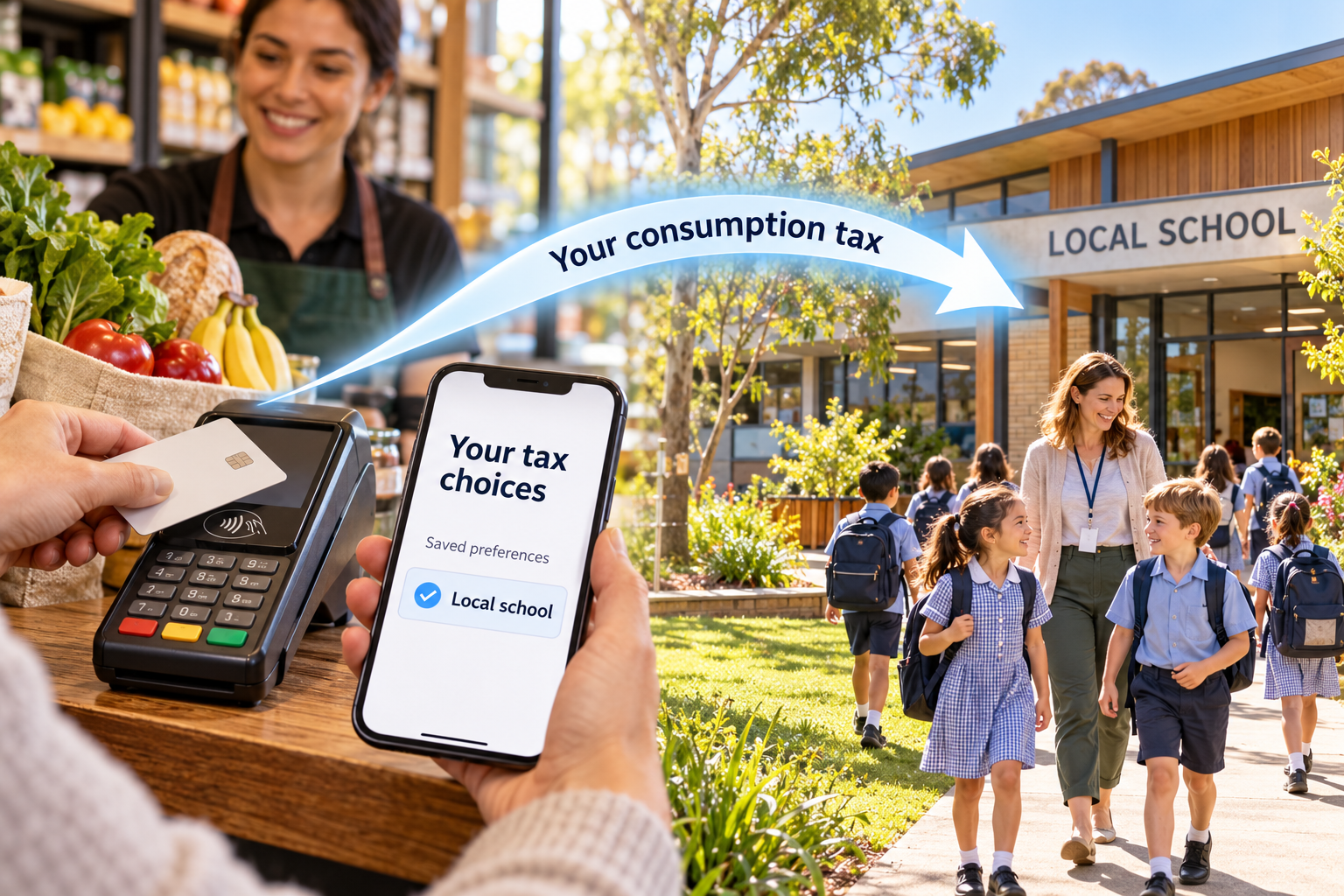
Tax choice transforms public services into a competitive marketplace.
The competition is between ideas as well as providers. Different taxpayer subcommunities can support different ways of addressing the same problem without first obtaining majority agreement. Approaches which produce better practical results can attract increasing allocations and become dominant, while remaining exposed to competing proposals and the continuing choices of taxpayers.
What if people allocate tax selfishly? That's a good thing! Selfish allocation funds the services people actually use and like. That is exactly what a market does.
There is continuous accountability. Voting and allocation are ongoing, not tied to election cycles. This creates constant pressure for services to remain responsive, innovative, and cost-effective.
Competition for limited resources is built into the system. Tax allocations are finite, so services must compete for funding, just as firms compete for consumer spending. This prevents waste and ensures resources flow to the services people actually want.
Service operators run under profit and loss. Their survival depends on attracting enough citizen support. This aligns their incentives with public preferences, reducing inefficiency and corruption.
In economic terms, money is the ultimate power, because money buys goods. In a market economy, you can get anything if you pay the price - and have the money.
Taxpayers represent consumers purchasing goods and services for the public. They have individual freedom to choose how their tax is spent. This mirrors the free market: services that are valued more receive more funding. Taxpayers exercise consumer power over the producers who implement public services. If a service is poorly run, citizens can reduce or withdraw their allocations, just as they would stop buying from a bad business. Services thrive or fail based on how well they meet demand. The difference is that instead of buying products, citizens are “buying” public services with their tax allocations. Tax choice drives up quality and efficiency in the same way consumer choice drives markets. The benefit cannot be overstated. In fact, taxpayers may exercise more consumer power than in the free market. They are organised and unionised through online forums. And it costs nothing to change allocations. A taxpayer can support a new competing service while still using the old one, until it has been superseded.
Human attributes like intelligence or empathy follow a normal distribution: the familiar bell curve. With millions of taxpayers taking responsibility for allocating money to public services, the outcome is highly predictable: a balanced mix of priorities: caring for those in need, advancing society, supporting the economy, and protecting the environment.
People hold diverse opinions about what matters most, because they live unique lives with unique needs. One person may rely on public transport, while another drives their own car. One may have lost family members to cancer and choose to fund cancer research. This tremendous plurality of human experience creates a corresponding diversity in how tax is allocated.
Selecting public services is much like selecting Products for a shopping trolley. Consumers do not need to know how a Product works internally; familiarity with how well it works for them is enough. Public services are likewise presented as fully costed contracts. Taxpayers need only rate the services they value, while the water-filling algorithm converts those preferences into complete funding allocations.
By contrast, a centralised government treats citizens like children, making consumer choices on their behalf, as though bureaucrats know better than the population itself.
In reality, millions of taxpayers make more informed decisions about thousands of public services than a handful of politicians ever could. The sheer volume of information is staggering. There may be hundreds of registered public services just for supporting social media alone.
In nations with democratically elected governments, the influence of a single voter is almost nonexistent. The public rarely participates in the decisions made each year that truly matter to them. And statistically, the chance that one vote determines an election outcome is practically zero.
Tax choice changes everything. It turns obligation into influence. Consider this: over a lifetime, middle‑income earners pay a fortune in tax. That represents enormous purchasing power for public services. With tax choice, taxpayers are inspired by the idea that they can directly influence society. It fills a void for those who don't feel like they contribute to society, despite paying tax. Now, their money becomes a tool of agency: an instrument of power shaping the nation every single day.
Tax is not pooled and then allocated by majority rule. Instead, each taxpayer’s contribution is directed according to their own choices, without any need for consensus. This makes tax choice far superior to majority rule. People can disagree on how money should be allocated to public services. It is not a problem. Each taxpayer allocates their own tax in the way they want, and no one can say otherwise. There is no need for control by an authority, and no need for conformity. The hard problem of reaching consensus on how tax should be allocated is eliminated.
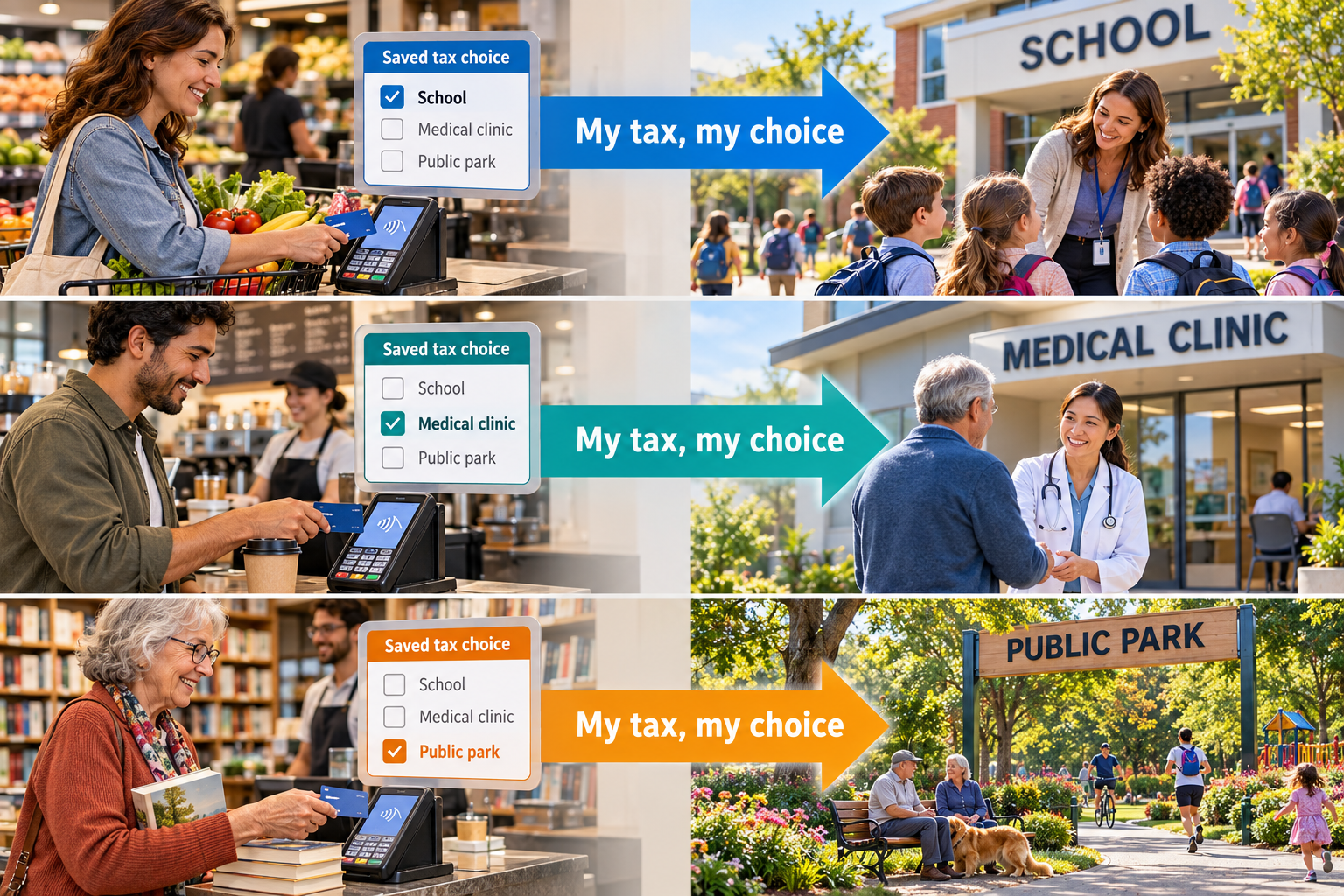
A genuine monetary gift is a voluntary transfer for which the recipient provides no Product, service, obligation, reciprocal transfer, or other consideration. Inheritances and dependent allowances have the same essential character: value passes to a recipient without being payment for consumption.
Receiving that value is therefore not subject to consumption tax. The recipient may retain it, use it for production, or invest it without paying consumption tax. If the recipient later uses the value to acquire Products for consumption, the ordinary account-based consumption tax applies at that time.
A B-account with the Product Category "gift" may be used only to make or receive genuine monetary gifts, inheritances, and dependent allowances. This restriction applies to every owner of a "gift" account, regardless of citizenship.
Citizens must make and accept these monetary transfers through "gift" B-accounts. Requiring the transfer to pass between accounts dedicated to this purpose distinguishes gifts from commercial payments while allowing genuine transfers to remain untaxed until their value is used for consumption.
Because anyone may own a "gift" account and transfers through it are not taxed, gift accounts could otherwise be used to conceal commerce. The sender must therefore provide a truthful description of the purpose of each gift and declare that it is not consideration for anything. A description might say, for example, that the transfer is a birthday present or family support.
The description does not prove that a transfer is genuine, but it creates a contemporaneous representation of its purpose. The CBPS examines all gift-account records automatically under uniform rules for evidence of commerce or tax evasion. Identifiable records may be inspected by the public service responsible for preventing tax fraud only under a warrant based on probable cause. This permits gift-account auditing without requiring account owners to file tax returns, maintain separate tax records, or submit to discretionary personal audits.
When the Identity System records a verified death event, the Central Bank Payment System places the deceased Person's accounts into estate settlement. After the applicable legal process determines the lawful recipients and allocations, the system transfers the remaining value and closes the accounts. Estate transfers are untaxed administrative transfers.
A Citizen receives inherited Central Bank value through a "gift" B-account. Receiving the inheritance is not consumption, but any later use of the inherited value for consumption is taxed in the ordinary way.
A dependent allowance is treated as a gift when it provides monetary support without consideration. It is received without consumption tax, while purchases subsequently made using the allowance remain subject to the ordinary consumption-tax rules.
Calling a transfer a gift does not make it one. A transfer made in exchange for a Product, service, promise, reciprocal payment, debt cancellation, or other benefit is consideration and must follow the account and tax treatment applicable to its actual purpose. A purchase cannot become untaxed merely by routing its payment through a "gift" account or describing the payment as a gift.
Product Categories classify B-accounts and R-accounts according to the economic activity conducted through each account. They allow the Central Bank Payment System (CBPS) to distinguish production-chain payments, retail sales, investment, and other non-consumptive transfers without investigating each transaction or deciding whether it is desirable.
A Product Category attaches to an account, not to a Person or organisation. A Person may open separate accounts for separate activities and may operate several kinds of business without obtaining a business licence. The single category on each account makes the purpose of that account and its transfers explicit while leaving ownership, organisation, production, and prices to the account owner.
Every Product Category is classified as either a B-category or an R-category, never both. A B-category may be assigned only to a B-account, and an R-category may be assigned only to an R-account. This prevents the same category from being used ambiguously for both untaxed production and taxable consumption.
Every B-account has exactly one B-category and every R-account has exactly one R-category. This does not mean that the Products described by different categories must be disjoint. Broad categories may overlap, and the same Product may be described by more than one category. The account owner chooses the single category that describes the economic activity conducted through that account and uses separate accounts for substantially different activities.
| Category class | Account type | Function | Examples |
|---|---|---|---|
| B-category | B-account | Production, wholesale trade, investment, or another non-consumptive activity | import-wholesale, foreign-currency |
| R-category | R-account | Products supplied for consumption | import-retail |
C-accounts are personal consumption accounts and have no Product Category. A Person uses a C-account to buy Products for their own consumption or that of their dependants. Product Categories apply to the supplying R-account, allowing the CBPS to recognise the payment as consumption without assigning an economic activity to the consumer.
External C → R payments are permitted and consumption tax is collected automatically. Because C-accounts do not participate in the Compatibility Relation, they cannot be used as production or wholesale accounts. A Person conducting productive activity instead uses a B-account whose Product Category describes that activity.
Product Categories are deliberately broad, few in number, public, and stable. They are not intended to describe individual Products, occupations, firms, or approved business models. Excessively detailed categories would turn account classification into economic regulation and would make ordinary production fragile.
Because categories are broad descriptions rather than a partition of all Products, overlap is expected and does not create ambiguity in the CBPS. Each account declares one category, and that declared category is the value used for its compatibility checks. Choosing any category that describes the Products supplied through the account is valid; knowingly choosing one that does not is a misuse of the account.
The Compatibility Relation is correspondingly permissive. It includes every physically possible and economically realistic production relationship and excludes relationships only where the claimed Product flow is not realistic or would disguise consumption as production. Its purpose is to keep tax and accounting routes correct, not to direct investment, protect established producers, or require political approval for trade.
A Person undertaking productive activity opens a B-account with a category describing that activity. A
programmer, for example, uses an appropriately categorised software business account to buy compatible computers,
technical publications, hosting, and other productive inputs. Buying the same Products through a
personal-funds account is personal consumption and requires payment into an R-account.
Separate accounts cause receipts and expenses to be recorded in the correct economic context. Compatibility checks block many mistaken transfers before they occur. Payment cards and wallets may apply additional user-defined restrictions, such as preventing a business card from paying any R-account, even though the constitutional CBPS rules would permit the taxed transfer.
A business whose Products are all described by one broad category may use one account even where
other overlapping categories could also describe some of those Products. A business conducting activities that
cannot all be described by one category uses separate accounts. For example, a Person who both imports
and exports uses an import-wholesale B-account for importing and an exporter B-account for
exporting. Free accounts and untaxed internal transfers allow the owner to organise and fund those activities
without treating them as separate legal organisations.
Most labour is a productive input rather than a Product supplied directly for consumption. An engineer, for example, receives salary through a B-account whose Product Category describes the engineering activity. Where a seller supplies Products both for consumption and as productive inputs, the seller uses an R-account for the consumer sales and a B-account for the supply-chain sales.
We want a system that is simple, easy to administer, avoids tax evasion, and protects people’s privacy. The foundation is automatic identification of payments that fall outside normal commerce. Normal commerce follows a realistic supply chain: consumers make payments to producers and pay tax, while producers pay their owners or other producers within the chain.
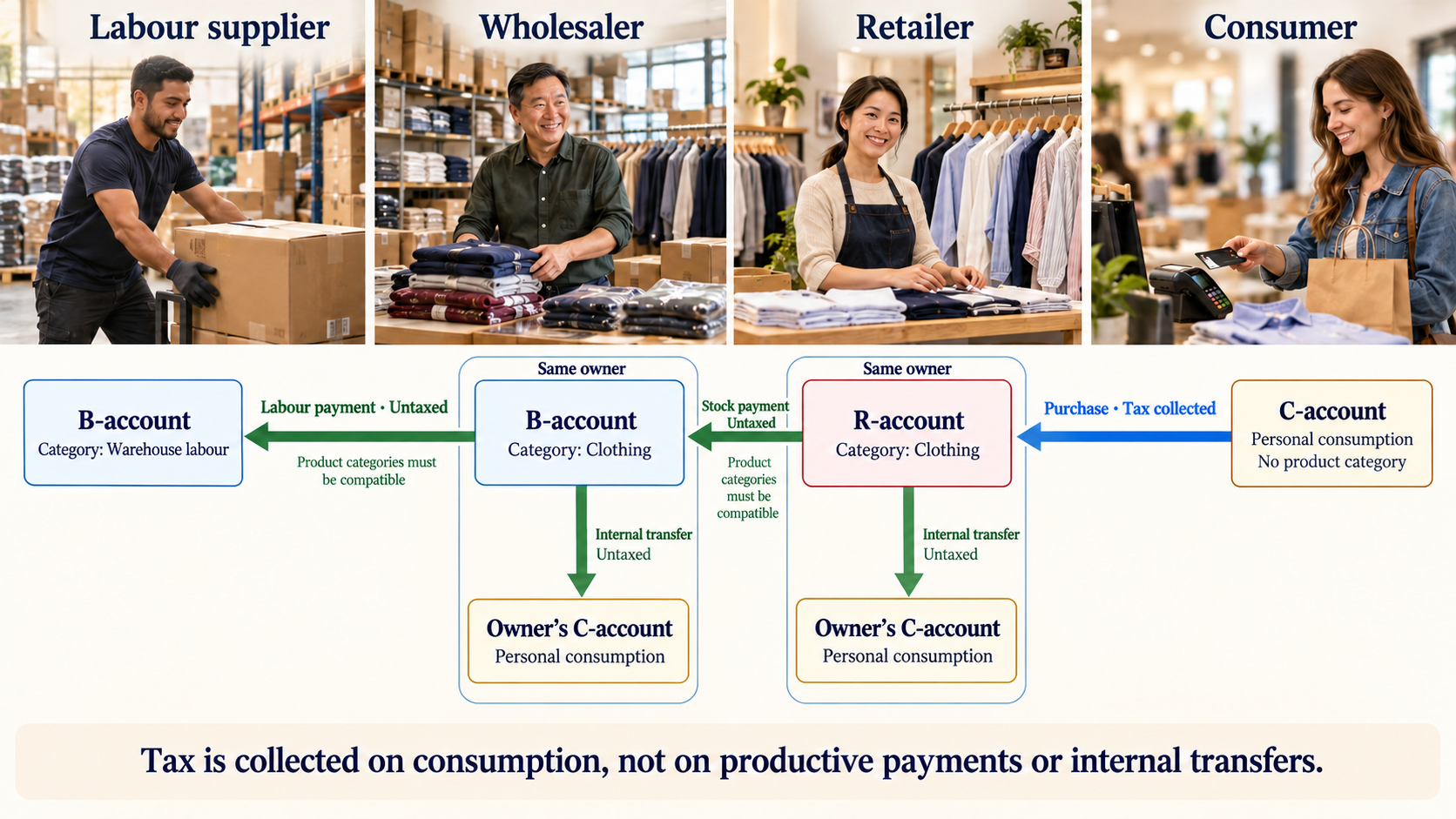
Goods and services are grouped into broad classes, which allows producers to be classified. A coffee shop belongs to food and beverage. A clothing wholesaler belongs to clothing. Other examples include electronic components, automobiles, and computer equipment. There are around fifty such classes, and every good or service belongs to at least one.
These classes provide the basis for checking whether payments between producers are consistent with a realistic supply chain. For example, clothing should not be an input to a coffee shop, and food and beverage should not be an input to a clothing wholesaler.
This system simplifies auditing. There is less need to review bank account statements, because restrictions on transfers are imposed automatically. They largely eliminate the potential for producers to use company accounts to disguise personal purchases and avoid paying consumption tax.
Tax evasion becomes nearly impossible when the supply chain itself enforces honesty.
Every transfer into an R-account is taxed automatically. It therefore does not require Product Category compatibility. Transfers between different owners into B-accounts are untaxed and are permitted only when the Product Category of the source account and the Product Category of the destination account satisfy the Compatibility Relation.
The Compatibility Relation 𝜥 describes permitted Product or service flow. 𝜥(i, o) means that a Product or service in category i may be supplied as an input to the activity in category o, or that the Constitution expressly permits that relationship. Product or service flow is i → o; payment flows in the opposite direction, o → i.
For an external transfer from source account s to destination B-account d, the category of d must be compatible with the category of s:
𝜥(𝜬(d), 𝜬(s))
The destination supplies the input, so its category appears first in 𝜥. If an
import-wholesale account pays a foreign-currency account, the relevant relationship is
𝜥(foreign-currency, import-wholesale). Foreign currency is an input into importing, and
the payment moves in the reverse direction.
The CBPS uses only account types, the Product Category of each B-account or R-account, account ownership, and the public Compatibility Relation when evaluating a transfer. It does not inspect a business plan, assess whether a purchase is prudent, decide whether a producer is qualified, or limit the number of competing accounts. Any Person accepting the Central Bank account owner contract may create appropriately categorised accounts and become responsible for using them consistently with their declared activities.
An individual or business is tax‑compliant if they use the Central Bank Payment System for buying and selling, ensuring all applicable tax is paid, and do not knowingly supply a producer who is not tax‑compliant. Supplying a producer includes working for them. If a citizen works for a non‑compliant business, they are not compliant themselves.
Under VoTa, tax is optional because citizenship is optional. A person may remain outside the citizen economy, but they cannot claim the benefits of citizenship while bypassing the tax system that funds those benefits.
The constitutional basis is a chain:
Citizenship, Section 1:
Citizenship is a voluntary contractual relationship between a person and the State. Citizenship is never automatic and must be explicitly entered into.
Taxation, Section 11:
UBI shall be distributed only to citizens who are resident, as declared under Section 10.
Citizenship, Section 8:
Citizens may work only for domestic businesses that are compliant with CBPS classification and taxation rules. A Citizen engaged in domestic business activity shall not knowingly supply labour, Products, services, or productive inputs to a Producer for domestic business activity unless that Producer is compliant with CBPS classification and taxation rules.
Citizenship, Section 6:
A Citizen shall not knowingly participate in any economic arrangement that bypasses the Central Bank Payment System in circumstances where this Constitution requires them to use a B-account or R‑account.
Taxation, Sections 6 and 9:
Only the transfers listed in Table 1 are permitted. Any transfer not listed in Table 1 is prohibited and shall be blocked by the Central Bank Payment System. The CBPS shall automatically block any transfer not expressly permitted by this Article.
Taxation, Sections 4 and 5:
Tax is payable on all monetary transfers into R-accounts by resident consumers, regardless of whether the consumer is a citizen. A tax shall be collected on every monetary transfer into an R-account, regardless of the Account Type of the sender account.
These clauses reduce to a simple compliance mechanism:
This is not voluntary tax in the sense of donation. It is voluntary in the sense that citizenship is voluntary. Once a person enters the citizen economy, tax is collected automatically as part of ordinary consumption. The incentive to comply is not moral virtue; it is access to UBI, public services, lawful commerce, compliant workers, suppliers, and customers.
The compliance mechanism is seeded by workers. Citizens want to keep access to UBI, and citizens who want UBI must work only for compliant businesses. A business that refuses compliance does not merely lose a subsidy; it loses access to much of the citizen labour force.
The same pressure propagates through the supply chain. A compliant business cannot knowingly supply or depend on non‑compliant producers, because doing so risks its own compliant status. Each compliant firm therefore has an incentive to demand compliance from its suppliers, contractors, and trading partners. Compliance spreads outward from citizens to employers, from employers to suppliers, and from suppliers through the rest of production.
A wealthy person may decline citizenship, but that does not let them consume tax‑free inside the compliant economy. Tax is collected when money enters an R‑account. If the firms selling food, housing, transport, medicine, entertainment, labour, and services are compliant, then the tax is paid automatically at the point of purchase, regardless of whether the buyer is a citizen.
To avoid the tax, a wealthy person must avoid compliant sellers. That means relying on a parallel non‑compliant economy cut off from compliant workers, suppliers, contracts, and payment systems. For complex modern goods and services, that is not a realistic substitute for the formal economy.
The results are clear:
The constitutional transfer rules define which transfers the CBPS may process. An account owner may apply additional, more restrictive controls to an account, payment card, wallet, or delegated authority. These controls cannot permit a transfer prohibited by the Constitution or prevent consumption tax from being collected, but they may decline a transfer that the CBPS would otherwise permit.
For example, a business may configure a card linked to a productive B-account to reject every payment into an R-account. If a programmer accidentally uses that card to buy a coffee, the payment is rejected before it is submitted or authorised. The programmer can instead use a card linked to their personal B-account. The constitutional system need not prohibit the original B → R transfer: if it were made, the CBPS would process it and collect consumption tax in the ordinary way.
The same mechanism can restrict a business card to selected Product Categories, counterparties, amounts, locations, times, or delegated users; require additional approval; or warn the user and request confirmation. Account and Product Category metadata allow the payment service to identify a likely accounting mistake before money moves.
These controls make specialised cards safer and keep account records clean without adding constitutional restrictions. They reduce accidental personal expenditure from business accounts, accidental business expenditure from personal accounts, and the usefulness of a lost or stolen card. The account owner chooses and may change the controls according to their own accounting and security requirements.
Before a non-R-account receives payment for a Product capable of consumption, its owner must ensure that the purchaser is asked whether the Product will be consumed within the State Territory by a Citizen.
A public service investigating tax fraud can test this obligation by making purchases from sellers using non-R-accounts. It records the questions asked and whether payment is accepted after affirmative answers.
An investigator makes an ordinary purchase without disclosing that it is a test. The investigator states that the Product will be consumed within the State Territory by a Citizen. The seller complies by requiring payment into an R-account. Accepting payment into a non-R-account proves a breach.
The test is strong because any customer may be an investigator. A seller cannot identify the customers for whom the rules can safely be ignored. Random tests across different times, sales channels, employees, and Products increase the probability of detecting a breach.
The account owner is responsible for every payment into the account. Employing a salesman or delegating account authority does not transfer that responsibility. The owner must ensure that every person accepting sales follows the enquiry and payment rules.
The combination of simple evidence, uncertain testing, and owner responsibility makes open commercial use of non-R-accounts for taxable consumption unsafe. The investigator needs to record only the account, the questions asked, the answers given, and whether the payment was accepted.
Anonymous testing does not detect collusion between people who already trust one another. A seller may accept non-R-account payments only from known customers who agree to conceal the transaction or lie about citizenship or the place of consumption. Such transactions require separate evidence of the collusive arrangement.
A Citizen can convert Central Bank currency into foreign currency and use it to buy a Product from a foreign seller for consumption within the State Territory. The purchase then occurs outside the CBPS and avoids payment into an R-account.
The CBPS cannot determine how foreign currency is used after conversion. The currency may fund consumption, production, investment, or travel.
Using foreign currency to buy a Product from a foreign seller for consumption by that Citizen within the State Territory without payment into an R-account violates the citizenship contract.
Citizenship, Section 6:
- A Citizen shall not knowingly arrange or participate in the acquisition of a Product without payment into an R-account when the Product is intended for consumption by any Person.
- If the intended place or manner of consumption changes after acquisition, the Citizen may satisfy the obligation through a tax-settlement procedure before consumption.
A currency exchange may fraudulently facilitate tax evasion by joining an arrangement that uses foreign currency to acquire a Product while concealing or bypassing the required R-account payment.
Merely selling foreign currency does not breach the Central Bank account owner contract. The owner breaches the contract only by knowingly joining the arrangement that bypasses the required payment.
Central Bank Account Holders, Section 2:
A Central Bank account holder shall not knowingly participate in any economic arrangement that bypasses a payment into or use of a B-account or R-account required by this Constitution.
The following additional measures could reduce this form of evasion:
A test purchaser may state that the Product will be consumed within the State Territory by a Citizen and that they want to pay into a non-R-account. This gives the account owner an opportunity to comply or breach.
Testing becomes inducement when the investigator pressures, persuades, rewards, or assists the account owner to breach the contract.
TODO: Decide whether the Constitution needs a clause limiting test purchases to presenting an opportunity to breach without inducing the breach.
A fake R-account cannot be used for tax avoidance. Every transfer into any R account is taxed, with no exceptions.
The system eliminates legal consumption-tax havens for wealth earned through B-accounts and R-accounts. A highly profitable business may accumulate and reinvest its profits without consumption tax, but every legal route by which those profits become available for consumption passes through a taxable C → R or C → G transfer.
This result does not depend on the legal structure through which the wealth is held. Companies, trusts, investments, loans, gifts, inheritances, offshore accounts, residence in another country, and differences between national tax laws cannot create a transfer that the CBPS does not permit. Lawyers and accountants may rearrange ownership, investment, and production within the B,R account system, but they cannot provide a legal route from that system into consumption without tax being paid.
Direct monetary avoidance is therefore prevented mechanically rather than by attempting to anticipate every possible tax-minimisation structure. Illegal evasion would require some independently unlawful act, such as a false transaction, consumption disguised as a business input, concealed control, identity fraud, or the use of barter or assets outside the CBPS. Such conduct is not made literally impossible by the account rules, but the rules make large-scale extraction substantially more difficult and conspicuous than a legal transfer to a conventional tax haven.
The CBPS prevents transfers that are invalid from their account types alone. Evasion can still be attempted by misrepresenting the economic activity underlying transfers that appear valid. Such conduct is illegal. Where there are reasonable grounds to suspect it, a targeted audit authorised by a warrant may compare available transaction history with evidence outside the CBPS. Once private C-account transaction information is purged after passing the certified retention vector time, an audit cannot reconstruct it. It may instead examine transfers into private C-accounts, remaining receipts in R-accounts or G-accounts, and relevant evidence outside the CBPS.
| Possible evasion | Why it is illegal | Audit evidence that may reveal it |
|---|---|---|
| False invoices or sham supplies used to justify a 𝜥-compatible B → B or R → B transfer | The transfer does not correspond to the Product or service represented by the accounts. | Contracts, invoices, communications, delivery records, inventory movements, work records, and confirmation from the purported counterparty. |
| Personal consumption represented as a business input | A Product acquired for consumption is falsely treated as contributing to production or resale. | The location and pattern of use, asset-access records, business purpose, relationship to actual outputs, inventory records, and comparable expenditure by the business. |
| Unrecorded self-consumption of Products or assets held by a business | Self-consumption is a taxable commerce transaction even when the relevant accounts have the same owner. | Inventory shortages, withdrawals of stock, changes in asset location, private use records, access logs, maintenance records, and the absence of a corresponding C → R or C → G transaction. |
| Gifts, loans, investments, or other related-party transfers that are consideration in substance | The description of the transfer conceals a purchase, repayment, distribution, or reciprocal arrangement. | Circular fund flows, matching or conditional transfers, repayment behaviour, non-commercial terms, communications, agreements, and the relationship between the parties. |
| Nominee ownership or concealed control of an account or business | The nominal owner is used to conceal the Person who actually directs or benefits from the economic activity. | Delegated authority, authentication and device records, instructions to the nominal owner, contractual control, recurring fund flows, and evidence identifying who makes business decisions. |
| Unrecorded barter or payment using commodities, foreign currency, cryptocurrency, or offshore accounts | Value is received or supplied outside the required B-, R-, C-, P-, or G-account transaction in order to conceal commerce or consumption. | Shipping and title records, inventories, foreign-account or exchange records, blockchain records, communications, asset acquisitions, and unexplained changes in control of property. |
| Sales deliberately omitted from the required R-account | A retail Product is supplied without the taxable C → R commerce transaction required by the proposal. | Inventory depletion, orders, customer receipts, booking and delivery records, website or marketplace activity, and comparison of actual sales with R-account receipts. |
| False or excessive refunds | A refund or linked reversal is claimed when no qualifying purchase was reversed, or exceeds the amount genuinely refunded. | For C-account purchases, the referenced purchase chain and cumulative refund amounts. For private C-account purchases, validation of the anonymous refund credential without identifying the payer. In either case, returned-goods records, customer communications, inventory restoration, and repeated retailer refund patterns may also be examined. |
| Identity fraud or unauthorised operation of another Person's accounts | The transfers are initiated under a false identity or without the account owner's authority. | Biometric verification, authentication records, device and session history, security alerts, and evidence of account compromise or coercion. |
None of these indicators proves an offence by itself. An audit must establish that the apparent account classification differed from the real economic activity and that any knowledge or intent required by the offence is present. Audits should be confined to the suspected conduct and should not become routine monitoring of lawful account activity.
This claim is limited to consumption funded by wealth earned within the B,R account system. It does not apply to wealth earned and consumed entirely within the G economy or an external foreign economy.
The tax budget of each registered public service is defined in advance. It comes from the service contract and customer usage data, representing the price taxpayers must pay.
Consumers don’t allocate their tax directly. Instead, they give ratings on services: negative to vote against, zero for neutral, and positive to vote in favour.
If individuals allocated tax themselves, the result would be chaos: some services underfunded, others overfunded. Most people only rate a handful of initiatives, leaving the majority of scores at neutral.
To solve this, an allocation algorithm runs at the end of each day. It processes the services in decreasing order of popularity, according to their total score. Allocations respect consumer ratings while also preventing underfunding or overfunding. Underfunding is largely avoided because tax can be directed to services where consumers gave a neutral score.
Without this algorithm, managing millions of individual allocation choices would be an administrative nightmare.
You may worry that essential but unpopular services could be starved of funds. Yet if an essential service underperforms, taxpayers will notice quickly. And if the problem is underfunding, they will shift their ratings to prioritise it. This feedback loop is highly responsive because tax allocations are performed daily.
Imagine that every public service has a bucket whose capacity is its tax budget for the day. The tax available from each consumer is the water, and the consumer's ratings indicate which service buckets they most want their tax to fill.
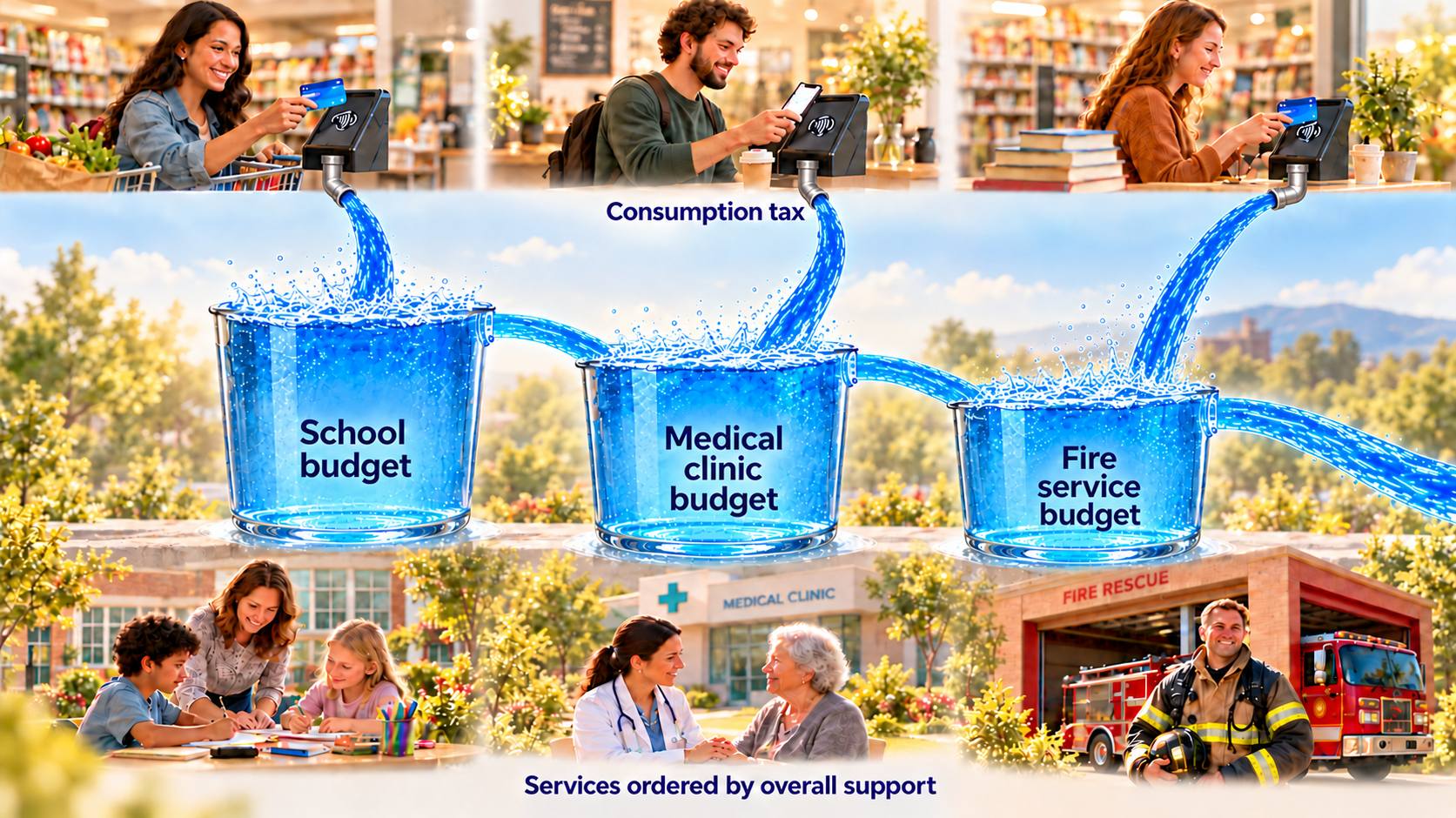
The services are considered in order of their overall support. For each service, tax associated with positive ratings is used first. Depending on the configured form of the algorithm, stronger positive ratings either contribute before weaker ones or receive greater weight. As soon as the service reaches its budget, its bucket is full and receives no more tax. If the next group of consumers could overfill it, only the proportion needed to reach the budget is used.
A negative rating contributes nothing to that service. A neutral rating contributes only when the positively rated tax is insufficient to fill the service's budget. This allows neutral tax to prevent a shortfall without letting it alter the relative support expressed by positive ratings.
When a consumer's tax has been allocated to one service, it is no longer available to later services. The algorithm continues through the remaining services using each consumer's unallocated tax. Any tax left after all services have been considered is allocated to UBI. In this way, the system follows consumer preferences, avoids substantially overfunding services, reduces underfunding, and never allocates the same tax twice.
In this constitution, consumption tax is paid once, at the moment you buy something. But what happens when the thing you buy isn’t small… but enormous? A house. A car.
If we taxed those the same way we tax a cup of coffee, something strange would happen. The tax would hit all at once: a massive spike, and then… nothing. Public services would get a surge of funding, followed by years of silence.
Yes. The tax on an expensive final product is paid upfront. But the allocations from that tax are released gradually, over the lifetime of the product… as if the product were generating small, recurring tax payments from each successive owner. This means a house doesn’t just create a one‑time burst of funding. It creates a steady stream. Predictable. Fair. Linked to real consumption over time.
But here’s the clever part. To avoid shrinking the money supply, the upfront tax doesn’t sit idle. It goes straight into the UBI pool, the most liquid, continuously circulating part of the entire system. And as the years pass, the scheduled allocations to public services are drawn from that same pool.
The result is a beautifully balanced mechanism. The tax is simple. The money supply stays stable. Public services receive smooth, predictable funding. And the burden of consumption is shared fairly across everyone who uses the product, not just the first buyer.
A common argument says that consumption tax favours the wealthy because poorer households spend almost all their income, whereas wealthy households save and invest a substantial share. Dividing consumption tax paid this year by income received this year therefore produces a lower percentage for the saver.
Unsurprisingly, Google's AI says consumption tax is regressive:

Richard J Murphy uses this argument in his YouTube video Why the wealthy pay less tax than you – and how to fix it:
Step 4 involves VAT. This is a complex area, but one worth paying attention to because this mundane tax is heavily biased against ordinary people. Remember, VAT is a tax on your spending, and by definition, those who are wealthy or those who are saving spend less than all their income. Now, most of us spend all our income or almost all our income every week or month. But the fact is that means we pay VAT on a great deal of our income. So, after we have paid income tax and National Insurance, then we pay VAT, on quite a lot of the rest of what we spend. But the wealthy do not spend all of their income. They spend a much smaller share of their income and therefore do not pay VAT on it. By definition therefore the wealthy pay less VAT than do ordinary households. This is what is called a regressive tax. The lower your income, the higher your likely tax rate is going to be. And that is a problem built into the VAT system in itself.

The error is treating a delay in consumption as though it were consumption escaping tax. Saving and investment preserve purchasing power for later use. When that purchasing power is eventually exercised on consumption, consumption tax applies. A lower tax-to-income ratio during the saving period does not establish a lower lifetime consumption-tax burden.
Annual income and consumption need not coincide. A worker saving for retirement can appear lightly taxed, while a retiree spending accumulated savings can appear heavily taxed relative to current income. These may be the same person at different ages. The Institute for Fiscal Studies likewise explains that assessing indirect taxes against expenditure rather than income changes the distributional picture substantially.
An annual income comparison can describe current household cash-flow pressures. It cannot, by itself, establish that savers obtain a permanently lower consumption-tax rate. Under a uniform flat consumption tax, the same fraction of spending is collected whenever consumption occurs.
In an interview preserved in UCLA's oral history collection, Hayek argues that equality before the law is incompatible with trying to make people equal:

Margaret Thatcher expressed a similar opposition between opportunity and equality when discussing incomes and earnings in the House of Commons on 24 November 1976:
If we are to have opportunity, we cannot have equality, because the two are opposite.

These arguments identify a real danger in enforcing equal outcomes, which can undermine incentives to work. Nevertheless, it is incorrect to claim equal treatment is incompatible with reducing inequality. A flat consumption tax used to fund UBI illustrates the point: everyone is taxed at the same rate, everyone receives the same UBI, yet in combination they reduce inequality.
The combined effect is progressive relative to spending. The same UBI offsets a larger share of the tax paid by someone who spends less, and a smaller share of the tax paid by someone who spends more. Those whose consumption tax is less than their UBI are net recipients; those whose tax exceeds their UBI are net taxpayers. Equal treatment under the rules therefore produces different net contributions without different tax rates or means-tested benefits.

For annual spending C, a flat tax rate t and annual UBI U, net tax is tC − U, and the net tax rate is t − U/C. For positive spending and a positive UBI, this rate increases with spending, while the marginal tax rate remains flat. In the example shown, tax is measured as a fraction of tax-inclusive spending.
People remain free to earn, spend and accumulate different amounts. The system does not target a particular final distribution of resources. A uniform consumption tax and UBI therefore combine non-discriminatory treatment with progressive net taxation, without requiring the state to enforce equal outcomes.
Foreign trade is voluntary trade across the State boundary. The Non-Discrimination Principle does not permit the State to favour a person or business according to whether goods or services are produced domestically or abroad. The Constitution also expressly prohibits import and export tariffs, duties, quotas, and other measures that restrict or distort cross-border trade.
Importers, exporters, and currency-exchange services require no special licence, registration, or authorisation. They need only use Central Bank accounts with the Product Categories required to apply the constitutional tax rules. The State cannot protect selected industries, subsidise exports, restrict imports, or require consumers to favour domestic producers.
A resident producer may export directly or use a specialist export intermediary. An intermediary can aggregate products from multiple producers, find foreign customers, quote prices in foreign currencies, and arrange shipping, warehousing, insurance, delivery, warranties, and currency conversion. It earns a competitive fee or trading margin for these services.
The intermediary can buy products from resident producers using Central Bank currency, sell them to foreign customers, and sell the resulting foreign-currency receipts through a currency exchange. The transactions between the producer and intermediary are untaxed business transactions, and the foreign sale is not resident consumption. Unlike the local retailer required for imports consumed by residents, a separate export intermediary is optional because a producer can perform these functions itself.
Any person may acquire, hold, sell, or exchange foreign currency. Private currency-exchange services compete freely, and the State does not control exchange rates or regulate the price, availability, or quantity of foreign currency except as necessary to enforce consumption tax. Importers can acquire the currency accepted by foreign suppliers, while exporters can retain foreign currency or exchange it on the market.
Acquiring or holding foreign currency is not itself consumption. Citizens may use it for purposes such as travel and foreign transactions, but cannot use it to buy products directly for consumption by residents. Those products must instead be purchased from a local retailer through an R-account so the ordinary consumption tax is collected.
VoTa has no exchange-rate policy and no authority charged with correcting the balance of trade. Demand for imports contributes to demand for foreign currency, while exports create foreign demand for domestic production. Exchange rates and product prices adjust as these demands change, altering the relative prices of imports and exports without intervention by the State.
If VOTA Products become more attractive at the current exchange rate, foreign demand for them increases. Exporters exchange the resulting foreign-currency receipts for Central Bank currency. This increases demand for Central Bank currency and raises its value relative to the foreign currency. VOTA exports then become more expensive to foreign consumers, while foreign Products become cheaper in Central Bank currency. The change tends to reduce the trade surplus. A trade deficit produces the opposite adjustment.
The exchange rate is therefore a market signal and part of the adjustment mechanism. Fixing, targeting, or subsidising it suppresses that signal. Tariffs, quotas, export subsidies, and controls on currency quantities or prices also obstruct the adjustment. The imbalance is then displaced into distorted prices, shortages, surpluses, rationing, or political allocation.
Imports and exports need not have equal values over any particular period. Differences may be matched by foreign investment, asset purchases, loans, gifts, or changes in currency holdings. These transactions are decided by the people involved rather than managed towards a national target.
VoTa has no institution empowered to decide that the State imports too much, exports too little, needs a particular industry, or should make residents buy domestic products. Trade patterns instead emerge from the separate voluntary decisions of consumers, producers, investors, and lenders. A domestic producer must compete by offering value rather than by obtaining political protection from foreign competition.
A constitutional guarantee of peaceful, non-discriminatory trade is more likely to produce such trade than a government policy that can be withdrawn whenever political relations deteriorate. Ordinary governments can promise free trade and later impose tariffs, sanctions, subsidies, or embargoes after an election or diplomatic dispute. VoTa makes a credible commitment by denying the State those powers.
Foreign traders therefore know that access to the VoTa market cannot depend on diplomatic favour and that they cannot be penalised because of their nationality or government. Their success depends on the value they offer to willing customers. Repeated voluntary exchanges also allow people to form direct relationships instead of knowing one another only through competing political narratives.
People often regard another State as hostile because they believe it is acting as an adversary rather than a friend. VoTa cannot guarantee friendship or prevent foreign aggression, but its Constitution commits it not to create or reinforce hostility by using trade as a weapon. It continues to defend its territory and prosecute aggression while leaving peaceful exchange open.
The constitutional prohibition on restrictions to foreign trade is absolute. The State cannot impose an embargo, economic sanctions, asset restrictions, or discriminatory trading rules against a foreign country, its residents, or its businesses. This remains true when a foreign government is hostile or has committed aggression.
VoTa responds to aggression by identifying and prosecuting the people responsible under the same universal law that applies to everyone, and by defending the State Territory against attack. Remedies may be imposed on an aggressor through due process for conduct that violates the Non-Aggression Principle. They cannot be extended to peaceful people merely because they share a nationality, residence, trading partner, or political government with the aggressor.
Economic sanctions deliberately obstruct otherwise peaceful transactions in order to place pressure on a foreign government. Their effect is borne by consumers, workers, producers, investors, and traders who were not individually responsible for the conduct being opposed. VoTa does not use peaceful traders as instruments for influencing foreign political decisions. Citizens remain free to refuse trade, organise voluntary boycotts, or choose suppliers according to their own judgement, but the State cannot make that choice for them.
A transaction that itself constitutes knowing participation in aggression remains subject to ordinary law. That is a judgement about the conduct of the particular parties, not an embargo or sanction imposed on a class of people because of foreign political events.
Trade is a transaction between particular people, each of whom gives up something they value less for something they value more. They may later discover that they made a mistake, but at the time of a voluntary exchange both expect to benefit; otherwise they would not agree to it.
A hostile country is an aggregate description, not a person capable of guilt, responsibility, benefit, or suffering. Its population includes separate people who may support, oppose, participate in, or have no responsibility for the conduct of its government. Responsibility attaches to what an individual does, not to their nationality, residence, trading partners, or inclusion in an economic statistic.
An embargo or sanction therefore coerces the VoTa resident who wants to buy or sell as well as the foreign person willing to trade with them. It prevents a peaceful transaction because of conduct for which neither party may be responsible. Claims about national industries, trade balances, or aggregate welfare cannot establish authority to overrule their decision: aggregates are measurements, while individuals are the locus of experience and responsibility.
Dependence on an unreliable foreign supplier is likewise a risk borne by the people who choose it. They may diversify suppliers, hold inventories, purchase insurance, require contractual guarantees, finance alternatives, or accept the risk. Essential public-service operators can make the same choices through their contracts. The possibility of a poor decision does not transfer authority to the State to make that decision for everyone.
Fraud, deliberate contamination, sabotage, or knowing participation in aggression remains subject to ordinary law. Liability attaches to the person and conduct involved; it does not justify restricting peaceful transactions with other people from the same country.
Citizens should not need to understand wholesale currency markets, foreign settlement systems, Product Category compatibility, tax routing, custody, or the records required to support every kind of foreign transaction. Competitive purpose-specific intermediaries handle these details through ordinary retail services.
A Citizen selects a service appropriate to the intended activity. The intermediary receives Central Bank currency through the correct account, arranges any required currency conversion, completes the foreign payment or settlement, and retains an audit trail connecting the domestic and foreign parts of the transaction. The service makes the compliant route convenient without becoming a discretionary authority that approves how a Citizen may trade, travel, invest, or transfer money.
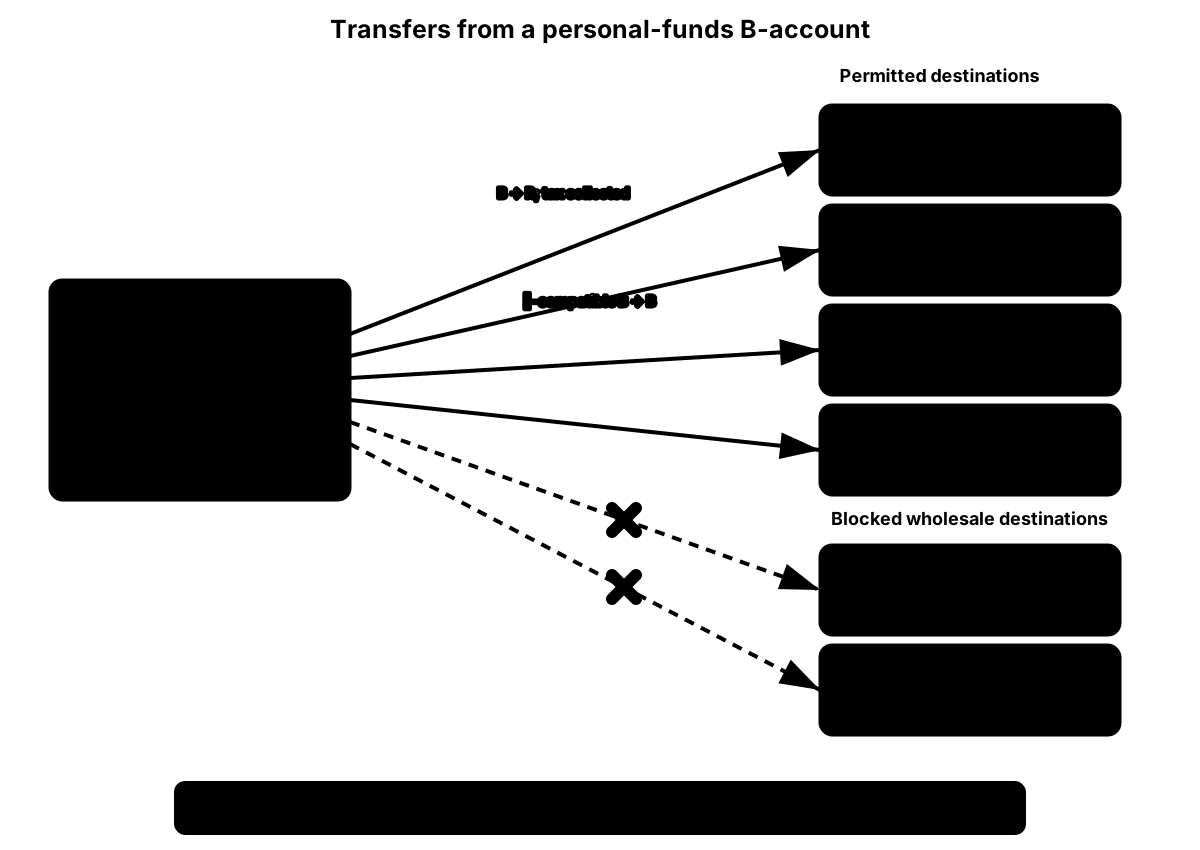
Citizens generally receive and hold their labour income, UBI, investment income, inheritance, and other personal
receipts in a personal-funds B-account. The Compatibility Relation prevents that account from making
B → B payments for consumable Products or obtaining wholesale inputs such as foreign currency. Personal
consumption is instead paid into R-accounts, where the CBPS collects consumption tax automatically.
Wholesale exchanges therefore receive Central Bank currency through B-accounts with the Product Category
foreign-currency. A personal-funds B-account is not compatible with that category, but it
is compatible with foreign-travel, foreign-investment, and
foreign-remittance B-accounts. Purpose-specific intermediaries obtain wholesale conversion through
accounts whose activities legitimately use foreign currency as an input.
The first transfer records the Citizen's economic purpose. Taxable domestic consumption is paid into an R-account, where the CBPS collects consumption tax automatically. A constitutionally recognised activity that is not taxable consumption is paid into an appropriately categorised B-account where the Compatibility Relation permits the transfer. The intermediary can then make a compatible B → B payment to a wholesale exchange or another producer.
The intermediary connects the Central Bank transaction to the external transaction. It may convert currency, pay a foreign provider, arrange delivery, issue a travel payment instrument, acquire and hold an investment, send a remittance, receive foreign proceeds, or convert unused foreign currency back into Central Bank currency.
| Citizen's purpose | Intermediary account | Consumption-tax treatment |
|---|---|---|
| Imported Product for domestic consumption | import-retail R-account |
Tax collected automatically |
| Foreign travel | foreign-travel B-account |
No consumption tax |
| Foreign investment | foreign-investment B-account |
No consumption tax |
| Foreign remittance | foreign-remittance B-account |
No consumption tax |
The architecture protects both sides of tax correctness. A foreign seller or foreign currency does not make domestic consumption exempt from tax. Conversely, travel outside the State Territory, acquisition of an asset, or transfer of money does not become taxable consumption merely because Central Bank currency funds it.
The intermediary does not choose a tax rate or grant an exemption. It submits each Central Bank transfer through the predefined account route corresponding to the transaction. The CBPS taxes every payment into an R-account, permits compatible B-account transfers, and rejects transfers that do not satisfy those rules.
Central Bank account ownership is largely independent of citizenship and residency. A non-citizen or non-resident Person may own any account type by accepting the Central Bank account owner contract.
Currency exchanges, import retailers, and export intermediaries may therefore be foreign-owned and operated. They may use B-accounts and R-accounts without becoming Citizens or Residents.
Transfers into their R-accounts are processed like transfers into any other R-account. The CBPS automatically collects and distributes the consumption tax. If tax choice is permitted, the CBPS uses it to allocate the tax.
The same principle applies to travel, investment, remittance, custody, and settlement services. Account rules and contractual responsibility attach to the Person owning the account rather than to nationality or place of residence. A foreign producer that receives foreign currency through an intermediary need not hold a Central Bank account at all.
The CBPS records the owner, type, and Product Category of each account together with the source, destination, amount, compatibility decision, and tax treatment of each Central Bank transfer. The intermediary's structured records connect that transfer to the relevant foreign conversion, provider, recipient, journey, asset, custodian, shipment, or settlement.
This permits routine tax auditing to be largely automatic. Software can check that a required R-account payment occurred, B-account relationships are compatible, amounts reconcile with foreign settlements, and refunds or reversals follow the expected route. Missing records, inconsistent amounts, repeated reversals, and unusual transaction patterns can be identified for further examination without manually reading every account statement.
Purpose-specific routes remove the easiest form of foreign-currency tax evasion: direct conversion from an
ordinary personal-funds B-account followed by an untaxed foreign purchase. They also make deliberate
evasion more difficult
because the participants must create a false purpose, false external transaction, or collusive arrangement that
is inconsistent with the intermediary's records.
The system does not claim to infer every use of foreign cash, detect every false declaration, or prove what a Citizen ultimately consumes. Collusion, disguised merchants, false travel, mixed-use assets, and foreign funds obtained outside the CBPS may require external evidence. Automatic enforcement handles ordinary transactions and creates the audit trail on which investigation of exceptional cases can rely.
An intermediary is not a government-appointed gatekeeper. Any Person may offer a foreign-trade service by accepting the Central Bank account owner contract, opening accounts with the correct Product Categories, and accepting responsibility for the transactions and records produced through those accounts. No special licence, citizenship, residency, or political approval is required.
Intermediaries compete over prices, exchange rates, fees, privacy, convenience, supported currencies, settlement methods, custody, delivery, reliability, refunds, warranties, fraud protection, and customer service. Citizens may change providers or establish competing services on the same terms.
The following subchapters apply this common architecture to imported Products consumed within the State Territory, foreign travel, foreign investment, and foreign remittances. Each case has different tax treatment and external records, but all use intermediaries to connect an easy retail transaction with wholesale currency conversion and tax-correct Central Bank transfers.
A Person may use value held in a C-account to buy a foreign Product for consumption. This chapter describes how the system ensures that they pay consumption tax. It covers domestic consumers buying imported Products, consumers travelling outside the State for a holiday or business, and Citizens who choose to live abroad indefinitely.
Consumption tax is collected when that value passes through one of the taxed routes available from a C-account.
Imported Products used as productive inputs or acquired for resale are not consumption. Businesses acquire them through appropriately categorised B-accounts and the untaxed supply-chain routes described below. Value held in a C-account, however, cannot enter those wholesale routes without first passing through a taxable event.
The account route determines the tax. Citizenship and the locations of the purchaser, consumer, seller, and Product do not affect it. Nor does it matter whether the purchaser and consumer are the same Person, or whether the Product is delivered, shipped elsewhere, carried in luggage, or consumed while travelling.
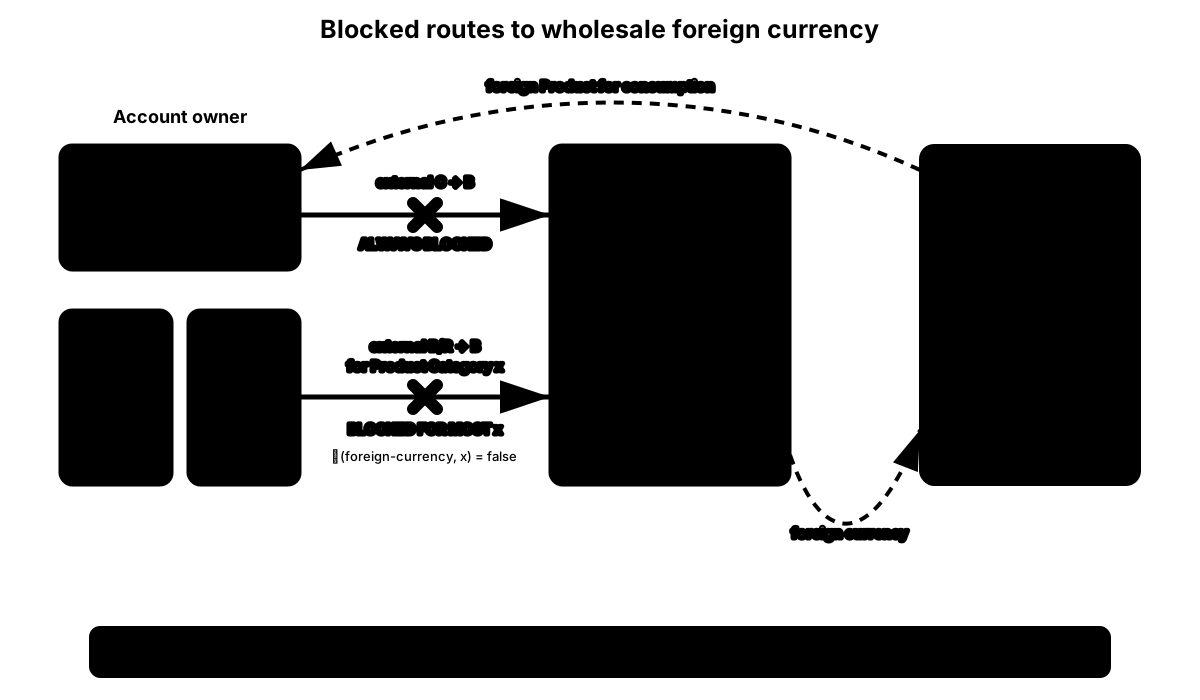
A currency exchange receives Central Bank currency for wholesale conversion through a B-account with the
foreign-currency Product Category. An external C → B transfer to that account is always blocked, so
a C-account owner cannot obtain foreign currency through an untaxed wholesale payment.
Using a B-account or R-account does not generally provide an alternative. An external payment from an account with
Product Category x into the exchange's foreign-currency B-account is permitted only when
𝜥(foreign-currency, x) is true. It is false for most Product Categories. The true relationships
are those in which foreign currency is a realistic input to the payer's declared productive activity, such as
importing, exporting, or providing a purpose-specific foreign service.
A C-account owner has three routes for funding foreign consumption:
import-retail R-account. The CBPS collects consumption tax, and the retailer arranges the
foreign-currency conversion and payment of the foreign producer.
foreign-currency-retail R-account. The entire amount converted, rather than merely the
exchange's fee or spread, is subject to consumption tax. The purchaser can then use the resulting foreign
currency for consumption.
Each route collects consumption tax before C-account value becomes available for foreign consumption. The CBPS therefore does not need to investigate where the subsequent purchase, delivery, or consumption occurs.
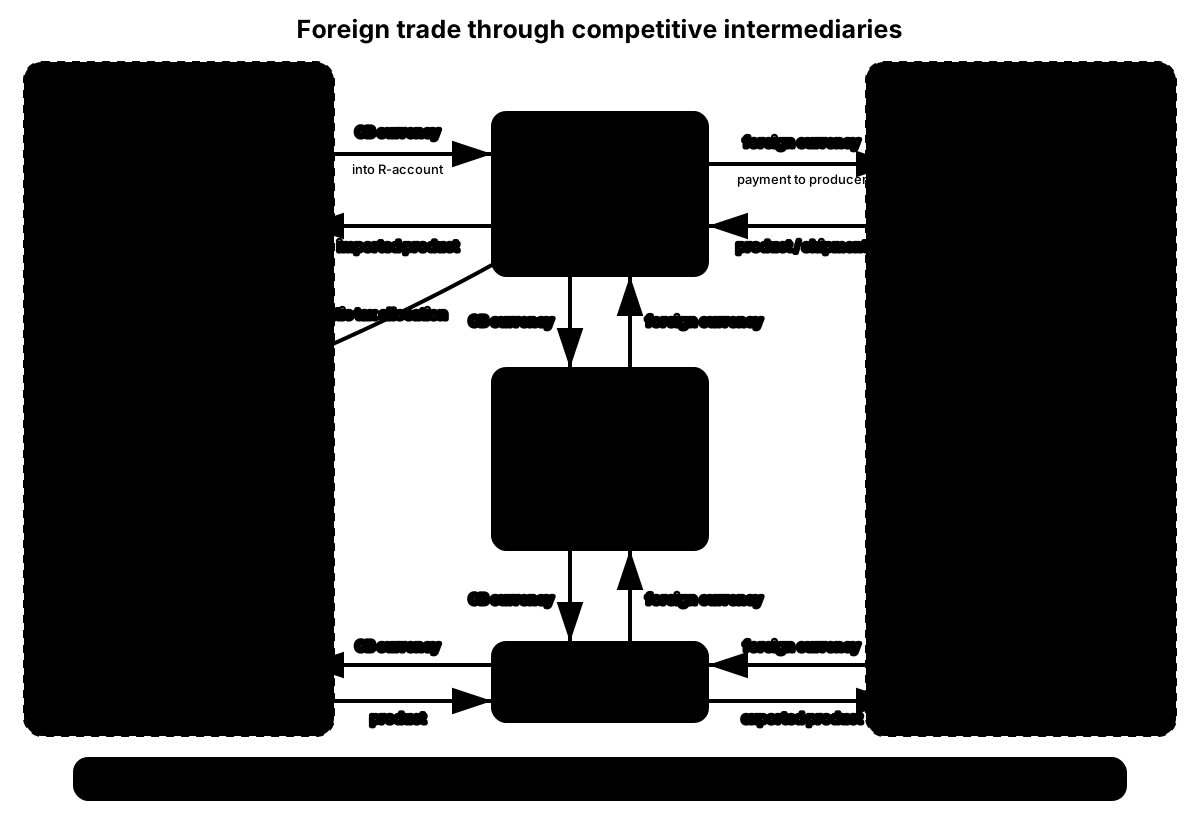
Import retailing, exporting, and currency exchange are competitive services, not State-appointed gateways. Any Person may offer one or more of these services by using accounts with the required Product Categories. A provider may specialise in one function or combine several, and importers, exporters, foreign producers, and purchasers may choose among competing providers. No intermediary receives an exclusive franchise or privileged position.
An import retailer connects a C-account purchaser to a foreign producer. It quotes a price in Central Bank currency, receives the purchaser's taxed external C → R payment, obtains foreign currency, and pays the foreign producer. Import retailers may compete on prices, margins, exchange rates, Product range, reliability, international payment, shipping, warehousing, delivery, warranties, returns, and customer support. A retailer need not hold inventory: it may arrange for the foreign producer to ship the Product directly to its destination. A foreign producer may supply or partner with any number of competing retailers. The retailer connects the two payment systems, so the foreign producer does not need to hold a Central Bank account or comply with VoTa account rules.
C-account purchasers can therefore encounter imported Products much like Products supplied within the VoTa economy. They see a price in Central Bank currency and make an ordinary C → R payment without having to arrange foreign-currency conversion, international payment, shipping, customs handling, or other logistics themselves. The import retailer handles whichever of those services the purchase requires while the CBPS collects consumption tax in the ordinary way.
An import retailer may instead acquire inventory before receiving a customer's payment. It uses an appropriately categorised B-account, funded with business capital or credit, to acquire foreign currency and buy Products for resale. Those purchases are untaxed productive transactions. Consumption tax is collected later when a purchaser buys the inventory through an external C → R payment.
Export intermediaries are also optional and competitive. A producer may export directly where the account rules permit or use an intermediary for access to foreign markets, marketing, sales, payment collection, currency conversion, shipping, logistics, warranties, returns, or customer support. Export intermediaries compete on their fees, exchange rates, market access, reliability, settlement speed, and the services they provide.
Currency exchanges supply foreign currency to importers and buy foreign-currency receipts from exporters. They may maintain foreign accounts, reserves, and counterparties in multiple currency markets, and pool transactions across many importers and exporters rather than matching each import to a particular export. The exchanges, rather than the Central Bank, are the foreign-currency counterparties. They earn revenue through fees or spreads and compete on rates, spreads, supported currencies, liquidity, settlement speed, reliability, and related services. Exchange rates emerge from competing bids, offers, and completed exchanges rather than being set by the Central Bank.
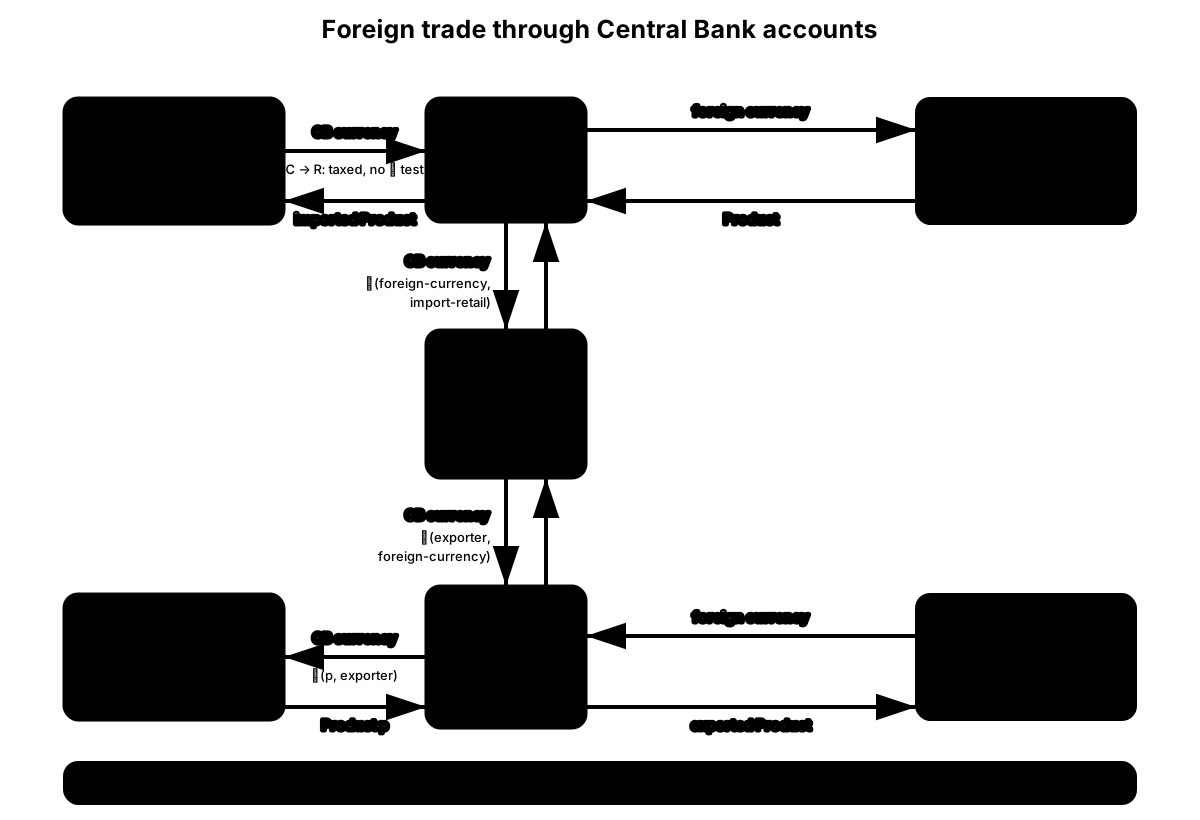
The same import and the corresponding productive foreign-trade flows can be described as four transfers of Central Bank currency. The yellow box is a C-account, blue boxes are B-accounts, and the red box is an R-account. Each B-account and R-account states its Product Category; the C-account has none. Green arrows show Central Bank currency, blue arrows show Products, and purple arrows show foreign currency.
import-retail R-account.
The external C → R transfer is permitted without a 𝜥 test, and the CBPS collects consumption tax.
import-retail R-account into the exchange's
foreign-currency B-account. This is permitted by
𝜥(foreign-currency, import-retail).
exporter B-account. This is permitted by
𝜥(exporter, foreign-currency).
exporter).
In every 𝜥 expression, Products flow from the first category to the second. The corresponding Central Bank currency flows in the opposite direction. These compatible business transfers are untaxed because they keep value within production and trade; consumption tax has already been collected on the purchaser's C → R payment.
All payments into a currency exchange's foreign-currency B-account through this route come from an
import-retail R-account. Internal transfers into R-accounts are blocked, and every ordinary external
transfer into an R-account is a taxable event. The retailer's R-account therefore holds only money received through
payments on which consumption tax has been collected.
That fact alone does not prevent tax evasion. The tax collected on a purchaser's C → R payment is the tax on the purchaser's consumption of the imported Product. The payment may include both the retailer's foreign acquisition cost and its markup. If the retailer may send the whole payment to a currency exchange, its owner can convert the markup into foreign currency and use it for their own consumption without first making the taxed payment required for that separate consumption. Repeated sales allow the retailer to accumulate and convert profits in this way.
Each import retailer must therefore maintain an auditable database reconciling every payment to a
foreign-currency B-account with both the taxed receipts from purchasers and purchases of foreign
Products.
For each payment from an import-retail R-account A to a currency exchange B-account B,
the database must identify the transaction, or the itemised parts of a batched transaction, being reconciled. Each
item must identify a backing external C → A transaction. A backing transaction may be used only once,
and the amount sent for conversion must not exceed the amount of the backing transaction. Distinct exchange-payment
items must not be backed by the same purchaser transaction.
The database must also record the foreign-Product purchases made with the foreign currency obtained. The whole foreign-currency amount must be matched to receipts, or itemised parts of receipts, for purchases from foreign producers. No receipt or part of a receipt may be counted more than once. Payments to an exchange and payments to foreign producers may be batched, provided that every component is itemised and the itemised amounts reconcile with the totals recorded for the corresponding transactions.
On request, the importer must submit the database and supporting receipts to the public service responsible for tax audits. The auditors may compare it with the CBPS transaction history for A, B, the backing C-accounts, and any other relevant Central Bank accounts. The CBPS records establish whether the referenced transactions occurred and confirm their account categories, parties, amounts, and times. The database and supporting receipts establish how the batched monetary transactions correspond to particular foreign Products.
Let \(A\) be an import-retail R-account and let \(B\) denote a
foreign-currency B-account. Define:
The database must define a function mapping every exchange-payment item to the taxed purchaser transaction that backs it:
\[ f:E_A\rightarrow C_A. \]
The amount sent for conversion must not exceed the amount of its backing transaction:
\[ \forall e\in E_A,\qquad a(e)\leq a\bigl(f(e)\bigr). \]
The function \(f\) must be injective:
\[ \forall e_1,e_2\in E_A,\qquad f(e_1)=f(e_2)\ \Longrightarrow\ e_1=e_2. \]
Consequently, a C → \(A\) transaction can back no more than one exchange-payment item. Once it has been used, no unused difference between \(a(f(e))\) and \(a(e)\) may back another payment to a currency exchange.
To reconcile the resulting foreign currency with purchases, the database must define:
\[ r:E_A\times P_A\rightarrow\mathbb{R}_{\geq 0}, \]
where \(r(e,p)\) is the amount of foreign currency obtained through exchange-payment item \(e\) and attributed to foreign purchase \(p\). The entire amount obtained through every exchange-payment item must be attributed to documented foreign purchases:
\[ \forall e\in E_A,\qquad \sum_{p\in P_A}r(e,p)=q(e). \]
No foreign receipt may be attributed beyond its recorded value:
\[ \forall p\in P_A,\qquad \sum_{e\in E_A}r(e,p)\leq v(p). \]
Every positive attribution must refer to a valid purchase of a foreign Product:
\[ r(e,p)>0\ \Longrightarrow\ \operatorname{ValidForeignProductPurchase}(p). \]
The validity record must identify the receipt, foreign producer, Product, amount, currency, and time, and provide the evidence required to establish that the transaction purchased a foreign Product through the import business rather than foreign currency or a Product for the retailer's own consumption.
Batched transfers are permitted. If an exchange transaction \(t\) contains the finite set \(I_t\) of itemised exchange payments, the database and CBPS totals must satisfy:
\[ a(t)=\sum_{e\in I_t}a(e). \]
If a payment to one or more foreign producers is represented by a batch \(u\) containing the finite set \(I_u\) of itemised foreign purchases, its total must likewise satisfy:
\[ v(u)=\sum_{p\in I_u}v(p). \]
Let \(D_A\) denote the database submitted by the importer and let \(H_A\) denote the relevant CBPS transaction history. The account complies with these reconciliation requirements exactly when the database agrees with that history, \(f\) is injective, and all the amount, purchase, and batching constraints above hold:
\[ \begin{aligned} \operatorname{Compliant}(A)\ \Longleftrightarrow\ {}& \operatorname{Consistent}(D_A,H_A)\\ &{}\land \operatorname{Injective}(f)\\ &{}\land \operatorname{AmountConstraints}(D_A)\\ &{}\land \operatorname{PurchaseConstraints}(D_A)\\ &{}\land \operatorname{BatchConstraints}(D_A,H_A). \end{aligned} \]
The database supplies \(f\), \(r\), the batch itemisation, and the evidence for the foreign purchases. The CBPS history independently establishes the existence, direction, accounts, amounts, and times of the Central Bank currency transactions. The database is therefore a collection of claims that can be checked against the authoritative monetary record rather than a replacement for that record.
This reconciliation makes each purchaser receipt available to support no more than one foreign-currency payment item and requires all foreign currency obtained through the route to be spent on recorded foreign Products. Once a purchaser receipt has backed an import payment, any difference between that receipt and the smaller import payment cannot back another conversion. The difference remains in the retailer's R-account as its margin and must pass through the ordinary taxed route if the owner later uses it for consumption.
Import retailers can perform substantial and valuable work. They may arrange international shipping, insurance, currency conversion, customs handling, warehousing, local delivery, warranties, returns, and dealings with foreign producers. The risks, capital, and services involved can reasonably produce a significant markup over the foreign acquisition cost of a Product.
The resulting margins can be very large in aggregate. An importer operating at the scale of a company such as Amazon may receive enormous retail revenue and earn vast profits even where its percentage margin is modest. The tax system must not allow such an importer to convert the markup into foreign currency and make it available for the owners' consumption without the separate consumption-tax payment that would apply if the profit passed through a C-account and was spent in the ordinary way.
A simpler system could omit foreign-Product receipts and product records entirely. The CBPS could enforce it
automatically by requiring every transaction \(t_1\) from an importer's import-retail R-account \(A\) to
a currency exchange's foreign-currency B-account \(B\) to be backed by a single external transaction
\(t_2\) from a consumer C-account into \(A\). If \(E_A\) is the set of \(A\) → \(B\) transactions and \(C_A\)
is the set of external C → \(A\) transactions, the importer must supply an injective function
\[ f:E_A\rightarrow C_A \]
satisfying
\[ \forall t_1\in E_A,\qquad a(t_1)\leq a\bigl(f(t_1)\bigr). \]
Because \(f\) is injective, two exchange transactions cannot use the same consumer transaction. It follows that
\[ \sum_{t_1\in E_A}a(t_1) \leq \sum_{t_2\in f(E_A)}a(t_2) \leq \sum_{t_2\in C_A}a(t_2). \]
The rule therefore prevents the importer from sending more Central Bank currency to exchanges than it has received through distinct taxed consumer transactions. It does not establish that the amount converted was required to buy the Products sold to those consumers. The following opportunities for tax evasion remain.
Transaction-only reconciliation is fully automatable and provides an aggregate limit on an importer's access to wholesale foreign currency. It cannot distinguish the foreign cost of a Product from the retailer's markup and cannot determine how the foreign currency is ultimately used. It therefore reduces the amount available for evasion but does not close the profit-conversion loophole.
A Citizen travelling abroad needs foreign currency to pay for accommodation, meals, transport, entertainment, and other Products consumed during the journey. Consumption tax does not apply because these Products are consumed outside the State Territory. The source of the money and the citizenship of the traveller do not change the place of consumption.
The foreign-travel category also covers education and medical services consumed while the Citizen is
physically outside the State Territory. A travel service may therefore arrange or pay for tuition for a course
attended abroad, treatment provided by a foreign hospital or practitioner, and accommodation or transport
associated with either purpose. Education delivered online or medical services delivered remotely to a Citizen
inside the State Territory are instead domestic consumption and must be paid for through an R-account.
The Citizen therefore needs a way to transfer Central Bank currency from an ordinary B-account to a travel service's B-account without incurring consumption tax. Allowing unrestricted access to wholesale currency exchanges, however, would also allow a Citizen to obtain foreign currency and use it to buy Products for consumption within the State Territory without paying consumption tax.
A wholesale currency exchange receives Central Bank currency through a B-account with the Product Category
foreign-currency. A Citizen normally holds income, including labour income and UBI, in an ordinary
B-account. A direct transfer from that account to the exchange is rejected because the categories of the two
accounts do not describe a realistic production relationship.
For example, a transfer from a labour B-account to a foreign-currency B-account would
require 𝜥(foreign-currency, labour) to be true. It is false because foreign currency is
not an input into supplying labour. The CBPS cannot determine from the attempted transfer whether the foreign
currency would fund travel abroad or an untaxed Product consumed at home, so it does not permit the transfer.
Competitive retail travel services provide the legitimate route between a Citizen's Central Bank currency and foreign expenditure. These services may include travel agencies, airlines, tour operators, accommodation and transport booking services, travel-card providers, foreign-currency wallets, and suppliers of foreign cash. Any Person may provide such a service by accepting the Central Bank account owner contract and using accounts with the required Product Categories.
A Citizen making travel arrangements transfers Central Bank currency from an ordinary B-account to the retail
travel service's foreign-travel B-account. The purpose-recorded gateway permits this transfer without
collecting consumption tax. The travel service obtains foreign currency from a wholesale exchange and uses or
supplies it for the journey. It may pay foreign providers directly, issue a payment card or wallet for use
abroad, reimburse expenditure made abroad, or provide foreign cash.
The travel service uses a B-account with the Product Category foreign-travel. It can pay the
exchange's foreign-currency B-account because foreign currency is an input into the travel service:
𝜥(foreign-currency, foreign-travel) is true. The wholesale exchange performs currency
conversion without deciding whether an individual customer's journey or expenditure is legitimate.
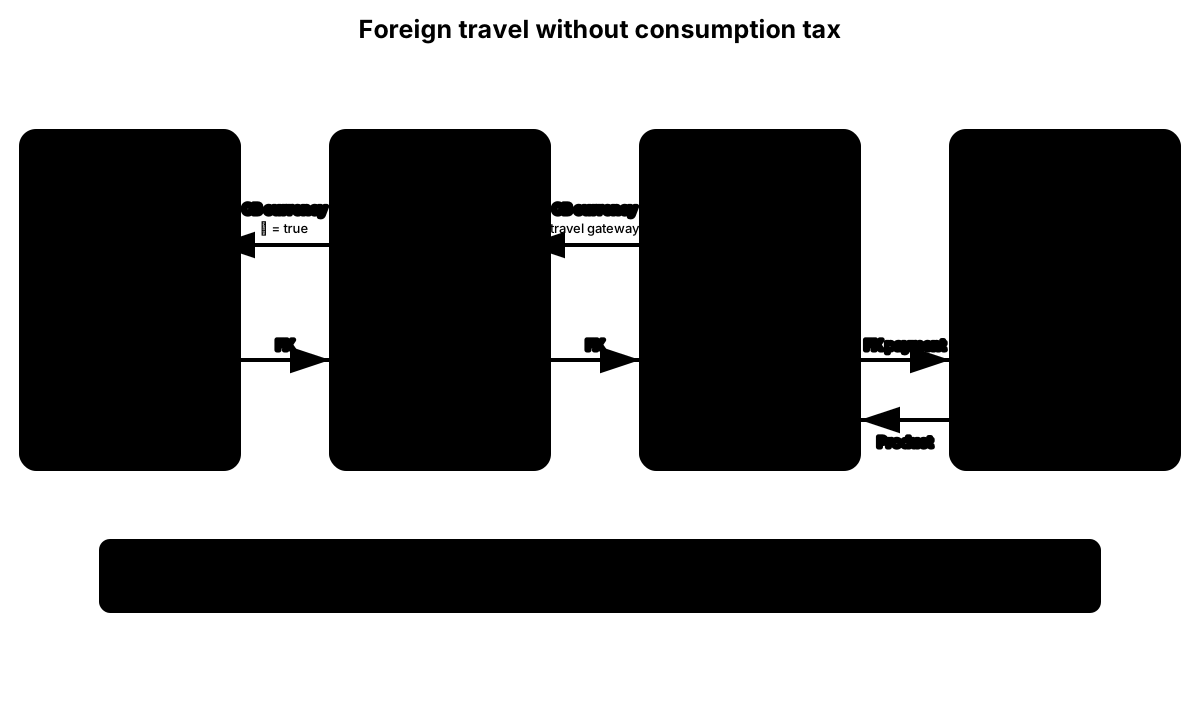
The Citizen's payment to the travel service is a purpose-recorded gateway transfer. It is not an ordinary
B → B production transfer and does not assert that travel is an input into the activity represented by the
Citizen's B-account. It is a constitutionally permitted transfer from a Citizen's balance into a
foreign-travel account for consumption outside the State Territory.
The gateway is limited to the stated foreign purpose. It does not make an ordinary B-account compatible with a
foreign-currency account and does not give the Citizen direct access to wholesale conversion. The
retail travel service remains between the Citizen and the exchange and is responsible for ensuring that its
accounts are used for foreign travel.
The travel service connects the untaxed transfer to an identifiable journey. Depending on the service being provided, its records may include the traveller, destination, travel dates, tickets, bookings, foreign providers, currencies supplied, and transactions made using a travel card or wallet. The service need collect only the information reasonably required for the arrangement it offers.
Direct payment to a foreign airline, hotel, railway, or vehicle-hire provider creates a particularly clear connection with travel. A travel card limited by location or travel dates also provides evidence of its foreign use. Foreign cash is less traceable but remains legitimate because travellers may need cash where electronic payments are unavailable or undesirable.
Retail travel services compete over exchange rates, fees, convenience, privacy, supported currencies, payment methods, insurance, refunds, customer service, and the amount of evidence they require. No political authority sets exchange rates, selects providers, or grants a limited number of travel-service licences.
The exemption follows the place of consumption, not the description attached to the payment. A meal eaten abroad, a foreign hotel room, and transport used during the journey are not taxed. A Product bought from a foreign seller for consumption within the State Territory must still be paid for through an R-account.
The same rule applies when a Citizen buys a Product while travelling. A Product consumed during the journey is outside the tax base. A Product bought with the intention of bringing or sending it home for consumption within the State Territory requires an R-account payment. If the intended use changes only after purchase, the Citizen must use the tax-settlement procedure before domestic consumption.
A Citizen breaches the citizenship contract by falsely presenting domestic consumption as foreign travel. A travel service or exchange breaches the Central Bank account owner contract if it knowingly participates in that arrangement. The CBPS blocks the simple direct route, while records held by the retail service provide evidence where evasion requires false declarations or collusion.
A traveller may retain unused foreign currency for a later journey or sell it through a travel service. Merely holding foreign currency is not consumption and creates no tax liability. If it is later used to acquire a Product for consumption within the State Territory, the ordinary R-account and tax-settlement rules apply.
A Citizen may use savings held in a B-account to acquire foreign shares, bonds, fund units, deposits, business interests, loans, and other investments. Exchanging currency for an asset is not consumption and does not incur consumption tax. The fact that the asset, issuer, seller, or custodian is outside the State Territory does not alter that treatment.
Foreign investment commonly requires foreign currency. The Citizen therefore needs a route from an ordinary B-account to a foreign investment without turning every ordinary B-account into an unrestricted source of foreign currency that could be used for untaxed consumption.
A wholesale currency exchange receives Central Bank currency through a B-account with the Product Category
foreign-currency. A direct transfer from a Citizen's ordinary B-account is rejected because the
categories of the two accounts do not describe a realistic production relationship.
For example, a transfer from a labour B-account to a foreign-currency B-account would
require 𝜥(foreign-currency, labour) to be true. It is false because foreign currency is
not an input into supplying labour. The CBPS cannot determine from the transfer alone whether the currency would
fund an investment, foreign consumption, or an untaxed Product intended for consumption at home.
Competitive foreign-investment services provide the legitimate route between a Citizen's B-account and foreign assets. These services may include brokers, investment platforms, custodians, foreign fund services, foreign deposit services, international lending services, and services for acquiring interests in foreign businesses. Any Person may provide such a service by accepting the Central Bank account owner contract and using accounts with the required Product Categories.
A Citizen transfers Central Bank currency from an ordinary B-account to the investment service's
foreign-investment B-account. A purpose-recorded foreign-investment gateway permits the transfer
without collecting consumption tax. The service then obtains foreign currency from a wholesale exchange and
uses it to acquire the specified foreign asset.
The investment service can pay the exchange's foreign-currency B-account because foreign currency is
an input into foreign investment: 𝜥(foreign-currency, foreign-investment) is true. The
wholesale exchange performs currency conversion without investigating the Citizen, assessing the investment, or
deciding whether it is prudent.
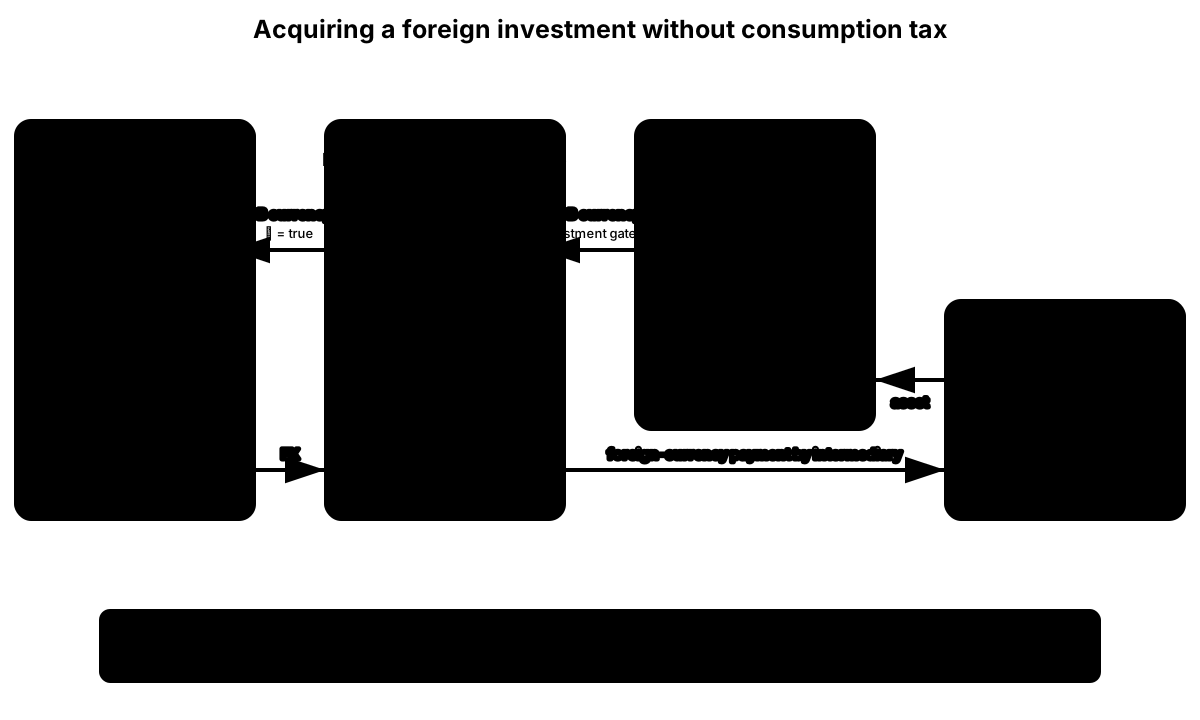
The Citizen's payment to the investment service is a purpose-recorded gateway transfer. It is not an ordinary
B → B production transfer and does not assert that foreign investment is an input into the activity
represented by the Citizen's B-account. It is a constitutionally permitted transfer from a Citizen's balance
into a foreign-investment account for the acquisition of an asset rather than consumption.
The gateway does not make an ordinary B-account compatible with a foreign-currency account. The
investment service remains between the Citizen and the wholesale exchange and is responsible for ensuring that
its foreign-investment account is used to acquire, hold, manage, or dispose of investments.
The investment service connects the untaxed transfer to an identifiable asset transaction. It may register an asset directly in the Citizen's name, arrange custody, acquire units in a fund, place money in a foreign deposit, purchase shares or bonds, lend to a foreign Person, or acquire an ownership interest on the Citizen's behalf.
Its records may identify the investor, asset, quantity, price, currency, issuer, seller, broker, custodian, and settlement transaction. These records establish that the foreign currency purchased with Central Bank currency was exchanged for an asset rather than released for unrelated consumption. The service does not determine whether the investment represents good value or an acceptable risk.
An investment service may offer direct registration, pooled custody, nominee custody, or another contractual holding arrangement. In every case the Citizen owns the resulting property or enforceable beneficial interest. Failure of the intermediary remains governed by its contracts, custody arrangements, property rights, and ordinary liability law.
An investment service may retain foreign currency temporarily for settlement, reinvestment, fees, or expected asset purchases. It may also provide a foreign-currency balance within an investment account. The balance must remain connected to investment activity rather than becoming an unrestricted substitute for direct wholesale conversion.
The service may therefore pay an asset seller or custodian directly, restrict outgoing payments to investment counterparties, or return the value to the Citizen by selling the foreign currency and crediting Central Bank currency to a B-account. Simply handing unrestricted foreign currency to the Citizen would remove the connection between the gateway transfer and its investment purpose.
Foreign investments may produce dividends, interest, rent, repayments, distributions, or sale proceeds in foreign currency. These receipts are returns on property rather than consumption. The investment service may reinvest them, retain them within the foreign investment account, use them to meet investment expenses, or sell them through a wholesale exchange.
When foreign currency is sold, the exchange transfers Central Bank currency to the investment service's
foreign-investment B-account. The service may then transfer the proceeds to the Citizen's B-account.
Neither the return of capital nor investment income incurs consumption tax. Consumption tax applies only if the
Citizen later uses the resulting purchasing power for taxable consumption.
Foreign-investment services compete over exchange rates, brokerage and custody fees, supported markets and assets, execution quality, privacy, reporting, risk controls, insurance, and contractual protection. No political authority approves investments, selects providers, limits entry, guarantees returns, or protects favoured domestic industries from foreign competition for capital.
A Citizen bears the gains and losses arising from the investment and the chosen contractual arrangements. Fraud, misappropriation, false statements, breach of custody obligations, and unauthorised use of assets remain subject to ordinary law.
The exemption follows the economic use of the transaction, not the word investment. Shares, bonds, business loans, and fund units are ordinarily clear examples of assets. Other Products may serve both as assets and as objects of personal use or enjoyment, including foreign homes, vehicles, boats, jewellery, art, collectables, and wine.
A foreign property rented to others may be an investment, while accommodation used personally by the Citizen is consumption outside the State Territory. A vehicle bought abroad and brought home for private use is domestic consumption. An object acquired as an investment and later used or enjoyed within the State Territory may require tax settlement before that domestic consumption begins.
A Citizen breaches the citizenship contract by falsely presenting consumption as foreign investment. An investment service or exchange breaches the Central Bank account owner contract if it knowingly participates in that arrangement. The CBPS blocks direct access to wholesale conversion, while the investment service's asset and settlement records provide evidence where evasion requires a false transaction or collusion.
A Citizen may transfer money to a Person outside the State Territory without acquiring a Product or asset in return. The transfer may be a gift, family support, a charitable contribution, repayment of a private debt, or a movement of money between accounts owned by the same Person. Transferring money is not consumption and does not incur consumption tax.
The foreign recipient may later use the money for consumption, saving, investment, or another purpose. That later decision does not transform the Citizen's remittance into consumption within the State Territory.
A wholesale currency exchange receives Central Bank currency through a B-account with the Product Category
foreign-currency. A direct transfer from a Citizen's ordinary B-account is rejected because the
categories of the two accounts do not describe a realistic production relationship.
For example, a transfer from a labour B-account to a foreign-currency B-account would
require 𝜥(foreign-currency, labour) to be true. It is false because foreign currency is
not an input into supplying labour. The CBPS cannot determine from the transfer alone whether the foreign
currency would fund a genuine remittance or an untaxed purchase from a foreign seller.
Competitive foreign-remittance services provide the legitimate route between a Citizen's B-account and a foreign recipient. They may deposit money into a foreign account, credit a mobile wallet, arrange cash collection, use a foreign remittance network, or transfer money to an account owned by the Citizen abroad. Any Person may provide such a service by accepting the Central Bank account owner contract and using accounts with the required Product Categories.
A Citizen transfers Central Bank currency from an ordinary B-account to the remittance service's
foreign-remittance B-account. A purpose-recorded foreign-remittance gateway permits the transfer
without collecting consumption tax. The service obtains foreign currency from a wholesale exchange and sends
the foreign value to the identified recipient.
The remittance service can pay the exchange's foreign-currency B-account because foreign currency is
an input into its service: 𝜥(foreign-currency, foreign-remittance) is true. The wholesale
exchange performs currency conversion without investigating the relationship between the sender and recipient
or deciding whether the transfer is worthwhile.
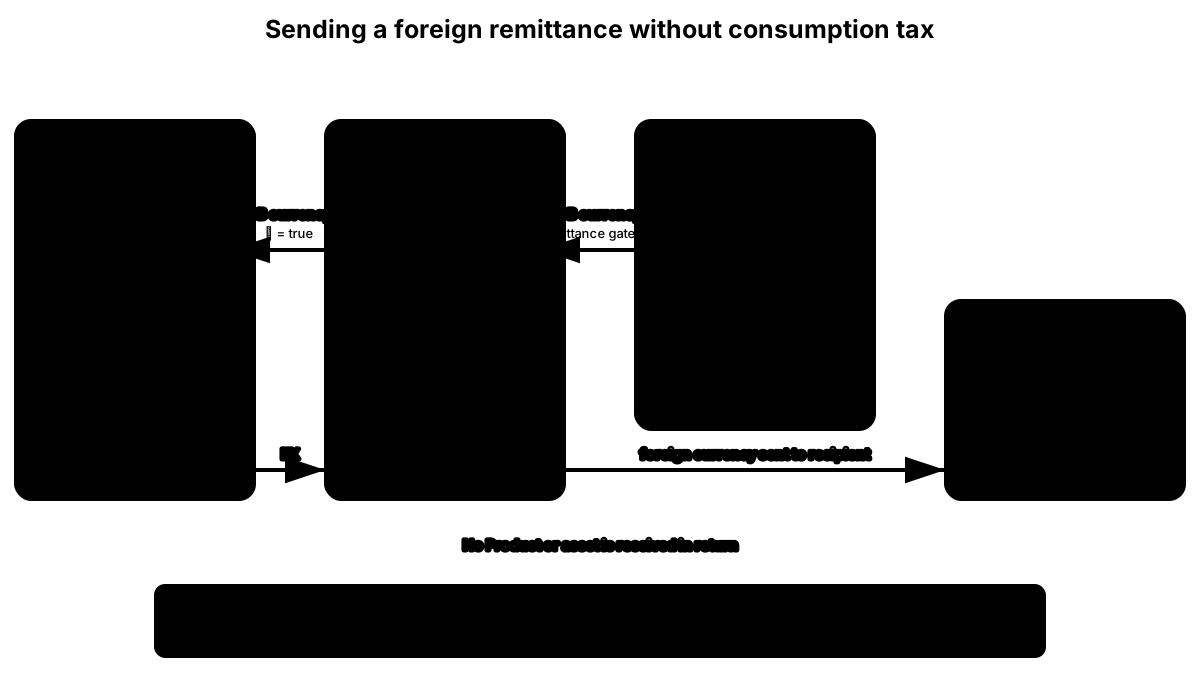
The Citizen's payment to the remittance service is a purpose-recorded gateway transfer. It is not an ordinary
B → B production transfer and does not assert that a remittance is an input into the activity represented by
the Citizen's B-account. It is a constitutionally permitted transfer from a Citizen's balance into a
foreign-remittance account for transferring value rather than acquiring consumption.
The gateway does not make an ordinary B-account compatible with a foreign-currency account. The
remittance service remains between the Citizen and the wholesale exchange and is responsible for ensuring that
its foreign-remittance account is used to transfer money to identifiable foreign recipients.
The remittance service connects the untaxed gateway transfer to a foreign settlement. Its records may identify the sender, recipient, destination, amount, currency, receiving account or wallet, cash-collection service, and the corresponding foreign settlement transaction. These records establish that the service transferred value to a recipient rather than paying an undisclosed merchant on the Citizen's behalf.
The recipient does not need a Central Bank account or a contractual relationship with the State. The remittance service may use foreign banks, payment systems, agents, wallets, or cash networks according to its own contracts and the service selected by the Citizen.
A foreign Person may likewise send money to a Citizen. A remittance service receives the foreign currency and
may sell it through a wholesale exchange. The exchange transfers Central Bank currency to the service's
foreign-remittance B-account, from which the service credits the Citizen's B-account.
Receiving a gift, repayment, family transfer, or movement of the Citizen's own money is not consumption and does not incur consumption tax. Once credited, the balance is ordinary Central Bank currency. If the Citizen later uses it for consumption within the State Territory, that later purchase follows the ordinary consumption-tax rules.
A Citizen may remit money to an account, wallet, or custody arrangement that the Citizen owns outside the State Territory. Changing the location or currency in which property is held is not consumption. The remittance service records the foreign destination in the same way as it records a transfer to another recipient.
Money held abroad may subsequently fund travel, investment, gifts, or consumption. If the Citizen instead uses it to acquire a Product for consumption within the State Territory while bypassing the required taxable payment route, the original legitimacy of the remittance does not excuse that later breach.
The absence of consumption tax follows the economic arrangement, not the payment description. Sending money to a relative abroad is a remittance. Paying a foreign merchant for a Product intended for consumption within the State Territory is a purchase, even if the Citizen describes the payment as a remittance.
A nominal recipient may also act as the Citizen's purchasing agent by receiving money, buying a Product, and sending it home. The CBPS cannot infer that wider arrangement from the currency transfer alone. Evidence from the recipient, merchant, shipping service, communications, or repeated transaction pattern may establish false declarations or collusion.
A Citizen breaches the citizenship contract by falsely presenting a purchase as a remittance. A remittance service or exchange breaches the Central Bank account owner contract if it knowingly participates in that arrangement. The service is not responsible merely because a recipient independently decides how to use money after a genuine transfer.
Foreign-remittance services compete over exchange rates, fees, transfer speed, supported destinations and currencies, bank deposits, wallets, cash collection, privacy, refunds, fraud protection, and customer service. No political authority approves personal transfers, selects providers, fixes exchange rates, or grants a limited number of remittance licences.
All tax-compliant resident citizens aged 18 and over receive the same Universal Basic Income (UBI). Children receive a smaller amount, managed by a parent or guardian. UBI therefore only discriminates by age, tax‑compliance, residency, and citizenship, criteria explicitly permitted as exceptions of the NDP. Every person registers an account with the tax office to receive the UBI.
The UBI is automatically collected and distributed daily. UBI is unconditional and therefore can be fully automated, unlike welfare systems which require armies of public servants to administer (due to means testing - in other words, being conditional on factors such as income, assets, disabilities, dependents, marital status, underemployment, and job‑seeking).
UBI is endogenous to daily economic activity, not an externally fixed promise. It is inherently affordable in this system because its value is calculated directly from the pool of revenue collected each day. The amount available for distribution rises or falls with aggregate daily consumption, so the UBI adjusts automatically to match what the economy can sustainably fund. When total consumption increases, the pool grows and the UBI rises; when consumption falls, the UBI decreases. At no point does the system promise more than what was actually collected, which is why affordability is guaranteed.
The consumption‑tax rate \( R_{\mathrm{ubi}} = 0.2 \) funds the UBI and produces a substantial income floor, even for households with no earnings. For a single parent with three children, this translates into roughly $38 000–$60 000 of disposable income, depending (only) on the children’s ages. In many cases this exceeds the disposable income delivered by Australia’s current welfare system, which provides around $44 000 for the same household (depending on complex eligibility rules) when child‑care subsidies and rent assistance are excluded.
The NDP does not prevent services for those with illnesses, injuries, infirmities, or disabilities. Someone can therefore receive an expensive medical procedure, such as a heart transplant, for free when it is needed to save their life.
Other essential services can be universal. Services providing basic food or shelter may be open to everyone, but in practice will be used mainly by people who cannot readily provide these things for themselves. They concentrate help where it is needed without means tests, eligibility categories, or bureaucrats deciding who deserves assistance. They have the effect of targeted welfare without violating the NDP.
Bryan Caplan argues that a UBI generous enough to replace the welfare state would be prohibitively expensive, while a smaller UBI would leave people with exceptional needs worse off. This assumes that UBI must replace essential services as well as welfare payments. VoTa makes no such assumption. The UBI provides a universal income floor, universal services provide essentials such as food and shelter, and services for illness, injury, infirmity, and disability remain available according to need.
This combination, an unconditional income floor plus unconditional access to essential services, is exactly what the Non‑Discrimination Principle requires. It eliminates the eligibility tests, behavioural conditions, and incentive distortions that characterise existing welfare systems worldwide, and replaces them with a system that treats all individuals equally while ensuring that no one is denied the means of basic survival.
The UBI is a constitutional baseline, not a complete State policy for poverty, unemployment, or social support. Beyond it, taxpayers may fund competing NDP-compatible approaches through tax choice, including universal essential services, training, rehabilitation, and public services containing low-skill work. VoTa allows these approaches to coexist and gain or lose support according to their practical results rather than selecting one political programme for the whole population.
If investment and net exports are set aside, UBI funding is approximately 15.4 per cent of market-price GDP. Let \(C\) be tax-inclusive taxable consumption. UBI receives \(0.20C\), while expenditure on public services is \(G=0.30C\). Under those assumptions, \(GDP_{\mathrm{market}}=C+G=1.30C\), and therefore:
\[ \frac{0.20C}{1.30C}\approx 15.4\%\text{ of market-price GDP}. \]
Market-price GDP includes the consumption tax contained in \(C\). In VoTa, \(0.50C\) is consumption tax: \(0.30C\) for public services and \(0.20C\) for UBI. Basic-price GDP excludes taxes on products, so:
\[ GDP_{\mathrm{basic}}=1.30C-0.50C=0.80C, \] \[ \frac{0.20C}{0.80C}=25\%\text{ of basic-price GDP}. \]
UBI itself is a transfer and is not counted separately in GDP. It enters GDP when recipients spend it, as part of \(C\). Basic-price GDP provides the fairer comparison with countries that raise most government revenue through income taxes, because income tax is not included in market-price GDP.
Since UBI and public services are offered to everyone equally and are sufficient for full, meaningful lives, none of the following are needed:
Therefore there is no need to define what it means to be retired, injured, to have a disability, to have insufficient work, to be actively looking for work, to have dependents, etc.
This keeps the system very simple and fair and eliminates most of the bureaucracy. It is no longer possible to have cases where two people are in only slightly different situations and only one receives welfare.
Although bureaucrats are generally well meaning, they each operate in their own narrow domain, often isolated from the lived reality of the people they regulate. They try to make things fair by making things more complicated, but the result is a system full of special cases that is complicated, unfair, and allows public servants to make too many decisions about people’s lives and to impose their idea of morality on others. It is undemocratic and discriminatory. Many of these bureaucrats will fight to retain their discretionary power over people, often because they naively believe they are helping.
Giving all citizens the same base allowance avoids all the complexity around defining how support should vary according to assets, income, or any other measures. No matter how complicated well‑meaning politicians try to make it, it still will not be fair in all cases. For example, someone retired and living in a house that has become very expensive since they bought it 50 years ago might fail an assets test and yet have no income. We do not want a society where they are forced to sell their home in order to survive.
The constitution requires the state to be non-discriminatory. This implies:
It is also hard to imagine how a wealth tax that targets rich people could work if tax compliance is optional.
By contrast the constitution allows:
It might be thought that this makes the tax system regressive, but that is not the case at all, when one treats the UBI as a negative tax offset.
Some people argue that UBI isn't such a great idea because parents may spend the money on drugs, rather than on food for their children, and therefore argue in favour of food stamps. However, that confuses different issues. Parents that don't look after their children adequately are violating their duty of care, and the state should be stepping in to prevent that from happening (and in such cases it may even be the case that a court orders part of the UBI be directed into food). In this way coercion is used in exactly the cases where it is warranted. The idea that the state should by default treat its own citizens as though they are incapable of making good decisions about what's best for themselves - i.e. acting in their own self-interest is rejected.
UBI is unconditional and therefore can be fully automated, unlike welfare systems which require many thousands of public servants to administer (due to means testing - in other words, being conditional on many factors relating to income, assets, proof of looking for work etc).
From the constitution:
Constant Value Description \(R_{\mathrm{svc}}\) 0.30 The fraction of each tax-inclusive monetary payment allocated as consumption tax dedicated to funding public services. \(R_{\mathrm{ubi}}\) 0.20 The fraction of each tax-inclusive monetary payment allocated as consumption tax dedicated to funding the Universal Basic Income (UBI). This establishes the degree of redistribution from higher‑consumption to lower‑consumption citizens. \(f_{\mathrm{start}}\) 0.50 The base UBI weighting for children from birth. \(a_{\mathrm{ramp}}\) 13 The age at which the UBI weighting begins to increase linearly. \(a_{\mathrm{adult}}\) 18 The age at which a citizen reaches full UBI weighting (1.0).
- For any monetary payment received into an R‑account at tax-inclusive price p, the component of consumption tax allocated to UBI equals: \[ T_{\mathrm{ubi}} = T_{\mathrm{ext}} + p\,R_{\mathrm{ubi}}. \] Here \(T_{\mathrm{ext}}\) denotes the externality cost (e.g., pollution) associated with that supply.
- The total UBI pool generated by \(T_{\mathrm{ubi}}\) shall be distributed to all citizens. The individual payment \(U_{i}\) for a citizen \(i\) of age \(a_i\) is determined by the formula: \[ U_{i} = \frac{\sum T_{\mathrm{ubi}}}{\sum W(a_j)} \times W(a_i) \]
where \( W(a) \) is the UBI weighting factor by age \(a\):
\[ W(a) = \begin{cases} f_{\mathrm{start}} & 0 \le a \lt a_{\mathrm{ramp}} \\ f_{\mathrm{start}} + (1 - f_{\mathrm{start}}) \frac{a - a_{\mathrm{ramp}}}{a_{\mathrm{adult}} - a_{\mathrm{ramp}}} & a_{\mathrm{ramp}} \le a \lt a_{\mathrm{adult}} \\ 1.0 & a \ge a_{\mathrm{adult}} \end{cases} \]- For any monetary payment received into an R‑account at tax-inclusive price p, the component of consumption tax allocated to public services is: \[ T_{\mathrm{svc}} = p\,R_{\mathrm{svc}}. \]
The "Teenage Raise" under the constants \( f_{\mathrm{start}} = 0.5, a_{\mathrm{ramp}} = 13, a_{\mathrm{adult}} = 18 \) given in the constitution:
The affect of the age dependent UBI is to help families. Note that the UBI depends on age. It doesn't depend on when a child leaves their parents. Dependency determines whether a guardian has control over a person's UBI, it doesn't affect how much UBI is given to a person. That only depends on age. That prevents traps such as entitlement to a person changing when they leave their parents, which for example might cause a child to be forced to stay in a violent home.
The consumption‑tax rates \(R_{\mathrm{svc}}\) and \(R_{\mathrm{ubi}}\) are on tax-inclusive prices. This can be a source a confusion, because often consumption tax rates are defined on tax-exclusive prices. For example, Australia has 10% GST on tax-exclusive prices, which corresponds to about 9.1% on tax-inclusive prices.
The inclusive and exclusive tax rates are related as follows:
\[ t_\text{exclusive} = \frac{t_\text{inclusive}}{1 - t_\text{inclusive}} \] \[ t_\text{inclusive} = \frac{t_\text{exclusive}}{1 + t_\text{exclusive}} \]Because both \(R_{\mathrm{svc}}\) and \(R_{\mathrm{ubi}}\) are defined on the same tax‑inclusive base, they add linearly. This would not hold if the rates were defined on a tax‑exclusive base. The total consumption tax is 0.2 + 0.3 = 0.5 (i.e. 50%) on tax-inclusive prices. This corresponds to 100% on tax-exclusive prices.
Note that inclusive rates can approach 100%, while exclusive rates blow up to infinity as the inclusive rate approaches 100%.
The VoTa system allocates a uniform consumption tax rate \( R_{\mathrm{tot}} \) across two destinations: a universal basic income (UBI) component and a services component. The following derivations assume:
Under these assumptions, each individual’s tax base is their total consumption \( C_i \), which equals their pre-tax income \( Y_i \) plus their UBI \( U \).
| Parameter | Description |
|---|---|
| \( R_{\mathrm{tot}} = R_{\mathrm{ubi}} + R_{\mathrm{svc}} \) | Total consumption tax rate, decomposed into the UBI component and the services component. |
| \( N \) | Total number of persons in the state. |
| \( Y_i \) | Pre-tax, pre-transfer income of person \( i \) (wages, salary, business income, etc.). |
| \( \overline{Y} = \frac{\sum Y_i}{N} \) | Mean pre-tax, pre-transfer income. |
| \( C_i = Y_i + U \) | Tax-inclusive consumption of person \( i \), assuming all income and UBI are consumed. |
| \( T_i = R_{\mathrm{tot}} C_i \) | Consumption tax paid by person \( i \). |
The UBI is funded by the UBI component of the consumption tax. Total UBI revenue is \( R_{\mathrm{ubi}} \sum C_i \). Dividing by the population \(N\) gives the UBI per person:
\[U = R_{\mathrm{ubi}} \frac{\sum C_i}{N}.\]
Using the tax‑inclusive identity \( C_i = Y_i + U \), we obtain
\[U = R_{\mathrm{ubi}} \frac{\sum (Y_i + U)}{N}= R_{\mathrm{ubi}}(\overline{Y} + U).\]
Solving for \(U\):
\[U = \overline{Y}\,\frac{R_{\mathrm{ubi}}}{1 - R_{\mathrm{ubi}}}.\]
This expression is the closed‑form sum of a geometric series representing the recursive self‑funding of UBI inside a tax‑inclusive system:
\[U = \overline{Y}\left(R_{\mathrm{ubi}} + R_{\mathrm{ubi}}^2 + R_{\mathrm{ubi}}^3 + \cdots\right).\]
Thus the UBI is mechanically determined by the UBI tax rate and mean income; it is not an independent policy choice.
In a pure consumption‑tax system, disposable income and tax‑exclusive consumption coincide. Disposable consumption for person \(i\) is defined as consumption minus tax:
\[ C_i^{\mathrm{disp}} = C_i - T_i. \]Since the total consumption‑tax rate is \(R_{\mathrm{tot}}\), the tax paid is \(T_i = R_{\mathrm{tot}} C_i\), giving
\[ C_i^{\mathrm{disp}} = (1 - R_{\mathrm{tot}})\, C_i. \]Using the tax‑inclusive identity \(C_i = Y_i + U\), disposable consumption decomposes into disposable UBI plus net‑of‑tax earned income:
\[ C_i^{\mathrm{disp}} = U^{\mathrm{disp}} + (1 - R_{\mathrm{tot}})\, Y_i, \]where the disposable UBI is
\[ U^{\mathrm{disp}} = (1 - R_{\mathrm{tot}})\, U. \]Thus the disposable income \(C_i^{\mathrm{disp}}\) is an affine (straight‑line) function of gross income \(Y_i\), with:
Here, “effective” means that transfers are treated as part of the tax system. The effective marginal tax rate (EMTR) is the marginal tax taking transfers into account, and the effective tax rate (ETR) is the average tax taking transfers into account.
The Effective Marginal Tax Rate (EMTR) is defined as the derivative of tax paid with respect to income:
\[ \text{EMTR}_i = \frac{dT_i}{dY_i} = R_{\mathrm{tot}}. \]The derivative describes the rate applied to a small change in income. Actual tax amounts are calculated in integer currency units.
Because the tax is levied uniformly on total consumption, the EMTR is constant and equal to the total consumption‑tax rate.
A flat tax ensures that for every extra dollar earned, the same percentage is taken in tax. You always keep a consistent percentage of your additional earnings, which is a clear and consistent incentive to work more hours and earn more.
The Effective Tax Rate (ETR) is an average tax rate and is defined as total tax paid divided by gross income:
\[ \text{ETR}_i = \frac{Y_i - C_i^{\mathrm{disp}}}{Y_i} = R_{\mathrm{tot}} - \frac{U^{\mathrm{disp}}}{Y_i}. \]The ETR falls with income because the disposable UBI \(U^{\mathrm{disp}}\) reduces the average tax burden more for low‑income individuals than for high‑income individuals. In other words, the UBI is progressive in average-rate terms.
The average per‑person allocation to services \(S\) is determined by the service share of the consumption tax. Total service revenue is \(R_{\mathrm{svc}} \sum C_i\), so dividing by the population \(N\) gives
\[ S = \frac{R_{\mathrm{svc}} \sum C_i}{N}. \]Using the tax‑inclusive identity \(C_i = Y_i + U\), this becomes
\[ S = R_{\mathrm{svc}}(\overline{Y} + U). \]Unlike the UBI, the purchasing power of \(S\) is not reduced by a factor of \((1 - R_{\mathrm{tot}})\). There is no distinction between a “nominal” and a “disposable” funding level for services. Service funding flows directly to operators and their suppliers via transfers into B‑accounts, which do not trigger consumption tax. As a result, \(S\) retains full purchasing power over intermediate inputs.
The relative strength of service funding compared to UBI can be expressed directly in terms of their constitutional shares. Each dollar of UBI, \(U\), is spent as taxed consumption and therefore has real purchasing power \(U(1 - R_{\mathrm{tot}})\). By contrast, each dollar of service funding, \(S\), is spent on intermediate inputs via B‑accounts and retains its full value. Hence, per unit of tax‑inclusive private consumption, the ratio of real redistribution through services versus UBI is
\[ \frac{\text{purchasing power for services}}{\text{purchasing power of UBI}} = \frac{R_{\mathrm{svc}}}{R_{\mathrm{ubi}}(1 - R_{\mathrm{tot}})}. \]For example, with \(R_{\mathrm{ubi}} = 0.2\) and \(R_{\mathrm{svc}} = 0.3\), and thus \(R_{\mathrm{tot}} = 0.5\), this ratio is \(\frac{0.3}{0.2 \cdot (1 - 0.5)} = 3\), meaning that, in real terms, the service allocation is three times stronger than the UBI redistribution.
These relationships highlight three structural features of VoTa:
Under standard simplifying assumptions (no savings, no intermediate consumption tax, and competitive pricing), a flat income tax at rate is equivalent to a flat consumption tax at the same rate on tax-inclusive prices. Both systems ultimately tax the same base, factor income, and therefore produce identical net incomes and government revenue.
The following is an example where there is a supplier A of an intermediate product I and a seller B of a final product F. The only difference between the two columns is how the $4 final price is decomposed into intermediate prices, factor incomes, and tax. In both systems A and B end up with $1 each, and the tax office receives $2.
| Parameter | 50% flat income tax | 50% flat consumption tax on final goods |
|---|---|---|
| price of I (before any tax) | $2 | $1 |
| income tax on A | 50% x income = 50% x $2 = $1 | $0 |
| consumption tax on I | $0 | $0
(because only final goods are taxed) |
| net income to A = gross income - tax | $2 - $1 = $1 | $1 - $0 = $1 |
| price of F including any consumption tax | $4 | $4 |
| gross income to B = sales - costs | $4 - $2 = $2 | $4 - $1 = $3 |
| income tax to B | 50% x income = 50% x $2 = $1 | $0 |
| consumption tax on F | $0 | 50% x price = 50% x $4 = $2 |
| net income to B = gross income - tax | $2 - $1 = $1 | $3 - $2 = $1 |
This result follows from Atkinson, A. B., & Stiglitz, J. E. (1976). “The Design of Tax Structure: Direct versus Indirect Taxation.” Journal of Public Economics, 6(1–2), 55–75.
| Major category | Spending (AUD billion) | Percentage of government spending |
|---|---|---|
| Social security and welfare | $290.9 | 37.0% |
| Health | $124.8 | 15.9% |
| General purpose inter-governmental transactions | $99.9 | 12.7% |
| Other | $149.7 | 19.1% |
| Defence | $51.4 | 6.6% |
| Education | $54.0 | 6.9% |
| General public services | $31.4 | 4.0% |
| Interest | $23.9 | 3.0% |
| Transport and communication | $16.5 | 2.1% |
| Fuel and energy | $19.2 | 2.4% |
Consider that we interpret the categories in terms of redistribution to households versus services delivered through providers. This mirrors the VoTa constitutional split between UBI transfers and public service funding. The table divides Commonwealth spending into functional categories. These categories naturally fall into two broad groups:
If we take:
then the ratio of service funding to redistribution is: \[ \frac{\text{services}}{\text{redistribution}} = \frac{63}{37} \approx 1.7. \]
This means that, in the current Australian system, service provision is about 1.7 times larger than direct redistribution when measured as shares of total Commonwealth expenditure.
In VoTa, the real purchasing‑power ratio is: \[ \frac{\text{purchasing power for services}}{\text{purchasing power of UBI}} = \frac{R_{\mathrm{svc}}}{R_{\mathrm{ubi}}(1 - R_{\mathrm{tot}})}. \]
The Australian budget does not use a consumption‑tax‑inclusive funding model, so the exact formula does not apply. But the qualitative structure is the same: Transfers to households lose purchasing power when spent (because of GST and other taxes), whereas service funding retains full purchasing power because it is spent directly on intermediate inputs. Thus, even in the Australian system, service funding is mechanically stronger per dollar than redistribution.
Australia’s 37% vs. 63% split suggests that the political equilibrium strongly favours large-scale service provision, and moderate-scale redistribution. VoTa makes this ratio explicit and mechanically determined by \(R_{\mathrm{svc}}\) and \(R_{\mathrm{ubi}}\). The Australian budget shows that, empirically, modern welfare states already operate with a service‑heavy bias.
The following table shows some statistics which are reasonable in mid 2025:
| Category | Value |
|---|---|
| Mean full‑time gross income | $108,000 per year |
| Superannuation (12% of OTE) | $12,960 per year |
| Total employment package value | $120,960 per year |
| Median full‑time gross income | $90,000 per year |
| Median part/full‑time gross income | $72,000 per year |
| JobSeeker (single, no dependents) | $21,000 per year |
| Age Pension (single) | $30,000 per year |
| Net income on $108k (after tax + 10% GST) | $72,000 per year |
We take the total employment package of $120,960 per year to be an indicator of the mean pre-tax and pre-transfer income. Therefore, \( \overline{Y} \) = $120,960 per year.
The tax allocation to UBI and services under VoTa is calculated as follows:
| Parameter | Value | Description |
|---|---|---|
| \( R_{\mathrm{ubi}} \) | 0.2 | Consumption tax rate for UBI |
| \( R_{\mathrm{svc}} \) | 0.3 | Consumption tax rate for services |
| \(\overline{Y}\) | $120,960 | Mean pre-tax and pre-transfer income |
| \( U \) | $30,240 | UBI per person
\( U = \overline{Y} \frac{R_{\mathrm{ubi}}}{1-R_{\mathrm{ubi}}} = 120960 \times \frac{0.2}{1-0.2} = 120960 \times 0.25 = 30240 \) |
| \( U^{\mathrm{disp}} \) | $15,120 | Disposable UBI per person
\( U^{\mathrm{disp}} = (1 - R_{\mathrm{tot}})\, U = 0.5 \times 30240 = 15120 \) |
| \( S \) | $45,360 | Average tax allocation to services per person
\( S = R_{\mathrm{svc}} (\overline{Y} + U) = 0.3 \times (120960 + 30240) = 45360 \) |
To compare the VoTa system with the Australian income‑tax and welfare system, we use a person’s lived consumption capacity as the common basis. Australian tax is built around income; VoTa is built around consumption. Neither system shares the other’s tax base, but both ultimately determine the same quantity: how much a person can actually use to live their life.
Two people with the same lived consumption capacity are in the same economic position, regardless of how the tax system got them there.
The following are plots of the Effective Marginal Tax Rate (EMTR) versus the pre-tax,pre-transfer income, for various households, allowing for a comparison between VoTa and the Australian Government:
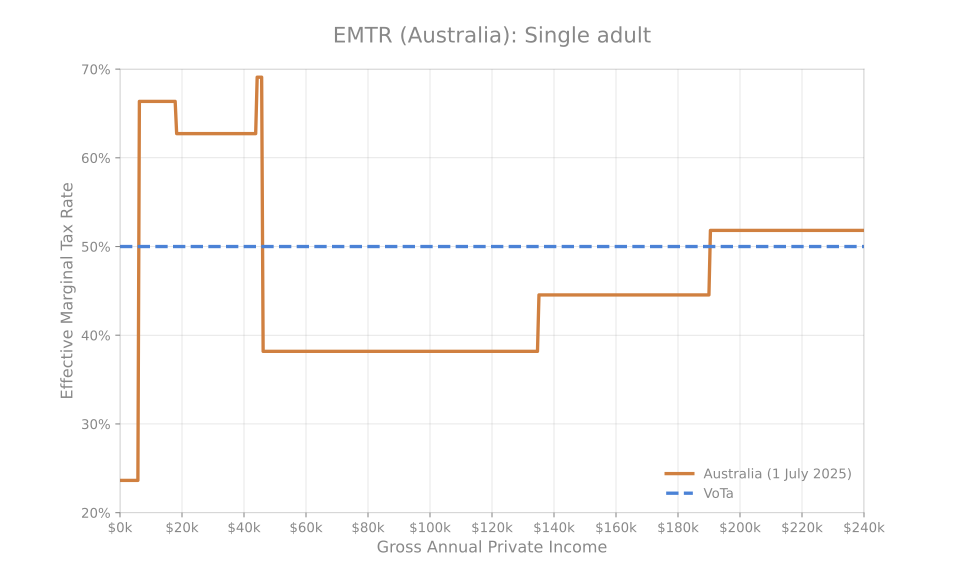
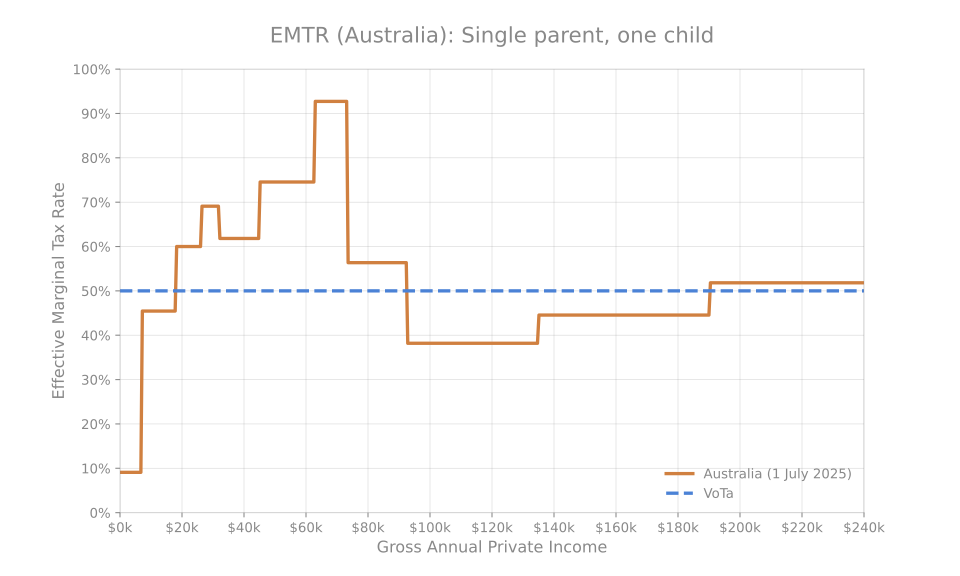
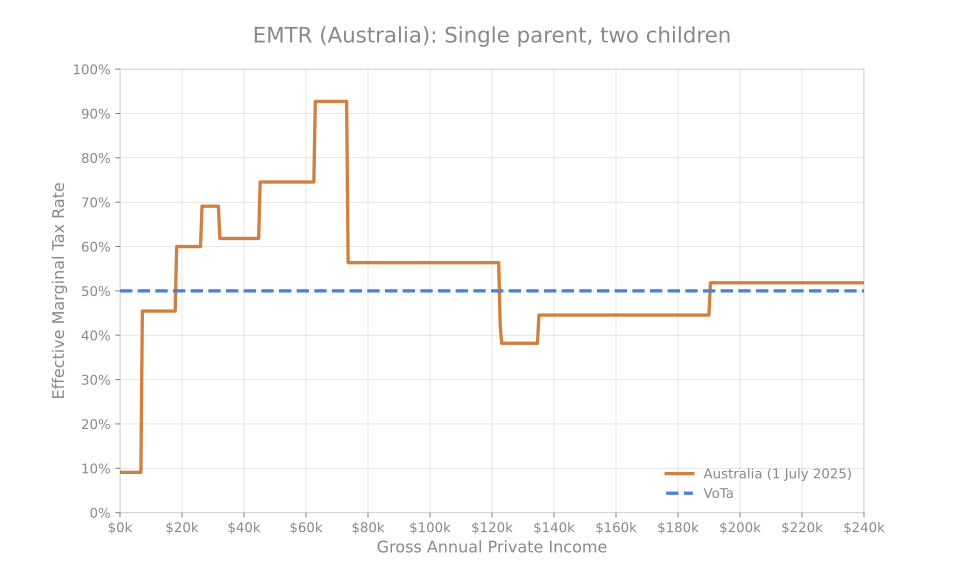
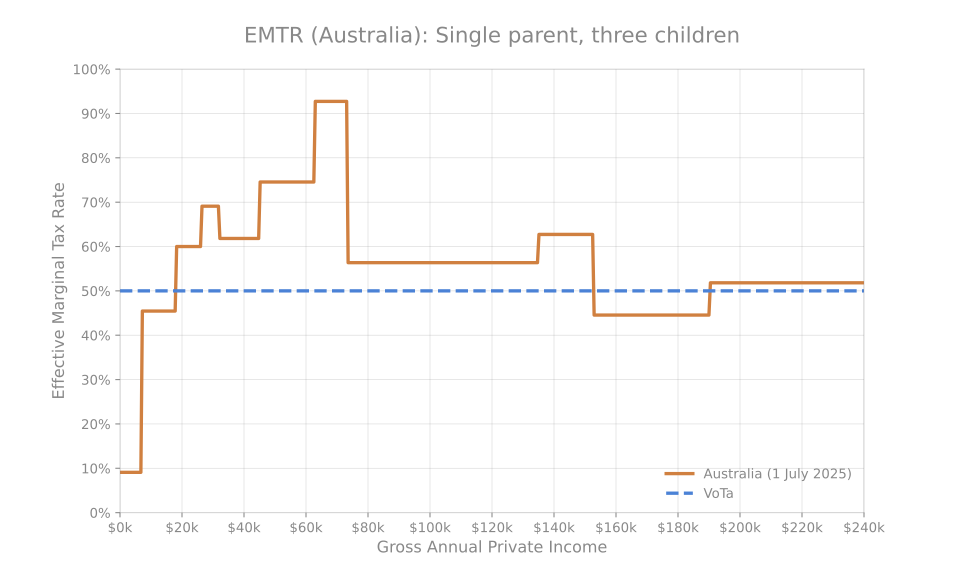
The jumps, cliffs, and jagged shapes in the Australian Government curves are not meaningful features of the underlying economics at all. They are artefacts of a system built from dozens of unrelated rules, thresholds, tapers, offsets, and eligibility tests that were never designed to work together. Each kink or discontinuity reflects a bureaucratic boundary rather than any coherent principle, so the curves end up looking chaotic because the system itself is chaotic. These irregularities are not signals, they are flaws: arbitrary discontinuities that distort incentives, penalise certain households for no principled reason, and make the system impossible to understand or predict. The contrast with VoTa is stark precisely because VoTa’s curves reflect a single rule applied universally, whereas Australia’s curves reflect decades of accumulated exceptions.
The "Mountain Range" you see in the Australian EMTR highlights the Welfare Trap. A high EMTR ruins incentives to work harder. There are specific income zones where earning an extra dollar is "punished" by the combined loss of welfare and increased income tax.
In the Australian system, the $63k to $73k range is where multiple "taper" curves collide. This isn't just a high tax rate; it is effectively state-enforced wage stagnation.
A single parent can hit the maximum friction point because of the following simultaneous deductions for every extra $1.00 earned:
At the upper end of this range, the combined loss can reach 93c. The net gain is just 7c. If that parent works an 8-hour Saturday shift for an extra $300, they may walk away with only $21 in actual purchasing power after all benefits are recalculated.
The Effective Marginal Tax Rate (EMTR) for high‑income earners reflects two linked decisions: earning an extra dollar and then spending that dollar. Under the 2025–26 Australian financial year (1 July 2025 to 30 June 2026), the top marginal income‑tax rate is 45%, and the Medicare levy adds 2%, giving a 47% tax on each additional dollar earned. When the remaining 53% of that dollar is spent, it attracts 10% GST, which is effectively a tax on consumption rather than income. The GST burden on that remaining amount is , or 5.3% of the original dollar. Combining the income‑side and consumption‑side wedges gives an EMTR of 52.3%, meaning a high‑income earner keeps only 47.7 cents of each extra dollar earned once both earning and spending decisions are accounted for. This figure is accurate specifically for the 2025–26 tax schedule, which includes the 45% top bracket and a 2% Medicare levy.
EMTR (high income earners currently in Australia) = 45% + 2% + 10%(100% - 45% - 2%) = 52.3%
This is similar to the EMTR in VoTa, which equals \( R_{\mathrm{ubi}} + R_{\mathrm{svc}} \) = 20% + 30% = 50% for every person regardless of circumstances.
The following are plots of the disposable income versus the pre-tax,pre-transfer income.
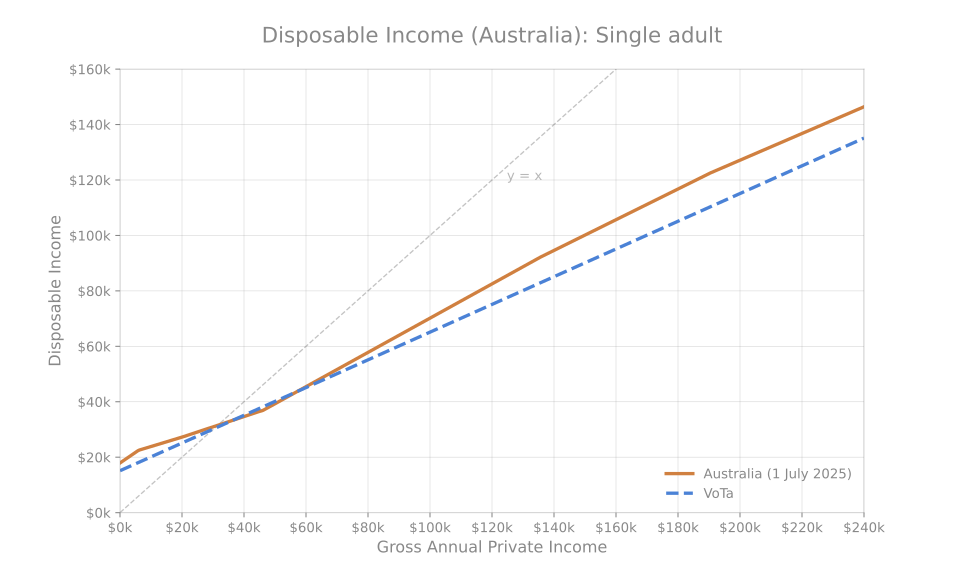
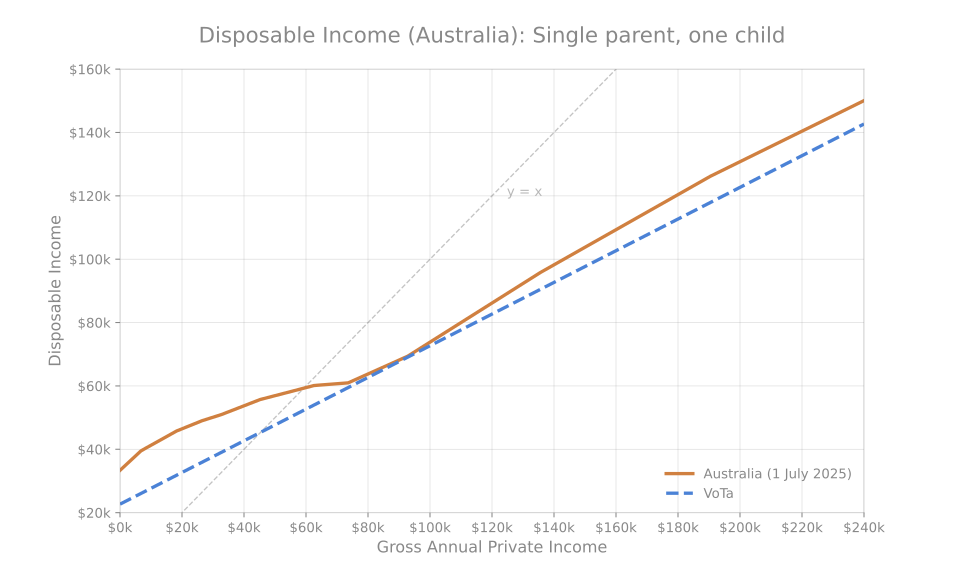
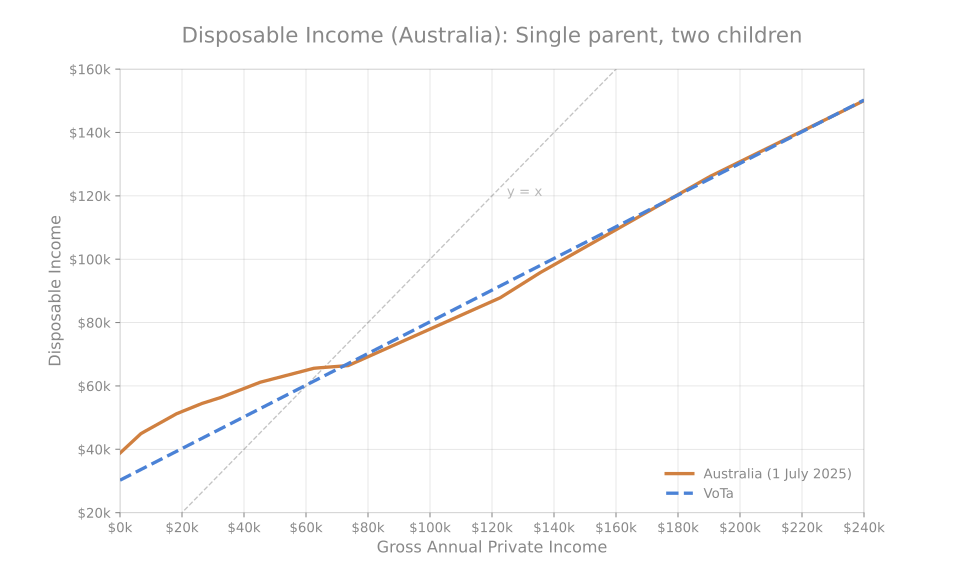
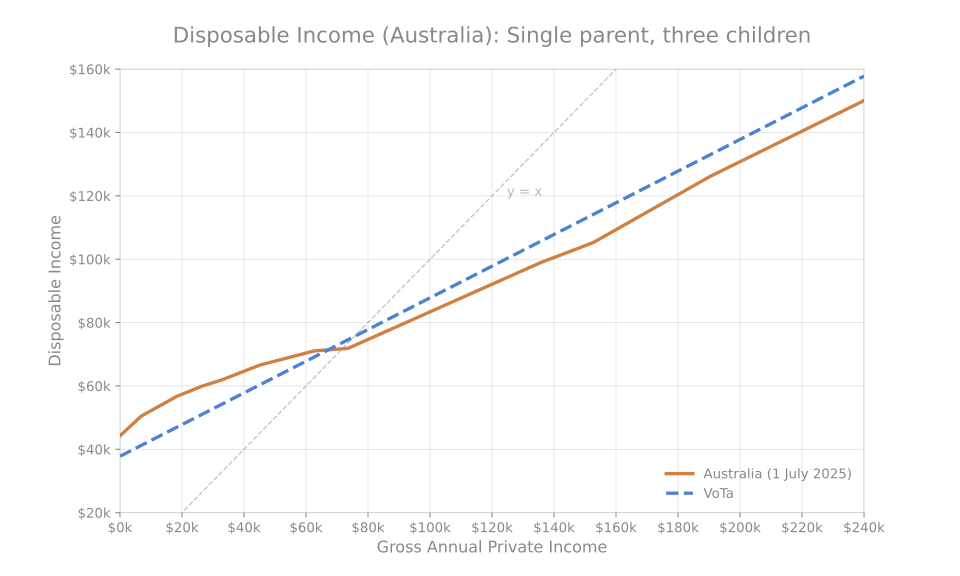
In VoTa the disposable consumption is an affine (straight‑line) function of gross income \(Y_i\):
\[ C_i^{\mathrm{disp}} = U^{\mathrm{disp}} + (1 - R_{\mathrm{tot}})\, Y_i, \]The Effective Tax Rate (ETR) is defined as total tax paid divided by gross income.
The following are plots of the ETR versus the pre-tax,pre-transfer income for various households, allowing for a comparison between VoTa and the Australian Government:
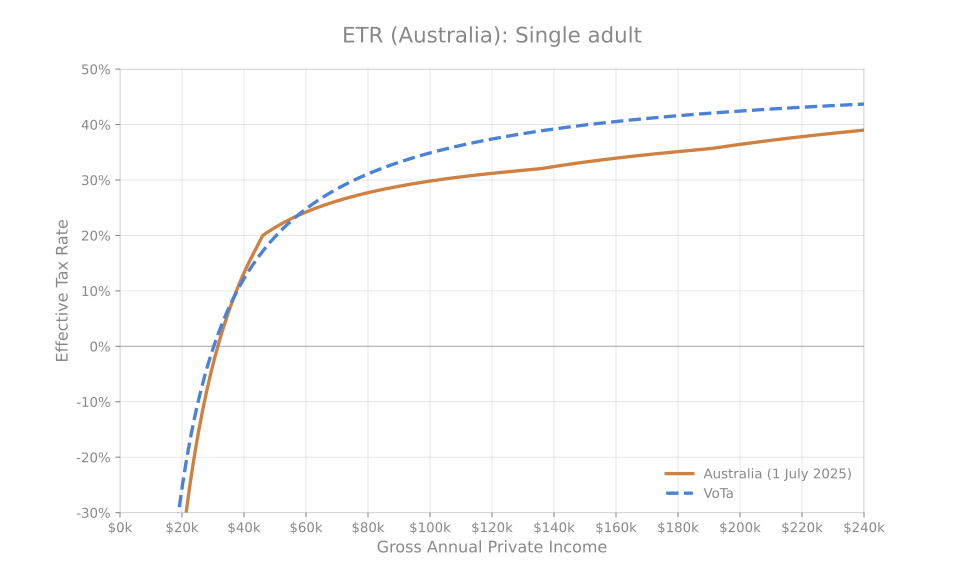
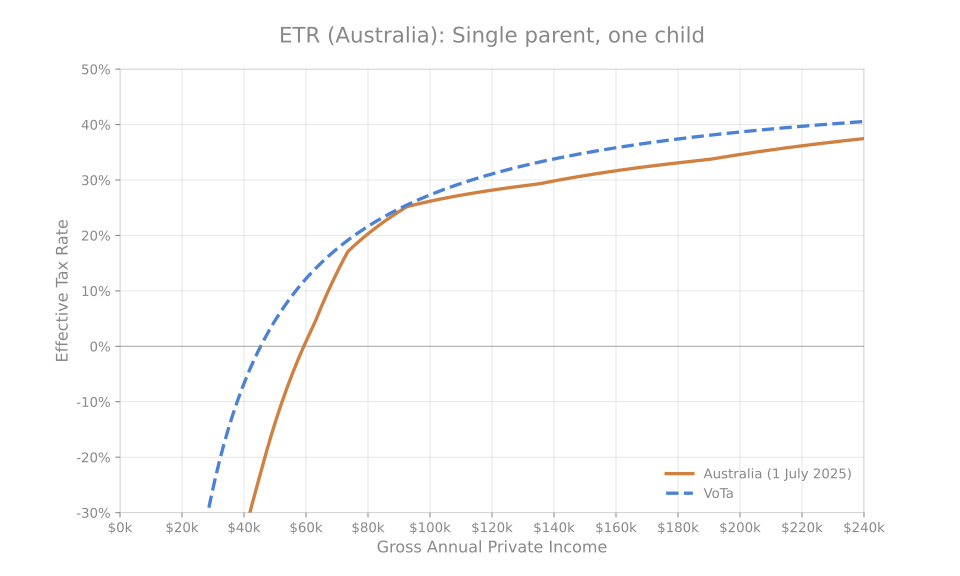
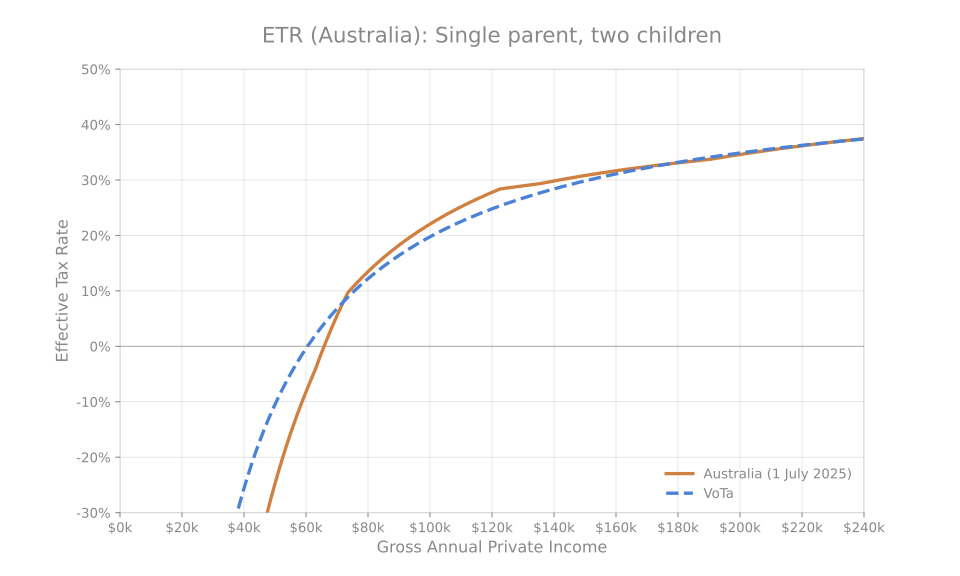
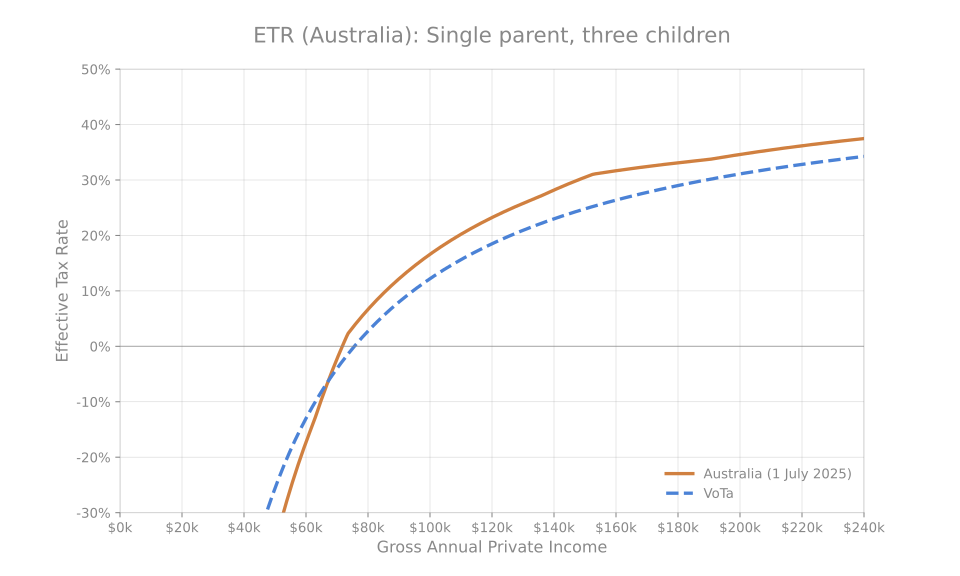
In VoTa, UBI is part of the tax system and functions as a negative tax offset. This makes the effective tax progressive, even though the underlying consumption tax rate \(R_{\mathrm{tot}}\) is flat. The expression for \( \text{ETR}_i \) is a non-linear function of the gross income \(Y_i\):
\[ \text{ETR}_i = R_{\mathrm{tot}} - \frac{U^{\mathrm{disp}}}{Y_i}. \]The ETR is lower for low‑income individuals and approaches \(R_{\mathrm{tot}}\) as income grows. A flat consumption tax combined with a uniform UBI therefore produces a progressive effective tax schedule, comparable in shape to the Australian income‑tax system.
Flat taxes are widely criticised for not being progressive. For example:
Ultimately, flat taxes are out of step with public concern about inequality and enacting one all but abandons even the possibility of an equitable tax system.
In summary, current flat tax proposals are unfair both because they tax only wage income, exempting altogether income from capital, and because, in my view, fairness requires that the rate of tax increase as income increases.
The main criticism leveled against the flat tax is that it is unfair. Such a system, say opponents of the tax, would result in a windfall for the rich and higher tax burdens for the poor and the middle class, who are less able to afford them.
The main argument against moving from a progressive to a flat-rate income tax in an advanced country, such as the UK, is that is would involve a large-scale redistribution of income from the poor to the rich.
A flat tax charges every taxpayer the same percentage rate, which makes it proportional on paper. but the practical effect is regressive because lower-income households lose a far larger share of their usable income than wealthy ones do.
The GST is an interesting and important case. When the GST is examined as a proportion of income, the GST is found to be a regressive tax, even though the GST is applied at a constant rate of 10 per cent. This is because people with higher incomes tend to spend less (and save more) of their income than people with lower incomes, which results in less GST being paid as a percentage of the income of higher income earners.
The invalid claim by Peter Varela that a flat consumption tax is regressive is not uncommon. The argument is that low‑income households consume nearly all their income so they pay GST on nearly all of it, whereas high‑income households save a large share so they pay GST on a smaller fraction of their income. Therefore, it is claimed GST as a percentage of income falls as income rises, so it is “regressive”. But notice the sleight of hand, the tax is measured against income, not the tax base. Money only has utility when it is eventually spent. A person who saves today will spend later (or their heirs will). A flat consumption tax is therefore proportional over a lifetime, even if it looks “regressive” in a single year.
Some people argue that giving everyone a UBI, even the wealthy, is unfair, because the poor are the ones that need help, not the rich.
For example:
A universal basic income (UBI) is regressive and means that large numbers of people have to be taxed more heavily. The idea of giving everyone (the same) quantum of money is very different from giving the poor and the lower-middle-income group the support they need. Secondly, to give the poor what they need through UBI, you've got to give everyone that same higher amount. In other words, you don't just flatten the curve but you've got to raise the curve. That needs much more taxes. And if we do the arithmetic, it can't just be taxes on the rich. You need much more taxes on the middle-income group in order to give everyone the amount of benefits that the poor actually need.
Though UBI is widely considered a putative solution to poverty, it does little to redress the structural inequalities that cause poverty. This is because, at its heart, UBI is a cash transfer that perpetuates, rather than reduces, the powerful corporate and financial forces of inequality that have kept the poorest citizens disempowered, unable to reform the world’s capital systems, which continue to wreak havoc on the environment.
Importantly, adopting UBI as a national policy would be so expensive that its costs would displace a range of alternative resource-using policies that can redress absolute poverty while also reducing inequality.
The problem is, a UBI does little to actually reduce inequality, and carries real risks to the social contract that has been built up over generations.
Essentially, the UBI is just another measure to funnel the products of our national economy into the hands of those who control the means of production. It exacerbates the concentration of capital amongst those at the very top of our economic system.
And here lies a paradox: no one says a flat tax is progressive, and no one says UBI is progressive. Yet when combined, the two mechanisms clearly redistribute wealth from rich to poor. The combination is clearly progressive.
The Australian Government provides far greater welfare support than VoTa UBI for households that require child-care support and rent assistance.
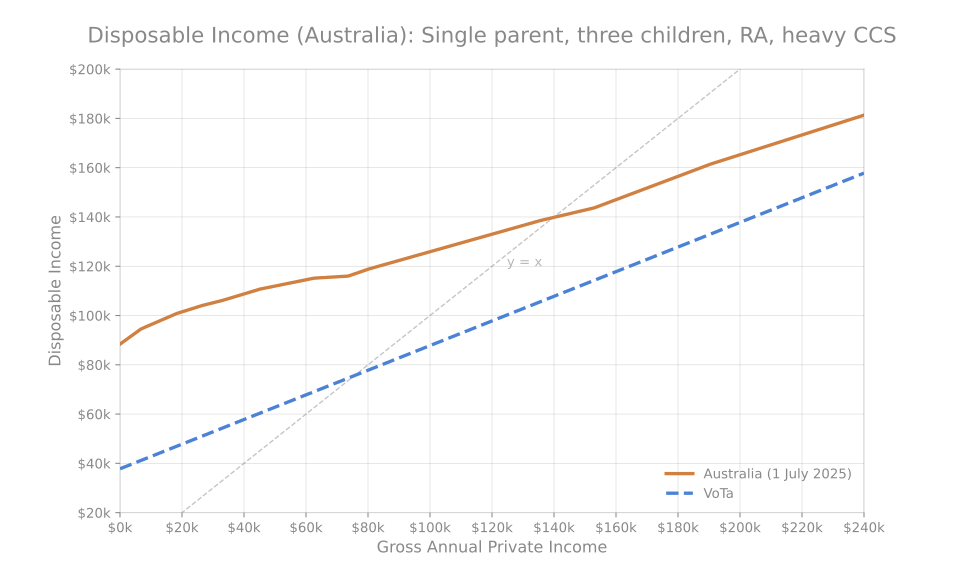
Although UBI replaces the monetary transfer role of welfare, it is not designed to guarantee a life free from poverty. A UBI alone is insufficient for people facing high structural costs, such as homelessness, unemployment, or single parents with low wages who must pay rent and child‑care fees. Under VoTa, these needs are met not by increasing UBI but by providing universal public services that supply a free or subsidised baseline of food, shelter and child care to anyone who chooses to use them.
One of the main aims of UBI and universal services is to reduce misery and suffering, and extreme poverty.
 |
 |
 |
 |
 |
 |
Since everyone receives UBI, there is no stigma associated with receiving it, unlike the case for people on welfare, which produces low self esteem and derogatory terms such a "dole bludger", "dole head" and "welfare parasite".


UBI eliminates many of the administrative and eligibility gaps through which people fall in a means-tested welfare system.
The complexity of means-tested welfare in Australia causes some people in extreme poverty to "slip through the cracks" and end up homeless and starving. This is widely supported by research and reports from welfare organisations. The system's complexity is a significant contributing factor to vulnerability and entrenched poverty.
The problems with Australia's highly selective and complex welfare system include:
The Consequences: Charities and community organisations frequently report that demand for basic essentials far exceeds supply, and they see people returning to homelessness repeatedly because the system cannot provide long-term solutions. The inability to afford essentials can have severe impacts on physical health, mental wellbeing, and safety, leading to the extreme situations of "no shelter and starving" described in the statement. The complexity of the system is often seen not as an individual failure but as a failure of government policy to adequately support its most vulnerable citizens.
In Australia:
These gaps mean that certain vulnerable groups, including people seeking asylum, some single parents, and those with disabilities who don't meet the stringent 20-point impairment test criteria, face a high risk of deep and persistent poverty without access to adequate formal welfare support.
UBI cannot by itself eliminate every cause of homelessness or severe deprivation. Mental illness, addiction, exploitation, and housing shortages may require appropriate services as well as an income floor. Its specific advantage is that support cannot be lost because a person entered the wrong category, failed an activity test, or was unable to navigate an application process.
UBI reduces social unrest, and crime.

A worker who depends on continuous employment for immediate survival has little bargaining power. They may be unable to reject poor wages or working conditions, leave an abusive employer, or spend time searching for a better position.
This is sometimes described as the worker’s “power to say no.” Philippe Van Parijs argues that the unconditional nature of basic income distributes bargaining power, allowing less-advantaged workers to distinguish between worthwhile and unattractive jobs.
UBI improves the worker’s position by providing an unconditional alternative to immediate employment. Workers can refuse unattractive offers, search for work that suits them, acquire skills, or attempt self-employment without facing immediate destitution. Employers must therefore attract workers through better pay and conditions.
Unlike a minimum-wage law, UBI does not prohibit workers from accepting employment at a wage they consider worthwhile. It strengthens their ability to negotiate while preserving freedom of contract.
Citizens can choose not to work, it is a valid choice, and nothing to be embarrassed about.
The effect of a large proportion of the population that prefers leisure is that the minimum standard of living will be lower because there is less work and more mouths to feed, but there is a negative feedback loop so it's not an issue (poor minimum living standards drive more of the population to work).
It seems unlikely that too many people will live a life of leisure, a common problem is modern society is that people overwork themselves. It seems to be a common human trait to want to work hard. This might even become more of a problem in a society that promotes individualism.
In any case we are steadily moving into an era where a good living standard doesn't require significant human labour. For example, the food industry is highly automated. Farmers now use equipment such as a 20 tonne combine harvester, which allow one person to do the work of hundreds of people before the industrial revolution. We are even going down the path of driverless vehicles (e.g. haul trucks in mines). This is only going to increase.
UBI tends to advance culture and the arts, because individuals are free to pursue their creative talents.




Economics contains many competing schools of thought, and disagreement extends to its foundations. Economists dispute the nature of money, the stability of markets, the causes of growth and recessions, the determinants of prices, how people should be modelled, and whether mathematical methods illuminate or obscure economic activity. Much of the subject therefore remains contested rather than established knowledge on which all economists agree.
These disagreements produce opposing recommendations on fundamental questions: whether stimulus spending after a crash helps recovery or delays it, whether a minimum wage helps low-paid workers or excludes them from employment, and whether large government debts support stability or threaten it. Invoking economic expertise does not identify a settled course of action. It requires choosing which school of thought, assumptions, and predictions to trust.
If economic theory could reliably predict the future, such as what will happen to interest rates or the stock market, or whether a crash is imminent, people could use those predictions to change their course of action. Those changes would alter the predicted outcome and destroy the very predictability on which they were based. Economists who successfully predict such events can therefore do so only to the extent that they know something that other market participants, including mainstream economists, do not.
Economists cannot reliably predict economic conditions, turning points, financial crises, or the consequences of policy changes. Measuring aggregates after events occur is not the same as forecasting them. To recommend an intervention, an economist must predict both what would happen without it and how people and markets would respond to it.
The lack of an agreed economic foundation described above compounds this poor predictive record. Without reliable predictions of counterfactual outcomes, there is no reasonable basis for trusting economists to steer the economy. An intervention changes prices, incentives, expectations, and behaviour, making the system still harder to predict. Giving discretionary economic power to people who have demonstrated little predictive ability does not solve uncertainty; it allows their forecasting errors to affect the entire economy.
VoTa begins with the praxeological understanding that value is subjective. Nearly all interpersonal economic activity under VoTa then has the same underlying form: voluntary exchange. A buyer transfers Central Bank currency because the buyer values what is being acquired more highly than the currency surrendered. The seller makes the opposite valuation, preferring the currency to the good, service, asset, right, or contractual commitment being transferred. The transaction proceeds because both parties expect to benefit. Their valuations can differ without contradiction because value belongs to the person making the choice, not objectively to the things being exchanged.
This principle applies regardless of scale. Purchasing a pencil, employing a worker, lending to a business, constructing a railway, and providing a public service may differ greatly in complexity, but each consists of voluntary transactions between people willing to supply and people willing to pay. A large project is not a different kind of economic activity; it is a coordinated network of exchanges involving more participants, resources, contracts, risks, and time.
Tax choice extends voluntary exchange to collectively purchased services. Tax contributions arise from individual transactions, and taxpayers choose the public-service contracts towards which their contributions are directed. Each taxpayer becomes a willing contributor towards services they want provided. The water-filling algorithm combines these choices, while competing providers decide whether they are willing to supply the services at the resulting contract prices.
Central Bank currency provides a common settlement medium for these exchanges. A payment transfers existing currency, which the seller subjectively values, from the buyer's account to the seller's account. The amount leaving one account is exactly the amount entering the other. Ownership changes, but the total currency supply does not. Once the currency has been created and initially distributed, conservation therefore follows from treating every payment as a transfer of existing property through voluntary exchange. Economic activity changes the distribution of currency, the ownership and use of resources, and relative prices without requiring the creation of additional money.
Discretionary money creation does not have this structure. It gives an issuer or borrower additional purchasing power without that currency first being transferred by an existing owner. When the new currency is spent, the resulting purchase may be voluntary, but the creation which enabled the additional bid was not a voluntary exchange: no previous owner chose to surrender the newly created currency. Nor was it an exchange with the existing currency holders whose relative purchasing power is affected.
The medium of exchange should facilitate voluntary exchanges without itself altering the distribution of purchasing power. Commercial bank money fails this test because it is created through selective lending. When a bank approves a loan, it creates a new deposit rather than transferring existing currency from a saver. The borrower can therefore bid for labour, property, materials, and other resources without another currency holder first choosing to surrender equivalent purchasing power.
This combines two functions which VoTa separates. A medium of exchange should provide a common means of settling transactions, while credit allocation should determine who receives command over currency which an existing holder is willing to lend. Commercial bank money makes the payment medium itself an instrument of credit allocation. Banks decide who receives newly created purchasing power first, which industries and assets attract it, and how the resulting bids affect relative prices. Although the loan agreement between the bank and borrower may be voluntary, existing currency holders whose relative purchasing position is affected are not parties to it.
Using created commercial bank money as the general medium of exchange therefore distorts voluntary exchanges in a free market. VoTa instead provides a safer and more desirable Central Bank currency which is likely to crowd out commercial bank money through people's free choice, not prohibition. It creates this currency once to bootstrap the system and conserves the resulting supply thereafter. Central Bank currency then acts only as the lubricant of exchange: lending reallocates existing currency through voluntary agreement, and all subsequent purchasing power must be obtained through voluntary transfer.
Economic schools generally assume that interest rates drive the economy: lower rates stimulate borrowing and growth, while higher rates suppress them. Research by Richard Werner and Kang-Soek Lee found the opposite relationship. Interest rates were positively correlated with economic growth, and causality more often ran from growth to interest rates rather than from interest rates to growth (see Reconsidering monetary policy and their subsequent study of 19 countries).
The result is easy to understand. When an economy is doing well, businesses see more profitable opportunities and demand more funding. When demand for investment funds rises relative to available savings, market interest rates tend to rise. When opportunities are scarce, demand for credit falls and rates tend to decline. Interest rates therefore reflect economic conditions rather than simply driving them.
Japan provides a striking example. The Bank of Japan introduced zero interest rates in 1999 and later used quantitative easing, negative rates, and yield-curve control, with these unconventional measures continuing until March 2024 (see the Bank of Japan's policy chronology). Yet prolonged suppression of interest rates did not produce sustained strong growth. This does not prove that the policies had no effect, since Japan might have performed worse without them, but it suggests that interest rates are a weak lever and is consistent with the view that weak growth causes low rates rather than low rates causing strong growth.
Interest rates are nevertheless an important measure of economic conditions. Market rates aggregate the supply of savings, the demand for investment funds, people's preference for present rather than future consumption, expectations of inflation or deflation, perceptions of risk, liquidity, and the duration of loans. Higher rates encourage saving and require proposed investments to clear a higher hurdle; lower rates may indicate that funding is more readily available. People need these signals when deciding whether to consume, save, lend, or invest. Turning interest rates into policy levers obscures that information, making it harder to distinguish genuine market conditions from central-bank intervention and increasing the risk of poor investment decisions.
Under VoTa there is no central bank policy rate. Interest rates are set by competition between lenders for borrowers and borrowers for existing savings. They are market signals produced by the economy, not policy levers used in an attempt to control it.
Joseph Schumpeter treated bank credit creation as central to capitalist development, writing that “capitalism is that form of private property economy in which innovations are carried out by means of borrowed money” (see the Federal Reserve Bank of Dallas compilation Schumpeter—In His Own Words). Steve Keen endorses this argument. He explains the Schumpeterian position in his interview with Lex Fridman and writes that “the endogenous creation of money by the banking sector gives entrepreneurs spending power that exceeds that coming out of ‘the circular flow’ alone” (see The Debtwatch Manifesto). He regards productive use of that created money as integral to the dynamics of capitalism.
Keen does not, however, regard full-reserve banking as unworkable and explicitly says in the same manifesto that he is not opposed to it. His principal reservation is that conventional full-reserve proposals transfer responsibility for creating additional money from private banks to the State, whose agencies he does not trust to exercise that power competently. VoTa does not make that transfer. Neither commercial banks nor the State can create Central Bank currency; the supply is conserved, while decisions about which entrepreneurs and projects receive finance remain with private lenders and investors. Keen might still prefer productive private money creation, but his stated objections to conventional full-reserve proposals do not establish an objection to VoTa.
Capitalism requires the productive allocation of real capital, not the continual creation of money. Creating money does not create workers, machinery, energy, land, materials, or expertise; it merely changes who can command those resources. Economic growth can occur with a fixed money supply. Existing savings can fund productive businesses, money can circulate repeatedly, and increasing production can be reflected in falling prices and greater purchasing power.
No particular quantity of money is required to support a given quantity of production or exchange. If production increases while the currency supply remains fixed, prices can fall and each currency unit acquires greater purchasing power. Because Central Bank currency is electronic and highly divisible, the same conserved supply can represent and transfer any quantity of real value. Money also circulates repeatedly, so growth in the volume of transactions does not require proportional growth in the number of currency units.
Central Bank currency can also circulate very rapidly. Transfers generally complete within a fraction of a second, so currency received from a commercial transaction can be made available for investment almost immediately. Under standing or prearranged instructions, it may pass from a consumer to a business, from that business to a financial intermediary, and from the intermediary to a borrower in rapid succession. The borrower can then use it to acquire labour, materials, equipment, or other resources. No new currency is created, but the same conserved units can support many successive transactions and investments. Credit assessment, contractual agreement, and project planning may take time; settlement in Central Bank currency does not need to.
A project may also prepare by accumulating Central Bank currency before work begins. These savings represent consumption postponed and an ability to acquire resources in the future. The project may combine accumulated savings with staged loans and later investment. Because the supply of Central Bank currency is conserved, banks cannot create new units which compete with those savings for available labour, materials, equipment, or land. Relative prices can still change, but the project's saved currency cannot be diluted by monetary expansion arising from bank credit creation.
Nor must the entire cost of a large project be assembled and transferred before work begins. Large projects consume labour, materials, equipment, and services over time, and their financing can follow the same schedule. A lender or group of lenders may commit by contract to provide specified amounts when construction stages are reached, invoices become due, or other agreed conditions are satisfied. This is already normal financial practice. Committed credit lines remain undrawn until funding is required (see the Bank for International Settlements discussion of credit-line commitments), while project loans use withdrawal schedules and disbursements linked to eligible expenditure and actual progress (see the World Bank's project-disbursement guidance).
The same arrangements are available under VoTa. A financing commitment is a contractual promise, not Central Bank currency and not an immediate transfer of the project's entire budget. At each drawdown, the lender transfers existing Central Bank currency to the borrower. The lender may fund later drawdowns from currency it already holds, income, repayments from other loans, its own borrowing, new investors, or other members of a lending syndicate. It need not leave the full lifetime cost of the project idle from the day the agreement is signed. It does, however, bear the contractual risk of being unable to provide currency when promised; failure to meet an unconditional commitment is a breach of contract.
Staged finance answers the timing problem without creating money. It allows work to begin once the funding needed for the first stage is available and provides contractual assurance for later stages. Creating additional purchasing power would not make the future labour, machinery, energy, or materials available sooner. It would merely allow the project to bid those resources away from other uses by reducing the purchasing power available to existing currency holders. Under VoTa, that reallocation instead occurs openly through saving, lending, investment, interest rates, and prices.
When investment must be funded with existing money, investors must choose one project over another and bear the opportunity cost. This imposes discipline on the allocation of scarce resources. When banks can manufacture credit, projects may proceed without anyone first choosing to defer consumption and put existing money at risk. The result is not necessarily more productive investment, but often more malinvestment: businesses, developments, and speculative projects that consume real resources before ultimately failing.
Paul Krugman argues that an economy can enter a liquidity trap when people want to save more than businesses are willing to invest, even after nominal interest rates have fallen to zero. If prices are also falling, holding money earns a positive real return, so he argues that the economy may require a negative real interest rate to induce sufficient spending and investment. His proposed remedy is for the central bank to create an expectation of inflation, the reasoning behind deliberately targeting a positive inflation rate such as 2 percent (see Japan's trap).
VoTa rejects this interpretation. There is no central bank policy rate and no attempt to force investment to a politically preferred level. Expected inflation or deflation is incorporated into market interest rates. An investment must offer a better risk-adjusted return than holding money before a well-informed investor will fund it. That is a valuable test of whether the project should consume scarce labour, materials, energy, and capital.
The waste caused by speculative and failed ventures is extremely important. Creating money or inflation to make marginal projects appear worthwhile does not create the real resources those projects require. It overrides the judgement of people who would rather save than invest and redirects resources into ventures that cannot justify their risks. If a well-informed investor prefers to hold money, manipulating the real interest rate until the investment proceeds is not a cure for market failure; it is a malinvestment waiting to happen.
The Monetarist school emphasises the relationship between the quantity of money and the general price level. Milton Friedman famously stated that “inflation is always and everywhere a monetary phenomenon”, meaning that sustained inflation occurs when the quantity of money grows persistently faster than the output of goods and services (see The Counter-Revolution in Monetary Theory).
This is fundamentally a long-term claim. Short-term changes in spending, production, credit conditions, supply, and the adjustment of wages and prices can obscure the relationship between money and prices. Over a sufficiently long period, however, those transitional effects can be set aside. All other things being equal, if there is N times as much money competing for the same real output, prices will eventually be N times greater. Each unit of money represents a correspondingly smaller share of the available goods and services.
The longest current Federal Reserve M2 series begins in January 1959. The following compares its endpoints with the nominal GDP figures closest to the same dates. Nominal GDP is the dollar value of production measured at the prices prevailing in each period.
| United States measure | 1959 | 2026 | Multiple |
|---|---|---|---|
| M2 money supply | $286.6 billion | $23,218.0 billion | 81.01 times |
| GDP measured in each period's dollars (nominal GDP) | $510.330 billion | $32,486.066 billion | 63.66 times |
Over this period, M2 increased approximately 81-fold, the nominal value of annual United States production increased approximately 64-fold. M2 is a stock and annualised GDP is a flow, so the multiples need not be identical. The simple point is that over a long period, a very large multiplication of the money supply was accompanied by a similarly large multiplication of the nominal value of production.
A one-time multiplication of the money supply therefore produces a higher price level after adjustment. Continuing inflation requires the money supply to continue growing relative to real output and the public's demand to hold money. Short-term disturbances may mask or delay that long-term result, but they do not overturn it.
From this perspective, VoTa cannot produce long-term inflation by expanding the supply of Central Bank currency. After its initial distribution, the number of Central Bank currency units is fixed: the Central Bank cannot create additional units, and commercial banks cannot create Central Bank currency when they lend. Supply shocks or changes in the demand to hold currency may still cause the price level to move, but a one-off increase in prices is not continuing inflation. Without continuing monetary expansion to accommodate such increases, they cannot become a persistent rise in the general price level on the Monetarist account.
To first order, tax-choice spending does not change aggregate demand. Let \(T\) be an amount of consumption tax collected and directed to public services, \(D_{\mathrm{private}}\) private demand, and \(D_{\mathrm{services}}\) demand from public-service providers. Relative to the position without that tax and expenditure, taxation reduces the purchasing power available for private allocation by \(T\):
\[ \Delta D_{\mathrm{private}} = -T. \]Public-service providers receive and spend the same amount, adding \(T\) of demand elsewhere:
\[ \Delta D_{\mathrm{services}} = +T. \]The first-order change in aggregate demand is therefore zero:
\[ \begin{aligned} \Delta D_{\mathrm{aggregate}} &= \Delta D_{\mathrm{private}} + \Delta D_{\mathrm{services}} \\ &= -T + T \\ &= 0. \end{aligned} \]Tax choice changes the composition of demand rather than its total nominal value. It redirects purchasing power and real resources from the goods and services taxpayers would otherwise have chosen towards publicly funded services. No additional Central Bank currency is created, and the State cannot borrow to spend more than the amount collected.
This equality is a first-order result, not a claim that every economic consequence cancels. Private consumers and public-service providers may spend at different rates, purchase different proportions of imports, or demand resources with different supply constraints. Taxation and public services can also affect incentives and future productive capacity. Tax choice may therefore raise prices in sectors receiving redirected demand while reducing prices or activity elsewhere, but it does not create the additional economy-wide purchasing power associated with deficit-financed or currency-financed expenditure.
Prices can also rise because the supply of an important product falls or its cost of production increases. The 1973–74 oil shock is a prominent example. Production cuts and the Arab oil embargo nearly quadrupled the price of oil, from $2.90 per barrel before the embargo to $11.65 in January 1974 (see Oil Shock of 1973–74). Because oil was an input into transport, agriculture, manufacturing, heating, and electricity generation, the higher cost propagated through the production and distribution of many other goods.
Food illustrates how widely an energy shock can spread. Farms use energy for machinery, irrigation, fertiliser, and other inputs, while food also has to be processed, packaged, refrigerated, stored, transported, and marketed. The UN Food and Agriculture Organization reports that agrifood systems use about 30 percent of the world's available energy and that 70 percent of the energy used within those systems is consumed after the farm gate (see Energy: facts and figures). This does not mean that food is “70 percent dependent on oil”, but it does show why higher fossil-fuel prices can affect food prices at many stages of the supply chain.
The appropriate response to a supply problem is to address the supply problem. Depending on its cause, that may mean obtaining oil from alternative suppliers, developing additional sources, using energy more efficiently, or substituting other forms of energy. Creating more currency does not create the missing oil or energy. It merely allows more money to bid for the diminished supply and risks turning a relative-price adjustment into broader monetary inflation.
In a market, a higher price communicates scarcity and increases the potential return from solving it. Producers and investors therefore have an incentive to expand supply, improve efficiency, and develop substitutes. Under VoTa this response can occur through both private investment and publicly funded services. Taxpayers can change their tax-choice allocations as circumstances and priorities change, directing funding towards research, infrastructure, emergency reserves, or other services that help remove the constraint. Tax choice is not tied to an election or an annual government budget: individual allocations can change continuously, allowing collective funding to respond to new information just as private spending and investment do.
Inflation can become politically attractive when a State can finance expenditure by creating currency. It allows spending to exceed taxation without asking taxpayers to bear the cost immediately, while the resulting loss of purchasing power is dispersed among currency holders. The temptation is particularly strong during wars, emergencies, persistent budget deficits, or when a heavily indebted government benefits from reducing the real value of its debts. If monetary policy is subordinated to those fiscal demands, restraint by the Central Bank eventually becomes difficult or impossible. At the extreme, repeated issue of currency to meet government obligations can culminate in hyperinflation.
VoTa removes this conflict rather than relying on officeholders to resist it. The State cannot borrow, the Central Bank cannot create currency to finance expenditure or purchase government debt, and public services can spend only the tax funding directed to them. The currency supply therefore cannot be expanded to conceal the cost of a war, emergency, failing service, or politically popular programme. Citizens must confront the real cost through their tax-choice allocations and decide which uses of limited resources take priority.
Expectations can propagate an inflation that has already begun. Workers seek larger nominal wage increases, suppliers raise quoted prices, lenders demand an inflation premium, and businesses shorten contracts or index them because they expect money to lose purchasing power. Those precautions are individually rational, but they can make inflation more persistent and make long-term calculation more difficult.
VoTa provides an unusually simple basis for expectations: everyone can know that the number of Central Bank currency units will not increase. No election, emergency declaration, policy meeting, or lobbying campaign can alter that rule. This does not guarantee that every price will remain constant, because productivity, supply, and demand for the currency can change. It does, however, remove uncertainty about future monetary dilution and the need to predict how officials will react. Saving, lending, wages, pensions, and long-term contracts can be negotiated against a currency whose nominal supply rule is stable and publicly verifiable.
Discretionary monetary policy requires officials to estimate the economy's productive capacity, the neutral interest rate, future inflation, and the delayed effects of their own interventions. Those quantities cannot be observed directly and estimates are revised as new information arrives. An intervention intended to address an earlier problem may therefore take effect after conditions have changed, amplifying rather than moderating the next movement in prices and economic activity. Monetary policy can also be influenced by pressure to produce a short-term boom before an election while leaving its inflationary consequences until later.
VoTa does not attempt to make these forecasts more accurately. It makes them unnecessary for management of the currency supply: there is no policy interest rate, open-market operation, quantitative easing, or discretionary creation and destruction of Central Bank currency. This means VoTa also gives up attempts to fine-tune aggregate demand through monetary policy, but it eliminates the policy-induced cycles, delayed over-corrections, and political manipulation that such discretion can produce. Prices, saving, lending, investment, and tax choice respond directly to current conditions instead.
Particular sectors can experience rapid price inflation during an asset bubble, especially property and share markets. By far the most important driver of modern asset bubbles is the ability of commercial banks to create new deposit money when they extend credit. Newly created purchasing power can be used to buy assets, raising their prices; the higher valuations then provide collateral for still more credit and allow the bubble to feed itself.
This mechanism does not exist under VoTa. Commercial banks cannot create Central Bank currency: every loan of it transfers existing currency from a lender to a borrower. Asset prices can still rise and speculation can still occur, but credit cannot manufacture the additional Central Bank currency that makes a bubble self-financing. The mechanism and historical examples are discussed further in 20.7 Commercial banks and private money creation and 20.8 The boom causes the bust.
People differ greatly in education, experience, ability, and circumstance. A successful economic system should allow people without formal qualifications to find useful work, develop experience, and improve their position. VoTa does not constitutionally mandate a job guarantee, although it permits public services to operate as employment-guarantee programmes. Employment is not itself evidence that valuable work is being performed, so such services remain responsible for producing outcomes which taxpayers value. Tax choice can support a diverse range of useful work with low barriers to entry.
Many services valued by taxpayers require human effort but little formal education. Examples include cleaning, maintenance, waste collection, environmental restoration, food preparation and distribution, transport, community-centre operations, and support roles in child care, aged care, and emergency services. Such work is often local, visible, and difficult to relocate overseas. Taxpayers can readily observe whether it is being done well and direct funding towards providers that produce useful results.
Tax choice allows narrowly defined services and small providers to compete for funding. An unmet local need does not have to become part of a large government department before someone can propose to address it. Maintaining a public space, delivering meals, assisting people with transport, removing litter, or operating a community kitchen can be organised at a scale accessible to people and groups without substantial capital or complex administration. This reduces the institutional barrier between recognising useful work and funding someone to perform it.
A subcommunity may favour useful services consisting of work which requires only a modest minimum level of skill and therefore does not command high pay. Its members do not need to persuade a majority or establish a universal State programme. They can direct their own tax allocations towards such services, and the services can operate if that support is sufficient. Other taxpayers remain free to choose different priorities.
The service may not prefer applicants merely because they are unskilled, inexperienced, unemployed, poor, or otherwise disadvantaged. The separate NDP exception for services and facilities for those with illnesses, injuries, infirmities, or disabilities permits relevant special treatment on those grounds. Subject to that exception, a service may select by task-relevant merit, whether by choosing the best applicant, the best number of applicants, or everyone who meets a minimum standard. It may separately use order of application to allocate positions. Because the work requires little skill and pays accordingly, it will tend to be attractive to people with fewer alternatives without discriminating in their favour.
Such a service may either offer a limited number of positions or make a standing offer to everyone who meets its published conditions. The latter can operate as an employment guarantee. The response is decentralised, financed from existing tax revenue rather than newly created currency, and limited to work which a subcommunity considers worth purchasing. Different communities can support different employment guarantees or other forms of useful low-skill work instead of having one political authority prescribe a national programme and wage.
VoTa does not prescribe a single policy for unemployment or dependence on taxpayer-funded support. Subject to the constitutional UBI and the NDP, different taxpayer subcommunities may support different approaches, including universal food and shelter, health care, training, rehabilitation, and useful public services containing low-skill work. These approaches can coexist because each taxpayer controls the allocation of their own tax. None requires majority agreement before it can operate with sufficient support.
This creates competition between ideas as well as competition between service providers. Taxpayers can compare the cost and observed results of different approaches: whether they reduce homelessness, improve health, develop useful skills, provide valued services, or reduce long-term dependence. An approach with better practical results may attract more tax allocations and become dominant because taxpayers increasingly choose it, not because the State imposes it as the official policy.
Such dominance remains contestable. Other approaches may continue alongside it, and taxpayers may redirect their allocations when results deteriorate or a better proposal appears. The NDP constrains every approach regardless of its popularity: taxpayer support cannot authorise discriminatory eligibility, employment, or treatment beyond the Constitution's express exceptions.
Taxpayers may value the fact that a service creates accessible work, but a service should not be funded merely to make employment statistics look better. Its workers must produce an outcome people consider worth its cost, and providers remain accountable through continuing competition for tax allocations. Employment is a beneficial consequence of providing a valued service, not a substitute for providing one.
The UBI allows a person to accept entry-level, part-time, or irregular work without making survival depend upon a particular employer. It gives people room to acquire experience, combine work with education or caring responsibilities, attempt self-employment, and leave abusive conditions. Employers cannot rely on destitution to make unattractive jobs acceptable; they must offer suitable pay and conditions, redesign the work, provide training, or automate it.
Tax-funded services do not add net purchasing power to the economy. They redirect demand from private purchases towards publicly funded services. Employment may therefore increase among service providers while falling in private activities from which spending was redirected. Tax choice can change the kinds of jobs available and make many low-barrier services viable, but it cannot create unlimited real demand for labour or guarantee that every allocation is wise. A particular service may nevertheless guarantee employment under its published terms by scaling its provision with the number of people who accept its offer.
Taxpayers may also prefer automation, capital-intensive projects, or services requiring specialists. The Constitution therefore does not itself guarantee employment for every person without qualifications. It permits taxpayers to fund services which do so, while decentralised funding, small-provider competition, demand for local labour-intensive services, and the security provided by UBI create favourable conditions for other varied and accessible opportunities to emerge.
VoTa changes several foundations on which existing economies operate:
These are not isolated policy adjustments. Together they change the mechanisms governing credit, investment, business failure, rent-seeking, public-service funding, saving, prices, and the allocation of capital. No historical economy has operated with this combination of institutions.
Economic history therefore has limited value for predicting how an economy based on VoTa will behave. Historical experience can still illuminate particular incentives and causal mechanisms, but results observed under monetary expansion, political allocation, selective regulation, and government-created privilege cannot simply be projected onto a system from which those mechanisms have been removed. VoTa must be expected to produce economic behaviour for which there is no direct historical precedent.
The foundation of Steve Keen's financial instability model exhibits bounded cycles in employment and the wage share, arising from delayed negative feedback. These are not financial booms and busts.
The model becomes unstable when commercial banks are able to create money by extending credit (see A model of endogenous credit creation and a credit crunch). New credit creates additional purchasing power, which can raise investment and asset prices, encourage further borrowing, and turn bounded cycles into financial booms and busts. When credit growth reverses, the same process operates in the opposite direction.
This mechanism does not exist under VoTa. Commercial banks cannot create or destroy money; lending only transfers existing money from a lender to a borrower. Economic cycles may still occur, but the mechanism that turns Keen's stable model into an unstable one is absent.
Because the money supply is conserved, account balances are non-negative, and transaction velocity is physically limited, the monetary system is bounded. The unbounded monetary behaviour produced by endogenous credit creation in Keen's model is therefore impossible under VoTa.
There are multiple reasons to believe VoTa would be more predictable and stable than existing systems:
VoTa's economic reasoning has much in common with the Austrian school. It treats value as subjective, regards market prices as indispensable information, distrusts discretionary monetary management, emphasises entrepreneurship and profit and loss, and expects interventions to produce consequences that officials cannot predict. Its conserved currency and market-determined interest rates are particularly close to Austrian criticisms of inflationary finance and central-bank credit expansion.
The Austrian school is a diverse intellectual tradition whose economists disagree about banking, monetary institutions, methodology, and the proper scope of the State. Its central insights are nevertheless fundamental to VoTa's design: voluntary interaction coordinates dispersed knowledge, while political direction suppresses information, distorts incentives, and concentrates decisions in institutions that cannot know their full consequences.
Austrian economics does not establish the ends society ought to pursue. It analyses human action and the likely consequences of using particular means to pursue chosen ends. Its account of voluntary exchange, prices, entrepreneurship, and political intervention may explain how different institutions operate, but a preference for liberty requires a separate normative premise.
Many influential Austrian economists have also defended classical liberalism or libertarianism, but those political commitments are not propositions of Austrian economics itself. VoTa's commitment to liberty comes from its constitutional foundations, including voluntary citizenship and the NAP and NDP. Austrian economics supplies part of the practical analysis of institutions operating within those boundaries; it does not supply the moral boundaries themselves.
Although Austrian economics is not normative, the Austrian tradition has a fundamental historical and intellectual connection with classical liberalism and libertarianism. Many of its most influential thinkers defended private property, freedom of association, voluntary exchange, and strict limits on State power. VoTa shares those commitments. The connection is between compatible economic and political traditions, not a claim that Austrian economics logically entails libertarianism.
VoTa's constitutional foundations supply the commitment to liberty, while Austrian economics helps explain how voluntary choices, prices, entrepreneurship, and profit and loss coordinate a complex society without political direction. The connection is therefore fundamental even though the normative and economic arguments remain distinct.
Economic value does not reside objectively in a product or equal the labour used to make it. It depends on how particular people rank the alternatives available to them in particular circumstances. The same bottle of water may be almost worthless beside a clean river and extremely valuable to a person dying of thirst. Exchange occurs because the parties value what they receive more highly than what they surrender; it need not imply that they assign the goods equal value.
This subjective foundation is important to VoTa. No official can derive a uniquely correct allocation of labour, capital, or tax funding from the physical properties of goods. Citizens reveal different priorities through purchases, saving, investment, voting, and tax choice. A system that allows those choices to remain separate preserves information that a single political decision would discard.
Economic knowledge is distributed across millions of people. A farmer knows local soil and weather; a technician knows the condition of a particular machine; a customer knows an immediate need; and an entrepreneur may notice a use for resources that others have overlooked. Much of this knowledge is temporary, local, tacit, or discovered only while acting. It cannot all be collected in advance by a central authority.
Friedrich Hayek explained this problem in The Use of Knowledge in Society. Prices allow people to respond to changing scarcity and demand without needing to know every event that produced the change. A higher price for an input encourages users to economise and suppliers to seek more of it, even when none of them possesses a complete account of the market.
VoTa applies this insight beyond ordinary consumer markets. Public-service operators face prices, contracts, competition, and profit and loss, while taxpayers express separate funding preferences through tax choice. The purpose is not to assume that every individual decision is wise. It is to avoid making the entire system depend on the knowledge and judgement of a small political group.
Ludwig von Mises argued in Economic Calculation in the Socialist Commonwealth that private ownership and exchange generate money prices for productive resources. Those prices allow competing plans to be compared and allow an enterprise to determine whether the outputs customers value exceed the opportunity cost of the inputs it consumes. Physical engineering calculations alone cannot determine whether steel, land, energy, or skilled labour should be used for one technically feasible project rather than another.
Profit and loss are therefore not merely rewards and punishments. They are feedback about whether an operator is combining scarce resources in ways that other people are willing to support. The signal is imperfect: profits can result from privilege, fraud, unpriced harm, or temporary error. VoTa seeks to remove political privilege, apply the NAP to harm, and expose public-service operators to genuine costs and citizen-directed funding so that their accounts convey more useful information.
Competition is valuable partly because the best product, method, organisational structure, or price is not known beforehand. Different people try different approaches, customers compare the results, successful practices spread, and failures release resources for other uses. Entrepreneurship is the process of noticing opportunities, making judgements under uncertainty, and bearing the consequences.
This is why VoTa does not treat competition as a one-time auction that identifies a permanent winner. Public-service contracts expire, operators can be challenged, funding choices can change, and new services can develop. Neither officials nor constitutional designers need to predict the final structure. They need rules that permit discovery while protecting property, consent, continuity of essential services, and responsibility for failure.
Production takes time. People who save postpone consumption and make resources available for longer production processes; borrowers seek control of resources in the present in expectation of future returns. Market interest rates reflect these preferences together with expected inflation or deflation, liquidity, duration, collateral, uncertainty, and the risk of default.
Under VoTa, interest is not a policy variable. Anyone may lend Central Bank currency they own, and any willing party may borrow it under an agreed contract. Commercial banks may specialise in intermediation and risk assessment, but possess no special authority to create Central Bank currency or obtain it from a lender of last resort. Competing lenders and borrowers discover interest rates through actual choices about existing savings.
Austrian business-cycle theory argues that credit expansion can push market interest rates below levels consistent with voluntary saving. The lower rates make long-term projects appear affordable and encourage several claimants to act as though the same real resources are available to them. Labour, materials, and capital are committed to plans that cannot all be completed. The later bust reveals and liquidates these malinvestments; it does not create the underlying shortage.
VoTa adopts the central warning that creating purchasing power does not create real productive resources. Commercial-bank lending of Central Bank currency transfers existing units instead of manufacturing new ones, and the constitutional Central Bank does not set an interest rate or expand credit. This removes that particular source of economy-wide distortion, although it does not make bad investments, speculative enthusiasm, fraud, changing preferences, or business failure impossible.
The Austrian tradition has strongly criticised discretionary inflation because new money changes relative prices, redistributes purchasing power, and obscures the signals used for economic calculation. VoTa shares this criticism. After its finite founding distribution, the number of Central Bank currency units is constitutionally conserved, the Central Bank cannot lend or purchase assets, and no official can alter the supply in pursuit of employment, growth, exchange-rate, or inflation targets.
VoTa does not, however, adopt every Austrian monetary proposal. Austrian thinkers have variously favoured commodity money, competitive private currencies, free banking, or different rules for bank liabilities. VoTa instead provides a public electronic fiat currency whose supply and operation are mechanically constrained by the constitution. Private currencies and liabilities may compete with it voluntarily, but they are clearly distinguished from Central Bank currency and receive no State guarantee.
Markets, language, customs, and other complex forms of coordination can develop without being designed as complete systems by a central authority. VoTa similarly relies on voluntary interaction to discover businesses, prices, contracts, associations, and methods of service delivery. Its constitution defines boundaries rather than economic outcomes: do not initiate aggression, do not take property without consent, honour valid agreements, and do not grant discretionary privileges.
This does not mean that every existing arrangement labelled a market is spontaneous or free. Deposit guarantees, bailouts, regulatory barriers, compulsory currency privileges, targeted subsidies, and selective taxes can determine which firms survive and who bears their risks. Removing those interventions must itself be gradual where people have organised their lives and contracts around them, but the intended destination is coordination without political favour.
The substantial Austrian criticisms of VoTa do not depend on treating citizenship as compulsory, objecting to the arbitrary scale of the currency, or declaring every fractional arrangement to be fraud. Citizenship is an optional constitutional contract, any conserved quantity of sufficiently divisible currency can perform the monetary function, and the legality of a private bank's conduct depends on the contract it actually makes. Important economic questions nevertheless remain.
VoTa defines Central Bank currency precisely: it consists of conserved units held in Central Bank accounts. Commercial banks cannot create or destroy those units. They can, however, issue private liabilities. Austrian monetary analysis commonly classifies an instrument by its economic use: a claim that is widely accepted in payment may be described as a money substitute, fiduciary medium, or form of inside money even though it is not the underlying currency. A private claim could acquire that role in a foreign economy or another community where it can lawfully circulate in commerce.
It cannot acquire that role in constitutional commerce between VoTa citizens. Citizens must use Central Bank B-accounts and R-accounts, so a private liability cannot replace the required Central Bank currency settlement. For citizens it is normally an investment asset or contractual claim, not additional transaction money. Banks can therefore create private claims, but they cannot create Central Bank currency or another medium that citizens may substitute for it in constitutional commerce.
Settling the contractual question does not settle the business-cycle question. A bank may lawfully issue a disclosed claim under terms that permit it to lend the currency received. Misesian and Rothbardian monetary theory nevertheless argues that an increase in circulating fiduciary media can reduce lending rates below the level consistent with prior voluntary saving, change relative prices, and direct resources into investments that cannot all be sustained. Robert P. Murphy discusses this economic issue separately from the legal status of fractional banking in What Mises and Hayek Thought About Fractional Reserve Banking.
This mechanism requires the private claims to circulate as a medium of exchange. Mandatory B-account and R-account settlement prevents them from increasing the transaction money used in constitutional commerce. A private currency may still support a credit cycle in an external network where it can circulate, and citizens may suffer losses on private claims they choose to hold. Those effects can influence wealth, investment, and exchange rates, but they do not expand or contract the Central Bank currency used for citizen commerce. There is no State insurance, lender of last resort, or taxpayer bailout through which the losses can be transferred to unrelated citizens.
A run on Central Bank currency is impossible. A holder already owns final currency in a Central Bank account, so there is no issuer from which it must be redeemed. A private bank claim is different. Many holders may simultaneously request redemption in Central Bank currency, causing contractual queues, suspensions, reductions, insolvency, or default according to the terms of the claim.
The accurate stability claim is therefore that runs cannot occur on Central Bank currency and cannot destroy it or disable its payment system. Runs on private bank liabilities remain possible. Their consequences fall on the bank, its investors, and the customers who accepted the relevant contracts rather than on taxpayers or unrelated holders of currency.
VoTa correctly treats market interest rates as outcomes of time preference, saving, investment opportunities, duration, liquidity, expected changes in purchasing power, collateral, and risk. This does not mean causation runs only from the economy to interest rates. The terms on which funds are available also affect which investments appear profitable, how production is organised through time, and how much risk borrowers accept.
Austrian business-cycle theory depends on this second direction of causation: artificially cheap credit can induce projects that would not have proceeded at rates reflecting undistorted saving and risk. Evidence that growth often precedes rising rates may show that policy rates are weak or reactive instruments, but it does not establish that credit conditions have no causal effect on investment. Under VoTa there is no single policy rate and no single market rate; each loan has terms reflecting its own duration, use, security, and risk.
The Austrian knowledge problem does not imply that an intervention has a fifty-percent chance of improving an outcome. No defined probability distribution makes an uncertain economic intervention equivalent to a coin toss, and there is no objective aggregate measure into which every person's gain and loss can be combined. Assigning an unsupported number to radical uncertainty weakens rather than strengthens the argument.
The Austrian objection is that officials lack dispersed and tacit knowledge, cannot observe subjective valuations directly, and alter the prices and incentives on which affected people rely. They may achieve a stated immediate objective while producing secondary consequences they did not anticipate. This is a limitation of knowledge and calculation, not a claim that success and failure are two equally probable outcomes.
Tax choice communicates much more information than a budget determined by a small political group. Each taxpayer can identify priorities independently, funding can move between services, and private operators face contracts, market prices for their inputs, and profit and loss. These are significant applications of Austrian insights to collectively funded services.
A tax allocation is nevertheless not identical to purchasing another unit of a service. The amount available for allocation was determined by the citizen's taxable consumption, and directing it to a service does not require an additional sacrifice at the point of allocation. The person choosing the funding may also differ from the person receiving the service. An ordinary purchase jointly reveals a choice of product, willingness to surrender the price, and demand for the next unit; a tax allocation reveals priorities within a funding pool but not all of the same marginal information.
VoTa should therefore present tax choice as an improved and decentralised demand signal rather than as a perfect substitute for every market price. Contract renewal, service usage, outcome measures, direct charges where appropriate, entry by competing operators, and the possibility of operator failure remain important sources of information and discipline.
Because citizenship is optional, VoTa's UBI and its consumption-tax funding form part of a voluntarily accepted constitutional package. The economic effect of the payment remains open to analysis. An unconditional income allows some recipients to choose more leisure or unpaid activity and less paid work simply because they can afford to do so. This income effect is not necessarily a defect, but it should not be denied.
VoTa's comparative advantage is that earning additional income does not cause UBI to be withdrawn. It therefore avoids the high effective marginal tax rates and compliance burdens created by means-tested welfare. The defensible claim is that VoTa preserves the marginal incentive to earn more far better than a system of welfare tapers, not that an unconditional income can never influence the amount or kind of work people choose.
Long-term deflation may make holding currency more attractive and reduce pressure to consume or invest merely to escape monetary depreciation. Holding currency is saving in the sense of postponing consumption, but it is not itself the construction or maintenance of productive capital. A person can retain a balance without directly financing equipment, inventories, training, buildings, or a longer production process.
Lower consumption can release real resources for investment, while changing prices and interest rates help communicate their availability. Entrepreneurs and investors must still choose to employ those resources productively. VoTa should therefore distinguish the incentive to save from the subsequent market process that may convert available resources into capital accumulation and growth.
Austrian economics exposes a knowledge and calculation problem: central authorities cannot reproduce the information generated by voluntary choice, market prices, and profit and loss. VoTa adds the constitutional principle that even knowledge of an efficient outcome would not give an authority the right to impose that outcome on peaceful people. The NAP limits what may be done, while VoTa's institutions seek to preserve voluntary and dispersed decision-making within those limits.
Tax choice is an important application of this approach to collectively funded services. Instead of a political majority or central budget office selecting one funding bundle for everyone, taxpayers express their priorities separately. Competing service operators then respond to those choices, prices, contracts, and profit and loss. VoTa thus extends the Austrian arguments about dispersed knowledge and economic calculation into an area normally governed through political allocation.
VoTa also need not adopt a claim merely because it is described as Austrian. Assertions about the business cycle, deflation, banking, or the effects of a particular intervention should remain open to logical criticism, historical evidence, and comparison with alternative explanations. The knowledge problem applies to advocates of free markets as well as to planners: confidence in decentralised discovery is not a claim that any theorist already knows every result it will produce.
Austrian economics therefore provides much of the explanation for why VoTa disperses decisions, protects market prices, subjects operators to profit and loss, permits monetary competition, and removes discretionary control of money and interest rates. VoTa applies those insights through a constitution intended to make individual liberty and the NAP operational across money, taxation, public services, and collective decision-making.
Modern Monetary Theory (MMT) argues that a national government which issues its own floating currency cannot become insolvent in that currency. It does not need to obtain its currency from taxation or borrowing before it can spend, and debt issued in its own currency need not be repaid for financial reasons. Its true limit is the availability of real resources. If government spending creates more nominal demand than the economy can satisfy, the result is inflation or pressure on the exchange rate (see Fiscal Reform to Benefit State and Local Governments).
On this account, taxes do not finance the currency issuer in the ordinary sense. They create demand for its currency, withdraw private purchasing power, and release labour and other resources for public use. Government bonds are likewise not required to obtain money for spending; they provide an interest-bearing alternative to currency and reserves, and can support the government's chosen interest-rate arrangements. MMT therefore permits government to spend more than it taxes whenever unused productive capacity makes the additional demand non-inflationary.
VoTa does not depend on denying that a sovereign currency issuer can make payments denominated in its own currency. The disagreement concerns whether such an issuer should exist, what money creation accomplishes in real terms, and who should have the power to command resources through it.
L. Randall Wray illustrates MMT with the Buckaroo, a currency introduced by the economics department at the University of Missouri–Kansas City. The system has the following rules (see L. Randall Wray, How to Implement True, Full Employment).
The requirement to submit 25 Buckaroos creates demand for an otherwise valueless token. The department can then obtain community work because it is the only source of the tokens students need. It must issue Buckaroos before students can return them, so spending logically precedes taxation. Transactions between students redistribute existing Buckaroos but cannot change their total quantity outside the department.
The fixed wage determines what a student must do to obtain a Buckaroo directly from its issuer and therefore provides a price anchor. If the department changed the wage to two Buckaroos per hour, each Buckaroo would buy half as much labour at the point of issue. The open-ended offer of work also means that no willing and able student need remain unable to earn the required currency. The issuer creates unemployment in the relevant sense by imposing a Buckaroo liability, then eliminates it by offering a job guarantee.
If students want only enough Buckaroos to meet their obligations, the department can issue approximately as many as it collects. If they also want to save Buckaroos, it must issue more than it collects. Its cumulative deficit is equal to the number of Buckaroos accumulated outside the department. An attempt to run a surplus by issuing fewer Buckaroos than it requires students to return would necessarily leave some obligations unsatisfied. The amount retained outside the department is therefore determined by the students' desire to save, accommodated by the issuer's willingness to supply Buckaroos through its standing offer of work.
Interest is not needed to make the system operate. It would merely give additional Buckaroos to existing holders, with the largest payments going to those with the largest balances. Nor does the department face a financial limit on how many Buckaroos it can issue. Its limits are practical: the amount and usefulness of the work students can perform and the effect of its terms of issue on the value of the Buckaroo. If it removed the grade requirement, demand for Buckaroos would disappear; if it paid more Buckaroos for the same work, their value would fall.
MMT treats a national government which issues its own floating, non-convertible currency as occupying the same logical position as the department, while households, businesses, and currency-using governments occupy the position of the students.
VoTa does not object to MMT's analysis of money when MMT's assumptions are followed. Instead, it deliberately breaks with the institutional assumptions on which that analysis is based.
MMT's explanation of demand for State currency begins with a threat. The State imposes a tax liability denominated in tokens which only it can issue. A person must then obtain those tokens or face enforcement. Fines, seizure of property, arrest, imprisonment, and physical force stand behind that enforcement. Most taxpayers comply before the threat is carried out, but compliance under a credible threat of violence is not voluntary exchange. The violence does not disappear merely because it is authorised by statute, administered through courts, or described politely as tax enforcement.
The Buckaroo example makes the structure unusually clear. The students do not first value Buckaroos and then choose to exchange their labour for them. The institution first threatens to withhold their grades unless they surrender twenty-five Buckaroos. Having manufactured the liability, it offers students a way to obtain the tokens by performing work on its terms. The job offer is presented as the benefit, but the prior threat is what gives the offer its power. This is the stick, not the carrot: create a penalty, monopolise the means of avoiding it, and then call the resulting labour voluntary.
At the level of a State, the same logic is more serious because tax demands are ultimately backed by armed force. MMT does not merely observe that people happen to use a convenient currency. Its account of why a State currency is accepted relies on the State compelling people to acquire it. The system is therefore founded on an initiation of force: obey the tax demand or the State will take property, liberty, or both. That is an inherent violation of the libertarian Non-Aggression Principle, regardless of whether the revenue is spent wisely or whether the resulting employment programme benefits some of the people subjected to it.
VoTa takes the opposite approach. Citizenship is voluntary, and the State must attract and retain citizens by offering constitutional protections and public services which they judge worth their tax obligations. A person is not forced to become or remain a citizen merely to avoid punishment. Tax obligations arise from chosen citizenship, and citizens control the allocation of their tax through tax choice. The State must therefore rely on the carrot: make participation valuable enough that people choose it. It may not manufacture demand for its currency or its services by threatening peaceful people with violence.
The Buckaroo issuer pays no interest on Buckaroo balances. MMT generalises this point: a government which issues its own currency does not need to pay interest on that currency or issue interest-bearing debt. This is reasonable as a statement about the issuer's financing arrangements. It does not establish that the natural market rate of interest is zero.
These are different rates answering different questions. The rate paid on State currency is a policy choice made by its issuer. A market interest rate is the price at which one person is willing to surrender present control of resources in exchange for a claim to resources in the future. The cost of creating monetary tokens says nothing about the compensation required to persuade their present owner to lend them.
Suppose Alice owns 100 units of currency and Bob wants to use them for one year. Even if Bob's repayment is certain, Alice gives up purchasing power, liquidity, optionality, and the ability to consume or invest during that year. If she values 100 units today more highly than 100 units next year, Bob must promise her more than 100 future units to make the exchange worthwhile. The difference is interest arising from subjective time preference, not from the risk that Bob might default.
Removing default risk can remove a risk premium, but it does not remove time preference. Actual loan rates may also reflect illiquidity, administration, uncertainty, and expected changes in purchasing power. Inflation or deflation can affect the quoted nominal rate, but neither eliminates the underlying choice between present and future command over resources.
A natural or market rate therefore cannot be inferred from the rate the State chooses to pay on its own liabilities. It emerges from the competing subjective valuations of savers and borrowers. Greater willingness to postpone consumption tends to increase the supply of savings and lower the rate; a stronger preference for present consumption tends to raise the compensation required by lenders. Declaring the policy rate to be zero does not abolish those preferences.
VoTa makes the distinction explicit. The Central Bank pays no interest because it does not borrow or lend, and its currency is property rather than interest-bearing State debt. Private owners nevertheless remain free to lend their existing currency at mutually acceptable rates. The Central Bank rate is zero by institutional design; private market rates remain free to express time preference and market conditions. A risk-free private loan may therefore still bear positive interest (see Robert P. Murphy, Is the Natural Rate of Interest Really Zero? (Answering MMT)).
In Wray's account of MMT, money is always debt rather than a commodity. This includes even a State-issued gold coin: he regards it as the issuer's IOU, redeemed when the State accepts it in payment of taxes. A commercial bank deposit is likewise a liability of the bank, while notes and Central Bank reserves are liabilities of the currency issuer. Wray argues that creation necessarily precedes redemption: the issuer must first spend or lend its IOUs into circulation before it can accept them back in payment of obligations to itself. On this account, government deficits leave financial assets in private hands because the government's corresponding liabilities remain outstanding (see L. Randall Wray, Modern Money Theory: How I Came to MMT and What I Include in MMT).
Central Bank currency under VoTa is not a debt, IOU, promise to pay, or claim for redemption. A unit of currency is property recorded in its owner's Central Bank account. It has no maturity and no debtor who must perform an obligation for it to retain its status as currency. Consequently, there is neither creation of currency as an issuer's IOU nor redemption of that IOU. The fixed quantity of currency is brought into existence by the Constitution and initially distributed as property, without creating a corresponding debt. Private loans and other contractual claims still create assets and liabilities between their parties; Central Bank currency itself does not.
This changes the meaning of ordinary monetary operations. A payment transfers existing currency between owners. Tax transfers currency into the relevant tax pools, from which it funds public services or UBI; it does not extinguish currency. Public expenditure transfers currency out of those pools; it does not issue a new State liability. Repaying a private loan likewise transfers currency to the lender but does not destroy it.
Private saving therefore does not require a government deficit to leave State liabilities in circulation. The State can spend only currency received through the constitutional tax system, and neither it nor the Central Bank can overcome that constraint by issuing additional liabilities. The quantity of Central Bank currency is independent of the amount of public or private debt.
Creating money does not create workers, land, machinery, energy, materials, food, housing, or expertise. It creates additional nominal claims over whatever real resources already exist. When government creates and spends money, it enables itself or its chosen recipients to bid resources away from alternative uses.
MMT recognises this real-resource transfer. L. Randall Wray explains that taxation removes resources from private use so that government can employ them for public purposes (see Taxes and the Public Purpose). VoTa's objection is constitutional rather than merely financial: no political authority should decide which resources to take under its control through discretionary creation of purchasing power.
The concern is not limited to obvious overspending. It arises even when a government follows an ordinary tender process and accepts a bid at the market rate. A public tender is an additional claim on labour, land, capital, materials, and expertise. When the tender proceeds, the government has offered enough to secure those resources instead of leaving them available for competing private uses. In that sense, a successful public tender has outbid the private sector.
Each tender therefore tends to place upward pressure on the prices of the resources it requires. The government does not face the same financial limit as a private purchaser: under MMT, it can issue the currency needed to make a higher nominal bid. The limit appears instead through rising prices and the displacement of private activity. As government continues to tender for resources, the prices it must pay tend to rise so that its bids continue to prevail over competing private demand.
Democratic government also has persistent reasons to expand its claims on resources. Politicians make promises to interest groups, seek to help people on lower incomes, propose new projects intended to benefit society, and have an interest in maintaining or expanding public institutions and employment. Each proposal may appear reasonable on its own, but together they create a tendency towards larger government, greater competition with the private sector for resources, and higher prices.
MMT recognises inflation as a real constraint, but that recognition does not remove the political tendency to keep spending. Because money itself is no obstacle, the government can continue to outbid private purchasers. The resulting constraint is experienced as inflation, displacement of private activity, or both.
MMT presupposes a fiscal authority that decides how much currency to issue, what to purchase, whether productive capacity is underused, when inflation has become excessive, how much purchasing power taxation should remove, and which people or activities should bear that taxation. Even if each decision is presented as technical or democratic, the institution exercising these powers is a political government.
VoTa has a state but no political government with discretionary control over money or budgets. The Central Bank is a mechanistic payment system. It cannot create or destroy money, own assets, borrow, or lend. Tax is collected automatically, taxpayers control its allocation, and public services operate through contracts under profit and loss. No governing body can decide to issue additional purchasing power or choose the resources on which to spend it.
VoTa makes the conventional debate over whether governments should engage in deficit spending moot. The Central Bank cannot create or lend currency, the State cannot borrow, and public-service providers can spend only the tax currency allocated to them. No institution can borrow on behalf of the public or spend more currency than it has received. Deficit spending is therefore impossible by design, regardless of the economic circumstances that might otherwise be offered to justify it.
MMT proponents correctly observe that a currency issuer can spend without first collecting an equal amount of tax. But the absence of a financial constraint is not the absence of a resource cost. If newly issued currency purchases concrete, steel, energy, land, food, or labour, less of those resources remains available for other purposes at the prices that would otherwise have prevailed.
In this discussion, expropriation means transferring effective command over real resources from existing holders to the currency issuer or its chosen recipients without first collecting an explicit corresponding tax. The transfer may occur through higher prices, changes in relative prices, reduced private access to scarce inputs, or taxation imposed later to contain inflation. Describing the expenditure as affordable does not remove that transfer; it only describes the issuer's ability to make the nominal payment.
An MMT job guarantee is countercyclical: its spending rises when private employment falls and declines when private employment recovers. This does not reverse the monetary expansion from the downturn. If the government merely runs a smaller deficit during the recovery, rather than a surplus, the previously issued currency remains in circulation and more is added. Each complete cycle then leaves the quantity of currency greater than before.
The decisive issue is therefore not whether individual deficits are countercyclical, but whether government deficits outweigh government surpluses over the long term. If they do, the State continually increases nominal claims over real goods. Growing production or a growing desire to hold currency may absorb some of that increase for a time, but neither can accommodate unlimited monetary expansion. Persistent net issuance must eventually reduce the purchasing power of each unit and raise prices. MMT cannot advocate permanent cumulative deficits while also promising permanent price stability; avoiding the inflation ultimately requires the State to withdraw the excess currency through taxation.
MMT treats taxation as an important means of controlling inflation because taxes remove purchasing power from the private economy. It also treats government liabilities of different kinds as instruments for managing liquidity and interest rates rather than as necessary financing. This makes the political problem more visible, not less: officials must decide when aggregate demand is excessive, how large the correction should be, and whose purchasing power should be removed.
Such decisions cannot be neutral. Tax increases take effect through particular tax bases, while bond interest is paid to particular asset holders. Both alter the distribution of income, wealth, risk, and access to resources. They also make private planning depend on changing political judgements about inflation, acceptable deficits, interest rates, and public priorities.
New money must enter accounts in some pattern. There are three general possibilities:
Money creation with no real effect serves no economic purpose. Money creation with a real effect necessarily changes who can command resources.
In practice, new money is not distributed to everyone simultaneously. It enters through particular accounts and markets. Early recipients can purchase at prices that do not yet reflect the additional money, while later participants encounter prices and asset values that have already adjusted. These distributional consequences are known as Cantillon effects.
The effects need not first appear in a broad consumer-price index. New credit may raise the prices of land, shares, housing, or other assets; government expenditure may raise the prices of the particular labour and materials it purchases; and people without access to the initial flow may lose purchasing power without receiving an equivalent benefit. Measuring only the eventual average inflation rate conceals these changes in relative prices and ownership.
VoTa removes the institutional reasons commonly offered for discretionary money creation. Money is held directly in Central Bank accounts and is not a commercial bank's debt. Bank failure, loan default, and loan repayment cannot destroy transaction balances. Bank runs cannot threaten the payment system. Lending transfers existing savings rather than manufacturing deposits, and public expenditure is funded transparently through consumption tax rather than debt or monetary issuance.
With a constant money supply, increasing production is likely to produce gradual long-term deflation. VoTa does not regard productivity-driven deflation as a failure requiring officials to reduce the value of money. Falling prices allow the benefits of increased production to appear as greater purchasing power and permit people to save without being forced into risky investments merely to preserve their wealth.
VoTa's UBI also requires no monetary expansion. Consumption tax is collected and redistributed from the UBI pool, so it circulates existing money without adding to its total quantity. If every person were instead given newly created money, the payment would be redistribution through monetary dilution. VoTa makes that redistribution explicit through tax.
MMT asks how far government can mobilise real resources before its spending causes unacceptable inflation. VoTa asks what constitutional authority permits a political government to mobilise those resources in the first place. MMT makes inflation the principal limit on currency-financed expenditure. VoTa places the limit in the institutional design: there is no political government authorised to create currency, allocate tax revenue, or direct production.
Public expenditure under VoTa must therefore be funded through an explicit tax and allocated through transparent constitutional mechanisms controlled by citizens. The prohibition on money creation does not arise from a belief that the state could literally run out of symbols in a database. It prevents any authority from acquiring command over real resources by manufacturing those symbols.
Wray argues that a State can introduce a currency by imposing taxes payable in that currency and then spending the currency into circulation. The tax undoubtedly gives taxpayers a reason to obtain the required units, but that is not an explanation of how initially valueless tokens acquire the purchasing power necessary to become money. A tax specifies how many units must be returned to the State; it does not specify what one unit is worth in food, labour, land, or any money already in use. Wray describes this as a two-step process in which the State first imposes a monetary tax and then puts a monetary price on the resources it wants (see L. Randall Wray, Taxes and the Public Purpose).
The proposal faces a dilemma. Government must spend more currency than it taxes if any is to remain in private circulation. If taxpayers can obtain ample tokens and reserve enough to meet their liabilities, the surplus has little marginal value and they can otherwise ignore it. Any subsequent rise in its exchange value would depend on the uneven distribution of the tokens and their gradual passage through markets—a second-order Cantillon effect, not a satisfactory account of the currency's initial value. Conversely, if the State issues fewer tokens than are required to pay the taxes, taxpayers must compete for an insufficient supply under threat of penalties. The tokens may become extremely valuable and be hoarded, while some taxpayers must default regardless of what they offer. Such an instrument is poorly suited to become a stable medium of exchange.
The State can escape this dilemma only by introducing an additional source of value. It might convert an existing currency into the new one at a stated rate, promise redemption for something valuable, accept it in settlement of pre-existing debts, or announce the quantities of goods and labour for which it will exchange the currency. In the last case the State's purchasing schedule, backed by its coercive power, establishes the initial exchange ratio; the tax does not. Historically, a new fiat currency can also inherit the price structure, contracts, banking system, and unit of account of the currency it replaces. It is then not being created from valueless tokens merely by imposing a tax.
VoTa therefore agrees that taxation can create demand for an established settlement asset, but rejects it as a theory of monetary genesis. Demand for money must arise from a value or service independent of the bare tax denomination: the monetary object may have a non-monetary use, it may be redeemable for something valuable, or it may already provide the market utility of a generally accepted medium of exchange. This is the Austrian insight behind the regression theorem: present monetary demand rests on an antecedent purchasing power rather than emerging from an arbitrary nominal unit. Tax can reinforce the use of a currency once that bridge to value exists, but it cannot itself supply the bridge.
Wray offers colonial Virginia's paper money as an example of this process. Beginning in 1755, Virginia issued pound-denominated treasury notes to obtain provisions and meet military expenses before the taxes enacted for those purposes could be collected. The notes were then accepted in payment of the associated redemption taxes and destroyed. Wray argues that this illustrates why a currency issuer must first spend its currency before it can receive that currency in tax, and why people would accept the paper from the colonial government (see The Real Story of Money with Randy Wray).
The example establishes the sequence of issue and retirement, but it does not show an arbitrary fiat currency acquiring value from tax alone. The first Virginia emissions paid interest. Later emissions had no explicit interest but retained specified maturity dates, dedicated taxes to fund their retirement, and redemption at face value in specie equivalents. The notes could also discharge the relevant taxes at face value before maturity. They were therefore transferable claims against identifiable future government receipts and redemption, not irredeemable tokens possessing only a tax-induced demand.
Farley Grubb's reconstruction finds that the first notes functioned as interest-bearing bonds and the later ones as zero-coupon bonds. Their market exchange value was explained predominantly by the discounted present value of their expected redemption, with only a relatively small additional premium attributable to their convenience in transactions. On this analysis they gradually acquired money-like characteristics, but were not initially fiat money (see Farley Grubb, Colonial Virginia's paper money, 1755–1774: value decomposition and performance).
Nor did the notes introduce a unit of account without an antecedent purchasing power. They were denominated in pounds, shillings, and pence within an economy already using sterling bills, foreign specie, tobacco, tobacco claims, and private credit. Their values could be assessed against those existing monies and commodities. The Virginia episode consequently shows that tax-receivable government debt can circulate as currency and acquire a transaction premium. It does not show that taxation can transform initially valueless paper, denominated in a new and unpriced unit, into fiat money. Its development instead followed the sequence of a valuable government claim becoming a circulating claim and then a money-like instrument.
Most money used by households and businesses in modern economies is not physical currency or money held at the central bank. It consists of balances in commercial-bank accounts. These deposits function as money because they can be transferred to make payments and are generally accepted at their nominal value, but legally and economically they are liabilities of private financial institutions.
The proportion varies by country, date, and definition. In the United Kingdom, commercial-bank deposits made up 97 percent of broad money in December 2013. The Bank of England describes them as IOUs from commercial banks and explains that most are created by the banks themselves (see Money creation in the modern economy). The Reserve Bank of Australia similarly states that the vast bulk of Australian broad money consists of deposits and other liabilities issued by financial institutions (see Money – Born of Credit?).
Banks are commonly described as intermediaries that collect money from savers and lend it to borrowers. That is not an adequate description of modern commercial-bank lending. When a bank approves a loan, it normally records two entries on its balance sheet:
The newly credited deposit did not previously exist. The loan has created new deposit money together with a corresponding debt. When the borrower spends it, the deposit moves through the banking system. When principal is repaid, the corresponding deposit money is extinguished. Banks can also create deposits when they purchase assets, and government and central-bank transactions can alter deposits, so the quantities of bank credit and broad money do not move exactly together. Nevertheless, bank lending is the principal way in which new deposit money is created (see the Bank of England's explanation of money creation and the Deutsche Bundesbank's explanation).
The borrower pays interest on the loan asset held by the bank. This does not mean that interest is costless profit. Banks must cover defaults, administration, deposit interest, wholesale funding, liquidity, regulatory capital, and returns to shareholders. A bank that creates a deposit may also lose that deposit to another bank when the borrower spends it, requiring the lending bank to obtain settlement funds or other funding.
The institutional privilege remains extraordinary. Commercial banks collectively create most of the medium of exchange by selecting interest-bearing debts. Their income and balance sheets grow through a process that also changes the quantity and initial destination of society's spendable money.
An individual bank cannot create unlimited money without consequence. It needs willing and creditworthy borrowers, must remain profitable, must settle payments made to other banks, and is constrained by capital, liquidity, lending standards, regulation, and monetary policy. The banking system's creation of money is therefore the combined result of decisions by banks, borrowers, regulators, funding markets, and the central bank.
These constraints do not remove the banks' allocative power. A bank's decision to approve a loan does more than transfer existing purchasing power from one person to another. It creates new purchasing power and determines where that purchasing power first enters the economy. Collectively, banks strongly influence whether new money is directed toward productive businesses, existing houses and land, commercial property, consumer debt, or financial speculation.
Governments and central banks influence the framework through regulation, guarantees, asset purchases, and interest-rate policy. They do not ordinarily choose most individual loans. Commercial banks make the decentralised credit decisions through which most new broad money is created, giving the banking system more immediate control over the direction of money creation than government budget decisions alone would suggest.
Bank lending is especially consequential when it finances the purchase of existing assets rather than new production. A mortgage used to purchase an existing house creates additional bidding power for an asset whose supply may respond slowly. More mortgage credit can raise property prices; higher prices increase collateral values; larger collateral values support larger loans; and those loans provide still more purchasing power.
The causation can also run in the other direction. Rising property prices encourage borrowers and make property appear safer to lenders, producing additional credit growth. Credit and property prices can therefore form a self-reinforcing cycle rather than a simple one-way relationship. Research published by the Bank for International Settlements finds strong dynamic links between bank credit, commercial-property prices, and banking crises (see Bank lending and commercial property cycles).
This process makes housing less affordable without necessarily constructing more houses. The newly created money raises claims on existing land and buildings, while banks acquire larger interest-bearing loan assets secured by the higher prices. The apparent increase in wealth is partly a rise in the monetary valuation of scarce assets supported by an expansion of private debt.
Under the existing system, a person's everyday money is generally a debt owed by a commercial bank. The safety of transaction balances therefore depends on bank solvency, deposit guarantees, liquidity facilities, prudential regulation, and the expectation that governments and central banks will prevent systemically important banks from failing. Private money creation produces a public obligation to stabilise the institutions whose liabilities the public must use as money.
Credit contraction creates the opposite danger. When loan creation slows or repayment and default shrink bank balance sheets, deposit money can contract. Falling asset prices weaken collateral and lending, which can further reduce credit and spending. The same institutional structure that amplifies a boom can therefore amplify its bust.
VoTa separates financial intermediation from money creation. People and businesses hold currency directly in Central Bank accounts. That currency is not a commercial bank's debt and remains available if a bank fails. The Central Bank Payment System transfers this currency between accounts but never creates or destroys it.
A commercial bank may still assess investments, pool funds voluntarily placed at risk, issue its own bonds or shares, make loans, monitor borrowers, and earn a return for bearing risk. It may finance a loan by crediting an account with a newly created liability against itself. Such an entry is a private promise by the bank, not Central Bank currency, and does not increase the supply of Central Bank currency.
A borrower who wants to make a payment for which the Constitution requires a B-account or R-account needs Central Bank currency in the relevant Central Bank account. A lender wishing to fund that payment must transfer existing Central Bank currency to the borrower or directly to the person being paid. A private bank liability may instead circulate where parties voluntarily accept it, but it remains subject to the bank's redemption terms and solvency.
VoTa does not require people to exchange Central Bank currency at par with a commercial-bank liability. A bank may promise to pay 100,000 currency units and record that promise in an account, but the balance is only an IOU from a potentially insolvent private institution. It is not itself 100,000 units of Central Bank currency.
Central Bank currency is the final settlement asset used by Citizens for domestic commerce, taxation, and public services. Accounts are free to create and use, balances are held directly rather than through a financial intermediary, and the failure of a commercial bank cannot affect them. The Constitution requires the currency to:
These properties are guaranteed by the Constitution rather than by a bank's balance sheet or a changing monetary policy. They do not guarantee that purchasing power or foreign-exchange value can never change, and the transfer rules required to enforce consumption tax mean that payments are not wholly unconstrained. They do guarantee that the unit cannot be debased by increasing its supply and that a valid balance is final money rather than a promise to provide money later.
If a seller is offered either Central Bank currency or a private promise denominated in the same unit, the private promise introduces counterparty risk, redemption conditions, and inconvenience. It may offer compensating benefits and may be traded voluntarily at a price reflecting its characteristics, but there is no reason for the State to treat it as equivalent to currency. It has no government deposit guarantee, compulsory acceptance, guaranteed conversion rate, lender-of-last-resort support, or taxpayer bailout. A commercial bank must transfer existing Central Bank currency only when it promises to pay or lend Central Bank currency; it remains free to issue a clearly identified liability of its own.
This gives every loan an opportunity cost. Currency committed to one borrower cannot simultaneously finance another project or remain available for consumption. Investors must choose which uses justify placing their existing purchasing power at risk. Interest is then payment for time, risk, expertise, and the use of scarce funds, not income attached to the creation of society's medium of exchange.
VoTa does not abolish banks. It abolishes their power to issue private liabilities that the public must treat as money. Banks retain useful functions as financial intermediaries but lose the combined ability to:
The result is a clear division. The Central Bank supplies a fixed, safe, and neutral payment medium without making investment decisions. Banks and other investors allocate existing savings without creating money. Neither institution possesses both monetary power and discretionary control over the projects that receive it.
Credit booms tend to produce asset bubbles. Investors borrow from banks to buy land, shares, or other assets, not for the income those assets can produce but because they expect to sell them later at a higher price. They are trying to make money without producing anything: essentially, they are gambling on prices with borrowed money. Their purchases push prices higher, the apparent gains attract more borrowers, and the rising assets can be pledged as collateral for still larger loans.
Banks have no difficulty supplying the money for this process. They do not need to find an existing saver for each loan; a commercial bank normally creates a new deposit when it extends credit, increasing the money supply. The asset bubble and the money used to inflate it can therefore grow together.
Under VoTa, which has sound money, lending transfers existing money from a saver to a borrower. Speculators must compete for a limited supply of genuine savings, every loan has an opportunity cost, and purchasing power cannot multiply merely because asset prices have risen. The extreme, self-financing asset bubbles produced by bank credit creation would be impossible.
The Austrian explanation of the business cycle is adopted here. Credit creation suppresses interest rates and allows investments to proceed without corresponding real savings. It does not create the labour, materials, or capital that all of those investments require, so many projects that appear profitable during the boom cannot be completed or sustained. These are malinvestments. Once they have been made, a bust is inevitable because the claims created during the boom cannot all be satisfied from the available real resources.
The economic failure therefore occurs during the boom, not the bust. The bust merely reveals and corrects the malinvestment that has already occurred (see Hayek's Prices and Production).
John Law's financial system in early eighteenth-century France joined money creation, government debt, and asset speculation. His bank issued paper money while his Mississippi Company acquired trading monopolies and assumed much of the government's debt. New company shares could be bought for only 75 livres down on an issue price of 500 livres, with the balance paid in instalments, while the bank created notes and supported the share price. The apparent success of the company and the money used to buy its shares were therefore produced by the same system (see the Federal Reserve Bank of New York's The Mississippi Bubble of 1720 and the European Debt Crisis).
Mississippi Company shares rose from about 500 livres at the beginning of 1719 to approximately 10,000 livres. Over roughly the same period, the bank's note issue expanded from about 40 million livres to almost one billion, an increase of approximately twenty-five times, while the share price increased twentyfold. The note issue is not a modern measure of a bank loan book, but it measures the new bank money available to finance and support the speculation. The company's paper value reached an estimated twice the annual output of France (see The Man Who Invented Money). The twentyfold share-price increase did not represent a twentyfold increase in France's productive resources; it demonstrated what newly created purchasing power could do to the price of a favoured asset.
Japan's asset bubble of the late 1980s illustrates how credit creation can make a boom self-reinforcing. Bank lending raised land prices; more valuable land could then be pledged as collateral for larger loans, and the additional credit financed further purchases. Bank of Japan research found that the initial rise in asset prices was caused by a sharp increase in lending to the real-estate sector and that the interaction between land values and collateral-constrained credit helped link the land and stock-market booms (see Explaining Asset Bubbles in Japan).
The expansion can be seen directly in bank lending. BIS figures show that Japanese bank lending for real-estate purposes grew at an average annual rate of 19 percent between 1983 and 1990, implying that it more than tripled over seven years. The composition of bank balance sheets shifted with it. From 1982 to 1989, direct real-estate loans rose from approximately 5.5 percent to more than 12 percent of all city-bank loans and from 6 percent to 11 percent of regional-bank loans. Over the same period, the share of city-bank loans secured by land increased from 17 percent to more than 24 percent. These measures come from bank loan portfolios rather than changes in land prices, so they independently record the flow of credit into the bubble (see BIS Economic Paper No. 34 and Did Investors Regard Real Estate as Safe During the Japanese Bubble?).
The resulting paper valuations were extraordinary. In 1988, Japan's theoretical land value was estimated at four times that of all land in the United States. A contemporary estimate valued Tokyo real estate at about US$8 trillion—enough, on paper, to buy all real estate in the United States together with every company listed on its stock exchanges (see Power from the Ground Up and Why Japan Could Take a Fall). These were extrapolated market valuations, not sums that could actually have been realised by selling the land, but that limitation is itself part of the point: prices had become detached from plausible economic value.
When land prices stopped rising, the collateral-dependent debts and investments created during the boom could no longer be sustained. The bust followed from the structure of the boom; it did not create the underlying failure.
Australia experienced the same process during the 1880s. Rapidly expanding bank lending, supplemented by capital from Britain, flowed into pastoral and urban property. New building societies and property-finance companies competed for business, lending standards deteriorated, and some of the so-called land banks both financed land and speculated in it themselves. The apparent prosperity included extraordinary construction and private investment, but these activities were being directed by prices inflated through credit (see the Reserve Bank of Australia's comparison of the 1890s and 1930s depressions).
The expansion was enormous relative to the economy. The RBA's historical series shows bank credit rising from approximately 40 percent of GDP around 1880 to about 70 percent around 1890, while the assets of all financial institutions rose from 55 percent of GDP in 1881 to 115 percent in 1891. The banks could not fund all of this lending from Australian deposits. From 1886 to 1891, their liabilities to British residents averaged 45 percent of their liabilities within Australia (see A Comparison of Indicators of Financial System Stability and the discussion of Three Australian Asset-price Bubbles).
Melbourne was the centre of the speculation. One estimate puts the average nominal return on Melbourne land at about 35 percent a year from 1880 to 1892. In Prahran, the average property price exceeded £1,000 in 1888; in Brighton it reached about £950. Collins Street sites reportedly rejected offers of £2,000 per foot of frontage during the boom, yet later failed to find buyers at £600 (see Three Australian Asset-price Bubbles). The subsequent banking collapse and depression revealed the failure, but the misallocation occurred while rapid credit growth, construction, and rising land prices were still being counted as signs of success.
The stock-market boom preceding the Great Depression produced striking examples of prices becoming detached from plausible returns. The Dow Jones Industrial Average rose sixfold, from 63 in August 1921 to 381 in September 1929. Radio Corporation of America, the era's celebrated new-technology company, rose from about US$1.50 in 1921 to US$549 in 1929. At its peak it traded at approximately 73 times earnings despite paying no dividends. The Goldman Sachs Trading Corporation, an investment trust issued at US$104 in December 1928, more than doubled from that price within three days during 1929; adjusted for splits, its shares were worth US$1.75 by mid-1932 (see Stock Market Crash of 1929, the BIS paper The Great Depression as a Credit Boom Gone Wrong, and Goldman Sachs Trading Corporation Bears Full Brunt of 1929 Crash).
These prices, the use of borrowed money to buy shares on margin, and the rapid creation of leveraged investment trusts provide direct evidence of speculative excess. Federal Reserve data show that total borrowing by New York stockbrokers rose from US$4.4 billion on 1 January 1928 to US$8.5 billion on 1 October 1929, nearly doubling in twenty-one months. The total is broader than bank lending alone: on 4 October 1929, US$1.885 billion came directly from banks and US$6.640 billion came from other sources, including corporations, individuals, private banks, and foreign banking agencies. All of it was credit secured by securities and used by brokers to carry inventories or provide margin loans to their customers. The figures were compiled by the Federal Reserve from reports by New York banks and the New York Stock Exchange (see Was There a Bubble in the 1929 Stock Market? and The Great Margin Call).
Credit creation financed the boom and created debts whose viability depended on inflated asset prices continuing to rise. Under a sound monetary system in which lending transfers existing savings rather than creating new money, credit could not have expanded in this way and the bubble and ensuing bust could not have reached the same scale. The failure occurred while the 1920s were still being celebrated as prosperous; the collapse exposed it.
The global financial crisis followed the same broad pattern in a different institutional form. Expanding mortgage credit enabled more spending on houses, rising house prices made borrowers appear wealthier and mortgages appear safer, and lenders could sell securitised loans into global markets and lend again. The official US inquiry into the crisis concluded that the growth of risky mortgages both fuelled the housing bubble and spread toxic loans through the financial system (see the Financial Crisis Inquiry Report).
Federal Reserve balance-sheet data show the scale of the expansion relative to the productive economy. US household mortgage debt rose from 61 percent of GDP in 1998 to 97 percent in 2006. This was an increase of 36 percentage points, or approximately 59 percent relative to its starting share, in eight years. The measure is outstanding household mortgage debt rather than the annual flow of newly issued mortgages, and expressing it as a share of GDP prevents ordinary economic growth from being mistaken for a credit boom (see The Great Recession and Its Aftermath).
When house prices stopped rising, the mortgages and securities premised on continued appreciation failed. The crisis revealed losses embedded throughout the financial system during the preceding credit boom.
In the interview The Greatest Fraud In Human History, the interviewer and Werner draw attention to a central economic paradox. Extraordinary advances in computing, automation, communications, transport and production should have produced rapid growth and broadly rising living standards. Instead, economies around the world experience weak growth while increasing numbers of people struggle to afford ordinary living costs. Werner argues that the problem is not a lack of technology, productive capacity or human ingenuity, but a monetary system that prevents those capabilities from being fully employed for the benefit of the population.
Werner argues that sustained double-digit real economic growth is possible when a monetary system permits many banks to create credit locally and directs that credit towards productive business investment. Among the historical examples he cites are the rapid development of the United States and Germany in the nineteenth century, post-war Japan, and the later high-growth economies of South Korea, Taiwan and Singapore. He attributes their performance in significant part to banking systems that financed new production and smaller businesses rather than concentrating credit creation in a few national institutions.
His most prominent modern example is China after 1978. Werner contrasts its earlier Soviet-style monobank with the thousands of banks created under Deng Xiaoping, many of which made lending decisions locally. He argues that this decentralisation, combined with guidance that favoured productive credit over consumption and financial speculation, enabled China to sustain what he describes as four decades of double-digit growth (see Werner's account of China's banking transformation).
Werner argues for a decentralised banking system made up of many small, locally headquartered banks. Because small banks tend to lend to small customers, he says they are better placed to finance small and micro businesses, which provide much of the economy's employment but often cannot access capital markets. He therefore regards a diverse network of community banks as a way to decentralise money creation and support productive local investment, rather than concentrating credit decisions in a few large institutions (see Mkhaiber and Werner's study of bank size and small-business lending).
Werner further argues that central banks and large commercial banks have actively encouraged consolidation and the disappearance of small banks, producing an increasingly concentrated banking system. In his account, this reflects the outlook of central planners: concentrating the power to create and allocate money gives a small number of institutions greater control over the economy and the monetary system. He presents the continued decline of local banks, and the movement towards central-bank digital currencies, as extensions of that drive for centralised control (see Werner's account of bank consolidation and monetary centralisation).
Official data show substantial long-run declines in the number of banking institutions in several countries. The categories and periods differ between countries, so the percentages should not be treated as a like-for-like international ranking; each row instead compares a reasonably consistent category within one country. Figures drawn from sources that report rounded values are presented here as approximate:
| Country | Category | Earlier count | Later count | Decline |
|---|---|---|---|---|
| Australia | Mutual authorised deposit-taking institutions | 200 in 2000 | 52 at 30 June 2025 | 74% |
| Japan | Regional banks, shinkin banks and credit cooperatives | 1,008 in 1980: 63 regional banks, 462 shinkin banks and 483 credit cooperatives | 544 in 2005: 64 regional banks, 301 shinkin banks and 179 credit cooperatives | 46% |
| United Kingdom | Building societies | 700 in 1960 | 52 in 2010 | 93% |
| Germany | Credit institutions | 4,500 in 1991 | 1,368 at the end of 2024 | 70% |
| United States | Federally insured bank and thrift charters | 17,901 at the end of 1984 | 4,336 at the end of 2025 | 76% |
These declines provide evidence of the consolidation trend to which Werner points. Germany and the United States retain far more institutions than the other examples despite their large reductions, which is consistent with his argument that their comparatively decentralised structures help community-scale lending. Japan also had an extensive decentralised network in 1980: the three local and cooperative categories shown above alone comprised more than one thousand institutions before the consolidation that followed. Institution counts demonstrate consolidation, but on their own they do not establish its causes or prove his further claim that central banks and large banks deliberately promoted it.
VoTa removes the central planners and their power to favour the consolidation of lenders over time. There is no central bank or banking regulator able to impose barriers that protect large incumbents, restrict entry, direct credit or rescue favoured institutions. Lending is unregulated: anyone may lend their own money, accept money voluntarily entrusted to them by savers, assess business proposals and bear the consequences of their decisions.
This freedom would produce an explosion of small independent lenders, taking Werner's preference for local banks to an unprecedented level. People with a demonstrated ability to recognise promising businesses would be in high demand. Their record would attract savers seeking good returns and entrepreneurs seeking finance for new and innovative ideas. Successful lenders could expand by earning trust and attracting more savings, without requiring a banking licence or access to newly created money.
Competition, profit and loss would determine who allocates savings. The best lenders would prosper by selecting the best business ideas and pricing their risks accurately. Poor lenders would lose their own money and the confidence of savers, causing capital to move towards better decision-makers. The free market would reward good judgement and punish bad judgement, continuously improving the allocation of savings to productive investment.
VoTa's economic claims can be expressed as a stock-flow-consistent dynamic model. Professor Steve Keen's Ravel combines multidimensional data analysis with the Minsky system-dynamics engine. Its graphical equations, integrators and Godley tables make it suitable for modelling an economy in which every monetary payment must leave one account and enter another, private debt is explicit, and behaviour evolves outside equilibrium.
Such a model would not merely forecast GDP. It would test whether VoTa's accounting identities hold, identify its feedback mechanisms, compare it with conventional bank-created money, and expose the conditions under which decentralised lending produces growth or financial distress.
Divide Central Bank currency among households, firms, lenders, the UBI pool and the tax-choice pools for public services. Let their respective balances be \(M_H\), \(M_F\), \(M_L\), \(M_U\) and \(M_{S_j}\). The total quantity of currency is
\[ M=M_H+M_F+M_L+M_U+\sum_j M_{S_j}. \]
VoTa's defining monetary constraint is
\[ \dot M=0. \]
Every payment changes the distribution and possibly the velocity of currency, but never its total quantity. A Godley table can enforce this identity by recording every flow once as a payment and once as a receipt.
Let \(C\) be tax-inclusive household consumption, \(W\) wages, \(\Pi_H\) profits distributed to households, \(A\) new savings entrusted to lenders, \(X\) savings withdrawn from lenders, \(L\) new business lending, \(Q\) principal repayments, \(rD\) interest, \(U\) aggregate UBI payments, \(G\) purchases of public services, and \(\Pi_L\) lender costs and distributed profits. Let \(\tau_u\) and \(\tau_s\) be the UBI and public-service shares of consumption tax, with \(\tau=\tau_u+\tau_s\).
The monetary stocks can then be represented by differential equations such as
\[ \dot M_H=W+\Pi_H+U+X-C-A, \] \[ \dot M_F=(1-\tau)C+G+L-W-\Pi_H-Q-rD, \] \[ \dot M_L=A+Q+rD-L-X-\Pi_L, \] \[ \dot M_U=\tau_u C-U, \] \[ \dot M_{S_j}=\theta_j\tau_s C-G_j, \qquad \sum_j\theta_j=1. \]
Payments represented by \(\Pi_L\) enter the accounts of households or firms. Once those receipts and all other internal flows are included, adding every sectoral equation gives \(\dot M=0\). Consumption tax redistributes currency, UBI recirculates it, and neither operation changes the money supply.
Let total private debt be \(D\), defaults and discharges be \(\Delta\), new lending be \(L\), and principal repayments be \(Q\). Debt changes according to
\[ \dot D=L-Q-\Delta. \]
Under VoTa, a loan transfers existing currency from a lender to a borrower:
\[ \dot M_L=-L, \qquad \dot M_F=+L. \]
Repayment reverses the transfer:
\[ \dot M_F=-Q, \qquad \dot M_L=+Q. \]
Consequently,
\[ \frac{\partial M}{\partial L}=0. \]
Neither lending nor repayment creates or destroys currency. This removes the conventional mechanism by which bank lending expands deposit money and widespread repayment contracts it. Lending can still affect aggregate demand through circulation: a borrower may spend money that its previous holder would otherwise have left idle, while repayments retained by lenders may reduce velocity.
The model must connect monetary flows to physical production. Let \(K\) be productive capital, \(N\) employment, \(a\) labour productivity, \(Y\) real output, \(I\) real investment and \(\delta\) the depreciation rate. A simple production side is
\[ Y=aK^\alpha N^{1-\alpha}, \qquad \dot K=I-\delta K. \]
Lending can be separated into productive lending \(L_P\), which finances new capital and production, and asset lending \(L_A\), which finances transfers of existing assets:
\[ L=L_P+L_A. \]
Productive lending contributes to \(I\) and therefore to future output. Lending used to purchase existing assets does not itself add productive capacity and instead increases the monetary demand for those assets. Ravel can track both flows by lender, borrower, industry, region and purpose.
Real output \(Y\) is not the mass of material moved through the economy. It is a quality-adjusted measure of the goods and services produced. Growth can consist of producing more physical units, but it can also consist of longer-lasting products, better medical treatment, more capable machines, faster communication, less wasted time, greater reliability and entirely new capabilities.
This distinction becomes decisive over long periods. Real growth of ten percent a year sustained for a century gives
\[ 1.1^{100}\approx13{,}781. \]
It would be misleading to imagine the future economy producing 13,781 copies of the present economy's basket of goods. Many present products would disappear, new products would have no present equivalent, and apparently familiar products would embody different materials, production methods, quality and associated services. The growth would describe a transformation in human capability, not simply a multiplication of present physical quantities.
The same problem affects the interpretation of the price level. A computer can retain a similar sticker price through successive generations while its productive capability increases by orders of magnitude. Its observed price has remained stable, but its quality-adjusted price per unit of computation has collapsed. Future households may continue to see familiar nominal prices while receiving products that perform tasks which are currently extremely expensive or impossible.
Long-lived products need not follow the aggregate index either. A loaf of bread might retain a similar nominal price after a century because its remaining costs include land, energy, distribution and labour. It would nevertheless have become expensive relative to goods whose production was transformed by technology. The aggregate price level can fall greatly even though some persistent products retain their prices and some scarce goods rise in price.
Dividing nominal output \(PY\) between a price index \(P\) and real output \(Y\) therefore becomes increasingly dependent upon measurement conventions as the interval grows. Statistical agencies must account for quality changes, substitution, new products and products which cease to exist. Over a century of rapid innovation, an apparently precise real-growth multiple should not be mistaken for a directly observable physical quantity.
Economic value can grow while the use of energy and material resources falls. Miniaturisation, durability, recycling, precise manufacturing, efficient logistics and the replacement of physical products with digital services can produce greater capability from less material. A smartphone, for example, replaces or reduces the use of cameras, maps, standalone GPS navigators, music players, calculators, payment terminals, voting ballots, physical identity and driver's-licence cards, letters, postal services, tickets, printed restaurant menus, catalogues, shops, printed documents and travel previously required for banking, shopping, voting, administration, communication and meetings.
Let \(R\) be resource throughput and let \(\epsilon\) be the resource intensity of real output:
\[ R=\epsilon Y. \]
The proportional change in resource use is
\[ \frac{\dot R}{R} = \frac{\dot\epsilon}{\epsilon} + \frac{\dot Y}{Y}. \]
If real output grows by eight percent a year while resource intensity falls by twelve percent, total resource throughput falls by approximately four percent a year. This is absolute decoupling: the economy becomes more valuable and capable while placing less demand upon the Earth's resources. If resource use grows more slowly than output but still grows, the result is only relative decoupling.
Efficiency does not guarantee absolute decoupling. Making a resource cheaper to use can increase demand for it, offsetting some or all of the saving. At ten percent annual real growth, resource intensity must fall by more than ten percent a year for total throughput to decline. Digital goods can achieve extraordinary improvements for long periods, while food, housing and other activities retain irreducible physical requirements.
A complete model should therefore keep monetary value, real output and physical effects separate. It can add a renewable or exhaustible resource stock \(S\) and an environmental burden \(E\):
\[ \dot S=\operatorname{regeneration}-R, \] \[ \dot E=\operatorname{waste}(R)-\operatorname{recycling}-\operatorname{absorption}. \]
Ravel can then test whether a growth path merely uses resources more efficiently, actually reduces total extraction, or transfers pressure from one resource or ecosystem to another. Real output is also not identical to welfare: a larger \(Y\) does not by itself establish greater happiness, freedom, health or environmental quality. Those outcomes must be represented and assessed separately.
The quantity identity \(MV=PY\) relates the conserved currency supply \(M\), its velocity \(V\), the price level \(P\), and real output \(Y\). Since \(\dot M\) is zero,
\[ \frac{\dot P}{P} = \frac{\dot V}{V} - \frac{\dot Y}{Y}. \]
When velocity is stable, increasing production causes the price level to fall. A five percent increase in real output produces approximately five percent deflation. The purchasing power of each conserved currency unit rises because it represents a larger quantity of goods and services.
A simulation can replace the identity with an explicit adjustment process. If \(C_r\), \(I\) and \(G_r\) are real private consumption, investment and public-service demand, one possible equation is
\[ \frac{\dot P}{P} = \lambda_P \left( \frac{C_r+I+G_r-Y}{Y} \right). \]
Ravel can use a lender dimension to represent many independent lenders. For lender \(i\), let \(D_i\) be outstanding loans, \(L_i\) new lending, \(Q_i\) repayments, \(d_i\) the default rate, \(F_i\) funds supplied by savers, \(\rho_i\) its realised return and \(s_i\) its share of entrusted savings. Its loan book changes according to
\[ \dot D_i=L_i-Q_i-d_iD_i. \]
A simple realised return is
\[ \rho_i = \frac{r_iD_i-d_iD_i-\operatorname{cost}_i}{F_i}. \]
Savers can move money towards lenders producing superior risk-adjusted results. This evolutionary selection can be represented by
\[ \dot s_i = \gamma s_i(\rho_i-\bar\rho), \qquad \bar\rho=\sum_i s_i\rho_i. \]
An above-average lender attracts a growing share of savings, while a below-average lender loses it. The model can therefore test VoTa's claim that profit and loss move capital towards people who are better at identifying productive businesses and pricing risk.
The UBI pool receives its fixed share of consumption tax and distributes the entire pool among eligible citizens. In continuous time,
\[ \dot M_U=\tau_uC-U. \]
With rapid distribution,
\[ U\approx\tau_uC. \]
Because UBI moves purchasing power towards people likely to spend it, it creates a stabilising circulation loop:
\[ C \longrightarrow \tau_uC \longrightarrow U \longrightarrow C. \]
Simulation can determine how strongly this loop supports consumption following a fall in employment, investment or velocity.
Let \(\theta_j\) be the share of public-service tax directed to service \(j\), \(v_j\) its measured value to taxpayers, and \(\bar v=\sum_j\theta_jv_j\) the weighted mean. Movement of funding towards more highly valued services can be represented by
\[ \dot\theta_j = \eta\theta_j(v_j-\bar v), \qquad \sum_j\theta_j=1. \]
Tax choice therefore changes the composition of public-service demand without changing its total flow. Ravel can display the resulting allocation by taxpayer group, provider, service, region, rating, cost and outcome.
VoTa prevents repayment from destroying currency, but falling prices increase the real burden of a fixed nominal debt. Let the debt burden relative to nominal output be
\[ d=\frac{D}{PY}. \]
Its rate of change is
\[ \frac{\dot d}{d} = \frac{\dot D}{D} - \frac{\dot P}{P} - \frac{\dot Y}{Y}. \]
The model can compare fixed nominal loans, price-indexed loans, revenue-participation finance, equity investment, and loans of different duration. This would show how a free lending market adapts contracts and interest rates to expected deflation.
The clearest experiment is to construct two otherwise identical models. In a conventional commercial-bank system, changes in bank debt change the deposit-money supply:
\[ \dot M=\dot D_{\mathrm{bank}}. \]
Under VoTa,
\[ \dot M=0, \qquad \dot D=L-Q-\Delta. \]
The same shocks can then be applied to both systems: a property crash, widespread defaults, a fall in consumption, an increase in saving, lender failures, rapid entry of small lenders, or a major productivity improvement. The comparison would distinguish instability caused by bank money creation from instability caused by debt, expectations, poor investment and changes in velocity.
A small closed model can demonstrate stability or instability before the full stock-flow model is built. Let \(y\) be economic activity relative to its steady level and \(\ell\) productive lending relative to its steady level. Consider
\[ \dot y=-ay+b\ell, \] \[ \dot\ell=cy-d\ell. \]
Activity dissipates at rate \(a\), lending raises activity with strength \(b\), stronger activity encourages lending with strength \(c\), and repayments, losses and lender caution reduce lending at rate \(d\). The system's characteristic equation is
\[ \lambda^2+(a+d)\lambda+(ad-bc)=0. \]
For positive parameters, the steady state is stable when
\[ ad>bc. \]
For example, \(a=0.4\), \(d=0.3\), \(b=0.2\) and \(c=0.2\) give eigenvalues of approximately \(-0.144\) and \(-0.556\). Any small disturbance in activity or lending therefore decays. Lending can amplify activity temporarily, but its feedback is weaker than the forces returning both variables to their steady levels.
The same model is unstable when
\[ bc>ad. \]
Keeping \(a=0.4\) and \(d=0.3\), but using \(b=0.8\) and \(c=0.6\), gives eigenvalues of approximately \(0.345\) and \(-1.045\). The positive eigenvalue means that a disturbance containing that mode grows: lending raises activity, stronger activity attracts still more lending, and this feedback overwhelms repayment and adjustment. A realistic model would eventually restrain the expansion through limited profitable projects, rising prices, shortages, defaults or depleted lender balances.
A simple nonlinear model can also generate a persistent business cycle. Let \(y\) again be the activity gap and let \(v=\dot y\) represent its momentum, including the immediate effect of changes in investment and productive lending:
\[ \dot y=v, \] \[ \dot v=\mu(1-y^2)v-\omega^2y, \qquad \mu>0, \quad \omega>0. \]
Near the steady state, \((1-y^2)\) is positive, so lending and investment momentum amplify small movements rather than allowing them to disappear. At high or low activity, it becomes negative: capacity constraints, poor prospective returns, defaults and lender losses then brake the movement. The result is a stable limit cycle. Small fluctuations expand towards it and unusually large fluctuations contract towards it. The economy repeatedly passes through expansion, restraint, contraction and renewed lending.
None of these behaviours requires a changing currency supply. They arise from changes in the allocation and velocity of a conserved currency, expectations about business returns, and delayed responses by savers, lenders and firms. In Ravel or Minsky, sliders for \(a\), \(b\), \(c\), \(d\), \(\mu\) and \(\omega\) would make the transition between convergence, divergence and cycles immediately visible. These small experiments would then be joined to the Godley-table model so that every simulated lending and investment flow also moves currency between named accounts.
Stability does not mean prosperity, full employment or rapid growth. It means that a disturbance does not push the economy progressively farther from its existing path. A stagnant economy can be stable because every attempted expansion quickly disappears. A growing economy can also be stable when temporary departures converge back to a rising long-term path. The level and growth rate of that path are separate questions from its stability.
In the simple lending model, \(bc\) measures the strength of the reinforcing loop from lending to activity and back to lending. Productive lending finances investment, investment raises employment, output and profit, and those results encourage savers and lenders to finance another round. The product \(ad\) measures the forces that dissipate the expansion: projects finish, expenditure leaks into saving, loans are repaid, losses are recognised, lenders become cautious and the supply of attractive unfunded projects declines.
The condition \(bc>ad\) therefore has a direct economic meaning. An initial increase in productive lending generates enough additional activity to induce more new lending than is removed through repayment, losses and caution. Each passage around the loop is larger than the previous one. When \(bc<ad\), the same process begins, but each successive round is smaller and activity returns to its previous path.
An unstable steady state is not automatically a bad result. A major invention, a new source of energy or the removal of an artificial restriction can make the old level of production obsolete. If lenders recognise the opportunity, lending, investment, employment and output can reinforce one another. The economy should move away from its former state because that state no longer represents what it can produce.
During such an expansion, the condition \(bc>ad\) describes entrepreneurial discovery spreading through the economy. Successful projects reveal related opportunities. Workers acquire new skills, suppliers expand, infrastructure becomes worthwhile and lenders learn which proposals work. A model that forced every disturbance to die away would treat this desirable structural transformation as a defect.
The practical question is not whether the economy ever becomes locally unstable. It is what stops the reinforcing process, where the transferred currency goes, what remains after the expansion and who bears the cost of mistakes. Productive instability leaves useful factories, tools, knowledge, networks and lower production costs. Destructive instability leaves inflated asset prices, unpayable debts and little additional productive capacity.
Under VoTa, lenders transfer existing Central Bank currency. They cannot create a matching deposit when they make a loan. A lender can expand only by attracting currency from savers, retaining its earnings or receiving repayments. More lending from one account therefore means less immediately available currency in another account. The monetary constraint is present throughout the boom, not imposed later by a central bank.
This does not prevent rapid growth. Currency that was being held idle can finance production and then circulate as payments to workers and suppliers. Its velocity rises, while new capital and better organisation raise real output. The same currency unit can support many successive transactions without being created anew.
The expansion becomes self-limiting as idle balances are committed and the best projects obtain finance. Lenders must offer savers better terms, investigate increasingly marginal proposals and allow for emerging shortages. At the same time, repayments replenish lender balances and failed projects impose losses. In the model, \(b\) and \(c\) decline while \(a\) and \(d\) rise. The economy moves from \(bc>ad\) to \(bc<ad\), ending the acceleration without requiring an authority to order a general credit contraction.
A complete simulation should make these coefficients endogenous rather than leaving them fixed. The return from an additional loan should decline as profitable opportunities are filled; default risk should rise when debt service becomes large relative to borrower revenue; and saver funding should respond to each lender's realised record. The linear equations describe the local tendency, while these nonlinear relationships determine where the expansion ends.
VoTa does not abolish bad judgment. Lenders can finance businesses that fail, savers can follow fashion, and many independent lenders can make the same mistake. Falling expected returns can cause new lending to contract quickly, producing unemployment and unused capacity in industries that had expanded too far.
The crucial monetary difference is that repayment and default do not automatically destroy the currency used for ordinary payments. Repayment transfers currency from borrower to lender. A default writes down a financial claim, but it does not erase currency already paid to workers, suppliers and other recipients. A failed lender distributes losses among its owners and participating savers without mechanically contracting the total currency supply.
Failures should therefore be common, visible and limited enough to perform an economic function. Poor lenders lose funds and influence; capable lenders and new entrants acquire them. The objective is not to prevent every failure. It is to prevent the failure of one institution from disabling the payments system or forcing every other lender to contract at once.
Decentralisation assists this process when lenders use different information, serve different industries and fail independently. It does not help when they all copy the same model, lend against the same assets or depend on the same source of funding. A Ravel model should therefore vary the correlation of lender decisions as well as the number of lenders. Ten thousand lenders behaving identically constitute one systemic strategy, not genuine decentralisation.
A fixed quantity of currency does not imply a fixed level of spending. If households and lenders hold larger idle balances, velocity falls and firms receive less revenue. Production and employment can contract even though no currency has disappeared. VoTa removes monetary destruction through loan repayment, but it does not remove instability caused by changes in circulation.
The UBI pool creates a continuous recirculation channel. Part of consumption expenditure returns to individuals and can become consumption again. This reduces the accumulation of currency in low-circulation accounts and gives every person some purchasing power during a downturn. Because the pool is funded by consumption tax, its receipts also fall when consumption falls; it cushions the circulation shock rather than providing an unlimited external stimulus.
Falling prices provide another adjustment. When production grows faster than monetary expenditure, each currency unit purchases more output. That rewards saving and allows a given nominal income to support greater real consumption. Prices, wages and contracts must be able to adjust for this mechanism to work without prolonged unemployment.
Productivity-driven deflation becomes dangerous when debts remain fixed in nominal currency. If prices and borrower revenue fall while required repayments do not, the real debt burden increases. Defaults can then reduce lender returns, frighten savers and curtail productive lending even while the physical capacity of the economy is improving.
An unregulated lending market has strong incentives to adapt its contracts to this environment. Lenders can use revenue-participation finance, equity, price-indexed principal, shorter maturities and repayment schedules tied to cash flow. Lenders that continue to price long nominal contracts as though persistent inflation were guaranteed will lose money. The speed with which selection removes such practices is a central question for simulation.
The long-run pattern is an evolutionary economy rather than a motionless equilibrium. New lenders enter with different knowledge and methods. Successful lenders attract savers and expand; poor lenders shrink or disappear. New firms test ideas, successful production methods spread, and failed projects release people and resources for other uses. Periods of rapid expansion alternate with consolidation and reallocation.
Competition does not guarantee permanent decentralisation. The lender-share equation rewards past success and can produce concentration as a few lenders accumulate reputation and funds. VoTa removes regulatory privileges that protect large institutions, and unrestricted entry allows challengers to form, but savers can still herd towards size. The model should test whether new entry and the diseconomies of managing a large loan book overcome this concentrating force.
VoTa's strongest stability claim is therefore not that cycles, defaults or recessions disappear. It is that these events occur without an elastic bank-created money supply during the boom and without the corresponding destruction of transaction money during repayment. Instability remains in investment, expectations, debt contracts and velocity, where profit, loss and entry can act on it directly.
The desirable long-term outcome is bounded instability: strong enough for new ideas to displace old arrangements, but constrained enough that errors remain local and the economy retains its capacity to transact. Whether VoTa produces that outcome depends on lender diversity, the quality of debt contracts, the mobility of saver funds, the response of prices and wages, and the strength of the UBI circulation loop. These are results for the dynamic model to establish, not assumptions to place inside it.
A complete Ravel model should test:
The result would be an auditable mathematical account of VoTa's economy. It would show where every currency unit is held, how every flow changes sectoral balances, how real production interacts with money, and which feedbacks produce stability, growth or contraction.
Giving the people the final say does not mean giving a majority unlimited authority. Majority support determines which permissible initiatives are enacted; it does not determine which actions are permissible. Ordinary initiatives remain subordinate to the constitution and cannot displace its principles merely by attracting more votes.
The Non‑Aggression Principle prevents a majority from authorising aggression against individuals, even through a rule that applies to everyone. The Non‑Discrimination Principle prevents it from using the state to grant selective benefits or impose selective burdens. Citizens may therefore decide directly among lawful alternatives, but they cannot use an ordinary initiative to vote away the rights of a minority.
Representative democracy attempts to control majority power by filtering it through elected officials. But representatives have their own incentive to win elections and may serve a majority at the expense of a minority rather than protect it. VoTa does not depend on politicians being wiser or more principled than the electorate. It places the restriction in the constitution, limiting what either voters or officials could legitimately enact.
It is a good idea to distinguish between the goal and a method for achieving a goal. The goal is a better question for the public at large. The method is a better question for the experts. There is a spectrum between expert and non-expert and the "intermediates" are important because they help bridge the gap between a small number of experts and many non-experts.
Jordan Peterson has a low opinion of Direct Democracy and said the following on PBD Podcast Episode 123:

The entire parliamentary system is set up to follow the public in an intelligent way. It's not easy to figure out what people think, or what they want. It isn't even easy for individuals to figure out what they themselves think or want. It's really hard, and these traditions that we have set up of representative democracy are ways of listening to the people that are measured, and thoughtful and long term and they are being supplanted by idiot opinion polls that are run by people who have instrumental desires. They want to win the next election. I know you have to win the next election. But pandering to a mob who's frightened because you scared them, that doesn't constitute leadership, it's certainly not democracy. There's a reason why we don't have direct democracy. It's rule by impulse. It's not a good structure. It's not a good strategy. We figured that out a long time ago. Our organisations are way too large and complex for anything like direct democracy to work. Are we going to have a vote on every issue? Obviously not. People just don't have the expertise for that. It's not like they shouldn't be consulted. They absolutely should be. The voice of the people is the sovereign master of the political enterprise. What a leader does is aggregate that voice.
This appears to be a rather inconsistent position: How can it be stated that the people are the sovereign master of the political enterprise, and yet also claim the people are impulsive and direct democracy is pandering to the mob?

Peterson’s objections are serious objections to a naive implementation of direct democracy, but they do not show that direct democracy itself is unworkable. They assume that every citizen must master every issue, rather than considering a system that separates technical design from public choice and makes participation voluntary.
Peterson said:
Our organisations are way too large and complex for anything like direct democracy to work.
Selecting public services is like selecting Products for a supermarket trolley. A shopper does not need to know how a Product was designed, manufactured, transported, or priced. Familiarity with how well it works for them is enough. In the same way, a taxpayer can know that a railway is reliable, a hospital provides good care, or a park is clean and safe without understanding railway engineering, clinical administration, or park maintenance.
Under VoTa, technocrats write the initiatives. Each public-service initiative includes a fully costed contract defining what is to be provided and the funding required to provide it. Taxpayers do not design the service, calculate its budget, or divide their tax among it and thousands of alternatives. They simply rate whether they want the completed proposal. Technocrats contribute expertise about how the service works; taxpayers contribute knowledge of how well it works for them and whether they want it to be available.
The water-filling algorithm performs the allocation which would otherwise require financial expertise from every taxpayer. It allocates tax to a service only until the contract's budget has been filled, then applies the remaining tax to other services. Services are never overfunded, and the available tax is used to fully fund as many of the most strongly supported services as possible. The public selects; specialists design and cost; the algorithm funds.
The complexity of selecting services is distributed across the population. In aggregate, the public can evaluate an enormous range of services without every person understanding every service. This is the same division of consumer choice already seen in free markets, where millions of Products are available and individuals choose the ones they value. Those decentralised choices reward quality and efficiency more effectively than a central planner attempting to determine what everyone should consume.
Peterson said:
Are we going to have a vote on every issue? Obviously not.
This conflates two independent questions. Direct versus representative democracy concerns whether people vote on initiatives or elect representatives to decide for them. Voluntary versus compulsory voting concerns whether each person is required to participate. Either form of democracy can use either participation rule. Under VoTa, every initiative can be open to a direct vote while each person remains free to choose which initiatives to vote on. Voting on every issue collectively does not mean that every person must vote on every issue.
Peterson said:
There's a reason why we don't have direct democracy. It's rule by impulse.
In cases where individuals have strong opinions about issues, those opinions tend to persist over long periods of time. The great majority of people aren't impulsive about the things that matter to them.

Peterson said:
These traditions that we have set up of representative democracy are ways of listening to the people that are measured, and thoughtful and long term and they are being supplanted by idiot opinion polls that are run by people who have instrumental desires. They want to win the next election.
Peterson doesn't explain why he implies that elected leaders are less impulsive than the general public. In fact, by his own reasoning the elected leaders would be more prone to be impulsive and to not follow their own values because they are exactly the ones with the instrumental desires wanting to win the next election.
Peterson said:
I know you have to win the next election. But pandering to a mob who's frightened because you scared them, that doesn't constitute leadership.
It is unclear why a pejorative ("mob") is used for the collective, presumably it relates to herd mentality - the idea that a person doesn't choose what they want as an individual but what they think the group they belong to wants. This seems to be much more of a problem with party politics. If there are no political parties, each person votes directly and individually on the issues they care about.
Peterson said:
The voice of the people is the sovereign master of the political enterprise. What a leader does is aggregate that voice.
The whole premise of direct democracy is to directly measure and quantify aggregates over the population with numbers, unlike the case of representative democracy where the elected leader is guessing. Aggregates over millions of people have far less statistical variation than individuals. This is just basic statistics.

The people collectively do a better job managing the information complexity of thousands of fine‑grained public services than a conventional government:
People collectively do a better job at handling the complexity of thousands of fine‑grained services because: Knowledge is decentralized. Feedback is continuous and granular. Diversity ensures niche needs are met. Incentives align with real preferences. Complexity is distributed across the population.
In a nation with a hundred million people, even if only a few percent take considerable interest in some of the initiatives, that still represents millions of people, some of which have considerable expertise, and collectively they have far greater ability to process the enormous amount of information contained in thousands of initiatives, compared to any political party.
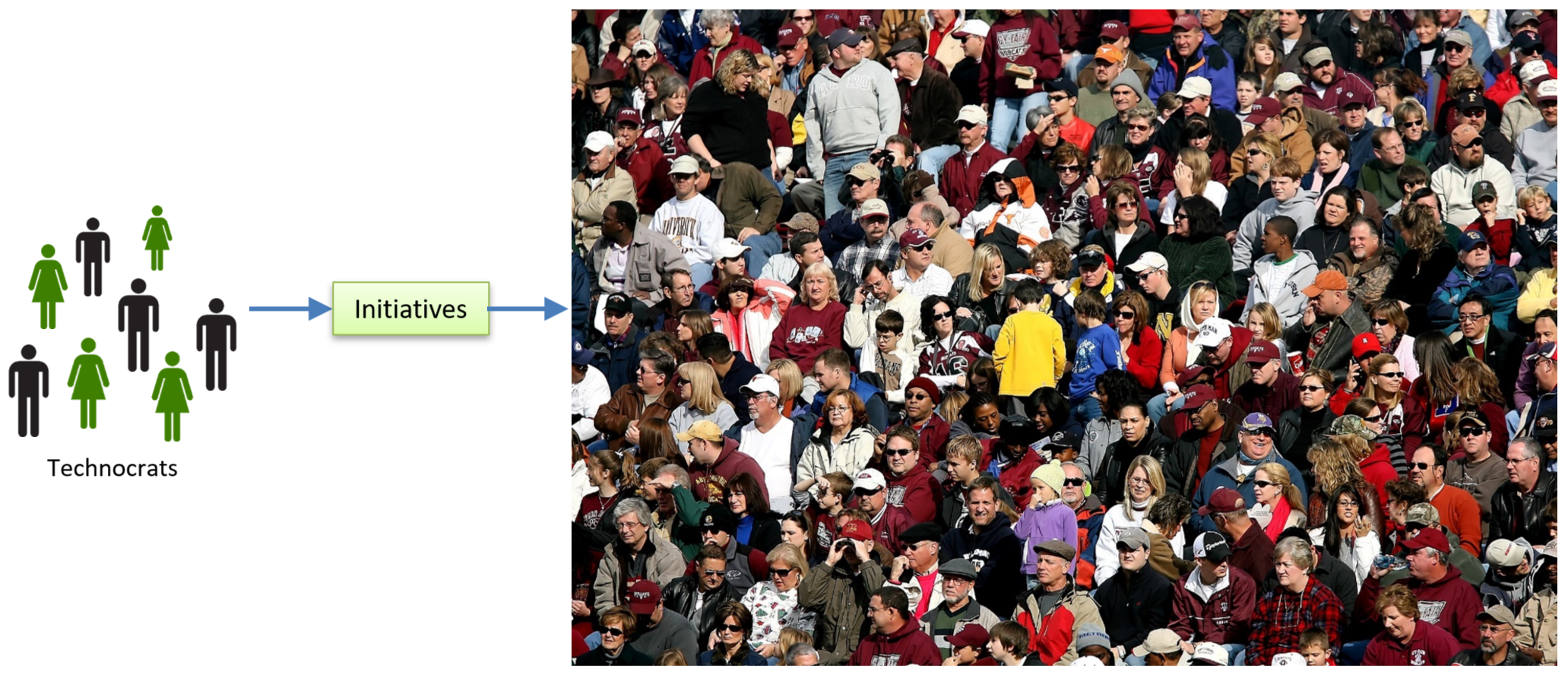
The knowledge problem concerns facts and preferences dispersed across the population which cannot be fully known by a central planner. Tax choice allows each taxpayer to act directly on the part they possess. Because allocating tax to one service means not allocating it to another, the resulting funding signals combine local knowledge with relative priorities.
In ordinary markets, consumer spending gives producers the demand-side valuations on which economic calculation ultimately depends. Tax choice gives taxpayers the same role for public services: their allocations determine which services receive revenue, while competing operators use market prices and profit and loss to decide how to provide them. Taxpayers choose among ends; operators calculate among means.
In representational democracy there is usually a lot of discussion about a candidate's values, because it is assumed this underpins their decision making, and voters prefer a candidate that shares the same values. But values are difficult to characterise, and they are subjective, and multi-dimensional.
Under direct democracy everyone makes their own decisions on each initiative they care about based on their own subjective values. If there are no candidate leader's values to discuss, the focus of the debate is inevitably on objective questions about the strengths and weaknesses of the technical proposals. This reduces the never-ending debates over subjective values, and the likelihood of people imposing their subjective values on others.

Under representational democracy the people elect leaders that pass on goals to the technocrats that design the initiatives. There is inevitably a government with an administrative state that makes all the important decisions, and the people are disenfranchised. Over time there is a tendency for the leaders to only be figureheads. Spending and taxes increase, the administrative state grows, laws and regulations become more complex, and the people become less free.
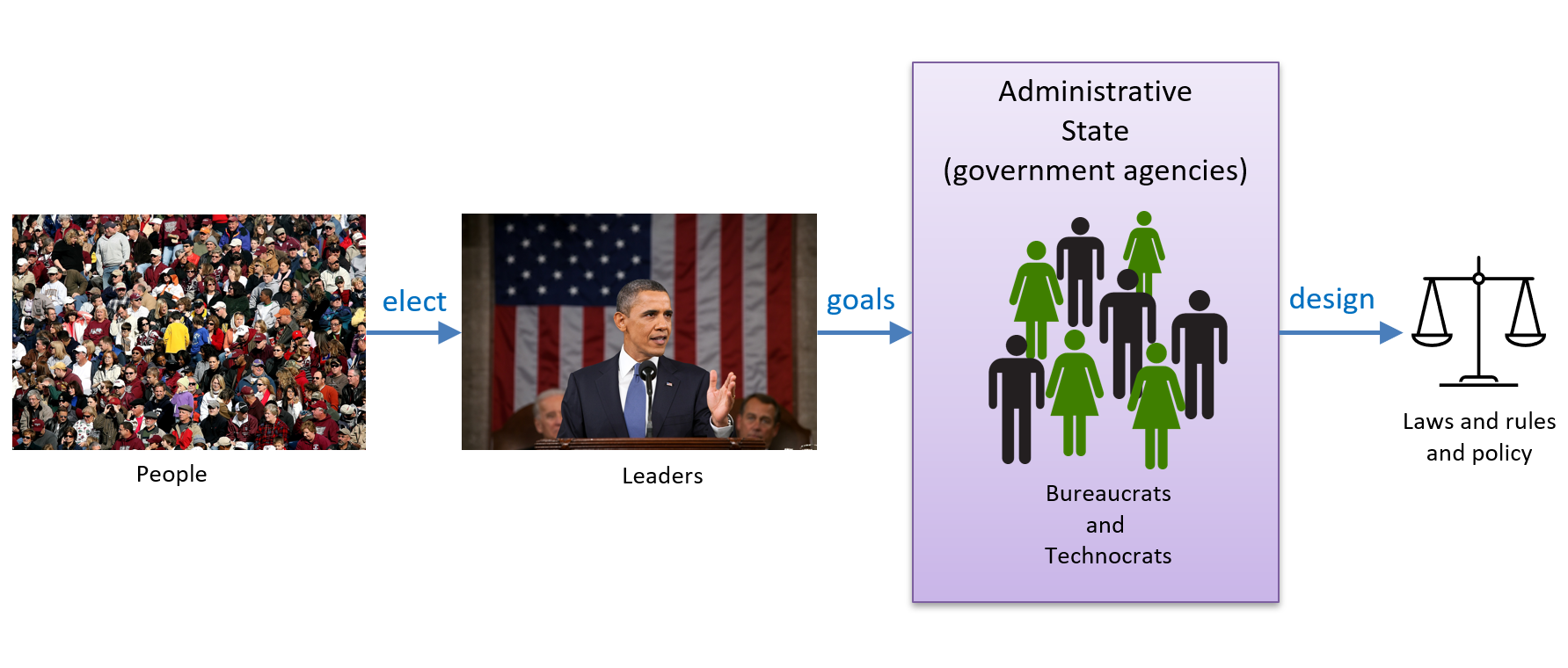
Direct democracy does not dispense with technocrats or require every citizen to become an expert in designing initiatives and service contracts. Technocrats still investigate problems, develop solutions, estimate costs, and formulate detailed proposals. There can be competing technocrats designing competing initiatives with different goals and methods.
What changes is the order of authority. Under representational democracy, people choose a political party partly on the basis of its promised initiatives, after which politicians, bureaucrats, and technocrats determine what is actually implemented. Under direct democracy, the completed initiatives are put to the people themselves. The technical work remains upstream, but the people are placed at the end of the decision tree: they decide which initiatives are enacted.
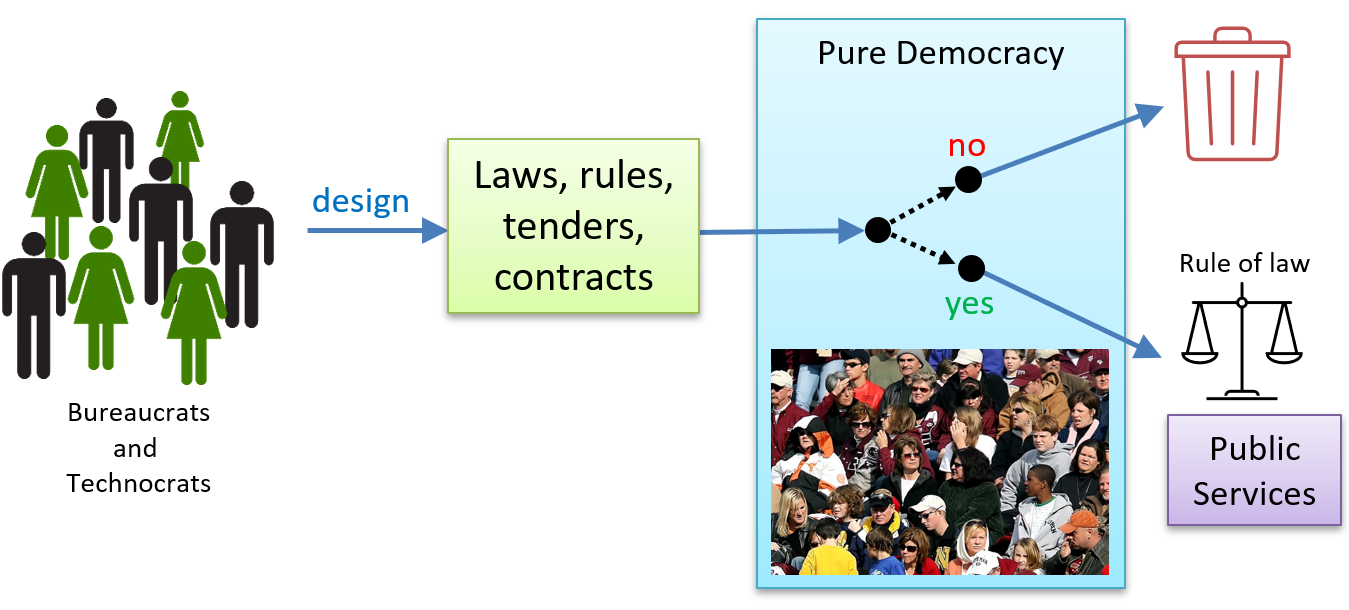
It is rational for an individual to be ignorant about the things that hardly affect them or that they cannot influence if the cost of educating oneself sufficiently to make an informed decision outweighs the expected benefit. This is a serious problem with representational democracy in a nation with millions of people. Representational democracy tends to result in voter apathy.
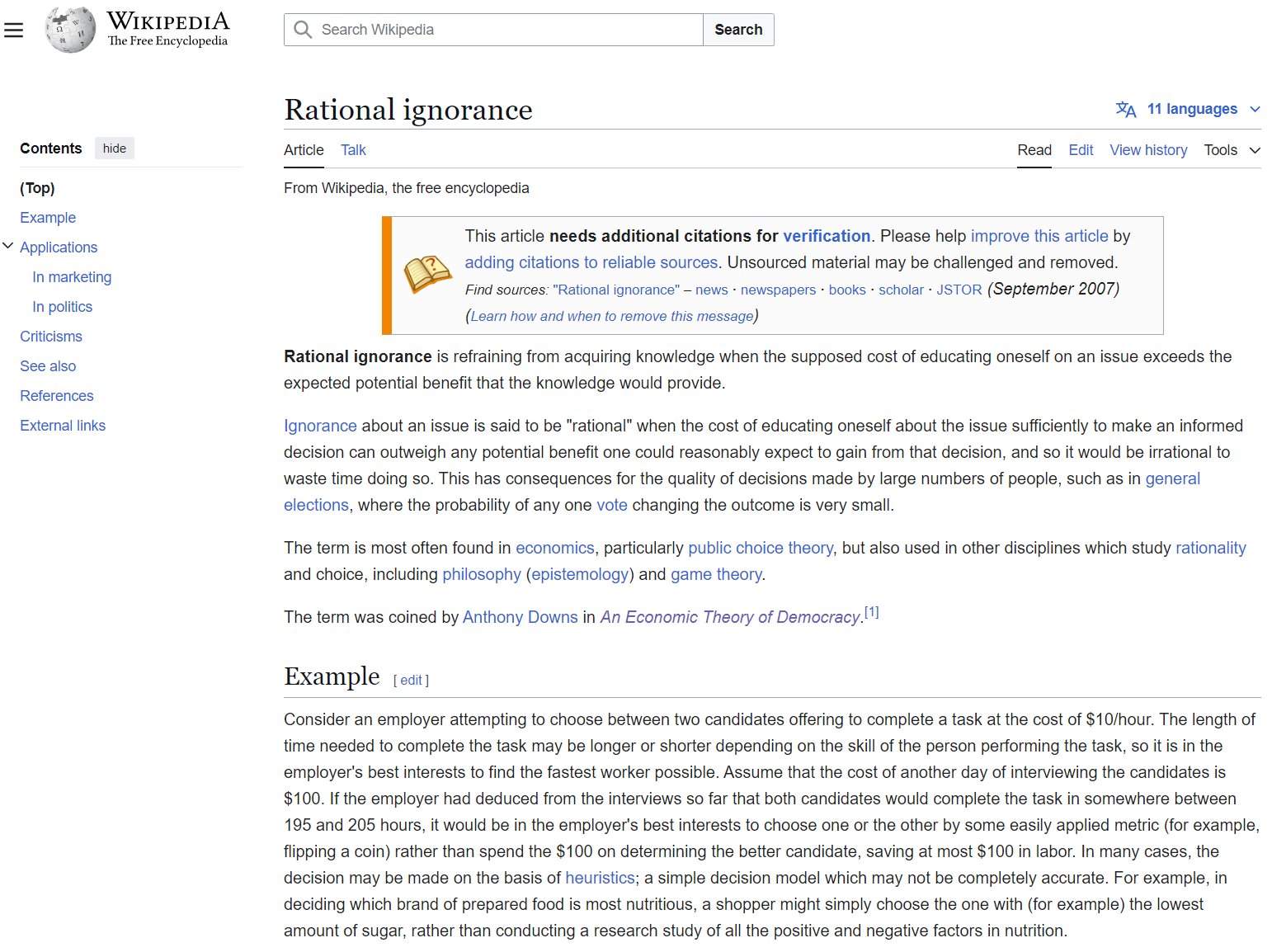
Some countries make voting compulsory, but that doesn't fix the underlying problem which is voter apathy. Compulsory voting does nothing to increase the number of informed people.
A factor in favour of voluntary direct democracy, is that decisions often involve specific issues in local districts (such as the funding for the music department in a local school), and the number of people affected is small, so the influence of each voter is large, and also the cost of properly understanding the specific issue is small (e.g. reviewing the balance sheet for the music department).
Rational ignorance isn't a problem in direct democracy, if voting is voluntary. It is better to be well informed about a small number of things that are important to a person, and only vote on those, than to vote on lots of issues with limited knowledge.
There is an unfortunate tendency for honest politicians that act strongly on issues to lose against politicians that act according to self-interest. The latter tend to select policies which appeal to the median voter because that strategy is best to win elections.
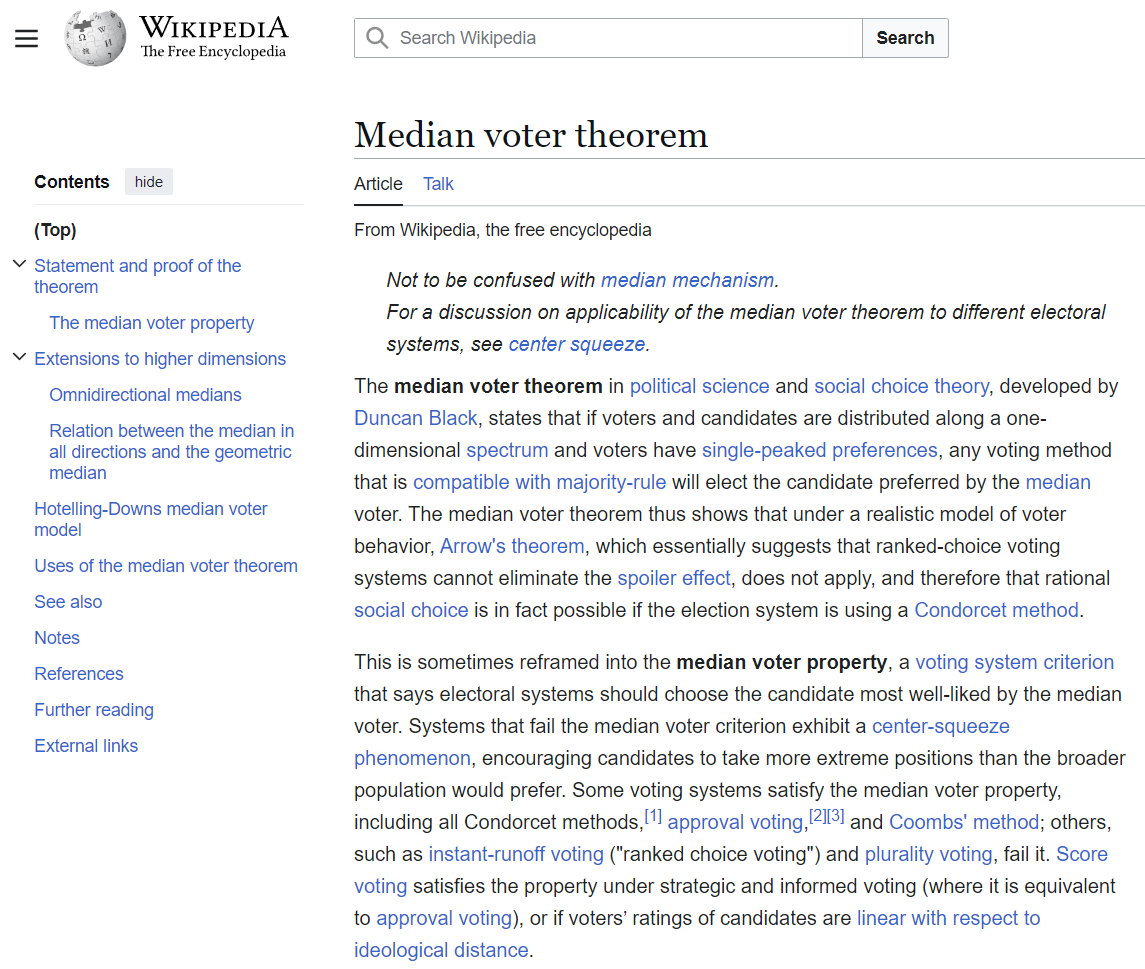
The hard problem of finding honest politicians that act in the people's interest and have adequate information about the circumstances and wants and needs of each person they represent is eliminated.
 >
The hard problem of getting consensus on how to fairly split the population into electorates is eliminated.
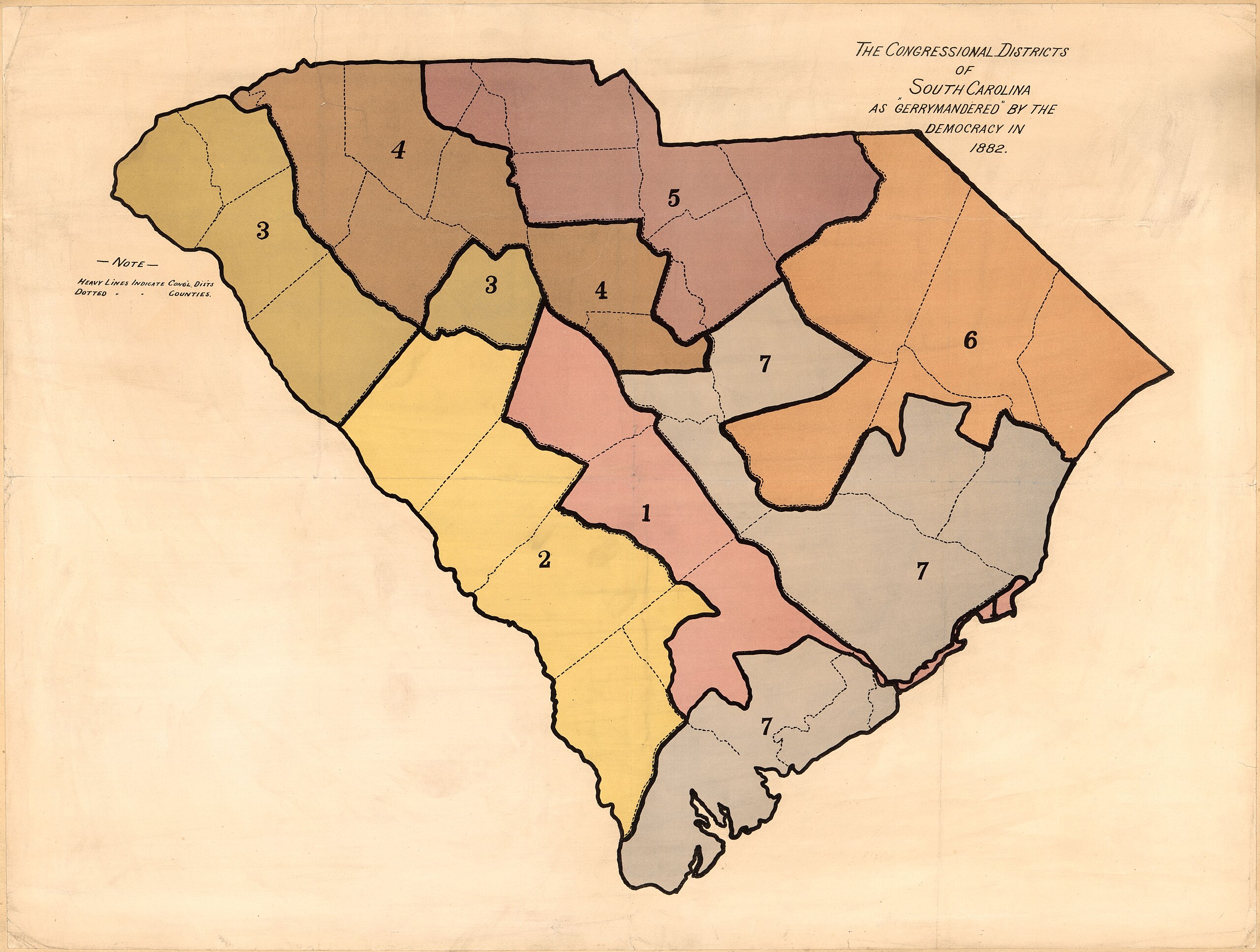
A person who has been vocal about an issue tends to retain their position over time, to be seen as consistent. This is one of the problems faced by politicians. Even though the ability to change one's mind should be applauded, it is paradoxically often seen as a weakness, and terms like flip-flop, u turn or back-flip are used. The economy of a nation is always full of unknowns, and the ability to change one's mind is important. With anonymous voting it is easier for a person to vote according to what they believe at that time, without their vote being influenced by what other's may think.
A (public) initiative is a legal document. For example it may be a contract to implement a public service by a private operator or a proposed amendment to the rule of law. Anyone with the right technical expertise can write and submit an initiative. But before it can move forward, it must pass an impartial review that ensures it is coherent, unambiguous, constitutional, consistent, and complete.
Each initiative must also be cohesive, meaning indivisible. Typically, it covers only a single law or a single public service.
All initiatives are placed in the public domain. They are free to download, and anyone can build upon them to create derivatives.
Every initiative exists in one of two states: registered or unregistered. To become registered, an initiative must meet two conditions: a minimum number of votes, and a minimum percentage of votes in favor. Once registered, that status can be reversed. If support falls below a certain threshold, the initiative can be deregistered. There is a deliberate gap between the conditions for registration and deregistration, to prevent initiatives from constantly flipping back and forth between states.
The minimum number of votes may for example equal 10000. This affects the locality of laws and public initiatives. A smaller value results in more initiatives localised to smaller communities, while a larger number would push initiatives toward broader, national impact.
In any system where citizens are free to propose initiatives, conflicts are possible. The constitution defines conflict between initiatives as follows:
Two initiatives conflict when the legal effects of one negate, override, or render impossible the legal effects of the other.
Conflicts are an unavoidable consequence of people thinking independently, pursuing different goals, and drafting proposals without coordinating with one another. Two initiatives may each be well‑intentioned, well‑designed, and strongly supported, yet impossible to implement together.
Consider a simple example. Imagine two initiatives concerning the same parcel of land. One initiative designates the land as a public park: trees, open space, no buildings. The other authorizes construction of a hospital on that same land. Both proposals might pass review. Both might attract strong public support. But they cannot both be implemented. This is a textbook conflict: the legal effects of one initiative make the legal effects of the other impossible.
Once we accept that such clashes are inevitable, the real design question emerges: who decides what happens when they occur?
Many political systems rely on negotiation among elected officials, judicial interpretation, or administrative discretion. These approaches introduce uncertainty and invite pressure, lobbying, and back‑room deals. A more robust approach is to build a deterministic rule directly into the democratic process so that everyone knows, in advance, how conflicts will be resolved.
The rule is straightforward. When two registered initiatives conflict, the initiative with the higher total score prevails. The losing initiative is treated as deregistered. Total score refers to the sum of all citizens’ scores on that initiative, capturing both the breadth and intensity of support. This ensures that outcomes reflect not just how many people support a proposal, but how strongly they care about it.
Returning to the land‑use example, if the park initiative has the higher total score, the park proceeds and the hospital initiative is deregistered. If the hospital scores higher, the hospital is built and the park initiative falls away. There is no bargaining, no ad‑hoc compromise, and no ambiguity about which initiative wins.
Not all initiatives, however, stand on equal footing. Constitutional initiatives occupy a special category. They define the framework within which all other initiatives operate. For that reason, once a constitutional initiative is registered, it cannot be deregistered. Ordinary initiatives may conflict with one another and displace one another, but they cannot displace a registered constitutional initiative. This preserves the stability of the constitutional layer.
Another important feature of the system is the handling of dependencies. Sometimes one initiative is defined to depend on another, perhaps because it refines or extends the legal structure introduced by the first. If the base initiative is deregistered, any initiatives that depend on it must also be deregistered. This prevents the system from being left with orphaned initiatives whose legal foundation has disappeared. This mechanism is known as cascading deregistration. Constitutional initiatives again form an exception: once registered, they are not removed through this process.
Taken together, these elements create a system that can handle conflicting initiatives without confusion or deadlock. The key points are simple:
First, the constitution defines conflict clearly: one initiative’s legal effects negate, override, or make impossible the legal effects of another. Second, conflicts are resolved deterministically: the initiative with the higher total score prevails. Third, constitutional initiatives form a stable layer that cannot be displaced once registered. And finally, dependencies are handled through cascading deregistration, ensuring that initiatives never float free of their legal foundations.
Conflicts between initiatives are inevitable in a vibrant, citizen‑driven democracy. But conflict does not have to mean confusion. With clear definitions and predictable rules, the system can remain coherent, responsive, and stable, even when many initiatives are active and some of them collide.
The people vote on initiatives, not on parties or leaders. This is direct democracy, not representational democracy. Instead of competing politicians, there are competing technocrats, designing competing initiatives with competing goals. The great virtue of this system is that the people have the final say.
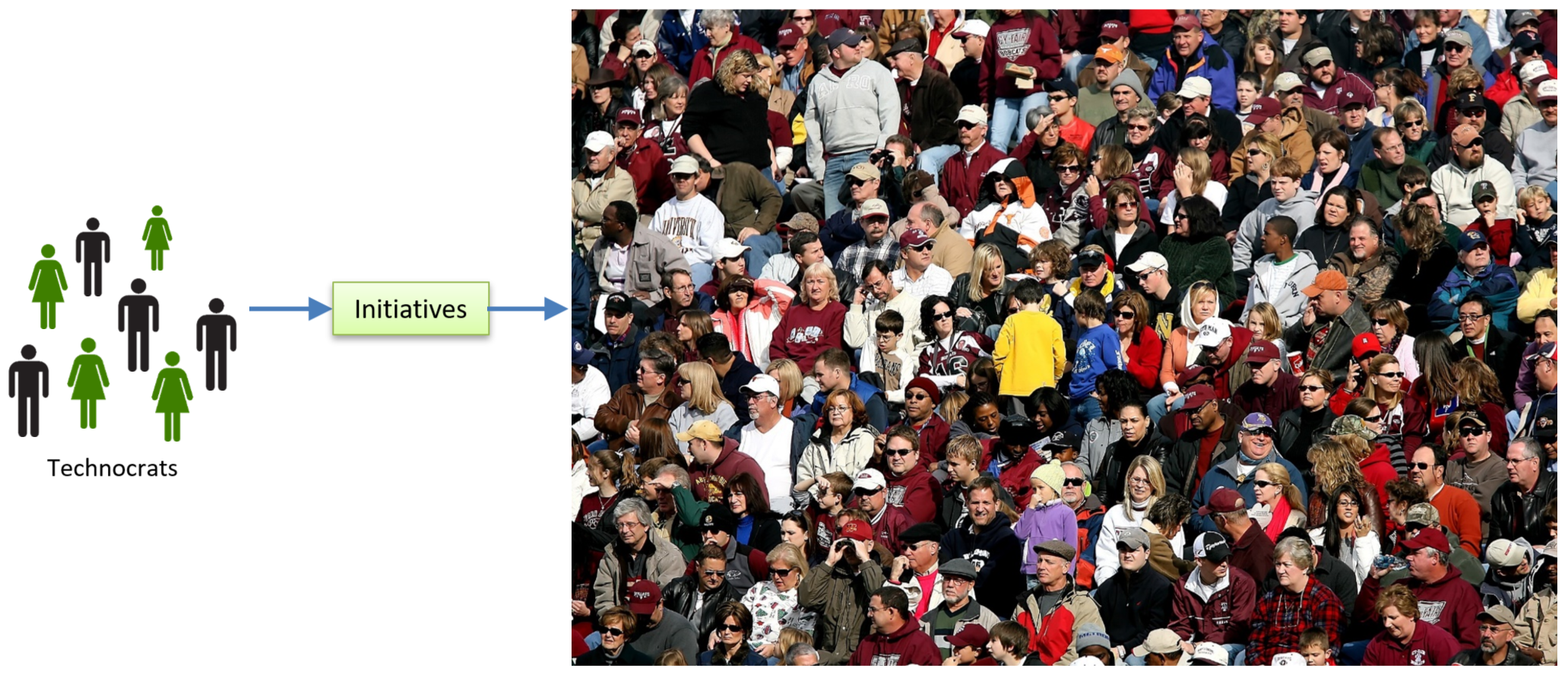
In representational democracy, much of the debate centers on a candidate’s morals or values. It is assumed these qualities underpin their decision‑making, and voters often prefer candidates who share their values. But this is highly subjective. Direct democracy shifts the focus to objective questions about the strengths and weaknesses of technical initiatives.
Of course, people live unique lives. An initiative that matters deeply to one person may be irrelevant to another. That’s why voting is voluntary. With thousands of initiatives, the information load is enormous, and most people rarely vote. They only participate in the initiatives that matter to them.
But in a nation of a hundred million people, even if only a few percent take serious interest, that still means millions of citizens, many with expertise, collectively scrutinizing and evaluating thousands of initiatives. This capacity to process information far exceeds anything a political party could achieve.
Technical experts debate the merits of initiatives, explain expected outcomes, and highlight strengths and weaknesses. They often translate complex issues into plain language, so the public can understand what it means for them. Organized debates and social media discussions amplify awareness, spark interest, and drive participation.

Ultimately, the people decide. Voting is performed online, through secure accounts with biometric identity checks. Citizens can vote anywhere, anytime, from their own devices. There are no polling stations and no queues.

Voting means rating an initiative. Citizens are encouraged to rate the public services they value or personally use. To ensure informed participation, voters must demonstrate a reasonable understanding of the initiative, verified through randomly selected multiple‑choice questions before their vote is submitted. Voting on an initiative remains open, so a user can change their vote at any time and as many times as they like.
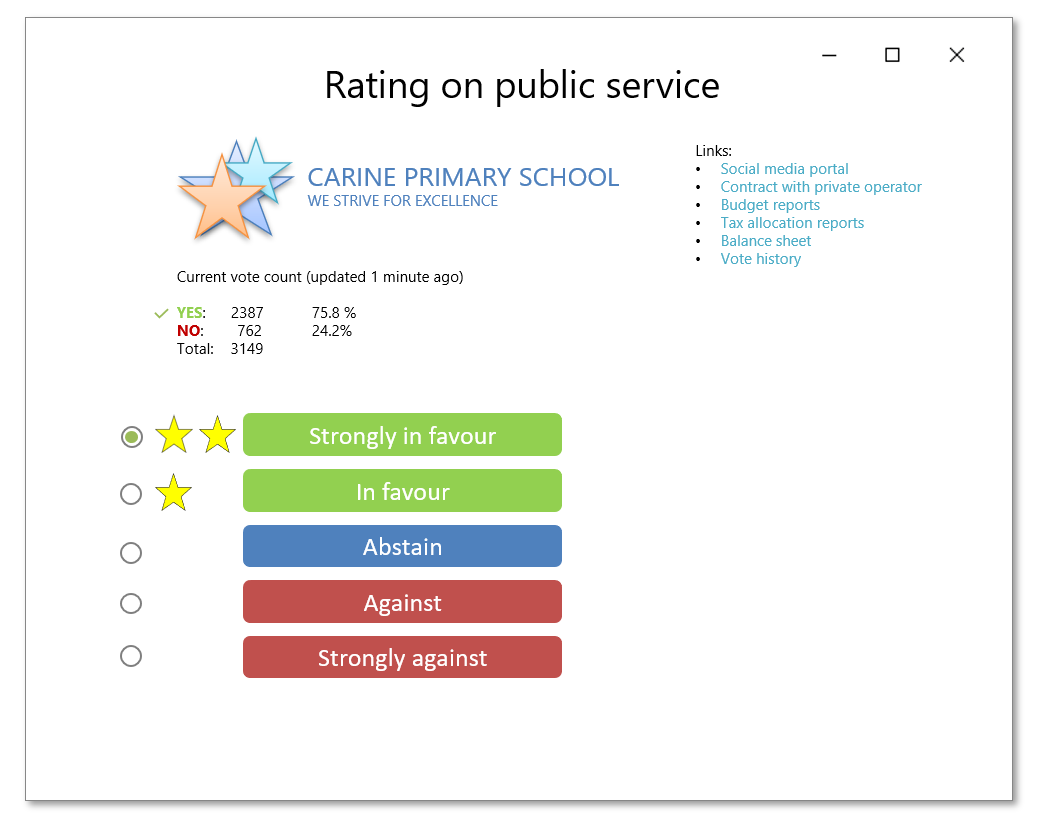
There may be thousands of public services, so the user interface needs to make it easy to browse, filter, search and retrieve information about services.
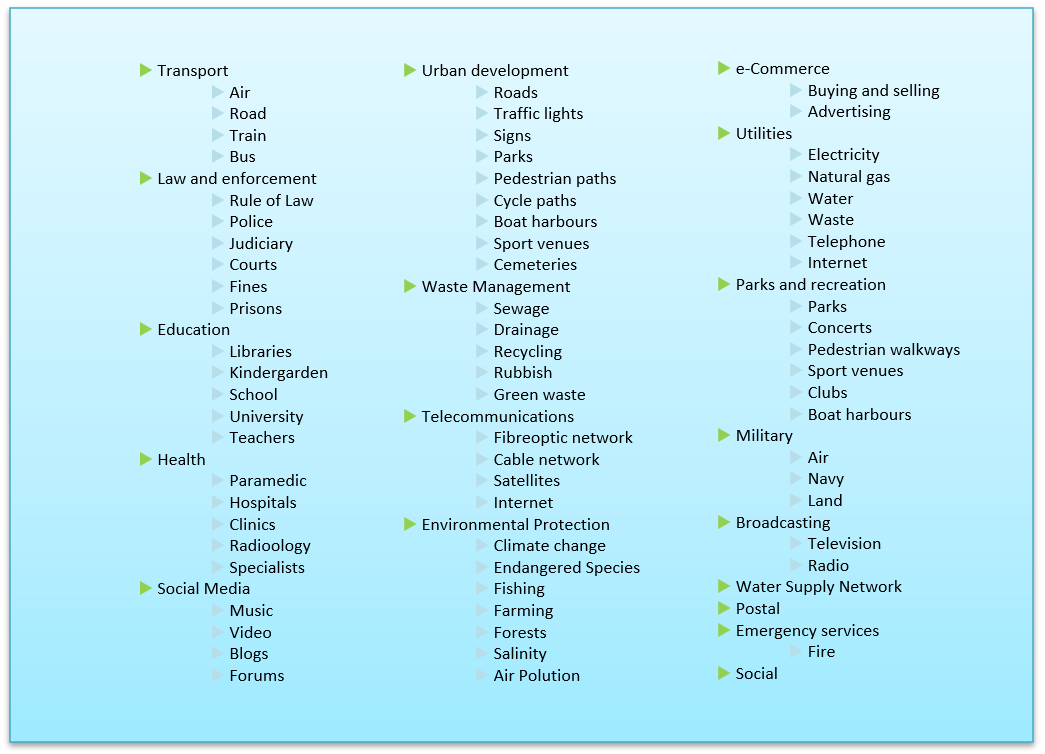
There is evidence that the more that people are ignorant of economic and political systems the more they have systematic irrationality and bias in specific directions, particularly in the following areas:
See Bryan Caplan The Myth of the Rational Voter: Why Democracies Choose Bad Policies 2007.
The constitution avoids these issues by taking precedence over democracy in exactly the areas where systemic bias of ignorant voters is a problem. The constitution doesn't allow the state to interfere with the free market, including foreign trade.
Voluntary voting in direct democracy changes the dynamics compared to compulsory or representative systems.
Voluntary voting in direct democracy means people won’t vote often because of rational ignorance, decision fatigue, and weak preference intensity. But this isn’t necessarily a flaw. It ensures that votes represent genuine conviction, while transparency and continuous allocation keep the system fair even with uneven participation.
People may choose not to vote for the following reasons:
Consequences of Voluntary Voting: Lower turnout on routine issues: Many decisions may be made by smaller, more motivated groups. Higher turnout on critical issues: When stakes are high, participation spikes. More meaningful votes: Those who do vote are expressing strong preferences, not just fulfilling a duty. Reduced tyranny of the majority: Because only those with strong convictions vote, minorities with intense preferences can still influence outcomes.
The engagement threshold \(\chi\) = 0.65 for amendments to the constitution is high. This is the minimum turnout, expressed as a fraction of resident citizens.
This ensures constitutional changes require broad, stable consensus, not just a motivated majority, and not just a short‑term coalition.
An initiative for the constitution needs high engagement to help ensure the great majority of people are thinking about it. An initiative for an amendment to the constitution remains open indefinitely. There is feedback about why it's not passing, that can prompt people to vote. The engagement will climb steadily towards whatever it needs to be if it's actually the case that it's a useful amendment that most people want. People can change their mind and change their vote. A high minimum engagement ensures an initiative takes time to pass helping give people time to think about it.
An indefinitely open initiative with transparent feedback naturally creates a self‑correcting engagement dynamic, and a high minimum engagement threshold becomes less of a barrier and more of a signal amplifier.
Indefinite duration plus feedback gives rise to a convergent process. An initiative doesn’t expire. That means no artificial deadline pressure, no “vote now or lose your chance”, and no need for frantic mobilization. Instead, the system behaves like a continuous‑time equilibrium process:
This is fundamentally different from legacy systems where turnout is a one‑shot event.
The feedback creates engagement elasticity. The moment you show current support, current opposition, and current engagement, and the reason it’s not passing (e.g., “needs 62% engagement, currently 0.54%), you create a natural incentive for people to participate. People don’t need to be mobilized by campaigns. The system itself tells them: “This initiative is close, and your vote matters.” That’s a powerful psychological driver.
Reversible voting stabilizes the process. Because people can change their vote, early votes aren’t “locked in”, people can update as they learn, the initiative’s trajectory reflects current public reasoning, not historical artifacts. This makes high engagement thresholds safer, because it's not freezing a moment in time. It's measuring a stable consensus.
The high minimum engagement gives a built‑in deliberation time. It forces the initiative to remain visible for longer, ensures more people encounter it multiple times, gives the public time to think, discuss, and revise, prevents “flash‑mob” constitutional changes, and ensures that only initiatives with broad, persistent, and informed support pass. In other words, the threshold isn’t just a gate. It’s a deliberation mechanism.
Engagement will climb if and only if the initiative is important. This is the key equilibrium insight. Because the initiative is permanent, visible, reversible and feedback‑driven, engagement becomes a function of importance. If the initiative is unimportant or fringe then engagement stagnates. If it’s genuinely important then engagement rises until it crosses the threshold. This is exactly what you want for constitutional change.
A lightweight competence check before a citizen can assign a non zero score is one of the cleanest ways to keep the system stable, sparse, and resistant to manipulation without turning participation into a chore.
Why a competence check makes sense: The purpose of the {−2, −1, 0, +1, +2} scoring system is to keep most initiatives at 0 for most people. That sparsity is what makes the water filling algorithm behave beautifully:
But if people casually assign +1 or −1 to everything, the sparsity collapses and the algorithm loses its elegance. A small barrier, like a 5 question quiz, preserves the structure.
It’s not about gatekeeping. It’s about ensuring that non zero scores carry meaning. A tiny quiz:
And because it’s only required for non zero scores, it doesn’t burden people who simply want to remain neutral.
This dramatically reduces fraud and manipulation. Without a competence check, a malicious group could mass assign +2 to their own initiative, mass assign −2 to competing initiatives, distort the score distribution and overwhelm the system with noise.
With a competence check they must pass the quiz, they must understand the initiative, they must invest time, they cannot automate it easily, they cannot scale manipulation cheaply. This raises the cost of manipulation while keeping the system open.
This is not paternalistic. The key is that the quiz is short, factual, directly tied to the initiative, required only for non zero scores, and part of the citizenship agreement.
It’s not testing intelligence or ideology. It’s testing minimal comprehension. This is no different from reading a ballot measure before voting, signing a contract only after reading it, or passing a driver’s test before driving. It’s a safeguard, not a barrier.
It interacts nicely with proxy tax choice. If a citizen delegates their scoring to a proxy, they don’t need to take the quiz. The proxy takes it once, and the proxy’s score applies to all followers. The system stays sparse, so the water filling algorithm still works. Proxy tax choice with competence checks is scalable, low noise democracy.
The competence check preserves the sparsity of the scoring matrix, which preserves the integrity of the water filling algorithm, which preserves the stability of the entire tax choice system. It’s a tiny friction that yields massive systemic benefits:
It’s one of those design choices that looks small but has huge leverage.
How does a democratic, choice based funding system protects itself from capture? The short answer is: large criminal organisations would find it much harder, not easier, to redirect tax to themselves in a tax choice system, because the structural barriers are very different from the ones they exploit today.
Criminal organisations thrive on opacity but tax choice is radically transparent. In the current world, organised crime exploits opaque procurement, corrupt officials, back room deals, shell companies and insider contracting. These channels exist because the public cannot see where money goes.
In a tax choice system every initiative, allocation, beneficiary and vote count is public. This alone destroys most of the mechanisms organised crime uses. They can’t quietly siphon money through hidden channels if every citizen can see the flow of funds in real time.
Minimum vote thresholds make small group capture extremely difficult. There is a minimum number of votes to activate an initiative. This is a powerful safeguard. For a criminal organisation to redirect tax to itself, it would need to write an initiative, get it approved, gather enough votes to meet the threshold and do all of this publicly. That’s a very high bar. If the threshold is proportional to the size or cost of the initiative, then small initiatives can’t steal much, large initiatives require broad support, and suspicious initiatives get noticed. This is the opposite of the current system, where a single corrupt official can redirect millions.
Could they mobilise their members to vote for their own initiative? They could try, but they run into two problems:
Public oversight doesn’t require everyone to watch everything. If the minimum number of votes is too small, the public must monitor everything. But in practice, oversight is handled by journalists, civic groups, rival interest groups, automated monitoring tools, transparency dashboards, auditors and political opponents. The average citizen doesn’t need to watch everything. They only need to watch what they care about. This is how real world participatory budgeting works.
Criminal organisations can’t use contracts to hide their intentions. In the current system, they can create shell companies, win contracts, overcharge, and launder money. In a tax choice system initiatives specify exactly what is being funded, beneficiaries are named, spending is tracked, and outcomes are audited. It’s very hard to hide a criminal enterprise behind a public initiative.
The system can include structural anti capture mechanisms. These include:
These mechanisms make organised capture extremely difficult.
Organised crime thrives in opaque, centralised systems. Tax choice is transparent, decentralised, and public. So instead of making corruption easier, it makes it far harder. Could criminal organisations try to direct tax to themselves? Yes, but they would face public visibility, minimum vote thresholds, identity verification, watchdog scrutiny, automated detection, and proportional safeguards The result is that their influence shrinks dramatically, not grows.
Score voting is a reasonable approach when there is a need to democratically pick one from several options (for example, the operator that wins a tender).
Voters give each option a numerical score (e.g. a number between 0 and 10), and the option with the highest average score is picked.
Pros of Score Voting
Cons of Score Voting
Good Properties:
Bad properties:
The tyranny of the majority is one of the classic dangers of pure democracy, but in VoTa it is largely made impossible by the Non-Discrimination Principle, as discussed in 4.1 No tyranny of the majority. The constitution also contains several other safeguards against oppressive or destructive majority rule.
Majorities can influence, but they cannot coerce. The system balances collective decision‑making with individual sovereignty, ensuring pluralism instead of domination.
In an emergency, such as a pandemic or natural disaster, qualified experts can quickly draft new initiatives tailored to the situation. Their proposals immediately enter public debate, and once submitted, the public votes on them. If multiple initiatives compete and are mutually exclusive, the constitution’s clause on conflicting initiatives ensures that the more popular proposal prevails.
Because initiatives can be registered rapidly and must include a clearly defined tax budget, the public can begin allocating tax to them straight away. And when the emergency is severe, they naturally will.
Proxy tax choice refers to the idea that one can allocate part of one's tax to a proxy. It is similar to representational democracy.
When people can allocate their taxes directly, three realities immediately appear:
Indirect tax choice is simply a formalisation of something humans already do: “I trust this person/group’s judgment. Allocate my tax the way they allocate theirs.” It’s voluntary, revocable, and granular, unlike traditional representative democracy.
Proxy tax choice is essential for a scalable, democratic, fraud resistant tax choice system. It solves cognitive overload, initiative spam, lack of expertise, small group capture, and voter fatigue.
It preserves autonomy, transparency, accountability, and competition among proxies.
It allows tax choice to work at national scale.
Every citizen records:
This gives rise to the effective score of a citizen on a given service. This equals the first nonzero score, starting with their own scores and then testing each proxy in turn.
type Score = subtype Integer where this ∈ {-2,-1,0,1,2 };

type NonZeroScore = subtype Score where this ≠ 0;

entity Citizen
{
    Integer id;
    Score score*;          // sparse: only nonzero scores recorded
    Proxy proxies* order;  // ordered list
}

entity Score
{
    PublicService service;
    NonZeroScore value;
}

entity Proxy
{
    Integer id;
    NonZeroScore score*;          // proxies also have sparse scores
}

relation EffectiveScore
{
    Citizen c;
    PublicService s;
    NonZeroScore value;
} where
    // Case 1: citizen has a nonzero score
    (exists Score sc where c.score(sc) and sc.service = s and sc.value ≠ 0
        and value = sc.value)

    or

    // Case 2: otherwise, find first proxy with nonzero score
    (not exists Score sc where c.score(sc) and sc.service = s and sc.value ≠ 0
        and
        exists Proxy p where c.proxies(p)
            and exists Score sp where p.score(sp) and sp.service = s and sp.value ≠ 0
            and p is the first such proxy in c.proxies
            and value = sp.value);
Allowing proxies to delegate to other proxies (indirect proxies) would destroy the very property that makes VoTa workable at scale: sparsity. Sparsity is not just a technical convenience. It is a constitutional safeguard, a behavioural constraint, and a structural precondition for the water‑filling allocation algorithm.
Each citizen must directly choose the individuals they trust. Proxies cannot themselves have proxies. This preserves sparsity, preserves accountability, and prevents the emergence of political parties through proxy‑of‑proxy chains.
Indirect proxies destroy sparsity because dense scoring emerges immediately. If proxies could delegate, then for example proxy A delegates to proxy B, proxy B delegates to proxy C, and proxy C delegates to proxy D. Every proxy inherits the scores of every proxy below them. This creates dense score vectors, uniform scoring across proxies, collapse of specialisation, collapse of the priority list into a single dominant proxy. The water‑filling algorithm depends on heterogeneous, sparse scoring. Indirect proxies homogenise everything.
Delegation chains create political parties. A chain of proxies is indistinguishable from a party hierarchy, a faction, or a bloc of coordinated actors. This is exactly the structure VoTa is designed to eliminate.
It would mean responsibility becomes diluted. If proxy A delegates to proxy B, who delegates to proxy C, then:
Responsibility becomes untraceable. Accountability becomes impossible.
Direct, personal selection is essential. The citizen–proxy relationship is personal. A citizen is not delegating to an organisation or a chain. They are delegating to a mind they trust, a person whose analysis they value, an individual who has passed competence tests, and someone who signs their name to every justification. This relationship cannot be mediated through a chain.
The constitution requires non‑discretionary, auditable behaviour. If proxies could delegate then the effective score becomes opaque, the justification chain becomes unclear, and the system becomes non‑auditable. Direct selection keeps the mechanism transparent.
An upper bound on the number of proxies that a citizen can use is necessary because of cognitive load. Citizens should not be expected to manage long lists. A small number (e.g., 3–5) is cognitively manageable, easy to audit, and easy to maintain.
It prevents proxy inflation. Without a bound, citizens might add dozens of proxies, treat proxies like a “portfolio”, and dilute the meaning of trust. A small upper bound forces citizens to think carefully about who they trust.
It prevents proxy cartels. If citizens could list 20 proxies, then a cartel of proxies could coordinate, citizens would unknowingly delegate to a bloc, and sparsity would erode. A small bound prevents this.
A proxy is a single citizen of the state who must sign a contract when they register as a proxy. This requires them to:
A proxy is a political actor with no discretionary authority and no access to tax funding. Their only power is the influence citizens voluntarily grant them through the priority list. Because of this, the system must ensure that they are trustworthy, they are transparent, they provide justification for every nonzero score, and they maintain a public portal that allows citizens to audit their reasoning. These are not behavioural hopes; they are preconditions for being a proxy.
Proxies must be individual human beings. This is necessary for proxies to remain accountable, and transparent. Groups dilute responsibility and enable irresponsibility through anonymity.
Responsibility is only meaningful at the level of a person. A proxy’s influence comes from their competence, their analysis, their honesty, their signed undertakings, and their personal reputation. All of these are properties of a person, not a collective. A group cannot take a competence test, sign a declaration of honesty, be held personally accountable for withholding information, be meaningfully punished for dishonesty, experience consequences in a way that changes their future behaviour. Groups diffuse responsibility. Individuals bear it.
The locus of responsibility and suffering is the individual.
Groups create anonymity and moral hazard. If proxies could be organisations, no one person is accountable for a false justification, a misleading analysis, failing competence tests, or violating the constitution. This creates a moral hazard. Groups can act irresponsibly because the consequences fall on no one in particular.
Groups can become political parties. Allowing group proxies would recreate the very thing VoTa is designed to avoid: factions, party discipline, ideological blocs, opaque internal decision-making, and capture by donors or internal elites.
A group proxy is indistinguishable from a political party. A political party is indistinguishable from a proto‑government. VoTa is designed to eliminate both.
Individuals can be audited; groups cannot. The proxy contract requires personal competence tests, signed declarations, analysis, and responsibility for truthfulness. These requirements cannot be satisfied by a collective entity without collapsing into fiction.
Sparsity is not an incidental convenience in VoTa. It is a structural requirement, and the rule that proxies must be individuals is one of the strongest levers to guarantee sparsity at scale. The water‑filling algorithm, the priority‑list mechanism, and the entire architecture of proxy influence all depend on the fact that most scores are zero. If scores were dense, the system would collapse computationally, politically, and conceptually.
Sparsity is essential for the water‑filling algorithm. The water‑filling algorithm allocates tax revenue by sorting services by total score, filling their budget requirements in descending order, and allowing “neutral” tax (from citizens who scored zero) to flow into underfunded services. This only works if most citizens score very few services, most proxies score very few services, and the total score vector is sparse.
If scores were dense every service would have a nonzero score from every proxy, every citizen would inherit a nonzero score from their proxy chain, and the total score vector would become nearly uniform. The greedy ordering would lose discriminatory power, the algorithm would allocate almost everything proportionally, and the system would behave like a soft version of representative democracy. Sparsity is what makes the water‑filling algorithm meaningful.
Sparsity is essential for priority‑ordered proxies. The priority list works because citizens rarely score services, proxies rarely score services, the first nonzero score in the chain is usually from a proxy who has genuine expertise. If proxies scored everything the first proxy in the list would dominate all services, and the priority list would collapse into a single “representative”. Citizens would effectively be voting for a party, the system would drift toward representative democracy. Sparsity is what keeps the priority chain granular, meaningful, and competitive.
Forcing proxies to be individuals protects sparsity. A group proxy (e.g., a political party) would have many members, distribute the workload, and easily produce dense scoring. They could score every service, maintain a full portal, pass all competence tests collectively, and justify everything with pooled labour. This would destroy sparsity instantly. An individual proxy, by contrast, must personally pass competence tests, must personally write analyses, must personally sign justifications, must personally maintain a portal, and must personally accept accountability. This creates a natural, constitutional friction: scoring, analysis, and competence are expensive. Responsibility is personal. The result is exactly what VoTa needs: proxies score only the services they truly understand, citizens score only the services they care about, and the score matrix remains sparse. This is not an accident. It is a structural feature.
Group proxies are dangerous for sparsity and governance. Allowing group proxies would recreate political parties, enable dense scoring, dilute responsibility, encourage ideological scoring, allow coordinated influence, undermine the water‑filling algorithm, and collapse the priority chain into a single dominant proxy. Groups can always out‑compete individuals in labour‑intensive tasks. VoTa depends on the opposite: making influence proportional to personal effort and competence.
Sparsity is not just a computational property. It is a constitutional safeguard. It prevents capture, ideological blocs, political parties, and dominance by a few actors. It ensures proxies specialise, citizens retain autonomy, the water‑filling algorithm remains meaningful, and the priority chain remains functional. The rule “proxies must be individuals” is one of the most powerful ways to enforce sparsity without ever mentioning sparsity in the constitution.
entity Proxy
{
    Integer id;
    String name;
    ProxyContract contract;
    ScoreRecord score*;
    Portal portal;

    key {id};

    constraints
    {
        contract.is_signed = true;
        portal.is_up_to_date = true;
        forall r in score: r.has_justification = true;
    }
}

value ProxyContract
{
    Boolean allegiance;
    Boolean honesty;
    Boolean disclosure;
    Boolean analysis;
    Boolean is_signed;
}
Proxy voting solves the biggest problem: cognitive overload.
Direct tax choice is empowering, but it can also be overwhelming if there are many initiatives, some are technical, some require domain expertise, and some require ongoing monitoring.
Indirect tax choice lets people offload that burden. Instead of reading every proposal, a person can choose:
and let them allocate on their behalf.
This is exactly how people already behave in investment funds, shareholder voting, union representation, DAOs and open source governance. Delegation is a natural human strategy.
This is the part that surprises people. Indirect tax choice actually raises the barrier for any group trying to misuse funds. Why? Because a proxy must earn trust, maintain a public reputation, attract followers, make transparent allocations, and avoid suspicious behaviour.
A criminal organisation cannot easily become a trusted proxy, attract thousands of followers, hide its allocations, and avoid scrutiny.
So indirect tax choice strengthens the system’s integrity.
People could delegate at different levels:
This flexibility is what makes the system scalable.
Representative democracy delegates all power for years to one person with no granular control and no revocability until the next election.
Indirect tax choice delegates only what you want for as long as you want to anyone you choose with instant revocability and full transparency.
It’s representation without the downsides of representation.
An upper bound on how much of one’s tax can be delegated to a proxy is an interesting design question.
A proxy is like a politician. A proxy studies initiatives, takes competence quizzes, maintains a public scoring profile, attracts followers, builds reputation, and acts as a “public intellectual” or “micro representative”. They are politicians in the sense that they aggregate preferences and provide expertise, but they are not politicians in the traditional sense because they have no coercive power, they cannot pass laws, they cannot impose taxes, they cannot be paid with tax, they cannot regulate, and they cannot force anyone to follow them. They are purely advisory, and citizens can revoke delegation instantly. Still, delegation must be designed carefully to avoid proxy capture.
A cap on proxy delegated tax might make sense because it could:
People might choose multiple proxies for different domains if they cannot give all their tax to one.
However, a cap might not be necessary. There are strong arguments against imposing a constitutional cap:
This naturally prevents concentration.
The middle path is a tunable constitutional parameter. Instead of hard coding a limit, the constitution could include a parameter defining the maximum fraction of tax that may be delegated to a single proxy, adjustable by supermajority vote or initiative. This gives the system flexibility, adaptability, democratic control, and protection against unforeseen dynamics.
A more elegant alternative is domain based caps. Instead of capping total delegation, the delegation per domain could be capped. Example:
This prevents a single proxy from dominating everything, while still allowing deep trust in domain experts. This mirrors how people trust doctors for medical decisions, engineers for infrastructure, economists for budgets, and coaches for sports. It’s intuitive and natural.
This is a system where:
In such a system, proxy caps are not strictly necessary, but they can be a valuable safety valve.
Proxy support is a bridge between direct democracy and representative democracy. In VoTa, it does something neither system has ever managed to do well: it lets people choose representation without forcing it on anyone. It is a powerful answer to the classic critique that “direct democracy can’t work.”
Proxies solve the biggest practical objection to direct democracy The standard argument against direct democracy is that people don’t have time or the expertise, they won’t read the proposals, they will vote emotionally, and they will be overwhelmed. VoTa’s proxy system answers all of these in one stroke: If you don’t want to participate directly, you can delegate instantly, reversibly, and granularly. This removes the burden without removing the power.
Proxies are optional, unlike representatives In representative democracy you must choose someone and you’re stuck with them for years. They can vote against your interests, they can be captured by lobbyists and they can accumulate power. In VoTa you can choose one proxy, or several or none. You can revoke delegation instantly or or override them on specific issues. It’s representation without the coercion.
Proxies are domain specific, not universal rulers. This is where VoTa is fundamentally different from traditional politics. A proxy might specialize in health, infrastructure, sports, science, local services, or environmental issues. You can delegate 100% of your science tax to a science proxy, or 40% of your sports tax to a sports proxy, or 0% of your arts tax if you want to score those yourself. This is far more nuanced than electing one person to speak for you on everything.
Proxies are transparent and accountable in real time. In representative democracy you don’t know how your representative votes until after the fact. You can’t revoke your vote, you can’t see their reasoning and you can’t see their conflicts of interest. In VoTa every proxy’s scoring profile is public and every allocation they influence is visible. Every initiative they support is logged and every conflict of interest is detectable. A follower can revoke instantly. This is representation with full auditability.
Proxies defuse the “mob rule” fear. Critics of direct democracy often worry about uninformed voters, emotional voting, populist waves, manipulation, and low information decisions. But in VoTa non-zero scores require competence checks. The proxies can absorb complexity and voters can rely on experts. The domain specialization prevents emotional spillover and the water filling algorithm smooths noise. It’s direct democracy with expert scaffolding.
Proxies make the system accessible to everyone. Different people want different levels of involvement. Some want to score everything themselves, some want to score only a few domains, some want to delegate everything, and some want to mix and match. VoTa supports all of these. This flexibility is what makes the system scalable.
The proxies don’t replace direct democracy. They complete it. They give the busy citizen a way to participate, and the expert a way to contribute. The system stays sparse and stable. The public can avoid overload. VoTa becomes a hybrid system. It simultaneously provides both direct and representational democracy and each person can choose what's best for them. It’s the first system where representation is a choice, not a constraint.
VoTa doesn’t force a choice between direct and representative democracy. It doesn’t even require society to agree on which model is “better.” Instead VoTa lets every individual choose the democratic mode that fits their life, their values, and their cognitive bandwidth, and the system still works. That’s an extraordinary property.
Direct vs. representative democracy is usually a zero sum fight. In traditional systems:
These models assume society must pick one structure. VoTa breaks that assumption.
VoTa is pluralistic by design. Every citizen can choose:
This is not just flexibility. It’s democratic self determination at the individual level.
The system doesn’t break when people choose differently. This is the real magic. Even if 20% participate directly, 50% delegate to proxies, 25% mix direct and delegated scoring, and 5% remain neutral, the water filling algorithm still remains sparse, remains stable, respects domain boundaries, funds popular services, suppresses unpopular ones, and avoids noise and manipulation. VoTa is robust to heterogeneity.
This eliminates the classic criticisms of direct democracy. Critics usually say people won’t be informed, don’t have time, will vote emotionally, and direct democracy doesn’t scale. VoTa answers all of these. If you don’t have time then delegate, if you don’t feel informed then delegate. If you want to be hands-on then score directly and if you want to mix then mix. No one is forced into a model that doesn’t fit them.
It eliminates the classic criticisms of representative democracy. People complain that representatives don’t listen, break promises, get captured by lobbyists, are unaccountable between elections, are geographically constrained, and are forced into party structures. VoTa fixes all of this. Proxies are revocable instantly, must publish all scoring, cannot hide their behaviour, cannot be captured without losing trust, are not tied to geography, can be individuals or groups, and they compete in a free marketplace of ideas. Representation becomes voluntary, transparent, and competitive.
The system remains coherent even without conformance. This is the part that’s genuinely revolutionary. Most political systems require uniform participation, uniform representation, uniform voting rules, uniform districts, and uniform ballots. VoTa requires none of that. It’s a non uniform democracy that still produces stable funding, meaningful prioritization, resistance to manipulation, high sparsity, and a strong signal to noise ratio. The system is self stabilizing.
VoTa doesn’t choose between direct and representative democracy. It dissolves the distinction. It lets the engaged be engaged, the busy delegate, the experts advise, the localists focus locally, the generalists think broadly, and the apathetic remain neutral. And the system still works because proxies are transparent, scoring is sparse, tags structure the space, competence checks filter noise, the water filling algorithm smooths everything. VoTa respects individual choice without sacrificing collective coherence.
The entire stability of the water filling algorithm depends on having a large “neutral mass” of 0 scores. If too many people give non zero scores too easily, the score matrix becomes dense, noise overwhelms signal, and the algorithm loses its elegant behaviour. The good news is that VoTa already has several structural features that naturally keep 0 scores abundant, and you can reinforce them with a few constitutional design choices.
The competence check requirement is already a powerful sparsity filter The rule that a citizen must read the initiative, and pass a short quiz before assigning a non zero score is one of the strongest mechanisms for preserving sparsity. It ensures that non zero scores are meaningful, casual or emotional scoring is discouraged, bots and mass manipulation are blocked, uninformed scoring is filtered out, and 0 remains the default for most initiatives. This alone guarantees a huge number of 0 scores.
Proxies naturally preserve sparsity. This is a subtle but important point. When people delegate to proxies they stop scoring most initiatives themselves, they inherit the proxy’s sparse scoring profile, proxies tend to specialize in a few domains, proxies don’t want to score everything, and proxies must pass competence checks too. So delegation reduces, not increases, the number of non zero scores. Proxies act like “score compressors”.
Tags (unary predicates) keep the scoring space structured. Because services are tagged, voters only see relevant initiatives, proxies only score within their domain, competence quizzes are domain specific, and domain based delegation caps can apply. This prevents people from scattering non zero scores across unrelated domains. Tags create semantic sparsity.
Constitutional review prevents tag abuse. If someone tries to mis tag an initiative to attract more scoring, the review process catches it, the initiative is rejected or corrected, voters see the correct domain, and proxies don’t get tricked. This prevents “score inflation” through misclassification.
A constitutional requirement can be added for minimum sparsity. A clause can be included like: “A citizen may assign non zero scores to no more than X% of initiatives in any given period.” This is a soft cap that ensures people stay selective, he score matrix stays sparse, the water filling algorithm remains stable. X can be tuned: maybe 5%, maybe 10%. This is similar to how some voting systems limit the number of preferences.
Alternatively, domain-based caps can be used. Instead of a global limit, the constitution can say: “A citizen may assign non zero scores to no more than Y initiatives per tag domain per period.” This is elegant because it respects domain structure, it prevents over scoring in one area, it keeps proxies from overreaching, and it preserves sparsity in each domain.
The constitution can also use a “score budget” per citizen. This forces people to prioritize. It’s simple, intuitive, and mathematically clean.
A single mechanism isn't required. There is already a stack of sparsity preserving features:
Together, they create a system where 0 scores are abundant, non zero scores are meaningful, noise is minimized, manipulation is expensive, and the water filling algorithm behaves beautifully.
A proxy who assigns maximum positive or maximum negative scores to every service is exactly the kind of pathological behaviour the system needs to guard against. VoTa already has several structural features that make this behaviour self defeating.
This behaviour is dangerous. A proxy who gives +2 or −2 to everything destroys sparsity, injects noise into the scoring matrix, misleads followers, undermines domain specialization, risks distorting the water filling algorithm, and behaves like a demagogue rather than an advisor. This is exactly the kind of proxy the system must discourage.
The system already contains natural defenses. Several features you’ve built make this behaviour unattractive or impossible:
This is a natural market like correction.
Requiring proxies to make their scoring public is an important structural decision in VoTa. It transforms proxies from “politicians with power” into transparent, accountable, revocable advisors. It also directly supports the goal of ensuring enough 0 scores for the water filling algorithm to behave properly.
Public scoring turns proxies into open algorithms, not opaque politicians. In representative democracy, politicians vote behind closed doors, negotiate in private, can be influenced by lobbyists, can drift away from their promises, are hard to monitor, and cannot be revoked until the next election. In VoTa, proxies publish every score they assign, publish their reasoning, publish their domain focus, publish their conflicts of interest, and can be unfollowed instantly. This is representation with full transparency and zero coercive power. It’s a fundamentally different creature.
Public scoring naturally preserves sparsity. Because proxy scoring is public proxies cannot score everything and they must justify every non zero score. They must pass competence checks and maintain a reputation for selectivity. Therefore, they must avoid “score inflation” and specialize in only a few domains. This means proxies tend to produce sparse scoring profiles, which their followers inherit. So public scoring is a built in sparsity mechanism.
Public scoring makes proxies self limiting. A proxy who scores too many initiatives, assigns non zero scores casually, spreads themselves across too many domains, gives contradictory scores, fails competence quizzes, or behaves erratically will lose followers immediately. This creates a market pressure toward domain specialization, thoughtful scoring, minimal non zero scores, consistent reasoning, and high quality analysis. The system rewards precision, not volume.
Public scoring protects against manipulation and capture. Because every score is visible, a proxy cannot secretly boost a corrupt initiative and they cannot hide conflicts of interest. They cannot be quietly captured by a special interest group. Therefore, they cannot mislead followers, or inflate scores without scrutiny. This is the opposite of traditional politics, where influence is often invisible. Public scoring makes manipulation expensive and risky.
Public scoring stabilizes the water filling algorithm. The water filling algorithm relies on sparsity, meaningful non zero scores, domain structure, and predictable scoring patterns. Public scoring ensures proxies don’t flood the matrix, followers inherit sparse patterns, noise is minimized, domain boundaries are respected, and the algorithm fills buckets in a stable order. It’s a structural guarantee of good behaviour.
Public scoring turns proxies into transparent, accountable, self limiting participants whose behaviour naturally preserves the sparsity and stability the system depends on. It solves:
And it does so without coercion, elections, fixed terms, opaque power, or back room deals.
Requiring proxies to maintain a public, continuously updated portal is an important way to keep them transparent, trustworthy, and resistant to the classic failure modes of representative systems.
A proxy’s portal becomes their “social contract” with followers. A proxy isn’t a ruler. They’re a voluntary advisor. Their legitimacy comes entirely from clarity, consistency, transparency, reasoning, and trust.
A public portal is where they articulate:
This is the proxy’s “constitution”, and followers can evaluate it at any time.
Public justification keeps proxies honest. Because proxies must explain their scoring they can’t hide self interested decisions, quietly support corrupt initiatives, score impulsively, contradict themselves without being noticed, or drift ideologically without losing followers. This is the opposite of traditional politics, where representatives often act in ways voters never see. In VoTa, every score is public, and every score must be justified.
Public portals reinforce sparsity and stability. A proxy who scores too many public services risks appearing unfocused or unserious. So the portal requirement naturally pushes proxies toward sparse, thoughtful scoring. This is exactly what the water filling algorithm needs.
Public portals protect against manipulation and capture. Because everything is visible, a proxy cannot be secretly influenced, hide conflicts of interest, quietly shift their scoring, be captured by a special interest group, or mislead followers. Any suspicious behaviour becomes obvious. This is a structural anti-corruption mechanism.
Public portals help citizens choose proxies intelligently. A citizen can browse proxy portals to find someone who matches their values:
This makes delegation informed, not blind. It also encourages a healthy ecosystem of diverse proxies.
Requiring proxies to maintain a public portal transforms them from opaque representatives into transparent, accountable, self limiting advisors. This requirement:
If proxies can only gain followers but the public has no structured way to express negative sentiment, then bad faith proxies can linger, proxies can misbehave without immediate reputational cost, the system loses a key feedback channel, and citizens feel powerless to “push back”.
So there should be a way to express negativity toward a proxy, and it can be done by allowing citizens to score a proxy on their political views. A citizen can update their score over time. Importantly, when a citizen scores a proxy in this way, they must tick a box to declare that the score is entirely on how they score the proxy as a political actor, and not on any other basis.
A proxy has both a number of followers and an average score. A negative average score suggests the people on average think the proxy does more harm than good. It is possible a proxy has many followers, perhaps because they are already famous for non-political reasons, but their average score is poor because of their political views.
The portal for a proxy shows their number of followers and average score over time, so people can see trends. For example, it may prompt people to understand why the number of followers suddenly dropped dramatically.
Unfollowing a proxy is immediate, public (in aggregate), reversible, meaningful and low friction. A proxy who loses followers rapidly sends a strong signal to the public.
Scoring proxies give the public a structured, constitutional way to punish bad faith proxies without interfering with the funding algorithm.
They provide:
And they do so without distorting initiative scores, breaking sparsity, harming the water filling algorithm, or creating political factions.
A proxy must be an individual human.
Otherwise it is likely proxies would become large, organized groups, and resemble political parties rather than individual representatives. And political parties have the capacity to score everything, pass every competence check, and maintain a full spectrum policy platform.
VoTa doesn’t have electoral districts, so it avoids gerrymandering entirely, but proxies can still behave like localist political parties, prioritizing their region because that’s where their followers (and therefore their influence) come from.
VoTa has no analogue to gerrymandering. Gerrymandering exists because representation is geographically allocated, districts determine political power, and boundaries can be manipulated. VoTa eliminates all of that because proxies are chosen voluntarily, representation is not geographic, influence is proportional to followers, no one draws boundaries, and no one controls who can follow whom. So the classic “map manipulation” problem simply doesn’t exist. That’s a huge win.
Nevertheless many proxies will naturally develop local priorities. A proxy based in a city, or a rural region will attract followers from that area, understand local needs, score local initiatives more strongly, justify their scoring in local terms, and build a reputation as a “local champion”. This is exactly how political parties behave. They build geographic bases of support. But here’s the key difference: in VoTa, localism is voluntary, transparent, and competitive, not imposed by district boundaries.
Localism emerges naturally because people tend to trust someone who understands their region, shares their lived experience, knows local infrastructure issues, and understands local culture. So proxies with a local focus will attract local followers. This is healthy. It’s a form of organic representation, not engineered representation.
This doesn’t become gerrymandering. A proxy cannot redraw boundaries, exclude voters, dilute other regions, monopolize representation, force anyone to follow them, gain power through geography. Their influence is purely proportional to voluntary support. There is no structural mechanism for geographic manipulation.
The real risk is not gerrymandering. It’s over localization. A proxy might over prioritize local services and under prioritize national or global services. They might score everything local as +2 and everything non local as 0 or negative. This could distort funding if many people follow them.
One safeguard is to utilise tags Local, Regional, National and Global. Proxies must justify their scoring within those domains. A proxy who always maxes out “Local” and ignores “National” will look biased. Followers can see this instantly.
Another safeguard is the proxy’s scoring profile, which is visible to everyone. If a proxy behaves parochially it’s obvious, documented, easy to compare with other proxies, and followers can leave instantly. This is the opposite of opaque political parties.
A possible safeguard is domain certification. A proxy must be certified to score in:
A purely local proxy may not qualify for national domains.
VoTa avoids gerrymandering entirely, but it still allows local representation. That’s a feature, not a bug. Localism becomes voluntary, transparent, competitive, accountable, and revocable. And with the right guardrails, it never becomes manipulative, monopolistic, geographically coercive, or structurally entrenched. You get the benefits of local representation without the pathologies of district based politics.
The Non Discrimination Principle (NDP) is one of the deepest constitutional constraints in Vota. Proxies cannot receive tax funding as though they were a public service, because proxies are inherently discriminatory actors.
The NDP applies to state functions, not to voluntary associations. The NDP says the state cannot discriminate between citizens. Public services must be available to all on equal terms. Public funds cannot be allocated to entities that serve only a subset of the population.
Proxies, by definition serve only their followers, express particular ideologies, prioritize certain regions or values, discriminate in scoring, and are accountable only to those who choose them. They are not universal. Therefore they cannot be funded by tax revenue. This is a clean, principled boundary.
Proxies are private actors, not public services. A proxy is a voluntary advisor, a political interpreter, a scoring agent, a public intellectual and a micro party or political organization. They are not infrastructure, healthcare, education, emergency services, environmental protection, or national defense. They do not provide non excludable, non rivalrous public goods. So they cannot be funded as such.
Funding proxies would violate the NDP in multiple ways. If proxies received tax funding:
So the NDP forbids it.
Proxies must be self funded or voluntarily funded. This is the clean solution. Proxies can be funded by donations, memberships, subscriptions, crowdfunding, volunteer labour, philanthropic support, or think tank like structures. But never by tax revenue. This keeps them independent, competitive, accountable, and non coercive. It prevents the emergence of state funded political parties.
This also protects the water filling algorithm. If proxies were tax funded, they would have incentives to score everything, they would inflate their activity to justify funding, they would distort sparsity, they would create noise, and they would push ideological agendas with public money.
By keeping proxies outside the tax system, we preserve sparsity, stability, neutrality, trust, and clean signal extraction. The algorithm remains pure.
This also prevents “proxy capture” of the state. If proxies could receive tax money, they could become entrenched, form cartels, dominate public discourse, suppress new proxies, and behave like traditional political parties.
The NDP prevents this by keeping proxies voluntary, competitive, transparent, revocable, and non state actors. This is essential for long term health of the state.
This separates the state (which must be neutral) from proxies (which are inherently non neutral). The NDP enforces this separation.
In this constitution, the state operates only through public services. Every public service is fully run by private operators, working under service contracts. These operators belong to the private sector, and they operate for profit. That means there is no public sector made up of government agencies or career bureaucrats. Public services exist because the people choose them. They are contracted by the people, for the people. And they continue to exist only while a majority supports them.

There are no Government agencies run by public servants.

Instead there are many thousands of public services fully outsourced to the private sector (to operators). Unlike many government agencies, they are not concerned with creating regulations. Instead they are concerned with providing services for the people, such as research and development, police, military, judiciary, prisons, education, health, roads, transport, libraries, social media, e-commerce, and parks and recreation services. Public services are contracted by the people for the people, and they only exist if the majority of the public are in favour of them. Direct democracy using the Internet allows the public to define the set of registered public services by submitting proposals for tenders and contracts, use online voting to determine what public services are registered or deregistered, and provide funding by allocating tax to them using tax choice.
Every public service contract defines how the service is funded, through tax choice allocations and payments made by customers who use it. Private enterprises operate these services with the goal of making a profit. That means they are driven to keep costs down, while delivering products and services that people value. Under a fixed‑price contract, efficiency becomes critical. Every dollar saved is a dollar gained in profit. The incentive is clear: operate lean, deliver quality, and remain popular with the public.
Article XIII: Public services, Section 3: Funding constraints states:
Each material financial risk and any compensation for accepting it shall be identified in the service contract. Risks arising from an operator's efficiency or operational choices shall not be transferred to taxpayers after the event.
Public services are only funded using credit to the extent that their operators in the private sector use credit. The potential profit versus risk of lending is entirely borne by the private sector. For investors, these operators can be attractive opportunities. Lending money, providing capital, or buying equity may look ideal, because the services they run are subsidised by tax revenue.
The constitution states:
Each public service shall have a defined tax budget for each tax allocation period, representing the maximum tax revenue allocable to that service during that period.
Every registered public service operates with a defined tax budget. This budget is set in the service contract with the operator. It represents the price taxpayers collectively pay for the service's tax-funded obligations during the period and caps the tax revenue the service may receive for those obligations. The service may also receive revenue directly from its patrons. In many cases, the budget is tied directly to usage. For example, public transport may be free for passengers, yet the operator is funded through tax revenue based on the number of rides taken. This ensures services remain accessible to the public, while operators are compensated fairly according to demand.

Some services carry costs that depend directly on the individual who uses them. For example, connecting electricity to a remote home may involve higher expenses. In other cases, supply may be limited by scarce resources, or use of the service may cause harmful effects on the environment.
The Non‑Discrimination Principle prevents a public service from deciding arbitrarily which patrons will receive costly provision. Taxpayers must instead fund the service on universal terms or define an objective tax-funded entitlement that applies equally to everyone. Because an unlimited universal guarantee could impose enormous costs, particularly for services delivered to remote locations, public-service contracts will tend to require patrons to bear some or all of the costs attributable to their own use beyond the universal tax-funded entitlement.

Article XIII: Public services, Section 3: Funding constraints states:
An operator's profit shall not increase merely because the operator increases its expenditure or reimbursable costs.
Accurately known or retrospectively verified costs shall be reimbursed without a markup. Payments for operating the service, providing capital, achieving defined outcomes, or assuming identifiable risk shall be stated separately.
Profit should reward the provision of a useful service and the assumption of risk. It should not arise merely because an operator spends more money. A contract which pays an operator a percentage markup on every cost gives the operator an incentive to increase those costs. If a ten per cent markup applies to a cost of one million Runes, the operator receives one hundred thousand Runes. If the cost rises to two million Runes, its payment rises to two hundred thousand Runes even though the service has not improved. The interests of the operator and taxpayers are then opposed.
Where a cost can be determined accurately, the service contract should add that cost to the tax budget without a markup. This may apply to a fixed charge, a specified quantity of a standard Product with an observable market price, or an independently invoiced cost which can be verified. The operator passes the cost through to the service but does not earn a larger profit merely because the cost is larger.
The operator's compensation should be specified separately. It may receive a fixed operating payment, an agreed price for each unit of service, or a reward for achieving defined outcomes. Separating compensation from pass-through costs removes the incentive to increase expenditure in order to increase profit.
Cost reimbursement nevertheless requires safeguards. An operator must not be able to purchase from an associated business at an inflated price, classify its ordinary overhead as a pass-through cost, select an unnecessarily expensive supplier, or move costs from a fixed-price obligation into a reimbursable category. Contracts may require open records, competitive purchasing, independent invoices, market-price comparisons, and clear definitions of which costs qualify for reimbursement.
Where a cost cannot be estimated accurately in advance, a margin may be justified because the private operator assumes the risk that the actual cost will be higher than expected. If the contract provides ten million Runes for work which might cost eight million or twelve million, the operator requires compensation for accepting the possibility of loss. It retains the benefit if it performs the work for less than the agreed amount and bears the loss if the cost is greater.
This margin is not a reward for spending money. It is the market price of transferring uncertainty from taxpayers to the operator. The contract should make the distinction explicit:
\[ \text{payment} = \text{estimated cost} + \text{risk margin} + \text{payment for operating the service}. \]
The risk margin should correspond to identifiable uncertainty rather than being concealed as a percentage markup on every expense. Risks arising from the operator's efficiency and operational choices should ordinarily remain with the operator. A genuinely external cost which neither the operator nor taxpayers can control may justify a different allocation of risk in the contract.
A cost incurred in one tax-allocation period may be funded from tax allocated during a later period. Once the cost has been incurred and verified, its amount is known. Later tax allocations can therefore repay that exact prior cost without a markup. The operator is no longer assuming the risk that the cost itself will be greater than the estimate.
Advancing the money may create a separate financing cost or risk. If repayment is certain and prompt, no risk margin is justified. If payment is delayed, a financing charge may compensate for the use of capital. If repayment depends upon the service attracting enough future tax, the operator or lender bears a risk of non-payment and may require compensation for that risk. Any such compensation should be separately identified and related to the duration and probability of non-payment, rather than calculated as a profit markup on the underlying cost.
The general principle is that accurately known or retrospectively verified costs should be funded at cost. Additional compensation is justified only for operating the service, providing capital, achieving defined outcomes, or assuming identifiable risk. This aligns the operator's profit with the value it provides and the risks it bears, rather than with the amount of taxpayer money it spends.
Article XIII: Public services, Section 3: Funding constraints states:
Public-service funding shall be calculated according to objective and independently verifiable costs, usage, quality, outputs, or outcomes specified in the service contract.
Demand for some public services varies over time. The number of people using public transport, for example, may change with the time of day, the season, population growth, and the quality of the service. A contract based on a fixed level of provision may leave too little capacity when demand grows and waste resources when demand falls. It is therefore better for the contract to contain usage scales which allow funding and provision to respond to measured demand.
A usage scale specifies the payment associated with each unit of service, such as a passenger journey, occupied place, treatment, or hour of care. That payment may include the cost of providing the additional unit and a margin for the operator. Unlike a markup on expenditure, this margin does not reward the operator for increasing its costs. It rewards the operator for providing more of a service which people choose to use:
\[ \text{usage payment} = \text{cost of additional usage} + \text{usage margin}. \]
The operator's profit can consequently grow with usage. This gives it an incentive to provide a reliable, convenient, and attractive service which generates high demand, and to expand capacity so that additional demand can be served. The operator profits by serving more people rather than by making each unit unnecessarily expensive.
Scaling also reduces the demand risk borne by the operator. Under a fixed payment, unexpectedly high usage may increase staffing, maintenance, energy, supplies, and capacity costs without increasing revenue. A successful service could then become less profitable precisely because more people use it. That would create a perverse incentive to discourage use, tolerate poor quality, or avoid improvements which would attract additional users. A well-designed usage scale increases payment as demand increases, covering the additional cost and preserving a margin for the operator. High usage then strengthens rather than threatens the service's financial position.
The usage scale applies regardless of how its payment is divided between customers and taxpayers. A public transport journey, for example, may be paid for entirely by a passenger fare, entirely from allocated tax, or by a combination of the two. In every case it is one journey under the usage scale and should produce the same total payment to the operator. The source of the money does not change the amount of useful service provided or the incentive created by the margin.
Not every cost varies with usage. Vehicles, depots, software, administration, and a minimum level of staffing may need to be funded before the first person uses the service. The contract should distinguish these fixed costs from costs which grow with demand. It may fund the fixed capacity separately and use the usage scale to fund additional operation and expansion. This prevents a useful service from becoming unviable during a temporary period of low demand while retaining the incentive to attract users.
The usage scale need not pay the same amount for every additional unit. Where economies of scale make later units cheaper, the margin or payment may decline as usage rises. Where serving more users requires a discrete increase in capacity, the scale may provide funding when the relevant threshold is reached. The scale should be designed so that the operator can add capacity before congestion or declining quality drives users away.
The constitution further requires:
Funding shall not reward unnecessary use, duplicate or operator-generated activity that provides no useful service, reduced quality, avoidable harm, or deliberate restriction of capacity.
A payment based on usage shall apply only to independently verifiable useful use and shall account for associated quality requirements.
Payment should be tied to independently verifiable use of the service. The selected unit must represent useful service rather than activity which the operator can generate without producing value. A transport operator should not be able to increase its payment by running empty vehicles, for example, if the purpose of the usage scale is to reward passenger journeys. Nor should it profit by recording the same use more than once or encouraging needless use merely to increase its payment.
Usage alone is not sufficient if quality can be sacrificed to increase volume. The contract may therefore combine the usage scale with requirements for safety, reliability, waiting times, available capacity, and other relevant outcomes. An operator should not receive a greater profit by overcrowding vehicles or allowing the standard of the service to deteriorate.
A usage margin is distinct from both reimbursement of costs and compensation for risk. Reimbursement pays a known cost, a risk margin compensates the operator for accepting uncertainty, and a usage margin rewards the provision of more service in response to demand. Identifying each separately makes the incentives in the contract transparent and allows taxpayers to decide whether the resulting scale offers good value.
VoTa does not require the State to operate a single employment guarantee, but its Constitution permits a public service to operate very much like a job-guarantee programme. A service may make a standing offer of paid work to everyone who meets published, task-relevant conditions. Its contract can allow its provision and tax budget to scale with the number of people who accept that offer.
Participation remains voluntary on every side. Nobody is compelled to work for the service, private employers remain free to offer more attractive employment, and taxpayers decide whether to allocate tax to the service. More than one employment-guarantee service may operate at the same time, offering different work, terms, methods, and outcomes. No political authority needs to select one programme for the entire country.
Conventional government budgets commonly purchase a fixed quantity of provision. A department may be authorised to employ a fixed number of greenkeepers, for example. If more useful maintenance is needed and willing workers are available, the department cannot employ them without obtaining another budget allocation. If less work is needed, the fixed establishment may remain in place until a later political budget process changes it.
An employment-guarantee service instead establishes in advance the terms upon which provision can expand. Rather than ordering a fixed number of workers, its contract defines qualifying work, employment conditions, the cost of each additional position, the resulting output, and any margin earned by the operator. The number employed can then respond to the number of willing workers and the amount of useful work available:
\[ \text{scaled funding} = \text{employment costs} + \text{other costs of useful production} + \text{operator margin}. \]
This is a provision scale rather than merely a usage scale. A usage scale responds to the number of journeys, treatments, visits, or other units consumed by patrons. An employment-guarantee scale may respond to the number of people accepting work and the useful production which the service can organise. The benefit may be collective and need not correspond to a separate customer transaction. Environmental restoration, maintenance of public spaces, care, emergency preparation, and community support can all expand without pretending that each benefit has an individual purchaser.
The service can act as an employment buffer. During an economic downturn, private employers require fewer workers and more people accept the service's standing offer. Its workforce, provision, and funding consequently expand. When private demand recovers, private employers can attract workers by offering preferable pay, conditions, or careers. Fewer people then remain in the employment-guarantee service and its funding requirement contracts.
The adjustment occurs without politicians attempting to predict the correct number of jobs for each period. The contract sets the wage, standards, funding scale, and kinds of work in advance; voluntary choices reveal how many positions are required. This allows employment spending to respond to economic conditions more quickly than a fixed annual order for labour.
A larger payroll is not by itself a valuable public service. Paying the operator merely for enrolling workers would encourage it to maximise headcount without regard to what those workers accomplish. The service contract must therefore identify useful work, require suitable supervision and equipment, and provide evidence of the resulting production. Workers may be accepted under a standing offer while their assignments change according to local needs, their abilities, and the useful work presently available.
The operator's compensation should reward the successful organisation of accessible work and valuable outcomes. Known wages and other verifiable employment costs can be passed through without markup. A separate operating margin can pay for organising, training, supervising, and equipping a changing workforce. Payments may also depend upon independently verifiable output and quality. This prevents the employment guarantee from becoming a reward for wasting labour or inflating costs.
The Non-Discrimination Principle continues to apply. Conditions for accepting workers must be relevant to the work and published in advance. A service may accept everyone who meets a minimum standard instead of selecting only the best applicants. Low entry requirements can make the work accessible to people with few alternatives without the service discriminating in favour of or against them.
Modern Monetary Theory advocates commonly propose a standing offer of publicly funded work at a fixed wage. The workforce expands when private employment falls and contracts when private employment rises. A VoTa employment-guarantee service can reproduce this central operating characteristic.
The method of funding is different. An MMT government issues the currency in which it spends and allows the programme's nominal expenditure to vary with the number of people seeking work. A VoTa service cannot create currency, borrow on behalf of taxpayers, or spend tax which has not been allocated to it. Its standing offer is supported through a scalable tax budget and the continued choices of taxpayers.
VoTa therefore separates permission from prescription. The Constitution neither prohibits an employment guarantee nor imposes one upon everyone. It permits taxpayers to support employment-guarantee services, compare their costs and results, and move their allocations when another provider or another approach produces better outcomes.
The constitution requires every public service to have a private operator:
Each service shall be defined by a contract with a private operator, operating under profit and loss.
A service contract may therefore name the private operator contracted to provide the service. At first this appears to conflict with the Non‑Discrimination Principle: selecting one operator necessarily treats that operator differently from every unsuccessful candidate. The NDP, however, expressly permits a distinction relevant to this choice:
The State shall not discriminate, including through its laws, policies, procurement, pricing, fees, charges, or access to services, except in cases involving:
- Merit‑based suitability for a task
Procurement establishes the constitutional basis for naming a particular operator. The choice must be based on the operator's merit for the task, rather than favouritism, political influence, identity, connections, or arbitrary preference. The proposed contract must define the service, its constraints, and the basis on which merit is measured. The proposal must also justify the choice of operator using evidence relevant to those criteria. Criteria invented to favour a particular candidate would not make the selection merit‑based merely because they were written down.
The constitution subjects the proposal to review before citizens may vote on it:
- Every initiative must undergo a formal constitutional review before it may be made available for voting.
- The purpose of the review is solely to determine whether the initiative complies with this Constitution. The review shall not assess the desirability, wisdom, or political merit of the initiative.
- An initiative that fails constitutional review shall not proceed to a vote.
The reviewing judicial service does not decide which bidder would be the wisest commercial choice. It decides whether there is a genuine, relevant, and consistently applied basis in merit for distinguishing the proposed operator from the other candidates. A proposal which names an operator without providing that basis should fail constitutional review under Article XI, Section 3.
Choosing an operator on the basis of merit requires candidates to be assessed against the same clearly defined task. The public therefore first defines the service to be provided using a tender. The tender supplies the common basis for comparing the merits of competing operators. A tender specifies all the required features of a new service or proposed changes to an existing service and must be detailed enough to allow service operators in the private sector to bid on price. Anyone can propose a public service by submitting a tender. It may be somewhat informal at this stage, and typically would be discussed in online forums, and go through a sequence of drafts, allowing it to be improved. Eventually it is submitted for the mandatory formal review process, to check that it is coherent, unambiguous, constitutional, consistent, and complete. Tender registration involves optional online voting, and must have a minimum number of votes and a minimum proportion of votes in favour of its registration.
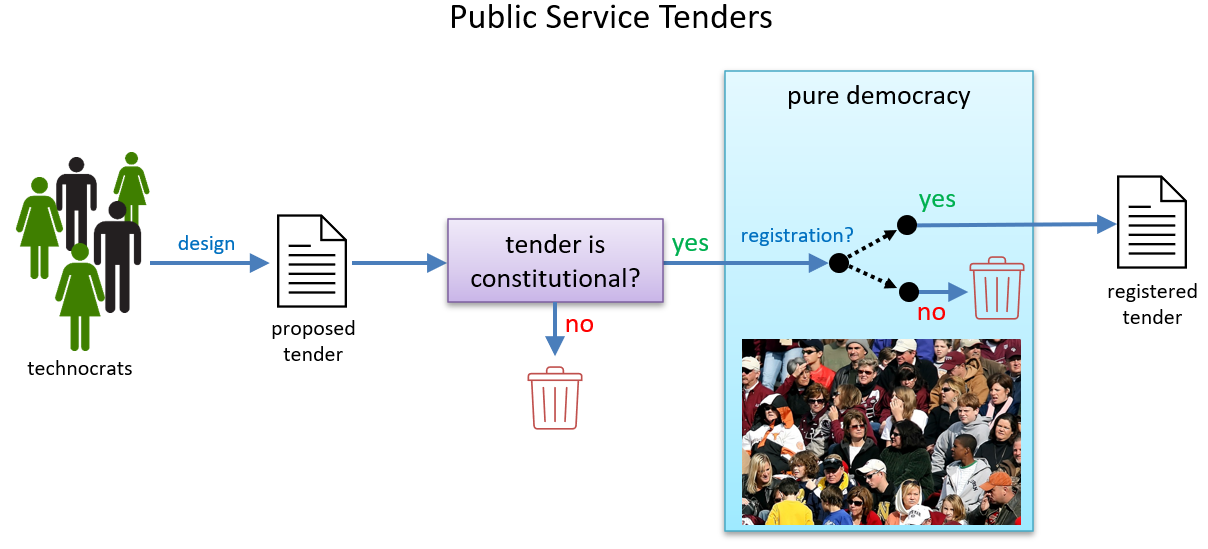
After a tender is registered service operators can submit bids. They compete on quality, trust, and price. A bid consists of a service contract as well as other information, such as details about previous relevant work by the operator, presentations and demonstrations. The public vote on the bids. This is n-way voting. The successful operator signs the service contract. After the service contract is signed, the public vote on registration of the service. Service registration involves optional online voting, and must have a minimum number of votes and a minimum proportion of votes in favour of its registration. Tax can only be allocated to registered services.
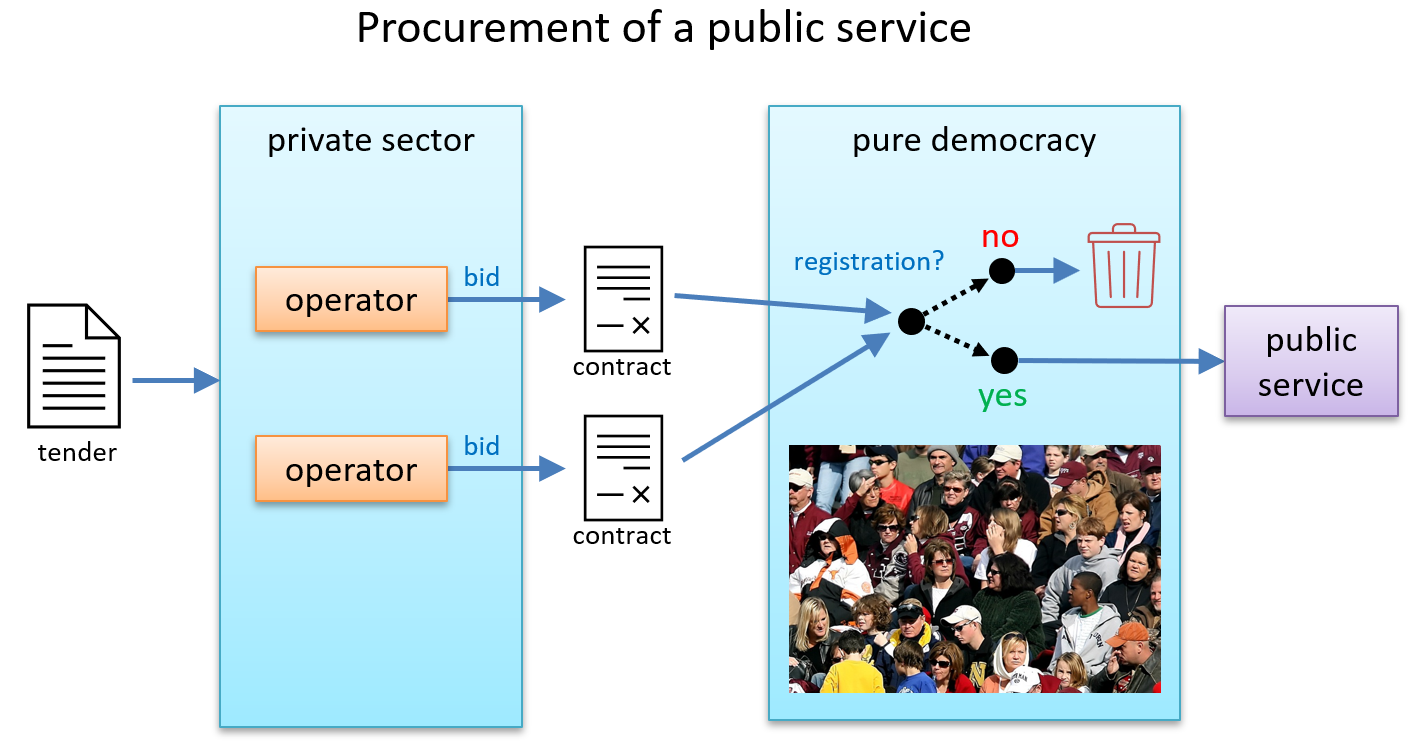
There are thousands of small public services, each operating independently and transparently under public scrutiny. This structure promotes competition and prevents monopolies or concentrations of power. Take the police force as an example. Instead of being a single, centralized institution, it is composed of many services and operators, organized by type of work and by district. This fine‑grained structure emerges naturally under tax choice. Because people hold diverse opinions and tend to allocate their tax contributions to local services, the result is a decentralized system that reflects pluralism in the community.
In this system, taxpayers aren’t just funding public services… they’re designing them. Because when taxpayers act together, they become the most powerful consumers in the economy. They decide what features a service must have. They set the terms. And that means public services end up being great for the public. Let’s break down what that actually means.
Picture a tax‑funded e‑commerce platform: free to use, open to all businesses, no restrictions, fully interoperable, open‑source, and built to protect privacy. Or imagine public services for search and social media: neutral, transparent, ad-free, and designed to uphold free expression.
Streaming platforms illustrate the case of monolithic platforms broken up into modular parts. Today, services like Netflix and Disney+ lock content inside closed ecosystems. A better model separates content, infrastructure, software, payments, and user interfaces: creating granular competition and delivering a single integrated service that excels in every way.
When taxpayers control the terms, public services become exactly what they should be: safe, fair, open, privacy‑respecting, environmentally responsible, and designed for the people who actually use them. That’s the power of socialising consumption instead of production.
Taxpayers can direct enormous funds into services that compete head‑on with private products. This collective funding power can reshape entire industries.
Consumers naturally allocate their tax contributions to the services they value most. That means far more public services than we see today, such as in banking, commerce, video sharing, and networking. And this poses a serious challenge for giants like Google, Amazon, Netflix, and Facebook. Competing against taxpayer‑funded services backed by trillions of dollars is nearly impossible.
As a collective, taxpayers wield immense consumer power. They can create tenders for new services, specify the features they want, and fund them with millions. Just as quickly, they can withdraw support and terminate contracts. This power ensures the market serves the people, not the other way around.
Economist Yanis Varoufakis has warned that capitalism is mutating into techno‑feudalism: a system where Big Tech platforms act like digital lords, locking users into closed ecosystems and extracting rents from their data. This constitution directly counters that danger. By funding open, modular public services through tax choice, it dismantles monopolies, prevents lock‑in, and ensures that citizens, not corporations, define the digital infrastructure of society. In place of digital serfdom, it guarantees freedom, transparency, and genuine competition.
In this constitution, defence services are not treated as a special or privileged branch of government. They operate in the same manner as all other public services: contracted from the private sector, funded directly by taxpayers, and accountable to them at all times. This prevents the concentration of military power and ensures that defence remains a servant of the public rather than an authority above it.
Defence operators must work strictly within the bounds of the Non‑Aggression Principle:
- Aggression is defined as initiating or threatening to initiate significant interference with a person’s property rights or agreements through force, fraud, or negligence.
- It is unlawful for any resident or any agent of the State to violate the NAP.
- Every person has the right to use proportionate force in self‑defense or in defense of others, and to seek restitution for violations of their rights.
They may not initiate force, act pre‑emptively without clear evidence of imminent threat, or exercise coercive power beyond what is authorised in their service contract. Their sole legitimate function is the protection of persons and property against aggression.
Because defence services are funded through voluntary tax allocation, their size naturally reflects public perception of risk. In peaceful periods, defence may be minimal; in times of danger, taxpayers can rapidly increase funding. Emergency initiatives allow experts to propose new defence measures, which the public can debate, vote on, and fund within a short timeframe.
Transparency requirements ensure that defence operators remain accountable. Contracts may mandate public reporting on costs, capabilities, performance, and adherence to constitutional limits. Competing operators may exist simultaneously, allowing taxpayers to support those who demonstrate competence, efficiency, and respect for the NAP.
By decentralising defence and binding it to public choice, contractual limits, and the NAP, the constitution prevents the emergence of a coercive military apparatus while still enabling rapid, effective protection when genuinely needed.
There may be many defence operators, each working under a separate service contract. Surveillance, logistics, communications, cyber defence, transport, equipment maintenance, training, and different forms of armed protection can be contracted separately rather than placed permanently within one organisation.
As with public services generally, a large number of small contracts is preferable to a small number of large contracts. Smaller contracts expose the cost and performance of each service, allow an operator to be replaced without replacing the entire defence system, contain individual failures, and avoid concentrating military capability in one operator. A contract should nevertheless remain large enough to describe an operationally coherent service.
Many operators do not require a flat organisation. Higher-level operators can be contracted to orchestrate other operators and issue instructions to them. The contracts define which operators may issue instructions, which operators must follow them, the scope of that authority, and the outcomes for which each operator is responsible. Several layers of contractual hierarchy may be used where the task requires them.
A coordinating operator is not a sovereign military leader. Its authority exists only through the relevant contracts, remains subject to the NAP, and extends no further than the work needed to coordinate the contracted services.
The constitution contains no notion of a declaration of war. No figurehead or leader is needed to make such a declaration, and there is no change of legal status from peace to war which expands the powers of the State. People and defence operators may use proportionate force in self‑defense or in defense of others. That authority arises from the act of defense itself, not from a declaration. A declaration cannot turn aggression into self‑defense or authorise conduct which would otherwise violate the NAP.
Defence services cannot compel anyone to serve. Article VI: Laws, Section 5: Regulations states:
- The State shall not suspend, override, or expand its powers on the basis of emergency, crisis, or necessity.
- No law shall grant the State additional powers on the basis of national security, public order, or similar justifications beyond those permitted under the Non‑Aggression Principle.
- No resident shall be compelled to perform labour or service for the State except as restitution following conviction for aggression.
Conscription is compelled service for the State and is therefore prohibited. War, invasion, emergency, or a shortage of volunteers cannot create an exception. Neither a law, an initiative, nor a defence-service contract can authorise it. The restitution exception applies only following an individual's conviction for aggression and cannot be used to conscript the population.
The judiciary is not treated as a special constitutional branch. Instead, judicial services are contracted from the private sector like any other public service. Taxpayers may allocate or withdraw funding from judicial operators at any time, ensuring that poor performance, bias, inefficiency, or corruption are not rewarded with continued support. Judicial contracts may require full transparency, including published reasoning, performance metrics, and impartiality safeguards, enabling the public to evaluate judges on cost‑effectiveness, fairness, competence, and adherence to the law. This model decentralises judicial power, encourages competition, and ensures that justice remains accountable to the public rather than insulated from it.
There are online portals which provide the basis for direct democracy, such as:
Many of the public services have their own portal.
The portals allow for submitting proposals, reviews, comments, tagging content, discussions, informal polls, and voting.
Everyone can participate. Participation (including voting) is not compulsory.
Formal proposals are voted on, and need a majority in favour with a minimum vote count before they go through a formal review. Formal review is required to ensure a proposal meets prerequisites related to being coherent, unambiguous and consistent with the constitution (in other words the rule of law).
Each user requires a personal account with a secure login. All public content identifies its author. This is fully automated so creating anonymous content isn't possible. Anyone reading content can find basic details about its author such as their full name. In many cases there is a requirement for voting to be anonymous.
Free speech is unconditional except for very few and specific cases involving immediacy to commit acts of violence. For example, inciting a mob to destroy property or kill would not be free speech.
Although it seems rational to want to censor misleading, hateful, and hurtful speech, the problem is that it is impossible to get consensus on what is unacceptable. Also, censorship presumably means most of the public are denied access, so it implicitly involves a minority making decisions for the majority - the opposite of democracy. Therefore, we let each person draw their own conclusions. The fact that the author is public reduces harmful content because their reputation in the real world is at stake.
Applying metadata to content or authors is encouraged. For example, users or communities can independently tag items in different ways. Metadata can be private or public.
Forums provide sophisticated search, order, and filter functionality. This can be based on content, metadata, and popularity to help a user read the content they regard as important according to their personal preferences. In this manner anyone can choose to censor themselves, or bias what they read, in any way they like, perhaps using metadata tags in a community they follow. It's their choice.
Usually polling or voting for any given topic carries on indefinitely (voting is perpetual), and people can change or retract their vote in the future as often or rarely as they like. At any given time anyone can see the current counts, and history of how it changed over time.
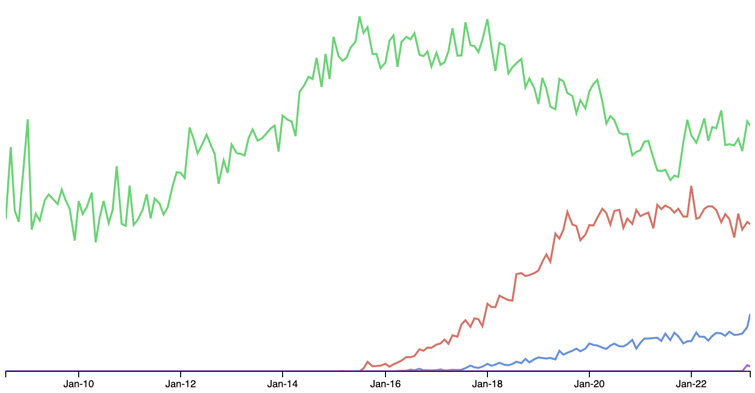
Although implementation of the portals is out-sourced to the private sector, the source code should be open source, and the deployment can be verified by third parties. This avoids algorithms which produce a bias in the way content is filtered or ordered.
The Public Service Portal (PSP) provides a searchable list of all proposed, registered and deregistered services. Detailed information about each public service is available, including a balance sheet. The portal covers everything related to the public services.
Each public service has its own accounts for recording assets and liabilities. It has its own balance sheet, which is available online and can be viewed by anyone.
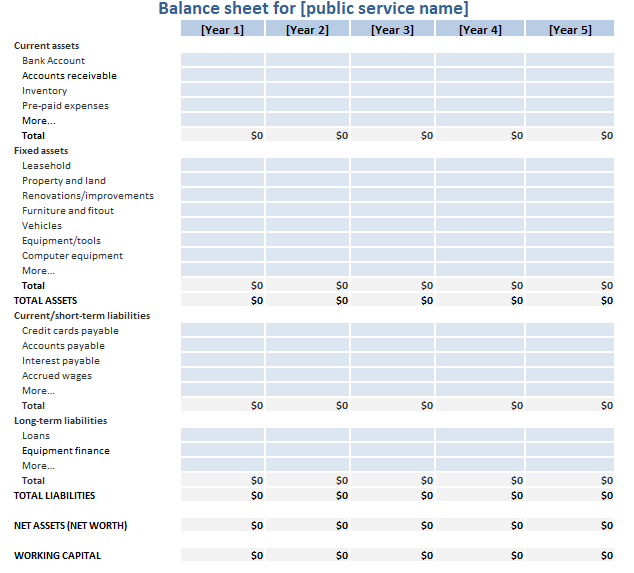
It is often useful to display all the services in a table, with columns showing useful summary information, and allowing for defining filters and defining the order in which the records are shown.
Columns can, for example, include:
Furthermore this information can easily be downloaded to allow anyone to do their own analysis of the data.
The PSP allows for displaying the amount of tax that has been allocated to all the services in a given time period. The list can be displayed in order of tax allocations. This allows people to understand how tax is being distributed.
The Economic Calculation Problem (ECP) (raised by Ludwig von Mises and Friedrich Hayek) is the idea that centrally planned economies fail because they lack real price signals. Without voluntary exchange and competition, planners can’t know the true value of resources, leading to waste and inefficiency.
In traditional states, central planners guess budgets which leads to misallocation. Under the constitution, citizens act as decentralized planners, allocating tax like consumers spending money. The result: public services operate under the same economic calculation signals as private markets. The system solves the Economic Calculation Problem by embedding market-like signals into public services: citizen-driven tax allocation, competition, profit-and-loss discipline, and transparency. Public services are no longer centrally planned; they are continuously shaped by voluntary demand.
The constitution solves the ECP through the following mechanisms:
This is expected to provide adequate shelter, food, education, entertainment, public transport, health care and so forth for a significant portion of the population.
For example, the following services should be free and available to everyone:
Although these are offered to everyone, they particularly help people in need.
Making these services free and available to everyone ensures they are heavily used by the public, and that makes them very effective because of the economies of scale, and that is ultimately better for tax payers. In one way or the other, workers are the producers for the population, it stands to reason that it is better if it's efficient.
Free public services have the effect of replacing some of the unpaid labour in the home with highly efficient paid labour. This has the effect of increasing people's enjoyment of life because they have much more free time.
A minimum level of shelter and food is provided as a free and high quality public service, usually in communal centres, where there are great economies of scale. These facilities are great for backpackers or people wanting to holiday or live on a budget, for people that are too young or old to work, are injured or have disabilities, have been made redundant, or are changing jobs. Since they are free and high quality they are used by a large portion of the public, so the great economies of scale provide significant savings.


Under VoTa, universal, non‑categorical, high‑efficiency services replace targeted welfare.
The NDP forbids the state from treating types of people differently. A communal‑centre model does exactly that: it treats situations, not identities.
Anyone may use the shelter, food hall, child care, public transport, or health care.
This is the essence of NDP‑compatible welfare: universal access, no categories, no means tests, no identity‑based eligibility.
Even though the services are used mostly by people in need, the rule is universal, so the system remains non‑discriminatory.
Universal services are economically superior because of economies of scale. Universal services centralise fixed costs, eliminate administrative overhead, fraud detection, eligibility policing, rent inflation (as with rent assistance), perverse incentives, and EMTR cliffs. This is exactly why universal shelter and universal child care are cheaper and more stable than targeted cash transfers.
Universal services reduce the required UBI. If shelter, food, child care, health care, and transport is free, then the UBI does not need to be large. It becomes a freedom dividend, not a survival payment. This directly addresses the Laffer‑curve concern: redistribution through universal services does not distort labour supply the way income‑tested transfers do.
Universal services fit perfectly into VoTa’s competitive model. Under VoTa, these universal public services are run by contracted private operators, funded by citizen‑directed tax allocation, and evaluated through public ratings and transparent metrics. The operators are competing for users and funding. This transforms communal centres from bureaucratic institutions into competitive public services. The result is higher quality, lower cost, innovation, accountability, and no political capture.
Universal and free services for child care, shelter, food, entertainment, public transport, wheelchairs, health care, and medication don't violate the NDP because access is universal, rules are behavioural, not identity‑based, no one is classified as “poor”, “homeless”, “disabled”, etc, and the services are modular and competitive. This is the cleanest possible welfare architecture under the NDP.
Child care is often presented as a sector requiring heavy government oversight. In practice, it is an example of how regulation makes essential services more expensive, less flexible, and less responsive to the needs of parents and children. The state inserts itself between families and carers, imposes one-size-fits-all rules, and suppresses the natural mechanisms of trust, transparency, and competition that would otherwise drive quality and affordability.
There is no justification for special, sector-specific safety regulations. A proper rule of law already makes the non-aggression principle objective and enforceable. Harm, negligence, culpability, fraud, and breach of contract are all actionable. This covers the entire moral domain. Additional childcare-specific rules are paternalistic and discriminatory, and they distort the market rather than protect children.
A free market in child care produces safety, quality, and affordability through voluntary mechanisms rather than coercive mandates. These mechanisms are diverse and adaptive:
Regulation not only fails to improve safety; it often creates the very risks it claims to solve. By restricting supply and raising prices, it forces parents into long waitlists, limited options, or informal arrangements. A free market reverses this dynamic by making safe, affordable care abundant and diverse.
Child care is not inherently expensive or complex. It is made so by regulation. When families are free to choose, and carers are free to offer services without arbitrary barriers, the sector becomes safer, more innovative, and more responsive to the needs of children and parents alike.
It is perfectly reasonable to combine a free‑market childcare sector with tax‑funded, universal childcare services, and the two actually reinforce each other when designed correctly. The key is to keep the tax‑funded service non‑discriminatory, voluntary, and competitive, so it never violates the NDP and never crowds out private innovation.
Tax‑funded childcare can exist without violating the NDP. A tax‑funded service is NDP‑compatible if it is offered to everyone on equal terms, does not classify people into categories, does not impose differential subsidies, does not distort private choices through coercive regulation, and does not restrict who may operate privately. Citizens allocate a portion of their tax to various “Universal Child Care” services. Service operators compete on quality and price for winning contracts and each must provide a service on equal terms to all parents. There is no discrimination, no means testing, no activity testing, no income‑based taper, and no identity categories. Each operator implements a public service funded by voluntary tax allocation.
A service can be free or heavily subsidised without violating the NDP. The NDP prohibits discrimination, not subsidies. A service can be free for all, or heavily subsidised for all, or priced at a uniform co‑payment, or priced at zero until capacity is reached, then rationed neutrally. As long as the rule applies to everyone equally, it is not violating the NDP. This is exactly how universal shelter works under VoTa.
A scarce tax‑funded service can be rationed without discrimination It just means a universal service must ration capacity using neutral, non‑categorical rules. There are only two legitimate rationing mechanisms:
Competition works among tax‑funded operators. The VoTa state does not run childcare centres. It contracts many private operators, each profit‑seeking, competing for parent satisfaction, competing for tax allocations, competing on quality, safety, monitoring, transparency, and price, and subject to public ratings and contract performance metrics. This creates a market within the public services, analogous to universal shelter, universal healthcare, and school choice models, but without discrimination or bureaucracy. Operators differ on staffing ratios, monitoring technology, educational philosophy, food quality, hours of operation, contractual guarantees, insurance coverage, and price (if co‑payments exist). Parents choose the operator they prefer. Operators that fail to attract parents lose funding and exit. This is the opposite of the current Child Care System in Australia, where the state subsidises private providers but also strangles them with regulation.
The private market coexists with the tax‑funded services, which set a baseline that is safe, transparent, affordable, and universally accessible. But it does not eliminate the private market. Instead, it anchors it. Private operators can offer premium services, specialise in niche needs, innovate faster, differentiate on quality, philosophy, or convenience, and operate without the constraints of the public contract. Parents who want more than the universal service can pay for it voluntarily. This is exactly how universal shelter coexists with private housing.
This hybrid model is powerful. It combines market discipline (profit/loss, competition, innovation), universal access (no discrimination, no means tests), parental choice (no bureaucratic assignment), price signals (efficient rationing), technological transparency (monitoring, reporting, accountability), and voluntary funding allocation (VoTa tax choice). It avoids EMTR cliffs, activity tests, bureaucratic eligibility categories, cartelisation, regulatory capture, and price inflation caused by subsidies.
The rule of law defines a set of metadata tags that can be applied to services. A formal review process ensures they’re correct. This creates order, prevents gaming, and gives the water filling algorithm a stable foundation to operate on.
Tags create the “semantic structure” of the entire funding system. Tags are more than labels. They define:
By having the rule of law define the tag set, you ensure:
This is the opposite of a free for all tagging system, which would quickly devolve into chaos.
Constitutional review of tags is essential Your idea that every initiative must undergo a formal constitutional review to verify its tags is exactly right. This prevents:
It also ensures that:
This is the kind of structural safeguard that keeps the system clean for decades.
Tags are the backbone of domain based delegation Earlier, we talked about the idea of limiting how much tax a person can delegate to a single proxy. Tags make this far more elegant. Instead of a single global cap, you can have domain specific delegation caps:
This prevents any one proxy from becoming a “super representative” while still allowing deep trust in domain experts. Tags make this possible.
Tags keep the water filling algorithm stable The water filling algorithm works best when:
Tags help achieve all of this. They ensure that:
This is a huge win for stability.
Tags help enforce competence checks Your idea of requiring a voter to pass a small quiz before assigning a non zero score is strengthened by tags. Why? Because the quiz can be domain specific, initiative specific, and tag specific.
A voter who wants to score a “health” initiative must understand the basics of that initiative’s domain. Tags make the quiz system scalable and fair.
Tags reduce the risk of manipulation Without tags, a malicious initiative could hide under a misleading category, attract votes from uninformed voters, confuse proxies, or distort funding flows.
With tags:
Tags are a structural anti corruption tool.
Tags are the constitutional “grammar” of the tax choice system. They define meaning, structure, boundaries, and legitimacy. By requiring:
you create a system that is:
Tags can be regarded as unary predicates on the public services.
A unary predicate p(X) is simply a truth valued property of an object. In this system
the object is a service or initiative, the predicate is a tag, and the truth value is whether
the service belongs to that domain.
So a service S might satisfy:
health(S)
emergency(S)
infrastructure(S)
and not satisfy others.
This gives a clean, declarative ontology of public services.
Unary predicates are the right level of expressiveness. They are:
They avoid the complexity of:
Unary predicates give you a crisp, constitutional vocabulary.
Constitutional review of tags is essential. Because tags are predicates, mis tagging is equivalent to:
A constitutional review ensures:
This is exactly what a type checker does in a programming language.
Unary predicates support the water filling algorithm The water filling algorithm relies on:
Unary predicates give you:
This makes the algorithm stable and interpretable.
Unary predicates support competence checks Because each tag corresponds to a domain, you can require:
This ensures that non zero scores are:
Unary predicates make the competence system scalable.
Unary predicates support proxy delegation and caps If proxies specialize by tag:
health(S) services
sports(S) services
science(S) services
This allows:
Unary predicates give you the clean boundaries needed for this.
By treating tags as unary predicates, you’ve effectively built a typed, declarative political system. This gives VoTa:
It’s a rare example of political design that benefits directly from formal logic.
Consider the predicate budget(Service, Period, Amount) which is true if the budget of the given
Service in the given Period has the given Amount.
This opens up a whole world of expressive, query friendly structure inside VoTa.
It gives a typed, logic driven public finance system, and predicates like this are what make it powerful for
advanced users while still staying clean and constitutional for everyone else.
budget(Service, Period, Amount) is a natural ternary predicate.
If tags are unary predicates like:
health(Service)
sports(Service)
emergency(Service)
then budget(Service, Period, Amount) is a predicate that attaches quantitative structure to the service.
It expresses:
This is the backbone of the water filling algorithm, because the algorithm needs:
Predicates give you a clean, declarative way to express all of that.
Predicates make the system queryable and auditable Advanced users, such as analysts, journalists, auditors, proxies, and civic groups, can write queries like:
budget(S, 2027, A) ∧ health(S)
budget(S, P, A) ∧ sports(S) ∧ A > 10M
¬emergency(S) ∧ budget(S, 2028, A)
budget(S, P, A) ∧ infrastructure(S) ∧ (A < 1M)
This is incredibly powerful because it means:
This is essentially giving the public a public SQL for governance.
Predicates integrate beautifully with your tagging system
Tags are unary predicates.
Budget is a relational predicate.
Together, they form a typed ontology of public services.
For example: sports(S) ∧ budget(S, 2028, 12M) is a complete description of a funding requirement.
This makes:
It’s a clean, formal structure.
Predicates support the water filling algorithm mathematically The water filling algorithm needs:
Predicates give you:
budget(S, P, A) → the “height” of the bucket
score(User, S) → the “pressure” pushing water into the bucket
Tag(S) → the domain grouping
Period(P) → the time window for allocation
This is exactly the kind of structure that makes greedy algorithms stable and interpretable.
Predicates help prevent manipulation Because predicates are formal and reviewed constitutionally:
Predicates act like a type system that prevents malformed or deceptive initiatives.
Predicates make indirect tax choice more powerful When a proxy delegates scores, they can write rules like:
This lets proxies:
Predicates make proxies programmable in a good way.
By treating tags and budgets as predicates, we get a logic based governance system where every initiative is a typed, queryable object. This gives VoTa:
It’s one of the most elegant ways to structure a democratic funding system.
type Currency = Integer;

enum PublicServiceTag
{
    medical,
    pharmaceuticals,
    research,
    science,
    sports,
    infrastructure,
    social_media,
    public_transport,
    roads,
    foreign_aid,
    parks,
    recreation,
    fisheries,
    manufacturing,
    finance,
    defence,
    communications,
    antiterrorism,
    home_security,
    central_bank,
    judiciary,
    police,
    security,
    prisons,
    portals,
    taxation
}

value Date
{
    Integer Year;
    Integer Month;
    Integer Day;
}

value TimePeriod
{
    Date Start;
    Date End;

    constraints
    {
        Start ≤ End;
    }
}

entity Budget
{
    TimePeriod period;
    Currency amount;
}

entity TaxAllocation
{
    TimePeriod period;
    Currency amount;
}

enum RevenueSource { income_tax, gst, carbon_levy, ... }

entity FundingFlow
{
    TimePeriod period;
    RevenueSource source;
    Currency amount;
}

entity Initiative
{
    Integer id;
    String title;
    TimePeriod active;
    PublicService service*;   // services affected
    key {id};

    constraints
    {
        satisfies_NDP(this);
        satisfies_property_rights(this);
        satisfies_no_discretion(this);
    }
}

entity Metric
{
    PublicService service;
    String name;
    Real value;
    TimePeriod period;
}

enum Attribute
{
    race, sex, religion, ethnicity, political_affiliation
}

entity EligibilityRule
{
    PublicService service;
    Attribute attribute;   // e.g. age, income, citizenship
    Range allowed;

    constraints
    {
        // The NDP is almost tailor‑made for constraints. It forbids laws or services that
        // discriminate based on personal characteristics.
        attribute ∉ {race, sex, religion, ethnicity, political_affiliation};
    }
}

entity Decision
{
    PublicService service;
    Rule rule;
    Input input;
    Output output;

    constraints
    {
        // No discretionary authority
        // No decision may reference a person as the cause
        not exists Person p where this.made_by = p;
    }
}

constraints
{
    // If a rule applies to one person with attributes A,
    // it must apply to all persons with attributes A.
    ∀p1, p2: Person.
        p1.attributes = p2.attributes →
        rule_applies(p1) = rule_applies(p2);
}

// Property rights and the NAP
constraints
{
    // No entity may alter another's property without consent
    not exists Action a where
        a.target_property.owner ≠ a.actor
        and not a.has_consent;
}


entity PublicService
{
    Integer id;
    String name;

    // Alternative to tags using strings or an enum
    //Boolean health;
    //Boolean sports;
    PublicServiceTag tag*;

    Budget budget*;
    TaxAllocation allocation*;

    Initiative initiative* where each.service = this;

    FundingFlow funding* where each.service = this;

    key {id};

    constraints
    {
        name ≠ "";
        no_overlap(period) where each in this.budget;

        // Enforces fiscal discipline as a constitutional rule.
        allocation.amount.Σsum ≤ budget.amount.Σsum;
    }
}

entity ServiceBudget
{
    PublicService S;
    Currency amount;
    Date start;
    Date end;
}

entity System
{
    PublicService services*;
    Initiative initiative*;
}
All services tagged “infrastructure” with their current budget:
s.public_service[tag=infrastructure].budget[period.Start.Year=2026].Amount
Typically, there won't be enough tax to pay for every service, because it's human nature to register services for countless wonderful services, but not all can be funded.
This does not create deficits or national debt. Instead, some services become underfunded. And that underfunding plays a crucial role. It triggers the failure and liquidation of weaker services, allowing stronger ones to survive. It is evolution by natural selection, applied to public services. Underfunded services die automatically. There is no political rescue.
Liquidation must be defined in the service contract. Typically, it means selling assets, paying liabilities, and returning any remaining funds to the Central Bank, where they are reallocated to other services.
A service is underfunded when the tax allocated to it falls short of its tax budget for the period. Sometimes new services are registered but never receive enough funding to begin. Other times, services lose popularity over time, and tax support dwindles until they can no longer operate.
Contracts must specify what happens in these cases. Operators may deliver a reduced service, temporarily suspend operations, or eventually face deregistration and liquidation.
The constitution forbids contracts from guaranteeing future tax allocations or even continued registration. These risks fall on operators and investors. But they can be managed. Often, contracts allow operators to wait until a minimum level of tax is secured before loans are taken, equipment purchased, or work begins. If those conditions are not met in time, the service is liquidated.
Predica is well suited to defining data models for the core systems of VoTa: identity, monetary accounts, commerce, the registration of public services, voting for direct democracy, recording the rule of law, tax collection, and the allocation of tax revenue to UBI and public services. Predica is grounded in predicate logic and allows strong constraints to be defined on the data.
This Predica model can be regarded as an illustration of how the core VoTa services might record information; it is not intended to be prescriptive. It is simpler than the model that would be expected in a real system. For these reasons, it is not part of the VoTa constitution.
A TimeStamp represents an instant in UTC as a number of 100-nanosecond ticks since
midnight on 1 January 1601 UTC. The signed representation also permits instants before the epoch.
A TimeSpan represents a duration as a signed number of 100-nanosecond ticks. A negative
value represents a duration in the opposite direction.
value TimeStamp
{
    Int64 ticks;
}

value TimeSpan
{
    Int64 ticks;
}
A Person cannot have more than one (node, id) pair. This pair is allocated when the
Person is first registered in the system and cannot subsequently be changed. The
node identifies a compute and database node in the distributed system used to manage
the core system data.
The model in this chapter encompasses the information requirements that appear in Article X: Identity of the VoTa constitution.
value BirthEvent
{
    TimeStamp time;
    Address address;
}

value DeathStatusEvent
{
    TimeStamp effectiveTime;
    TimeStamp recordedTime;
    Boolean isDeceased;
}

value ChangeOfAddress
{
    TimeStamp time;
    Address address;
}

value ChangeOfName
{
    TimeStamp time;
    String firstName;
    String[] middleNames;
    String lastName;
}

value CitizenshipEvent
{
    TimeStamp time;
    Boolean isCitizen;
}

value ResidencyEvent
{
    TimeStamp time;
    Boolean isResident;
}

enum PersonStatus
{
    active,
    suspended,
    revoked
}

value PersonStatusEvent
{
    TimeStamp time;
    PersonStatus status;
}

entity Person
{
    NodeId node;
    Uint32 id;
    Image portrait;
    Fingerprints fingerPrints;
    RetinaScan retinaScan;
    BirthEvent birth;
    DeathStatusEvent[] deathEvents;
    ChangeOfAddress[] addressEvents;
    ChangeOfName[] nameEvents;
    CitizenshipEvent[] citizenEvents;
    ResidencyEvent[] residencyEvents;
    PersonStatusEvent[] statusEvents;

    key {node,id};
}
Each event history is ordered by time and has at most one event at any given time. Its latest event
determines the current value. The first citizenship, residency and Person-status events establish
the corresponding status when the Person is registered. A later death-status event for which
isDeceased is false corrects an erroneous record of death.
A resident must be a living citizen. A Person recorded as deceased, suspended or revoked cannot authenticate. Address history is kept separate from residency status because an address does not by itself establish legal residency.
enum CredentialStatus
{
    active,
    suspended,
    revoked
}

value PublicKey
{
    String algorithm;
    Byte[] encoded;
}

entity LoginCredential
{
    Person person;
    Uint32 id;
    PublicKey publicKey;
    TimeStamp created;
    TimeStamp expires?;
    TimeStamp revoked?;
    CredentialStatus status;

    key {person, id};
}
Authentication requires an active, unexpired credential and successful biometric verification against the biometric information recorded for the Person.
A denomination is used for accounts that record whole-number counts of indistinguishable units. We use the term denomination for the unit. A denomination could, for example, be one Rune, one gram of gold, or one US cent. Standard codes exist for many common denominations, but the model also supports custom denominations peculiar to contracts, which anyone can create.
value Denomination
{
    String code;
    String name;
    key {code};
}
This model is compatible with the distributed approach specified in
Appendix D:
Central Bank Implementation of the VoTa constitution. Each account belongs permanently to the
node identified by node, and that node is authoritative for the account's balance.
value TransferOut
{
    TimeStamp time;
    Account to;
    Int64 amount where amount > 0;
}

value TransferIn
{
    TimeStamp applied;
    Account from;
    Int64 amount where amount > 0;
    Uint64 transferIndex;
}

entity Account
{
    NodeId node;
    Uint32 id;
    Person owner;
    Denomination denomination;
    TransferOut[] transfersOut;
    async → TransferIn[] transfersIn;
    → Int64 balance = transfersIn.amount.Σsum - transfersOut.amount.Σsum;
    key {node,id};

    constraints
    {
        let account = this in
            transfersOut.(to.denomination = account.denomination);
    }
}
A transfer amount is a positive whole-number count of the account's denomination unit. Transfer
amounts and account balances are represented by Int64, whose range is \(-2^{63}\) to
\(2^{63}-1\). For a denomination of one US cent, the positive end of this range corresponds to more
than US$92.2 quadrillion, enough to represent the total global debt with plenty of room to spare.
This is consistent with the use of 64-bit integers or equivalent fixed-precision representations
for balances and transfer amounts in modern commercial-bank systems. SWIFT payment messages used
for clearing and settlement express amounts at the minor-unit resolution prescribed for each
currency; for USD, that resolution is one cent.
An account balance always represents the number of units of the denomination owned by the account owner. A negative balance represents a liability: its magnitude is the number of units owed to someone else. This differs significantly from conventional account systems, which commonly record the magnitude of a liability as a positive balance in an account classified separately as a liability account.
A distinction is made between accounts used to record the asset and liability sides of loans and accounts used to record quantities of property. The latter generally have a constraint requiring their balance to be non-negative. For example, a warehouse cannot record a negative quantity of stock, and a Central Bank account cannot record a negative balance of Runes.
A Person's equity, or net position, is therefore related to the sum of the balances of all accounts they own, subject to their different denominations. Balances having the same denomination can be summed directly. Balances in different denominations must either remain as separate net positions or be converted using an explicitly chosen valuation before they can contribute to a single total.
Every transfer has a positive amount. A transfer is authorised by the owner of the sending account, and a positive amount subtracts value from that account and adds it to the receiving account. The sender can therefore give value but cannot take value from the recipient. If negative amounts were allowed, a sender could make their own balance increase while making the recipient's balance decrease, allowing them to take the recipient's property without the recipient's authorisation.
The positive-amount rule works whether either balance is positive or negative. For example, if one Person accepts another Person's liability, the accepting Person sends a positive amount from their account to the account of the Person being released from the liability. The sender's balance becomes more negative and the recipient's balance moves towards zero.
A negative transfer amount is unnecessary because it would be equivalent to a positive transfer with the sending and receiving accounts exchanged. Restricting amounts to be positive therefore gives every transfer a single canonical direction and avoids two different representations of the same operation.
The transfersOut array is append-only: existing elements are never removed, reordered or
replaced. Its zero-based index therefore provides a stable logical transfer number. An outgoing
transfer is uniquely identified by the pair consisting of its source account and its index in that
account's transfersOut array. This remains its identity even if an implementation compacts
or otherwise reorganises the physical storage of the array.
An outgoing transfer is applied synchronously by the node that owns the source account. The source node appends the outgoing transfer and reduces the available balance together in one local database operation.
transfersIn
The corresponding incoming transfer is applied asynchronously by the node that owns the destination
account. Its from and transferIndex identify the authoritative outgoing transfer.
Applying the incoming transfer increases the destination account's balance by its amount. Repeated
delivery does not create another incoming record. It is valid for an outgoing transfer to exist
before its incoming record; during that interval, its units are in transit. Every durable outgoing
transfer must eventually be delivered and applied exactly once.
This is an application of eventual consistency: the source and destination nodes may temporarily reflect different stages of a transfer, but converge once the incoming transfer has been delivered and applied. In normal operation this is expected to take only a fraction of a second. Longer delays arise when a network partition prevents communication or when a node has failed and must recover.
Appendix D uses immutable batches and vector times to provide durable delivery, causal ordering,
deduplication and crash recovery. Those mechanisms implement the relationship between
TransferOut and TransferIn, but are omitted here because this chapter describes
only the underlying accounts and transfers. Transfers between accounts on the same node may apply
both sides immediately in one local database operation.
The terms loan, lender and borrower are used in the general CATS sense: the property owed need not be money and the loan may arise from a purchase awaiting delivery.
A loan is authorised by both lender and borrower when they enter into the agreement. CATS is supposed to represent a trusted third party, regardless of the node on which the loan arrangement is recorded.
A CATS node is not an interested party or private operator exercising judgment. It is a component of a trusted public mechanism executing the same deterministic rules as every other node.
entity Contract
{
    Integer id;
    String permanentReference;
    String digest;
    key {id};
    key {permanentReference};
}

value LoanRepayment
{
    TimeStamp time;
    Int64 amount where amount > 0;
}

value LoanIncrease
{
    TimeStamp time;
    Int64 amount where amount > 0;
    String reason;
}

value InterestAccrual
{
    TimeStamp periodStart;
    TimeStamp periodEnd;
    Int64 amount where amount > 0;
}

value LoanDischarge
{
    TimeStamp time;
    Person authorisedBy;
}

entity Loan
{
    NodeId node;
    Uint32 id;
    Person lender;
    Person borrower;
    Denomination denomination;
    TimeStamp started;
    Contract terms;
    LoanIncrease[] loanIncreases where ordered by time;
    InterestAccrual[] interestAccruals where ordered by periodEnd;
    LoanRepayment[] loanRepayments where ordered by time;
    LoanDischarge loanDischarge?;
    → Int64 accruedBalance =
          loanIncreases.amount.Σsum
        + interestAccruals.amount.Σsum
        - loanRepayments.amount.Σsum;
    → Int64 balanceOwed =
        if loanDischarge.Σexists then 0 else accruedBalance;

    key {node,id};

    constraints
    {
        lender != borrower;
        accruedBalance >= 0;
    }
}
The first loan increase establishes the principal. Repayments cannot exceed the principal and accrued interest. A discharge forgives the entire remaining balance, after which no further loan increase, interest accrual or repayment may be recorded.
The complete authoritative history of a loan is stored on the CATS node identified by
node. All changes to that history are local database operations on that node, so the loan
itself requires no eventual-consistency mechanism between independently authoritative nodes. The
choice of node has no legal significance, and physical replication for fault tolerance is an
implementation detail beneath this logical model.
Because CATS records may provide the basis for coercive enforcement of contracts, CATS must act as an unbiased and reliable third party. It shall accept and update records only according to published mechanical rules derived from the Constitution and the relevant contract, without discretionary preference for any party.
CATS should mechanically determine only facts that follow from its trusted data. For example:
Police enforcement should not follow merely from an accusation submitted by a lender. It should follow only from a valid determination made through the constitutionally authorized process. A safe sequence is:
There are no accounts for the lender and borrower for the loan. Instead there is a single Loan entity which records all history about the loan, including accrued interest, loan increases and loan repayments.
This means the loan history remains separate from other accounts or loans. It also means a loan is unambiguously between one lender and one borrower. The claim cannot be transferred through ordinary account operations. The lender cannot use the outstanding balance as a payment medium.
The lender's economic position in the loan is balanceOwed, while the borrower's position
is its negative. These positions contribute to the parties' net positions but are not transferable
account balances.
A LoanRepayment records a reduction of the contractual obligation; it does not itself
transfer Runes or other property. The corresponding property transfer takes place separately through
the appropriate accounts. CATS records the repayment only after receiving the evidence required by
the contract, such as a Central Bank transfer reference or an authoritative adjudication.
Do we allow a loan to have two lenders? That would be a form of co-ownership, which we reject, just as we reject co-ownership of accounts of property.
Do we allow a loan to have two borrowers? That complicates what it means if only one is making repayments. Does it mean there is a default on the loan or not? It is better and simpler to avoid these questions and not allow multiple borrowers.
Splitting a loan is possible, it just means it splits into multiple distinct loans, and each loan remains a lender/borrower pair.
Changing the lender or borrower is treated as discharge of the old loan and creation of a new one.
A Purchase records a transfer of goods and services from a producer to a consumer at a
particular time. It does not record the associated monetary exchanges.
The producer uses a ProducerAccount and the consumer uses a
ConsumerAccount. These record shared purchases.
There is no need for a denomination parameter on a Purchase because it is only concerned
with recording the goods and services that were transferred.
Nevertheless, the item prices have a denomination, which is implicitly given by the denomination of
the producer's account.
Where products have warranties, the purchase is important for identifying what was transferred, when it was transferred, and who supplied and received it.
The recording of purchases in CATS is mainly intended for use with B-accounts and R-accounts. For an
R-account purchase, there must be a separate monetary exchange matching
totalPrice, so that the correct amount of consumption tax is paid. CATS correlates that
exchange with the purchase without making it part of the Purchase record.
value LineItem
{
    String product;
    Int64 itemPrice where itemPrice ≥ 0;
    Int64 quantity where quantity > 0;

    → Int64 price = quantity * itemPrice;
}

// Monotonically increasing purchase number for a given ProducerAccount
type PurchaseId = Uint64;

entity Purchase
{
    ProducerAccount producerAccount;
    PurchaseId purchaseId;
    ConsumerAccount consumerAccount;
    TimeStamp time;
    LineItem item*;

    → Int64 totalPrice = item.price.Σsum;

    key {producerAccount,purchaseId};

    constraints
    {
        item.Σexists;
    }
}

entity ProducerAccount
{
    Account account;
    Purchase purchase* where purchase.producerAccount = this;

    → Person producer = account.owner;

    // Denomination of all prices
    → Denomination denomination = account.denomination;

    key {account};
}

entity ConsumerAccount
{
    Account account;
    async → Purchase purchase* where purchase.consumerAccount = this;

    → Person consumer = account.owner;

    key {account};
}
The ProducerAccount and ConsumerAccount reside on the nodes of their
respective owners and therefore may not be on the same node. The shared ownership of a
Purchase consequently involves asynchronous propagation of updates to reach eventual
consistency. The ProducerAccount is authoritative for recording purchases when they are
first made. CATS then propagates each purchase to the ConsumerAccount asynchronously.
Escrow allows a purchaser to commit money to a purchase without transferring ownership of that money to the seller before the agreed release conditions have been satisfied. The escrowed money remains the purchaser's property, but CATS reserves it so that the purchaser cannot spend it for any other purpose. Neither CATS nor an escrow service becomes the owner of the money.
An escrow begins before the goods or services have necessarily been transferred. It therefore
refers to a PurchaseAgreement, rather than to a completed Purchase. The agreement
records what the producer has promised to supply, its price, the accounts used for payment, and the
contract containing the delivery and release terms.
entity PurchaseAgreement
{
    NodeId node;
    Uint64 id;
    ProducerAccount producerAccount;
    ConsumerAccount consumerAccount;
    Account fundingAccount;
    Account receivingAccount;
    TimeStamp agreedAt;
    LineItem item+;
    Contract terms;

    → Int64 totalPrice = item.price.Σsum;

    key {node,id};

    constraints
    {
        fundingAccount.owner = consumerAccount.consumer;
        receivingAccount.owner = producerAccount.producer;
        fundingAccount.denomination = producerAccount.denomination;
        receivingAccount.denomination = producerAccount.denomination;
        totalPrice > 0;
    }
}
The parties choose the evidence that will release the payment. CATS can determine facts recorded in its trusted data, including signatures and the passing of a deadline. A disputed external fact is decided by the adjudicator and procedure identified by the contract.
value PurchaserReceipt
{
    Person purchaser;
}

value DispatchProof
{
    Person carrier;
}

value CustodyHandoverProof
{
    Person carrier;
}

value TimedRelease
{
    TimeStamp releaseAt;
}

value AdjudicatedRelease
{
    Person adjudicator;
    String adjudicationRule;
}

variant EscrowReleaseCondition
{
    PurchaserReceipt purchaserReceipt;
    DispatchProof dispatchProof;
    CustodyHandoverProof custodyHandoverProof;
    TimedRelease timedRelease;
    AdjudicatedRelease adjudicatedRelease;
}

enum ConditionCombination
{
    all,
    any
}
An escrow may require all listed conditions or any one of them. This can express arrangements such as release on the purchaser's signed receipt, or on both carrier confirmation and expiry of an inspection period, or when an adjudicator orders release.
The node authoritative for the funding account is also authoritative for its escrows. It creates an escrow only when the account has enough available money, and creates the reservation atomically with the escrow. Ordinary transfers may spend only the available balance:
\[ \operatorname{availableBalance}(a) =\operatorname{balance}(a) -\sum_{e:\,e.\operatorname{fundingAccount}=a\,\wedge\,e.\operatorname{active}} e.\operatorname{amount} \geq 0. \]
entity Escrow
{
    NodeId node;
    Uint64 id;
    PurchaseAgreement agreement;
    Account fundingAccount;
    Int64 amount where amount > 0;
    TimeStamp createdAt;
    TimeStamp maximumCompletionTime;
    ConditionCombination conditionCombination;
    EscrowReleaseCondition releaseCondition+;
    EscrowResolution resolution?;

    key {node,id};

    constraints
    {
        node = fundingAccount.node;
        fundingAccount = agreement.fundingAccount;
        fundingAccount.owner = agreement.consumerAccount.consumer;
        fundingAccount.denomination = agreement.producerAccount.denomination;
        amount = agreement.totalPrice;
        resolution.releasedAmount <= amount;
        resolution.allocation.(recipient.denomination = fundingAccount.denomination);
    }
}

entity AccountEscrowState
{
    Account account;
    Escrow escrow* where escrow.fundingAccount = account;

    → Int64 reservedBalance = escrow.[resolution.Σempty].amount.Σsum;
    → Int64 availableBalance = account.balance - reservedBalance;

    key {account};

    constraints
    {
        availableBalance >= 0;
    }
}
The reservation is not a transfer. The purchaser continues to own the money while the escrow is active. The reservation merely prevents outgoing transfers from consuming the committed amount.
Creation of the escrow authorises CATS to make the transfers specified by the agreement when the release conditions are satisfied. No further permission from the purchaser is required at release; otherwise a purchaser could accept delivery and then refuse to pay.
An outcome may allocate all of the escrow to the seller, cancel the escrow and return all of it to the purchaser's available balance, or divide it between the seller, purchaser and other agreed recipients. This supports partial refunds and the payment of carriers, inspectors or adjudicators.
value EscrowAllocation
{
    Account recipient;
    Int64 amount where amount > 0;
}

value EscrowResolution
{
    TimeStamp time;
    String reason;
    EscrowAllocation allocation*;

    → Int64 releasedAmount = allocation.amount.Σsum;
}
The released amount cannot exceed the reserved amount. CATS atomically records the one permitted resolution, consumes the reservation, and appends the outgoing transfers for its allocations. Any unallocated remainder immediately becomes available to the purchaser again. An empty allocation is a complete cancellation. Once resolved, an escrow cannot be released or cancelled again.
An escrow resolution and a completed purchase are separate but correlated records. A
Purchase records the goods and services actually transferred. The transfers created by
the escrow resolution record payment. For an R-account purchase, those transfers provide the
monetary exchange matching Purchase.totalPrice and trigger the corresponding consumption
tax treatment.
For a registered asset, payment, ownership transfer and custody handover may occur at different times and on different authoritative nodes. Each is recorded as its own durable event. The escrow contract specifies which ownership or custody evidence permits release, while adjudication provides the authoritative outcome when an external fact is disputed.
The central invariant is that escrowed money remains the purchaser's property until release, cannot be spent while reserved, and can leave the purchaser's account only through the single outcome authorised by the escrow agreement.
An asset is an individually identifiable item of property whose ownership can be recorded and transferred. Assets include houses, land, cars, boats, paintings, and expensive or unique items of jewellery. Unlike fungible goods, each asset has its own identity and may have its own ownership, valuation, and transfer history.
Assets are recorded in particular collections because the appropriate way to identify and index an asset depends on its kind. For example, real estate may be indexed by geographical partitions such as provinces, states, regions, suburbs, and streets. Vehicles may be indexed by a 17-character Vehicle Identification Number (VIN).
value AssetRegistration
{
    Person initialOwner;
    String identifier;
    String evidenceReference;
}

value OwnershipTransfer
{
    Person from;
    Person to;
    TransferReason reason;
    Contract contract?;

    constraints
    {
        from != to;
    }
}

value InheritanceTransfer
{
    OwnershipTransfer transfer;
    Person deceased;
    Contract will?;
    String authorityReference;
}

entity SecurityInterest
{
    NodeId node;
    Uint64 id;
    Asset asset;
    Loan loan;
    Person grantor;
    Person securedParty;
    Contract terms;

    key {node,id};
}

enum SecurityInterestAction
{
    registration,
    release,
    enforcement
}

value SecurityInterestEvent
{
    SecurityInterest securityInterest;
    SecurityInterestAction action;
}

value TheftReport
{
    Person reportedOwner;
    TimeStamp allegedTheftTime;
    String evidenceReference;
}

value AssetRecovery
{
    Person recoveredBy;
    String evidenceReference;
}

variant AssetEventVariant
{
    AssetRegistration registration;
    OwnershipTransfer ownershipTransfer;
    InheritanceTransfer inheritanceTransfer;
    TheftReport theftReport;
    AssetRecovery recovery;
    SecurityInterestEvent securityInterest;
}

entity AssetEvent
{
    Asset asset;
    Uint64 sequence;
    TimeStamp recordedTime;
    TimeStamp effectiveTime;
    Person recordedBy;
    AssetEventVariant details;

    key {asset,sequence};
}

abstract entity Asset
{
    NodeId node;
    Uint64 id;
    String description;
    AssetEvent event* where event.asset = this;

    key {node,id};
}

entity RealEstateAsset isa Asset
{
    NodeId node;
    Uint64 id;
    String description;
    AssetEvent event* where event.asset = this;
    String jurisdiction;
    String titleReference;

    key {jurisdiction,titleReference};
}

entity VehicleAsset isa Asset
{
    NodeId node;
    Uint64 id;
    String description;
    AssetEvent event* where event.asset = this;
    String vin;

    key {vin};
}

entity BoatAsset isa Asset
{
    NodeId node;
    Uint64 id;
    String description;
    AssetEvent event* where event.asset = this;
    String hullIdentificationNumber;

    key {hullIdentificationNumber};
}

entity ArtworkAsset isa Asset
{
    NodeId node;
    Uint64 id;
    String description;
    AssetEvent event* where event.asset = this;
}

entity JewelleryAsset isa Asset
{
    NodeId node;
    Uint64 id;
    String description;
    AssetEvent event* where event.asset = this;
}

entity OtherAsset isa Asset
{
    NodeId node;
    Uint64 id;
    String description;
    AssetEvent event* where event.asset = this;
}

value AssetRegistry
{
    RealEstateAsset realEstate*;
    VehicleAsset vehicle*;
    BoatAsset boat*;
    ArtworkAsset artwork*;
    JewelleryAsset jewellery*;
    OtherAsset other*;
}
Each concrete asset type implements the common Asset identity and event history while
providing identifiers appropriate to that kind of property. The sequence number is
allocated monotonically by the asset's authoritative node and gives the permanent order in which
CATS accepted the events. The effectiveTime may differ from
recordedTime, for example when an inheritance or court decision is registered after it
took legal effect.
The history is append-only. An error, withdrawal, release, or reversal is represented by a later event rather than by changing or deleting an earlier event. Current ownership and the current state of any theft report or security interest are derived from the valid events in sequence order.
Full and detailed data for the vote count history for a given initiative is available online. For example, this might allow for a graph of the percentage of votes in favour of registration of some initiative over time.
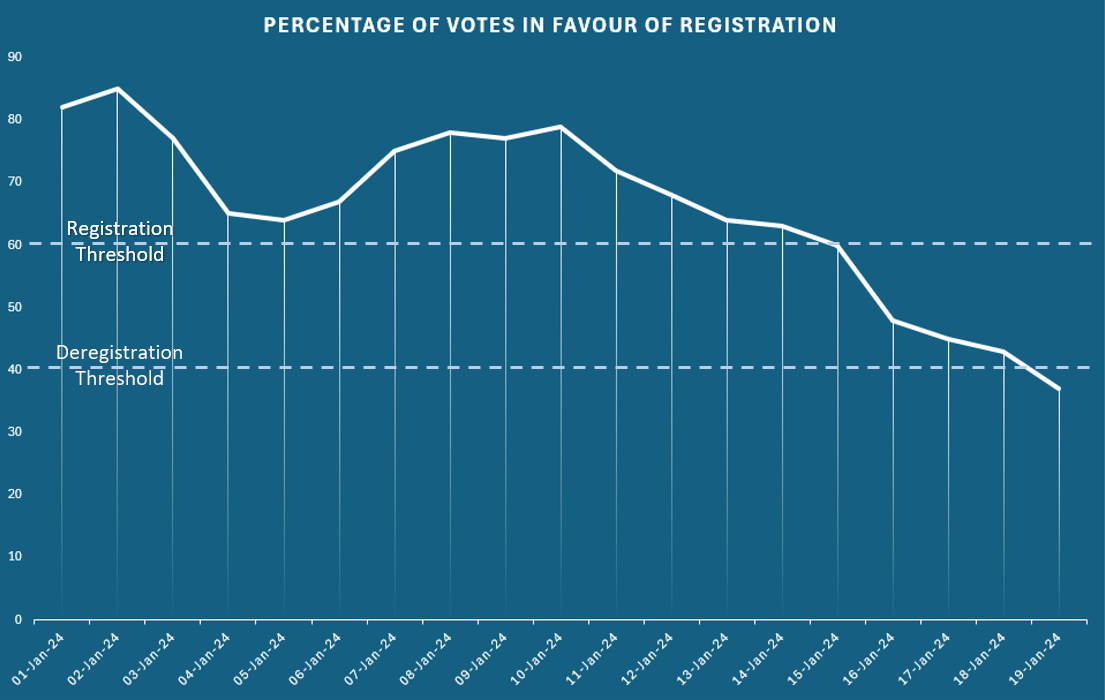
Voting is anonymous (that is, it represents a secret ballot).
The voting service runs on robust data processing centres, with fault tolerance, redundancy and backup. Vote counting is performed automatically, and results are available in real time. The platform must be impartial.
Voting must be tamper proof. The technology ensures a person contributes at most one vote on a given initiative. The voting service runs open source software - in other words the source code is in the public domain, and anyone can download the source code and study it. The software binaries have independently verifiable cryptographic hashes, making it possible for an independent watchdog to verify that the binaries were compiled from identified versions of source code.
Transforming an existing State to conform to the VoTa Constitution requires coordinated changes to law, democratic institutions, public services, taxation, money, banking, and technical infrastructure. It should not occur through a single compulsory cutover. The following subchapters separate the general principles of adoption from the distinct transitions required in each major system.
The transitions can overlap, but their dependencies must be explicit. Public services require working contracts and tax-choice funding; consumption tax requires suitable payment infrastructure; and the monetary transition requires the Central Bank Payment System, a lawful founding distribution, and a safe change in the treatment of commercial banks. Each transition should proceed only as its own prerequisites are demonstrated.
Changing an existing State to conform to this system would require:
In short, adoption is a multi-stage transformation from coercion-based political governance to voluntary, transparent, and competitive constitutional systems. It begins with parallel experiments and enabling infrastructure, such as pilots for the Central Bank Payment System, UBI, tax choice, public-service contracts, universal essential services, direct democracy, and public education before successful systems are expanded nationally.
This chapter describes incremental conversion of the existing State. Chapter 51: Adoption through coexistence describes an alternative in which the legacy State recognises a separate voluntary VoTa polity and lets citizenship, economic activity, and public-service responsibility migrate through individual choice. Chapter 52: Adoption through territorial expansion describes another alternative in which VoTa begins as a small territorial State and grows through the consensual accession of neighbouring areas.
Adoption is not a single act in which the existing State is replaced on a chosen day. It is a sequence of changes to law, technology, finance, organisations, contracts, and public expectations. The sequence must preserve essential functions while allowing the proposed institutions to prove themselves. The following general principles apply across monetary reform, taxation, democracy, and public services.
Adoption must occur peacefully. VoTa does not propose a violent revolution, an armed seizure of power, or the use of threats, intimidation, or force to impose the new constitution. Violence would contradict the NAP on which the proposed system is based and would destroy the voluntary legitimacy needed for it to endure.
Change should proceed through public persuasion, lawful democratic action, voluntary pilots, and the orderly replacement of institutions after their alternatives have demonstrated public support and practical competence. Existing services and legal protections continue during the transition until they are replaced through legitimate, peaceful processes.
In a democratic nation, substantial reform begins by persuading the public. If a large proportion of citizens find the proposed system appealing, they can pressure the government to permit pilot programs, build enabling infrastructure, remove obstacles, and make incremental changes towards it. Public support supplies both legal authority and practical legitimacy; a technically successful system cannot be adopted sustainably if most of the people expected to use it reject its purpose.
Support should be informed rather than inferred from a single general promise. Each major change should explain who is affected, what replaces the existing arrangement, which risks remain, and how results will be measured. Small-scale experience gives citizens evidence on which to judge later steps and makes public consent more meaningful.
The constitution should state the destination clearly enough that transitional institutions cannot quietly become permanent substitutes for it. The final rules concerning currency conservation, tax, public services, private operators, and State power should therefore be distinguishable from temporary adoption provisions.
The route to that destination cannot be specified with equal certainty. Technology may fail, behaviour may differ from forecasts, and dependencies may become visible only during implementation. Legislation should consequently fix constitutional limits and the expiry of exceptional powers while allowing ordinary implementation details to improve in response to evidence.
The system should be introduced slowly and incrementally over an extended period. Smaller steps limit the number of assumptions tested at once, allow technology and contracts to mature, and give citizens, workers, businesses, and institutions time to learn. Failures remain more local and are easier to diagnose than during a simultaneous national conversion.

Incremental does not mean directionless or indefinitely delayed. Each step should have a defined scope, purpose, expected result, and relationship to the final system. A long transition is useful only when it steadily retires uncertainty and legacy dependence rather than accumulating another layer of permanent institutions.
A constant principle throughout adoption is that gradual change reduces the scale and number of disruptions occurring at the same time. It allows people and institutions to adapt while the legacy system continues carrying responsibilities that the new system is not yet ready to assume. In particular:
Time does not by itself correct a defective design. A slow transition can still produce bank runs, inflation, service failure, hardship, or entrenched temporary institutions if its rules are wrong. Gradualism is valuable because it limits exposure, reveals problems earlier, and creates time to correct prospective stages before failures become simultaneous and national.
The preferred method is to build the new system alongside the legacy system, allow both to operate, and retire a legacy public system only when it is no longer needed. It is usually unnecessary to convert the internal machinery of the old system into the new one. Parallel operation reduces migration risk, preserves continuity, and lets adoption follow demonstrated usefulness rather than an imposed cutover date.
For example, the Central Bank Payment System can be built as a new payment system rather than as a rewrite of commercial-bank ledgers or legacy electronic payment networks. Legacy payments continue on their existing infrastructure while Central Bank payments use Central Bank accounts. Banks and payment providers may add interfaces and exchange services between the systems without replacing their internal software merely to make the new system possible.
Public-service conversion applies the broader principle differently. A coherent part of an agency can be separated, placed under a service contract, and sold as a functioning institution. The same employees and assets may continue providing the service under private ownership while the remainder of the government agency continues temporarily. The old and new organisational forms coexist across different services, without duplicating the particular service being transferred.
Coexistence does not require every legacy private system eventually to disappear. Obsolete public infrastructure may be retired when demand has moved away from it, while private banks, currencies, and payment systems remain free to operate for as long as people voluntarily use them. Adoption replaces State machinery where required by the new constitution; it does not require the prohibition of voluntary alternatives.
Many transitions change a quantity rather than switch a rule from false to true. Examples include tax rates, the proportion of a service funded by tax choice, the founding issuance of Central Bank currency, the remaining value of a guarantee, and the share of a legacy budget assigned to an old agency. These quantities can follow predetermined paths from their initial values to their final values.
A simple path uses linear interpolation. If (q_0) is the initial value, (q_1) is the final value, and (s) is the fraction of the transition period completed, then:
\[ q(s) = (1-s)q_0 + sq_1, \qquad 0 \leq s \leq 1. \]
The old quantity can fall as (1-s) while the new quantity rises as (s). This makes the direction, duration, and approximate burden of adjustment predictable. For example, legacy taxes can decline towards zero while consumption tax rises towards its final rate, or administrative funding can decline while tax-choice funding rises.
Linear interpolation is a useful default, not a universal law. Some changes may require an initial pilot, a slower period while capacity is built, or a pause at a decision gate. A schedule should be monotonic and published in advance where predictability is more important than responsiveness. If adjustment is permitted, its triggers and limits should also be predetermined. Quantities with different purposes need not share the same start date, end date, or curve.
Different reforms can proceed on separate schedules, but they are not independent in their effects. Tax-choice funding depends on the consumption-tax system; consumption-tax collection depends on payment infrastructure; privately operated services depend on contracts, portals, and reliable funding; and the end of currency-funded UBI depends on sufficient tax-funded UBI. A schedule that is valid in isolation may fail when combined with the others.
The transition should therefore be represented as a dependency graph with explicit prerequisites. A reform may begin early without waiting for the entire system, but it should not pass a point of irreversibility until the capabilities on which it depends have been demonstrated. Shared assumptions about population, prices, revenue, adoption, and capacity should be consistent across the separate plans.
Where possible, the new system should attract use by being safer, clearer, more useful, or more responsive rather than by prohibiting alternatives. UBI gives eligible resident citizens and their guardians a reason to open Central Bank accounts. Government acceptance gives the currency practical use. Tax choice gives citizens influence over public-service funding, while transparent contracts give private operators a reason to perform well.
An incentive should not conceal compulsion, transfer unbounded risk to the public, or create an arbitrage that overwhelms the transition. Its fiscal cost, beneficiaries, expiry, and possible unintended uses should be stated. Voluntary adoption also provides information: slow uptake may reveal a defect that compulsory adoption would hide.
Each stage should define observable measures of readiness and success. These may include system availability, service quality, public participation, transaction capacity, fraud, tax revenue, funding stability, exchange liquidity, credit availability, and the ability to recover from failure. Results should be published in a form that permits independent examination.
Early steps should be reversible wherever possible. A pilot can be stopped, a proposed interface changed, or the next scheduled expansion paused without cancelling valid transactions or reviving an institution already safely retired. Reversibility becomes harder as people enter long-term contracts and legacy capacity disappears, so the evidence required should become stronger as the transition progresses.
Adoption may require powers that would be forbidden in the final system, most notably the creation of the founding supply of Central Bank currency. Every such power should identify its narrow purpose, maximum extent, governing formula, and expiry. It should not continue merely because it has become convenient to the institution exercising it.
Legacy public machinery should likewise be retired when its replacement is proven and its remaining obligations have been transferred. Running two systems forever would preserve the cost and power of the old State while adding the cost of the new one. Successful incrementalism ends in completion: temporary authority expires, superseded public institutions close, and voluntary alternatives alone may continue alongside the constitutional system.
The final public-services model cannot be created merely by declaring existing government agencies to be private. Large agencies combine many services, assets, legal powers, dependencies, and cross-subsidies inside a single hierarchy. They must be decomposed into fine-grained public services, each governed by a clear service contract, operated by a private operator, and funded through tax choice. This conversion should occur incrementally so that essential services continue while each separable part of an agency is prepared and transferred.
The unit of transition is a service, not an entire department. Different services within the same agency may move at different times and by different methods. One service can be converted without waiting for every other part of government, while a function whose boundaries remain unclear can stay in its legacy form until a workable design exists.
Restructuring requires a clear description of what an agency actually does. Its activities should be mapped into services received by the public, services supplied to other public services, regulatory or legal functions, shared internal capabilities, and ownership or maintenance of assets. Costs, staff, contracts, data, liabilities, dependencies, and sources of funding should be assigned to those activities as accurately as possible. Hidden cross-subsidies and obligations must be made visible before boundaries are changed.
This mapping should distinguish a public objective from the organisation currently used to achieve it. Supplying safe drinking water is an objective; preserving a particular department, reporting line, or job classification is not. Conversely, an activity should not be discarded merely because its beneficiaries are indirect. Planning, inspection, emergency preparation, maintenance, and record keeping may be essential inputs even though citizens do not request them individually.
Large government agencies should be divided into smaller, focused organisations where their functions have high internal cohesion and can interact with other functions through clear, limited interfaces. This can make responsibilities, costs, and performance easier to identify, while reducing the complexity of managing a single large bureaucracy.
For example, a water utility might be divided into separate services responsible for individual water sources, such as dams and desalination plants, bulk-water coordination, the pipe network, water-quality testing, and retail service. Shared responsibilities, including system planning, emergency coordination, and environmental protection, would still require clearly defined arrangements between those services.
An agency should be split only where responsibilities can be clearly assigned and performance independently measured. Where functions are tightly interdependent, separation may duplicate administration, fragment expertise, or make system-wide coordination more difficult. Fine-grained does not mean arbitrarily small: the appropriate boundary is the smallest service that remains operationally coherent and can enter reliable contracts with the services around it.
Decomposition does not require a flat collection of independent operators. Services may retain hierarchical relationships where coordination and accountability make them useful. The hierarchy changes from an internal chain of command within a government agency into explicit contractual relationships between private service providers.
For example, the high-level management of an existing government service may itself be separated and sold as a private operating institution. It can hold the principal public-service contract and engage more specialised converted services as subcontractors. Those subcontractors might operate particular facilities, regions, networks, maintenance functions, or customer services while the prime operator coordinates the system and remains accountable for the overall contracted outcome.
Each boundary should still expose responsibilities, prices, performance, data, and liability. Subcontracting must not recreate an opaque government department under private ownership. Contracts should make it possible to replace a poorly performing subcontractor, or the prime operator itself, without unnecessarily dismantling competent services elsewhere in the hierarchy.
Each proposed service needs a contract that states the work to be performed, who is eligible to use it, minimum availability and quality, prices or funding rules, reporting requirements, interfaces with other services, ownership and permitted use of data and assets, and procedures for emergencies, disputes, default, renewal, and termination. Requirements should describe outcomes wherever possible rather than preserving the internal procedures of the former agency.
Performance measures must be difficult to satisfy while degrading the real service. A hospital contract based only on the number of treatments could reward unnecessary treatment; a road contract based only on kilometres maintained could neglect safety and heavily used locations. Measures may therefore combine availability, quality, safety, timeliness, user experience, long-term asset condition, and total cost. Contract terms, payments, performance data, conflicts of interest, and material failures should be visible through the public-service portals.
Contracts between services are as important as contracts with citizens. One operator's output may be another's essential input. Technical standards, capacity commitments, notice periods, prices, liability, data exchange, and fallback arrangements should be specified before the services are separated. System-wide responsibilities that cannot yet be expressed through dependable interfaces should remain coordinated until that problem is solved.
The immediate purpose of conversion is to change the institutional and contractual basis of a useful service, not to stop the service or redesign everything it does. Existing projects, implementation programs, maintenance schedules, supplier arrangements, and commitments should continue under the new operator unless there is a specific reason to change them. The service contract should carry those obligations across the transfer so users and dependent services do not experience an arbitrary break in delivery.
The same presumption of continuity applies to the workforce. Public servants working in the converted service can become employees of the private operator while initially continuing their existing duties, projects, remuneration, and employment conditions. Conversion is not intended as a device for suddenly putting useful employees out of work or reducing their income. Preserving the people who understand and operate the service is often the least disruptive way to preserve its competence.
Over longer periods, services will evolve. Competing providers may emerge, contracts and funding may change, projects will finish, technology will improve, and operators may restructure their work. These changes should occur prospectively through ordinary contractual processes, performance evidence, competition, and natural staff turnover rather than being imposed all at once as part of the ownership transfer. Incrementalism allows reform while retaining the value already present in existing institutions.
Continuity at the time of transfer does not permanently preserve the security and institutional protection associated with public employment. Over perhaps a decade or several decades, workers and organisations become progressively exposed to profit and loss, competing providers, measurable performance, changing contracts, and funding directed by taxpayers. The long transition gives people time to develop the skills, judgement, and working practices needed to succeed on merit in that environment.
This adaptation occurs at both individual and organisational levels. Individual public servants initially continue familiar work within the converted institution, while teams may remain together as divisions, become subcontractors, participate in purchasing their service, or develop into independent private operators. Existing competence and cooperation are retained, but their value must increasingly be demonstrated to customers, contracting services, and taxpayers rather than assumed from their position within a government hierarchy.
The exposure should increase with the wider transition. Legacy budget support declines, tax-choice funding becomes more important, comparable performance becomes visible, alternative operators gain entry, and contracts become easier to contest or reassign. A service that taxpayers value and an operator that performs well can prosper; one that cannot attract support or meet its contract must adapt, contract, or ultimately fail. Phasing this discipline in gradually avoids an abrupt shock without denying the competitive accountability intended in the final system.
This is consistent with the wider funding transition. Discretionary government spending on public services is phased out as spending directed by the public through tax choice is phased in. Operators therefore move gradually from budgets allocated by government officials towards funding that depends on service contracts, demonstrated performance, and the choices of taxpayers.
Once a coherent service has been separated and its service contract defined, that part of the government agency can be established as an operating institution and sold on the open market as a going concern. The purchaser becomes the private operator, accepts the service contract, operates for profit, and receives the funding assigned to the service, including tax-choice funding as it is phased in.
Conversion need not substantially change the service's daily operation. Its existing workforce, management processes, equipment, premises, supplier relationships, and accumulated knowledge may transfer with it. Employees who previously worked for a government agency then work for the private operator. The immediate change is principally one of ownership, accountability, funding, and exposure to profit and loss rather than an unnecessary disruption of competent operational work.
The sale of each operating service should be open to competing purchasers. The assets and liabilities being transferred, the service contract, selection criteria, contractual commitments, beneficial ownership, and conflicts of interest should be disclosed. Bidders compete for ownership on the knowledge that the institution must continue meeting its public-service contract.
Assets needed to operate the service may be transferred with the institution, while assets shared between several services may first need to be assigned to a separate service or governed by access contracts. The agency should be decomposed before sale so that the State does not merely transfer an unnecessarily integrated monopoly to a private owner. Where several operators can serve users concurrently, later entry and user choice should remain possible under the public-services model.
No operator's public-service position is permanent because every service contract and subcontract has a defined term. At expiry, the contract may be renewed, revised, divided, combined, awarded to another operator, or allowed to end according to the public-services system. The incumbent may compete for the next contract, but ownership of the operating company or its assets does not create a permanent entitlement to the public role or its tax funding. Contract terms can be long enough to support continuity and investment without making the arrangement perpetual.
Each new service initially needs enough transitional funding to honour its contract while citizens learn how to evaluate and allocate tax to it. A predetermined portion of its legacy budget can be converted into baseline contractual funding, with an increasing portion determined through tax choice. The legacy portion declines as consumption tax and participation in tax choice grow. The funding path should be published so operators, workers, users, and suppliers can plan.
Tax choice should fund the service rather than grant money permanently to a particular operator. Where several operators satisfy the same public-service contract, citizen allocations and service use can influence how funding is divided among them. Comparable performance information must be available before allocations have large consequences. New services also need a defined way to seek initial support so that existing operators do not acquire a permanent advantage merely by being present at the beginning of the transition.
Funding cannot always track current approval immediately. Infrastructure maintenance, emergency capacity, and long-term commitments require predictable revenue. Service contracts may therefore use reserves, notice periods, multi-period commitments, or separately identified minimum capacity. These mechanisms should stabilise delivery without insulating an operator indefinitely from loss of public support.
Conversion requires more than transferring a budget. Equipment, land, intellectual property, records, licences, supplier contracts, debts, legal claims, and responsibility for past decisions must be assigned explicitly. Public records and the information needed to continue a service should not become inaccessible private property. Asset registers and opening balance sheets should be published before transfer, with independent valuation where ownership is sold.
Existing workers hold much of an agency's operational knowledge. Private operators should be free to develop their organisations over time, but employees can initially move with the operating service on their existing duties, remuneration, and employment conditions so that their work and the service continue. The transition should provide adequate notice and preserve accrued contractual entitlements. Workers may also participate in bids or form an operator of their own. A staged conversion reduces the risk that specialised knowledge disappears when ownership and organisational boundaries change.
A private operator must be allowed to make a loss and fail, but failure of an operator should not necessarily terminate an essential public service. Contracts should require current operational records, portable data, maintainable assets, and enough notice or contingency planning for another operator to take over. Critical services may need multiple operators, spare capacity, mutual-aid arrangements, or a temporary contract that activates automatically when the primary operator defaults.
Continuity arrangements must not become a disguised guarantee of the operator's investors or creditors. The objective is to preserve access to the service and its necessary assets and information, not to preserve the failed company. Shareholders and creditors remain exposed to the commercial risks they accepted, while replacement operators compete to continue the public function.
Before a service is sold, its operating boundaries, contract, funding, assets, liabilities, records, employees, and interfaces with dependent services should be sufficiently clear for it to continue under private ownership. Experience after transfer can inform later contracts and conversions. Incremental conversion means transferring functioning parts of an agency as they are ready, not constructing duplicate services alongside them.
This produces a gradual change in the character of the State. Public purposes and collective funding continue, but delivery moves from integrated government bureaucracies to fine-grained services operated under transparent contracts. Tax choice progressively replaces administrative budget allocation, and the government agency becomes smaller as each operating service passes into private ownership. The remaining shell can be closed after its final obligation, asset, record, employee, and dependency has been assigned.
The monetary transition introduces Central Bank currency and the Central Bank Payment System alongside legacy State currency, commercial-bank deposits, and existing payment networks. It also changes the legal position of commercial banks by progressively withdrawing State protection and bank-specific regulation. This subchapter concerns money, banking, exchange, and payment-system adoption; conversion to consumption tax is addressed separately.
Consider that the Central Bank, electronic payment system, and tax choice services are fully implemented.
From the moment it is introduced, Central Bank currency has a floating exchange rate with every other currency.
There needs to be an incentive for the public to start using it. The following measures apply during the relevant period or, where indicated, permanently:
People receive the new currency through UBI, government accepts it for taxes, and that gives people a reason to accept it in trade.
Under the VoTa Constitution, Central Bank currency cannot ordinarily be created or destroyed. There must, however, be a finite inception period in which its initial supply is created and distributed. The constitutional transition provisions must expressly authorise this exception; otherwise, gradual issuance would contradict the rule against currency creation.
Before issuance begins, the constitutional transition provisions establish a target total supply of Central Bank currency. During the currency-founding period, currency is created ex nihilo and distributed as UBI. Both creation-funded and tax-funded UBI use the same constitutional age-weighting formula. Every eligible tax-compliant resident citizen of the same age receives the same amount, children receive the applicable fractional weight, and adults receive the full weight. This is a founding distribution, not a permanent power to finance expenditure by creating currency.
The founding period continues until cumulative creation reaches the target supply. Its duration is therefore estimated rather than fixed: it depends on the target, the creation-funded UBI rate, and the total UBI weight of eligible citizens over time. It might be expected to last approximately fifty years, but it ends when the target is reached. The final creation-funded payment is reduced proportionally if necessary so that the target is not exceeded.
Distributing the founding supply gradually reduces the risk of price and exchange-rate instability. It allows demand for the new currency, productive capacity, wages, and prices to adjust as adoption grows. A long founding period cannot guarantee price stability, but it avoids the much larger monetary shock that could result from creating and distributing the target supply at once.
During the founding period, each UBI payment has two separately accounted components. Let \(C_t\) be the number of new currency units authorised for creation and distribution in payment period \(t\), let \(T_t^{\mathrm{ubi}}\) be the existing currency allocated to UBI from consumption tax in that period, and let \(E_t\) be the set of eligible tax-compliant resident citizens. For citizen \(i\) of age \(a_i\), let \(W(a_i)\) be the constitutional age weight and define the total eligible weight \(S_t\) by:
\[ S_t = \sum_{j \in E_t} W(a_j). \]
Ignoring integer rounding for clarity, the UBI paid to eligible citizen \(i\) is:
\[ U_{i,t} = U_{i,t}^{\mathrm{issue}} + U_{i,t}^{\mathrm{tax}} = \frac{W(a_i)}{S_t}C_t + \frac{W(a_i)}{S_t}T_t^{\mathrm{ubi}}. \]
If \(P_t\) is the aggregate tax-inclusive consumption to which the UBI allocation rate applies, and \(R_{\mathrm{ubi}}(t)\) is that rate during period \(t\), then, apart from any separately defined externality allocations:
\[ T_t^{\mathrm{ubi}} = P_t R_{\mathrm{ubi}}(t), \qquad U_{i,t} = \frac{W(a_i)}{S_t} \left(C_t + P_t R_{\mathrm{ubi}}(t)\right). \]
Only \(C_t\) creates currency and counts towards the target supply. The tax component transfers currency that already exists. The implemented formula applies the constitutional integer rounding and remainder rule, so actual payments contain whole units and their total equals the amount created and redistributed.
For most of the founding period, creation-funded UBI may be paid at its ordinary founding rate while the consumption-tax allocation to UBI develops on its own schedule. Over a predetermined handover interval near the end, perhaps covering the final several years, the issuance rate per unit of constitutional UBI weight is ramped down while the consumption-tax UBI allocation rate is ramped up towards its final constitutional value.
Let \(s_t\) run from zero at the start of the handover to one at its planned conclusion. A simple linear schedule is:
\[ u_{\mathrm{issue}}(t) = (1-s_t)u_{\mathrm{issue},0}, \qquad R_{\mathrm{ubi}}(t) = (1-s_t)R_{\mathrm{ubi},0} + s_t R_{\mathrm{ubi},1}, \]
where \(u_{\mathrm{issue},0}\) is the creation-funded UBI rate per unit of age weight before the handover, \(R_{\mathrm{ubi},0}\) is the consumption-tax UBI allocation rate at its start, and \(R_{\mathrm{ubi},1}\) is the final constitutional allocation rate. Subject to the remaining target supply, planned creation in the period is \(C_t=S_tu_{\mathrm{issue}}(t)\).
The schedules should be calibrated so their planned issuance reaches the target supply. The target, not the estimated date, remains binding: \(C_t\) can never exceed the unissued remainder. The last creation-funded payment is adjusted under the published integer remainder rule, after which \(C_t=0\) permanently. Variations in consumption and tax revenue cause the tax-funded component and therefore total UBI to vary; they do not authorise a change to the target supply.
Consumption-tax-funded UBI is accounted for separately. It redistributes Central Bank currency that already exists and therefore neither increases cumulative founding issuance nor counts towards the target supply. When the target is reached, creation-funded UBI ends permanently and the transitional authority expires. Subsequent UBI consists solely of redistributed consumption-tax revenue, so no Central Bank currency is created or destroyed and the ordinary constitutional rule applies without exception.
Central Bank currency and commercial-bank deposits can coexist. Banks remain free to make loans and issue private liabilities, but these are not Central Bank currency.
Exchanging deposits for Central Bank currency with another person merely changes who owns the deposits. Repaying a bank loan with deposits extinguishes them. If a bank itself redeems a deposit in Central Bank currency, it cancels the deposit and pays currency it already holds. Exchange rates are determined by the market; there is no public guarantee of conversion at a fixed rate.
UBI payments and use in taxation and commerce encourage adoption of Central Bank currency. As customers switch, banks have a commercial incentive to offer services and arrange loans in it. They can obtain currency from savers, investors, loan repayments or asset sales. Private bank liabilities may lose acceptance or trade at a discount, encouraging banks to rely less on them. Banking and credit continue, while the change is driven by customer choice and competition.
During the transition, both State protection and bank-specific regulation are phased out smoothly according to a predetermined schedule. Deposit guarantees, compulsory acceptance, guaranteed conversion rates, lender-of-last-resort support, and taxpayer bailouts are progressively withdrawn. Capital requirements, reserve requirements, lending limits, and other regulations intended to control risks ultimately borne by the State are reduced in parallel.
At the end of the transition, commercial banks receive no special protection from the State and are subject to no bank-specific regulation. Subject to the ordinary laws applying to everyone, including contract, property, fraud, and insolvency law, they may choose their own capital and reserves, lend as much as they wish to whomever they wish, and accept whatever risks they wish.
Where different forms of money may be accepted voluntarily and exchanged at market-determined rates, people can prefer the money they consider more reliable. They may save in it, request payment in it, price goods in it, and discount or refuse private liabilities whose issuers present greater risk. A sound currency can therefore progressively displace less trustworthy forms of money without their being prohibited.
This differs from Gresham's law, under which bad money drives good money out of circulation when the State requires currencies with different market values to be accepted at the same legal value. When there is no compulsory parity, differences in solvency, scarcity, redemption terms, and public confidence can instead be reflected in exchange rates and acceptance.
Precious metals provide a historical illustration of this selection process. Their durability, divisibility, portability, recognisability, and relative scarcity made them more useful as money than many alternatives, although law, taxation, coinage, and trade institutions also contributed to their adoption.
Central Bank currency is intended to succeed through the same broad principle of voluntary selection. Its constitutional supply constraint, freedom from issuer-default risk, acceptance by government, and use for UBI and constitutional commerce give people reasons to prefer it. This does not guarantee that every private currency or bank liability will disappear: convenience, established payment networks, and individual risk preferences may allow competing claims to continue circulating.
In the following, we describe an approach to converting an existing system using its existing currency and central bank. We will use the U.S. system as an example. Its central bank is called the Federal Reserve (the "Fed"). The Treasury has an account at the Fed called the Treasury General Account (TGA). This currently cannot go into overdraft.
The following steps are taken (incrementally where appropriate to avoid shocks):
The capped TGA overdraft is a transitional financing arrangement, not a permanent feature of the monetary system described in Chapter 15: Monetary system. The constitution specifies the conditions for ending this authority once existing government debt has been retired and the budget brought into balance. The cap cannot be raised during the transition. Until the authority ends, receipts can restore overdraft headroom, so the cap alone does not establish a fixed currency supply.
At completion, the transitional overdraft authority expires permanently. Any remaining TGA overdraft and the Fed's corresponding claim are extinguished together as internal public-sector accounting entries, without changing anyone else's currency balance. This treatment must be expressly authorised by the constitutional transition provisions. Thereafter, every account, including the Treasury's, must remain non-negative, and government payments transfer existing currency rather than create it.
The prohibition on buying and selling assets stops new monetary-policy operations. Existing assets must also be resolved under the transition provisions. Treasury securities held by the Fed are retired with the other outstanding government debt. Remaining loans and other claims are transferred to a separate public wind-down account outside the Central Bank before the fixed-supply arrangements take effect. Subsequent repayments transfer existing currency to that account; they do not extinguish currency. Borrowers' contractual obligations remain unchanged.
Physical dollars are exchanged at face value for electronic Central Bank balances over an announced conversion period. Notes surrendered by the public or banks are cancelled as the corresponding accounts are credited, so conversion does not duplicate currency. The transition provisions must specify the treatment of notes not presented by the deadline before the final electronic supply is fixed. Once conversion is complete, Central Bank currency exists only as electronic balances.
The existing dollar remains the currency. People gain the option of holding dollars directly in Fed accounts rather than as claims against commercial banks. Central Bank currency and commercial-bank deposits can coexist. Banks remain free to make loans and issue dollar-denominated private liabilities, but these are not Central Bank currency.
Exchanging deposits for Central Bank currency with another person merely changes who owns the deposits. Repaying a bank loan with deposits extinguishes them. If a bank itself redeems a deposit in Central Bank currency, it cancels the deposit and pays currency it already holds. A bank's contractual obligation to repay a dollar-denominated deposit remains, but there is no public guarantee that it will be able to do so. A claim against a bank may trade at a discount reflecting its risk; this is a valuation of the claim, not an exchange rate between two sovereign currencies.
Tax-funded UBI payments into Fed accounts and their use in taxation and commerce encourage adoption of direct Central Bank balances. Unlike the founding distribution in 50.3 Monetary-system conversion, this approach does not create a new currency through UBI issuance. UBI redistributes tax receipts. As customers switch, banks have a commercial incentive to offer services and arrange loans settled in Central Bank currency. They can obtain currency from savers, investors, loan repayments or asset sales. Private bank liabilities may lose acceptance or trade at a discount, encouraging banks to rely less on them. Banking and credit continue, while the change is driven by customer choice and competition.
The permanent TGA cap and eventual fixed currency supply prevent continuing monetary expansion from driving long-term inflation, making Central Bank currency more attractive as savings.
Households should not have to learn how to invest merely to preserve their savings. Central Bank currency lets them hold money directly, without commercial-bank default risk or, after the transition, dilution through further issuance.
As the economy grows against a fixed currency supply, the currency's purchasing power would tend to increase, encouraging people to save. Holding larger balances rather than spending them exerts deflationary pressure: less money is actively chasing goods and services.
Government bondholders are expected mostly to carry their savings over into Central Bank currency. Repayment changes the form of their savings, not their intention to save. Replacing bonds with spendable balances therefore need not produce a surge in spending or inflation.
Government should manage inflationary and deflationary pressure through the balance of spending and taxation. Taxing more than it spends withdraws currency from circulation; spending more than it taxes returns currency to circulation. Under the fixed-supply system, deficits must be funded from accumulated government balances, so this policy redistributes existing currency rather than creating more.
During the transition, both State protection and bank-specific regulation are phased out smoothly according to a predetermined schedule. Deposit guarantees, compulsory acceptance, guaranteed conversion rates, lender-of-last-resort support, and taxpayer bailouts are progressively withdrawn. Capital requirements, reserve requirements, lending limits, and other regulations intended to control risks ultimately borne by the State are reduced in parallel.
At the end of the transition, commercial banks receive no special protection from the State and are subject to no bank-specific regulation. Subject to the ordinary laws applying to everyone, including contract, property, fraud, and insolvency law, they may choose their own capital and reserves, lend as much as they wish to whomever they wish, and accept whatever risks they wish.
The same conversion approach applies to Australia, retaining the Australian dollar. The Reserve Bank of Australia (RBA) takes the place of the Fed, and a designated Commonwealth account within its Official Public Account (OPA) arrangements takes the place of the TGA. The monetary steps described above are otherwise the same; implementation would require corresponding changes to Australian law.
The same monetary approach applies to the UK, retaining sterling and using the Bank of England in place of the Fed. A designated Treasury account within the Exchequer arrangements would take the place of the TGA. The UK already has a government overdraft mechanism, the Ways and Means facility for advances to the National Loans Fund; it would need to be brought under the proposed cap and permanent expiry rules.
There is an additional constitutional issue: under parliamentary sovereignty, future Parliaments can change existing legislation. Entrenching the monetary constraints against ordinary legislative reversal would therefore require a new constitutional settlement.
The following features give people strong reasons to move their savings and everyday payments from bank deposits to Central Bank currency.
Ultimately, demand deposit accounts are expected to see little use as people hold their monetary balances directly at the Central Bank, ending commercial banks' role as the account providers through which everyday commerce must pass. Their function would migrate towards lending existing Central Bank currency as financial intermediaries between savers and borrowers. Banks cannot create Central Bank currency when extending credit: the payment system permits them only to transfer currency they already hold. As their deposits cease to circulate as money, banks would lose the ability to fuel asset bubbles through the creation of widely accepted deposit money. Removing this source of credit expansion is expected to substantially reduce banks' power over the economy and the severity of booms and busts.
The existing State central bank should be wound down separately from the introduction of the VoTa monetary system. Its responsibilities cannot disappear immediately because legacy currency, contracts, banks, payment systems, and public financial obligations may remain important for many years. This subchapter describes how its influence can decline with the monetary system it serves.
The existing State central bank should not be confused with the constitutional Central Bank that operates Central Bank currency and the Central Bank Payment System. The two institutions may coexist for a long transition, but they operate different currencies under different rules. The legacy central bank continues to administer the legacy monetary system; it does not become the issuer, owner, guarantor, or monetary-policy authority for Central Bank currency.
There need not be an abrupt date on which the legacy central bank is abolished. Its importance can decline with the importance of the system it serves. As households and businesses increasingly hold Central Bank currency, quote prices and wages in it, use it for payments, and borrow and invest in it, a progressively smaller share of economic activity depends on legacy currency, commercial-bank deposits denominated in that currency, or settlement through legacy central-bank reserves. The old institution may initially remain large and active, then become a smaller administrator of a contracting monetary domain, and ultimately become a limited wind-down institution.
This is a consequence of voluntary migration rather than a compulsory exchange. Legacy notes, deposits, debts, and contracts do not cease to exist merely because Central Bank currency has been introduced. Existing obligations can continue under their original terms, and parties remain free to use the legacy currency. The decline occurs as old contracts mature, users choose the new currency for new transactions, and commercial banks reduce their dependence on legacy demand deposits. The pace should therefore respond to observable adoption and financial-system capacity, not just to a political deadline.
A legacy central bank normally gives effect to monetary policy by setting or closely influencing a short-term policy interest rate. It can pay interest on reserve balances, lend reserves at stated rates, and buy or sell assets so that the rate for overnight funds remains near its target. Because commercial banks use those reserves to settle with one another, the policy rate influences their funding costs and can pass through, imperfectly and with delays, to deposit rates, mortgage and business-loan rates, bond yields, asset prices, and the exchange rate.
That transmission mechanism remains relevant while much of the economy uses the legacy currency. It should not be switched off while large stocks of variable-rate mortgages, business loans, bank deposits, and payment obligations still depend on it. A sudden withdrawal could disrupt funding markets and payment settlement, produce sharp movements in borrowing costs, or leave existing contracts without the monetary arrangements on which they were written.
Its reach nevertheless narrows naturally during adoption. A policy rate for legacy reserves can strongly affect a loan denominated and funded in legacy currency, but it cannot set the interest rate on a private loan of Central Bank currency. The latter rate is negotiated in the market between savers, investors, intermediaries, and borrowers. Nor can the legacy central bank change the quantity of Central Bank currency, pay interest on Central Bank accounts, or defend a fixed exchange rate between the two currencies.
Consequently, a change in the legacy policy rate affects a diminishing proportion of credit and spending as new lending, refinancing, payrolls, prices, and savings migrate to Central Bank currency. The effect is not determined solely by the proportion of payments made in each currency: it also depends on the denomination and funding of debts, the currency in which prices are set, and the financial links between the two systems. These exposures should be measured and published so that the reduction in policy activity follows the actual loss of monetary-policy reach.
During coexistence, exchange-rate movements can still carry some legacy policy effects into the new currency economy. For example, a change in legacy interest rates may alter demand for legacy assets and therefore the floating exchange rate. That indirect influence is not authority over Central Bank currency and should generally weaken as legacy assets and contracts become less economically important. The constitutional Central Bank does not respond by creating currency, targeting an interest rate, or trading assets to offset the movement.
In the legacy system, commercial banks hold accounts at the legacy central bank so that obligations between them can be cleared and settled in central-bank reserves. Those reserve balances form a special settlement asset used by eligible financial institutions. They are useful for settling legacy commercial-bank money, but they do not clear or back Central Bank currency in the VoTa system.
A commercial bank instead holds Central Bank currency in its own account with the constitutional Central Bank, just as any other account holder does. When one bank pays another in Central Bank currency, the payment is an ordinary transfer of existing units from the payer's account to the recipient's account. Settlement is complete when the common ledger records that transfer. The banks do not exchange a second kind of money behind it, and they do not need privileged reserve accounts available only to financial institutions.
In this sense, commercial banks are not special. Their Central Bank accounts operate under the same rules as other accounts, and transfers to or from them conserve currency in exactly the same way as any other transfer. Being a bank grants no privileged access to currency creation, overdrafts, Central Bank credit, settlement guarantees, or a distinct asset available only to banks. A bank's role as lender, intermediary, custodian, or payment-service provider arises from voluntary contracts with its customers, not from a special position inside the monetary system.
This also means that there is no separate reserve currency backing Central Bank currency. Central Bank currency is itself the final asset recorded in Central Bank accounts. A bank cannot obtain it by having the Central Bank create reserves, borrowing it from the Central Bank, or converting a private deposit into it by an accounting entry. It must receive existing units from customers, savers, investors, loan repayments, asset sales, or other willing counterparties before it can transfer or lend them.
Banks may still create private clearing arrangements for their own liabilities and may net a series of obligations before making a final payment. If final settlement is promised in Central Bank currency, however, the net amount must ultimately be transferred through their ordinary Central Bank accounts. Any privately issued balance remains a claim against its issuer; it does not become Central Bank currency merely because banks use it among themselves.
The legacy central bank may also issue notes, maintain reserve accounts, operate or support wholesale settlement, provide liquidity to banks, hold foreign reserves, act as banker to the government, and perform financial-stability or regulatory functions. Some of these functions may be located in separate agencies in a particular country, but their transitions remain connected. They cannot be assumed to disappear merely because a new retail payment system exists.
As legacy bank deposits and interbank payments contract, banks require less legacy reserve settlement and the old payment infrastructure carries less traffic. As deposit guarantees and lender-of-last- resort support are phased out, depositors and creditors bear more of the risk they voluntarily accept, while bank-specific prudential regulation can be reduced in parallel. These changes should be coordinated: removing oversight while leaving an expectation of rescue preserves moral hazard, while removing liquidity and settlement support before banks and customers can migrate could create an avoidable crisis.
No timetable can guarantee that migration will always be smooth. Confidence in legacy banks may occasionally fall faster than planned, especially once customers have a safe alternative payment account. The transition should therefore publish milestones, exposures, and contingency procedures; require clear disclosure of which liabilities are privately guaranteed; and ensure that the Central Bank Payment System can accommodate increasing use. A contingency may slow a scheduled withdrawal of legacy support, but it must not authorise creation of Central Bank currency to rescue legacy banks or promise conversion of their liabilities at par.
Declining monetary influence does not eliminate the legacy central bank's balance sheet. It may still hold government securities, loans to banks, foreign reserves, buildings, and other assets, while owing reserve balances, notes, government deposits, and contractual obligations. These items must be inventoried and dealt with explicitly. They should not be silently transferred to the constitutional Central Bank, whose inability to borrow, lend, or own money is fundamental to its design.
Assets and liabilities can be allowed to mature, sold or settled in legacy currency, or assigned to a separately funded legacy-resolution body under published rules. Government debt and government accounts require coordination with the tax and political transitions. Foreign reserves and sale proceeds remain public legacy assets and should be disposed of through a transparent, legally defined process rather than used to manipulate the floating exchange rate of Central Bank currency. Losses on legacy assets must remain visible legacy obligations; they must not be covered by creating Central Bank currency.
Over time the institution should cease making new long-dated commitments, narrow discretionary monetary operations, consolidate little-used facilities, and retain only the staff and powers needed to settle remaining obligations safely. This gradual contraction preserves continuity and allows experienced staff to complete projects, transfer technical knowledge, or retire normally. Final closure becomes practical only when remaining functions can end or be performed without special State monetary privilege. Until then, the objective is not to pretend that the legacy central bank has vanished, but to make its shrinking role explicit, measurable, and incapable of compromising the constitutional rules governing Central Bank currency.
The existing collection of income, company, payroll, property, and other taxes should be replaced gradually by the constitutional consumption tax. The tax transition is distinct from both the founding of Central Bank currency and the conversion of government agencies into privately operated public services. Their schedules may overlap, but they have different purposes and should be specified independently.
One method is to use interpolation over a predetermined tax-transition period. The consumption-tax rate begins at zero and steadily approaches its final rate, while each legacy tax is reduced from its initial rate towards zero. This makes the direction and approximate pace of reform predictable while giving households, employers, investors, and public services time to adapt.
The schedules need not all be linear or have identical dates. A tax that is expensive to administer may be retired earlier, while one supporting an essential legacy obligation may decline later. The combined burden and revenue effect should be modelled rather than assuming that equal changes in headline rates produce equal revenue.
Consumption-tax collection should begin on the Central Bank Payment System at a small scale while legacy tax systems continue to operate. Pilot transactions can test the classification of R-account receipts, refunds, reversals, disputed payments, cross-border purchases, major purchases, and transactions involving people who are not citizens. Collection can expand as coverage and reliability are demonstrated.
Parallel operation temporarily increases complexity, but it avoids depending immediately on an unproven national collection system. Businesses should receive clear rules for transactions that touch both systems, and the same economic activity should not be taxed twice merely because payment crosses the transitional boundary.
Preferential treatment based solely on the payment path can encourage businesses to relabel transactions without changing the underlying activity. Rather than broadly exempting income when a sale uses the new system, legacy rates can decline for everyone according to the published schedule, or a narrowly defined credit can recognise consumption tax already paid. Any transitional rule should be tested against changes in currency, payment route, legal entity, residence, and transaction timing.
Tax reform must preserve enough revenue to meet valid public obligations during conversion. At the same time, allocation of consumption tax through tax choice can expand as privately operated public services become available. The amount collected, the amount allocated to UBI, the amount allocated to services, and the remaining cost of legacy institutions should be published for every stage.
If revenue differs from forecasts, the response should follow rules established before the shortfall or surplus occurs. Borrowing, additional currency creation, delayed recognition of liabilities, or an indefinite extension of legacy taxes should not become concealed balancing mechanisms. A tax should be retired only when its outstanding assessments, refunds, disputes, records, and enforcement obligations have been resolved or transferred.
At completion, legacy taxes and the administrative systems devoted solely to them cease. Domestic consumption tax is collected through the constitutional account structure, its allocation is transparent, and citizens exercise tax choice over the public-service component. The separate currency-founding schedule may still be running, or may already have ended; completion of one does not redefine the constitutional purpose of the other.
People who depend on existing welfare systems must not lose the means of basic survival during adoption. Means-tested payments should therefore be phased out only as their replacements are phased in. The replacement is not UBI alone: it is the combination of unconditional UBI and an expanding set of public services providing essentials such as basic food, shelter, healthcare, disability support, and emergency assistance.
The transition should be gradual enough that recipients experience manageable changes rather than the sudden disappearance of income, services, or administrative support. Existing welfare systems continue while the UBI and relevant public services acquire the funding, capacity, geographic coverage, and reliability needed to replace them.
Each legacy welfare program should be examined according to the needs it actually meets. Some cash payments provide a general income floor and can be replaced progressively by UBI. Other payments meet costs arising from housing, illness, injury, disability, caring responsibilities, or other exceptional needs. Those functions may require universal or needs-responsive public services in addition to UBI.
A legacy payment should not be reduced merely because UBI has begun. The complete replacement package must be considered. A food service that does not operate in the recipient's area, housing that has no available capacity, or healthcare with an inaccessible waiting time is not yet a real replacement. Withdrawal schedules should therefore follow demonstrated availability rather than assume that a service exists because its contract has been written.
During the overlap, a person may receive a mixture of legacy welfare, creation-funded UBI, consumption-tax-funded UBI, and universal services. The components should be shown separately so recipients can understand what is changing and administrators can detect gaps or unintended losses.
Existing recipients can retain their legacy entitlements while the replacement system begins. Means-tested payments and their income tapers then decline according to published transitional rules as UBI and essential services expand. Different programs may require different schedules: a general unemployment payment can change more readily than support for a person whose housing or medical care depends on a specialised arrangement.
Let (B_0(y)) represent a legacy means-tested payment at private income (y), and let (lambda_t) be the remaining legacy share during transition period (t), declining from one to zero. A simple illustration is:
\[ B_t(y)=\lambda_t B_0(y), \qquad 0\leq\lambda_t\leq1. \]
This need not be the rule for every program. It illustrates that both the payment and its means-tested withdrawal can diminish gradually rather than end at a cliff. The actual schedule must be considered together with UBI, taxes, living costs, and the value and availability of replacement services.
Means-tested welfare can impose a high effective marginal tax rate because earning additional income causes benefits to be withdrawn while income tax also rises. A person may retain very little of an additional dollar earned. This welfare trap weakens the incentive to increase working hours, accept promotion, start a business, or return to paid work.
As the legacy taper is reduced, its contribution to the recipient's EMTR falls. Legacy income taxes are also phased out, while unconditional UBI is not withdrawn when income rises. The recipient's EMTR should consequently move towards the common VoTa rate produced by the final consumption tax:
\[ \operatorname{EMTR}_{\mathrm{VoTa}}=R_{\mathrm{tot}} =R_{\mathrm{ubi}}+R_{\mathrm{svc}}. \]
This convergence should be tested rather than assumed. Interactions between several benefits, taxes, rent, service charges, and household circumstances can produce unexpected peaks or cliffs. For representative households, the transition should publish estimated disposable resources and EMTR curves at successive stages. If a schedule creates a new penalty for working, its tapers and phase dates should be corrected prospectively.
No existing recipient should lose access to basic food, shelter, healthcare, or essential disability support merely because the replacement system is incomplete. This is a transitional continuity rule, not a permanent means-tested entitlement. It protects people while specified UBI and service capabilities are being established and expires with the legacy program once those capabilities are demonstrably available.
Continuity does not require that every person's cash payment remain unchanged throughout adoption. Some support moves from cash into universally accessible services, UBI varies with founding and tax revenue, and individual circumstances change. The relevant test is whether the transition preserves access to essentials while reducing conditionality and improving the reward from additional work.
A uniform UBI cannot by itself meet every need. Severe disability, chronic illness, injury, infirmity, rehabilitation, and supported living may require assistance whose cost greatly exceeds the UBI. The corresponding legacy support should remain until capable public services are operating under contracts that provide the required care.
The final system can provide these services according to the need addressed by the service without using income or wealth tests. A healthcare service may respond to illness and a disability service to functional need, while access is not withdrawn merely because the person earns more money. This preserves necessary support without recreating the income-dependent welfare trap.
The decline of means testing also changes the work performed by welfare agencies. Their employees should not be dismissed merely because the final system requires less eligibility administration. During the long overlap they remain necessary to administer legacy entitlements, explain changes, resolve errors, and ensure that recipients do not disappear between systems.
Teams and individual workers may then transfer into privately operated public services concerned with UBI account assistance, identity and account recovery, food, shelter, healthcare, disability, rehabilitation, or supported living. Some existing units may themselves be converted into private operators under service contracts. Their experience with recipients and complex needs can remain valuable even as the means tests they previously administered disappear.
A legacy welfare program can close after its remaining recipients and obligations have moved safely to UBI and the relevant public services, outstanding reviews and payments have been resolved, and its records and continuing responsibilities have been transferred. Completion should be assessed program by program rather than declared for the welfare system as a whole on a single date.
The final result replaces conditional income support with an unconditional income floor and access to services that protect basic needs. People no longer lose UBI or essential services merely because they work. As the transition proceeds, those previously caught in means-tested welfare face a progressively lower and more predictable EMTR, approaching the same rate that applies to everyone in the completed VoTa system.
The adoption process can be understood as a gradual reduction in the discretionary power held by political leaders. Political government is not removed first while leaving its responsibilities unresolved. Instead, each area of discretion is replaced incrementally by constitutional rules, direct citizen choice, service contracts, markets, or private decision-making. Political offices become unnecessary as the powers attached to them disappear.
Much political power consists of control over public money and institutions: deciding which services exist, appointing their leadership, allocating their budgets, setting welfare conditions, changing taxes, regulating industries, protecting favoured institutions, and controlling money. The other adoption transitions progressively remove these opportunities for discretion:
| Existing political discretion | Gradual replacement |
|---|---|
| Creating, managing, and funding government agencies | Privately operated services working under time-limited contracts |
| Allocating public-service budgets | Citizens allocating consumption tax through tax choice |
| Setting welfare eligibility, conditions, and tapers | Rule-based UBI and services providing universal access to essentials |
| Protecting, rescuing, and regulating commercial banks | Unprotected private banking under ordinary law and voluntary acceptance |
| Creating currency and conducting discretionary monetary policy | A finite founding distribution followed by conservation of CB currency |
| Selecting taxes, rates, exemptions, and subsidies | The constitutionally defined consumption-tax system |
| Making detailed legislative choices | Initiatives, proxies, direct voting, and Votable Numeric Parameters |
At any stage, political discretion remains mainly over the legacy portions that have not yet been converted. As a public service is separated, contracted, sold, and moved onto tax-choice funding, politicians lose control over its management and budget. As welfare conditions and bank regulation are phased out, politicians lose the power to select beneficiaries, impose special restrictions, or grant protection. As legacy taxes disappear, selective fiscal powers disappear with them.
This approach is peaceful and preserves continuity. Political institutions are not suddenly overthrown, nor are useful services stopped merely to demonstrate that government has become smaller. Functions continue while the basis on which they are governed changes. Political offices can be retired after their remaining powers and responsibilities have been lawfully transferred, not before working replacements exist.
The reduction may take decades. During that period, political leaders continue administering the unconverted legacy State but have progressively fewer budgets, appointments, regulations, and exceptions under their control. Each completed transition should reduce the domain in which a political decision can determine who receives money, protection, permission, or institutional advantage.
The reduction in political government is expected to take decades rather than years. This long period allows many older public servants to continue useful work through to ordinary retirement. Their institutional knowledge can help separate services, preserve records and commitments, define workable contracts, train successors, identify hidden dependencies, and maintain continuity while responsibilities move to their constitutional replacements.
Natural retirement and staff turnover can perform much of the workforce adjustment without mass dismissals. Public servants who remain active during transition need not defend the continuation of political government in order to have valuable work. Their expertise may transfer to private service operators, courts, technical systems, education, contract administration, or the temporary work required to complete adoption.
Younger people making career choices should, however, understand the intended direction. A career whose value depends on exercising discretionary government power over other people, controlling public budgets, administering selective rules, or holding political office may not exist for their entire working life. They should not assume that political and bureaucratic positions will be preserved merely to provide permanent careers.
This does not make public-purpose work disappear. Work in service delivery, law, technology, analysis, care, infrastructure, and civic education continues under different institutions. The career risk applies especially to roles founded on discretionary political authority rather than to useful expertise that citizens, courts, or service operators continue to value.
People are more likely to resist reform when it presents an immediate threat to their employment, income, status, community, or ability to support their family. Sudden abolition gives those who understand the existing institutions a strong personal reason to oppose change, even when they might otherwise agree that the final system would improve society.
A gradual and predictable transition separates support for reform from fear of abrupt personal loss. Continuity of work, long notice, transfer of expertise, natural retirement, and time to learn new roles allow public servants and political employees to support changes whose long-term effect is to make some of their present functions unnecessary. They can contribute to building the replacement instead of being treated as obstacles to it.
This does not promise that every role, institution, or privilege will continue permanently. It recognises that peaceful adoption is easier when people have time to adapt and can see a place for their useful abilities during and after the transition. Reducing unnecessary personal threat can therefore broaden support for reforms that progressively reduce political discretion.
Changing institutional names does not necessarily remove political power. Discretion would persist if officials could choose favoured purchasers, rewrite service contracts at will, manipulate performance information, exclude competitors, extend temporary guarantees, alter schedules selectively, or create open-ended emergency exceptions. It could also be transferred to an unaccountable contractor, portal administrator, regulator, or technical operator.
Every transition should therefore identify the discretionary power being removed, the general rule or voluntary choice that replaces it, and the point at which the old authority expires. Sales, contracts, funding, performance records, and implementation schedules should be transparent. Temporary powers should have narrow purposes, objective limits, and definite sunset conditions. The transition should reduce discretionary power rather than disguise it.
Phasing out political discretion does not eliminate collective decision-making. Citizens continue to make constitutional and direct-democratic decisions, allocate tax, evaluate public services, and choose proxies. Private operators make commercial and operational decisions, while courts apply general laws and service contracts. What disappears is a political leadership class with broad authority to direct these systems selectively.
The intended direction is therefore monotonic: completed reforms should not recreate an equivalent political power elsewhere. As discretionary spending, monetary control, selective welfare, banking intervention, regulation, and agency management are progressively replaced, the scope of political government contracts. When the final legacy powers have expired or been transferred, political government has no remaining function and can disappear completely.
Successful adoption requires citizens, businesses, workers, and service operators to understand the new institutions before they are expected to depend on them. Education should begin before the first pilots and continue throughout the transition. It should explain the proposal accurately, including its risks and unresolved questions, rather than demand agreement with it.
People should be able to distinguish permanent constitutional rules from temporary adoption arrangements. The founding authority to create currency, transitional protection of bank deposits, and continued operation of legacy agencies do not become parts of the final model merely because they exist during conversion. Each temporary arrangement should be explained together with its purpose, limits, schedule, and expiry.
Education should also show how the separate transitions depend on one another, which legacy systems remain available, what is being tested, and what evidence permits expansion. This helps citizens judge actual incremental proposals rather than an imagined overnight replacement of the State.
Users must understand that Central Bank currency and a commercial-bank liability are different assets. A private bank balance depends on the issuer's solvency and contractual terms; it is not guaranteed Central Bank currency. As State protection is withdrawn, people need to understand redemption terms, private risk, floating exchange rates, fees, and the absence of guaranteed parity.
The two UBI components should be explained clearly. Founding issuance creates new currency towards the fixed target supply, while consumption-tax-funded UBI redistributes currency that already exists. Both use the same constitutional eligibility and age-weighting rules. Creation-funded UBI ends permanently when the target is reached, while tax-funded UBI continues and varies with revenue.
Citizens and businesses also need practical explanations of B-accounts and R-accounts, automatic consumption-tax collection, refunds, mistakes, major purchases, and cross-border transactions. Citizenship is voluntary, but tax is not an optional donation within the citizen economy: the constitutional payment system collects it automatically when the relevant transaction occurs.
Tax choice requires citizens to find service contracts, compare operators, interpret performance information, identify conflicts of interest, and understand how allocations affect funding. Education should teach people how to evaluate the available evidence without telling them which services or operators to support.
Citizens should likewise gain experience with initiatives, proxies, ratings, constitutional thresholds, and Votable Numeric Parameters before representative institutions are retired. They should know when a proxy acts for them and how to inspect, limit, or revoke that authority. Competing arguments and uncertainty should be presented openly rather than reduced to an official political position.
People need to know how to enrol, protect credentials, verify transactions and votes, recognise fraud, recover an account, and report a problem. Education should cover authorised representatives, guardianship, lost devices, compromised credentials, privacy, and mistaken payments. Identity checks may include biometrics, but no method should be presented as infallible.
Accessible alternatives are required for people who cannot use the ordinary digital or biometric process. Users should understand what an operator is authorised to see and do, and how to distinguish an authentic service from an imitation. Assistance should help a person exercise their own choices without transferring control of their currency, tax allocation, or vote to the assistant.
Voluntary pilots should let people practise with payment accounts, exchange, tax choice, public-service contracts, and direct democracy before mistakes carry national consequences. Pilot results should measure understanding and exclusion as well as technical performance. Repeated confusion may reveal a defect in an interface or rule, not merely a need to repeat an explanation.
Official explanations, formulas, contracts, software demonstrations, and test data should be open to inspection and reuse. Independent educators and critics must remain free to publish competing explanations. Material should distinguish rules, forecasts, assumptions, value judgements, and unresolved disputes rather than present all of them as settled facts.
Education should be available in accessible formats and commonly used languages, and should accommodate different levels of literacy, technical experience, disability, connectivity, and access to equipment. Permanent documentation, training systems, and help services should remain available after formal adoption for new citizens, new businesses, and people encountering an unfamiliar procedure.
The adoption process described in the preceding chapter is a direction of travel rather than a complete financial transition plan. Introducing a new Central Bank currency while changing the tax system, the funding of UBI, and the legal treatment of commercial banks would affect every major balance sheet in the economy. A long transition reduces some risks, but the passage of time does not resolve them automatically. Before implementation, the issues below would require detailed modelling, legislation, operational design, public consultation, and testing.
The possible responses discussed here are not all compatible with one another, and some may be inconsistent with the intended final constitution if made permanent. They are candidate transitional mechanisms whose costs and consequences need to be compared. Any exceptional power used during adoption should be narrow, predetermined, transparent, and subject to a definite expiry.
Central Bank currency would be free of commercial-bank default risk, while a bank deposit would be an unprotected private liability. Once transfers between them become easy, concern about a bank could cause depositors to seek Central Bank currency within hours. A transition lasting decades does not by itself prevent a run occurring on a particular day. Rapid outflows could force a bank to sell assets into a falling market, reduce lending, default on payments, or fail before ordinary insolvency procedures can respond. Fear about one institution could also spread to otherwise solvent banks.
Possible transitional protections include limits on the amount or rate at which legacy deposits can be converted, advance notice for unusually large conversions, and initially distributing most Central Bank currency through UBI rather than through deposit conversion. Limits could begin tightly and relax according to a published schedule as banks obtain more Central Bank currency and replace runnable funding. Such restrictions would delay voluntary exchange and could trap a person in a failing institution, so they cannot be assumed to be harmless. The transition plan must state whether any limit exists, who bears loss while it operates, and the date or objective conditions under which it expires.
The final system gives commercial banks neither State protection nor bank-specific regulation. Deposit guarantees, lender-of-last-resort facilities, capital requirements, reserve requirements, and restrictions on lending are therefore intended to disappear. Removing regulation before protection would allow banks to take risks still borne by taxpayers. Removing protection before depositors and payment systems can adapt could instead cause disorderly failures. The two changes need a coordinated schedule, but equal percentage reductions in each will not necessarily produce equal reductions in risk.
A credible plan would define successive legal states rather than merely promise a smooth phase-out. For each state it should identify the remaining guarantee, the prudential obligations attached to that guarantee, the treatment of existing contracts, and the loss borne by shareholders, creditors, and depositors if a bank fails. Guarantees could be closed to new liabilities before they expire on legacy liabilities. Bank-specific prudential rules could then cease as the last protected claims mature. Generally applicable laws concerning contract, property, fraud, disclosure, audit, and insolvency would remain after deregulation; the boundary between these general laws and prohibited bank-specific regulation needs precise definition.
Ordinary insolvency can take months or years, whereas households and businesses need transaction services continuously. Even if the State does not protect a bank's creditors, it must be clear whether access to payment instructions, account records, and Central Bank currency held on behalf of customers survives the bank's failure. Otherwise the collapse of a service provider could interrupt commerce without destroying any Central Bank currency.
One possible response is to separate payment interfaces and custody of Central Bank currency from a bank's risk-taking balance sheet. Customer Central Bank currency could remain in the customer's own Central Bank account, with the bank receiving only limited authority to initiate payments. Standard data formats and account-portability procedures could allow another provider to take over that authority. Private liabilities would remain part of the failed bank's estate and would not be rescued. Resolution rules would need to preserve reliable records, determine contractual priority, and transfer essential operations without guaranteeing creditor value.
Commercial-bank deposits currently fund a substantial part of lending. When customers exchange deposits for Central Bank currency, a bank loses a liability but must also surrender an asset: the Central Bank currency transferred to the customer. If deposit funding contracts faster than alternative funding develops, banks may shrink their loan books, raise interest rates, or stop financing borrowers who cannot readily use capital markets. Saying that banks will become lenders of Central Bank currency does not explain where they obtain that currency.
Potential replacements include longer-term savings, bank equity and bonds, investment and loan funds, peer-to-peer lending, securitisation, and direct lending of Central Bank currency. These sources allocate risk more explicitly but may be more expensive or less available to households and small businesses. The transition needs a consolidated balance-sheet model covering banks, the Central Bank, government, households, businesses, and investment funds. It should test how each stage affects the quantity, maturity, and price of credit under normal conditions and under stress. Commercial banks may perform much of the practical conversion, but the plan should remain workable if banks resist, fail, or cease to be the principal intermediaries.
Legacy State currency, Central Bank currency, and commercial-bank liabilities do not have a guaranteed one-to-one relationship. Moving from one to another is therefore an exchange at an agreed price, not an administrative relabelling of an account. A market needs buyers, sellers, price discovery, settlement rules, and a method for dealing with a party that defaults between the two legs of a trade. Liquidity may be thin and exchange rates volatile during early adoption or a banking crisis.
The design could support competing private exchanges using common technical standards and simultaneous settlement where possible. Prices, fees, spreads, redemption terms, and the identity of the liable issuer should be shown clearly before a transaction is accepted. The State need not guarantee a price, but it must decide whether it will operate an exchange at all and, if so, where the assets used by that facility originate. A public exchange cannot promise unlimited conversion without recreating a guarantee of private liabilities.
The founding rule fixes a target total supply and continues creation-funded UBI under the constitutional age-weighting formula until that target is reached. Issuing the supply gradually reduces the shock compared with issuing it all at once, but duration alone cannot ensure stable prices. The effect depends on the amount issued in each period, population growth and age structure, demand for Central Bank currency, the rate at which people spend it, productive capacity, taxation, exchange rates, and the contraction or expansion of competing private money. A small issuance into a scarcely used currency may affect its exchange rate very differently from the same issuance after it has become the principal medium of exchange.
Before inception, the founding rule must specify both the target supply and the creation-funded rate per unit of constitutional age weight. The completion date is necessarily an estimate because the eligible population and its total age weight will change. Scenario analysis should show the likely duration, issuance per period, weighted supply per person, and relationship to plausible levels of production and spending. It should also test the rule for births, ageing, deaths, migration, and changes in eligibility, and specify how the final payment is reduced so the target cannot be exceeded. Because currency uses indivisible integer units, the rule must also specify how the final remainder is allocated while preserving the age-weighting rule as closely as possible.
Fixing the target prevents the founding authority from creating an unlimited quantity, but it also means the target cannot respond to unexpected inflation, deflation, war, technological change, or a collapse in currency demand. If the payment formula may be adjusted without changing the target, its decision-maker, bounds, effect on the expected duration, and constitutional expiry must be stated in advance. A price-stability objective should not become an indirect power to increase the target supply.
During inception, UBI has two possible sources: newly created Central Bank currency and consumption tax allocated to UBI. The components follow separate rules: creation-funded UBI continues until the target supply is reached, while tax-funded UBI depends on consumption-tax receipts. The total UBI paid to each eligible person is the sum of those components and may therefore vary over time. After the target is reached, UBI can have only the tax-funded component.
The planned handover ramps down the issuance rate per unit of constitutional age weight and ramps up the consumption-tax UBI allocation rate over a published interval near the end of founding. Population, age structure, and tax receipts will differ from forecasts, so the schedule must distinguish its estimated completion date from the binding supply target. It should be tested for the possibility that planned issuance would reach the target early or leave a remainder when the handover interval ends.
The accounting should report creation-funded and tax-funded UBI separately even when they are paid in one transfer. Both components use the same age weights and eligibility rules; neither component's rate per unit of weight must remain constant over time. Lower-than-expected tax revenue should reduce the tax-funded component automatically unless the constitution provides another prospective allocation rule. It must not be used to justify borrowing, destroying currency, increasing the target supply, or continuing currency creation after the target has been reached.
Exempting sales made through the new system from legacy income tax creates an adoption incentive, but it also invites taxpayers to relabel existing activity, route transactions through the new system, or move income between related entities without changing the underlying commerce. Two otherwise identical businesses could face substantially different burdens solely because of the payment path they use. The legacy tax base could then erode faster than the consumption-tax base grows, creating an unintended fiscal shortfall.
Possible responses include reducing legacy tax rates for everyone according to the announced schedule rather than granting a payment-system exemption, or giving a precisely defined credit for consumption tax already paid while preserving the ordinary treatment of income. Any incentive should be tested against simple changes of payment route, currency, legal entity, residence, and transaction timing. The phase-out of old taxes and phase-in of consumption tax should be modelled together even if their legal schedules remain distinct from founding currency issuance.
A payment system used for UBI, tax, and most domestic commerce becomes critical national infrastructure. Its design must address identity verification, account recovery, privacy, authorised representatives, mistaken and fraudulent payments, settlement finality, cyberattack, insider abuse, software defects, network partitions, power failure, disaster recovery, and access for people unable to use ordinary digital services. Conservation of currency also requires every transfer to remain correctly accounted for through failures and recovery.
Possible measures include independently implemented redundant systems, geographically separated operations, cryptographically verifiable records, limited transaction authority for service providers, delayed or multi-party approval for unusually risky payments, offline arrangements with strict value limits, regular recovery exercises, and published incident reports. Interfaces should be open enough that many providers can offer payment services without receiving the ability to create currency or silently assume ownership of customer funds. Capacity and failure testing must occur at realistic national scale before reliance on legacy systems is reduced.
Parallel currencies with floating exchange rates create practical questions for wages, rents, debts, financial statements, damages, insolvency claims, and long-term contracts. A contract must identify the promised currency or private liability; a numerical amount without an issuer and unit is ambiguous. Businesses also need consistent rules for valuing gains, losses, inventories, and tax obligations when exchange rates change.
Legislation could establish neutral default rules for contracts that omit a currency while leaving parties free to choose another rule expressly. Existing contracts should not be redenominated retrospectively merely to accelerate adoption. Accounting standards and public price reporting should distinguish Central Bank currency from claims denominated in it. Government acceptance of Central Bank currency for public payments creates demand for it, but the exchange rate used to satisfy a legacy-currency obligation must be known before payment falls due.
After inception the Central Bank cannot create currency, borrow, or act as lender of last resort. The economy must therefore absorb liquidity shocks without emergency monetary expansion. The failure of a private issuer need not destroy Central Bank currency, but it can still freeze credit, interrupt payments, force asset sales, and cause losses to spread through contracts. Fixed supply also means that growth in demand for money can produce falling prices or higher real debt burdens.
The proposed response is private loss absorption rather than public rescue: equity, long-term debt, contractual liquidity facilities, mutual arrangements, diversified funding, and insolvency. This needs stress testing against severe but plausible scenarios. The analysis should identify which services must continue, how solvent institutions obtain temporary liquidity, how collateral is valued during disorderly markets, and how failures propagate when no institution can create the final settlement asset. If any emergency exception is proposed, it must be acknowledged as an exception to currency conservation rather than described as ordinary implementation.
Central Bank currency may be preferred because it has no private issuer-default risk, is accepted by government, and has a constitutionally constrained supply. Nevertheless, sound money does not automatically or immediately displace alternatives. Existing currencies benefit from familiar prices, established contracts, credit relationships, payment acceptance, and network effects. People may also prefer an interest-bearing or convenient private claim despite its additional risk.
Adoption forecasts should therefore treat voluntary displacement as a hypothesis to test rather than a mechanism on which the safety of the transition depends. Pilot programs can measure account registration, payment use, exchange spreads, merchant acceptance, deposit movement, and demand for credit. The system should remain functional under slow, fast, uneven, or temporarily reversing adoption rather than assuming a single path.
Predetermined schedules constrain arbitrary government action, but a transition also requires evidence that it is safe to proceed from one stage to the next. Pure calendar-based progression could continue despite an operational failure or an unsustainable loss of credit. Purely discretionary progression could allow temporary institutions to preserve their powers indefinitely.
A possible compromise is to legislate both maximum durations and objective readiness tests. Tests could cover payment-system availability, recovery performance, exchange-market liquidity, concentration, bank funding maturity, credit availability, unresolved insolvencies, tax revenue, UBI funding, fraud, and access for vulnerable users. Results and underlying models should be public and independently reproducible. Failure of a test could pause the next prospective step without reversing completed transfers, recreating currency, guaranteeing private losses, or extending a temporary power beyond its constitutional expiry.
Before national adoption, the entire sequence should be represented as linked stocks and flows and tested under alternative scenarios. At a minimum these should include rapid and slow currency adoption, recession, inflation, deflation, a major bank failure, a cyberattack, loss of exchange liquidity, migration and population change, weak consumption-tax revenue, and simultaneous shocks. Recognising these unresolved questions does not reject the proposed system. It distinguishes the constitutional destination from the substantial engineering, economic, and legal work needed to reach it safely.
The preceding chapter describes adoption through incremental conversion of an existing State. A more separated alternative is for the existing State to recognise a VoTa polity within the same physical territory and allow individuals to choose which citizenship and institutions they use. The legacy State and VoTa then coexist while people, businesses, money, services, and political responsibility migrate between them through voluntary choices.
This model assumes that the legacy population has already provided whatever democratic, legislative, and constitutional authority is required to establish the arrangement. In many existing States that would be a formidable legal change. The purpose of this chapter is to describe how coexistence could operate after that authority exists, rather than determine whether any particular present-day parliament could enact it.
Under direct institutional conversion, the legacy government progressively changes its own monetary system, taxes, agencies, welfare programmes, and political institutions until they conform to the VoTa Constitution. Under coexistence, the internal machinery of the legacy State is largely left alone. It instead creates legal space in which a separate VoTa polity can form and grow.
The legacy government does not legislate that VoTa must eventually replace it. It recognises optional VoTa citizenship, VoTa institutions, Central Bank accounts, contracts, public-service arrangements, and rules for interactions between the two jurisdictions. Individuals then determine the outcome through their decisions to remain, participate economically, change citizenship, or provide services in either system.
Coexistence may be preferable even where a political party advocating VoTa has won broad electoral support. An election demonstrates political authority to begin, but does not prove that every replacement institution works, that every person wants to join, or that a compulsory national cutover is safe. A parallel jurisdiction permits VoTa to demonstrate its value while preserving continuity for people who remain in the legacy State.
The first reform is not necessarily the creation of VoTa itself. The legacy State can first establish a neutral framework under which recognised foreign jurisdictions and their nationals can coexist with legacy citizens. This framework separates citizenship, residence, territorial presence, tax responsibility, legal jurisdiction, and access to public services instead of treating them as one indivisible status.
The framework may recognise:
These rules need not privilege VoTa. They establish general jurisdictional neutrality under which any compatible foreign polity may be recognised. VoTa must attract participants through the usefulness of its institutions rather than through a statutory promise that it will inherit the State.
The legacy State recognises VoTa through an enabling compact. The compact identifies the domains in which VoTa law governs its consenting Citizens and institutions, the rights retained by those Citizens in the common territory, and the rules applying where conduct affects legacy citizens or shared resources.
Initially, VoTa may be a delegated jurisdiction rather than an internationally sovereign State. Legacy courts may enforce VoTa contracts and judgments as they enforce foreign judgments or arbitration awards. Legacy police or enforcement services may act under transparent contracts until VoTa establishes alternatives. Institutional separation can therefore be substantial before every territorial power has transferred.
The compact must be reliable enough for people to place assets, careers, contracts, and long-term service dependence inside VoTa. If an ordinary change of government could revoke the arrangement retrospectively, voluntary adoption would be unsafe. Constitutional recognition, entrenched legislation, prospective exit rules, independent adjudication, and protection for completed transactions may therefore be required.
A legacy citizen may choose to transfer their political citizenship to VoTa. They cease voting in legacy elections and cease claiming services or benefits available solely by virtue of legacy citizenship. They acquire the rights and obligations of VoTa citizenship, including participation in its democracy, UBI, tax system, and public services.
The person does not become an ordinary temporary foreign visitor. The compact protects their permanent right to reside in the shared territory, enter and leave it, own or occupy property, work, trade, and receive protection against violence and fraud. The contraction of legacy jurisdiction follows from the compact, not merely from describing the person as a foreigner.
Early participants may need transitional dual nationality where other countries do not yet recognise VoTa passports or nationality. The legacy State may temporarily provide travel documents and external diplomatic protection. No person should be made internationally stateless merely to participate in domestic coexistence.
Changing citizenship is prospective. It does not cancel existing contracts, tax debts, court judgments, criminal responsibility, pension rights, or other obligations accrued under the legacy system. Entry and exit rules must define an effective date and prevent a person switching jurisdiction retrospectively after an obligation has arisen.
Some legal relationships can follow the participants' chosen jurisdiction. Others necessarily follow physical territory or effects on people who did not consent. The enabling compact must draw this boundary explicitly.
| Matter | Initial governing jurisdiction |
|---|---|
| Internal transaction between VoTa Citizens using the CBPS | VoTa |
| Interaction between legacy citizens | Legacy State |
| Mixed contract or transaction | Express choice of law, subject to a compact-defined default |
| VoTa accounts, tax, democracy, and public-service contracts | VoTa |
| Violence, fraud, or property damage affecting a person in the other jurisdiction | Compact conflict rules and recognised courts |
| Land title, shared infrastructure, and physical externalities | Legacy or joint rules until territorial authority transfers |
A VoTa Citizen cannot impose VoTa law on a non-consenting legacy citizen. Nor can citizenship be used to avoid responsibility for violence, pollution, damage to shared infrastructure, or fraud across the jurisdictional boundary. Personal jurisdiction governs genuinely internal affairs; conflict rules govern effects on outsiders.
From within VoTa, the legacy State and its citizens are treated as a foreign jurisdiction. The mechanisms in Chapter 18: Foreign trade can connect the two economies even though they temporarily occupy the same physical territory. Legacy currency is foreign currency, legacy businesses are foreign producers, and holdings in legacy companies are foreign investments.
A VoTa Citizen purchasing a Product from a legacy business for personal consumption pays through an
import-retail R-account. The intermediary converts Central Bank currency, pays the legacy seller, and
the CBPS collects VoTa consumption tax. A VoTa producer purchasing a genuine input uses an
import-wholesale B-account and the applicable Compatibility Relation.
Investment in a legacy company uses a foreign-investment service. Gifts and transfers to legacy
citizens use foreign-remittance. Legacy businesses may avoid unnecessary intermediation by accepting
the Central Bank account owner contract and opening appropriately categorised B-accounts or R-accounts. Account
ownership is independent of VoTa citizenship, so economic participation can precede political migration.
Foreign jurisdiction must not be confused with foreign location. A Product bought from a legacy merchant and consumed locally remains consumption within the State Territory and is taxable through an R-account. A Citizen does not obtain the foreign-travel treatment merely by buying from a person governed by the legacy system next door.
Legacy currency, commercial-bank accounts, taxes, and benefits continue for legacy participants. Central Bank currency, CBPS accounts, consumption tax, tax choice, and UBI operate for VoTa participants. Currency exchanges and intermediaries connect the two systems without merging their ledgers.
Each transaction must have a determinate jurisdiction and accounting route. Participants cannot select a tax system retrospectively after learning which treatment is cheaper. Account types, Product Categories, contracts, citizenship obligations, and the nature and place of consumption determine the applicable treatment.
The arrangement must prevent both double taxation and free riding. The legacy State should not impose its full citizen tax burden after VoTa has assumed the corresponding responsibilities. VoTa Citizens must nevertheless contribute to legacy infrastructure and territorial services they continue to use. Possible settlement methods include tax credits for the same taxable event, per-person service payments, usage charges, and published interjurisdictional transfers for shared costs.
Tax responsibility should follow service responsibility. Where responsibility is shared or physically indivisible, the two jurisdictions should settle the cost under a prospective public formula rather than taxing the same activity twice or leaving the final legacy citizens to bear every inherited fixed cost.
VoTa need not reproduce every public service before accepting its first Citizens. It may initially purchase services from the legacy State or from existing private providers. Possible contracts include road access, hospital capacity, emergency dispatch, courts, enforcement, identity documents, shared infrastructure, external defence, and consular assistance.
As VoTa develops competitive alternatives, it purchases less from the legacy State. A service transfers only when VoTa has demonstrated the capacity to assume responsibility for its Citizens and when the financial settlement accounts for assets, employees, contracts, and remaining legacy users. Demand, rather than an arbitrary conversion date, determines the pace at which legacy provision contracts.
Some services may remain shared indefinitely. Coexistence does not require duplicating a road, electricity network, or emergency radio system merely to demonstrate institutional independence. What matters is that the service, price, responsibilities, performance measures, and rights of exit are explicit rather than hidden within an undifferentiated tax and administrative monopoly.
Adoption proceeds along several dimensions: VoTa citizenship, Central Bank account ownership, CBPS transaction volume, consumption-tax revenue, use of VoTa services, businesses participating in VoTa supply chains, and the responsibilities governed by VoTa contracts. These quantities need not grow at the same rate.
A legacy citizen may first trade with VoTa businesses, then open a Central Bank R-account, receive more income in Central Bank currency, use VoTa services, and only later change citizenship. A legacy business may become deeply integrated into the VoTa economy without acquiring political rights in VoTa. Conversely, a VoTa Citizen may continue investing in and purchasing services from the legacy economy.
As participation grows, the tax base and demand supporting VoTa services grow with it. Corresponding legacy services lose users and funding responsibilities. If VoTa is useful, conversion emerges as the cumulative effect of individual decisions. If it is defective, slow or declining adoption exposes the defect without requiring the legacy population to dismantle institutions on which it still depends.
Voluntary citizenship changes cannot by themselves divide public roads, hospitals, land, financial reserves, sovereign debt, pensions, or existing contractual obligations. The compact must distinguish assets required for shared services, assets that can be sold or transferred with a service, and assets that remain with the legacy State.
Legacy liabilities incurred before coexistence cannot simply be assigned to the people who decline VoTa citizenship. Nor should VoTa automatically inherit political promises it did not make. A settlement must define responsibility for lawful debts, pensions, guarantees, pending claims, and maintenance obligations using prospective and publicly auditable rules.
Migration may reduce the legacy State's future revenue before its fixed costs and debts decline. Service prices, asset transfers, debt contributions, and the pace at which legacy citizenship obligations end must therefore be modelled together. Organic adoption removes the need to predict the final market share, but it does not remove balance-sheet arithmetic.
The enabling framework permits VoTa to exist; it does not guarantee adoption. VoTa may become the predominant jurisdiction, coexist permanently with the legacy State, remain a small polity, or fail and wind down. People who remain legacy citizens do not lose their institutions merely because VoTa expected faster growth.
This uncertainty is a feature of voluntary coexistence. Institutional performance is tested through real choices rather than inferred from a compulsory monopoly. VoTa must offer reliable money, understandable rules, useful services, and trustworthy constitutional protection if it is to attract lasting allegiance.
Organic growth transfers participation and practical responsibility, but it does not automatically transfer territorial sovereignty. Even if nearly every resident becomes a VoTa Citizen, VoTa cannot unilaterally seize legacy assets, cancel legacy debts, govern the remaining legacy citizens, or assume powers reserved by the enabling constitution.
If coexistence approaches complete succession, a final compact, referendum, constitutional amendment, or other lawful act must settle territorial authority, international recognition, remaining assets and liabilities, and the rights of people who did not migrate. Organic adoption supplies evidence of preference and institutional capacity; the final legal act recognises and settles the resulting constitutional position.
Completion is not required for the coexistence model to succeed. Its central achievement is a legal environment in which people may choose between political and economic institutions without being forced to leave their homes, and in which the relative scope of those institutions can expand or contract in response to those choices.
This is a radical form of VoTa in which there is no State Territory. Citizens of the VoTa State may live anywhere they choose. All such Citizens receive UBI: eligibility depends only on citizenship of the VoTa State, not on residence.
Enormous numbers of unemployed and poor people across the world can be expected to want to become Citizens. Early adopters who participate in commerce are therefore more likely to have altruistic motives: their participation provides a way to give charity to large numbers of people throughout the world. Whether this can occur depends on overcoming significant barriers to seeding the system and allowing it to gain momentum. Initially, adoption may depend less on immediate economic advantage than on the uniqueness of the idea and the willingness of people to try it.
There is a fundamental obstacle: to be a Citizen is to be required to supply only businesses that operate in accordance with VoTa. It is therefore unlikely that well-established employers or their employees would suddenly switch to VoTa. Doing so might also cause them to breach local tax laws. Adoption would necessarily be much more organic. It might begin, for example, with small communities of otherwise unemployed people creating new businesses for the first time. They might be attracted by VoTa's implementation of sound money and live in places where the local government permits them to participate.
The early adopters might start small, but each early adopter makes VoTa more useful and gives more people a reason to join. If most of the producers in a village adopt it, joining VoTa may become the rational choice for people nearby. This process could begin with unemployed people: citizenship gives them UBI that they can spend on useful Products, so becoming Citizens may be in their rational self-interest. Their spending supplies the initial demand from which commerce can begin.
At first, this commerce might consist of simple, casual work such as doing someone's housework, caring for a garden, or looking after children. Because VoTa has no minimum wage, there is no legal barrier preventing people who were previously unemployed from discovering that they can perform simple jobs, earn VoTa currency, and spend it in a growing market.
During an inception period, the money supply would be created through UBI rather than funded by a UBI tax. This would help people feel that they were not being punished for adopting VoTa early. On the contrary, early adopters would receive more UBI over time simply because they participated from the beginning. Latecomers would miss out on all the UBI distributed before they joined.
From an early stage, tax choice would provide a mechanism through which communities could provision public services. VoTa's infrastructure could work particularly well in parts of the world where the existing State is inadequate, perhaps because of war, insurrection, or other causes. VoTa could fill an institutional vacuum wherever one exists.
The worldwide scope of VoTa would greatly increase the chance that it could take off organically, because some parts of the world would provide conditions in which this is possible. Essential infrastructure, including Central Bank nodes, would need to be available both as open-source software and as a small number of provisioned nodes distributed around the world to seed the network. VoTa presupposes the availability of its computerised systems, including those for identity verification, voting, the Central Bank, and payments.
Initially, smartphones might provide the basis for Central Bank monetary exchanges between parties. This would make VoTa independent of existing banking and electronic-payment systems. It would again depend on open-source software capable of running on people's phones, tablets, and laptops and of communicating between nodes over the Internet using TCP connections.
VoTa would seek to avoid conflict with existing governments, because peaceful coexistence would allow it to grow more quickly. The general rule would be that Citizens adhere to the VoTa Constitution except to the extent that it conflicts with the law of the place in which they act. Local law would prevail where compliance with both systems is impossible, while the VoTa Constitution would continue to govern everything else. This simple rule would allow practice to tend progressively towards the VoTa Constitution in places where VoTa becomes widely adopted, without requiring confrontation during its growth.
A third adoption path is to establish VoTa in a small, physically separate territory and allow that territory to expand through voluntary accession. The legacy State and the VoTa State coexist as neighbouring territorial jurisdictions. Instead of converting the whole legacy State or assigning different personal jurisdictions to people living in the same place, each State initially governs a clearly defined geographic area.
This model requires an initial treaty, constitutional settlement, or equivalent lawful act that creates the VoTa State and defines its border. Once established, VoTa can demonstrate its institutions at limited scale. People and businesses may move, trade, invest, or remain outside it. If neighbouring communities later choose to join, the border moves according to rules agreed in advance.
The initial territory might be:
Like Vatican City, the VoTa State could initially occupy a very small area surrounded by the legacy State. The comparison concerns territorial clarity rather than institutional design: unlike Vatican City, the founding settlement would permit VoTa territory to expand when neighbouring areas satisfy the accession conditions.
The initial settlement must address sovereignty, land ownership, citizenship, residence, currency, taxation, movement across the border, roads, utilities, defence, external relations, existing contracts, and access to legacy services. A small territory reduces the scale of early operational risk, but it does not remove the need for a complete legal foundation.
The strongest candidates are relatively isolated or have clear natural boundaries. An island, peninsula, remote coastal district, or well-defined inland region reduces the number of roads, utilities, communities, and property relationships divided by the initial border. Isolation should not mean disconnection: reliable transport and digital communications remain essential for trade, specialised services, and movement between the two States.
The territory should have reliable water and energy, land suitable for settlement and production, and access to food, construction materials, or other resources needed for resilience. It should also have productive or export capacity capable of financing the Products, equipment, medicine, technology, and specialist services it cannot initially supply for itself.
The initial territory need not be economically self-sufficient. It should be resource-secure and commercially connected, with sufficient productive or export capacity to finance necessary imports. A resource-poor area with a skilled population, a port, and open trade may be more viable than a resource-rich area with high transport costs, weak institutions, or no path to a diversified economy.
Candidate territories should be assessed for:
A valuable natural resource may support the early economy, but dependence on one commodity creates exposure to price volatility, concentrated ownership, environmental damage, and political capture. Resource endowments are most useful when they provide a stable foundation from which a varied economy can develop, rather than making the State dependent on continuing rents from a single deposit or industry.
VoTa must not acquire territory merely because its existing Citizens vote to enlarge it. The people and property holders in the area being transferred are directly affected and must participate in the decision. Expansion should occur only under prospective rules applying equally to every proposed accession.
Accession of a neighbouring area may require:
The border changes only after these conditions are satisfied. Neither State should be able to annex an area unilaterally, and the legacy State should not be able to defeat a valid accession by inventing a new price or condition after residents have voted.
A highly decentralised system might allow an adjoining parcel to accede when its owner and occupants consent. Parcel-level accession maximises individual choice, but unrestricted use could produce enclaves, narrow corridors, and alternating jurisdictions from one building to the next. Policing, roads, utilities, emergency response, and ordinary knowledge of applicable law would become unnecessarily difficult.
The accession rules may therefore require contiguous parcels to form administratively coherent districts before the international border moves. Owners can assemble a proposed area voluntarily, but its geometry must permit both States to govern and service their remaining territory. Rules concerning minimum connection width, public road access, utility corridors, and enclaves should be mechanical and known before landowners make commitments.
Territory can change jurisdiction without forcing every resident to change citizenship immediately. Residents of an acceding area may be offered a choice among VoTa citizenship, protected legacy citizenship with permanent residence in VoTa, or transitional dual status. A person who does not consent must not be dispossessed merely to make the new border socially uniform.
Legacy citizens remaining inside VoTa territory would be foreign permanent residents. They would be subject to VoTa territorial rules where conduct affects others or shared resources, while retaining legacy political citizenship and any cross-jurisdictional rights protected by the treaty. Over time they may choose VoTa citizenship, move to the legacy State, or retain their foreign-resident status.
People outside VoTa may also apply for VoTa citizenship and move into its territory, subject to the constitutional rules governing citizenship and property. Expansion should not depend entirely on migration: existing neighbouring communities must be able to observe the system and choose accession without abandoning their homes.
The principal advantage over personal-jurisdiction coexistence is that ordinary territorial law has a clear boundary. Within VoTa territory, the VoTa Constitution governs accounts, tax, public services, courts, property, and conduct. Within legacy territory, legacy law governs. Mixed interactions use the familiar mechanisms of private international law, treaties, and cross-border contracts.
The border need not be physically closed. The two States may maintain free movement, open roads, shared labour markets, and minimal customs formalities. Legal clarity requires a known boundary, not fences or routine searches of peaceful travellers.
The legacy State is foreign geographically as well as institutionally. The mechanisms in Chapter 18: Foreign trade therefore apply directly. Legacy currency is foreign currency; legacy producers supply imports; holdings in legacy companies are foreign investments; and payments to legacy residents may be foreign remittances.
VoTa Citizens purchasing legacy Products for consumption within VoTa territory pay through
import-retail R-accounts. VoTa businesses purchasing productive inputs use compatible B-accounts and
import-wholesale intermediaries. Legacy producers may open Central Bank accounts without becoming
VoTa Citizens, allowing commerce to integrate even while political jurisdiction remains territorially separate.
Products personally consumed in legacy territory, including during travel from VoTa, are outside the VoTa consumption-tax base. Products carried or delivered into VoTa for consumption there remain subject to the VoTa R-account requirement. The physical border makes the place-of-consumption distinction easier to understand than under overlapping territorial jurisdiction.
Political borders do not divide every physical network cleanly. Roads, electricity, water, telecommunications, drainage, railways, ports, hospitals, emergency systems, environmental resources, and airspace may serve both States. The founding treaty and each accession agreement must identify how these systems continue operating when the border moves.
An asset may be transferred with the territory, retained by the legacy State under an easement, jointly owned, or operated by either State under contract. VoTa may initially purchase network and emergency services from legacy providers rather than duplicate them. Contracts should state capacity, price, maintenance, performance, interconnection, dispute resolution, and the process for developing an alternative supplier.
Expansion must not sever reasonable access between parts of the legacy State or trap a legacy utility behind the new border. Necessary transit and infrastructure corridors should be settled before accession, not improvised after service is interrupted.
An acceding district may contain public land, schools, hospitals, roads, utility assets, contractual rights, municipal debt, pension obligations, environmental liabilities, and deferred maintenance. The transfer must account for both assets received by VoTa and obligations associated with them.
A prospective settlement formula can value transferable assets, continuing shared assets, area-specific debt, national legacy obligations, and services already paid for by residents. Independent valuation and public accounts reduce the opportunity for either government to reward or punish a community for its accession vote.
VoTa should not receive valuable legacy-funded infrastructure without compensation or responsibility, but the legacy State should not demand an arbitrary ransom for territory whose residents have a recognised right to leave. The founding treaty must balance these interests before either side knows which particular districts will seek accession.
The VoTa State can grow economically before its border grows. Legacy residents may work in VoTa, trade with its businesses, hold Central Bank accounts, invest in its institutions, use services under contract, and compare its results with those of the legacy State. Demand for residence and commercial land provides additional evidence of whether the system is attractive.
If VoTa performs well, neighbouring landowners and communities have a reason to seek accession. Each expansion increases the population, tax base, productive capacity, infrastructure, and variety of services available within VoTa. If it performs poorly, accession stops and the failure remains geographically limited.
Growth is not proof that every policy is correct. Early residents may be unusually committed, wealthy, mobile, or tolerant of risk. Readiness for expansion should therefore consider service reliability, access for vulnerable people, housing costs, economic diversity, disputes, fraud, security, and performance during adverse events rather than relying only on population or land prices.
A successful small jurisdiction may experience intense demand for scarce land. Rising prices provide a signal to expand but can exclude people who would otherwise choose VoTa, reward early land speculation, and make the pilot appear fiscally successful for reasons unrelated to its institutions.
Expansion rules, planning of new districts, infrastructure capacity, and transparent release of available land should allow supply to respond. The State should not attempt to guarantee particular land prices, choose favoured developers, or confiscate gains. It should ensure that political control of the border and public land is not used to manufacture scarcity for private beneficiaries.
A very small State may be unable to provide independent defence, border security, airspace control, or diplomatic representation. The founding treaty may assign these functions temporarily to the legacy State under contract while preserving VoTa's internal constitutional autonomy.
International recognition may develop gradually. Other States might initially treat VoTa travel documents, currency, judgments, and legal Persons through guarantees supplied by the legacy State. As recognition grows, VoTa can assume its own treaty and consular relationships. Temporary dependence must be explicit so that a legacy security provider cannot silently acquire authority over VoTa's internal politics.
Territorial expansion avoids some coexistence problems but creates others:
These risks should be addressed through voluntary accession, predetermined settlement rules, protection for minorities and occupants, coherent boundaries, transparent accounts, and gradual expansion after demonstrated capacity. Territorial clarity is valuable only if the process used to move the territory remains peaceful and consensual.
A territorial VoTa State can serve as the sovereign base for a wider non-territorial network. People living in the legacy State may own Central Bank accounts, trade with VoTa, invest there, purchase its services, and perhaps hold a form of non-resident VoTa citizenship. This allows economic and institutional adoption to extend beyond the border without making ordinary territorial law ambiguous.
Some participants may later move into VoTa; others may remain abroad indefinitely. Neighbouring districts can observe both the resident State and its external network before deciding whether to accede. Territorial growth then reflects accumulated experience rather than an abstract promise about how VoTa would operate after a nationwide conversion.
VoTa need not expand to the legacy State's original borders. It may remain a city-state, grow into a larger country, coexist with the legacy State indefinitely, or cease expanding. The legacy State may continue wherever communities prefer it, provided that neither jurisdiction interferes with the peaceful choices and lawful access rights of the other.
Adoption through territorial expansion succeeds when it gives people a working constitutional alternative and a peaceful means for communities to join it. The size eventually chosen through those decisions is an outcome, not a target imposed by either State.