6 Multi-master
Operations on the same data can be generated at different sites regardless of network partitions. In the database theory literature this is called multi-master replication and is known to be highly desirable but very challenging to implement. Indeed there have been hundreds of papers on the subject in the past 40 years. It is like the Holy Grail for data management systems, especially large distributed systems.
It is also called update-anywhere-anytime replication, because a user is always able to update their local copy of the data, even if they are disconnected from other computers. Indeed the network can be very unreliable, dropping out intermittently all the time, and yet users continue working on their local copy, immune to these problems. The editing experience is unaffected by network latency or disconnections. It means multi-user software is just as responsive as single user software.
Multi-master replication is known to be difficult because of some negative results which have been established in the literature, such as the CAP theorem. CEDA addresses the limitations of the CAP theorem by allowing sites to temporarily diverge as operations are performed in different orders. This is sometimes called eventual consistency.
Once all sites have received all operations they necessarily converge to the same state. CEDA does not compromise on availability and partition tolerance (in contrast to systems which don't are therefore are fragile). When there is a network failure users are able to continue updating their local copies of the data, they are autonomous. The algorithms are very robust, and allow for redundant data paths, failed connections, changes to the network topology and numerous other failure conditions.
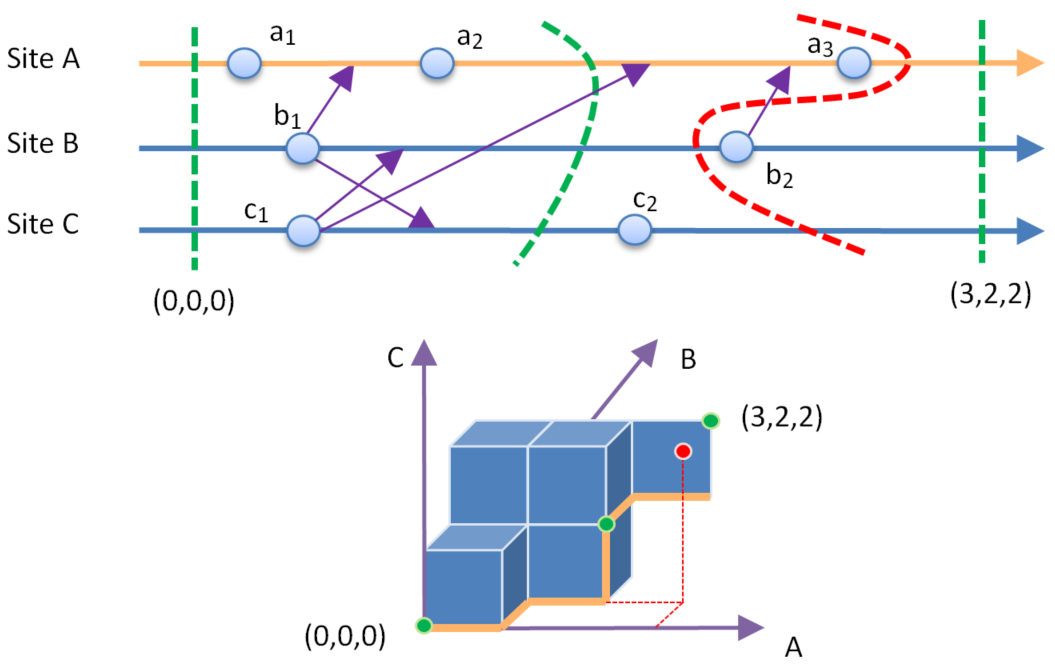
In fact CEDA is well suited to replication in extremely unreliable networks. It even allows connections to be broken every few seconds and yet allows robust synchronisation of replicated data. This has been proven to work with reconnections in arbitrary network topologies that change over time. Computers can even connect that have never directly connected before in the past and exchange operations that were received from other peers. The CEDA replication system was first implemented 8 years ago and has been subjected to ongoing, heavy testing with billions of randomly generated operations on randomly generated network topologies with randomly generated reconnections.
Another negative result in the literature is a paper showing that under quite general assumptions replication is not scalable because the computational load increases 1000 fold when the system is 10 times larger. This can easily mean a system cannot keep up with a very modest transaction rate, much to the surprise of its developers. Such a situation is unrecoverable because the load increases as the divergence in the copies of the database increases.
As a result many systems tend to only use master-slave replication. This means updates can only be
applied to one computer (the master
) and updates only propagate in one direction to
all the slaves
.
This is quite limiting compared to update-anywhere-anytime replication. E.g. users cannot work if
they cannot connect to the master and the data entry application may seem sluggish because of network
latency (i.e. the time for messages to be sent to and from the master over the network).
Nevertheless CEDA has a computational load which is proportional to the size of the system, possible because it avoids the assumptions in the literature than imply replication cannot scale. In fact the algorithms are extraordinarily efficient.
Google have tried to support update-anywhere-anytime with Google Wave, a project that caught the interest of industry experts for its exciting proposal to use Operational Transformation to achieve multi-master replication, but their solution doesn't satisfy a mathematical property in the literature called TP2, which means it is not able to merge changes in arbitrary orders for arbitrary network topologies.
CEDA was compared to ObjectStore (a popular object oriented DBMS) in 2004 and CEDA was found to achieve 100 times the transaction throughput in a multi-user database system on a LAN. The benefits of CEDA would have been even greater on a WAN. This is essentially because CEDA uses multi-master replication with fully asynchronous operations, whereas Object Store uses distributed transactions, multi-phase commit and pessimistic locking. ObjectStore is using the conventional approach still emphasised in the database literature today, but which exhibits both poor performance and can't be made robust to network partitions because of the theoretical impossibility of guaranteeing all sites agree to commit a distributed transaction or not when the network is unreliable.
Keys features include:
- Avoids pessimistic locking of data and the complexity and pitfalls with distributed locking, dead-lock detection, and multiphase commit protocols;
- True peer-peer based replication with a symmetric protocol;
- Locally generated operations are always applied immediately without being delayed or blocked - even in the presence of network failure;
- Efficient: The sender only sends operations that have not yet been applied on the receiver. Operations are only sent over a link once; and
- Robust:
- The network can partition at any time in any way and users can continue working;
- There can be arbitrary changes to the network topology at any time. Sites can reconnect in an entirely new topology and exchange operations as required;
- Any site can fail permanently or temporarily. A site can crash and roll back to an earlier state; and
- There can be cycles in the topology