Persistent storage for arbitrary-sized binary objects
Part I: Overview
1 Log Structured Store (LSS)
The CEDA database management system is built on top of the CEDA Log Structured Store.
The LSS provides low level persistence for arbitrary sized binary objects
indexed with 64 bit identifiers.
The LSS has all the features required for an industrial strength storage system. In particular it fully supports
transactions and guarantees their atomicity in the face of power failures.
It supports recovery, backup, hot standby and is self cleaning to avoid fragmentation.
Multiplexing of the output allows for hotstandby and backup consistent with 24 x 7 operation.
Part VI, Implementation, provides extensive detail about the LSS implementation.
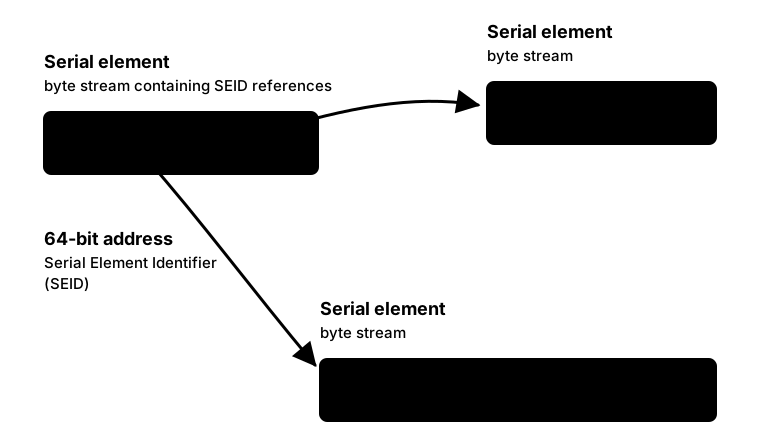
The LSS could be regarded as a key-value store where the keys are 64 bit integers called
Serial Element Identifiers (seids) and the values are arbitrary length octet ("byte")
strings called serial elements.
Another possible analogy is to consider the LSS to be a persistent heap. The keys are like "pointers" to
"memory buffers" that persist on disk.
The serial elements are like byte streams, in that they are both read and written in the manner of an I/O stream.
In fact a single serial element can be much larger than the available physical memory, and yet can be read or written
efficiently as a stream of octets.
The LSS doesn't care about the content of each serial element, as far as the LSS is concerned it is just a sequence
of octets.
The number of octets in a single serial element can be anything from 0 to many terabytes.
All the serial elements persist in a single file on the file system of the host operating system.
Typically serial elements reference other serial elements by storing seid values in the byte streams. Circular
references are possible.
Seids are virtual addresses
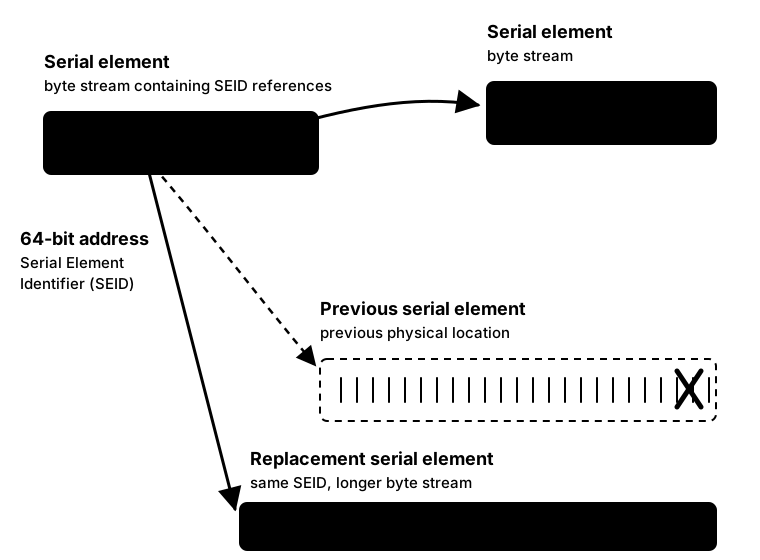
Seids are "virtual" or "logical" addresses, not physical addresses, allowing serial elements to be written to a new
physical location on disk while still being identified by the same 64 bit seid value. When a serial element is
rewritten to a new location (typically with a different number and sequence of octets) the old version can be recycled.
Three basic operations
There are just three basic operations on the LSS, to write, delete, and read serial elements.
Write serial element
Delete serial element
Read serial element
This is analogous to CRUD operations, except that writing a serial
element encompasses both creating a new serial element as well as updating an existing serial element.
To update a serial element is to rewrite it from scratch. There is no concept of incremental updates to
an existing serial element.
Serial elements are always written and read in their entirety (i.e. from start to finish).
Transactions
All write and delete serial element operations are applied in the context of an explicitly declared
transaction on the LSS.
Transactions are opened then later closed. Although any number of threads can perform transactions, they are applied sequentially.
A thread opening a transaction blocks until another thread closes its transaction.
There is no concept of aborting or rolling back an LSS transaction. Once a transaction has been
opened, it must eventually be closed, and closing it completes the transaction.
Transactions define atomic changes to the LSS. If the system crashes the LSS will always crash recover to a state where either
all of a transaction is applied or none at all. Furthermore, if a transaction is applied then all transactions that preceded it
will have been applied as well.
API
The LSS API is defined in the header file ILogStructuredStore.h.
The public API is declared in the Ceda/cxLss header directory.
2 Serial element
A serial element is a sequence of octets uniquely
identified by a 64 bit integer called a Seid.
The serial elements are like byte streams, in that they are both read and written in the manner of an I/O stream.
In fact a single serial element can be much larger than the available physical memory, and yet can be read or written
efficiently as a stream of octets.
The stream interfaces are defined in Ceda/cxUtils/StreamInterfaces.h as follows:
There are four background threads that take on responsibility for writing segments, flushing the log,
check pointing the store (setting the point from which a recovery scan is required) and cleaning partially
fill segments to avoid fragmentation.
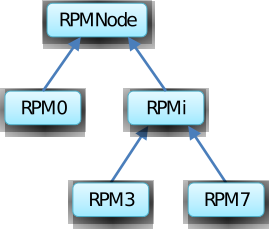
The Recoverable Packet Map (RPM) is an 8 level hierarchical map keyed by 64 bit OID used to record the
locations of blobs in the store. The Segment Utilisation Table (SUT) records the utilisation of every
segment in the LSS. Both of these data structures are only updated on disk during a check point. Check
points are performed after writing 64MB to the store.
No need for Write Ahead Logging
Data is read or written in pages in most conventional DB systems. Atomicity of transactions is achieved
by the technique of Write Ahead Logging (WAL). This means changes to the data pages must first
be recorded and flushed in a separate log file, which can be scanned during recovery as required to
undo/redo partially completed transactions to ensure the database recovers back to a consistent state when
the server is restarted.
Unfortunately non-volatile storage devices have write caches which can reorder writes, defeating the
WAL assumption.
For that reason it is actually unsafe for products like SQL Server or Oracle to use stock hardware without
disabling the write caches which can reorder writes (but that is rarely done because write performance would
drop by a factor of 10 or more - maybe even 100).
By contrast the CEDA LSS uses a far more resilient and efficient
system for crash recovery that is almost independent of the order of writes and therefore allows for crash
recovery to be performed without needing to disable the write cache on the hard-disk.
The CEDA LSS achieves excellent write performance by treating the log itself as the data! Therefore all writing
occurs at the end of the log, allowing for continuous writing at the sustained write rate of the storage
device.
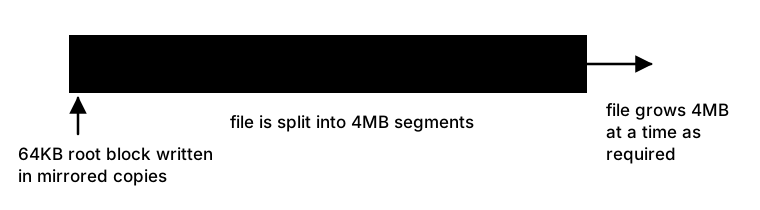
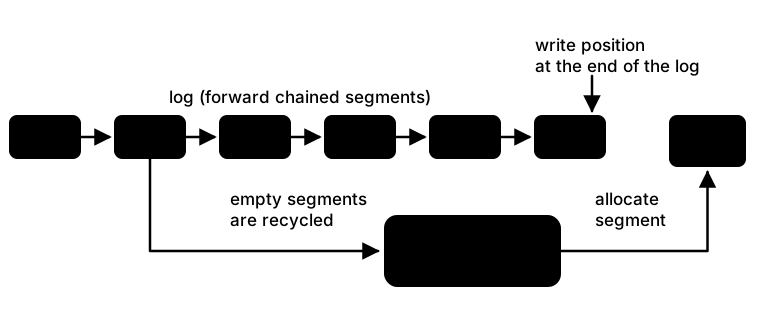
The log is divided up into relatively large pieces (called segments), perhaps 4MB. Reading and writing at this
coarse granularity minimises disk head seeking overheads.
Segments in the LSS File
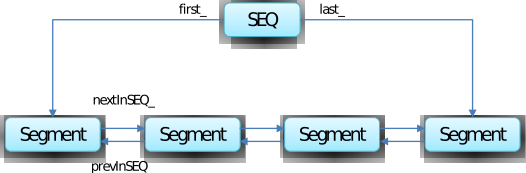
The underlying LSS file consists of a root block followed by a linear list of segments. The segment size
can be chosen at the time the store is created. Typically a segment size of about 4MB is appropriate. The ideal
size depends on how well the data tends to be clustered on disk, and the product of latency and bandwidth. It
represents a tradeoff between sustained I/O and random access.
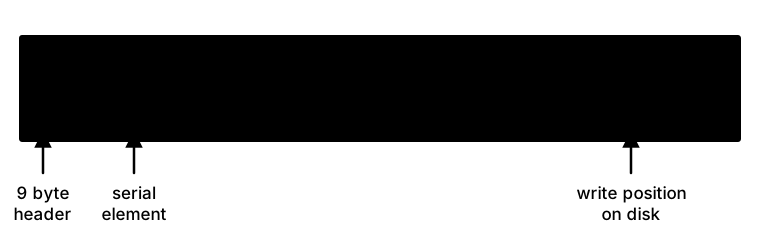
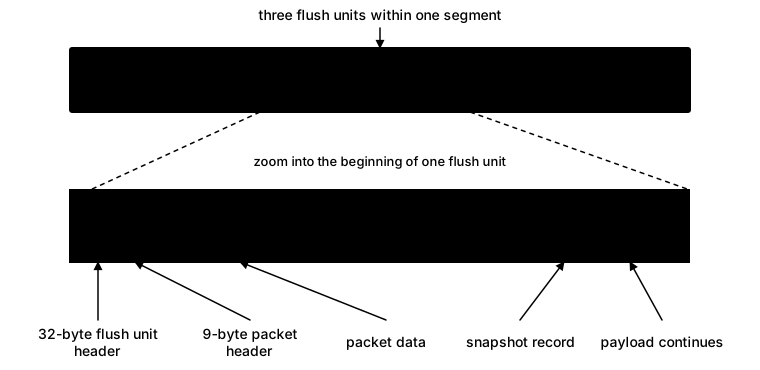
Serial elements are written one after the other to a segment with only a 9 byte header on each serial element. The
space overhead of the CEDA LSS is very low in practise.
If the end of the segment is encountered while writing a serial element it can be continued in a fresh
segment.
Forward chaining of segments
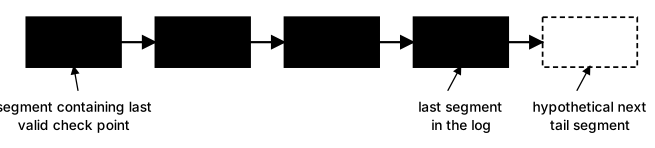
Segments are forward chained to allow for a crash recovery scan if the store is not closed properly.
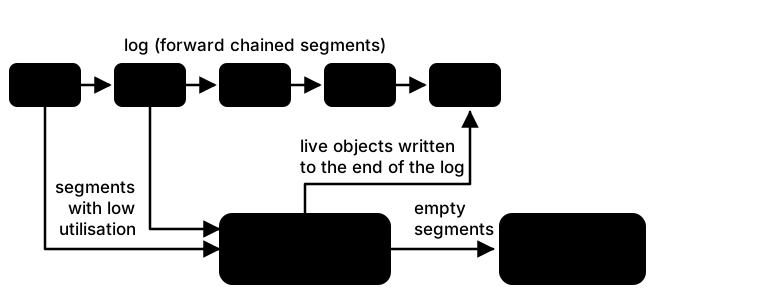
The segment cleaner
Segments are cleaned automatically when their space utilisation falls below a threshold. If segment utilisation
falls below 80% then the remaining serial elements are copied to the end of the log and the segment is recycled
(put into a free segment list).
5 Chunk size
For a given device, the product of latency and sustained bandwidth gives an idea of the size
in bytes of contiguous chunks which are read or written where transfer time starts to be dominated
by bandwidth rather than latency.
Device / Link
Latency (approx)
Bandwidth (approx)
Latency × Bandwidth (“natural chunk”)
L1 cache
1 ns
1 TB/s
~1 KB
L2 cache
3 ns
500 GB/s
~1.5 KB
L3 cache
10 ns
200 GB/s
~2 KB
Main memory (DRAM)
80 ns
50 GB/s
~4 KB
NVMe SSD
100 µs
3 GB/s
~300 KB
SATA SSD
100 µs
500 MB/s
~50 KB
HDD
10 ms
200 MB/s
~2 MB
1 GbE LAN
0.1 ms
125 MB/s
~12.5 KB
10 GbE LAN
0.1 ms
1.25 GB/s
~125 KB
Typical WAN
50 ms
50 Mb/s
~300 KB
6 Storage assumptions and failure model
The LSS stores its data through a Random Access Store (RAS), normally implemented by a file. This
chapter describes the assumptions made by the file format and the limitations of the current RAS
implementations.
Block size and alignment
Storage devices expose logical blocks and may have a different physical block size or direct-I/O
alignment requirement. Common block sizes include 512 bytes and 4096 bytes. An application using
unbuffered or direct
I/O must align file offsets, transfer lengths, and sometimes memory-buffer addresses according to
requirements reported by the operating system. It should not infer them from a fixed historical
sector size.
The RAS exposes this unit through GetDiskSectorSize(). Flush units begin
and end on boundaries of that size, and the segment and root-block layouts must be compatible with
it. The current Windows and Linux file RAS implementations return a hard-coded value of 512 bytes.
The root-block layout also requires this value to be no greater than 1024 bytes. These are current
implementation and file-format limitations, not general properties of modern storage.
Torn and incomplete writes
The LSS does not assume that writing one sector, block, or larger transfer is atomic across process,
operating-system, or power failure. A failed write may leave a mixture of old and new data. This is
particularly important because segments are recycled without first being cleared.
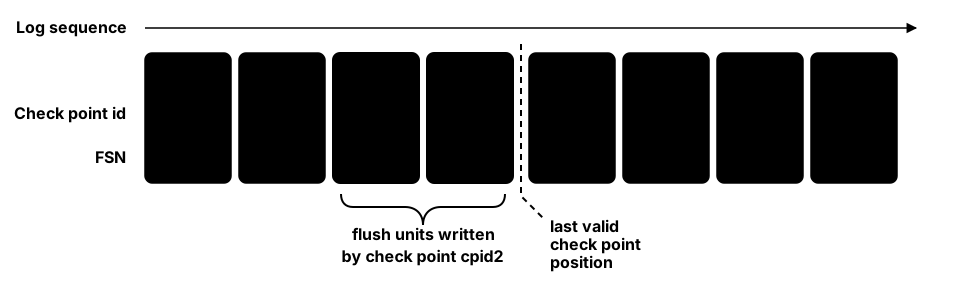
The log is written as a sequence of flush units. Each flush unit
contains a 128-bit check point identity, a 32-bit flush sequence number, its payload size, and a
32-bit CRC covering its header and payload. During recovery, the LSS accepts a flush unit only when
these fields are mutually consistent. The recovery scan stops at the first invalid flush unit rather
than interpreting a partial write or stale data as the tail of the log.
Root-block redundancy
The root block contains two check point divisions. They are written
in strict alternation using Challis' algorithm, with sequence values at both ends and a 32-bit CRC.
On startup, the LSS selects the newest valid division. These are two copies of the changing check point
state, not two complete copies of all root-block data; the static and dynamic root-block headers are
stored separately.
Current implementation notes and user impact
The current file RAS supports ordinary LSS reading, writing, check pointing, and recovery. The CRC,
check point identity, and alternating root-block divisions continue to protect recovery from torn,
stale, and inconsistent data. The following implementation details have narrower consequences for
users:
Exceptional forced durability:
Ordinary LSS transactions deliberately do not flush on close.
ILssTransaction::FlushWhenClose() is provided for exceptional
external-coordination cases and drains the relevant LSS writes, but
IRAS has no explicit durability-barrier operation.
With the default Windows settings, and with the current Linux implementation, callers must not
rely on FlushWhenClose() to preserve the transaction across an
operating-system crash or sudden power loss. This does not affect the atomic recovery of data
that did reach non-volatile storage. Windows write-through mode can provide a stronger request,
subject to support from the complete storage stack.
Linux configuration:
the Linux file RAS currently uses ordinary buffered file I/O and ignores the file-buffering and
write-through settings. Buffered I/O is not itself a correctness problem and is often desirable
for performance. The user-visible limitation is that those settings cannot currently be used to
select direct or per-write synchronous I/O on Linux, and no fsync()
barrier is available for FlushWhenClose().
Direct-I/O portability:
both file implementations report a fixed 512-byte I/O unit. This is harmless for ordinary
buffered I/O and for environments compatible with that alignment. A store using unbuffered or
direct I/O can fail to open or perform I/O when the host requires stricter alignment, such as a
4 kB boundary. The implementation should query the actual requirements before claiming support
for such an environment.
None of these limitations places a storage barrier on the normal transaction path. The
FlushWhenClose() limitation affects only callers that explicitly
request the exceptional forced-durability operation. The fixed alignment and ignored Linux settings
are portability and configuration limitations rather than evidence that ordinary LSS operation is
incorrect. A proposal to add an explicit RAS durability operation appears in
Other Proposals.
7 Write ordering on storage devices
Persistent data normally passes through several independently buffered layers: an application,
operating-system page cache, filesystem, block layer and driver, controller or bridge, and finally a
device with its own firmware, volatile RAM, and non-volatile media. RAID controllers, virtual
machines, network storage, and USB-to-SATA bridges can add more layers. The order in which an
application submits writes is therefore not, by itself, the order in which those writes become
persistent.
This chapter describes the contract that a crash-consistent storage protocol needs from that stack.
It is primarily about local block devices, but the same reasoning applies to other persistent
storage: a higher layer can provide no stronger guarantee than the weakest layer through which its
durability request passes.
Four different properties
Discussions of a "completed write" often conflate four independent properties:
Visibility: a subsequent read observes the new data. It may merely be reading a cache.
Durability: the data will survive the relevant failure, particularly abrupt loss of power.
Ordering: write A is guaranteed to be durable before write B can become durable.
Atomicity: after a failure a write is entirely old or entirely new, rather than torn.
A successful buffered write normally establishes visibility, not durability. A cache flush can
establish durability for preceding writes, but does not make a large write atomic. Checksums and
redundant records can detect or tolerate torn writes, but do not force earlier data to storage. A
correct protocol states which property it needs at each step rather than relying on the word
"write" to imply all four.
Why volatile write caches exist
HDDs and SSDs commonly acknowledge writes after accepting them into volatile device memory. This
reduces latency, permits request merging and reordering, and lets the device schedule media updates
efficiently. SSD firmware also performs address translation, garbage collection, wear levelling,
and metadata updates whose physical order need not resemble the host's logical write order.
Disabling a device write cache is therefore a costly and usually unnecessary way to obtain a
durability guarantee. The normal arrangement on commodity hardware is to leave the cache enabled
and issue an explicit cache flush at the points required by the storage protocol. The 2008 Microsoft
Research report Enforcing Database Recoverability on Disks that Lack Write-Through
describes this approach for IDE disks. It reports that most single-disk IDE drives supported the ATA
flush command even though most did not support per-write Force Unit Access, and explains both the
performance cost and the unreliability of attempting to disable caching as the general solution.
ATA and SATA: FLUSH CACHE
For an ATA or SATA device with a volatile write cache, the FLUSH CACHE
and FLUSH CACHE EXT commands tell the device to complete cached writes
to non-volatile media before reporting successful completion. An operating system normally emits
these commands on behalf of a filesystem durability operation; applications using files do not send
ATA commands directly.
A completed flush provides a boundary for writes accepted before it. A protocol can therefore write
a set of dependent records, wait for a flush, and only then issue the record that publishes or makes
those records reachable. If the publication record must itself be durable before success is reported,
it needs either a subsequent flush or a write with suitable FUA semantics.
Force Unit Access (FUA) is a property of an individual write: completion must not be reported
until that write is in non-volatile storage. FUA is not the same as a flush of all prior cached writes.
A pre-flush and an FUA publication write can be combined to express "everything before this write is
durable first, and this write is durable before completion." Older ATA devices and parts of the SATA
software stack have not always provided usable native FUA, so operating systems can implement the
same result with cache flushes.
SCSI and NVMe
SCSI provides analogous mechanisms through SYNCHRONIZE CACHE and the
FUA bit on suitable write commands. NVMe provides a Flush command and an FUA bit on NVM write
commands. When a volatile write cache is present, a successful NVMe Flush makes the relevant earlier
writes persistent; an FUA write is not to complete until its data is persistent. These are interface
contracts rather than claims about the device's internal physical write sequence. The current
contracts are specified by the
NVM Express specifications.
NVMe also reports atomic-write units, including a distinct atomic-write unit for power-fail
conditions. This distinction is important: a device may promise that a small write is atomic during
normal operation while making a weaker promise if power is removed during the write. Atomic-write
limits do not replace Flush or FUA, and Flush or FUA do not enlarge an atomic-write limit.
Linux
For ordinary file I/O, fsync() requests that modified file data and
the metadata needed to retrieve it be transferred to the storage device, and waits for the device to
report completion. fdatasync() may omit metadata that is not needed for
subsequent data retrieval. Creating or renaming a file can additionally require an
fsync() of its directory. These details are described by the
Linux fsync(2) manual page.
Direct I/O is not a substitute for a durability operation: bypassing the page cache does not, by
itself, force a volatile device cache to non-volatile media.
Within the Linux block layer, filesystems express the device-side requirements using a forced flush
and FUA. REQ_PREFLUSH guarantees that previously completed writes are
non-volatile before the associated write begins. REQ_FUA guarantees
that completion of the marked write is not reported until that write is non-volatile. The block layer
can translate FUA into a post-write flush when a device has a write cache but no native FUA support.
See the Linux kernel documentation on
explicit volatile write-back cache control.
Windows
On Windows, FlushFileBuffers()
flushes buffered information for a file to the device. A file opened with
FILE_FLAG_WRITE_THROUGH requests write-through behavior;
FILE_FLAG_NO_BUFFERING separately controls system caching and imposes
alignment requirements. The flags are independent. Microsoft describes their interaction and the
fact that support ultimately depends on the hardware in
File Buffering.
An explicit flush operation is normally preferable to treating every write as write-through. It
preserves batching: many related writes can be submitted efficiently and then covered by one
deliberate durability boundary. Write-through may still be useful for an individual write or for
environments whose lower-level interface maps it efficiently to FUA.
Abrupt power loss
When power disappears, acknowledged data that exists only in volatile memory is lost. The failure
can also interrupt a media update, producing a torn write, or interrupt SSD firmware while it is
updating translation metadata. Drives with genuine power-loss protection use stored energy to drain
volatile state and finish essential metadata updates. An external uninterruptible power supply is
valuable, but is not equivalent: it does not cover a device, cable, controller, kernel, or firmware
failure that prevents an orderly flush.
Device behavior under power fault has not always matched the simple model "only unflushed writes are
lost." Zheng et al., Reliability Analysis of SSDs Under
Power Fault (ACM TOCS, 2016), tested 17 commodity SSDs from six vendors over more than 3000
power-fault injections. Fourteen exhibited at least one surprising behavior, including bit corruption,
shorn writes, unserializable writes, metadata corruption, or complete device failure. This result does
not mean that every tested device ignored a successfully completed flush, and should not be read as a
claim about that narrower case. It does show why software should use integrity checks and why a
deployment requiring strong guarantees should validate its actual devices, firmware, controllers,
and power-loss-protection claims.
The filesystem is another part of the contract. Pillai et al.,
All File Systems Are Not
Created Equal: On the Complexity of Crafting Crash-Consistent Applications (OSDI 2014),
found that persistence properties varied across six Linux filesystems and identified 60 crash
vulnerabilities in eleven applications. The lesson is not that flushes are futile, but that a protocol
must use the documented filesystem operations and must not infer persistence order from incidental
behavior observed on one filesystem.
What the guarantee depends upon
On a typical PC with a directly attached SATA HDD or SSD, write caching can normally remain enabled.
The application asks the operating system for durability, the filesystem and block layer translate
that request into flush or FUA operations, and a conforming device honours them. IDE-era devices also
commonly implemented ATA FLUSH CACHE. Thus it is inaccurate to say that most off-the-shelf disks must
have their caches disabled to support ordered persistence.
The guarantee is conditional on the entire path. A RAID controller with unprotected write-back RAM,
a USB bridge that drops cache-management commands, a hypervisor that acknowledges them too early, or
firmware that falsely reports completion breaks the contract. Multiple independent devices also
create multiple cache domains: flushing one does not flush another. Storage vendors and system
operators therefore commonly qualify support by controller configuration, battery or capacitor health,
firmware version, and power-loss-protection capability.
8 Log structured store versus Write ahead logging
Write Ahead Logging and the CEDA LSS make fundamentally different choices about persistent layout
and whether non-volatile durability lies on the normal transaction path.
Write Ahead Logging
Most conventional transactional database systems use Write Ahead Logging (WAL), commonly
with ARIES or a similar recovery algorithm. WAL allows data pages to be updated in place while
supporting transaction atomicity and crash recovery. A change is first represented in the WAL and is
later written again as part of its data page.
Write-ahead invariant
The defining invariant is that a dirty data page must not reach persistent storage before every WAL
record needed to recover that version of the page is persistent. A page may be changed immediately in
the in-memory buffer pool, but before the page is written to storage the WAL must be flushed through
the page's log sequence number. "Before" refers to persistence, not merely to the order in which the
application issues writes.
For a strictly durable transaction, WAL also puts a flush on the commit path. The transaction's commit
record must be written to the WAL and the WAL must be flushed through that record before commit can
return successfully. The data pages need not be written at commit, but the thread cannot begin a
causally subsequent operation that depends on successful commit until the WAL flush completes.
Performance consequences
With strict ACID durability, a successful WAL commit must wait for a flush that covers its commit
record. If transactions are serialised, this puts one completed persistence barrier between successive
transactions. Serialization may arise because one thread performs the transactions in sequence,
because a later transaction causally depends on the earlier durable result, or because transactions
contend on the same pages or other shared state. The achievable transaction rate is then bounded by
flush latency, irrespective of the WAL's sequential transfer rate.
Group commit changes this only when the system has multiple transactions concurrently ready to commit
and is allowed to hold them at the durability boundary together. It does not improve a genuinely
serial stream in which the next transaction cannot proceed until the preceding commit is known to be
durable. Asynchronous commit removes the wait only by relaxing the D in ACID. These are direct
consequences of the force-at-commit design used by a synchronously durable WAL system.
WAL has further costs:
Every change is written to the WAL and later written again in its data pages. In the basic
case this means writing the changes twice, so effective write performance can be roughly
halved. Log framing, page granularity, indexes, and check pointing can increase the write
amplification further.
The page writer must continually respect the write-ahead invariant, introducing coordination
between WAL progress, dirty-page eviction, and check pointing.
In-place page writes can be scattered. Lazy writers and page scheduling reduce the cost, but
cannot make them equivalent to a single append stream. For typical HDDs and SSDs, the product
of sequential bandwidth and I/O latency is commonly between about 64 kB and several
megabytes. This latency-equivalent transfer size is usually much larger than a database page,
so writing individual dirty pages tends to be dominated by I/O latency rather than transfer
bandwidth. Sorting, batching, and concurrent I/O mitigate the effect, but require additional
buffering and coordination and cannot make scattered page writes equivalent to the LSS append
stream.
In-place allocation makes variable-sized values awkward, particularly strings, which are
extremely common in database records. A page representation must reserve a fixed amount of
space, impose a size limit, move records when their strings grow, or store the string data
separately. Separate storage introduces indirection and harms clustering, so reading one
logical record can require access to data held elsewhere. When an object shrinks, its old
allocation can leave unused space within the page. More generally, in-place update favours
keeping objects at their previous physical locations, making compaction difficult and causing
free space and live data to become fragmented over time.
WAL is principally a recovery mechanism for in-place updates, which is the opposite of the
natural requirement of Multi-Version Concurrency Control (MVCC): old versions must remain
available while readers can still see them. WAL-based systems can implement MVCC, but must
compensate using mechanisms such as undo records, copied tuples, version chains, and vacuum
or garbage collection. These add indirection, write amplification, and reclamation work. If
MVCC is a primary design goal, an in-place update architecture is therefore a poor starting
point.
The durability barriers are implemented using the mechanisms described in
Write ordering on storage devices. Volatile drive caches do
not normally need to be disabled, but every layer of the storage stack must honour the barrier.
Log structured store
The CEDA LSS writes new and changed serial elements to the end of the log. The log is the persistent
representation of the data; there is no separate set of in-place data pages to which every change
must later be copied. Writes are large and sequential, serial elements can vary in size, and related
values can be clustered together. Write performance is therefore typically limited only by the
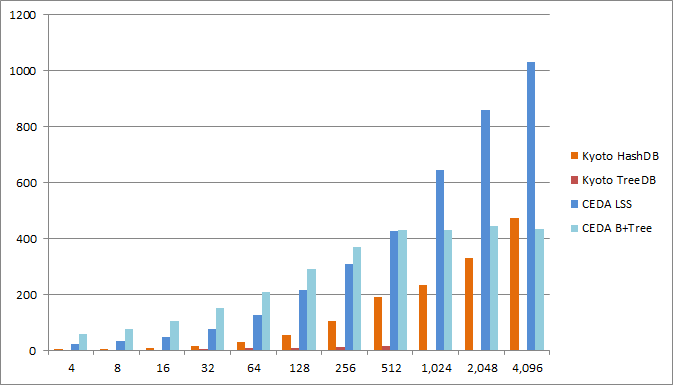
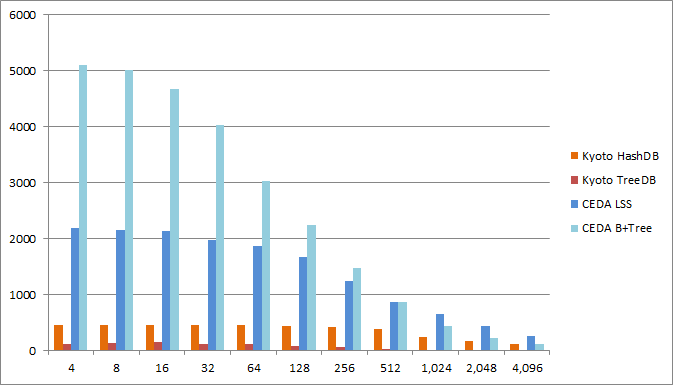
maximum sequential transfer rate of the storage device. The LSS
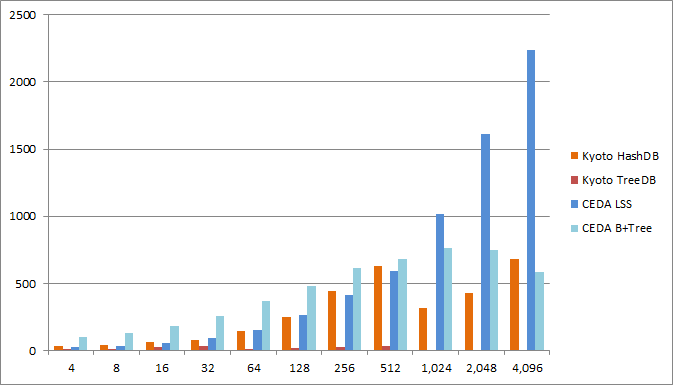
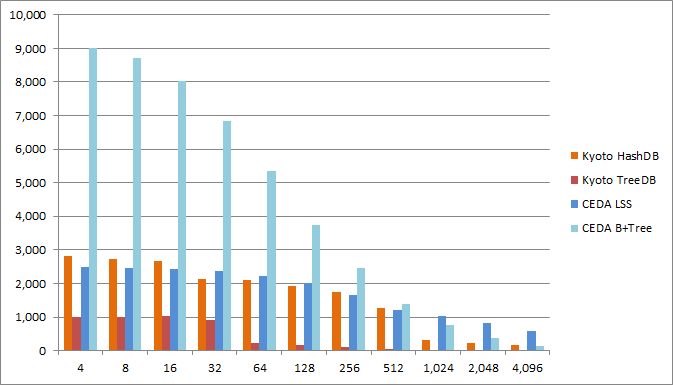
performance measurements demonstrate this behaviour in practice.
The append model is also naturally compatible with MVCC. Updating an element creates a new rendition
without requiring the previous rendition to be overwritten immediately. Readers can continue to use
an older rendition while it is visible to them, and obsolete renditions can be reclaimed later by
the cleaner. Cleaning copies live renditions out of sparsely used segments and recovers whole
segments, so object shrinkage and relocation do not leave permanent holes at old physical locations.
Transaction path
Ordinary LSS transaction close does not flush the log. Transactions are serialised and atomic, and a
subsequent transaction on the same thread can begin immediately, without waiting for a storage
device. The lazy flusher advances durability independently in large sequential units. A failure can
therefore lose a recent suffix of closed transactions, but recovery retains an atomic, internally
consistent prefix.
This deliberate separation of transaction close from non-volatile durability is central to LSS
performance. It allows the CEDA LSS to process about one million serial transactions per second using
one thread. A strictly durable WAL transaction cannot follow the same path: its commit cannot return
until its WAL record has crossed a persistence barrier. Comparing ordinary LSS transaction throughput
with synchronous WAL commit throughput is therefore also a comparison of their intentionally
different durability contracts, not merely their file layouts.
FlushWhenClose() is an exceptional escape hatch for code that must
coordinate an LSS transaction with an external durable event. One example is two-phase commit, a
blocking protocol that is expensive and impractical, and whose coordination and forced-durability
costs make it a poor fit for the normal LSS model.
FlushWhenClose() exists to make such exceptional integration possible,
not to recommend it. When requested, it necessarily sacrifices the ordinary fast path and waits for
the transaction and all preceding transactions to become durable.
Check-point publication
Check pointing is also outside the ordinary per-transaction path. During recovery the LSS validates
the segment containing the check point referenced by the newest root-block division. If the segment
is not valid through the recorded position, recovery rejects that division and reverts to the other
root-block division. This makes an out-of-order root-block write recoverable while the preceding
division and its reachable data remain intact.
The preferred publication protocol first makes the new check point's dependent log data durable,
then writes and makes durable the root-block division that publishes it. This avoids unnecessary
fallback and preserves the intended ordering without putting a flush into every transaction:
Write all data on which the new check point depends.
Issue and wait for a durability barrier covering those writes.
Write the root-block division that publishes the check point.
Issue and wait for a durability operation covering the root-block division.
The current RAS API has no explicit durability operation. Other Proposals
proposes one for correct check-point publication and for the exceptional
FlushWhenClose() path. CRCs, flush sequence numbers, and alternating
root-block divisions allow recovery to reject many torn or inconsistent states, but do not themselves
impose persistence order.
9 Check pointing
The LSS internally uses a hierarchical map to track the physical locations of all serial elements
in the store. It also maintains information about the current utilisation of all the segments.
All this information is itself written to the root block or the log, but only during a check point.
A check point is performed at the following times
After the store is opened and a recovery scan is required
After writing 128 segments (i.e. 64MB) of data to the end of the log
When the store is closed.
A recovery scan is performed when the store is opened and it was found that it had not previously
been closed gracefully. In that case it has to scan all segments in the end of the log since the
last check point. This allows it to recover all committed transactions and roll back any
uncommitted transactions.
The maximum time for the recovery scan is bounded by the time taken to read the segments at the
end of the log since the last check point. The time to read 128 segments only takes a few seconds
on a modern hard-disk.
10 Cleaning
A background thread that cleans segments with a poor utilisation is started automatically. This
defragments the store.
When the store is created or opened, the cleaner threshold can be specified. This defaults to 85%
meaning that all segments that are less than 85% utilised will be cleaned.
The cleaner is provided an ordered list of segments to clean after each check point.
11 Lazy writer
The LSS uses a background thread called the "Lazy writer" to write dirty segments in the segment
cache to disk. Therefore the thread that opens a transaction and writes some serial elements will
typically only write the byte stream to a buffer in memory, allowing it to complete the
transaction very quickly without blocking on I/O.
It is important to understand that ending a transaction implicitly commits it, but only in the
sense of defining an atomic unit of work. The actual data is written to disk in the background.
When writing larges amounts of data, the segment cache can become full of dirty segments, and in
that case it is possible for the thread performing a transaction to block on I/O.
12 Clustering
The easiest way to achieve good read performance is to partition a very large database into mutually
exclusive groups of serial elements, where each group is characterised as follows
The serial elements in a group are all closely related, meaning that when one serial
element is read from disk, it is likely that other serial elements in the group will also
be read in the near future.
There is a tendency for the serial elements in a group to be written to the same segment.
This is achieved by writing batches of related serial elements to the LSS at a time.
As a corollary to this requirement, a group of related serial elements can't be so large
that it defeats the whole idea of them being "clustered together".
Every serial element in the group shares the same high 32 bits of the Serial element Id
(Seid).
This allows the LSS to achieve clustering in its internal hierarchical map used to track
the physical locations of serial elements.
Over time there is an "increasing entropy" effect where related serial elements become spread
around the disk. It can be very beneficial to recluster serial elements, particularly serial
elements used to implement directory structures. This is achieved by occasionally rewriting all
the relevant serial elements to the LSS in a single "batch".
Interestingly, it is the excellent write performance of the LSS, that makes it economical to
recluster related data together. Therefore the LSS can also provide very competitive read
performance. Experiments have shown it to significantly outperform NTFS when reading or writing
thousands of text files.
13 MSSN
MSSN stands for Missing Shutdown Sequence Number. This is a value stored in the root block of the
LSS. It equals the number of times that the store has not been gracefully shutdown over its life.
This is zero if the store has always been properly closed (so that the store is check pointed and
flushed correctly). A large value indicates that there have been many power failures or the
client software is not closing the LSS correctly.
The MSSN is useful for correctly mapping Seids to a larger global address space that encompasses
objects stored on many computers. Single user applications of the LSS have no need for the MSSN
other than a simple diagnostic.
When the store is first created the MSSN is initialised to zero. The value persists and is only
incremented during recovery if it is found that the store wasn't previously shut down gracefully.
Part III: Operations and administration
14 Reading serial elements
It is not necessary to open a transaction in order to read serial elements. In fact multiple
threads can concurrently read serial elements. This corresponds to the shared read access mode
often provided by high performance database systems. Furthermore, multiple threads can be reading
serial elements concurrently with a running transaction! In other words, the LSS provides no mutex
between the thread writing new data to the store, and the threads that are reading existing serial
elements.
It is therefore up to the layers above the LSS to make sure concurrent reading and writing is a
valid thing to do. For example if there is some sense in which the database is logically
partitioned into "separate worlds" then concurrent reading and writing can make sense in certain
cases. For example, while one "world" provides exclusive write access, another "world" can
support shared read access.
Reading a serial element may block on I/O as the LSS loads a segment from disk. A very large serial
element may take up many segments. These are loaded on demand as the serial element is read as a
byte stream.
The serial element is read as a non-seekable byte stream. I.e. the entire serial element must be
read from start to finish. It provides a reliable "End of stream" indicator.
15 Writing serial elements
To write a serial element, call the following function on a
ILssTransaction:
This function is used to write new serial elements and also to re-write existing serial elements.
It returns an output stream that can be used to write the content as a byte stream. Note that
the entire serial element must always be written. Then the output stream must be closed. The
interface pointer must not be deleted.
It is very important to close the output stream before calling WriteSerialElement() again to write
another serial element, and also before closing the transaction.
Only the thread that opened the transaction is allowed to write a serial element.
Example
The following code either opens an existing store and reads the root serial element or creates a new store
if it doesn't exist and writes the root serial element.
Then the store is closed.
For simplicity error handling is not shown.
Each serial element is uniquely identified by a 64 bit number called a Seid. A serial element
cannot change its Seid over time.
Each time a serial element is written to the LSS, it must be rewritten in its entirety - even if
only a small part of its content changes. It will in fact be written to a completely new location
within the store - i.e. at the "end of the log".
If that seems particularly wasteful then the serial elements should be finer grained. Although it
is intuitively better to have quite small serial elements to minimise the number of bytes to be
written to disk when changes are made, it can often be better to use fairly coarse serial elements
because that is an easy way to ensure clustering on disk is reasonably good. It also reduces the
various space and time overheads associated with a serial element, such as the need to index its
physical location. Note finally that the product of transfer rate and seek time for a modern
hard-disk is quite large - of the order 512k, so it is not efficient to write lots of small
objects to disk if they can become poorly clustered over time.
When a new serial element is to be written to the LSS for the first time, it is necessary to
allocate a fresh Seid for it. According to the above section on clustering, the programmer needs
to have some concept of partitioning the serial elements into groups that will be clustered on
disk. Therefore Seid allocation involves two separate calls.
// Create a new Seid space.  This is the upper 32 bits of the Seids shared by a group of
// related serial elements that should be clustered together on disk.
// Never returns 0.
virtual SeidHigh CreateSeidSpace() = 0;

// Allocate a new, unused Seid within the Seid space associated with the given SeidHigh.
// Never returns a null Seid.
virtual Seid AllocateSeid(SeidHigh seidHigh) = 0;
CreateSeidSpace() is used to create a high 32 bit part of a Seid, giving a "Seid space" allowing
for up to 4 billion "related" serial elements. Each serial element within this cluster is
allocated a Seid with a call to AllocateSeid().
In practice there shouldn't be anywhere near 4 billion serial elements in a single "cluster"
because that would defeat the whole idea! The "sweet spot" for a cluster is of the order of a few
mega bytes.
It is permissible to make these calls outside of an LSS transaction! Any number of threads can
concurrently allocate Seids because the above Seid allocation functions are thread-safe.
Allocation of affiliate Seids
The following is an alternative Seid allocation function
bool AllocateAffiliateSeid(Seid& seid);
This is useful for very large sets of serial elements where it is difficult to know a priori how
to divide the serial elements into separate Seid spaces.
Before this function can be used to allocate Seids, it is first necessary to "bootstrap" by
calling CreateSeidSpace() to allocate a Seid space, then AllocateSeid() to allocate a root serial
element in the space. Then, instead of calling AllocateSeid() to allocate additional serial
elements, it can be preferable to call AllocateAffiliateSeid(). The Seid passed into the function
represents an "affiliate" Seid to which the new Seid returned by the function will be clustered.
Eg the affiliate may be a parent node in a tree of nodes. AllocateAffiliateSeid() does a good job
of allocating Seids for trees of nodes which grow over time from any position by adding child
nodes.
Boot strapping a store
It is common for a serial element to store (within its byte stream content) the Seids of other
serial elements. For example. these could represent the "children" in a whole-part hierarchy of
objects.
Typically an application using the LSS will need to write some sort of "root" registry or directory
object to the store with a known Seid. This is the starting point for accessing all other objects
in the store.
ROOT_SEID is the Seid for this root serial element.
Just after creating a new LSS, it is guaranteed that the first call to CreateSeidSpace() will
return the high 32 bits of ROOT_SEID. It is then guaranteed that the first call to AllocateSeid()
(passing in the high 32 bits of ROOT_SEID) will return ROOT_SEID.
17 Durability
Durability relates to the 'D' in the so called ACID properties typically
expected of OO and relational database systems.
ACID properties are particularly relevant to the management of data that relates directly to real
world processes such as airplane reservation systems, or financial systems. In these cases, a
transaction on a computer is associated with events in the real world. For example, when a client
withdraws cash from an ATM. Clearly it is necessary for the database to correctly record all such
withdrawals. This leads to the durability requirement. In practice this means that every
transaction must be flushed to disk as part of the commit.
Ordinary storage devices can retain write caching while supporting explicit durability barriers.
The operating system translates a file flush into the appropriate device cache flush or FUA
operation. The barrier is nevertheless expensive compared with an in-memory transaction: a thread
executing serial durable transactions must wait for one before beginning an action that depends on
the preceding commit. Write ordering on storage devices
describes these mechanisms and the conditions under which they can be trusted.
The same limit applies when transactions are serialised by contention rather than by the application
thread—for example, when they repeatedly update the same pages or shared state. A synchronously
durable WAL system must complete a flush covering each commit before the next dependent commit can
advance. Without a set of concurrent commits to batch, storage-barrier latency directly limits TPS.
On a rotating HDD, a forced flush can wait for cached writes, head movement, and media rotation. The
durable transaction rate is bounded by the complete write-and-barrier latency, which varies with the
drive and workload. A 10 ms barrier permits at most 100 serial durable transactions per second,
before any transaction-processing cost is included. Barrier latencies in this range place a rotating
HDD in the same general territory as the 50 to 70 flushes per second historically observed on some
5400 and 7200 RPM IDE drives.
An SSD removes mechanical seek and rotational delays, but does not make a durability barrier free. A
synchronous request still crosses the operating system, filesystem, driver, controller, and device
firmware, and may need to drain volatile state and complete NAND or mapping-metadata updates. Latency
varies greatly between SATA SSDs, ordinary NVMe SSDs, devices with power-loss protection, and
specialised low-latency media. Measurements in
Asynchronous I/O Stack:
A Low-latency Kernel I/O Stack for Ultra-Low Latency SSDs show that even when device latency
has fallen to tens of microseconds, operating-system overhead is a material part of a synchronous
write()+fsync() path.
The arithmetic illustrates the limit independently of any particular device:
Complete durability-barrier latency
Maximum serial durable transactions per second
10 ms
100
1 ms
1,000
100 microseconds
10,000
10 microseconds
100,000
In practice, a rotating HDD supports only tens to low hundreds of serial forced-durability operations
per second. Stock SATA and NVMe SSDs can raise this to hundreds, thousands, or in favourable cases low
tens of thousands per second, with large differences between devices, filesystems, workloads, and
power-loss-protection arrangements. These are barrier rates rather than complete transaction rates;
transaction processing reduces the achievable result further. SSDs therefore raise the ceiling
substantially, but a forced flush still destroys the ordinary LSS transaction-performance model.
By contrast the LSS focuses on the management of data that doesn't (in a transactional sense) relate
to real world processes. Examples are editing of text documents, spreadsheets, statistical
analysis, web browsing, GIS, multimedia databases, source code repositories and CAD. In these
cases the durability constraints can be relaxed a little - by only flushing transactions to disk
every few seconds. Atomicity is still required to protect the integrity of the data. However, a
transaction only "commits" in the sense of defining an atomic unit of work, rather than demanding
it go to non-volatile storage as part of the commit.
This of course means that a user may lose some edits on system failure, but losing at most a few
seconds of work is fine for the type of data managed by the LSS.
The exceptional FlushWhenClose() mode allows an LSS transaction and
all preceding transactions to request durability before close returns. It exists for external
coordination protocols such as two-phase commit. Two-phase commit is blocking and imposes coordination
and forced-durability costs that make it expensive and impractical. Those costs conflict with the
normal LSS performance model; its mention here is not a recommendation. Normal transactions retain
the high-throughput path described above. The current RAS interface still needs an explicit
non-volatile-storage operation before the exceptional mode can make that guarantee reliably on every
supported platform.
18 Backup and hot standby for the LSS
The LSS optionally supports hot standby and incremental backup.
Note however that at present, hot standby has fairly relaxed assumptions about how up to date
the standby store must be.
The backup / hot-standby system is compatible with 24x7 operation of a store which continuously
reads/writes large amounts of data. The LSS properly supports applications that are write bound
for prolonged periods.
When the LSS is created or opened, a path to a directory for the delta files can optionally be
provided. LSS delta-files will automatically be written to this directory. These files are named
as follows
nnnnnn.lssdelta
where nnnnnn is a sequence number, called a Check Point Sequence Number (CPSN).
Note that the path to the main LSS file is independent of the path to the directory of delta-files.
They could easily be on different hard-disks.
To avoid limiting the write performance of the system, it is recommended that a separate local
hard-disk be used for storing the deltas. This will allow the deltas and the LSS file to be
written concurrently. It also means either hard-disk can fail without losing data.
Note that with virtual file systems it is easy to have delta files written directly to a remote
site. However that may expose the LSS to network outages. A better strategy may be to write
deltas to a local hard-drive, and a separate process is responsible for copying these files to a
remote site. During network outages the application is able to continue running.
A single delta-file is written for each check point on the LSS. The LSS stores a CPSN in the main
LSS file. This helps ensure that deltas are applied in the right sequence. The CPSN directly
corresponds to the sequence number used for naming the delta files.
With the default settings the LSS performs a check point after writing 128 segments (or 64 MB).
A check point is also performed whenever the store is closed.
Delta files respect check point boundaries. Note in turn that check point boundaries respect both
flush unit and transaction boundaries.
Snapshot records in delta files contain timestamps. When deltas are applied, a maximum timestamp
can be specified to reconstruct the latest complete transaction at or before that time.
Check point identifiers
The LSS generates a 128 bit GUID called a Check Point Identifier (CPID) for each check point. The
current CPID is stored in the root block of the LSS. Each delta-file stores an input CPID and
output CPID. A delta file may only be applied if its input CPID matches the current CPID of the
store. The store's CPID is then set to the output CPID defined by the delta-file.
Both the CPID and CPSN are used to validate a delta-file (i.e. to see whether it is allowed to be
applied to the store). Note that two stores can share a common ancestry, then diverge. The use of
CPIDs ensure that delta-files are never applied incorrectly.
Note that the first CPSN to be applied isn't specified on the command line to LssApplyDeltas.exe.
Instead the LSS can work this out itself (because it stores the current CPSN in its root block).
This, together with the CPID validation makes LssApplyDeltas.exe "idiot proof".
Hot standby configuration
As long as the main application is not running, (and the main LSS file is not opened) it can be
copied using the file system. This creates a "level 0 backup". The copy will of course have
the same CPID and CPSN, recorded in the root block. However, there are two significant problems
with making a complete copy of the store
If the store is large then it can take a long time
The application that reads/writes the store can't be running while the copy is made.
Once a copy has been made the delta-files can be used to very efficiently and safely bring the copy
into sync with the main store.
Consider that we have previously created a "standby" store (by making a file system copy). Let the
24x7 application be configured to automatically create the delta-files in the normal way. Let
LssApplyDeltas.exe be run repeatedly so it applies deltas to the "standby" as soon as they become
available. At quiescence the standby will match the main store.
Note that this process is compatible with 24x7 operation of the main store (because it never needs
to be shut down).
It is easy to create any number of "standby" stores in various stages of how up to date they are,
because deltas are not consumed when they are applied to a store. Furthermore the standby stores
and the deltas can be backed up to tape etc. Therefore this approach provides a great deal of
flexibility.
This console application can be used to compare two LSS stores to see if they are (logically) equal
- i.e. as a mapping from OID to byte stream.
Command line:
LssCompare path1 path2
where path1 and path2 are paths to two different LSS files to be compared.
This is useful for validating the backup system.
20 LssApplyDeltas.exe
A console application called LssApplyDeltas.exe is able to apply deltas to an existing LSS store,
called a "level 0", to bring it more up to date.
On the command line two or three arguments may be specified...
LssApplyDeltas level0path deltasDirPath [cpsn2]
Argument 1
    level0path      The path to an existing LSS store, called the "level 0"

Argument 2
    deltasDirPath   the path to the directory containing the delta-files

Argument 3 [optional]
    cpsn2           A "one past end" value of the cpsn, to specify what delta files should
                    be applied to the level 0.

                    The half open interval [cpsn1, cpcn2) is applied.  cpsn1 is determined
                    automatically from the level 0 file.  Note that delta files are applied up
                    but not including cpsn2.
LssApplyDeltas can be passed the cpsn2 parameter to limit the number of deltas to be applied.
Currently this is only at the coarse granularity of check-point boundaries. [In the future it
is expected that it will also be possible to specify a date/time stamp for more precisely
controlling what transactions are applied]
If the delta files directory contains the delta files from 0 onwards, and there is no level 0
LSS file, then LssApplyDeltas.exe will actually create a level 0 from the delta files
The LSS always uses the extension "partial" for the current delta file being written. This is
renamed with the extension "lssdelta" after the delta file has been completed. It is assumed that
this approach is sufficient to ensure that LssApplyDeltas won't apply a partially written delta
file.
LssApplyDeltas is idiot proof in that it will never apply an inappropriate delta.
Part IV: API reference
21 CEDA LSS API
The LSS (Log Structured Store) is a persistent store for arbitrary sized binary objects, referred
to as serial elements.
The LSS is supported on all flavors of 32 bit and 64 bit Windows from Windows 95 onwards. The
store is written to the hard-disk (which could be FAT32 or NTFS) as a single file. This file
grows as required to accommodate new data written to the store.
Public header
The API is defined in the header ILogStructuredStore.h, here it is reproduced without all the comments and
other distractions and simplified slightly:
Simple example
The serial elements are written to the store within a transaction,
and the LSS ensures atomicity of each transaction. i.e. all changes made to the store by a transaction
are applied or else none are applied.
For example, a transaction could fail to commit because of a power failure.
The next time the store is opened, any uncommitted transactions are rolled back.
This "recovery scan" is performed automatically whenever the store is opened.
The time for a recovery scan is bounded, and on typical hardware will never take longer than a few
seconds.
Serial elements are read or written as a byte stream, in a manner similar to the C functions
fread() and fwrite(). The store can deal efficiently with very small and very large serial
elements. Assuming compacting is good, the overhead is of the order of 20 bytes per object.
The LSS achieves excellent write performance, typically limited only by the maximum transfer rate
of the hard-disk. Disk head seeks during writing of data are kept to a minimum by writing new data
to the end of the log using large segments. By default segments are 512 kbyte.
When the LSS is opened, a background thread is automatically started that cleans segments with a
poor utilisation (i.e. below a preset threshold). The data on a segment to be cleaned is written
to the end of the log, allowing the segment to be returned to an internal free segment pool.
Because of this, users of the LSS never need to concern themselves with "fragmentation" of the
store.
However, a user of the LSS needs to be concerned with clustering related data together, in order to
achieve maximum read performance. This is essentially achieved by writing related data close
together in time (so the related serial elements tend to be written to the same segments).
Note that rewriting individual serial elements over time has the effect of upsetting the clustering.
Reclustering simply involves rewriting a collection of related serial elements to the end of the
log. The background cleaner thread will automatically defragment the store.
It is important to note that the LSS is not concerned with concurrency control on access to the
serial elements. It certainly doesn't provide strict two phase locking, or any other locking
protocol to enforce serialisation of transactions. Instead, it assumes that a layer above the LSS
is responsible for concurrency control.
Serial elements are identified by a 64 bit Seid (Serial element identifier).
The LSS provides a mechanism for allocating new, unused Seids as required.
The number of serial elements is actually limited by the maximum size of the store which is about
500 TB, rather than the size of the 64 bit Seid space.
Create or open a Log Structured Store, using the given path and LssSettings.
Subsequent access to the store is through the ILogStructuredStore
interface.
Note that the underlying file is opened with exclusive read/write access. It is not possible for
another process (say) to open the same LSS file.
The EOpenMode parameter provides a number of options
for opening and creating LSS stores. If errors occur due to a file's existence
when it's not expected or absence when it's expected will result in a FileException being thrown.
If lssPath = "memfile", then the LSS will reside in memory.
createdNew returns a flag for whether a new store was created. If the openMode = OM_CREATE_ALWAYS,
OM_DELETE_EXISTING or OM_CREATE_NEW any existing files will be deleted and createdNew will be true.
Note that if an existing store is opened and the existing segment size doesn't match the
segment size specified in the settings, then the requested segment size will be ignored.
If an error occurs then throws a FileException (see FileException.h) or CorruptLSSException.
After using the store it must be closed by calling the Close() method. The interface pointer must
not be deleted.
If deltasDirPath is not nullptr then it specifies the path to a directory in which to create delta
files.
The following code either opens an existing store or creates a new one if it doesn't exist. Then the store is closed.
For simplicity error handling is not shown.
With the settings below, 4MB segments are used. This is the unit of reading and writing from disk.
The segment size cannot be changed for existing stores.
There are 64 segments in the cache. This means the cache takes up 64 x 4MB = 256MB of system memory.
#include "Ceda/cxLss/ILogStructuredStore.h"

void OpenThenCloseLssExample()
{
    const char* path = "myfile";
    bool createdNew;
    LssSettings settings;
    settings.segmentSize = 4*1024*1024;
    settings.maxNumSegmentsInCache = 64;
    settings.flushTimeMilliSec = 2000;
    ILogStructuredStore* lss = CreateOrOpenLSS(
        path,
        nullptr,
        createdNew,
        OM_OPEN_ALWAYS,
        settings);
    if (createdNew)
    {
        std::cout << "A new store was created";
    }
    else
    {
        std::cout << "An existing store was opened";
    }
    lss->Close();
}
23 LssSettings
Various settings that are used to initialise an LSS when it is created or opened with a call to
CreateOrOpenLSS().
struct LssSettings
{
    int flushTimeMilliSec;
    double cleanerUtilisationPercent;
    bool enableFileBuffering;
    bool enableWriteThrough;
    int maxNumSegmentsInCache;
    int numSegmentsPerCheckPoint;
    int segmentSize;
    bool forceIncrementMSSN;
    bool validateSUTDuringCheckPoint;
};
int flushTimeMilliSec
Maximum time to flush the log after committing a transaction
Default value : 1000
double cleanerUtilisationPercent
If utilisation falls below this threshold then the segment is cleaned
Default value : 85.0
bool enableFileBuffering
If set then the Win32 file cache will be used. Typically not required because the LSS
performs its own buffering, with its segment cache.
If enableFileBuffering is false then CreateFile() is called with FILE_FLAG_NO_BUFFERING
Default value : false
bool enableWriteThrough
If enableWriteThrough is true then CreateFile() is called with FILE_FLAG_WRITE_THROUGH
Default value : false
int maxNumSegmentsInCache
Maximum number of segments in the segment cache. With default values segment cache is
32 x 512kB = 16 MB.
Default value : 32
int numSegmentsPerCheckPoint
Sets the "rate" at which the store is check pointed. With the default values a check point
is performed after writing 128 x 512kB = 64 MB to the log.
This controls the maximum time taken to perform a recovery scan. For a modern hard-disk,
it only takes about one second to read 64MB.
Performing check points rarely has the advantage of writing less "meta data" to the log, and
ensuring that the meta data is well clustered. It also means the root block is written less
often.
Default value : 128
int segmentSize
Size of each segment - the unit of reading from disk. If too small, then performance
becomes dominated by the head seek and rotational delay times of the hard-disk. If too
large then performance becomes overly dependent on the clustering of related data.
As a very rough guide, should equal the product of the maximum transfer rate of the hard-disk
in bytes per second, times the seek time in seconds.
Eg for transfer rate = 50 MB/sec, seek = 10 msec then product = 500k
See Chunk size for a broader discussion of the relationship between device latency,
bandwidth and an appropriate transfer size.
Default value : 524288 (512kB)
bool forceIncrementMSSN
Force increment of the MSSN during start up
Default value : false
bool validateSUTDuringCheckPoint
For debugging purposes only
Default value : false
24 ILogStructuredStore
Any of the methods in the interface can throw either of the following types of exception
CorruptLSSException: Indicates a serious error with the store.
In theory this should never happen unless there has been file corruption.
FileException: Indicates a low level file I/O error.
The LSS must be explicitly closed, even if exceptions have been thrown by the LSS
It is an error to close the LSS while reading a serial element, or a transaction is open.
void SetMaxNumSegmentsInCache(int n)
Set the maximum number of segments in the segment cache. Note that the one segment cache
serves as both a read and write cache. n must be at least 4.
MSSN GetMissingShutdownSeqNum() const
Returns the number of times the store has not been gracefully shut down over its entire life
Create a new Seid space. This is the upper 32 bits of the Seids shared by a group of
related serial elements that should be clustered together on disk.
This function is threadsafe - i.e. multiple threads can safely call this function
Never returns 0.
Seid AllocateSeid(SeidHigh seidHigh)
Allocate a new, unused Seid within the Seid space associated with the given SeidHigh.
This function is threadsafe - i.e. multiple threads can safely call this function
Never returns a null Seid.
bool ReserveSeid(Seid seid)
Ensures the seids in { Seid(low,high) | high == seid.high_ && low <= seid.low_ } are reserved.
Returns false if that range of seids was already reserved.
SeidLow PeekNextSeidLow(SeidHigh seidHigh)
Returns the next available SeidLow for the given SeidHigh, without actually performing an
allocation. Not compatible with using AllocateAffiliateSeid().
bool AllocateAffiliateSeid(Seid& seid)
The Seid passed by reference serves as both an in and out parameter to the function. This
function allocates a fresh Seid (the out-parameter) that is "affiliated" with an existing
Seid (passed as the in-parameter).
Consider that a new Seid needs to be allocated, and the new serial element should be
clustered with some other existing serial element, called the "affiliate". Eg the affiliate
may be a parent node in a tree of nodes. AllocateAffiliateSeid() does a good job of
allocating Seids no matter the order in which nodes are added to the tree.
This function is threadsafe - i.e. multiple threads can safely call this function
Retrieve all the Seids (actually only the low 32 bit part of each Seid) in the Seid space
associated with the given SeidHigh. seidHigh must not be zero.
Read serial elements
bool SerialElementExists(Seid seid) const
Does a serial element with the given Seid exist?
The given Seid must not be null
This function is threadsafe - i.e. multiple threads can safely call this function
Provides a stream for reading the serial element with the given Seid.
The given Seid must not be null
The returned stream must be closed after it is used (including when exceptions are thrown
by the LSS).
Returns nullptr if no serial element exists with the given Seid
It is an error to call this function on a serial element that is currently opened for
writing (within a transaction), or being deleted using a call to DeleteSerialElement().
Shared reading of serial elements is supported. I.e. any number of threads can independently
(and concurrently) read the same serial element, assuming each such thread has made an
independent call to ReadSerialElement() - i.e. they don't try to share a returned
ICloseableInputStream.
Provides an alternative to ReadSerialElement() for reading a serial element as a contiguous
block of memory. Obviously this function shouldn't be called for very large serial elements
that don't fit in physical memory and therefore would result in page faulting.
The given Seid must not be null
The returned IContiguousSerialElement must be closed
after it is used (including when exceptions are thrown by the LSS).
Returns nullptr if no serial element exists with the given Seid
It is an error to call this function on a serial element that is currently opened for
writing (within a transaction), or being deleted using a call to DeleteSerialElement().
Shared reading of serial elements is supported. I.e. any number of threads can independently
(and concurrently) read the same serial element
Transactions
ILssTransaction* OpenTransaction()
All changes (i.e. mutative work) done on an LSS (apart from Seid allocations) must be done by
a thread that has opened a transaction.
A transaction is intended for a single thread. Only the thread that called
OpenTransaction() on the LSS is permitted to call the methods on the returned
ILssTransaction
It is an error to close the LSS while there is an open transaction.
The LSS internally uses a mutex to ensure that only one thread opens a transaction at a
time.
There is no concept of aborting or rolling back a transaction.
Throttle control on a "producer"
void BlockUntilLowWaterMark() const
Blocks until it is appropriate for the producer to begin writing changes to the LSS
again (because the LSS has written enough segments out to disk).
bool ReachedHighWaterMark() const
Returns immediately, and indicates whether the producer has written enough changes to
the LSS such that it should call BlockUntilLowWaterMark() in order to wait for the LSS
lazy writer to "catch up"
Diagnostics support
void GetStats(LssStats& stats) const
Retrieve stats about the LSS in an LssStats variable.
Write information about all the segments, flush units and packets in the entire store to the
given output stream according to the flags in the given LssDumpSettings.
This function should only be called on relatively small stores because it will write many mega bytes
of text for a large store.
Can be used to recurse through all the Seids in the store. This is based on the fact that
Seids form an 8 level hierarchical map.
RecurseSeidMap() should first be called with a seid equal to BEGIN_RECURSE_SEID_MAP. This
will return the children at the top level. Up to 256 children may be returned. A child
seid may then be passed in again to a call to RecurseSeidMap(), to recurse down through the
Seid map. After doing this 4 times, a SeidHigh will be obtained. After doing this an extra
4 times the Seids of serial elements will be obtained. ReadSerialElement() may then call
called to access their serialised state.
enableOverflowPackets determines whether seids of overflow packets will be returned in the
iteration of the seids. It is usually appropriate to call with enableOverflowPackets = false
Interface IContiguousSerialElement provides access to a single serial element recorded in
a ReadOnlyBuffer which represents a contiguous buffer in memory.
A contiguous serial element must be explicitly closed, even if exceptions have been
thrown by the LSS.
It is an error to close the LSS before the closing all the contiguous serial elements
that have been opened for reading.
A transaction is associated with mutative work on the LSS - i.e. for creating,
rewriting or deleting serial elements.
During a transaction it is possible to delete or write serial elements. Writing a serial element
encompasses creation of a new serial element as well as rewriting an existing serial element.
There is no concept of clients aborting a transaction. If a thread begins a transaction then it
must eventually commit the transaction. As such there is no concept of roll-back during the
normal operation of the LSS. Roll-back only occurs during recovery (i.e. when the store is opened
when it was not previously closed gracefully)
Only a single thread can open a transaction on a given LSS at a time. This is enforced by a
mutex within the implementation of the LSS. The mutex is locked by OpenTransaction() and unlocked
when Close() is called on the transaction.
An exception may occur in the middle of a transaction. For example, a call to ReadSerialElement()
may fail because of a low level I/O error, throwing a FileException. It is vital that the client
still calls Close() even though an exception occurred. Otherwise the mutex will not be
closed, and there could be a subsequent dead-lock - such as when the client tries to close the LSS.
Note that when such an internal I/O error occurs, the LSS will enter an "error" state, preventing
any transactions from being propagated to disk, even though the transaction is explicitly closed.
In other words, closing a transaction normally but doesn't always mean it is being committed.
The best way to ensure correctness in the face of exceptions is to declare an instance of an
AutoCloser<ILssTransaction> on the frame in order to perform a transaction on the LSS within a
lexical scope.
A transaction must be explicitly closed, even if exceptions have been thrown by the LSS.
Must only be called by the thread that originally opened this transaction.
It is an error to close the transaction before the current serial element being written is
closed.
If FlushWhenClose() has previously been called on this transaction then Close() will
synchronously flush this and all previous transactions on the LSS.
void FlushWhenClose()
Puts this transaction into a mode where it will synchronously flush all data written to the
LSS when this transaction is closed.
Must only be called by the thread that originally opened this transaction
The subsequent Close() will only return after the transaction (and all previous
transactions) have been written to disk - at least according to the Win32 calls. Note that
the LSS file is opened with "no write through cache". Despite this hard-disks that have
their local cache enabled may defeat the assumption that the data is made durable. This
could be a problem for a multi-phase commit protocol (for example).
Returns a stream to be used to write the serial element with the given Seid. If the
serial element already exists then the previous rendition will be replaced by a new one.
The returned stream must be closed after it is used. Furthermore, it must be closed before
the next call to WriteSerialElement(), DeleteSerialElement(), DeleteSeidSpace() or
Close() on this transaction.
Never returns nullptr.
Must only be called by the thread that originally opened this transaction
It is an error to call this function on a serial element that is currently opened for
reading
Permanently delete the serial element with the given Seid
Must only be called by the thread that originally opened this transaction
It is an error to delete a serial element that is currently opened for reading or writing
Returns false if there is no serial element with the given Seid.
void DeleteSeidSpace(SeidHigh seidHigh)
Delete the Seid space associated with the given SeidHigh. The Seid space must be empty -
i.e. by calling DeleteSerialElement() as required to delete all serial elements in the Seid
space.
Must only be called by the thread that originally opened this transaction
28 LssStats
Records summary statistics over the entire store
struct LssStats
{
int numCheckPoints; // Total number of check points that have been performed
int numRecoveries; // Number of times that the store has performed a recovery
int64 numTransactions; // Total number of transactions
int segmentSize; // Size of each segment in bytes
int64 fileSize; // The current size of the LSS file in bytes. Total size
// in bytes taken up by all live packets in the store
int64 utilisation;
int numLiveHeadPackets;
int numLiveOverflowPackets;
int numLiveRPMPackets;
int numObsoletePackets;
};
The CEDA LSS achieves read/write performance unmatched by other database technologies. It has been found to outperform
BTrieve by a significant factor and yet Btrieve is supposed to be one of the fastest database systems in
the world.
A comparison of the write performance of the CEDA LSS to the Oracle BerkeleyDB C++
has been undertaken.
The test involved writing a million (key,value) pairs using 1000 atomic transactions on an Intel Core i7-4700MQ 2.4GHz laptop
with 16GB RAM with a pair of SSDs in RAID0. In both cases the database used a 512MB cache.
With 4096 byte mapped values BerkeleyDB took 2 minutes 20 seconds while the CEDA LSS took 5 seconds.
BerkeleyDB was not space efficient. It wrote over 12GB to disk (more than 3 times the amount of actual data).
By contrast the CEDA space overhead was tiny (about 0.3%).
The following table summaries the results
Measure
BerkeleyDB
CEDA LSS
Time
2 minutes and 20 seconds
4 seconds
Num disk read operations
3266
0
Num disk write operations
1009525
988
Num bytes read from disk
23252282
0
Num bytes written to disk
12672112224
4117327872
Disk space overhead factor
3.22
1.0034
Effective write rate
28 MB/sec
980 MB/sec
NuoDB
NuoDB is a memory centric, ACID compliant distributed SQL database.
The NuoDB ingestion rate has been measured. With 4096 byte mapped
values NuoDB took 12 minutes and 30 seconds on the same i7-4700MQ laptop.
Kyoto Cabinet
Kyoto Cabinet is a high performance database storage engine.
The database is a simple data file organized in either a hash table or a B+ tree containing key value pairs
which are variable length byte sequences.
With 4096 byte mapped values Kyoto Cabinet took 19 seconds with a hash table and 8 minutes
with a B+Tree. Unfortunately the SSDs on the machine are now fragmented and performance may have been
somewhat better when the SSDs were new.
A comparison has also been performed using a 4GB RAM disk, and for 4096 byte mapped values Kyoto Cabinet
took over 8 seconds with a hash table (half the rate of CEDA LSS).
On a RAM disk for 4 byte mapped values CEDA B+Tree was 11x faster at writing and 3x faster
at reading than Kyoto HashDB, and 42x faster at writing and 9x faster at reading than Kyoto TreeDB.
For 128 byte mapped values CEDA LSS was 4x faster at writing than Kyoto HashDB, and 22x faster at writing
and 13x faster at reading than Kyoto TreeDB.
31 CEDA LSS versus Oracle BerkeleyDB
CEDA has a high performance storage engine which features atomic transactions, automatic
crash recovery, incremental backup, slave mirroring, optional transaction durability and
concurrent reading with writing. It is well suited to being used as an embedded key-value
database, as an alternative to products like the Oracle BerkeleyDB.
The following are the results of a comparison of the write performance of the CEDA LSS against the
Oracle BerkeleyDB (C++ version).
The test involved writing a million (key,value) pairs using 1000 atomic transactions (not flushed) on a
laptop which is an x64 Windows 7 platform with a pair of SSDs in RAID0 (striped). In both cases the database
used a 512MB cache. Note that certainly for the CEDA LSS the file was unbuffered (i.e. not using the
Windows file system cache) (see the code used for the test).
Results with 4096 byte mapped values
With 4096 byte mapped values the total amount of data to be written to disk is about 4GB. For both databases
this is 8 times the size of the cache, so the test is dominated by the writing of data to non-volatile
storage.
BerkeleyDB was not space efficient. It wrote over 12GB to disk (more than 3 times the amount of actual data).
By contrast the CEDA space overhead was tiny (about 0.3%).
BerkeleyDB performance was very poor. It took 2 minutes and 20 seconds using over 1 million write operations
while CEDA only took 4 seconds using less than 1000 write operations.
BerkeleyDB used over a million write operations while the CEDA LSS used less than a thousand.
These results were discussed on an Oracle BerkeleyDB forum here.
Results for other sizes of the mapped values are tabulated below. Also shown are results for a B+Tree
implemented on top of the CEDA LSS.
Across all the mapped value sizes tested, the CEDA LSS completed the workload between 5.7 and 40 times
faster than BerkeleyDB. It also used substantially less disk space and required far fewer write operations.
The total number of I/O operations and total I/O bytes for the process were recorded using the Windows Task Manager.
The numbers in both the following tables seem repeatable down to the last digit.
BerkeleyDB
Mapped value size (bytes)
Reads
Writes
Bytes read
Bytes written
4
25
3816
19770
201576287
8
26
4261
19770
212867996
16
27
5631
19770
243405945
32
32
8961
19770
314159978
64
38
12649
19770
406681096
128
56
28481
19770
731210030
256
87
51905
19770
1244327637
512
23979
107405
195341626
2215365406
1024
360135
575797
2947861818
7660111973
2048
3071
1008353
23252282
10624106569
4096
3266
1009525
23252282
12672112224
8192
30287
2038569
241290554
25322162241
These numbers reveal inherent inefficiencies in BDB, particularly for 1024 byte mapped values. It is reading 3x
the amount of data it is supposed to be writing!
CEDA LSS
Mapped value size (bytes)
Reads
Writes
Bytes read
Bytes written
4
0
11
0
25229824
8
0
12
0
29229568
16
0
14
0
37230080
32
0
18
0
53230592
64
0
26
0
85231104
128
0
41
0
149232128
256
0
72
0
277233664
512
0
133
0
533237760
1024
0
255
0
1045244928
2048
0
499
0
2069260288
4096
0
988
0
4117327872
8192
0
1968
0
8213450240
32 LSS performance measurement code
The following code was timed for various values of mappedValueSize to measure the ingestion
rate of the CEDA LSS.
NuoDB is a memory centric, ACID compliant distributed SQL database.
This test was written using the C++ API
accessing the NuoDB Community Edition
Release 2.5.6 for Windows which is a single-host version of the NuoDB distributed database.
The ingestion rate was measured on an Intel Core i7-4700MQ 2.4GHz laptop with 16GB RAM, running Windows 10 64 bit,
having a pair of SSDs in RAID0 (striped).
Test 1
A single table was created in an otherwise empty database named 'pt' on localhost:48004 using the following command:
create table names (id int primary key, name string)
The following C++ code was used to populate the table with a million records using one thousand transactions,
where each record has a 64 bit key and a mapped value of 4kB:
const int NUM_TXN = 1000;
const int NUM_ROWS_PER_TXN = 1000;
const int MAPPED_VALUE_SIZE = 4096;
std::string nameStr(MAPPED_VALUE_SIZE,'x');
const char* name = nameStr.c_str();
PreparedStatement* stmt = connection->prepareStatement(
"insert into names (id,name) values (?,?)");
try
{
int id = 0;
for (int t=0 ; t < NUM_TXN ; ++t)
{
for (int r = 0; r < NUM_ROWS_PER_TXN; r++)
{
stmt->setInt(1, id++);
stmt->setString(2, name);
stmt->addBatch();
}
stmt->executeBatch();
connection->commit();
}
stmt->close();
}
catch (SQLException& xcp)
{
connection->rollback();
throw;
}
The time taken to run the test was about 13 minutes. The final size of the database files
(C:\ProgramData\nuodb\production-archives\pt) was 4.31GB.
Test 2
The previous test was only using 32 bit keys, and using strings for the mapped values.
This test instead uses the 'bigint' datatype for the keys which is 64 bit as used in the
performance measurements on the other DBMS products that have been tested, and also uses
'varbinary' for the mapped values, in case this is more efficient than 'string'.
create table names (id bigint primary key, name varbinary(8192))
The following C++ code was used to populate the table with a million records using one thousand transactions:
const int NUM_TXN = 1000;
const int NUM_ROWS_PER_TXN = 1000;
const int MAPPED_VALUE_SIZE = 4096;
std::string nameStr(MAPPED_VALUE_SIZE,'x');
const char* name = nameStr.c_str();
PreparedStatement* stmt = connection->prepareStatement(
"insert into names (id,name) values (?,?)");
try
{
int64_t id = 0;
for (int t=0 ; t < NUM_TXN ; ++t)
{
for (int r = 0; r < NUM_ROWS_PER_TXN; r++)
{
stmt->setLong(1, id++);
stmt->setBytes(2, MAPPED_VALUE_SIZE, name);
stmt->addBatch();
}
stmt->executeBatch();
connection->commit();
}
stmt->close();
}
catch (SQLException& xcp)
{
connection->rollback();
throw;
}
The time taken to run the test was 749 seconds (12.5 minutes).
According to the Windows Task Manager, during this time the following processes were
taking up the CPU and memory resources:
Process name
Memory
CPU
MsMpEng.exe
61MB
12%
nuodb.exe
2.4GB
10%
Note that when one of the eight processors is at 100%, the CPU usage is reported as 12.5%
in the Windows Task Manager on this machine.
Test 3
This is essentially Test 2 with various mapped value sizes: 4,8,16,32,64,128,...,8192.
For each mapped value size, before the ingestion of a million records the table was dropped
but the database was not deleted.
Mapped value size
Time (s)
Effective data rate (MB/s)
4
37.8
0.303
8
37.4
0.408
16
39.2
0.584
32
38.8
0.984
64
40.4
1.70
128
42.0
3.09
256
47.1
5.34
512
51.1
9.70
1024
107
9.24
2048
425
4.61
4096
916
4.27
8192
2070
3.77
Interestingly for 4096 byte mapped values the test took 916 seconds (previously was 749).
It appears the database performance degrades over time.
To get an idea of the disk space usage the following information was obtained on the
folder C:\ProgramData\nuodb\production-archives\pt:
Size
17.7 GB (19,053,864,558 bytes)
Size on disk
18.7 GB (20,158,586,880 bytes)
Contains
310,182 files 3,129 folders
The average file size is only 60kB.
34 Kyoto Cabinet ingestion rate measurement
Kyoto Cabinet is a high performance database storage engine.
The database is a simple data file organized in either a hash table or a B+ tree containing key value pairs
which are variable length byte sequences.
The performance measurements have been made on an Intel Core i7-4700MQ 2.4GHz laptop with 16GB RAM, running
Windows 10 64 bit.
The RAM disk is useful for measuring the CPU load.
The time to write 1M, 10M or 100M records (i.e. key-value pairs) with sequentially increasing 64 bit keys
has been measured. The size of the mapped value is either 4,8,16,32,..., or 8192 bytes. In the case of the
4GB RAM disk there is a limit imposed on the mapped value size to allow the database to fit on a 4GB drive.
The data is written using 1000 transactions.
After writing the store it is closed then reopened, and all the records in the database are read with sequentially
increasing keys.
It might be expected that the Kyoto HashDB will perform badly when the amount of data is too large to fit in the memory
cache, if the sequential key access is randomised by the hash function.
Building the Kyoto library
Kyoto Cabinet version 1.2.76 was built using Microsoft Visual Studio 2015. The VCmakefile was modified to support an
x64 build under VS2015 with dynamic CRT libs (i.e. using the /MD compiler switch instead of /MT):
The following C++ code has been used to tune the HashDB for a given number of records.
Earlier results without tuning suggest this is worth doing to
achieve better performance.
void tuneDB(HashDB& db, int numRecords)
{
db.tune_options(HashDB::TLINEAR);
db.tune_buckets(2*numRecords);
db.tune_map(512*1024*1024);
}
TreeDB database tuning
The following C++ code has been used to tune the TreeDB for a given number of records
Code to write key value pairs with sequential keys to a database
The following C++ code has been used to insert key,value pairs ("records") where the keys are
sequentially increasing 64 bit numbers.
This is achieved using a given number of transactions where each transaction inserts a given
number of records.
For simplicity the error handling code is not shown.
void write(const char* path, int numTxns, int numRecordsPerTxn, int mappedValueSize)
{
HashDB db;
int numRecords = numTxns * numRecordsPerTxn;
tuneDB(db, numRecords);
db.open(path, HashDB::OWRITER | HashDB::OCREATE);
int64 id = 0;
std::vector<char> buffer(mappedValueSize);
for (int t=0 ; t < numTxns ; ++t)
{
db.begin_transaction();
for (int r = 0; r < numRecordsPerTxn; ++r)
{
db.set( (const char*)&id, sizeof(id), buffer.data(), buffer.size());
++id;
}
db.end_transaction();
}
db.close();
}
Code to read key value pairs with sequential keys from a database
The following C++ code has been used to read all the records with sequentially increasing keys.
void read(const char* path, int numTxns, int numRecordsPerTxn, int mappedValueSize)
{
HashDB db;
int numRecords = numTxns * numRecordsPerTxn;
tuneDB(db, numRecords);
db.open(path, HashDB::OWRITER);
std::vector<char> buffer(mappedValueSize);
for (int64 id=0 ; id < numRecords ; ++id)
{
db.get((const char*)&id, sizeof(id), buffer.data(), buffer.size());
}
db.close();
}
Results
It would be good to do comparisons for the pair of SSDs in RAID0. Unfortunately it appears they have become
heavily fragmented over time, such that the maximum write rate is only about 300-400MB/sec (it was about
850MB/sec originally).
The write and read rate is given both in terms of the records per second
(the unit is kops/s which means 1000 records per second) and bytes per second (the unit is MB/s which means 220
bytes per second).
HashDB with RAM disk
num txns
num records per txn
mapped value size (bytes)
total data (bytes)
database size (bytes)
space overhead per record (bytes)
write data time (s)
read data time (s)
write record rate (kops/s)
read record rate (kops/s)
effective write rate (MB/s)
effective read rate (MB/s)
1000
1000
4
12000000
36589240
24.6
2.22
0.36
450
2815
5.2
32.2
1000
1000
8
16000000
44589240
28.6
2.22
0.37
450
2735
6.9
41.7
1000
1000
16
24000000
52589240
28.6
2.19
0.37
456
2680
10.4
61.3
1000
1000
32
40000000
68589240
28.6
2.20
0.47
455
2123
17.4
81.0
1000
1000
64
72000000
100589240
28.6
2.20
0.48
454
2094
31.2
143.8
1000
1000
128
136000000
164589240
28.6
2.26
0.52
442
1917
57.3
248.6
1000
1000
256
264000000
292589240
28.6
2.35
0.57
425
1752
106.9
441.1
1000
1000
512
520000000
548589240
28.6
2.57
0.78
390
1275
193.2
632.1
1000
1000
1024
1032000000
1060589240
28.6
4.17
3.07
240
326
235.8
320.6
1000
1000
2048
2056000000
2084589240
28.6
5.90
4.56
169
219
332.2
429.6
1000
1000
4096
4104000000
4132589240
28.6
8.27
5.76
121
173
473.4
679.0
1000
10000
4
120000000
382365640
26.2
20.84
3.66
480
2732
5.5
31.3
1000
10000
8
160000000
462365640
30.2
20.97
3.74
477
2674
7.3
40.8
1000
10000
16
240000000
542365640
30.2
21.16
4.20
473
2383
10.8
54.5
1000
10000
32
400000000
702365640
30.2
26.66
18.06
375
554
14.3
21.1
1000
10000
64
720000000
1022365640
30.2
32.91
28.23
304
354
20.9
24.3
1000
10000
128
1360000000
1662365640
30.2
39.39
35.56
254
281
32.9
36.5
1000
10000
256
2640000000
2942365640
30.2
44.47
40.63
225
246
56.6
62.0
1000
100000
4
1200000000
3754364736
25.5
1005.80
542.76
99
184
1.1
2.1
Note that the performance drops when the database size exceeds the cache (512MB). For example for 4 byte mapped values
the write rate dropped from 5MB/s to about 1MB/s when writing 100M records.
TreeDB with RAM disk
num txns
num records per txn
mapped value size (bytes)
total data (bytes)
database size (bytes)
space overhead per record (bytes)
write data time (s)
read data time (s)
write record rate (kops/s)
read record rate (kops/s)
effective write rate (MB/s)
effective read rate (MB/s)
1000
1000
4
12000000
37548544
25.6
8.13
1.01
123
987
1.4
11.3
1000
1000
8
16000000
34189056
18.2
7.43
1.00
135
996
2.0
15.2
1000
1000
16
24000000
48890880
24.9
6.41
0.98
156
1020
3.6
23.3
1000
1000
32
40000000
74410752
34.4
8.14
1.10
123
906
4.7
34.5
1000
1000
64
72000000
187328256
115.3
9.18
4.44
109
225
7.5
15.5
1000
1000
128
136000000
295424512
159.4
13.07
6.45
77
155
9.9
20.1
1000
1000
256
264000000
567815680
303.8
17.77
9.73
56
103
14.2
25.9
1000
1000
512
520000000
2054669824
1534.7
30.04
16.09
33
62
16.5
30.8
1000
10000
4
120000000
439591680
32.0
165.68
231.13
60
43
0.7
0.5
1000
10000
8
160000000
335977216
17.6
176.95
232.51
57
43
0.9
0.7
1000
10000
16
240000000
2128638976
188.9
261.68
298.52
38
33
0.9
0.8
1000
10000
32
400000000
999380736
59.9
276.85
305.10
36
33
1.4
1.2
1000
10000
64
720000000
2531212800
181.1
394.35
283.12
25
35
1.7
2.4
1000
50000
4
600000000
2605504768
40.1
2980.22
2522.90
17
20
0.2
0.2
These measurements suggest the TreeDB doesn't perform well when the amount of data exceeds the memory cache.
CEDA LSS with RAM disk
num txns
num records per txn
mapped value size (bytes)
total data (bytes)
database size (bytes)
space overhead per record (bytes)
write data time (s)
read data time (s)
write record rate (kops/s)
read record rate (kops/s)
effective write rate (MB/s)
effective read rate (MB/s)
1000
1000
4
12000000
25690112
13.7
0.46
0.40
2191
2481
25.1
28.4
1000
1000
8
16000000
29360128
13.4
0.46
0.41
2157
2450
32.9
37.4
1000
1000
16
24000000
37748736
13.8
0.47
0.41
2139
2438
49.0
55.8
1000
1000
32
40000000
53477376
13.5
0.51
0.42
1980
2370
75.5
90.4
1000
1000
64
72000000
85458944
13.5
0.53
0.45
1870
2209
128.4
151.7
1000
1000
128
136000000
149422080
13.4
0.60
0.49
1679
2024
217.8
262.4
1000
1000
256
264000000
277348352
13.3
0.81
0.60
1235
1658
311.0
417.5
1000
1000
512
520000000
533725184
13.7
1.16
0.83
862
1200
427.4
595.2
1000
1000
1024
1032000000
1045430272
13.4
1.53
0.96
655
1037
644.3
1020.2
1000
1000
2048
2056000000
2069364736
13.4
2.28
1.22
439
821
861.5
1609.2
1000
1000
4096
4104000000
4117757952
13.8
3.80
1.75
263
572
1029.9
2239.2
1000
10000
4
120000000
251658240
13.2
4.61
4.32
2167
2314
24.8
26.5
1000
10000
8
160000000
292028416
13.2
4.68
4.17
2139
2399
32.6
36.6
1000
10000
16
240000000
371720192
13.2
4.73
4.38
2116
2284
48.4
52.3
1000
10000
32
400000000
531628032
13.2
4.92
4.50
2031
2224
77.5
84.8
1000
10000
64
720000000
851968000
13.2
5.18
4.47
1929
2236
132.5
153.5
1000
10000
128
1360000000
1491599360
13.2
5.63
4.76
1776
2101
230.3
272.5
1000
10000
256
2640000000
2771910656
13.2
7.12
5.43
1404
1842
353.4
463.6
1000
100000
4
1200000000
2515009536
13.2
45.81
41.96
2183
2383
25.0
27.3
1000
100000
8
1600000000
2915041280
13.2
46.38
41.81
2156
2392
32.9
36.5
1000
100000
16
2400000000
3715104768
13.2
46.81
42.20
2136
2370
48.9
54.2
The CEDA LSS scales very well in this test, even though the database size well exceeds the size of the LSS segment
cache. For 4, 8 and 16 byte mapped values the write and read rates are independent of the number of records from 1M
to 100M records:
num records
4 byte value write rate (MB/s)
4 byte value read rate (MB/s)
8 byte value write rate (MB/s)
8 byte value read rate (MB/s)
16 byte value write rate (MB/s)
16 byte value read rate (MB/s)
1000000
25.1
28.4
32.9
37.4
49.0
55.8
10000000
24.8
26.5
32.6
36.6
48.4
52.3
100000000
25.0
27.3
32.9
36.5
48.9
54.2
CEDA B+Tree with RAM disk
num txns
num records per txn
mapped value size (bytes)
total data (bytes)
database size (bytes)
space overhead per record (bytes)
write data time (s)
read data time (s)
write record rate (kops/s)
read record rate (kops/s)
effective write rate (MB/s)
effective read rate (MB/s)
1000
1000
4
12000000
12582912
0.6
0.20
0.11
5111
9003
58.5
103.0
1000
1000
8
16000000
16252928
0.2
0.20
0.11
5020
8723
76.6
133.1
1000
1000
16
24000000
24641536
0.6
0.21
0.12
4679
8017
107.1
183.5
1000
1000
32
40000000
40370176
0.4
0.25
0.15
4034
6823
153.9
260.3
1000
1000
64
72000000
72351744
0.3
0.33
0.19
3034
5351
208.3
367.4
1000
1000
128
136000000
136314880
0.3
0.45
0.27
2240
3728
290.5
483.5
1000
1000
256
264000000
264241152
0.2
0.68
0.41
1468
2454
369.7
617.8
1000
1000
512
520000000
520617984
0.6
1.15
0.72
870
1382
431.2
685.1
1000
1000
1024
1032000000
1032323072
0.3
2.28
1.29
438
775
431.4
762.4
1000
1000
2048
2056000000
2056257536
0.3
4.42
2.62
226
382
443.4
748.7
1000
1000
4096
4104000000
4104650752
0.7
9.00
6.68
111
150
435.0
585.8
1000
10000
4
120000000
121110528
0.1
2.27
1.49
4409
6722
50.5
76.9
1000
10000
8
160000000
160956416
0.1
2.33
1.53
4292
6537
65.5
99.8
1000
10000
16
240000000
240648192
0.1
2.47
1.62
4047
6182
92.6
141.5
1000
10000
32
400000000
401080320
0.1
2.82
2.06
3548
4844
135.3
184.8
1000
10000
64
720000000
720896000
0.1
3.45
2.19
2897
4556
198.9
312.8
1000
10000
128
1360000000
1361051648
0.1
4.77
2.94
2096
3400
271.8
440.9
1000
10000
256
2640000000
2640838656
0.1
9.03
4.80
1108
2085
278.9
525.0
1000
100000
4
1200000000
1205862400
0.1
29.01
20.78
3447
4812
39.4
55.1
1000
100000
8
1600000000
1605894144
0.1
28.82
21.36
3470
4682
53.0
71.5
1000
100000
16
2400000000
2405957632
0.1
40.68
33.56
2458
2980
56.3
68.2
1000
100000
32
4000000000
4006084608
0.1
40.93
26.43
2443
3784
93.2
144.3
1000
300000
4
3600000000
3617062912
0.1
87.10
55.47
3444
5408
39.4
61.9
Side by side comparisons on RAM disk for 1M records
The following comparisons are between the CEDA LSS, CEDA B+Tree, Kyoto HashDB and Kyoto TreeDB on the
same machine, built with the same compiler, for 1000 transactions and 1000000 records, on the 4GB RAM disk.
Note that there is no data for Kyoto TreeDB for mapped values of 1024, 2048 and 4096 bytes because in those
cases the 4GB RAM disk wasn't large enough for the database.
Write octets rate
Comparison of the effective write rate in MB/second
(i.e. the rate for which real data in the keys and values is written).
Write records rate
Comparison of the rate at which records are written in units of 1000 records/second.
Read octets rate
Comparison of the effective read rate in MB/second.
Read records rate
Comparison of the rate at which records are read in units of 1000 records/second.
Space overhead
These plots show the average space overhead in bytes per key,value pair for different sizes of the mapped value.
Taking out the Kyoto TreeDB allows us to see the space overheads of the other databases more clearly.
The space overhead for the CEDA LSS is between 13 and 14 bytes, and less than one byte for the CEDA B+Tree.
35 Kyoto Cabinet without tuning
It has been found tuning can improve the results, so these numbers should not be taken as indicative
of the potential performance of the Kyoto HashDB and TreeDB.
HashDB with SSD
Note this is with the default tuning parameters
mapped value size (bytes)
total data (bytes)
database size (bytes)
space overhead per record (bytes)
open database time (ms)
write data time (s)
read data time (s)
close database time (ms)
effective write rate (MB/s)
effective read rate (MB/s)
4
12000000
38297720
26.3
2.5
3.31
0.44
3.4
3.5
26.2
8
16000000
38297720
22.3
0.9
3.35
0.46
3.7
4.6
33.3
16
24000000
46297720
22.3
1.1
3.36
0.44
4.2
6.8
52.1
32
40000000
62297720
22.3
1.0
3.25
0.56
5.3
11.8
67.7
64
72000000
94297720
22.3
1.1
4.38
2.54
5.5
15.7
27.1
128
136000000
166297720
30.3
0.9
6.04
4.48
5.5
21.5
28.9
256
264000000
294297720
30.3
0.8
7.14
5.51
5.6
35.3
45.7
512
520000000
550297720
30.3
0.8
8.32
6.05
5.3
59.6
82.0
1024
1032000000
1062297720
30.3
0.9
10.80
6.84
5.4
91.1
143.9
2048
2056000000
2086297720
30.3
0.9
12.73
7.40
5.5
154.0
264.9
4096
4104000000
4134297720
30.3
1.2
19.04
8.77
5.6
205.6
446.4
8192
8200000000
8230297720
30.3
1.0
34.91
35.99
5.7
224.0
217.3
TreeDB with SSD
Note this is with the default tuning parameters.
mapped value size (bytes)
total data (bytes)
database size (bytes)
space overhead per record (bytes)
open database time (ms)
write data time (s)
read data time (s)
close database time (ms)
effective write rate (MB/s)
effective read rate (MB/s)
4
12000000
37331712
25.3
2.0
11.17
1.10
122.2
1.0
10.4
8
16000000
35577856
19.6
1.6
9.39
1.09
119.3
1.6
14.0
16
24000000
44252416
20.3
3.7
8.59
0.88
132.4
2.7
26.1
32
40000000
74349824
34.3
3.5
10.98
1.17
141.2
3.5
32.7
64
72000000
199813120
127.8
2.1
14.74
7.31
133.9
4.7
9.4
128
136000000
295232256
159.2
3.1
21.96
10.33
84.5
5.9
12.6
256
264000000
568140032
304.1
3.6
34.80
17.32
60.3
7.2
14.5
512
520000000
2054346240
1534.3
1.4
48.66
21.00
63.8
10.2
23.6
1024
1032000000
4284145152
3252.1
1.6
122.29
23.53
136.5
8.0
41.8
2048
2056000000
4935943168
2879.9
1.8
206.73
28.77
283.7
9.5
68.1
4096
4104000000
4374228480
270.2
1.5
474.11
149.67
2596.2
8.3
26.2
8192
8200000000
8470268160
270.3
1.6
1026.33
409.39
22424.5
7.6
19.1
HashDB with RAM disk
Note this is with the default tuning parameters
mapped value size (bytes)
total data (bytes)
database size (bytes)
space overhead per record (bytes)
open database time (ms)
write data time (s)
read data time (s)
close database time (ms)
effective write rate (MB/s)
effective read rate (MB/s)
4
12000000
38297720
26.3
2.2
2.28
0.43
18.8
5.0
26.7
8
16000000
38297720
22.3
4.5
2.26
0.43
19.1
6.7
35.5
16
24000000
46297720
22.3
3.5
2.23
0.43
22.9
10.2
53.3
32
40000000
62297720
22.3
4.8
2.25
0.56
30.2
17.0
68.7
64
72000000
94297720
22.3
3.5
2.99
2.27
32.5
22.9
30.2
128
136000000
166297720
30.3
4.2
4.26
3.99
57.0
30.4
32.5
256
264000000
294297720
30.3
1.7
5.17
5.01
105.9
48.7
50.3
512
520000000
550297720
30.3
3.8
6.12
5.43
151.9
81.1
91.4
1024
1032000000
1062297720
30.3
1.6
7.30
5.93
195.0
134.9
165.8
2048
2056000000
2086297720
30.3
4.3
8.68
6.73
288.8
225.8
291.4
4096
4104000000
4134297720
30.3
4.0
11.45
7.70
356.5
341.9
508.2
TreeDB with RAM disk
Note this is with the default tuning parameters
mapped value size (bytes)
total data (bytes)
database size (bytes)
space overhead per record (bytes)
open database time (ms)
write data time (s)
read data time (s)
close database time (ms)
effective write rate (MB/s)
effective read rate (MB/s)
4
12000000
37331712
25.3
2.2
9.22
1.13
134.7
1.2
10.2
8
16000000
35577856
19.6
4.2
8.76
1.11
136.2
1.7
13.7
16
24000000
44252416
20.3
5.3
7.73
0.92
161.5
3.0
25.0
32
40000000
74349824
34.3
2.2
9.64
1.16
161.8
4.0
32.9
64
72000000
199813120
127.8
2.1
18.95
7.66
154.1
3.6
9.0
128
136000000
295232256
159.2
4.8
19.67
11.02
139.8
6.6
11.8
256
264000000
568140032
304.1
5.7
30.63
17.74
114.5
8.2
14.2
512
520000000
2054346240
1534.3
2.1
65.47
19.90
99.8
7.6
24.9
Part VI: Implementation
This part describes the internal design of the CEDA Log Structured Store. It is intended for readers
interested in storage-engine architecture, crash recovery, persistent indexing, concurrency and the
classes used by the reference implementation. Earlier parts define the externally visible behaviour
and can be read independently of these implementation details.
These notes were developed alongside the implementation and retain some proposals, TODOs and records
of earlier designs. Such material is preserved because it exposes design trade-offs, but it should not
automatically be read as a statement of the current interface. Chapters devoted to proposals or historical
material are labelled explicitly.
36 Implementation overview
The implementation is organised around a segment writer and a collection of cooperating background
tasks. Transactions append log records to the segment currently being prepared in memory. Completed
segments pass through a writer queue and are written and flushed asynchronously. Checkpointing bounds
recovery work, while the cleaner reclaims poorly utilised segments.
Principal classes
The following diagram shows the principal implementation classes and their relationships. An orange
arrow denotes inheritance, a blue arrow denotes ownership, and a dotted blue line denotes a reference.
Classes carrying a mutex are also identified.
The chapters that follow trace the implementation from the storage medium and on-disk structures,
through the write and read paths, to persistent maps, checkpointing, recovery and maintenance.
37 Storage medium
The LSS accesses its storage through the IRAS random-access-store interface. An
IRAS is a linear byte-addressed store with 64-bit addresses. It supports aligned memory
allocation, reading, writing, querying the current size, and truncating the store.
The caller may invoke RAS operations from multiple threads without using an external mutex. The
IRAS implementation is responsible for making those calls thread-safe and for serialising
them, so two operations on the same RAS do not execute concurrently. As with other explicitly closed
interfaces, the caller must ensure that no operation is in progress, and that no new operation can
begin, when it calls Close() or destroys the RAS.
AllocateMemoryBlock() returns a buffer suitable for the implementation's
Read() and Write() operations. A write can extend the store. The supplied
implementations return zeroes for the portion of a read beyond the current size.
StopWriting() prevents subsequent writes.
Source: Ceda/cxLss/IRAS.h
The supplied implementations store the LSS in a file on Windows or Linux, or in a
PagedBuffer using MemRAS. The abstraction could represent another linear
medium, but raw-partition support has not been implemented. It is recorded as a proposal in
Other.
Segments and addressing
The storage medium contains fixed-size segments. The segment size is
chosen when an LSS is created and cannot subsequently be changed for that store. The default is
512 kB. A segment is identified by a positive 32-bit SegId; zero is reserved to represent
a null segment reference.
For a file-backed LSS, the 64 kB root block occupies the start of
the file and the segments follow it. Segment identifiers begin at one, so the byte position of a
segment is calculated as:
ROOT_BLOCK_SIZE + (segid - 1) * segmentSize
Writes automatically grow the underlying RAS as necessary. At a checkpoint, the LSS finds the
highest utilised segment and truncates the RAS immediately after it. The lazy cleaner does not give
special preference to segments at the end of the file: it selects sufficiently underutilised
segments by utilisation. The file therefore becomes shorter only when all segments beyond the
highest utilised segment have become free.
File fragmentation
Growing a file in many small steps can contribute to filesystem fragmentation. Each extension may
be allocated from the free space available at that moment, and allocations for other files can
occupy the adjacent space between extensions. The file can consequently be represented by many
separate extents rather than a small number of contiguous extents.
The file RAS implementations try to reduce this effect by extending the file in 512 kB increments
rather than extending it by only the size of each write. Larger extensions can reduce the number of
filesystem allocation and metadata operations and can improve the opportunity for contiguous
allocation, but they do not guarantee it.
There is also a distinction between changing a file's logical length and reserving physical storage.
In particular, ftruncate() on Linux can extend the logical file without immediately
allocating all of its data blocks. Those blocks can still be allocated separately as they are
written. A filesystem preallocation operation such as fallocate() expresses the intention
to reserve an extent more directly, but LinuxFileRAS does not currently use it.
Fragmentation is most directly harmful on a rotating disk, where accessing separated extents can
require additional head movement. It is generally less costly on an SSD because there is no
mechanical seek, although a large number of extents can still increase filesystem metadata and I/O
overhead. The benefit of the 512 kB extension policy therefore depends on the filesystem, storage
device, available free space, and other allocation activity.
Windows file: FileRAS
FileRAS stores the LSS in a single Windows file and uses Win32 operations with 64-bit file positions. File buffering
is disabled by default using FILE_FLAG_NO_BUFFERING, because the LSS maintains its own
segment cache. Buffers are allocated with VirtualAlloc() so they satisfy the alignment
expected by the current implementation. File buffering can instead be enabled through
LssSettings.
FILE_FLAG_WRITE_THROUGH can be requested separately. Reads and writes are serialised by
a mutex. When a write extends the file, FileRAS rounds the new file size up to the next
512 kB boundary to reduce filesystem fragmentation. This extension granularity is independent of
the configurable LSS segment size. A checkpoint can subsequently truncate the file to the exact end
of the highest utilised segment. The implementation currently reports a hard-coded 512-byte sector
size rather than querying the alignment requirements of the file or volume.
Sources: Ceda/cxLss/src/FileRAS.h and
Ceda/cxLss/src/FileRAS.cpp
Linux file: LinuxFileRAS
LinuxFileRAS stores the LSS in a single file using open(), read(),
write(), lseek(), and ftruncate(). It uses Linux open-file-description
locks to prevent conflicting access by another process. Shared-read mode takes a read lock; other
open modes take a write lock. Reads and writes within the process are serialised by a mutex.
As on Windows, a write that extends the file rounds its new size up to the next 512 kB boundary,
while a checkpoint can truncate it to the exact end of the highest utilised segment. Although
LinuxFileRAS::Open() accepts the file-buffering and write-through settings, it currently
does not use them: the file is opened without O_DIRECT or O_SYNC. The implementation
therefore uses buffered file I/O while still reporting a hard-coded 512-byte sector size and
enforcing 512-byte offsets and transfer lengths.
Sources: Ceda/cxLss/src/LinuxFileRAS.h and
Ceda/cxLss/src/LinuxFileRAS.cpp
Memory: MemRAS
MemRAS stores the LSS in a caller-owned PagedBuffer. It is useful for tests
and transient stores small enough to keep in memory. Close() has no work to do, and
truncation changes the size of the paged buffer. Like the file implementations, access is
serialised and reads beyond the current size are completed with zeroes.
For consistency with the file implementations, MemRAS reports a 512-byte sector size and
requires buffers, offsets, and transfer sizes to be aligned to 512 bytes. On Windows it allocates
buffers with VirtualAlloc(); on other platforms it uses malloc().
Sources: Ceda/cxLss/src/MemRAS.h and
Ceda/cxLss/src/MemRAS.cpp
See RootBlock for the implications of the historical alignment
assumptions shared by these implementations.
38 RootBlock
When the RAS uses unbuffered or direct file I/O, the operating system or filesystem may require file
offsets, transfer lengths, and memory-buffer addresses to satisfy storage-specific alignment
constraints. These constraints should be queried for the file or volume rather than inferred from a
fixed historical sector size. Modern storage can require 4 kB alignment.
The current cxLss file format places the static and dynamic root-block headers on 1 kB boundaries.
The current file RAS also reports a hard-coded 512-byte sector size rather than querying the actual
direct-I/O alignment requirements. The 1 kB layout therefore reflects a historical format assumption;
it does not by itself support an environment that requires alignment greater than 1 kB.
The total size of the root block is 64k bytes. It consists of the following sections.
Description
Size
Root block header - static part
1k
Root block header - dynamic part
1k
1st root block division
31k
2nd root block division
31k
Total
64k
The static part of the root block stores the following information
The magic string "CEDANET-LSS" used to verify that the file is in fact a Ceda LSS
The total size of the root block header (currently 2k = 2048 bytes)
The total size of the root block (currently 64k = 65536 bytes)
The segment size (currently 512k = 524288 bytes)
The disk sector size (typically 512 bytes)
The remainder is padded with zeros.
The dynamic part of the header starts on a new 1k boundary so it can be written independently
of the static part.
It contains a single boolean flag - the Graceful Shutdown Flag (GSF) used during startup to
test whether the LSS was shut down gracefully the last time it was opened.
The root block divisions contain the check point information and are written in strict
alternation using Challis' algorithm and validated with a 32bit CRC.
The divisions start and end on 1k boundaries to ensure they can be written independently.
A root block division contains the following fields
Data type
Description
int m_crc
32 bit CRC to validate the division
int m_msn1
For Challis’ algorithm
SUT m_sut
A snapshot of the SUT at the time of the last check point.
RPM m_rpm
A snapshot of the root RPM-node at the time of the last check point
LogRecordPosition m_positionOfLastCheckPoint
Identifies the location of the last check point record in the log
int m_currentOSID
GUID m_checkPointId
Each check point is given a unique identity by creating a guid at the time of the check point. This is used to validate flush units during a recovery scan.
int m_msn2
For Challis’ algorithm
Unbuffered or direct I/O can require aligned file offsets, transfer lengths, and memory buffers. The
required alignment depends on the file, filesystem, volume, and storage device, and should be queried
from the operating system. The 1 kB boundaries used by this root-block layout are a historical file-format
choice, not a general statement about modern storage-sector sizes.
The total size of the root block is 64k bytes. It consists of the following sections
Description Size
----------------------------------------------
root block header
static part 1k
dynamic part 1k
1st root block division 31k
2nd root block division 31k
----------------------------------------------
total 64k
The static part of the root block stores the following information
The magic string "CEDANET-LSS" used to verify that the file is in fact a Ceda LSS
The total size of the root block header (currently 2k = 2048 bytes)
The total size of the root block (currently 64k = 65536 bytes)
The segment size (typically 512k = 524288 bytes)
The disk sector size (typically 512 bytes)
The remainder is padded with zeros.
The dynamic part of the header starts on a new 1k boundary so it can be written independently of
the static part. It contains a single boolean flag - the Graceful Shutdown Flag (GSF) used during
startup to test whether the LSS was shut down gracefully the last time it was opened.
The root block divisions contain the check point information and are written in strict alternation
using Challis' algorithm and validated with a 32bit CRC. The divisions start and end on 1k
boundaries to ensure they can be written independently.
Code
struct RootBlockHeader
{
void Init(int diskSectorSize, int segmentSize);
void Validate(int diskSectorSize);
void WriteDiagnosticInfo(xostream& os) const;
static constexpr size_t SizeOnDisk() { return StaticSize() + DynamicSize(); }
static constexpr size_t StaticSize() { return ROOT_BLOCK_STATIC_HEADER_SIZE; }
static constexpr size_t StaticUsed() { return sizeof(magicStr_) + sizeof(schema_) + sizeof(rootHeaderSize_) + sizeof(rootBlockSize_) + sizeof(segmentSize_) + sizeof(diskSectorSize_); }
static constexpr size_t StaticPadding() { return StaticSize() - StaticUsed(); }
char magicStr_[LSS_MAGIC_STR_SIZE];
int32 schema_;
int32 rootHeaderSize_;
int32 rootBlockSize_; // Total size of the root block including the header
int32 segmentSize_;
int32 diskSectorSize_;
static constexpr size_t DynamicSize() { return ROOT_BLOCK_DYNAMIC_HEADER_SIZE; }
static constexpr size_t DynamicUsed() { return sizeof(gracefulShutdown_); }
static constexpr size_t DynamicPadding() { return DynamicSize() - DynamicUsed(); }
bool gracefulShutdown_;
};
/*
The root block consists of a header and two divisions. The divisions are written in strict
alternation using Challis' algorithm.
Each division needs to store the following information (see LSS::SerialiseRootBlockDivisionPayload())
Size
first magic string 14 bytes
schema 4 bytes
sut_ up to 28k bytes will allow for 448 terra byte stores
assuming 512k segments.
rpm_ up to about 2K bytes
positionOfLastCheckPoint_ 8 bytes
currentOidHigh_ 4 bytes
checkPointId_ 16 bytes
second magic string 12 bytes
*/
const int ROOT_BLOCK_DIVISION_SIZE = 31 * 1024;
// A division has [ crc, msn1, payload, msn2 ]
// The space available for the payload is 31732
const int ROOT_BLOCK_DIVISION_PAYLOAD_SIZE = ROOT_BLOCK_DIVISION_SIZE - sizeof(CRC32) - 2*sizeof(ModSeqNum);
// division must be 0 or 1.
// Returns the offset to the start of the division from the start of the root block - i.e. this is the
// offset to the division within the file.
inline ssize_t GetRootBlockDivisionOffset(int division)
{
cxAssert(division == 0 || division == 1);
return ROOT_BLOCK_HEADER_SIZE + division * ROOT_BLOCK_DIVISION_SIZE;
}
class RootBlock
{
public:
RootBlock(LSS& lss);
~RootBlock();
void Read(bool& gracefulShutdown);
void WriteStaticHeader();
void WriteDynamicHeader(bool gsf);
void PrepareNextDivisionInMemory(IInputStream& serialisedRpmRootNode);
void WriteNextDivisionToDisk();
void WriteDiagnosticInfo(xostream& os) const;
private:
LSS& lss_;
RootBlockHeader header_;
octet_t* rootBlockBuffer_ = nullptr;
ModSeqNum msn_ = 0;
};
38.1 MSSN
The LSS persists a counter called the MSSN
(Missing Shutdown Sequence Number) for
the number of times the store has been opened and found it was not previously shut down gracefully.
struct ILogStructuredStore
{
// Returns the number of times the store has not been gracefully shut down over its entire life
virtual MSSN GetMissingShutdownSeqNum() const = 0;
...
};
This feature is implemented by:
Splitting he root block into two parts that can be written independently
because they occupy distinct disk sectors.
One part is called the static part and is written during check points
The other part is called the dynamic part and is written when the store
is created or opened and when it is closed.
persisting a gracefulShutdown flag in the dynamic part of the root block
persisting the MSSN in the root block divisions.
While a store is in normal use the gracefulShutdown flag in the root block on disk is written with the
value false, so if the LSS is not closed correctly it will indicate non-graceful shutdown when it is
next reopened.
Otherwise if the LSS is closed properly the gracefulShutdown flag in the root block on disk is written
with the value true.
The root block is only read when the LSS is opened, and both the static and dynamic parts are read in a
single I/O operation.
struct RootBlockHeader
{
void Init(int diskSectorSize, int segmentSize)
{
...
gracefulShutdown_ = false;
}
...
// Indicates whether the LSS was gracefully shutdown the last time it was run
// This is used to detect rollback of the persistent store
bool gracefulShutdown_;
};
void RootBlock::WriteDynamicHeader(bool gsf)
{
RootBlockHeader& header = buffer_->header_;
header.gracefulShutdown_ = gsf;
// Write to disk
...
}
void RootBlock::Read(bool& gracefulShutdown)
{
// Read the entire root block from disk
...
gracefulShutdown = buffer_->header_.gracefulShutdown_;
}
class LSS
{
LSS() : mssn_(0) {}
void Close()
{
if (!readOnly_ && !HaveError())
{
rootBlock_.WriteDynamicHeader(true); // Indicate graceful shutdown
}
...
}
void CreateNewStore()
{
...
rootBlock_.WriteDynamicHeader(false);
}
MSSN GetMissingShutdownSeqNum() const
{
return mssn_;
}
// Missing shutdown sequence number.
// Allows clients to know whether the store has rolled back to an earlier state
MSSN mssn_;
void Recover()
{
bool gracefulShutdown;
rootBlock_.Read(gracefulShutdown);
if (!gracefulShutdown || forceIncrementMSSN)
{
// LSS was not shutdown gracefully.
// Clients that call GetMissingShutdownSeqNum(), and save its value will be able to see
// that the MSSN has been incremented since they last stored its value.
// This tells them that it is possible that the LSS has rolled back to an earlier state.
++mssn_;
}
// Indicate that the LSS is not in a graceful shutdown state (in case there is a power failure etc)
if (!readOnly_)
{
rootBlock_.WriteDynamicHeader(false);
}
...
}
void SerialiseRootBlockDivision(Archive& ar, IInputStream* serialisedRpmRootNode)
{
ar << sut_;
ar.WriteStream(serialisedRpmRootNode);
ar << positionOfLastCheckPoint_
<< mssn_
<< checkPointId_
<< txsn_
<< cpsn_;
}
void DeserialiseRootBlockDivision(InputArchive& ar)
{
...
ar >> sut_
>> rpm_
>> positionOfLastCheckPoint_
>> mssn_
>> checkPointId_;
}
};
38.2 Challis algorithm
The Challis algorithm is used for the information in the root block of the LSS which is updated during each
check point.
Consider that we need to atomically write some data to a fixed check point location on disk.
One approach is to duplicate the data in two different places and write them in strict alternation.
Each mirrored copy (or division) begins and ends with a modification sequence number (MSN).
This serves two purposes:
On recovery, if the start and end MSNs of a division are different then it indicates that
a crash occurred in the middle of writing that division, so it is corrupt and must be ignored.
For extra confidence, it is also possible to compute a checksum such as a CRC and store this
in each division.
If both divisions are valid, then we pick the one with the largest MSN, since this is the
most up to date.
This is called Challis' algorithm.
When writing a division it is vital that error codes are checked to be confident that the division is
written correctly. Otherwise it is possible that both divisions become invalid, and that may be
disastrous.
Representation of each division on disk
The following grammar defines the layout of a division on disk.
Note that the representation is the same on all platforms (and involves little endian representation of integers).
It is assumed the total size of the division is statically defined, therefore zero padding of the payload may be
required. The trailing MSN always occupies the last 4 octets of the division.
The 32 bit CRC is calculated on all the octets in the division apart from the first 4 octets.
Buffers in system memory
When the LSS root block is read into a buffer in system memory (in a similar manner to using fread), the buffer
corresponds exactly to the bytes on disk. So on a big endian machine, the buffer in memory is using little endian format,
just as in the file. For example this is the case for the recorded CRC and the leading and trailing MSNs.
This is the same when a buffer is prepared in memory, ready to be written to disk.
No longer using packed structures
Originally the implementation used data structures which exactly match the representation on disk.
However that approach has the following disadvantages:
It requires #pragma pack(push,1) directives, and that raises questions about unaligned memory access
on some architectures such as ARMv7.
The memory footprint is increased when the disk representation is greater than what is needed in memory - such as
typically in the case where there are mirrored copies, and the copies may be padded with zeros
Even if unaligned memory access is supported by the hardware, there may be performance issues
We don't get the little endian versus big endian byte swapping for platform independent representations of
ints and floats on disk. We want to allow LSS files to be written on one machine and read on another.
It is typically best to work with the native platform dependent representation in system memory and only use the platform
independent representation in the buffers which are read/written from disk.
CRC
The CRC32 on each division is calculated on the buffer in memory which starts with the leading MSN (msn1) and ending with
the trailing MSN (msn2). Note that the CRC is inclusive of the leading and trailing MSNs.
Having both the buffer in memory as well as platform dependent data structures representing the same information
makes the design more complex to understand. It is better to only use a buffer when it is needed. This happens
when:
Reading the rootblock - this involves a single 64kB read.
Writing the rootblock when the store is being created for the first time.
Writing the dynamic header just after the store is opened and just before it is closed, to indicate whether
a graceful shutdown has occurred.
Write a Challis division during a check point
The two divisions are identified by an index which can be 0 or 1.
ChallisDivisionInfo
The following data structure holds information about a single division:
struct ChallisDivisionInfo
{
CRC32 file_crc = 0; // The CRC recorded in the file
CRC32 calc_crc = 0; // The CRC calculated from the data in the file
ModSeqNum msn1 = 0; // The leading MSN
ModSeqNum msn2 = 0; // The trailing MSN
};
Consider that the LSS has just been opened and the 64kB root block has been read from disk into a buffer in memory.
For a given division we can obtain a pointer to the start of the division in system memory.
The following method of ChallisDivisionInfo can be used to initialise all four members from a
division loaded into a buffer in system memory.
The following methods of interface IRAS are relevant to writing the root block.
Note unfortunately that this API implies synchronous I/O and memory copying. We won't be fixing that today!
It is important to allocate the buffer with the provided allocation function.
typedef int64 RASAddress;
struct IRAS
{
// Allocate memory blocks that are suitable for Read() and Write() calls because they are aligned
// on sector boundaries.
virtual void* AllocateMemoryBlock(int size) = 0;
virtual void FreeMemoryBlock(void* p) = 0;
// Write a buffer to the store. The size of the file will automatically grow if necessary
// to include the given range.
// Throws exceptions on error
// Note that write caching is not employed. The data is flushed synchronously by this function
virtual void Write(const void* buffer, RASAddress offset, int numBytes) = 0;
...
};
Root block sections
const int ROOT_BLOCK_STATIC_HEADER_SIZE = 1024;
const int ROOT_BLOCK_DYNAMIC_HEADER_SIZE = 1024;
const int ROOT_BLOCK_HEADER_SIZE = ROOT_BLOCK_STATIC_HEADER_SIZE + ROOT_BLOCK_DYNAMIC_HEADER_SIZE;
const int ROOT_BLOCK_DIVISION_SIZE = 31 * 1024;
// The root block consists of the header plus two divisions. With the above values this is
// 1k + 1k + 31K + 31k = 64k
const int ROOT_BLOCK_SIZE = ROOT_BLOCK_HEADER_SIZE + (2 * ROOT_BLOCK_DIVISION_SIZE);
The following function gets the offset into the file for the given division.
// division must be 0 or 1.
inline ssize_t GetDivisionOffset(int division)
{
cxAssert(division == 0 || division == 1);
return ROOT_BLOCK_HEADER_SIZE + division * ROOT_BLOCK_DIVISION_SIZE;
}
Writing a new division
It is assumed the two divisions in the root block can be written independently, so writing the next division
doesn't upset the previous valid division.
In order to write a new Challis division we need to know which division. This is determined by the least significant bit
of the MSN.
With existing compile time settings the root block is 64kB, with a 2kB header.
Division 0 is offset 2kB and division 1 is offset 33kB.
// rootBlockBuffer is the pointer to 64kB buffer used for reading and writing the root block or parts thereof
void WriteDivision(IRAS& ras, int32 msn, octet_t* rootBlockBuffer)
{
int division = (msn & 1); // 0 or 1
RASAddress divisionOffset = GetDivisionOffset(division);
octet_t* buffer = rootBlockBuffer + divisionOffset;
// Leave space for the CRC
octet_t* start = buffer + sizeof(CRC32);
OutputArchive ar(start);
ar << msn;
SerialisePayloadOfDivision(ar);
ar << msn;
cxAssert(ar-buffer == ROOT_BLOCK_DIVISION_SIZE);
// Fill in the CRC
Serialise(buffer, CalculateCRC32(start, ar-start));
ras.Write(buffer, divisionOffset, ROOT_BLOCK_DIVISION_SIZE);
}
Validating a division
When the LSS is opened we need to check the two divisions to see whether they are valid.
If neither is valid we are stuffed. If only one is valid then that is the one we pick.
If both are valid we pick the one with the highest MSN.
We want a function which validates a given division, and either returns -1 if invalid, or else
the MSN
// rootBlockBuffer is the pointer to 64kB buffer used for reading the root block
int32 ValidateDivision(const octet_t* rootBlockBuffer, int division)
{
cxAssert(division == 0 || division == 1);
RASAddress divisionOffset = GetDivisionOffset(division);
octet_t* buffer = rootBlockBuffer + divisionOffset;
CRC32 crc;
int32 msn1, msn2;
InputArchive ar(buffer);
ar >> crc >> msn1;
ar.Skip( ROOT_BLOCK_DIVISION_SIZE - sizeof(CRC32) - 2*sizeof(MSN) );
ar >> msn2;
cxAssert(ar-buffer == ROOT_BLOCK_DIVISION_SIZE);
if (msn1 < 0)
return -1; // Invalid MSN
if (msn1 != msn2)
return -1; // Leading and trailing MSNs are unequal
if (crc != CalculateCRC32(buffer + sizeof(CRC32), ROOT_BLOCK_DIVISION_SIZE - sizeof(CRC32)))
return -1; // Invalid because CRC is wrong
return msn1;
}
References
Challis, M. F. "Database Consistency and Integrity in a Multi-User Environment",
Databases: Improving Usability and Responsiveness, Academic Press, pp. 245-270, 1978.
Code
using ModSeqNum = int32;
void WriteChallisDivisionInfo(octet_t* pDivision, ssize_t divisionSize, ModSeqNum msn);
struct ChallisDivisionInfo
{
bool IsValid() const { return msn1 >= 0 && msn1 == msn2 && file_crc == calc_crc; }
void WriteDiagnosticInfo(xostream& os) const;
void ReadFromFile(const octet_t* pDivision, ssize_t divisionSize);
ModSeqNum GetMsn() const { return IsValid() ? msn1 : -1; }
static constexpr ssize_t PayLoadSize(ssize_t divisionSize) { return divisionSize - sizeof(CRC32) - 2*sizeof(ModSeqNum); }
static constexpr ssize_t PayLoadOffset() { return sizeof(CRC32) + sizeof(ModSeqNum); }
CRC32 file_crc = 0; // The CRC recorded in the file
CRC32 calc_crc = 0; // The CRC calculated from the data in the file
ModSeqNum msn1 = 0; // The leading MSN
ModSeqNum msn2 = 0; // The trailing MSN
};
struct ChallisDivisionPair
{
void WriteDiagnosticInfo(xostream& os) const;
// Returns MSN for the latest valid version, or -1 if neither version is valid
// if useMostUpToDateDivision is false then try to return the second latest version
ModSeqNum GetMSNOfLatestValidVersion(bool useMostUpToDateDivision) const;
ChallisDivisionInfo divisions[2];
};
39 The log
The LSS records changes by appending log records to a sequence of segments. Log records describe
the stored packets and the events needed for recovery, while log flush units provide the framing,
validation and durability boundaries used when the log is written and recovered.
The following subchapters describe log flush units, the different forms of log record, and the
positions used to identify records within the segmented log.
39.1 Log Flush Units
Flush Unit Header
A Flush Unit Header is 32 bytes and contains the following fields:
Field
Description
CRC32 crc32
32 bit CRC calculated on all remaining bytes in the flush unit starting with the checkPointId and ending with the payload
Guid checkPointId
Used to verify that this is in fact a flush unit header belonging to the LSS
FlushSeqNumber fsn
A 32 bit Flush Sequence Number assigned when the flush unit was written to the tail of the log.
int numBytesInPayload
32 bit size of the binary payload in bytes associated with this flush unit
SegId nextSegid
Identifies the next segment in the forward linked list of segments in the log.
Never zero - even for the last segment in the log!
To avoid needing to write this value later, we instead make an early decision on what segment will be used next!
This choice is marked in the SUT in memory. Since this value is never zero some other means is required to
identify the end of the log. This is achieved using a strong validation test on flush units during the
recovery scan.
Log Flush Unit
The RAS provides a method that returns the sector size. This will typically be 512 bytes. In that
case there will be 1024 sectors per 512k segment.
Data is always written to the end of the log using a Log Flush Unit (LFU). An LFU always begins and
ends on disk sector boundaries within a single segment. LFUs are written one after the other until
the segment is full.
A flush of the log involves
Preparing the relevant sectors in memory (within the segment in memory to be flushed)
Writing all the sectors to disk.
An LFU begins with a FlushUnitHeader. This takes up the first 32 bytes of the first sector in the LFU.
The header stores the CRC calculated on the header + payload, allowing for validity testing of the LFU.
In particular it tests whether the LFU was written in its entirety to disk. This avoids many
assumptions about the hard-disk such as atomicity of writing disk sectors, or the order in which
sectors are written.
After the header is the binary payload. The payload is zero padded to fill up the last sector in the
LFU.
Checksum
The first field in a flush unit header is a 32 bit CRC. When a flush unit is closed, the LSS calculates
the CRC over the rest of the header, beginning with the check point Id, and the flush unit payload. The
CRC field itself and the sector padding after the payload are not included. The recorded CRC is checked
when a flush unit is read during recovery and other operations which scan flush units.
Calculating a CRC over every flush unit payload has proved to be a significant overhead to write
performance. The source contains a faster additive 32 bit checksum named CalcChecksum32 as a
commented alternative, but the current implementation uses CalculateCRC32.
The compile-time macro ENABLE_FLUSH_UNIT_CRC controls the CRC calculation. Setting it to zero
causes the calculated value to be zero, effectively disabling validation of the flush unit contents. This
option was only added to measure the performance cost of CRC calculation. The intention has never been to
use an LSS without checksums.
Checksums are required because a process may fail after only part of a flush unit has been written. Segments
are not cleared when they are recycled, so a partial write can leave a mixture of new data and data from the
previous use of the segment. The old data may include log records and snapshot records. Recovering those
records as though they belonged to the new flush unit could corrupt the recovered state of the store.
The LSS also makes no assumption about the order in which writes reach non-volatile storage. Storage devices
are well known for reordering writes, particularly when they have large on-device memory caches. Such
reordering is particularly problematic for Write Ahead Logging, which depends on log records reaching durable
storage before the data pages they protect. In practice, reliable durability barriers may be unavailable,
incorrectly implemented, or sufficiently expensive that they are disabled. The correctness of a WAL system
then depends on assumptions that the storage stack does not satisfy. The LSS instead combines the checksum,
check point Id and flush sequence number when validating flush units, making it extremely unlikely that a
recovery scan will accept invalid data.
Check points should not be performed too frequently, because a check point updates the root block with a new
recovery position and check point Id, exposing another boundary at which out-of-order writes must be considered.
When the store is opened, the LSS reads the last valid root block division and validates every flush unit from
the beginning of the segment containing the check point up to the recorded check point position. The flush
units must have valid payload sizes and checksums, and the scan must end exactly at the recorded position. This
is intended to detect errors caused by writes reaching non-volatile storage out of order around a check point.
During recovery, the system will find the last valid LFU. All the following must be true for a valid
LFU.
The checkPointId is correct
The FSN corresponds to the next assigned sequence number to the LFU
The size of the payload is reasonable (e.g. it must not overflow the segment)
The NextSegId is a valid segment number
The last sector is correctly padded with zeros
The CRC is correct
Note that segments can be recycled without clearing away old data. The system must robustly identify the
end of the log. It is assumed that the validity test defined above will have extremely low probability
of making a mistake.
The checkPointId is a guid generated each time a check point is performed, and stored in the root
block. This avoids one LSS file accidentally recovering LFUs that don't belong to the check point.
Recovery
Recovery begins by reading the root block and finding the last valid check point. The check point
has an associated check point Id - a 128 bit guid. This is used to validate flush units in the
recovery scan.
Now 2^128 = 3.4E38 is a very large number, so the probability of incorrectly validating a flush unit
is very small. In fact, recovering flush units at the rate of 1GHz would take 10^22 years to give
a reasonable chance of seeing randomly generated bytes look like the check point Id.
Between check points, it is not possible for segments to be recycled - because of the use of the
delta-FSS. Therefore, all segments written with the checkPointId will comprise a single linear
list of segments.
After recovery is completed, the store is immediately check pointed. This generates a new check
point id, eliminating the chance that previously written flush units will be accidentally validated
on a subsequent recovery.
Example scenario :
Store is gracefully shut down. This always involves a check point, and therefore a new check point
id will be generated. On startup no recovery scan of the store will be attempted.
Also, there is no need to check point the store on startup. Flush units will be written using the
last valid check point.
[It will be safer to check point the store anyway - because when the file for the store is copied,
we always continue writing flush units with independent GUIDs, avoiding any risk of one store
recovering the other's store's flush units]
Store is not gracefully shut down, a large number of segments have been written since the last valid
check point. In the worst case, the sectors may have been written to disk out of order.
On startup a recovery scan will be performed. This will validate flush units in turn. The recovery
scan ends at the first flush unit with an invalid CRC or checkPointId. This may happen "early" if
sectors have been written out of order. If the power fails then recovery will be repeated the next
time. After recovery a check point is performed. Only when this is completed successfully will the
next recovery start the scan from a different position and use a different check point Id. At that point
we don't care about all the old flush units because they will have an out of date check point Id in
the flush unit headers.
Between check points segments may be cleaned. However they are only marked as free in the delta-FSS,
so there is no chance they will be recycled. Therefore we will never write a segment that already
contains flush units with the existing check point id.
Code
// Sequence number assigned to flush units in the log. Starts at one for each check point
typedef int32 FlushSeqNumber;
// 32 bytes
const int FLUSH_UNIT_HEADER_SIZE = sizeof(CRC32) + sizeof(Guid) + sizeof(FlushSeqNumber) + sizeof(int32) + sizeof(SegId);
#pragma pack(push,1)
struct FlushUnitHeader
{
void AssignCRC() { crc32_ = CalcCRC(); }
bool IsValidCRC() const { return crc32_ == CalcCRC(); }
enum EStatus
{
OK,
BAD_CRC,
BAD_CHECKPOINTID,
BAD_FSN,
BAD_PAYLOAD_SIZE,
BAD_NEXT_SEGID,
};
// Validate this flush unit, where it is expected to have the given checkPointId and fsn.
// positionOfFlushUnit is the zero based offset in bytes of the flush unit header from the
// start of the segment.
EStatus GetValidityStatus(const Guid& checkPointId, FlushSeqNumber fsn, int positionOfFlushUnit, int lssSegmentSize) const;
bool IsPayloadSizeValid(int positionOfFlushUnit, int lssSegmentSize) const;
void WriteToStream(xostream& os) const;
// Assumes numBytesInPayload_ is initialised correctly
CRC32 CalcCRC() const;
//////////////// Member variables
CRC32 crc32_;
Guid checkPointId_;
FlushSeqNumber fsn_;
int32 numBytesInPayload_;
SegId nextSegid_;
};
#pragma pack(pop)
class FlushUnitIterator
{
public:
FlushUnitIterator() : segment_(nullptr), pos_(0) { }
FlushUnitIterator(Segment* segment, int pos) { Set(segment,pos); }
int GetPos() const { return pos_; }
int GetEndPos() const;
Segment& GetSegment() const { cxAssert(segment_); return *segment_; }
void Set(Segment* segment, int pos)
{
segment_ = segment;
pos_ = pos;
AssertValid();
}
FlushUnitHeader& operator*() const
{
AssertValid();
cxAssert(pos_ < segment_->GetSegmentSize());
return * (FlushUnitHeader*) segment_->GetRawBuffer(pos_);
}
FlushUnitHeader* operator->() const
{
return &operator*();
}
FlushUnitIterator& operator++() // Prefix
{
pos_ = GetEndPos();
AssertValid();
return *this;
}
bool IsPayloadSizeValid() const
{
cxAssert(segment_);
FlushUnitHeader& header = operator*();
return header.IsPayloadSizeValid(pos_, segment_->GetSegmentSize());
}
int GetPayloadPos1() const
{
return pos_ + FLUSH_UNIT_HEADER_SIZE;
}
int GetPayloadPos2() const
{
FlushUnitHeader& header = operator*();
return pos_ + FLUSH_UNIT_HEADER_SIZE + header.numBytesInPayload_;
}
void WriteToStream(xostream& os) const;
public:
Segment* segment_;
// The zero based offset in bytes of the flush unit header from the start of the segment.
// Must be a multiple of the disk sector size.
int pos_;
};
struct IFlushUnitVisitor
{
virtual void VisitFlushUnit(int positionOfFlushUnit, const FlushUnitHeader& h) = 0;
};
const FlushSeqNumber DONT_CHECK_INITIAL_FSN = -1;
// Visit all the valid flush units within the range [i1,i2) of the given segment where i1 and i2
// are multiples of the disk sector size.
// Returns the end position of the scan, which will be a multiple of the disk sector size. This
// may be i2, or less than i2 if an invalid flush unit was encountered.
int VisitValidFlushUnitsInSegment(
Segment& segment,
int i1, int i2, // Range [i1,i2) where i1 and i2 are on disk sector boundaries
FlushSeqNumber& fsn, // Can equal DONT_CHECK_INITIAL_FSN
const Guid& checkPointId,
IFlushUnitVisitor& visitor);
39.2 LogRecord
Log records are written to flush units within segments.
Obviously it is not permissible for a log record to overflow a FlushUnit or Segment.
The physical position of a log record is specified with a LogRecordPosition.
This identifies the segment using a 32 bit SegId and a 32 bit integer offset within the segment.
A packet contains a contiguous blob of binary data and is uniquely identified by a Seid.
There are two kinds of packets:
An RPM packet records the serialised state of a single RPM node at level 0 through to level 6.
Dirty RPM nodes are serialised as RPM packet log records in bottom up order during a check point.
Data packets are used for recording serial elements.
Serial elements can be very large (many giga bytes) therefore they may be split into a forward linked list
of data packets. These are sometimes called packet chains.
We call the first packet in the chain the head packet.
Each packet in the chain is identified by a Seid. A data packet records the seid of the next data packet
in the chain if any. The RPM records the locations of all the data packets in a chain.
LR_DELETE_PACKET
Records the deletion of a single serial element with a given Seid.
The Seid must identify the head packet of a packet chain.
LR_SNAPSHOT
Commits previously written packet records.
Used in version 1 stores, otherwise no longer used.
LR_TIMESTAMPED_SNAPSHOT
Like LR_SNAPSHOT but adds both a transaction sequence number and a timestamp for when the transaction was committed.
Used after version 1 stores.
LR_NEXT_SEID_HIGH
Records a SeidHigh to log a change to the seid high allocator in the RPM
(i.e. the member nextSeidHigh_ of RPM7).
A log record begins with a single octet which gives its type:
using LogRecordType = octet_t;
Since there are only 5 kinds of log records, we can use the low 4 bits of LogRecordType
for recording the ELogRecordType and the high 4 bits provide 4 additional flags,
which are used by LR_PACKET log records.
Set for a data packet record which is not at the end of the packet chain.
In that case the serialised packet finishes with the Seid of the next packet in
the chain.
HEAD_PACKET_BITPOS
Set for a data packet which is at the head of a packet chain recording a serial element
(i.e. the first packet in the packet chain).
For robustness, it is preferable to distinguish between packets at the head of their chain
from the remaining overflow packets. This allows the LSS to detect when an
attempt is made to read/write or delete an invalid Seid - i.e. that doesn't
correspond to the head packet of a serial element.
RPM_PACKET_BITPOS
Set for an RPM packet. Otherwise it is a data packet.
CLEANING_PACKET_BITPOS
Serialised format of log records
The serialised format of a log record is described by the following (binary) grammar
Log records can appear at almost any offset position within a segment because log records are written consecutively
within a flush unit and log records can be almost any size when serialised.
Therefore is not possible to use data structures for reading and writing the parameters of log records on
architectures such as ARMv7 which don't support unaligned memory access for 32 bit and 64 bit values.
Code
enum ELogRecordType
{
LR_PACKET,
LR_DELETE_PACKET,
LR_SNAPSHOT,
LR_TIMESTAMPED_SNAPSHOT,
LR_NEXT_SEID_HIGH
};
const int NEXT_SEID_PRESENT_BITPOS = 7;
const int HEAD_PACKET_BITPOS = 6;
const int RPM_PACKET_BITPOS = 5;
const int CLEANING_PACKET_BITPOS = 4;
using LogRecordType = octet_t;
const LogRecordType NEXT_SEID_PRESENT_MASK = (LogRecordType) (1 << NEXT_SEID_PRESENT_BITPOS);
const LogRecordType HEAD_PACKET_MASK = (LogRecordType) (1 << HEAD_PACKET_BITPOS);
const LogRecordType RPM_PACKET_MASK = (LogRecordType) (1 << RPM_PACKET_BITPOS);
const LogRecordType CLEANING_PACKET_MASK = (LogRecordType) (1 << CLEANING_PACKET_BITPOS);
// The size of a packet header is 13 octets:
//
// LogRecordType type 1 octet
// Seid seid 8 octets
// int32 bufferSize 4 octets
const size_t PACKET_HEADER_SIZE = sizeof(LogRecordType) + sizeof(Seid) + sizeof(int32);
// Sequence number assigned to snapshot records in the log
using TxnSeqNumber = int64;
const size_t TIMESTAMPED_SNAPSHOT_LOG_RECORD_SIZE = sizeof(LogRecordType) + sizeof(TxnSeqNumber) + sizeof(HPTime);
const size_t NEXT_SEID_HIGH_LOG_RECORD_SIZE = sizeof(LogRecordType) + sizeof(SeidHigh);
const size_t DELETE_PACKET_LOG_RECORD_SIZE = sizeof(LogRecordType) + sizeof(Seid);
struct PacketInfo
{
LogRecordType type_ = 0; // Low two bits equals LR_PACKET
Seid seid_;
int32 bufferSize_ = 0;
LogRecordPosition position_; // Current position of the packet
octet_t* buffer_ = nullptr; // Points at the data of the packet (i.e. offset by PACKET_HEADER_SIZE)
Seid nextSeid_;
SegmentUnreserver segmentUnreserver_; // Unreserves segid when destructs
SegmentAccessor segmentAccessor_; // Releases the segment when destructs
};
struct ILogRecordVisitor
{
virtual void VisitPacketRecord(const PacketInfo& pi) = 0;
virtual void VisitSnapshotRecord(LogRecordPosition nextPos, TxnSeqNumber txsn, HPTime timeStamp) = 0;
virtual void VisitDeletePacketRecord(Seid seid) = 0;
virtual void VisitNextSeidHighLogRecord(SeidHigh seidHigh) = 0;
};
void VisitLogRecordsInBuffer(octet_t* buffer, int segid, int s1, int s2, bool onlyVisitPackets, ILogRecordVisitor& visitor);
// Visit all log records within the given segment in the range [s1,s2) where s1 and s2 are integer
// offset positions into the buffer
// 'onlyVisitPackets' indicates whether the client is only interested in packet log records
void VisitLogRecordsInBuffer(Segment& segment, int s1, int s2, bool onlyVisitPackets, ILogRecordVisitor& visitor);
void VisitAllLogRecordsInSegment(Segment& segment, bool onlyVisitPackets, ILogRecordVisitor& visitor);
///////////////////////////////////////////////////////////////////////////////////////////////////
/*
RetrievePacketBufferAtGivenPosition() provides the basis for reading any given packet in the LSS.
It is suitabe for both data and RPM packets.
Typically the given LogRecordPosition will have been recorded by the RPM.
This function is fully threadsafe (any number of threads can access existing packet buffers).
The implementation calls GetSegment() on the segment cache which may block on I/O or on eviction
of a segment from the cache. The corresponding ReleaseSegment() in performed when the PacketInfo
provided by the caller destructs (see PacketInfo::segmentAccessor_).
The segment is not reserved (in the SUT) by this function.
*/
void RetrievePacketBufferAtGivenPosition(LSS& lss, LogRecordPosition p, PacketInfo* pi);
bool RemoveChain(LSS& lss, Seid seid);
39.3 LogRecordPosition
A LogRecordPosition identifies the physical position of a log record using a SegId
and an offset within the segment.
struct LogRecordPosition
{
SegId segid_; // Identifies the segment
int32 offset_; // The offset in bytes within the segment
};
SerialElementWriter is used by LssTxn to write a serial element
(i.e. a packet chain) to the LSS.
The entire serial element is uniquely identified by a Seid, and this identifies the head data packet.
Additional Seids may be allocated in order to identify the overflow packets in the packet chain.
SerialElementWriter implements ICloseableOutputStream. As a client makes calls
to WriteStream the data is written into the segment being prepared in memory.
As an output stream, the SerialElementWriter is opened, written to, then closed.
The packet header contains the Seid of the next packet in the chain and the size of the packet.
This presents a problem because we don't know these values at the time we write the header to the segment being prepared
in memory. There are two solutions:
Buffer the data packet in a temporary area so we know how big it is; or
Write incomplete packet headers to the segment being prepared in memory, and complete them later
We choose the second solution because it avoids the need for additional buffering.
The SegmentWriter exposes the current segment being written,
and a Segment exposes the raw buffer.
With random access to the segment buffer, the SerialElementWriter can easily go back and complete the
details in the packet header.
Avoiding unaligned memory accesses
ARMv7 doesn't allow for unaligned memory accesses. Therefore we cannot use "packed" structures for the
packet log record header.
Instead when writing the packet header we need to use an OutputArchive. This currently uses
memcpy for basic types like int64. So although we haven't yet gone as far as supporting
big endian machines, we can at least support a little endian ARMv7. Also, it is fairly straightforward
to make OutputArchive support big endian, that is actually half way there already.
There are two private methods involved with writing the packet header:
void BeginWritePacket();
void EndWritePacket(Seid nextSeid); // Write the packet header, update the RPM and SUT
BeginWritePacket records a pointer to the start of the packet log record then offsets the write position
in memory by 13 bytes without writing the header.
The header is written later in EndWritePacket using an OutputArchive.
This needs to be done after writing the data because the packet header records the number of bytes in the data.
Code
class SerialElementWriter : public ICloseableOutputStream
{
public:
SerialElementWriter(LSS& lss);
void Open(Seid seid);
bool IsOpen() const;
Seid GetSeidBeingWritten() const;
virtual void FlushStream() {}
virtual void WriteStream(const void* buffer, ssize_t numBytes);
virtual void Close();
private:
void BeginWritePacket();
void EndWritePacket(Seid nextSeid); // Write the packet header, update the RPM and SUT
private:
LSS& lss_;
SegmentBeingWrittenInMemory& sm_;
bool isOpen_ = false;
LogRecordPosition lrPos_; // Position of the packet
Seid seid_;
bool isHeadOfChain_ = false;
octet_t* startOfPacketLogRecord_ = nullptr;
int64 totalNumBytesWritten_ = 0; // Used to calculate the total number of octets in the serial element
mutable std::mutex mutex_;
Seid seidBeingWritten_;
};
41 SegmentWriter
Each log flush unit (LFU) stores a check point id and a 32 bit Flush Sequence Number (FSN). The check point is a guid that is generated each time a check point is performed. Consider the following depiction of the log broken up into LFUs.
Note the following
An LFU stores the identity of the last completed check point. The LFUs written while
check point cpid2 is being made therefore still contain
cpid1.
After the last check-point LFU is closed, the LSS records the boundary shown by the dotted line
as positionOfLastCheckPoint_. This
LogRecordPosition is written into the new root-block division.
The open, empty LFU immediately after that position is then changed to
cpid2, and its FSN is reset to 1. Later LFUs increment the FSN.
If the preceding LFU exactly fills a segment, the stored position is the end of that segment;
logically it is still the dotted boundary before the first cpid2 LFU.
When to start a new segment
The Segment Writer is responsible for breaking up serial elements into packets.
Serial elements that overflow without good reason will reduce performance. A small serial element that spans two segments reduces localisation which degrades read performance.
Criteria...
Let nFree be the number of bytes remaining in the segment.
Let nSize be the remaining size of the serial element.
If nSize ≤ nFree then we should write the remainder of the serial element as a single packet. If nSize > nFree then the object will overflow. We choose to write part of the serial element to the current segment if nFree > T1 and nSize > T2 where T1 and T2 are suitable fixed thresholds
SegmentWriter
Takes on two responsibilities
manages the writing of Log Record Sets to segments being prepared in memory
manages a lazy writer that uses posted tasks to write segments to disk.
Writing a Log Record Set
Only one thread can write a Log Record Set (LRS) at a time. This is enforced by using a mutex,
and providing the following two methods
It is crucial that any thread that calls BeginLRS() will (soon) call EndLRS(), otherwise other
threads will be prevented from writing an LRS.
After calling BeginLRS(), a thread will typically call GetSegmentBeingWrittenInMemory() to
gain access to the current segment being prepared in memory.
It can be assumed that a flush unit has already been opened, and the client simply writes
log records at the current write position.
A client will need to check whether the next log record will fit by calling
SegmentBeingWrittenInMemory::GetNumFreeBytes(). If there is insufficient space in the current
segment, then the client should call
void StartNewSegment()
in order to start a fresh segment in memory. Again it can be assumed that a flush unit has already
been opened, and the client simply writes log records at the current write position. The previous
segment will be pushed onto the back of the LazyWriterQueue (LWQ)
allowing it to be written to disk by the LazyWriter.
There is no advantage in flushing only part of an LRS. Therefore a client writing an LRS will not
be interested in breaking up a segment into smaller flush units. Therefore the client should not
call the following methods on SegmentBeingWrittenInMemory
All that is required is to start and stop it. Also, a method is provided to allow the log to be
flushed.
Support for check pointing
The thread performing a check point must open an LRS in order to write the dirty RPM nodes to
the log. BeginLRS() takes a boolean flag to indicate whether the thread is performing a check
point.
After writing all the dirty RPM nodes during a check point, the following function is called.
This makes the LRS flushable by closing the current flush unit and opening a new fresh one. The
given check point id uniquely identifies the check point. This is written to the freshly opened
flush unit and all the subsequent flush unit headers to validate flush units read by a recovery
scan. Also the freshly opened flush unit has its FSN reset back to 1.
The returned LogRecordPosition points at the end of the log (for the check point). The position
will be aligned on a disk sector boundary and may equal the LSS segment size. It is the
appropriate start position for a recovery scan, and therefore will be stored in the root block as
part of the check point information.
After the LRS has been closed by calling EndLRS(), the log must be flushed. This is guaranteed to
flush the last LRS because the call to MakeLRSFlushableForCheckPoint() made it flushable.
Determining when to perform a check point
The SegmentWriter is responsible for determining when check points should be performed. It
simply counts the number of segments that have been prepared in memory since the last check point.
When this exceeds a threshold (currently 128, corresponding to 64MB for 512k segments), the
following method is called on the LSS.
LSS::SignalNeedToCheckPoint()
This tells the LSS that another check point needs to be performed.
SegmentBeingWrittenInMemory is concerned with tracking the write position of the current segment
being prepared in memory. It also is responsible for writing the flush unit headers.
There is a concept of opening a flush unit (which means that some members of the header are
initialised, and the write position is offset past the header, ready to write log records for the
flush unit payload.
A flush unit must be closed before the next one is opened. When a flush unit is closed the size
of the payload and the CRC can be written to the flush unit header.
Write position
The following two members are zero based offsets into the current segment being prepared in memory
int startPositionOfFlushUnit_;
int writePosition_;
startPositionOfFlushUnit_ will always be a multiple of the disk sector size. It locates the
currentflush unit.
writePosition_ will never be less than startPositionOfFlushUnit_.
If writePosition_ equals startPositionOfFlushUnit_, then we must have closed the last flush unit,
and we haven't opened the next one. In fact, it is allowable for
which means that the current segment is full, and to open a new flush unit we will need to
allocate a fresh segment.
Interface to the SegmentWriter
The thread writing to the segment in memory will write to the buffer at the current write position
represented by
int writePosition_;
This of course assumes that the current flush unit has already been opened.
After writing data to a flush unit, the segment writer may want to close the flush unit (in
order to make the LRS flushable, or because the segment is full). In that case just after closing
the flush unit, it immediately opens a new one, in preparation for continued writing to the log.
This means that the SegmentWriter will always see a currently open flush unit.
Check Point Id and FSN
Each flush unit stores a check point id and a 32 bit Flush Sequence Number (FSN). The check point
is a guid that is generated each time a check point is performed.
Consider the following depiction of the log broken up into log flush units (LFUs)
Note the following
An LFU stores the identity of the last completed check point. The LFUs written while
check point cpid2 is being made therefore still contain
cpid1.
After the last check-point LFU is closed, the LSS records the boundary shown by the dotted line
as positionOfLastCheckPoint_. This
LogRecordPosition is written into the new root-block division.
The open, empty LFU immediately after that position is then changed to
cpid2, and its FSN is reset to 1. Later LFUs increment the FSN.
If the preceding LFU exactly fills a segment, the stored position is the end of that segment;
logically it is still the dotted boundary before the first cpid2 LFU.
When to calculate the CRC
A previous design used the LazyWriter to calculate the CRC on each flush unit before it was written
to disk. However, this caused a bug with the cleaner, which needs to be able to iterate through
the flush units of segments in memory that haven't yet been written to disk (and had their CRC
calculated).
Therefore, the current design calculates the CRC of each flush unit as soon as it is closed by the
segment writer.
The lazy writer employs a low priority worker thread to write filled segments to disk.
This allows other threads (that write to the log in memory) to avoid blocking on I/O,
unless the segment cache becomes full.
The lazy writer has a LazyWriterQueue (LWQ) to manage a
FIFO queue of filled segments that need to be written to disk.
The lazy writer thread pops segments from the front of
this queue and writes them to disk. When there are no filled segments, the thread blocks
in an efficient wait state on an event.
This event is signalled each time a segment is pushed onto the back of the queue.
After a filled segment is written to disk, it is released (see Segment::Release()).
This decrements the access count.
Typically the access count will fall to zero, allowing the segment to be pushed onto the
back of the Segment Eviction Queue (SEQ), in turn allowing it to be
evicted from memory.
The worker thread is only interested in writing full segments to disk.
It will never itself flush the log (and write a partially filled segment).
However the LazyWriter class does provide a threadsafe Flush() method
that a client can use to flush the log.
This uses a mutex to avoid contention with other threads trying to flush
the log, and the lazy writer worker thread that writes filled segments to disk.
Note that the lazy writer must be explicitly started and stopped.
It is an error to start it while it has already been started, and to stop it while it has
already been stopped.
It is an error to allow the LazyWriter to destruct before it has been stopped.
Error handling
All writing to the store and the delta file is performed by WriteSegmentSectionToRAS().
This uses a try-catch block to catch FileExceptions.
A copy of the exception is saved in the LSSFileExceptionStatus member in the LSS.
A boolean flag to indicate that an error has occurred is set to true.
Subsequent calls to WriteSegmentSectionToRAS() make no further attempts to write the segments (by
testing the boolean flag).
Therefore as a "consumer" the lazy writer will eat segments from the LWQ very quickly ensuring
that the SegmentWriter (the "producer") is not blocked because the lazy
writer is unable to continue writing to disk.
This ensures that the SegmentWriter doesn't get stuck waiting for a free segment, and not actually get
around to propagating the error condition to clients of the LSS.
We simplify the discussion initially by only considering segments that are full.
As segments are filled with data in memory they are passed onto the LazyWriterQueue (LWQ). More
specifically, when a segment becomes full the SegmentWriter calls
LazyWriterQueue::OnFilledSegment(Segment* s)
This pushes the given segment onto the back of the queue. The lazy writer pops (full) segments
from the front of the queue by calling
Segment* LazyWriterQueue::GetNextFullSegment()
and writes them to disk.
The LWQ employs a private mutex in order to be threadsafe - i.e. to allow one thread
(associated with the SegmentWriter) to push segments while another thread (the lazy writer) pops
segments.
The LWQ can't be involved in a dead-lock scenario because all methods return without needing to
block on external resources or events.
Segments in the LWQ are assumed to have a positive access count to protect them from eviction by
the SEQ. The lazy writer will only release a segment after it is finished with it.
Segments that are full should be written to disk as fast as the lazy writer can go - i.e. there is
no concept of timeout before directing the lazy writer to write segments that are full.
Allowing for partially full segments and flushing
The last segment in the LWQ may be partially full. In that case the lazy writer will only write it
to disk when the log is flushed.
After a Log Record Set (LRS) is written by the SegmentWriter, it calls
void LazyWriterQueue::SetFlushPosition(Segment* s, int size)
This allows the LWQ to remember the partially full segment at the end of the log, and its "size".
The size relates to the amount of data in the segment that should be flushed to disk. This may
differ from the current size according to the SegmentWriter, because that is updated continually
as new log records are written to the end of the log. There is no point flushing data
between snapshot records, so the flush position only needs to advance each time a snap shot
record is written to the log.
For a partially full segment the lazy writer will only access the data up to the last flush
position set by the SegmentWriter. This range of bytes in the segment is immutable - because new
log records written by the SegmentWriter never overwrite existing log records in a segment.
Therefore a flush of the log can proceed in parallel with the SegmentWriter.
A single Log Record Set can involve many segments being written to disk. In that case there will
be repeated calls to OnFilledSegment(), for each segment that is full, followed by a call to
SetFlushPosition() for the partially full segment at the end of the log. This segment is not
added to the queue (yet). However the partially full segment is available in the LWQ for the
purpose of flushing the log.
For maximum transaction throughput, we normally only flush a segment when it is completely full. ie we buffer it in memory. Then the entire segment, including the segment trailer is written in one go – with a single call to WriteFile().
Without battery protected RAM to hold the buffered segments, there is a risk of losing data if the system crashes. Therefore, occasionally there may be a need to flush the log. This will typically flush a partially full segment to the end of the log. For space efficiency, we support appending additional log records to the same segment at a later time.
The application programmer should be aware that committing a transaction doesn’t imply that the log is flushed. The Ceda framework will automatically flush the log so that data never remains in the cache for longer than a few seconds (this is configurable) to reduce data loss on power failure.
The lazy writer is signalled when a full segment is available to be written to disk.
41.6 LazyFlusher
LSS::Flush() needs to be called on a regular basis in order to flush the log to avoid data
loss if there is a system failure (such as loss of power).
This is a synchronous call - i.e. it won't return until the log has been flushed.
LSS::Flush() is threadsafe, so it is permissible for a worker thread to call this function.
LazyFlusher employs a low priority background thread in order to make repeated calls to
LSS::Flush().
The rate at which it will flush the log is determined by the int variable
LssSettings::flushTimeMilliSec which defaults to 1000 milliseconds.
When the system is I/O bound writing to disk, we don't want to waste time flushing partially full
segments to disk. To support this concept, LazyFlusher::SignalDontNeedToFlush() is called each
time a full segment is written to disk by the lazy writer. When this is called repeatedly, the
TimeOutTask will be prevented from timing out and therefore the LazyFlusher
avoids flushing the log.
This ensures that auto-flushing has no impact on the maximum write performance.
LazyFlusher previously used a TimeOutTask
but that was using a dedicated thread, so instead an
AsyncPeriodicTimer is used.
Note that it is important that Reset() on the AsyncPeriodicTimer can be called from within
the timeout task - i.e. without creating a dead-lock.
This is because LSS::Flush() will very often synchronously call
LazyFlusher::SignalDontNeedToFlush().
The cleaner basically needs to clean segments with the lowest utilisation first.
It would be very expensive to maintain a list of (segment Id, utilisation) pairs ordered by
utilisation. For a one terabyte store, there are 2 million segments. To continually remove
elements and move them to a new position would be quite expensive.
Consider that the cleaner only occasionally scans the SUT in order to calculate a list of segments
to be cleaned. This can be done at startup, and after each check point. This could involve the
following approach:
Perform a linear scan of the SUT. For each segment id, add it to a "bin" according to the
utilisation.
The bins correspond to utilisation ranges [0%,10%), [10%,20%), .... , [90%,100%).
Note that binning gives us reasonable ordering without the need for an O(nlogn) sorting
algorithm
From the bins, determine what segments need to be cleaned
The third-party literature includes research on cleaning algorithms
for log-structured stores.
Running the cleaner in the background at regular intervals
Previously
The LazyCleaner used to use a TimeOutTask.
The TimeOutTask has a dedicated std::thread
which (effectively) sits in a loop waiting for 1000 milliseconds then cleaning segments for up to 200 milliseconds.
So the cleaner has an upper bound of about 20% usage of one CPU processor.
The LSS has a LazyCleaner directly in a member variable, so their lifetimes are tied. Start/stop on an LSS calls Start/Stop
on the LazyCleaner.
This used to in turn call Start/Stop on the TimeOutTask which starts/stops the std::thread:
In other words the LazyCleaner doesn't have a std::thread, instead it uses a boost::asio::io_context
from an IoContextPool and a dead-line timer.
That means we have no counterpart to calling join() on a std::thread to
wait until the thread has finished running the lambda.
An AsyncRepeatedTask is similar to a TimeOutTask
in that it repeatedly runs a given task and it provides a Stop() function that synchronously guarantees that
the task is no longer executed.
The cleaner is able to relocate objects without loading them into C++ objects
(i.e. it simply moves the bytes around).
It works at the level of the packets.
Therefore it doesn't need a CedaLock, improving concurrency.
The cleaner uses a LRS-op.
It transfers live packets within one or more segments to the end of the log, to allow the segments
to be freed (ie returned to the FSS).
There is no need to flush the log after cleaning a segment.
It is important to understand that cleaning a segment doesn't write to the segment -
either in memory or on disk.
On the contrary, it is important that it be left alone! This is because the segment is
still needed in case of power failure because it is reachable from the last valid check point.
In fact it is not permissible to return a cleaned segment back to the FSS, because that
may mean that the segment gets reallocated (saying for writing more data to the end of the log).
Instead, it is necessary to wait for the end of the next check point.
Only then is the segment ready to be re-used.
This gives us the concept of the delta-FSS to track the segments that have been freed since the
last valid check point.
The delta-FSS is only transferred to the FSS at the end of a check point.
Steps to clean a segment
Choose the next segment to be cleaned
Access the segment in the SC. This will load the segment if required
Open a commit phase on the LSS. This will gain a write lock on the log
Scan the packets in the segment, and interrogate the RPM to find out which
packets are live. Write the live packets to the end of the log
Close the commit phase. This will write a snapshot record, update the SUT,
RPM and release the write lock on the log
Add the SegId of the cleaned segment to the delta-FSS. (Actually this may be implicit -
because the utilisation of the segment should have fallen to zero and the
SUT detects this transition)
Note that the cleaner only interrogates the RPM during the commit phase.
The cleaner sees a stable version of an up to date RPM at this time, so it can't make
mistakes about what packets are live.
The cleaner is only permitted to clean segments that come before the last check point.
In these segments, only live packet records are useful.
Snapshot records have already been taken into account by the last valid check point and
are obsolete.
The cleaner can't work on segments that haven't been flushed to disk because the cleaner
may only work on segments that come before the last valid check point, and a check point
flushes the log.
Choosing the segment to clean
There are significant advantages in prioritising segments to clean, according to the
utilisation and the assumed likelihood that the segment will undergo further changes.
Cleaning is performed by a low priority background thread that spends most of its time asleep.
It wakes up occasionally and checks whether the utilisation of any segments has fallen
below a threshold.
If so those segments are cleaned.
In practise some packets are "hot" and are changed repeatedly, while other packets are
"cold" and are only rarely changed.
A segment is as hot as the hottest live packet remaining within it.
It is assumed that coldness of a live packet is proportional to its age.
The age of a segment is defined to be the age of the youngest live packet remaining within
it (ie the minimum of all the ages).
A hot segment should be cleaned at a lower utilisation threshold than a cold segment because
it is likely that the utilisation of a hot segment will continue to fall - and the longer we
wait the less unnecessary work that is performed by the cleaner.
A particularly hot segment should not be cleaned because its utilisation may fall rapidly
to zero, so the cleaner only needs to remove it from the log.
The Sprite log structured storage uses the following measure to prioritise segment cleaning
quality = benefit/cost = free space generated * age / cost = (1-u) * age / (1+u)
where u is the utilisation (from 0 to 1) of the segment.
The "benefit" is proportional to the age because a long age suggests that the cleaning
will be long lasting.
When a transaction commits, all packets marked as dirty as part of that transaction are stamped
with the current system clock.
We record the timestamp of the youngest live object within each segment in the SUT.
When a transaction commits, for each dirty object (ie live object that becomes obsolete in a segment),
we compare its modification time stamp in the PBT to the time stamp stored in the SUT.
The SUT is adjusted if necessary so it continues to provide the modification timestamp of the
youngest live object remaining in the segment.
When the SUT is check pointed (ie written to the root block) there is probably no advantage
in recording the timestamps.
This will help reduce the size of the root block.
When segments are first loaded into memory, the modification timestamp is initialised to the
current time.
This represents very hot segments that are less likely to be cleaned.
SegmentCache owns the set of Segment objects resident in
memory and provides pinned access to them by SegId. It is both a read cache for segments
loaded from the Random Access Store (RAS) and a write cache for segments prepared by the
SegmentWriter and awaiting output by the lazy writer.
A successful call to GetSegment() or AllocateFreeSegment() returns a segment with
one acquired access, called a pin in this chapter. The caller must eventually release that pin.
A pinned segment remains resident and cannot be evicted or recycled. Code normally uses
SegmentAccessor to release a pin automatically.
Public operations
GetSegment(segid)
Returns a pinned segment, loading it from the RAS if it is not already resident. It may block while
another thread loads the same segment, or while waiting for an unpinned cache entry that can be
evicted.
AllocateFreeSegment(segid)
Returns a pinned, empty in-memory segment for a SegId which the caller has already allocated
from the SUT free-space machinery. It does not read the former contents of that physical segment.
It may create a new cache object, recycle an unpinned cache object, or reuse an unpinned object with
the requested SegId which is still resident.
ReleaseSegment(segment)
Releases one pin. When the access count becomes zero, the segment is inserted into the Segment
Eviction Queue (SEQ) and becomes eligible for eviction or recycling.
SetMaxNumSegmentsInCache(n)
Sets the cache-size limit, which must be at least four, and immediately attempts to evict enough
unpinned segments to meet it. Shrinking is best effort when segments are pinned.
GetStats(stats)
Returns a synchronized snapshot of cache counters, the configured limit, and the number of resident
segments.
Clear()
Deletes every resident segment. Although access to the cache structures is synchronized, the caller
must ensure that every pin has already been released and no cache operation remains in progress.
The SegmentCache destructor calls this operation.
Clients and read path
The ordinary packet-read path first uses the RPM to map a logical packet Seid to a
LogRecordPosition. The position supplies the physical SegId and byte offset.
RetrievePacketBufferAtGivenPosition() then calls GetSegment() and addresses the
packet at that offset in the pinned segment buffer. Packet chains repeat this process for their
remaining packets.
The lazy cleaner is another important client. It pins an entire source segment with a
SegmentAccessor while scanning its log records and identifying live packets. Dumping,
checkpointing and recovery scanning also use scoped accessors when examining resident segments.
Owned state and representation
The cache owns a map from SegId to resident Segment*, and owns every segment in
that map. It also owns the SEQ, the configured capacity,
statistics and the mutex which protects their combined state.
The following diagram shows a snapshot of this state. Every entry in map_ points to one
resident segment. The clients above the cache hold pins on the top three segments, whose positive
access counts equal their incoming pin arrows. The bottom three segments have zero access counts and
form the intrusive doubly linked SEQ; the SEQ object points to its first and last members.
Part of the cache representation is stored intrusively in each Segment:
int accessCount_;
Segment* prevInSEQ_;
Segment* nextInSEQ_;
These fields are physically members of Segment, but semantically belong to the SegmentCache
module. They are private and accessible only to SegmentCache and SEQ. This intrusive
representation permits constant-time removal from the eviction queue without a separate node
allocation or lookup.
Representation invariant
For every segment resident in the cache:
If its access count is positive, it is pinned and is not in the SEQ.
If its access count is zero, it occurs exactly once in the SEQ.
Every segment in the SEQ is owned by the cache and is present in the cache map.
Only code holding the SegmentCache mutex changes map membership, access counts or SEQ links.
The cache mutex therefore protects state distributed across three classes:
The public SegmentCache operations in this list acquire the mutex. The private helpers and SEQ
operations are called only when the SegmentCache mutex is already held. This gives the complete set
of related state one synchronization boundary even though that state is distributed across
SegmentCache, SEQ and Segment.
None of these operations waits for cache capacity or performs RAS I/O while holding the mutex.
GetSegment() releases the mutex before loading a segment or waiting on an event, and
AllocateFreeSegment() releases it before waiting for the SEQ to become nonempty. This avoids
lock-order dependencies between the cache mutex, I/O and blocking waits, and prevents unrelated
segment operations from being held behind them.
Cache hits and concurrent loading
Internally, a lookup produces one of three results:
For a cache hit, the access count is incremented under the mutex. If it was previously zero, the
segment is first removed from the SEQ. The returned pin prevents the segment from being evicted while
the client reads it.
For a miss, one thread installs a pinned segment in the map and becomes responsible for loading it.
It sets isLoading_, resets the segment's loadedEvent_, releases the cache mutex and
calls Segment::ReadFromRAS(). Other threads requesting the same SegId acquire their
own pins and wait on that event. Completion is published with a release store to
isLoading_; waiting threads use an acquire load before accessing the buffer.
Loading is coordinated per segment, not globally. The cache permits different segments to be loaded
concurrently because it does not retain its mutex across RAS I/O. This establishes what
SegmentCache permits; it does not by itself establish that every RAS implementation supports those
overlapping calls correctly.
Capacity, eviction and recycling
The default LssSettings::maxNumSegmentsInCache is 32. With the historical default segment
size of 512 KiB this represents 16 MiB of segment buffers. The setting limits the number of resident
segments, so the corresponding byte capacity changes with the configured segment size.
There are no separately sized read and write caches. Segments loaded for reading and segments in the
write pipeline share the complete capacity. This allows an unpinned read-cache entry to be recycled
instead of blocking a writer merely because a fixed write-cache partition is full, and conversely
allows recently written segments to remain useful as cached read data.
If a missing segment is requested while the number of resident segments is below the configured
limit, the cache creates a new Segment. At the limit it instead pops an unpinned segment from
the front of the SEQ, removes its old map entry, resets it and inserts it under the requested
SegId. Recycling avoids a deallocation and allocation of the segment and its buffer.
If the cache is full and the SEQ is empty, every resident segment is pinned. The caller waits on the
SEQ's manual-reset event. Releasing the final pin on a segment inserts it into the SEQ, signals the
event and allows a waiting request to try again.
Eviction policy
The eviction policy is thread-local and defaults to LSS_LRU_EVICTION. Under the LRU policy,
the final release pushes a segment onto the back of the SEQ and eviction pops the segment which has
been inactive longest from the front. Under LSS_MRU_EVICTION, the final release pushes the
segment onto the front, making a recently released segment the next candidate. The public
LssEvictionPolicySetter provides scoped changes to this thread-local policy.
Resizing
Reducing the configured limit immediately evicts available SEQ entries. If all remaining segments
are pinned, the attempt stops and the actual cache size may temporarily exceed the new limit. In the
current implementation, a later ReleaseSegment() adds an entry to the SEQ but does not itself
resume EvictExcessSegments_(); convergence to the lower limit therefore depends on subsequent
cache activity. This behaviour should be considered if prompt shrinking is required.
Writable segments
The SegmentWriter calls AllocateFreeSegment() to obtain an empty pinned segment. The pin is
handed from the SegmentWriter to the lazy writer along with the completed segment. The lazy writer
releases it after writing it to disk. Consequently, segments in the write pipeline cannot be
evicted even when the cache is under pressure.
All packets in a segment being prepared in memory can become obsolete before the lazy writer writes
that segment. The segment must nevertheless continue through the write pipeline: it forms part of
the forward log sequence, including its flush-unit sequence numbers and recovery framing. Its pin
prevents cache pressure from discarding it merely because its live-packet utilisation has fallen to
zero.
The current log-tail segment is mutable while the SegmentWriter prepares it. Once the SegmentWriter
has finished a segment and handed it to the lazy writer, readers may share it while it remains pinned
for output; the lazy writer does not modify its recorded contents.
Relationship with segment utilisation and free space
The SegmentCache does not decide whether a physical SegId is logically free. The
SUT, reservations, FSS and delta-FSS establish when a SegId may
safely be allocated for new log data. The SegmentCache answers a different question: whether a
resident in-memory Segment object is currently unpinned and may be evicted or repurposed.
The cache does not inspect utilisation when a pin is released, and it does not add segments to the
delta-FSS. A segment with zero live packet utilisation may remain resident like any other cached
segment. When the SUT later supplies its SegId to AllocateFreeSegment(), the old
cache object can be reset and reused if it is unpinned.
For the ordinary data-read path, this separation permits cleaning to coexist with readers. A cleaner
can relocate a live packet and atomically redirect the RPM while an earlier reader continues to use
the old packet through its pinned segment. The SUT reservation held by that reader prevents the old
physical segment from entering the delta-FSS until the read has released both its cache pin and reservation.
The cleaner and reservations
chapters describe the wider relocation and reuse protocol.
An allocated SegId already resident in the cache
A segment can remain cached across the checkpoint which makes its SegId reusable. If
AllocateFreeSegment() finds that SegId in the map, the current implementation
requires its access count to be zero. It removes the segment from the SEQ, sets its access count to
one, clears its recorded size and returns it as the new writable segment.
A positive access count in this case is an assertion failure, not a defined blocking path. The
ordinary data-read path supports this assertion by pairing the cache pin with a SUT reservation:
the RPM lookup reserves the physical segment before the packet buffer is obtained, and
PacketInfo destroys its SegmentAccessor before its
SegmentUnreserver. A contiguous zero-copy read likewise releases its segment before
unreserving the SegId. This proves the required ordering for those read paths: a long-running
reader prevents a zero-utilisation segment from reaching the delta-FSS and, ultimately, the reusable
FSS. It has not yet been established here that every other cache client which can overlap checkpoint
publication preserves an equivalent lifetime rule.
Error handling
If ReadFromRAS() throws a FileException, the loading thread records the error in
the LSS file-exception status, clears isLoading_, signals waiting threads, releases its pin
and rethrows. The cache contains no per-segment load-result state. A waiting caller therefore wakes
after the event is signalled without directly receiving the loader's exception from SegmentCache.
The wider LSS error state may prevent useful work after such a failure, but this dependence is not
expressed by the SegmentCache interface. The failure path should be reviewed to ensure that every
waiting caller observes the failed load before using the segment buffer.
Open questions
The following points are not resolved by the current review and should not be treated as established
properties of the implementation:
All pin and reservation lifetimes. The ordinary packet and contiguous zero-copy read
paths release their SegmentCache pin before their SUT reservation. A complete audit is still needed
for recovery, checkpointing, dumping, cleaning, the writer pipeline and any other client that can
overlap checkpoint publication. Until that audit is complete, the assertion in
TryAllocateFreeSegment_() that an already-resident free SegId has access count
zero is supported for normal readers but not proved globally.
Concurrent RAS reads. SegmentCache deliberately permits different segments to execute
ReadFromRAS() concurrently. Each concrete RAS backend must be checked for the required
thread safety and for any hidden serialization or shared file-position state.
Failure observed by waiting loaders. When the responsible loading thread fails, it
signals the same completion event used for success. A waiting caller does not receive a stored
per-segment exception. It remains to be established that the global LSS error state is checked on
every such path before the caller can use an invalid buffer, or else the cache needs an explicit
failed-load state.
Convergence after shrinking. If SetMaxNumSegmentsInCache() cannot reach the
new limit because all candidates are pinned, later releases only place candidates in the SEQ. It is
unresolved whether delayed convergence is intentional or whether final release should resume
eviction until the configured limit is met.
Redundant segments in the writer pipeline. The implementation keeps a completed segment
pinned until the lazy writer writes it, even if its live-packet utilisation has fallen to zero. The
historical rationale is preservation of the forward log and flush-unit recovery sequence. That
rationale should be checked against the current recovery format to determine whether writing every
such redundant segment remains required or is merely a consequence of the current pipeline.
Implementation components
The following subchapters describe the principal representation components owned by this module:
Segment contains the buffer, write size, loading coordination and intrusive cache state.
SegmentAccessor provides scoped release of a pinned segment.
A segment doesn't know about packets or log records. All it knows about is reading/writing
a contiguous block of memory from/to disk.
A segment is able to keep track of the current write position, and allow for flushing of more and
more data as it is added to the segment.
Forward Linked List for Recovery Scan
The segments on disk from the last valid check point onwards form a forward-linked list, allowing a
forward scan during recovery when the store is opened. Other segments are not regarded as part of
the forward-linked list, regardless of what their flush unit headers record. For example, they may
be in the free segment stack.
Flush Units inside a Segment
On disk, a segment consists of a sequence of flush units. A segment has no header or footer.
Each flush unit header records the SegId of the next segment in the log. This requires the next
segment to be preallocated, so a flush unit can be written already knowing which segment will follow.
Alignment for unbuffered I/O
Windows unbuffered file I/O requires the buffer address, file offset and transfer size to have the
required sector alignment. FileRAS opens the file with
FILE_FLAG_NO_BUFFERING when file buffering is disabled. These alignment requirements
apply to individual LFU writes as well as whole-segment I/O.
Segment buffers are allocated with VirtualAlloc(), which returns page-aligned memory.
Segment file offsets and segment sizes are multiples of the reported disk sector size. Partial
segment writes contain complete sectors: flush units begin and end on sector boundaries, so the
buffer offset, file offset and transfer size remain sector-aligned.
The implementation currently reports a 512-byte disk sector size and applies these alignment rules
using that value.
Linux
Linux O_DIRECT may require alignment of the user buffer address, file offset and transfer
length. The requirements vary by filesystem and kernel. Since Linux 6.1 they can be queried with
statx() using STATX_DIOALIGN:
stx_dio_mem_align gives the required buffer alignment.
stx_dio_offset_align gives the required file-offset and transfer-length alignment.
A Linux implementation using O_DIRECT must allocate segment buffers with the reported
alignment, for example using posix_memalign(). LFU offsets and sizes must be multiples of
stx_dio_offset_align. The current Linux RAS uses buffered I/O and does not use
O_DIRECT.
The Segment Eviction Queue (SEQ) is responsible for tracking access to segments on behalf of the
SegmentCache, and for providing an LRU eviction policy for segments that are not currently
accessed.
The Segment Cache has a constraint on the maximum number of segments that may be resident in memory.
Once the Segment Cache is full, each time we load or write a segment we must first free the segment at the front
of the SEQ.
Segments are loaded lazily (i.e. on demand).
When physical memory runs low it may be necessary to unload some segments. Only segments with
an access count of zero are allowed to be unloaded.
When a segment is accessed by a client, it is first removed from the SEQ.
This eliminates any chance that it will be evicted while it is used by the client.
When the client has finished with the segment it must be released. To allow a segment to be accessed by
multiple clients, we have the concept of an access count.
When the access count falls back to zero the segment is returned to the back of the SEQ where it is queued
for eviction.
Note that this has the effect of implementing a Least Recently Used (LRU) segment eviction policy.
Access count
Each segment records an access count initialised to 1:
class Segment
{
...
// Counts the number of clients that are accessing the segment.
int accessCount_ = 1;
};
While a segment is in use, a positive access count protects the segment from being unloaded.
You can use a SegmentAccessor to hold the reference.
Double linked list
A doubly linked list is a suitable data structure for the SEQ because it supports fast insertion and removal
from any position.
It is necessary to store the prev and next segment pointers within a segment so they can be found given
a pointer to a segment.
Each segment in memory has prevInSEQ_ and nextInSEQ_ segment pointers
to support placement in the SEQ.
Both of these pointers are NULL if the segment doesn't currently reside in the SEQ.
class Segment : public SegmentBase
{
...
///////////// State used by the Segment Eviction Queue (SEQ) ///////////////////////////////
// This state must not be accessed by anything but the SEQ
// Counts the number of clients that are accessing the segment. Initialised to 1 in the constructor.
int accessCount_;
// Segments in the eviction queue form a doubly linked list
Segment* prevInSEQ_;
Segment* nextInSEQ_;
ManualResetEvent loadedEvent_;
// This flag is used to indicate that the loading of the segment from disk has been completed.
// A write-release synchronises with a read-acquire.
std::atomic<bool> isLoading_;
friend class SEQ;
};
The SEQ has segment pointers first_ and last_ to point at the first
and last segments in the SEQ. These are NULL if the SEQ is empty.
first_ points at the next segment to be evicted.
class SEQ
{
...
private:
// Pointers to the first and last segments (resp) in the doubly linked list of segments
// that comprise the SEQ. Both of these pointers will be nullptr if and only if the SEQ
// is empty. It is an error for only one of these pointers to be nullptr.
Segment* first_;
Segment* last_;
};
Note that a std::list is not suitable for the SEQ, because given a segment pointer we need to be able to
quickly remove the segment from the SEQ, and that is fast with a std::list when one has an iterator that
points at the element to be removed.
The Recoverable Packet Map (RPM) is a persistent map from Seid to
LogRecordPosition. It records every data packet in a packet chain, not only the head
packet. The head and each overflow packet have their own Seid and their own entry in the RPM. The
RPM also records the locations of RPM packets. For each entry, the LogRecordPosition
identifies the physical location in the log of the latest version of that packet. There is one RPM
for the LSS.
The RPM also maintains the state used to allocate Seids. It records the next available SeidHigh
and, for each SeidHigh, the next available SeidLow.
Structure
The RPM is implemented as an eight-level radix tree keyed by the eight bytes of a 64-bit Seid.
Each RPM node in the radix tree stores an array of 256 LogRecordPosition values, using
an index in the range [0,255]. The storage space required is at most 256 x 8 = 2 KiB. The levels are labelled
from 0 to 7 where 0 is at the "bottom" and 7 is at the "top" of the radix tree. There is exactly
one RPM-node at level 7. This node is stored in the root block of the LSS. All the other
RPM-nodes are stored in the log as indivisible (packet) log records (indivisible means that the
RPM-node can't be broken up into a chain of packets, as done for serial elements).
The level 7 RPM-node in the root block stores the current locations of the RPM-nodes at level 6.
The RPM-nodes at level 6 store the current locations of the RPM-nodes at level 5. This continues
until we get to the RPM-nodes at level 0. These store the current locations of the packets that
contain actual data.
Seid allocations increment the next SeidLow or SeidHigh as ordinary unsigned integers. This fills
RPM-nodes in index order at level 0 (for SeidLow) or level 4 (for SeidHigh). When a level 0 RPM-node is
filled, we create a new level 0 RPM-node under the parent (level 1) RPM-node. If this level 1
RPM-node is full then we create a new level 1 RPM-node under the parent (level 2) RPM-node. This
"create RPM-node on overflow" concept continues up through the levels, corresponding to normal
base-256 integer counting. Therefore the fan-out at a given node will often be much less than 256. When an
RPM-node is serialised to disk, only the portion of the array of LogRecordPosition that is in use
is written to the archive.
In-memory and on-disk state
The on-disk RPM is a snapshot taken at the last checkpoint. It is updated only by a checkpoint and
does not change as individual transactions write serial elements. The SUT follows the same model:
its in-memory state is current, while its on-disk state is updated at checkpoints.
The in-memory RPM represents the current logical state, but only a subset of its nodes need to be
resident. Nodes from the checkpointed RPM are faulted into memory on demand. A clean resident node
contains no changes relative to its on-disk representation and may be evicted and loaded again
later.
As the Segment Writer writes serial elements as packet chains into segments in memory, it updates
the in-memory RPM with the locations of the new data packets. The affected RPM nodes are marked as
dirty. Collectively, the dirty nodes record the delta between the current in-memory RPM and the
checkpointed RPM on disk. A dirty node cannot be evicted because its changes do not yet exist in the
on-disk RPM.
Dirtiness is propagated eagerly up through the ancestors all the way to the root node at level 7.
This traversal up through the ancestors can terminate as soon as a node is encountered that has
already been marked as dirty.
Checkpoints
When a checkpoint is performed, the dirty RPM nodes at level 0 are written to the log as
packet records. This updates the positions of those level 0 nodes recorded in their dirty level 1
parents. The dirty level 1 nodes are then written, followed by each successive dirty level through
level 6. The RPM must therefore be written in bottom-up order, beginning with level 0 and ending
with level 6.
Finally the level 7 RPM node, which has also been marked as dirty, is written to the
root block.
Recovery
The on-disk RPM and SUT are brought up to date at checkpoints rather than being rewritten for every
transaction. A checkpoint writes the dirty RPM nodes in bottom-up order, writes the level 7 node to
the root block, and records the corresponding SUT state. Together these structures describe the
store at the checkpoint.
Recovery begins from the last valid checkpoint and scans the subsequent log records. Data-packet
records are self-describing: they identify the Seid and physical packet location and provide the
information needed to reconstruct subsequent changes to both the RPM and SUT. Delete records and
other recovery-relevant records are handled in the same scan. These changes are not applied merely
because their records were encountered; they become part of the recovered state only when the scan
reaches the snapshot log record that commits their transaction. Records after the final valid
snapshot are ignored.
The recovery scan therefore starts with the checkpointed RPM and SUT and deduces every committed
change made since that checkpoint. Transactions do not need to contain explicit records for each
corresponding RPM or SUT update. This permits checkpoints to be relatively infrequent while still
allowing the current state to be recovered.
Packet relocation and SUT accounting
RPM-nodes that are written to the log have a Seid. Like any
other packets they can be copied to the end of the log as a segment is cleaned.
During a check point, dirty RPM-nodes are written to the log. This renders previous versions of
the RPM-nodes obsolete - in fact an obsolete packet will no longer be referenced by the RPM. It is
necessary to subtract the total size of the obsolete RPM packet from the utilisation in the SUT.
Level 0 RPM nodes do not store data-packet sizes. Updating the SUT for an existing serial element
requires processing its packet chain through the Segment Read Cache to obtain each packet's size
and next Seid. Caching only the head packet's size in the RPM would therefore provide little benefit,
while caching the complete chain metadata would increase the size and complexity of the RPM.
Seid encoding
The 64-bit space of valid Seid values is partitioned into four mutually exclusive sets:
Description
Minimum Seid
Maximum Seid
Null Seid
0x0000000000000000
0x0000000000000000
Seids used for data packets
0x0000000100000000
0xfeffffffffffffff
Seids used for RPM packets
0xff00000000000000
0xfffffffffffffffe
Level 7 RPM-node identifier
0xffffffffffffffff
0xffffffffffffffff
A Seid used for a data packet has the byte representation c6.c5.c4.c3 c2.c1.c0.p, ordered from
most significant to least significant. The four-byte SeidHigh value c6.c5.c4.c3 is in
the range 0x00000001 through 0xfeffffff, while the four-byte SeidLow value
c2.c1.c0.p may have any value from 0x00000000 through 0xffffffff.
Consequently, c6 is less than 0xff; when c6 is zero, at least one
of c5, c4 and c3 is nonzero. The range used for data packets is
contiguous across both SeidHigh and SeidLow.
SeidHigh : 00000001 to feffffff
SeidLow : 00000000 to ffffffff for each SeidHigh
This provides approximately 1.837 x 10¹⁹ data Seids. More importantly, SeidLow is an
ordinary contiguous 32-bit allocation space. Allocating the next Seid normally requires only an
integer increment, and ranges of related Seids remain numerically contiguous. This makes allocation,
range storage, Seid compression and affiliation substantially simpler.
RPM nodes occupy the separate region whose most significant byte is 0xff. For levels 0
through 6, one or more leading 0xff bytes identify an RPM packet, and the number of
leading 0xff bytes identifies its level. The prefix is unambiguous because a Seid used
for a data packet cannot begin with 0xff.
The all-ones value 0xffffffffffffffff identifies the single level 7 RPM node. That node
is stored in the root block and is not written as an RPM packet.
Testing the most significant byte distinguishes Seids used for data packets from RPM-node identifiers.
Testing the complete Seid against zero detects the null Seid. No reserved values or gaps need to be skipped while allocating
within a SeidLow range.
Traversing the RPM
The eight bytes of a data Seid are consumed from most significant to least significant while
traversing the RPM. The byte c6 indexes the level 7 root to select a level 6 node,
c5 selects a level 5 node, and so on. The final byte p indexes a level 0
node to select the data packet's LogRecordPosition.
Masking and shifting expresses the traversal independently of the host machine's byte order:
uint64 value = seid.value_;
for (int level = 7; level >= 0; --level)
{
int index = (value >> (level * 8)) & 0xff;
// Use index at this level of the RPM.
}
Every index is in [0,255], so each RPM node has a uniform fan-out of 256. For an RPM-packet Seid,
the leading 0xff bytes identify the node level and the remaining bytes identify its path.
Eviction policy for RPM nodes
RPM nodes are faulted into memory from disk on demand. For a very large store the memory footprint
of the RPM nodes can become excessive. Therefore an eviction policy is required.
Navigation to an RPM node always proceeds downwards from the root node. This suggests that parent
nodes are evicted if and only if there are no descendants resident in memory.
As a result we only worry about an LRU eviction policy on the level 0 nodes.
Eviction of RPM nodes is performed occasionally by the lazy cleaner thread (only when it is not
cleaning). This involves a depth first traversal of the entire RPM tree currently resident in
memory. This traversal can automatically evict level 1-6 nodes that have no child nodes resident
in memory.
Note that it is important to only evict clean RPM nodes.
Seids must be allocated independently of writing serial elements
Otherwise it would be impossible to create two objects that referenced each other by Seid! This
means that Seid allocation must be able to run in a separate phase from writing the serial
elements.
Unfortunately this means that we must support creation of whole trees of RPM nodes that don't
actually have any descendent data packets. Therefore lifetime management of RPM nodes can't
simply depend on whether there exist descendent data packets.
The RPM should be marked as dirty from Seid allocations
It is conceivable that the implementation would only mark the RPM as dirty when the mapping from Seid
to LogRecordPosition changes, but not when Seid allocation information changes. However there are
two good reasons to additionally mark the RPM as dirty when allocation information changes.
This avoids the chance that eviction of RPM nodes leads to recycled seid allocations
Closing and opening the store (gracefully) won't cause recycled seid allocations - which
could surprise the application programmer.
Seid allocations
In order to support independent creation of objects at different sites, each process has its own
independent "Seid space", uniquely identified by a 128 bit GUID called an OidSpaceGuid. Each process
independently maps OidSpaceGuids to local 32 bit SeidHigh values. This mapping is 1-1.
When a Seid is sent over the wire, it is necessary to map the remote SeidHigh to a local SeidHigh. The
OidSpaceGuids are used to initialise the SeidHigh conversion map correctly. This can be done on demand during
the course of a session - the sender simply sends (OidSpaceGuid,SeidHigh) pairs before sending new SeidHighs for that
session.
Each site will still want to cluster related Seids. Note that inevitably Seids created by different
sites can't be clustered because they will always use a different SeidHigh.
Within a Seid space (i.e. for a given SeidHigh), the LSS supports allocation of affiliate
Seids. This is based on trying to use the largest possible prefix in the Seidlow. Note that the
SeidHigh is disregarded! Related Seids will naturally cluster even though they may have been affiliated
via Seids generated on a different site!
We require a map from SeidHigh to OidSpaceGuid and vice versa. The former could be achieved by storing OidSpaceGuids
directly in the RPM. The latter would required a separate data structure. However we choose to
put this is a layer above the LSS, to keep the LSS simple.
Consider that in a single CedaLock many thousands of objects are created. We want these to
affiliate correctly. An autoincrement approach may be reasonably good, but perhaps not as good
as using the affiliation hints provided by the process. It is possible to imagine pathological
cases where the time order of creating objects doesn't relate very well to their affiliation.
When a Seid is allocated we *expect* that in the near future it will really be used. Therefore
there seems little disadvantage in eagerly allocating the RPM nodes.
The only remaining issue is to correctly clip RPM nodes from the tree.
Consider the following scenario :
Create objects
Check into repository.
Delete all objects
Create more objects.
Check into repository.
It would be bad to recycle Seids in step 4. Note that there was no non-graceful shutdown so we
can't assume a new Seid space will prevent recycled Seids. The conclusion is that it is not
reasonable to recycle Seids.
Non-affiliated Seid Allocations
An individual non-affiliated SeidLow allocation does not append an explicit allocation record to
the log. The checkpointed RPM records nextSeidLow_ in each RPM3, while every committed
data-packet record written after the checkpoint contains the Seid that was allocated for that packet.
The log also has an LR_NEXT_SEID_HIGH record for changes to the SeidHigh allocator.
During recovery, replaying a data-packet record is therefore also evidence that its Seid has already
been allocated. If its SeidLow is greater than or equal to the checkpointed nextSeidLow_,
the RPM advances nextSeidLow_ to the value immediately after the recovered SeidLow. The
same high-water-mark rule is applied to nextSeidHigh_ when required, in addition to
replaying LR_NEXT_SEID_HIGH records. Because non-affiliated allocation is sequential and
the counters only move forwards, advancing each counter beyond every recovered Seid is sufficient
to prevent a recovered Seid from being allocated again.
To support recovery correctly, the RPM needs to be able to create nodes on demand as requests are
made to add entries.
For an RPM3 that uses only non-affiliated allocation, nextSeidLow_ records the complete
allocation history. Empty descendant RPM nodes therefore contain no allocation state and can be
removed without allowing Seids to be reused. When affiliated allocation is used, descendant nodes
may contain allocation counters and overflow links that must be retained even when they contain no
live data-packet positions. The RPM3 itself must be retained in either case because it stores
nextSeidLow_.
Writing dirty RPM nodes
Dirty RPM nodes must be written to the log during a check point.
RPMNode defines a virtual WriteDirtyRPMNodes() method. This base class implementation is suitable
for RPM0. If the node is dirty it serialises the RPM packet to the given writer.
WriteDirtyRPMNodes() is overridden by RPMi to *first* recurse into the (dirty) child nodes, before
processing that node. Note that dirty nodes are always resident in memory - there is no need to load
child nodes into memory. By processing child nodes first, we ensure that dirty nodes are written
to the log in bottom up order.
WriteDirtyRPMNodesToLogAndRPM7ToArchive() is implemented by RPM7. This needs to lock the RPM mutex.
Also, only the descendent nodes are written to the log. The RPM7 node itself is written to a
separate archive that will end up being written to the root block as part of the check point.
Note that RPM dirty does not imply there are nodes to write to the log!
Consider that only a Seid space has been allocated. This only marks the RPM7 as dirty, and
therefore there are no dirty nodes to be written to the log.
Bad idea : Using the RPM to track which data packets have been loaded
RPM-nodes for levels 1 to 7 keep track of what RPM-nodes at the next (lower) level have been brought into memory. In fact they directly cache an array of 256 memory pointers to RPM-nodes. By analogy, it would seem reasonable for the level 0 RPM-nodes to keep track of what data packets have been brought into memory.
Instead, the Segment Read Cache (SRC) keeps track of the segments that have been faulted into memory, and there is no concept of eagerly breaking up a segment into independent packets. For that reason we don’t have a C++ class that represents a single packet, and the level 0 RPM-nodes have no idea of what data packets have already been loaded into memory by the SRC.
Interestingly, if packets were indeed represented as C++ objects, and the RPM was used to track which packets have been brought into memory, we would have a significant problem : Segment loading would be unbounded. When a segment is loaded we may read a packet with an OID that requires other segments to be loaded in order to retrieve the relevant RPM nodes (in order to indicate the fact that the packet has been loaded in the RPM in memory). These segments can in turn read packets that require yet more packets to be loaded. In the worst case, a chain reaction could end up loading the entire store into memory!
As a general rule, we favour a design that keeps the (complicated) RPM as simple as possible. This will hopefully reduce the amount of meta-data that needs to be written to the store. For example, the RPM won’t be able to tell us how big an existing packet is for the purposes of updating the segment utilisation in the SUT. Only the SRC can give us access to information stored in the packet, such as the total packet size or the next OID in the chain.
Indexing into the RPM
Given a Seid c6.c5.c4.c3 c2.c1.c0.p used for a data packet, the RPM consumes the bytes in that
order. Each byte is used directly as an index in [0,255]. The first seven indexes select the path
from the root to a level 0 node; p selects the data packet position stored in that node.
No byte value acts as a terminator or requires special treatment.
RPM responsibilities
The RPM is responsible for the following:
Provides a mapping from Seid ---> LogRecordPosition, for every packet in the system, i.e. for
both data and RPM packets.
Takes care of marking nodes as dirty, and ensure they are all written to the log in the
right order during a check point.
Provide functions for adding and removing entries, either by the LRSWriterForCheckPoint,
or during recovery
Provides functions for allocating Seids
Class inheritance hierarchy
Use of LSS& in RPM nodes
Every RPMNode stores an
LSS&. The reference is accepted by the base-class constructor and
is propagated into every node created at every level of the RPM:
class RPMNode
{
public:
RPMNode(LSS& lss, RPMNode* parent, int index, int level, Seid seid);
protected:
LSS& lss_;
};
The reference does not represent ownership of the LSS. The LSS owns the RPM, which in turn owns its
resident nodes. It is an upward reference from each node to the aggregate which ultimately owns it,
and is used as a route from a node to other LSS modules and store-wide state.
Faulting child RPM nodes into memory
Only some of the RPM tree is resident in memory. An internal RPM node records the
LogRecordPosition of each non-resident child. When traversal needs
such a child, the RPM uses the LSS reference to reach the segment-reading facilities, locate
the packet containing the child RPM node, access its bytes and deserialise a new child node. The LSS
reference is then passed to the child constructor so the same process can continue at lower levels.
Segment access and reservation
Resolving an RPM entry ultimately produces the physical position of a packet in a segment. RPM
operations can use LSS& to reach the segment cache and, where
requested by the operation, reserve or acquire access to the corresponding segment. RPM navigation
is therefore coupled to both the logical Seid-to-position mapping and the mechanism used to make the
containing segment accessible.
SUT utilisation accounting
RPM packets themselves occupy space in log segments. When an RPM packet is replaced, relocated or
made obsolete, the utilisation recorded for the affected segments must be adjusted. The RPM
uses its route through the LSS to reach the SUT and its reservation/accounting operations. This means
an operation which appears to update an RPM node may also update store-wide segment utilisation.
Dirty-node and checkpoint coordination
Changing a packet position or Seid-allocation state marks an RPM node and its ancestors as dirty.
Dirty nodes must remain resident and are later written in bottom-up order during a checkpoint. The
implementation uses LSS-level RPM and checkpoint state when maintaining this bookkeeping,
including store-wide dirty-node counts and the decision that enough RPM work has accumulated to
require a checkpoint.
Consequences of the reference
The single LSS& therefore conceals several different dependencies:
loading RPM packets, accessing or reserving segments, updating SUT utilisation, maintaining RPM-wide
state and coordinating checkpoint work. A node constructor does not reveal which of these facilities
a particular node operation can use. Because every descendant receives the reference, every node is
also coupled to the lifetime and complete private interface of the LSS even when most node operations
only manipulate the node's local arrays and metadata.
The Segment Utilisation Table (SUT) describes the utilisation and availability of the
segments in an LSS. The cleaner uses it to choose segments worth cleaning, and the Segment Writer
uses it to allocate segments that may safely be overwritten.
Logical state
Logically, the SUT consists of the following state:
State
Meaning
Segment size
The fixed size in bytes of every segment in the LSS.
Number of segment entries
The exclusive upper bound of the allocated SegId address space.
Utilisation map
A 32-bit utilisation value for every allocated SegId.
Total utilisation
The sum of all values in the utilisation map, recorded as a 64-bit integer.
FSS
SegIds that may be allocated and overwritten immediately.
Delta-FSS
SegIds that have become free but cannot be reused until a checkpoint makes that safe.
Reservation counts
The number of active uses temporarily preventing each SegId from becoming free.
SegId zero is not a usable segment. If the number of segment entries is N, the allocated
segments have SegIds in the range 1 through N - 1, and N is the next SegId that
will be created if no existing segment can be reused. Each utilisation must be non-negative and less
than the segment size. The total utilisation permits the amount of live packet data in the LSS to be
obtained without scanning the utilisation map.
Utilisation
The utilisation of a segment is the total encoded size of all live data and RPM
packets in that segment. The encoded size of a packet includes its 13-byte packet header, its payload,
and the optional trailing 8-byte Seid identifying the next packet in the chain.
Utilisation does not include snapshot records, delete-packet records, flush unit headers, or padding
added at the end of a flush unit to reach a disk-sector boundary. Snapshot and delete-packet records
contain recovery information but are not live packets that must be retained or relocated by the
cleaner.
Every segment containing packets has at least one 32-byte flush unit header. Consequently, for a
512 KiB segment, the utilisation is strictly less than the segment size and cannot exceed
512 KiB - 32 bytes = 524256 bytes.
Writing a new packet increases the utilisation of its destination segment. Removing or superseding a
packet decreases the utilisation of its former segment. Recovery replays these changes so that the
in-memory SUT is brought forward from the last valid checkpoint.
Segment availability and reservations
A utilisation of zero means that the segment contains no live data or RPM packet bytes. It does not
by itself mean that the segment can be overwritten. Recovery may still need the segment, a reader
may still be accessing an obsolete packet, the Segment Writer may be preparing the segment in memory,
or the segment may hold an internal SUT section whose bytes are not counted as packet utilisation.
For each segment, the SUT therefore also maintains a reservation count. A reservation denotes a
current use that prevents the segment from becoming free, independently of its utilisation. More
than one user may reserve the same segment, so the count rather than a Boolean value is logically
significant. A segment cannot become eligible for reuse until both its utilisation and reservation
count are zero.
The SUT owns two sets of zero-utilisation, unreserved segments:
The Free Segment Stack (FSS) contains segments that may be allocated and
overwritten immediately.
The delta-FSS contains segments that have become free since the last valid
checkpoint. They cannot yet be overwritten because recovery from that checkpoint may still need
their contents.
When a segment's utilisation falls to zero, it is added to the delta-FSS if its reservation count is
also zero. If reservations remain, it is added when the final reservation is released, provided its
utilisation is still zero. A successful checkpoint makes the segments accumulated in its delta-FSS
safe to overwrite, so they are transferred to the FSS after the new checkpoint has been published.
Allocation removes a SegId from the FSS and immediately reserves it. If the FSS is empty, allocation
extends the segment address space by creating a new SegId and reserves that instead. The reservation
protects a newly allocated segment while its utilisation may still be zero. These rules are described
further in Free Segment Stack (FSS) and
Reservations.
In-memory and on-disk state
The SUT in memory represents the current logical state. Its utilisation values, total utilisation,
segment address-space extent, FSS, delta-FSS and reservations change as the Segment Writer writes
packets, packets become obsolete, segments are allocated, and users acquire or release reservations.
The on-disk SUT remains the snapshot from the last valid checkpoint; these changes are not written to
it individually.
Only part of the in-memory state is persistent. A checkpoint records the total utilisation, the
number of segment entries and every segment's utilisation. The FSS is derived from this information
at startup by finding zero-utilisation segments that are not occupied by persistent internal
structures. The delta-FSS is empty at the state represented by a checkpoint, and reservations for
ordinary runtime users are transient. Any reservations required for persistent internal structures
are reconstructed when those structures are loaded.
During recovery, the SUT is first reconstructed from the last valid checkpoint. The recovery scan
then applies the effects of subsequently committed packet writes, deletions and segment allocations.
The resulting in-memory SUT again represents the current logical state, even though those later
changes are not yet part of an on-disk SUT checkpoint.
Implementation structure
The SUT class owns the complete state described above and the mutex
that protects it. It delegates storage of the segment count and individual utilisation values through
the pure abstract interface ISUT. This permits it to select either
SmallSUT or LargeSUT without
changing the higher-level utilisation, allocation, reservation or checkpoint rules.
SmallSUT stores all utilisations directly in the root block. When that representation grows beyond
its configured capacity, the SUT changes permanently to the two-level LargeSUT representation.
LargeSUT writes dirty SUT sections using shadow paging and stores references to those sections in the
root block. Until the new root-block division is committed, the representation belonging to the
previous checkpoint remains valid.
Thread safety
The SUT class serializes access to utilisation, allocation,
free-segment and reservation state with one mutex. SmallSUT and LargeSUT are used through that class
and do not independently provide the complete concurrency policy.
Why utilisation is not stored at 16-bit resolution
It might appear worthwhile to store each utilisation as a 16-bit value. This would halve the storage
required for the utilisation entries in both SmallSUT and LargeSUT, allowing approximately twice as
many entries in a root-block division or SUT-section. A lower-resolution value would also seem
adequate for comparing segments when selecting profitable candidates for cleaning.
Utilisation is not merely a cleaning estimate, however. It is exact accounting of the encoded bytes
belonging to live data and RPM packets. When a packet is written, its exact encoded size is added;
when that packet is superseded or deleted, the same exact size is subtracted. The exact result is
needed to determine when a segment has no live packets and, subject to its reservation count, may be
added to the delta-FSS.
Rounding utilisation to 16-bit resolution loses information needed by later subtractions. Two
different exact byte counts can have the same rounded representation. Subtracting the same obsolete
packet size can then leave one of those segments empty and the other nonempty, even though the stored
values are indistinguishable. Rounding each individual packet contribution does not solve the
problem: rounding errors accumulate across packets, small packets may receive inappropriate charges,
and the sum of independently rounded contributions may exceed the available 16-bit range.
Segments commonly reach zero without being processed by the cleaner. A segment may contain only a
few serial elements, or temporal clustering may place a related tree of objects together so that
deleting the tree makes all its packets obsolete. Exact accounting allows these ordinary updates to
recognize an empty segment immediately. With only a rounded value, the LSS would instead need an
additional exact per-segment counter, a reverse index, or a scan of the segment combined with RPM
lookups before it could safely release the segment. Those mechanisms remove the simplicity and much
of the storage benefit of the proposed representation.
Consequently, a rounded 16-bit utilisation could serve as a separate cleaning heuristic, but it
cannot replace the exact utilisation value while retaining the current zero-detection and
free-segment safety guarantees. The SUT therefore stores exact 32-bit utilisations.
ISUT is the pure abstract interface for the persistent representation of the
Segment Utilisation Table. It provides the operations that the
SUT facade needs without exposing whether the utilisations are held by
SmallSUT or LargeSUT.
The interface contains only the operations common to the two representations. Persistent
utilisation storage and the number of allocated segments belong to the selected implementation.
Higher-level operations—including applying utilisation offsets, allocating SegIds, managing free
segments and reservations, and synchronization—remain in the SUT facade and related
classes.
GetUtilisation() and SetUtilisation() read and replace the exact utilisation
for one segment. GetTotalNumSegments() and IncrementTotalNumSegments() expose the
size of the allocated segment address space. Higher-level operations, such as applying a positive or
negative utilisation offset and allocating a SegId, are implemented by the SUT facade in
terms of these primitives.
Serialise() and Deserialise() persist and restore the implementation's root
state. They do not imply that every implementation stores every utilisation directly in the root
block: for LargeSUT, that state includes references to separately checkpointed SUT sections.
45.2 SmallSUT
SmallSUT is an implementation of the pure abstract interface ISUT
when the entire SUT can be stored in the root block.
Representation
SmallSUT stores one 32-bit utilisation for every segment in a contiguous in-memory vector. The vector
is serialized directly into each new root-block division during a checkpoint, so no separately
allocated SUT-section segments are required. Lookups and updates are constant-time array operations.
Transition to LargeSUT
The transition is governed by the space required to serialize the SmallSUT into a root-block
division. It is not triggered directly by allocating a segment and there is no separately maintained
maximum segment count. Instead, the SUT facade tests the serialized size
when SUT::WriteDirtySUTSections() is called during preparation for a checkpoint. It tests
the size of the complete SUT representation that would be written to the root block:
The first three terms account for the SUT schema, total utilisation and the flag identifying which
implementation is active. SmallSUT::GetSerialisationSize() adds the SmallSUT schema, the
serialized vector length, and one int utilisation value for every vector entry:
Conversion takes place when the resulting size is greater thanMAX_SUT_SIZE_IN_ROOT_BLOCK. The current default for this limit is 20 KiB. This is a
deliberately conservative limit: the implementation notes that more root-block space is reserved,
but uses 20 KiB so that it changes to separately stored SUT sections earlier. The limit can also be
reduced by the stress-test program to exercise the transition more frequently. Thus the effective
maximum size of a SmallSUT follows from its serialized representation and this configured byte
limit; it is not an independent architectural limit on the number of segments.
With the current data types, the expression has a fixed overhead of 21 bytes and requires four bytes
for each entry in the utilisation vector. The first vector size for which the expression exceeds
20 KiB is therefore 5,115 entries:
21 + 4 * 5115 = 20481 > 20 * 1024
Vector entry zero does not represent a store segment, so 5,115 entries correspond to 5,114
segments. The following table gives the resulting file size at the earliest checkpoint which can
cause the transition. It includes the 64 KiB root block in addition to the segments.
Segment size
Number of segments
Store size
512 KiB
5,114
2,557.0625 MiB (approximately 2.497 GiB)
1 MiB
5,114
5,114.0625 MiB (approximately 4.994 GiB)
2 MiB
5,114
10,228.0625 MiB (approximately 9.988 GiB)
4 MiB
5,114
20,456.0625 MiB (approximately 19.977 GiB)
Because the test occurs during checkpoint preparation, allocating the segment that takes the
SmallSUT over the limit does not itself perform the conversion. The in-memory SmallSUT may exceed
the limit temporarily. Consequently, if multiple segments are allocated before the next checkpoint,
the actual store can be larger than the values in the table when conversion occurs. At the subsequent
call to WriteDirtySUTSections(), the facade
initializes LargeSUT from all the entries in SmallSUT, clears the
SmallSUT vector, and changes its current implementation to LargeSUT. It then writes any dirty
LargeSUT sections required by that checkpoint.
The transition is one way. Once LargeSUT has been selected, the size test is no longer performed and
the store does not revert to SmallSUT, even if high-numbered segments later become free. This avoids
changing representations merely because current utilisation falls, and ensures that a store whose
segment address space has grown beyond the root-block representation continues to use the scalable
on-disk representation.
Code
class SmallSUT : public ISUT
{
public:
SmallSUT() {}
void Clear();
virtual void Serialise(Archive& ar) const;
virtual void Deserialise(InputArchive& ar);
virtual int GetUtilisation(SegId segid) const;
virtual void SetUtilisation(SegId segid, int u);
virtual int GetTotalNumSegments() const;
virtual void IncrementTotalNumSegments();
int GetSerialisationSize() const;
private:
xvector<int> utilisations_;
};
45.3 LargeSUT
LargeSUT is an implementation of the pure abstract interface ISUT
when the SUT is too large to be stored in the root block, so it uses a two
level hierarchical map.
Two-level representation
The root of the map is serialized into the root-block division. Its children are
SUTSection objects, each occupying an entire segment and storing a
contiguous array of 32-bit utilisations. SUTSectionRef
records the SegId of a section and permits it to be loaded into memory when needed.
With 512 KiB segments, one SUT section contains 128 Ki utilisations and describes 64 GiB of store
space. The root therefore needs relatively few section references even for a large store. Indexing is
a direct two-level lookup.
Loading and dirty sections
SUT sections are loaded on demand. A utilisation update marks the containing section dirty. The
current implementation does not evict resident sections; dirty sections in particular cannot be
evicted until their state has been written by a checkpoint.
At startup the FSS is reconstructed by scanning zero
utilisations, which currently causes all SUT sections to be loaded. This is acceptable for stores with
few sections but would need a more scalable free-space discovery mechanism for very large stores.
Checkpoint and shadow paging
Dirty SUT sections are written using shadow paging. A checkpoint allocates fresh segments from the
FSS rather than overwriting the sections referenced by the
last valid root-block division. If the checkpoint fails, the previous sections therefore remain
available to the previous checkpoint.
Writing a replacement section must not make the SUT a moving target. Segments occupied by SUT sections
have zero packet utilisation and are protected with reservations.
When a section is replaced, its previous segment is unreserved at the appropriate checkpoint. During
deserialization, every referenced SUT-section segment is reserved; destruction releases those
reservations.
LargeSUT exposes the SegIds occupied by its sections so that startup reconstruction does not mistake
their zero utilisations for free segments.
Concurrency
LargeSUT is used through the SUT facade. Utilisation updates, allocation and checkpoint serialization
are synchronized by that facade and the SegmentWriter/checkpoint protocol; the two-level map does not
define an independent public locking policy.
Limitations
SUT sections should be protected by a checksum.
A scalable implementation needs eviction or another bounded residency policy.
Startup should not require loading every SUT section merely to reconstruct free space.
Code
class LargeSUT : public ISUT
{
public:
LargeSUT(LSS& lss, Reservations& reservations);
~LargeSUT();
void Clear();
void SetSegmentSize(int segmentSize);
void Init(const SmallSUT& sm);
void WriteDirtySUTSections(SUT& sut);
void GetSegmentsUsedBySUTSections(std::set<SegId>& s) const;
SegId GetLastSUTSection() const;
virtual void Serialise(Archive& ar) const;
virtual void Deserialise(InputArchive& ar);
virtual int GetUtilisation(SegId segid) const;
virtual void SetUtilisation(SegId segid, int u);
virtual int GetTotalNumSegments() const;
virtual void IncrementTotalNumSegments();
private:
void AddSUTSection();
SUTSection* GetSUTSection(SegId segid);
private:
LSS& lss_;
Reservations& reservations_;
int segmentSize_;
int numSegmentsPerSUTSection_;
xvector<SUTSectionRef> sutSections_;
int totalNumSegments_;
};
45.4 SUTSection
An SUT Section is an array of 32 bit utilisations, taking up a full segment.
The Free Segment Stack (FSS) contains the SegIds that may be allocated and overwritten
immediately. It is distinct from the SUT: a zero utilisation is necessary
for ordinary packet segments to become free, but is not by itself permission to reuse a segment.
FSS and delta-FSS
The LSS maintains an FSS and a delta-FSS. When a segment becomes eligible to be freed, its SegId is
first added to the delta-FSS. The delta-FSS records segments freed since the last valid checkpoint.
Those segments cannot yet be overwritten because recovery from that checkpoint may still need to
scan them.
After a new checkpoint has been published successfully, the delta-FSS is transferred to the FSS. The
segments are then old enough to be reused without invalidating recovery from the latest checkpoint.
This delayed transfer is a central storage-safety rule.
Allocation
When the SegmentWriter needs a new segment, it pops a SegId from the FSS. If the FSS is empty, it
allocates a previously unused SegId beyond the current end of the store. The FSS is kept in an order
that encourages heavy log writing to proceed through nearby file ranges and preserve clustering.
Allocating a segment implicitly reserves it. The caller must later
unreserve it. This prevents a newly allocated current or preallocated segment from being returned to
the delta-FSS merely because its utilisation is temporarily zero.
Initialisation at startup
The FSS is deliberately not serialized in the root block or elsewhere on disk. It is derived state:
the persisted SUT records which ordinary packet segments have zero utilisation, while the
reservation state identifies zero-utilisation segments that are nevertheless occupied for an
internal purpose. Reconstructing the FSS from these authoritative inputs avoids maintaining another
check-pointed structure whose contents would have to be kept consistent with the SUT.
After reading the SUT from the selected valid root-block division, the implementation clears both
the FSS and delta-FSS and scans every allocated SegId, starting at SegId 1 and proceeding in ascending
order. A SegId is added to the FSS precisely when its stored utilisation is zero and it is not
reserved. This scan necessarily reads the utilisation of every segment and, for a LargeSUT, faults
the complete SUT into memory.
Reservations are essential to the reconstruction. Segments occupied by
LargeSUT sections have zero packet utilisation because SUT-section
data is not counted as live packet data, but those segments are not free. Before scanning, LargeSUT
reports the set of SegIds occupied by the SUT sections referenced by the valid checkpoint. Those
segments are represented as reserved and are therefore excluded from the reconstructed FSS. The
implementation also verifies in diagnostic assertions that membership of this set agrees with the
reservation state.
Scanning SegIds in ascending order creates an FSS ordered from the front of the file towards the end.
Allocation removes the first entry, so the lowest available SegId is normally reused first. The same
policy is restored when newly safe entries are transferred from the delta-FSS: the implementation
sorts the combined FSS by SegId. This ordering has two intended benefits. Consecutive allocations are
more likely to refer to nearby file locations, which helps keep the writing of large serial elements
clustered, and reuse is biased towards the beginning of the file, leaving free segments near the end
and making eventual file truncation more feasible. Despite the historical names
Free Segment Stack and SegIdStack, allocation is therefore not LIFO stack
ordering.
The delta-FSS always starts empty. Its meaning is relative to the checkpoint from which the store is
being recovered: it contains segments that became free after that checkpoint and which cannot
yet be overwritten safely. At the instant represented by the selected checkpoint there are no such
post-checkpoint transitions. Any allocation and freeing activity recorded later in the log is dealt
with by recovery replay rather than being guessed during initial reconstruction. This preserves the
rule that a segment needed to scan and recover records after the last valid checkpoint must not be
reused prematurely.
When utilisation falls to zero
When a segment's utilisation falls to zero, it normally becomes a candidate for the delta-FSS. It is
added only when it has no reservations. Conceptually, for segment
s with utilisation u(s) and
reservation count r(s), the transition occurs when both values are
zero.
Reservations handle cases in which zero utilisation is transient or does not mean that access has
finished. These include the segment currently being prepared by the SegmentWriter, a preallocated
next segment, a reader still using an obsolete packet, and a segment holding a LargeSUT section.
Recovery replay
Recovery scans the log after the last valid checkpoint and replays segment allocation history. A
segment that was originally allocated with AllocateSegId() is
reallocated during replay with AllocateGivenSegId(). Snapshot
boundaries determine when the allocation and unreservation transitions are replayed.
Concurrency
The current FSS is protected by the SUT facade's mutex. This is required because checkpoint activity
can transfer segments into the FSS outside the SegmentWriter lock. FSS and delta-FSS transitions must
be serialized with utilisation and reservation changes so that a segment cannot be made available
while it is still protected.
Implementation
The FSS and delta-FSS use SegIdStack, which derives from
std::deque<SegId>. Their ownership and operations are currently
implemented by the SUT facade rather than by a separate FSS class.
45.7 Reservations
A reservation temporarily prevents a segment from becoming eligible for the
delta-FSS, even when its
utilisation is zero. Reservations are transient and are not stored in a
checkpoint.
Why segments are reserved
A serial-element reader reserves a segment while accessing a packet that cleaning may make
obsolete.
The SegmentWriter reserves the current segment being prepared in memory and its preallocated
next segment.
LargeSUT reserves segments occupied by SUT sections, whose
packet utilisation is zero even though the segments are in use.
The RPM lookup of a packet position and reservation of its segment must form one safe logical
operation. Otherwise a cleaner could relocate the packet and free its old segment between the lookup
and reservation.
Relationship with zero utilisation
A segment is transferred to the delta-FSS only when its utilisation and reservation count are both
zero. If utilisation reaches zero while reservations remain, the final unreservation performs the
eligibility transition. Reserving the current log-tail segment also handles temporary transitions to
zero while packets are removed before their replacements are written.
AllocateSegId() and
AllocateGivenSegId() implicitly reserve their result. Their caller
must eventually unreserve it. The latter operation is used while recovery replays historical segment
allocation.
Lifetime and diagnostics
All reservations should have been released when an LSS is closed. A remaining reservation indicates
a lifetime error analogous to a memory leak and can cause the store file to grow because an otherwise
free segment never becomes reusable. SegmentUnreserver
provides RAII-based release for relevant operations.
Implementation
The current implementation represents a reservation count by repeating the SegId in a vector. A
segment is reserved if the vector contains its SegId; unreserving removes one occurrence. The vector
contains only active reservations and is expected to remain small.
class Reservations
{
public:
~Reservations();
void Write(xostream& os) const;
bool IsSegmentReserved(SegId segid) const;
void ReserveSegment(SegId segid);
bool UnreserveSegment(SegId segid);
private:
// Store all SegIds that are reserved, order doesn't matter, a given SegId can be repeated.
std::vector<SegId> values_;
};
45.8 SegIdStack
SegIdStack is the container currently used for the
FSS and delta-FSS. It is also used as a temporary container
when checkpoint processing retrieves the delta-FSS from the SUT and later transfers those SegIds
into the FSS. The type derives publicly from std::deque<SegId>, so the SUT can iterate,
sort, search, insert, erase and swap its contents as well as use the two convenience operations shown
below.
Despite its name, SegIdStack is not a LIFO stack. Push() appends a SegId at the
back of the deque, whereas Pop() removes the SegId at the front. With no intervening
reordering, these operations provide FIFO behaviour. Pop() assumes that the deque is not
empty; its callers perform the empty check when required.
The FSS does not rely on FIFO ordering either. When a successfully published checkpoint makes the
contents of the delta-FSS reusable, SUT::AddToFss() appends those SegIds and sorts the entire
FSS in ascending SegId order. Since allocation removes the front entry, the lowest available SegId
is normally allocated first. Startup reconstruction produces the same order by scanning segments
from the lowest SegId to the highest.
This policy helps consecutive allocations remain in nearby regions of the file and favours reuse
near the beginning, making it more likely that free space accumulates at the end where eventual file
truncation is possible. Ordering is therefore a policy imposed by the SUT, not an invariant provided
by SegIdStack itself.
Set membership
Conceptually, the FSS contains a set of SegIds that are safe to reuse, but
SegIdStack does not enforce uniqueness or provide set semantics. Correct membership is
maintained by the SUT's utilisation, reservation, checkpoint and recovery rules. Diagnostic FSS
validation constructs and sorts temporary SegIdStack values so that the recorded free
segments can be compared with the free segments derived independently from utilisation and
reservation state.
Naming
Both SegIdStack and the expansion Free Segment Stack are historical names that can
mislead readers into expecting LIFO behaviour. Other Proposals proposes
renaming the FSS as the Free Segment Set and using neutral container terminology in the code,
while documenting lowest-SegId-first allocation as a separate policy.
45.9 SegmentUnreserver
SegmentUnreserver is an RAII class which calls UnreserveSegment
on the SUT for a given segment when it destructs.
A check point is performed at regular intervals to reduce the time required for crash recovery.
The last valid check point divides the log at a position called the
last valid check point position. This position is represented by a
LogRecordPosition, which identifies a segment and an offset within
that segment. It divides the log into two sections:
The records before the last valid check point are referred to as the check pointed records.
The records on or after the last valid check point are referred to as the recovery records.
These are the records that are scanned to perform a recovery
The recovery segments are the segments that contain recovery records.
Check point identity and log position
Each log flush unit (LFU) contains a check point identity (CPID) and a 32-bit Flush Sequence Number
(FSN). The CPID identifies the last completed check point from which recovery can begin. The FSN
increases through the LFUs belonging to that recovery sequence.
The diagram shows check point cpid2 being made. Its check-point data,
including dirty RPM nodes, is appended in the two highlighted LFUs with FSNs 22 and 23. Those LFUs
still contain cpid1, because
cpid1 remains the last completed check point while the new check point
is being constructed.
After the final check-point LFU has been closed,
SegmentWriter::UpdateFlushPos() returns a
LogRecordPosition at the end of that LFU. The LSS assigns this value
to positionOfLastCheckPoint_. It is exactly the position represented
by the dotted line in the diagram: the boundary after the LFUs written by the check point and before
the first LFU belonging to the new recovery sequence.
The LSS then calls SegmentBeingWrittenInMemory::SetCheckPointId().
This changes the already open but still empty LFU immediately to the right of the dotted line to
cpid2 and resets its FSN to 1. Subsequent LFUs retain
cpid2 and increment the FSN.
If the LFU immediately before the dotted line exactly fills a segment, the stored
LogRecordPosition is represented as the end of that segment rather
than offset zero of the next segment. It still denotes the same logical boundary in the LFU sequence.
Publication in the root block
The next root-block division is prepared with a coherent snapshot of the SUT root, RPM root,
positionOfLastCheckPoint_, the new CPID, and the other check-point
state. LSS::SerialiseRootBlockDivisionPayload() serialises
positionOfLastCheckPoint_ directly into the division as a
LogRecordPosition.
The checkpoint LFUs are made flushable and the log is flushed before
RootBlock::WriteNextDivisionToDisk() writes the prepared division.
Once that division is valid on disk, it publishes cpid2 as the newest
check point and records the dotted-line position as the place from which its recovery scan begins.
The relevant source path is:
SegmentWriter::UpdateFlushPos() closes the last check-point LFU and returns the boundary position.
LSS::CheckPointWithGivenCpid() stores the position and switches the empty next LFU to the new CPID and FSN 1.
RootBlock::PrepareNextDivisionInMemory() serialises the check-point state into the next division.
RootBlock::WriteNextDivisionToDisk() writes that division after the log flush.
A checkpoint writes a coherent, up to date version of the RPM and SUT to the log and root block.
Locking of the log ensures that no other thread is making changes to the RPM and SUT as they
are check pointed.
Check pointing involves the following steps
Begin an LRS-op
Write any dirty RPM-nodes to the log
Write any dirty SUT-nodes to the log
Set lastCheckPoint to point at the end of the log
End the LRS-op
Flush the log
Write the SUT, root RPM-node and the position of the check point record to the root block.
After the check point is completed, the cleaner may be allowed to process more segments
because the location of the last check point has advanced.
It is vital that the log be flushed to perform a check point.
It is not allowable for the root block to reference log records that haven't been flushed yet.
A check point is not performed if the last LRS-op was a check point.
Check pointing is performed by a thread that sits in an infinite loop, performing check point
operations then sleeping for a configurable time (say 3 minutes).
The check point reduces the amount of recovery work after a crash.
We should flush the log more regularly than we check point to reduce the potential for
significant data loss.
Flushing every 20 seconds may be suitable.
The following code might be suitable for the check pointing thread
while(1)
{
for (int i=0 ; i < numFlushesPerCheckPoint ; ++i)
{
FlushLog();
Sleep(tmFlushInterval);
}
CheckPoint();
Sleep(tmFlushInterval);
}
By sleeping for long intervals, check pointing represents a relatively small I/O and
CPU load on the system.
TODO: It would be better to perform a check point after a configurable number of bytes has
been written to the log since the last check point - because this relates to the time taken
for recovery.
During quiet periods check points will be far apart.
Thread safety
The LSS uses a mutex to make sure that only one thread does a check point
at a given time.
// Used to write a single LRS for the purposes of a check point
class LRSWriterForCheckPoint
{
public:
LRSWriterForCheckPoint(LSS& lss);
~LRSWriterForCheckPoint();
// Allow for writing an RPM packet.
// Used by the RPM to write its dirty nodes during a check point.
/*gives*/ IOutputStream* WriteRPMPacket(Seid seid, RPMNode* node);
private:
LSS& lss_;
};
46.1 LazyCheckPointer
A worker thread should be doing check points
LSS::SynchronousCheckPoint() performs the following steps:
Write all the dirty RPM nodes to the log within the scope of a SegmentWriter lock.
Prepare a snapshot of the root block in memory
Flush the log
Write the division within the root block
This can take a reasonable amount of time - particularly given the need to flush the log, so it is a
good idea to use a worker thread to perform check points.
Previous implementation
LazyCheckPointer previously used a
SignaledTask
which uses a worker thread to perform
occasional check points of the LSS, by issuing calls to LSS::SynchronousCheckPoint().
Usually the worker thread is in an efficient wait state, blocking on an event. The event is
signalled in order to wake up the thread to make it perform a check point.
New implementation
The LazyCheckPointer has been changed to use an
AsyncSignaledTask
to avoid it using a dedicated std::thread.
Conceptually, recovery involves two separate phases
Initialise the store according to the last valid check point.
Scan forwards through the daisy chained segments from the last valid check point,
"replaying history" but only when snapshot log records are encountered.
Note that this scan typically begins midway through the first segment to be scanned.
The "replay history" concept forces certain design decisions. For example, at the end of phase 1
the LSS should be in a valid state, and corresponding to the time when the last valid check point
was performed. This makes phase 2 optional apart from a desire to recover as much data as
possible.
Phase 1 begins by reading the root block and finding the last valid check point. The check
point has an associated Check Point Id (CPID) - a 128 bit guid. This is used to validate
flush units in the recovery scan.
Now 2^128 = 3.4 x 10^38 is a very large number, so the probability of incorrectly validating a
flush unit is very small. In fact, recovering flush units at the rate of 1GHz would take
10^22 years to give a reasonable chance of seeing randomly generates bytes look like the check
point Id.
During recovery, the system will find the last valid Log Flush Unit (LFU). All the following
must be true for a valid LFU.
The CPID is correct
The FSN corresponds to the next assigned sequence number to the LFU
The size of the payload is reasonable (e.g. it must not overflow the segment)
The NextSegId is a valid segment number
The last disk sector is correctly padded with zeros
The CRC is correct
Note that segments can be recycled (from the free segment stack) without clearing away old
data. The system must robustly identify the end of the log - it certainly must not inadvertently
recover garbage. It is assumed that the above validity test will have extremely low probability of
making a mistake.
Between check points, it is not possible for segments to be recycled - because of the use of the
delta-FSS. Therefore, all segments written with the CPID will comprise a single linear list of
segments.
Example scenario :
Store is gracefully shut down. This always involves a check point, and therefore a new CPID
will be generated. On startup no recovery scan of the store will be attempted. Also, there is
no need to check point the store on startup. Flush units will be written using the last valid
check point.
Consider that the store is copied after it has been gracefully shutdown. Unfortunately both
stores will use the same CPID. The downside is that the file system may recycle disk sectors
as one file is deleted or truncated, and the other file grows, allowing for erroneous yet
valid looking flush units to be seen in the growing file.
Store is not gracefully shut down, a large number of segments have been written since the last
valid check point. In the worst case, the sectors may have been written to disk out of order.
On startup a recovery scan will be performed. This will validate flush units in turn. The
recovery scan ends at the first flush unit with an invalid CRC or CPID. This may happen
"early" if sectors have been written out of order. If the power fails then recovery will be
repeated the next time. After recovery a check point is performed. Only when this is
completed successfully will the next recovery start the scan from a different position and use
a different CPID. At that point we don't care about all the old flush units because they will
have an out of date CPID in the flush unit headers.
Between check points segments may be cleaned. However they are only marked as free in the
delta-FSS, so there is no chance they will be recycled. Therefore we will never write a segment
that already contains flush units with the existing check point id.
Replaying history
Conceptually recovery should be compared to replaying history. During the scan numerous function
calls must be made to bring the RPM, SUT, FSS, delta-FSS etc up to date. These should match the
same calls that were made when the data was originally written to the log.
Cleaning packets
Some data packets seen in the recovery scan may correspond to packets that were moved to
the end of the log by the cleaner. It is necessary to update the RPM (to track the new
location of the packet) and SUT (to update the utilisation of the source and destination
segments).
RPM packets
These only represent secondary (i.e. indirect) information about changes to the store.
Therefore for the purposes of recovery they can be ignored.
Data packets
If a head of a packet chain, then the old serial element chain must be removed (updating
both the RPM and SUT).
The new location of the packet must be recorded in the RPM, and the utilisation of the
segment must be updated in the SUT.
Note that during this "replay", the utilisation of segments may fall to zero and therefore they
will automatically be saved in the delta-FSS.
To ensure transactions are atomic, these changes should only be applied when the snapshot log
records are encountered.
Replay must include the calls to UnreserveSegment() and AllocateGivenSegId() on the SUT.
Truncation of the log
The recovery scan must avoid making any changes to the flush units. Attempting to make a change
could cause data loss because writing flush units is not guaranteed to be atomic - particularly if
the flush unit is larger than a disk sector. I.e. trying to modify a flush unit can leave it in a
partially written state (if there is a power failure during the recovery), and its CRC is no longer
valid.
As a result of this, we only allow the log to be truncated at flush unit boundaries. Therefore the
recovered flush units may contain log records that aren't actually committed by a snapshot record.
The log is always truncated at the end of the last valid flush unit containing a snapshot record.
Regeneration of the last delta file
Note that different hard-disks can have different amounts of write cache, and therefore it can't be
assumed that on power failure the data actually written to the disks is consistent with the order
in which write operations were issued by the software.
During recovery it is necessary to regenerate the delta file - because it may have been written
on a different hard-disk and less was written to the delta file because that disk happens to use a
large write cache.
Recovery can come across RPM log records. In fact there could be any amount of such records
without ever encountering a snapshot record. In that case we assume there is nothing to recover
and therefore no check point will be performed at the end of the recovery. This aligns well with
the idea to use dirtiness of the RPM as a test for whether an attempted check point is done.
It seems possible that during recovery we write flush units to a delta file, but it is eventually
found that there was no "real" data to recover. Testing the RPM is the best indicator. In that
case the delta file should be rewritten from scratch!
Note that only valid flush units (e.g. valid CRC) are recovered, and written to the delta file.
Therefore barring disk failures, an invalid flush unit should never been seen in a delta file.
However, we must allow for flush units that contain log records that are never actually committed
by a snapshot log record.
The recovery only iterates over the flush units a single time. Therefore it will write flush units
to the delta file without actually knowing whether they will end up being committed by a subsequent
snapshot log record. At the end of the recovery it may be necessary to truncate the delta file.
To achieve this we need to calculate the length of the delta-file. This is done as follows
int64 committedLength = 0;
int64 deltaLength = 0;
int committedfsn = 0;
int fsn = 1;
for each flush unit
{
< process flush unit >
deltaLength += size of flush unit;
if (flush unit contained snapshot record)
{
committedLength += deltaLength;
deltaLength = 0;
committedfsn = fsn;
endOfLog = position at end of flush unit
}
++fsn;
}
Recovery of the FSN
During the recovery scan, each time we read a snapshot log record we should record the FSN of the
flush unit containing the snapshot record. This gives us the last flush unit, and is used to
initialise the FSN in the SegmentWriter.
Recovery
An initial implementation of recovery can simply truncate the log at the position of the last valid check point. However this may cause excessive data loss on failure.
A more advanced recovery algorithm scans the log from the last valid check point, because a number of valid snapshots of committed transactions may be present. These must be applied to the RPM and SUT.
It is assumed that the recovery effort is not great, and there is no need to log the recovery process itself. If the system crashes before recovery is complete, then the same work must be repeated the next time the recovery is performed.
It is not allowable for transactions to run while recovery is in progress – because the LSS can’t reliably return the most up to date version of a serial element until recovery has brought the RPM up to date. Therefore recovery is completed before the LSS returns the ILSS interface pointer, preventing clients from calling any ILSS methods while recovery is in progress.
Truncation of the log
When the recovery scan reaches the end of the log, it is possible that a number of packet records have been scanned without the subsequent snapshot record (perhaps because of a power failure before all data was flushed to the log). Before the log can be used, it is necessary to truncate the log – or otherwise these packet records may wrongly be realised as part of a subsequent snap shot in another recovery.
If truncation is required, it is performed synchronously at the end of recovery by
Rewrite the segment trailer for each segment being removed from the log. Set the nextSegId, size, and SSN to zero. This must be done in reverse order – ie start at the last segment in the log and work backwards.
Rewrite the size in the segment trailer of the segment containing the last snapshot or check point record.
Recovery algorithm
Recovery involves a scan of the log records beginning from the last valid check point.
Let the following structure be used to store information about a data packet
struct PacketInfo
{
LogRecordPosition m_position; // The position of this data packet (ie SegId and offset)
OID m_oid; // The OID assigned to the packet
int m_size; // The size of the packet in bytes
}
Let the PacketList (PL) be a std::deque<PacketInfo>, used to store information about all the data packets that have been encountered during the recovery scan.
Let the DeletionList (DL) be a std::deque<OID> used to accumulate all the LR_DELETE_PACKET records during the recovery scan.
Steps
Read the root block, according to Challis’ algorithm. Load the SUT, root RPM-node and the segment and offset of the last valid check point
Initialise the truncate-log-position to null
Initialise the PL and DL to empty
Initialise a vector S SegId to empty
Let SSN equal the SSN of the segment containing the last valid check point.
Scan the log records from just after the last valid check point. For each encountered segment add its SegId to S.
If we come across an RPM-packet record then goto 7.
Store each data packet record in the PL
If reach a snapshot record
SW.SSN += S.size()
Clear S
For each packet in the PL, add entry to the RPM and apply change to the SUT (ie account for obsoleted packet, if any and the new packet).
For each OID in the DL, remove the entry from the RPM. Decrease the utilisation of the segment containing the packet by the size of the packet with the given OID.
Clear the PL and DL
Set the truncate-log-position to just after the snapshot record
If the truncate-log-position is not null and it doesn’t match the end of the log then truncate the log to that position. S contains the list of segments that need to be removed from the log.
If an instance of class RecoveryLogRecordVisitor is used to visit all the log records
in order after the last valid check point then it will make the appropriate adjustments to the
SUT and RPM for a recovery of the data.
Note that data is only recovered when a snap shot record is encountered.
class RecoveryLogRecordVisitor : public ILogRecordVisitor
{
public:
RecoveryLogRecordVisitor(LSS& lss, RecoveryScanInfo& rsi);
void VisitPacketRecord(const PacketInfo& pi) override;
void VisitSnapshotRecord(LogRecordPosition nextPos, TxnSeqNumber txsn, HPTime timeStamp) override;
void VisitDeletePacketRecord(Seid seid) override;
void VisitNextSeidHighLogRecord(SeidHigh seidHigh) override;
void SetNextSegment(SegId segid);
int GetTotalNumDataPacketsRecovered() const { return totalNumDataPacketsRecovered_; }
int GetTotalNumSerialElementsDeleted() const { return totalNumDeletesRecovered_; }
private:
enum
{
// Lowest 2 bits indicate one of three types
REC_NEXT_SEGID,
REC_DELETE,
REC_PACKET,
// Bit masks to provide additional information about packet recovery entries
REC_HEAD_PACKET_MASK = 0x80,
REC_CLEANING_PACKET_MASK = 0x40
};
// Used to record locations of data packets, and delete packet records for the purposes of a
// recovery
struct RecoveryEntry
{
uint32 type_; // See enum above
Seid seid_;
LogRecordPosition position_;
int totalPacketSize_;
};
LSS& lss_;
RecoveryScanInfo& rsi_;
int numDataPackets_;
int numDeletes_;
int totalNumDataPacketsRecovered_;
int totalNumDeletesRecovered_;
std::deque recoveryEntries_;
};
48 ReadSerialElement
ReadSerialElement.cpp
Source: Ceda/cxLss/src/ReadSerialElement.cpp
49 DeltaFile
DeltaFileWriter is used to write LSS delta files. These provide a basis for
backup of an LSS.
Delta files always begin at 0, and are sequenced by the CPSN (Check Point Sequence Number)
It is assumed that the initial, empty store is check pointed with CPSN=0 and
CPID={00000000-0000-0000-0000-000000000000}
When all delta files are present (i.e. starting from 0), it is possible to create the initial
level 0 by simply creating an empty store. I.e. there is no need to make a copy of the
original empty store. This is because all empty stores are equivalent.
Delta files respect check point boundaries. Note in turn that check point boundaries
respect both flush unit and transaction boundaries.
Each check point involves writing dirty RPM nodes to the end of the log and the delta file.
So a delta file tends to finish with RPM packets. These are ignored when a delta file is
applied to a level 0.
When LSS::SynchronousCheckPoint() is called, it (normally) tests whether the root RPM node is
dirty. If the RPM is clean then there have been no changes to the store since the last check
point so no check point is performed.
Data packet log records written by the cleaner don't represent a logical change to the store,
and therefore should not be applied to the level 0. This is not merely a question of
efficiency! The cleaner works at the level of packets, not whole serial elements, and there
is no assumption of consistency between how the main LSS and a level 0 break up serial elements
into packets.
It is possible that between two check points nothing but cleaning has occurred. So there are
no "logical" changes to the store. Therefore when applying the delta to the level 0, it may be
found that nothing needs to be done. After applying a delta to the level 0 and a checkpoint is
performed, the RPM may be clean, yet the check point needs to be done anyway, just to make sure
the level 0 root block records the new CPSN and CPID.
For correctness, the existing delta file (as well as the log) must be flushed before updating
the root block. Otherwise, if a power failure occurs a delta file could be incomplete, making
it impossible to bring the level 0 up to date.
To help ensure this we open the delta files with write-through cache.
The LSS may be on a different disk from the delta files. This makes it difficult to know
for certain whether one is ahead of the other.
On recovery we always use the main LSS store for the recovery scan (not the delta file), and
rewrite the last delta file from scratch (overwriting any previous data).
We are careful to initialise the segment writer so it continues using the last CPID and respects
the FSN's. In any case, after recovery we immediately check point, (unless the RPM is clean).
During recovery only valid flush units may be written to the delta file. Flush units are always
written in their entirety, even if recovery only actually made partial use of the flush unit.
This may happen because recovery depends on finding snapshot log records.
Therefore to respect transaction atomicity, when a delta file is applied to a level 0, it is
necessary to only apply changes when snapshot records are encountered. The delta file format
definition must allow for some final log records that aren't committed by a snapshot record.
Writing delta file issues
It is not reasonable to break up delta files in an arbitrary way. For example, delta files should
respect transaction boundaries or else applying delta files will be complicated by the need for
transaction atomicity. Furthermore validation of adjacent delta files is made easier if they
respect check point boundaries, for then we can think of each delta file as mapping the LSS from
an input CPID to an output CPID.
A Check Point Id (CPID) is a guid generated at each check point.
During a check point the LSS maximises concurrency by flushing the log (which can block on I/O)
without blocking other threads from performing additional transactions. I.e. it releases the
check point LRS mutex (used to write the dirty RPM nodes) *before* flushing the log.
This can be a significant advantage, because check points are typically performed in the background
by the lazy check pointer thread, so it makes sense for this thread to block while flushing the
log without holding up threads that want to continue writing data to the segment cache.
Unfortunately this complicates the writing of the delta files. Conceptually during each check
point the existing delta file should have its footer written and be closed, and the next delta
file should be opened. However, once the check point releases the LRS mutex, another
thread may write new data to the log. Furthermore there is nothing to stop the lazy writer waking
up and needing to write the new data to a fresh delta file. This may happen concurrently with the
check pointer which is synchronously flushing the log and old delta file.
Only one thread is able to write to the log and the delta files at a time. (Usually this is the
lazy writer thread. Less often it is the thread that is flushing the log - either a client of the
LSS, or else the thread doing a check point). It therefore makes sense for the thread writing to
the delta files to itself work out when the old delta file needs to be closed and the next delta
file opened (rather than the thread doing a check point). With this approach the delta file writer
has no need to be thread-safe, because delta-files are only opened, written and closed by one
thread at a time.
As the delta file writer writes sections of segments to disk, they can be scanned as a sequence of
flush units. The flush unit headers tell the delta file writer precisely where the check point
boundaries are. Note that check point boundaries always respect both flush unit boundaries and
transaction boundaries.
A synchronous flush call is made to flush the log as part of a check point. This blocks out the lazy
writer - because the mutex LazyWriter::writeSegmentsToDiskMutex_ ensures that only one
thread is able to write segments to disk at a time. This calls
The argument cpsn identifies the delta file to be closed. There is only a need to close the
delta file if it hasn't been closed already.
Power failure while applying a delta
When a delta is applied to a level 0 we validate the CPID, CPSN and TXSN.
Then we scan the delta file and apply each transaction in turn. During this process check points on the level 0 are not
performed, because the flag LSS::forBackUp_ is set to true.
If there is a power failure then only some of the transactions may have been applied to the
level 0. However, because no check points have been performed, in fact it is more a case that
*none* of the delta file has been applied to the level 0. In fact the next time we try to apply
the delta file, all transactions will need to be applied from scratch.
The TXSN in the root block makes it possible (in a future version of the LSS) to partially apply
a delta to the LSS, and to later correctly apply the remainder of the delta file.
Code
class SFile
{
cxNotCloneable(SFile)
public:
SFile();
~SFile();
void Open(ConstStringZ filename, bool read);
bool IsOpen() const;
void WriteBuffer(const void* buffer, int numBytes);
void SetSize(int size);
void Close();
private:
FILE* fp_;
xstring filename_;
int numBytesWritten_;
};
class DeltaFileWriter
{
public:
DeltaFileWriter(LSS& lss, ConstStringZ deltasDirPath);
bool EnableWriteDeltaFiles() const { return enableWriteDeltaFiles_; }
void SetCpsn(int cpsn, const Guid& cpid) { cpsn_ = cpsn; cpid_ = cpid; }
// If writing to delta files is enabled then
// 1. Opens the delta file (if not already opened)
// 2. writes the given buffer to the delta file
// Does nothing if writing to delta files is not enabled.
// May throw FileException
void Write(const void* buffer, int numBytes);
// Called during a check point of the LSS. If the delta file with given cpsn is still open
// then write its footer.
// May throw a FileException
void CloseDeltaFileIfOpen(int cpsn, const Guid& cpid);
void AbortDeltaFile();
void TruncateDeltaFile(int fsn, int length);
private:
bool DeltaFileIsOpen() const { return file_.IsOpen(); }
// Throws FileException if there was an error writing the file
void WriteFooterAndClose(const Guid& checkPointId);
// Throws FileException if file couldn't be opened
void OpenDeltaFile();
// Throws FileException if there was an error writing the file
void WriteBuffer(const octet_t* p1, const octet_t* p2);
// Throws FileException if there was an error closing the file
void CloseDeltaFile();
private:
LSS& lss_;
bool enableWriteDeltaFiles_;
xstring deltasDirPath_;
int fsn_;
Guid cpid_;
int cpsn_;
SFile file_;
};
50 CopyStore
An entire Log Structured Store file can be copied with a call to LssCopy().
This has the effect of compacting the store. All the live serial
elements are written to a new LSS using a single transaction. There is no space wasted on
redundant serial elements, RPM packets, snapshot log records and SUT sections.
CopyStore.cpp
Source: Ceda/cxLss/src/CopyStore.cpp
51 DumpLss
DumpLss.cpp
Source: Ceda/cxLss/src/DumpLss.cpp
52 Component source reference
The implementation chapters identify the principal files in the cxLss source tree.
Complete source listings are not duplicated in this document because they would quickly become stale;
the source tree remains authoritative for exact interfaces and current code.
The explanatory chapters name the relevant header and implementation files at the point where each
component is discussed. The source tree remains the authority for exact interfaces and current code.
53 Third-party literature
The following independent research is relevant to the design of log-structured stores.
Research by David Lomet and Chen Luo on prioritising segment cleaning in log-structured stores. Published at IEEE ICDE 2021.
Part VII: Proposals
The chapters in this part describe possible future designs. They are not descriptions of the
current LSS or cxPersistStore implementations.
54 Implementation status and open issues
This chapter preserves the status notes formerly maintained on the cxLss implementation index.
The open items are possible future work rather than descriptions of the current implementation or
commitments, and some may have been superseded by later work.
Open issues and proposals
Investigate the deadlock issue discussed in Deadlock bug, February 2022, including whether the lazy flusher can avoid locking the segment writer to update the flush position.
Clip redundant RPM nodes from the tree and consider an alternative serialisation for sparse RPM nodes.
Scale the txLss test for high-core-count machines and reduce its output verbosity.
Use a platform-independent 32-bit type for MSSN rather than int.
Complete support for asynchronous serial-element loading and MVCC.
Validate and refine RPM-node eviction.
Develop a more advanced policy for choosing when to clean segments.
Allow Linux permissions to be passed to LinuxFileRAS::Open().
Replace an assertion in VisitLogRecordsInBuffer() with an appropriate run-time check.
Clarify assumptions about file-sector and page sizes.
Provide a function that validates an entire LSS.
Expand diagnostics, including store statistics, segment utilisation, packet listings and RPM browsing.
Recorded completed work
Dedicated threads were replaced by IoContextPool.
LazyWriter and LazyCheckPointer use AsyncSignaledTask.
LazyFlusher uses AsyncPeriodicTimer.
LazyCleaner uses AsyncRepeatedTask.
An LSS can be supplied with an IoContextPool, or use the default pool provided by cxThread.
55 Fully asynchronous LSS
Status: unimplemented proposal. This proposal makes storage I/O asynchronous
throughout the LSS, including at its public API, so an LSS does not require a collection of threads
which block while I/O is in progress.
Motivation
The LSS already separates most background work into LazyWriter,
LazyFlusher,
LazyCheckPointer and
LazyCleaner. Their clients normally signal that work is needed
and continue; they do not need the work to finish before making progress. These components are
therefore natural asynchronous tasks rather than reasons to dedicate threads to an LSS.
The current asynchronous task wrappers make invocation asynchronous, but the invoked function can
still occupy an io_context thread for the entire duration of a blocking
file operation. Instead, an operation should submit I/O, return to the executor and resume when its
completion is delivered. This is particularly important on platforms such as WebAssembly where
threads may be unavailable or undesirable and storage is naturally exposed through asynchronous
interfaces.
Transaction commit remains an in-memory operation
Closing an LSS transaction does not provide per-transaction synchronous durability. It commits the
transaction to the in-memory log and need not perform any I/O. This fast path should remain immediate,
even when represented by an asynchronous public API: an operation which has no reason to suspend may
complete immediately.
The proposed design removes FlushWhenClose(). Waiting for a storage
flush on every selected transaction would complicate the normal execution model for a facility that
is not central to the intended use of the LSS. Applications interested in persistence should instead
observe the asynchronous durability progress described below.
Asynchronous storage interface
An asynchronous counterpart or replacement for IRAS should report the
completion of reads, writes, resizing and persistence barriers without blocking the calling thread.
The exact C++ representation could be an awaitable or a completion handler; the important property is
that the LSS can suspend an operation and resume it on its serialized executor.
This is illustrative rather than a proposed final signature. Buffers passed to an operation must
remain alive until its completion. The segment queues already provide much of the ownership needed
for outstanding segment writes.
Platform implementations can map the interface to native asynchronous facilities, WebAssembly
storage promises, or, as a compatibility fallback, blocking file operations performed by a shared
worker facility. The fallback may use threads, but the LSS itself does not require a set of threads
per store.
Existing lazy activities
LazyWriter
Submit writes for queued segment ranges, retain each segment until completion, and advance the
written log position across the contiguous prefix of successful writes.
LazyFlusher
Periodically request writer progress and, when required by the persistence policy, submit a
storage persistence barrier. It should not occupy an executor thread while that barrier is pending.
LazyCheckPointer
Construct check-point information in memory, request that the required log prefix be written,
and continue with the root-block-division write after the prerequisite completions have arrived.
LazyCleaner
Perform cleaning incrementally, resuming its reads and writes from completion notifications and
yielding between units of work.
These activities can share one serialized LSS executor. Storage operations may be outstanding
concurrently, while all changes to logical LSS state are applied in a well-defined order on that
executor. This can also replace a significant amount of mutex-based coordination.
Asynchronous public API
The public LSS API should not synchronously wait for I/O. Operations which may need storage include
opening and recovery, loading an uncached segment, applying back-pressure when no reusable segment
buffer is available, explicit maintenance operations, and closing the store. Such operations should
complete asynchronously. Transaction operations which touch only resident memory can complete
immediately through the same API.
Closing an LSS must itself be asynchronous. It stops the creation of new work, allows or cancels
outstanding operations according to a documented policy, and completes only when no completion can
subsequently access the LSS. I/O errors must be reported to the affected operation and retained as
store state where they also affect later operations.
Durability notification by TSN
Rather than making a transaction wait for durability, the LSS should notify an application when a
prefix of committed transactions is known to be durable. Since transactions are serialized, this can
be represented by a monotonically increasing transaction serial number (TSN):
A notification of TSN n means that every committed transaction with a TSN less than or
equal to n is known to be recoverable after the documented class of storage failure. A single
notification can therefore cover many transactions. GetDurableTSN()
allows a caller to handle the case where the TSN of interest became durable before it registered its
interest or processed a notification.
The durable watermark advances only over a contiguous log prefix, even if asynchronous writes
complete out of order. Completion of a buffered write is not necessarily evidence of durability
under abrupt power loss. The watermark must be advanced according to the persistence guarantee of the
underlying RAS, normally after the applicable asynchronous flush or barrier has completed.
A check point is not itself the definition of transaction durability: recovery can scan valid log
data following the last valid check point. Check-point publication nevertheless has a strict
dependency. All log data and metadata referenced by a new root-block division must have completed the
required writes before that division is submitted. Expressing the root-block write as a continuation
of those completions makes this ordering explicit without blocking a thread.
Back-pressure and ordering
Asynchronous I/O does not imply unbounded buffering. When the segment cache cannot supply another
buffer, the transaction operation requesting one should remain pending until writer progress releases
a segment. This applies back-pressure without blocking a thread. Cancellation and shutdown must not
release buffers which are still referenced by outstanding I/O.
Writes may be issued concurrently where their logical independence permits it, but completion order
must not be confused with publication order. Written and durable log positions, reusable buffers,
check-point state and the durable TSN are advanced only when their respective contiguous prerequisites
have completed successfully.
56 Asynchronous loading of serial elements
Status: partially superseded proposal. The worker-task design discussed below has
since evolved, but asynchronous reading of contiguous serial elements is not part of the established
LSS interface.
At the time of this proposal, each opened instance of the LSS created four worker threads for the
following:
The proposal considered using a shared worker facility for these tasks and, in addition, supporting
asynchronous loading of contiguous serial elements.
This is needed to implement asynchronous loading of objects in a PSpace.
Perhaps better still, when the LSS is opened, it is provided with some kind of thread-pool it
can use?
That way, if an application needs to create many LSS instances, it could avoid creating
so many threads.
In fact a boost asio context pool might be the way to go, because it provides a
boost::asio::deadline_timer
, which is exactly what we need to run jobs periodically without having threads call a Sleep() function.
The LSS has a Lazy check pointer etc as follows:
class LazyWriter
{
LazyFlusher lazyFlusher_;
};
class SegmentWriter
{
LazyWriter lazyWriter_;
};
class LSS
{
SegmentWriter segmentWriter_;
LazyCleaner lazyCleaner_;
LazyCheckPointer lazyCheckPointer_;
};
Interface to synchronously read contiguous serial elements
The following structs represent contiguous serial elements:
struct ReadOnlyBuffer
{
    const octet_t* buffer;
    ssize_t size;
};
// Provides access to a serial element recorded as a contiguous buffer in memory.
struct IContiguousSerialElement
{
// A contiguous serial element must be explicitly closed, even if exceptions have been
// thrown by the LSS.
// It is an error to close the LSS before the closing all the contiguous serial elements
// that have been opened for reading.
virtual void Close() = 0;
virtual ReadOnlyBuffer GetBuffer() const = 0;
};
Synchronous loading of contiguous serial elements from the LSS involves calling the following
method of ILogStructuredStore:
/*
Provides an alternative to ReadSerialElement() for reading a serial element as a contiguous
block of memory.  Obviously this function shouldn't be called for very large serial elements
that don't fit in physical memory and therefore would result in page faulting.

The given Seid must not be null

The returned IContiguousSerialElement must be closed after it is used (including when
exceptions are thrown by the LSS).

Returns nullptr if no serial element exists with the given Seid

It is an error to call this function on a serial element that is currently opened for
writing (within a transaction), or being deleted using a call to DeleteSerialElement().

Shared reading of serial elements is supported. I.e. any number of threads can independently
(and concurrently) read the same serial element
*/
virtual IContiguousSerialElement* ReadContiguousSerialElement(Seid seid) const = 0;
Asynchronous API
It is proposed that the following method be added to interface ILogStructuredStore:
'handler' is a callback function which is called when the serial element has been loaded, or else
an error occurred.
If an error occurred then the handler is called with buffer==nullptr and size==0.
The std::function is copied by value into what could be regarded as a job queue in the LSS.
Note that in C++11 passing by value is recommended if a copy is needed - it often produces
more efficient code
(see Want Speed? Pass by Value
by Dave Abrahams).
Therefore the std::function is passed by value since it will need to be copied to put it in a job queue.
A std::function value may contain a std::shared_ptr, allowing it to hold objects alive while the async I/O is pending.
For example the caller may use this technique:
class MyClass : std::enable_shared_from_this<MyClass>
{
    void do_read(Seid seid)
    {
        auto self(shared_from_this());
        lss_.AsyncReadContiguousSerialElement(seid,
            [this, self](std::error_code ec, const octet_t* buffer, ssze_t size)
            {
                if (!ec)
                {
                    // handle async load of the object
                }
            });
    }
    ILogStructuredStore& lss_;
};
If the LSS is closed then all the pending handlers are called with an error code that indicates
the operation was aborted.
Review of existing support for asynchronous loads from the LSS
It might be appropriate to tailor the API to support the requirements of PSpaces:
It might make sense for each PSpace to use a different io_context
for loading serial elements, to provide better concurrency.
Note that the LSS supports concurrent loading of serial elements from its segment cache.
When a PSpace is closed there is a need to ensure all the async loading
for that PSpace is stopped synchronously.
The PSpaceROT only needs a single call-back function to handle all async load serial
element requests, we don't need a separate std::function instance for each OID.
All AsyncBinds in a PSpace are protected by the CSpace mutex. Therefore the "producer"
of the sequence of OIDs to be loaded is effectively single threaded.
For performance it would be good if most AsyncBinds simply push an OID onto a std::deque
which is protected by the CSpace mutex.
All the loading of serial elements in a PSpace uses a single io_context which is run by a single
thread. Therefore we have a single threaded "consumer".
For fairness to other clients that happen to use the same io_context, it shouldn't process too many OIDs
in one batch.
Let a PSpace record a std::deque<OID>
for the OIDs that need to be loaded asynchronously.
This std::deque<OID> is protected by the CSpace mutex.
PSpace::AsyncBind(OID oid) may cause an oid to be pushed onto this deque.
If the deque transitions from empty to non-empty then a task to process the deque is posted.
For a given PSpace there is a single AsyncObjectLoader which
uses a single io_context to load serial elements from the LSS.
AsyncObjectLoader has a std::deque<OID> member which
is only accessed by the single threaded io_context.
When the AsyncObjectLoader deque is empty the io_context thread can
lock the PSpace and swap the two deques.
57 Proposed MVCC support in the LSS
Status: proposal. This chapter describes intended behaviour, not the current LSS implementation.
This chapter describes the intended changes required to make the LSS support multiversion
concurrency control (MVCC). It is a proposal, not a description of the current implementation.
The existing LSS has one mutable Recoverable Packet Map (RPM), and clients must prevent a serial
element from being rewritten or deleted while it is open for reading. The proposed design replaces
that restriction with stable read snapshots. A reader will continue to see the same committed
rendition of every serial element for the lifetime of its read transaction, even while the writer
publishes later renditions.
The proposal retains an important simplifying property of the LSS: there is one serial writer.
MVCC is used to allow any number of readers to run concurrently with that writer; it is not intended
to introduce concurrently mutating LSS transactions. Write transactions remain totally ordered,
so the LSS does not require deadlock detection, general write-write conflict detection, or a
multi-writer commit protocol.
At a high level, a snapshot is formalised as a map from Seids to serial elements. A consistent
snapshot means that this map remains unchanged for the lifetime of the read transaction, regardless
of writers creating new serial elements, deleting existing serial elements, or rewriting existing
serial elements. A write transaction starts from the state left by preceding write transactions and
updates its own map without changing the maps used by existing readers. Close() completes
the transaction, and subsequent write transactions see its changes, but existing and new readers
continue to use the most recently published LSS snapshot. The old map and every packet needed through
it remain available until its last reader has finished.
LSS writer transactions are serialised. Each is assigned a unique, monotonically increasing 64-bit
transaction sequence number from the history of the LSS, going back to when its empty file was first
created. Only a subset of writer transactions are required to publish snapshots. In the following example, writers
100 and 102 decay directly into already-pinned readers at the instant they call
CloseAndPublishSnapshot(), whereas writer 101 closes without publishing. The writer transactions
need not be contiguous in time, and long-lived readers can overlap idle periods, later writers, and
later readers.
LSS API changes
The API must express snapshot lifetime explicitly. It is not sufficient for each call to
ReadSerialElement() to select the latest mapping independently: two such calls made by one
logical operation could straddle publication of an LSS snapshot and observe an inconsistent mixture of states. A read
transaction therefore owns a snapshot, and every read performed through that transaction resolves
its Seid through the same RPM root.
Read transactions
The LSS will provide the following explicit read-transaction handle:
Putting the read operations on the transaction handle ensures that every read in the transaction
uses the same snapshot, preventing an operation from observing an inconsistent mixture of states.
The handle is both the authority to read and the object that pins the selected root. This design
rejects passing a separate snapshot handle to read methods on ILogStructuredStore, because
putting the operations on ILssReadTransaction expresses their required snapshot directly.
There is no implicit selection of a new root during a transaction.
Opening a read transaction selects and retains the most recently published snapshot. Closing the
transaction releases that snapshot. The selected snapshot may already be stale when the read
transaction begins: it does not include writer transactions completed since the most recent
publication. A read transaction is read-only; it cannot be promoted into a write transaction. It may
be used for an arbitrary number of serial elements and for serial elements discovered by following
information read earlier in the same transaction.
The following rules form part of the API contract:
Every operation on a read transaction observes exactly one committed snapshot.
The snapshot's map from Seids to serial elements remains unchanged until the transaction is closed, regardless of writers creating, deleting, or rewriting serial elements.
Every serial element in that map remains readable regardless of whether its RPM nodes or serial-element data are currently resident in memory.
A deletion committed after the snapshot was opened does not remove the element from that snapshot.
An element created after the snapshot was opened does not appear in that snapshot.
Closing an LSS while read transactions or streams are open remains an error.
A read transaction must be closed even when a read operation throws an exception.
An ILssReadTransaction can serve concurrent immutable reads on several threads. Each returned stream is confined to the thread using that stream.
An input stream inherits the snapshot of its transaction. Closing the transaction while one of its
streams remains open is an error, because the stream may still need RPM nodes or data packets retained
by the snapshot. Closing a stream does not close the transaction; this permits several sequential or
simultaneous streams to share one consistent view.
The owner of a read transaction closes it only after all readers and streams using that snapshot
have released it. Concurrent read support does not require
concurrent mutation of the RPM; it requires thread-safe immutable traversal, lazy loading, and segment
cache access.
Rejected allowStale alternative
An alternative API could make OpenReadTransaction() take a Boolean
allowStale argument. When true, it would immediately pin the most recently published root.
When false, it would have to synchronise with the single writer, wait behind any write transaction
that already owns the writer lock, publish the latest completed writer frontier, and only then return
a read transaction. The resulting snapshot would include every write transaction completed before
that publication point, but opening the read transaction could block for the duration of an active
write transaction.
This design rejects that freshness flag as the mechanism for associating a read snapshot with a
particular writer view. The LSS instead provides
ILssWriteTransaction::CloseAndPublishSnapshot(), which
completes the writer transaction, publishes its exact working frontier, and returns an
ILssReadTransaction pinned to the resulting root. This directly transfers a mutable writer
view into its immutable read view without a second operation racing to identify what "current" means.
Write transactions
The existing ILssTransaction is replaced by ILssWriteTransaction. There is still
at most one open write transaction. It owns a committed base root and a private working root. Reads
made through the write transaction observe the base snapshot plus that transaction's own writes and
deletions.
Read-your-writes behaviour is important. After replacing an element, a read through the same write
transaction returns the replacement. After deleting it, existence tests and reads report that it is
absent. Other read transactions continue to see the previously committed rendition until the write
frontier is published at an LSS persistence boundary; read transactions already open continue to see
their existing snapshot.
Both streaming and contiguous reads resolve through the write transaction's private working root.
Any output stream for the element must be closed before it is read, and every returned input stream
or contiguous serial element must be closed before the write transaction is closed or published.
There is no concept of aborting an LSS transaction. Close() completes the transaction but
does not require creation of a reader-visible RPM snapshot. Its changes become part of the completed
writer frontier from which the next write transaction proceeds. CloseAndPublishSnapshot() completes
the transaction, atomically publishes that frontier as an immutable RPM root, consumes the write
transaction, and returns an ILssReadTransaction pinned to exactly that root.
Snapshot identity and diagnostics
A transaction sequence number is useful as a diagnostic snapshot identity. It can be exposed for
tracing and testing, but callers must not use it to locate packets or mutate retention state. The
snapshot handle, rather than a bare sequence number supplied by a caller, proves that the corresponding
root is still pinned.
Statistics should report the number of active read transactions, the oldest active snapshot, the age
of that snapshot, the number of deferred root releases awaiting the writer, the oldest deferred
release, the number of retained RPM nodes, and the bytes and segments retained solely because of old
or deferred snapshots. These values are essential when diagnosing either a slow reader that prevents
reclamation or an idle store whose writer has not yet drained completed releases.
Implementation changes
Separate committed, working and checkpoint roots
The current LSS owns one mutable RPMRoot. MVCC requires at least three distinct roles:
Published root: the newest completed LSS root offered to readers.
Working root: the writer-private frontier containing completed unpublished transactions and the active transaction's changes.
Checkpoint root: a root pinned while its state is made durable and installed in the root block.
These roles may temporarily refer to the same root, but the implementation must not assume that they
do. A reader can hold an older published root while many newer write transactions complete without
publication. A checkpoint can serialise one completed root while the writer proceeds to construct
and later publish another root at an LSS persistence boundary.
Copy-on-write RPM
The RPM is an eight-level radix tree selected by the eight bytes of a Seid. That structure is naturally
suited to copy-on-write. To change one level-zero entry, the writer copies the nodes on the path from
the root to that entry and shares every unchanged subtree. A transaction changing nearby Seids can
reuse paths it has already copied.
old root R100 ── A ── B ── old leaf
                 └──────── many unchanged subtrees

new root R101 ── A'── B'── new leaf
                 └──────── the same unchanged subtrees
Published nodes are logically immutable. A writer must never alter a node reachable from a published,
checkpoint or reader-pinned root. It first ensures that the path belongs exclusively to its working
view, copying nodes where necessary, and then changes the private copy.
The present RPM representation has parent pointers, mutable child arrays, dirty flags, and eviction
state. These concerns need to be separated. A node in a DAG can have more than one parent, so a single
parent pointer is not meaningful. Dirty and construction state belongs to the writer or checkpoint
machinery, not to a shared immutable logical node. Physical cache state may remain mutable only where
it does not alter the logical contents of the snapshot.
Deferred single-writer reference counting
RPM nodes use intrusive reference counts, but those counts need not be atomic. The one LSS writer has
exclusive authority to change every logical RPM-node reference count. Each retained logical root owns
a reference to its top node, and each internal node owns references to its logical children. Copying a
path, installing a child, publishing a root, releasing a writer base, checkpoint retention, and the
recursive destruction of an unreachable subtree are all performed by the writer. Readers only
traverse immutable nodes; they never increment or decrement references within the RPM DAG.
This deliberately differs from a graph built from shared_ptr. Atomic reference counts on
every shared RPM edge would introduce read-modify-write operations and memory barriers throughout a
large, frequently shared radix-tree DAG. The LSS already serialises mutation, so paying for concurrent
ownership mutation at every node would discard an important benefit of its single-writer design.
Centralising logical reference-count changes in the writer permits ordinary integer counts and makes
the ordering of root retirement, packet retirement, SUT accounting and node destruction explicit.
Closing a read transaction
Closing an ILssReadTransaction does not immediately decrement the associated immutable RPM
root. It makes the transaction unusable and submits a deferred root-release record to the LSS. The
root remains physically retained until the LSS writer drains that record. Delayed release is safe:
it can retain memory and packets for longer than necessary, but it cannot allow a reader-visible node
or packet to be reclaimed too early.
last reference to an LSS read transaction is released
    └── closes the ILssReadTransaction
            └── enqueue deferred release of RPM root R100

next LSS writer obtains exclusive ownership
    └── drain deferred releases
            └── decref R100 and recursively release newly unreachable nodes
The deferred-release record must keep the root identity valid until it is consumed. Closing may occur
on any reader thread, so transferring the record to the writer requires one coarse-grained
synchronisation operation, such as a mutex-protected list, an MPSC queue, or a per-thread retirement
list handed to the writer. This is one synchronisation event per retired LSS snapshot, not one atomic
operation per reader, serial-element read, RPM node, or shared edge. Even the root-level event is
expected to be relatively infrequent.
Draining deferred releases
After acquiring exclusive writer access, a write transaction drains all pending root releases before
it begins modifying the working RPM. For each released root the writer decrements its ordinary
reference count. A count reaching zero causes the writer to release the node's logical children,
which may recursively make whole unshared paths unreachable. The same pass performs or records the
corresponding packet-retirement and segment-utilisation changes. No reader can race with these count
updates: a reader with a live transaction still retains its root, while a closed transaction is no
longer permitted to traverse it.
void DrainDeferredRootReleases()
{
    for (RPMNode* root : TakeDeferredRootReleases())
        Decref(root);
}

void Decref(RPMNode* node)
{
    assert(HasExclusiveWriterAccess());
    assert(node->refCount > 0);

    if (--node->refCount == 0)
    {
        for (RPMNode* child : node->logicalChildren)
            if (child) Decref(child);
        RetireNodeMappingsAndDelete(node);
    }
}
The code is illustrative: a lazily unloaded child may be represented by a packet position rather
than a resident pointer, and destruction must update the ownership representation actually used by
the RPM. The invariant is that logical child ownership is changed only under exclusive writer access.
A physical cache reference used to keep a lazily loaded node in memory is a separate concern and must
not silently become another concurrently modified logical RPM reference count.
Creation and acquisition of snapshot handles
CloseAndPublishSnapshot() is the normal writer-to-reader acquisition path and requires no concurrent
increment. While it already has exclusive writer access, the LSS installs the immutable root's
ownership and constructs an ILssReadTransaction for it. Readers retain that transaction
handle and never touch RPM reference counts.
The exceptional OpenReadTransaction() operation still needs a safe way to acquire the
currently published root. The simplest initial implementation serialises this short acquisition with
root publication and retirement, increments the root using the same exclusive ownership discipline,
and then releases the lock before any serial-element I/O. If strict writer-thread-only count mutation is
required, the acquisition can instead be routed through the writer; this additional machinery is
introduced only if concurrent direct LSS clients require it.
Idle stores, maintenance and shutdown
If no later write transaction opens, deferred releases may otherwise remain pending indefinitely.
That does not compromise correctness, but it delays memory and segment reclamation. The queue must
also be drained at maintenance boundaries that already obtain exclusive LSS access, including
checkpoint or cleaning preparation where appropriate, and while closing the LSS after all read
transactions have closed. An implementation may additionally drain when the queue or retained-byte
estimate crosses a threshold. A dedicated reclamation thread is unnecessary unless bounded release
latency becomes an actual requirement.
Closing the LSS while read transactions remain open is still an error. Once they have all closed,
shutdown drains the final deferred releases before destroying the RPM and verifies that every root
reference is accounted for. Diagnostics must distinguish live reader-held roots from closed roots
awaiting writer reclamation; otherwise a quiet store can appear to leak snapshots even though their
release records are pending.
Lazy RPM loading and eviction
RPM nodes can currently be loaded lazily from their packet positions and evicted to limit memory use.
MVCC must preserve that facility without modifying snapshot meaning. An immutable node may contain a
thread-safe cache slot that changes from an unloaded packet position to a loaded immutable child. That
is a physical caching transition, not a logical mapping change: every thread must obtain an equivalent
child regardless of which thread performs the load.
Eviction similarly removes only a cached in-memory representation. It cannot remove or rewrite a
logical child of an immutable snapshot. Loading, publication, reference release and eviction can run
on different threads, so the ownership of a loaded child and the synchronisation of each cache slot
must be specified carefully. It should be possible to prove that a node cannot be destroyed while a
thread is loading or traversing one of its children.
Building a write transaction
Opening a write transaction continues from the latest completed writer frontier and creates a
working-root reference. Writing or deleting a serial element appends the appropriate log records as it does now,
but updates only the working RPM. It must not subtract the old packet from global live-byte accounting
merely because the working view supersedes it; a published reader may still use the old mapping.
The working mapping must not expose a partially written serial element. The serial-element writer can
accumulate the new packet chain and install its first mapping only after the output stream closes
successfully. If writing fails, the incomplete records remain unreachable. A replacement should be
represented as one logical mapping change from the old chain to the completed new chain.
Deletes are tombstones in the working view rather than destructive changes to older roots. Deleting
and then rewriting the same Seid within one transaction must have well-defined read-your-writes
behaviour and must produce only the final mapping when the root is published.
Atomic completion and root publication
Close() completes a log transaction and advances the unpublished writer frontier without
changing which root future readers select. CloseAndPublishSnapshot() additionally converts that
frontier into an immutable published root and returns a read handle pinned to it. Its required
ordering is approximately:
Close every serial-element output stream and finish its packet chain.
Finish the working RPM and all transaction-local liveness changes.
Append the timestamped snapshot log record that marks the transaction complete for recovery.
Advance the committed transaction sequence number.
Make the root immutable and transfer one of the writer's references to a new ILssReadTransaction, thereby pinning exactly that root.
Publish the already-pinned root with release semantics.
Consume the write transaction and release its references to the old base and transaction-private state.
Perform a synchronous flush if requested by FlushWhenClose().
Ownership is continuous across this transition. The write transaction owns the working root from its
creation, and CloseAndPublishSnapshot() establishes the returned read transaction's ownership before
making the immutable root visible. There is no interval in which the root has been published but a
reader must race to acquire a reference to it. This is both safer and cheaper than separate
Close(), publish, and OpenReadTransaction() operations.
The returned read transaction owns the newly published LSS root. Publication is a non-failing
in-memory step after all
allocations and fallible preparation have completed. A mutex can initially protect selection and
publication of the root and the exceptional acquisition performed by
OpenReadTransaction(). It is never held while reading serial-element data. Readers with an
existing transaction do not participate in this acquisition protocol.
Packet lifetime and segment utilisation
Packet retention is the most significant change outside the RPM. In the current implementation, a
packet becomes dead when the one RPM no longer points to it. Under MVCC a packet is live while it is
reachable from any reader-pinned root, the published root, the working root, or a root required by
checkpoint and recovery processing.
reclaimable(packet) =
    not reachable from any retained logical root
    and not required by the recovery boundary
    and not reserved or actively accessed by the segment machinery
The SUT must therefore stop treating replacement in the newest mapping as immediate physical death.
There are two promising accounting strategies:
Reference accounting associates ownership with immutable level-zero RPM nodes or packet mappings.
When the last node containing a mapping is destroyed, the corresponding packet chain loses its final
logical reference and its bytes can be subtracted from segment utilisation.
Epoch reclamation records the commit at which a packet was superseded. Because commits are totally
ordered, it can be reclaimed when every active snapshot is newer than that retirement point and no
checkpoint or recovery constraint retains it.
Deferred single-writer reference accounting follows the RPM DAG directly and permits node and packet
ownership counts to remain non-atomic. Closing a read transaction merely queues its root release; the
next writer can release batches of retired nodes and packet mappings while it has exclusive access.
An epoch scheme remains a possible alternative if measurement shows that recursive reference
accounting is too expensive, but it must preserve the same conservative lifetime guarantees.
Whichever representation is chosen must account for every packet in a chained serial element,
including chains spanning several segments.
Retirement and physical reuse are different events. A packet can cease to be visible to every logical
root yet remain unavailable for overwrite until checkpoint, segment-cache access, reservations and
the delta-FSS rules also permit reuse. MVCC adds a retention condition; it does not replace the existing
crash-safety conditions.
Snapshot-aware cleaning
The cleaner currently determines liveness by comparing a packet with the position selected by the
current RPM. It must instead respect all retained snapshots. A packet used only by an old reader is
still live, and the containing segment cannot be returned to the FSS.
The simplest correct first design is for the cleaner to relocate packets selected by the current
committed view while leaving old-snapshot-only packets in place. An old root contains an old physical
position, so copying that packet elsewhere does not help the old reader unless the root can also be
changed—which would violate its immutability. The source segment remains pinned until those readers
finish.
A later design could introduce stable physical indirection so relocation updates a shared location
cell without changing the logical rendition selected by a snapshot. That adds another concurrent data
structure and recovery concern and should not be required for initial MVCC support. Long-running read
transactions pinning sparsely used segments are an acceptable and diagnosable first trade-off.
Cleaner selection should take retained bytes into account. A segment with little current-state data
but much snapshot-pinned data is not a useful cleaning candidate. Statistics should distinguish
current live bytes, old-snapshot live bytes, reservations, and bytes that are logically retired but
awaiting a checkpoint boundary.
Segment cache and open streams
Snapshot retention protects a packet's logical and on-disk lifetime. The segment cache continues to
protect the memory containing a packet while an input stream accesses it. These are complementary:
a snapshot may retain a packet for a long time without keeping its segment resident, and the segment
may be loaded on demand when a later read through that snapshot reaches it.
Consequently, recycling checks must consider both MVCC reachability and the existing segment access
and reservation counts. The transition to zero logical references must use the same synchronisation
domain as the decision to enter the delta-FSS, so a reader cannot resolve a retained packet just as
its segment becomes reusable.
Checkpoints
A checkpoint pins one committed RPM root and writes its dirty nodes bottom-up before installing its
root in the distinguished root-block area. Writer transactions may continue to create later roots,
provided all packets and RPM nodes needed by the checkpoint remain retained until installation is
complete.
The checkpoint machinery must no longer use mutable dirty flags embedded in nodes shared with readers.
It needs a way to identify which immutable nodes already have valid durable packet positions and which
new nodes must be serialised. A newly constructed node can record immutable provenance or checkpoint
metadata outside its logical contents. Once serialised, the durable position may be installed in a
thread-safe physical metadata field or in checkpoint-owned tables.
The published root and checkpoint root advance independently. Publication provides in-process
visibility; checkpointing shortens recovery and advances the boundary after which eligible segments
can be reused. A graceful close must prevent new transactions, wait for readers or reject the close,
finish required background work, and checkpoint an appropriate final committed root.
Recovery
Recovery still begins from the last valid checkpoint root and scans subsequent log records. A
timestamped snapshot record identifies the end of a complete transaction. Changes after the last
complete snapshot record are ignored. Replaying each complete transaction constructs the next
committed RPM root, although recovery need retain only the newest root because no pre-crash read
transactions survive process termination.
The on-disk format need not store all historical in-memory roots. MVCC history is retained for active
runtime snapshots, not as a promise to reopen an arbitrary old snapshot after restart. If copy-on-write
RPM packets change the checkpoint encoding or node metadata, the root-block schema must be versioned
and old stores must either remain readable or receive an explicit migration tool.
Memory ordering and locking
The single writer serialises logical mapping changes, but several shorter-lived synchronisation
problems remain. Readers concurrently retain the published root, traverse and lazily load RPM nodes,
access the segment cache, and release old roots. Background checkpoint and cleaner tasks also retain
roots and update physical bookkeeping.
The design should use a small publication lock or a proven atomic-reference scheme to prevent a root
from being destroyed between loading its pointer and retaining it. After a reader has retained a root,
ordinary logical RPM traversal should require no global writer lock. Locks for lazy loading, the
segment cache, SUT and FSS should have a documented order, and root destruction must not call into
those subsystems while holding a lock that creates an inverse ordering.
Resource limits and operational policy
MVCC replaces blocking between readers and the writer with retention pressure. A reader that remains
open indefinitely can prevent old packets and poorly utilised segments from being reclaimed. The LSS
must make this cost visible and may provide configurable warnings or limits for snapshot age and
retained bytes.
Forcibly invalidating a snapshot would break the primary API guarantee and should not be the default.
If an installation requires hard resource bounds, expiration must be an explicit policy under which
later reads fail with a specific exception. Normal operation should instead identify the owner and
age of long-lived transactions through tracing and statistics.
Validation and tests
Correct reclamation is more difficult than retaining versions, so implementation should proceed in
stages. The first working version can conservatively retain every superseded packet. Once snapshot
selection and atomic publication are thoroughly tested, packet retirement, SUT changes and cleaning
can be enabled incrementally.
Required tests include:
A reader continues reading an old multi-segment rendition while the writer replaces it.
Several Seids read through one transaction always come from one committed root.
A writer observes its own creations, replacements and deletions.
Readers opened before and after CloseAndPublishSnapshot() observe the expected different renditions.
Delete followed by recreation of the same Seid does not confuse an older snapshot.
Releasing the last old snapshot makes its retired packets eligible for reclamation.
Closing a read transaction queues a root release without changing any RPM-node reference count on the reader thread.
The next writer drains queued releases and recursively decrements RPM nodes using only its exclusive access.
Many reader threads can close snapshots concurrently without losing or processing a deferred release twice.
A store with no subsequent writes drains deferred releases during maintenance or orderly shutdown.
No snapshot-reachable segment enters the FSS, including during cleaner and checkpoint activity.
A snapshot can reload an evicted RPM node and data segment after later commits.
Failure at every log-write, snapshot-record, publication and flush boundary recovers a valid committed state.
Many readers can share a root without copying the RPM or holding the writer lock during I/O.
Diagnostics correctly attribute retained nodes, packets and segments to old snapshots.
Stress testing should combine long and short readers, large packet chains, repeated replacement of hot
Seids, deletions, RPM eviction, segment-cache pressure, cleaning, checkpoints and injected I/O failures.
The validator should be extended to calculate packet reachability from every retained root and compare
it with SUT accounting. Assertions should favour retaining too much storage over reclaiming a packet
whose reachability is uncertain.
Suggested implementation sequence
Specify API lifetime, visibility, thread-affinity and error semantics in executable tests.
Implement an in-memory copy-on-write RPM with retained immutable roots.
Add explicit read transactions and make write transactions use private working roots.
Implement CloseAndPublishSnapshot() as the atomic conversion from a write frontier to a pinned immutable read root.
Add deferred root-release submission and drain it under exclusive writer access.
Use non-atomic intrusive counts for logical RPM-node ownership and validate every increment and decrement as writer-owned.
Keep superseded packets conservatively live while validating snapshot behaviour.
Add snapshot-aware packet retirement and SUT accounting.
Make the cleaner and FSS rules aware of retained snapshots.
Adapt RPM eviction, checkpoints and recovery to immutable shared nodes.
Add operational statistics, leak detection and long-snapshot diagnostics.
Run correctness, crash-injection and performance tests before removing the old access-clash restrictions.
The log-structured layout already preserves old packet bytes until they are cleaned or their segments
are reused. MVCC therefore does not require a second value store. The essential change is to retain
the old mappings that identify those bytes and to make every reclamation path respect those mappings.
Copy-on-write RPM roots provide stable logical snapshots; snapshot-aware SUT, cleaner, checkpoint and
segment-reuse rules keep their physical packets alive for exactly as long as required.
58 Proposed MVCC support in cxPersistStore
Status: proposal. This chapter describes intended behaviour, not the current cxPersistStore implementation.
This proposal builds on the proposed MVCC support in the LSS. The LSS
provides stable snapshots of persisted serial elements; cxPersistStore composes each of those bases
with an immutable per-PSpace object delta so application readers can observe stable states that have
not yet been written to the LSS.
Layered overview
cxPersistStore partitions the objects in one LSS into PSpaces. Each PSpace has its own mutex,
mutable Resident Object Table (ROT), dirty-object state, and immutable ROT snapshots. A user
transaction is declared on a PSpace, not on the whole PersistStore. The PSpace is therefore the unit
of logical mutation and snapshot isolation above the LSS.
The LSS and a PSpace require snapshots for different reasons and at very different rates. An LSS
snapshot preserves a map from Seids to serial elements already applied to the LSS. A PSpace snapshot
preserves the object state visible to an application operation, including edits that have not yet
been applied to the LSS. Consequently, an immutable ROT root does not always correspond to a newly
published RPM root.
A PSpace snapshot is composed of an immutable ROT root and a retained LSS base snapshot. The ROT
embodies an in-memory delta for that PSpace relative to the base:
PSpace snapshot S = LSS base snapshot B + immutable PSpace ROT delta D
Several successive snapshots of one PSpace can share the same LSS base while representing different
in-memory deltas. Different PSpaces can publish independently. This is necessary for interactive
applications. Moving an object with a mouse may produce updates at approximately 50 Hz, and
asynchronous calculations need frequent stable inputs so that readers do not block writers and
independent calculations can run in parallel. Writing each of those application states to the LSS
would be wasteful. A PSpace can instead publish cheap copy-on-write ROT snapshots at the required
interactive rate, while cxPersistStore applies accumulated deltas from one or more PSpaces
to the shared LSS every few seconds.
Where concurrency comes from
The mutex of PSpace A does not prevent a transaction from mutating PSpace B. Writers in well
partitioned PSpaces can therefore run concurrently in memory. Immutable ROT snapshots allow readers
and asynchronous calculations to continue without taking the PSpace writer mutex. On a ROT cache
miss, the LSS already permits different threads to read different serial elements concurrently. The
single LSS writer serialises only the eventual physical application of PSpace deltas; it does not
serialise ordinary PSpace mutation or immutable reads.
This means the database can support considerably more concurrency than the single LSS writer might
initially suggest. Its scalability depends on placing independently updated object graphs in separate
PSpaces and avoiding unnecessary shared mutable state. The design must preserve concurrent LSS reads:
an immutable snapshot read must not acquire the LSS writer lock or a PersistStore-wide lock.
Three independent cadences
The design separates three events which must not be conflated:
Publishing a PSpace snapshot. That PSpace's mutable ROT root is frozen and a new mutable root is created by copy-on-write. Each PSpace can do this independently and frequently enough to feed its user-interface readers and asynchronous calculations.
Applying PSpace deltas to the LSS. At a lower rate, normally every few seconds, cxPersistStore selects stable deltas from one or more dirty PSpaces and serialises them through one LSS write transaction. CloseAndPublishSnapshot() turns the resulting global RPM state into a new retained LSS base snapshot.
Flushing completed LSS transactions to durable storage. This is independent of both snapshot cadences. A transaction can request a synchronous flush on close through FlushWhenClose(); the same force-flush facility is available to user transactions declared on a PSpace through cxPersistStore. Without a forced flush, the LSS LazyFlusher periodically flushes completed work according to LssSettings::flushTimeMilliSec, which defaults to 1000 milliseconds.
The first cadence controls how quickly readers and calculated results observe a stable application
state. The second controls how much in-memory change can accumulate before it is represented in the
LSS. The third controls the amount of completed LSS work that can be lost in a process or machine
failure. Relaxed durability permits the common editing case to avoid a disk flush for every mouse
movement, while an operation with an external durability requirement can explicitly force a flush.
The writer-to-reader transition is especially appropriate when MVCC is exposed by layers above the
LSS. When cxPersistStore applies selected immutable PSpace deltas to the LSS, it uses the read
transaction returned by CloseAndPublishSnapshot() as the new persisted base for subsequent PSpace
snapshots. This pins exactly the LSS state produced from that persistence batch. A call to
OpenReadTransaction(false) would instead publish whichever writer state happened to be
current, independently of the selected PSpace cutoffs. It is therefore
the wrong composition mechanism. The Boolean API is not part of this design; it can be reconsidered
separately if direct LSS clients establish a concrete requirement for it.
PSpace snapshots over an LSS base
Each immutable ROT root represents one snapshot of one PSpace. It retains an LSS base snapshot and
records that PSpace's object-level delta relative to the base. Many immutable ROT roots, belonging to
one or several PSpaces, can share one base. The retained base owns the
ILssReadTransaction that pins its global RPM root; an individual ROT root retains the base
rather than necessarily owning a distinct LSS read transaction.
When cxPersistStore opens, it obtains the initial base with
OpenReadTransaction(). A later persistence batch obtains its replacement base from
CloseAndPublishSnapshot(). Replacing a PSpace's current base does not alter its existing ROT
snapshots: an old base remains pinned until the last ROT root, reader, or calculation in any PSpace
that depends on it is released.
                         ┌── PSpace A snapshot A101 with delta DA101
LSS base snapshot B100 ──├── PSpace A snapshot A102 with delta DA102
                         ├── PSpace B snapshot B51  with delta DB51
                         └── PSpace C snapshot C7   with delta DC7
Partition independence and global LSS bases
An RPM root is global to the LSS file, whereas a ROT root concerns one PSpace. PSpaces can therefore
retain global LSS roots with different transaction sequence numbers. This is safe for ordinary object
access because each PSpace reads and writes its own OID/Seid domain. A persistence batch that changes
PSpace A need not force unchanged PSpace B to publish a new ROT snapshot merely because the global RPM
root advanced.
PersistStore-wide metadata, including the PSpace map and any serial elements not owned by one PSpace,
requires an explicit base-selection policy. Such metadata must not be interpreted through an
arbitrary PSpace snapshot. Similarly, an operation that reads several PSpaces holds a collection of
PSpace snapshots. Ordinary PSpace transactions do not imply that this collection is one atomic
PersistStore-wide snapshot; a requirement for cross-PSpace consistency needs explicit coordination.
A lookup first consults the immutable ROT snapshot. A resident object entry supplies the object
rendition and a tombstone reports that the object does not exist. If there is no entry, the object is
loaded through the LSS read transaction retained by the base. Every lazy load therefore uses the same
base as that PSpace's ROT delta and cannot accidentally advance to a newer RPM snapshot. The dirty state of the
ROT path and entry records whether the object is part of the delta or is merely a clean cached object
loaded from the base.
Read(snapshot, oid)
{
    if (auto entry = snapshot.rot.Find(oid))
    {
        if (entry.IsTombstone())
            return DoesNotExist;
        return entry.Object();
    }

    return snapshot.lssBase->Read(oid);
}
Delta lifetime and eviction
Dirty ROT nodes and the dirty object renditions or tombstones reachable through them embody the delta
pending application to the LSS. The delta contains objects created since the base, rewritten
renditions of existing objects, and tombstones for deleted objects. Freezing a mutable ROT does not
make those entries clean; it makes that particular delta immutable. An absent ROT entry means
"consult the LSS base" and therefore cannot also represent deletion. A tombstone must remain in the
delta for as long as the snapshot exists.
An object rendition that forms part of the delta cannot be evicted if eviction would leave only the
older rendition in the LSS base. Reloading it from that base would make the snapshot revert. The
initial implementation therefore strongly retains every new or rewritten object rendition and every
deletion tombstone required by a live snapshot. Clean objects whose values come entirely from the LSS
base can be evicted and reloaded through the retained LSS read transaction.
Later implementations can replace a retained C++ object with another snapshot-stable representation,
such as an immutable serialised byte sequence, a compact delta record, or a record in a spill file.
The invariant is not that every delta object must remain materialised as a C++ object; it is that the
snapshot must retain enough information to reproduce exactly the same Seid-to-serial-element and
OID-to-object mappings without consulting a newer state or falling back to an older base rendition.
Cheap high-frequency ROT snapshots
Publishing a PSpace snapshot freezes that PSpace's current mutable ROT root and publishes it as
immutable. A new mutable root initially shares the frozen nodes and object renditions. The next write
under that PSpace's mutex copies only the changed object and affected ROT path. Snapshot creation must
not scan the complete ROT or serialise every dirty object; delta membership is maintained incrementally
as objects are created, rewritten, and deleted.
Publishing a new latest snapshot releases the latest-reference held on the preceding snapshot. If no
reader or calculation retained the old root, it is destroyed immediately and its unshared ROT paths
and delta objects are reclaimed. A high publication rate therefore does not by itself retain a long
history. Memory grows only for snapshots still used by readers or asynchronous work, plus COW nodes
and object renditions shared with those snapshots.
Asynchronous calculations retain the immutable PSpace ROT root that defines their input. Calculations
for different snapshots or different PSpaces can run concurrently without blocking PSpace writers and
without observing changing inputs. Each result records the identity of its input PSpace snapshot. When
it completes, cxPersistStore installs it only where it is valid; a slow result for an older
snapshot must not overwrite a result for a newer snapshot. Work scheduling can cancel obsolete
calculations or coalesce pending requests so that a 50 Hz edit stream does not require every
intermediate calculation to run to completion.
Periodically applying PSpace deltas to the LSS
At the persistence cadence, cxPersistStore selects an immutable ROT snapshot as the cutoff
for each dirty PSpace included in a batch. Because each cutoff is immutable, serialization can proceed
without allowing later edits to change what is being written. The selected deltas are applied through
one serialized LSS write transaction. Calling CloseAndPublishSnapshot() at the end of that transaction
publishes the resulting global RPM root and returns the already-pinned LSS read transaction for the
new shared base.
Selecting a cutoff requires the PSpace mutex only long enough to retain the immutable root and record
its generation. Serialization and LSS writing occur after releasing that mutex, while new user
transactions continue against the PSpace's newer mutable ROT root. The persistence worker can collect
cutoffs from several PSpaces without holding all of their mutexes throughout object serialization or
LSS I/O.
selected cutoffs:  PSpace A snapshot A104, PSpace C snapshot C28

before applying A104:  current A = B100 + DA104 + changes after A104
before applying C28:   current C = B100 + DC28  + changes after C28

apply DA104 and DC28 in one LSS transaction; call CloseAndPublishSnapshot()
                                      ↓
new global LSS base B105:             B100 + DA104 + DC28
current A after rebasing:              B105 + changes after A104
current C after rebasing:              B105 + changes after C28
Earlier PSpace snapshots remain unchanged as their old base plus their own delta. New snapshots of A
and C use B105 as their base. A PSpace not included in the batch can retain B100. Rebasing mutable
state must not simply clear dirty flags: an object written from a cutoff may have been edited again
while serialization was in progress. Generation-tagged delta entries or comparison with the immutable
cutoff identifies which changes were included in B105 and which later changes must remain dirty.
If PSpace B later persists a delta still based on B100, its LSS write transaction nevertheless starts
from the latest global LSS state, B105, and applies only B's own Seid changes. It must not reconstruct
and publish the whole older B100 map, which would erase the persisted changes from A and C. Disjoint
PSpace Seid domains make this merge straightforward; updates to PersistStore-wide metadata require
the explicit coordination described above.
Visibility and durability remain separate. CloseAndPublishSnapshot() makes B105 available as an LSS
base but does not by itself require a synchronous disk flush. If the declaring
PSpace transaction requests forced durability through cxPersistStore, that request propagates to
FlushWhenClose() on the LSS transaction. Otherwise the
LazyFlusher flushes according
to LssSettings::flushTimeMilliSec, whose default is 1000 milliseconds.
A PSpace transaction that requests forced durability cannot merely leave its delta for the normal
multi-second persistence cadence. Closing that transaction waits until a persistence batch containing
at least its cutoff has completed and the corresponding LSS flush has returned. Other dirty PSpaces
can be included in the same batch, and the flush also makes all preceding completed LSS transactions
durable.
After the LSS API is changed, each PSpace must maintain immutable ROT deltas and retain their LSS
bases. cxPersistStore must batch selected PSpace deltas into LSS transactions and rebase each
participating PSpace's later mutable state without losing edits made after its cutoff.
Preparing objects in a temporary PSpace
cxPersistStore can create and populate objects in a temporary PSpace and later transfer
them into a parent PSpace. Most construction then occurs while holding only the temporary PSpace's
mutex. The parent mutex is needed only for the transfer, reducing contention on a heavily used parent
and preventing readers of the parent from observing partially prepared objects.
The transfer acquires write access to both PSpaces in the defined lock order and transfers object
ownership, dirty-object state, deletion state, and resident ROT entries as one operation. The
parent snapshot immediately before the transfer contains none of the transferred objects; the first
parent snapshot published afterward contains the complete transferred state. An already-retained
snapshot of the temporary PSpace remains immutable and readable for its lifetime even though the
mutable temporary PSpace has transferred its objects.
The current transfer machinery must be audited for in-place changes to object or CSpace ownership
metadata. It must not mutate an object rendition reachable from an older immutable temporary-PSpace
snapshot. Where ownership metadata is observable through the snapshot, transfer creates the parent
rendition by copy-on-write and leaves the old rendition intact. ROT and dirty-set transfer likewise
updates only the new mutable roots, not retained snapshot roots.
Transferred dirty objects remain pending application to the LSS under the parent PSpace. A later
persistence batch serialises them with the parent's selected cutoff. Transfer therefore shortens the
parent's logical critical section without requiring construction-time mouse movements, imports, or
derived work to become separate LSS transactions.
Snapshot identity and diagnostics
A PSpace snapshot identity is distinct from the LSS transaction sequence number and is scoped to its
PSpace. Several ROT snapshots in one or more PSpaces can share one LSS base sequence while carrying
different deltas. Asynchronous results and ROT-version comparisons therefore use the identity of the
relevant PSpace snapshot, not merely the sequence number of the retained LSS base.
Resource limits and operational policy
cxPersistStore must report these values per PSpace: the number and age of
retained ROT snapshots, the LSS base shared by each snapshot, bytes retained in immutable deltas, and
asynchronous calculations holding old roots. Aggregate statistics must show which PSpaces and LSS
bases account for retention. A rapid publication rate is harmless when superseded roots are unused
and released immediately. Sustained growth indicates real outstanding readers or calculations. The
scheduler can apply backpressure, cancellation, or latest-value coalescing to calculations without
invalidating a snapshot already in use.
Validation and tests
Required cxPersistStore tests include:
Many immutable ROT snapshots from one or several PSpaces share one LSS base while returning their distinct new, rewritten, and deleted object states.
Evicting clean ROT cache entries reloads through the retained base, while delta renditions and tombstones cannot revert to that base.
Replacing the latest ROT snapshot immediately reclaims its predecessor when no reader or calculation retained it.
A slow calculation over an old ROT snapshot observes stable inputs and cannot overwrite a result belonging to a newer snapshot.
Transactions mutate different PSpaces concurrently while mutation within each PSpace remains serialised by its mutex.
Readers in different PSpaces concurrently load different serial elements without acquiring the LSS writer lock.
Applying immutable cutoffs from several PSpaces in one LSS batch does not clear later edits from any participating mutable delta.
A PSpace omitted from a persistence batch continues using its existing base and snapshots correctly.
A multi-PSpace reader observes the explicitly selected component snapshots and is not accidentally presented as a globally atomic snapshot.
Objects constructed in a temporary PSpace become visible in the parent as one complete transfer while older retained snapshots remain unchanged.
Forced durability flushes the selected cutoff synchronously, while ordinary updates remain eligible for periodic lazy flushing.
Suggested implementation sequence
Represent each PSpace snapshot as an immutable ROT delta over a retained LSS base, allowing snapshots from several PSpaces to share that base.
Strongly retain delta renditions and tombstones until another snapshot-stable representation exists.
Publish and reclaim high-frequency COW ROT snapshots independently in each PSpace and independently of the lower-frequency LSS persistence cadence.
Batch immutable cutoffs from several dirty PSpaces into one LSS transaction and rebase each participating mutable state without clearing later changes.
Associate asynchronous calculated results with their input PSpace snapshots and prevent obsolete results from replacing newer results.
Preserve temporary-to-parent PSpace transfer as a short, atomic parent update under ordered PSpace locks.
Propagate forced durability from PSpace transactions declared through cxPersistStore while retaining LazyFlusher as the default durability path.
The resulting design separates logical publication from physical persistence. A PSpace can cheaply
publish immutable application snapshots as often as its readers and calculations require, while
cxPersistStore periodically batches stable deltas through the single LSS writer. Retained LSS bases,
ROT deltas, and tombstones together preserve each PSpace snapshot until its final user releases it.
59 Backup enhancements
Status: unimplemented proposals. The existing delta-file and hot-standby
facilities are described in Backup and hot standby for the LSS. This chapter records
possible extensions to those facilities.
Apply a delta while it is being written
The LSS could open each delta file for exclusive write access while allowing shared read access.
LssApplyDeltas could then apply complete transactions to a standby before the delta file
is closed, reducing replication latency.
Coalescing delta files
A utility could merge a sequence of delta files into one composite delta covering a range of
checkpoint sequence numbers. It would verify that the output checkpoint identifier of each input
matches the input checkpoint identifier of the next. The composite would inherit its first input
identifier and its final output identifier, and could itself participate in a later merge.
A composite delta file could be named:
nnnnnn-mmmmmm.lssdelta
where nnnnnn and mmmmmm are the first and last checkpoint sequence numbers.
LssApplyDeltas could select an efficient combination of individual and composite deltas
from the same directory.
Merging could omit intermediate versions of a serial element and deletions that supersede earlier
writes. The result could be smaller than its inputs, but would no longer provide every intermediate
snapshot. Repeated coalescing could retain fine-grained snapshots for the recent past and
progressively coarser snapshots for older periods.
60 RPM improvements
Status: unimplemented proposals. The current Recoverable Packet Map is described
in Recoverable Packet Map (RPM). This chapter collects possible changes
to its representation, allocation interface, and maintenance.
Remove redundant nodes
An RPM node with no descendant data packets cannot always be deleted because it can preserve Seid
allocation state and thereby prevent reuse of previously allocated Seids. Most Seid spaces are not
used for local allocation, however, and do not need to preserve that state.
The LSS could be told which Seid spaces are eligible for allocation. It could then recursively
remove empty RPM nodes from all other spaces. The upper levels do not need to preserve
SeidHigh allocation state because that state is held by the non-evictable
RPM7 root. A related optimisation could remove redundant nodes more aggressively from an
RPM3 that uses only non-affiliated allocation.
Pin a Seid-allocation node
The LSS could give a client a handle to a Seid space used for allocation. Keeping the corresponding
level-three RPM node resident would avoid traversing the upper four levels for every allocation. The
handle would need to be closed explicitly so the node could again become eligible for eviction.
Replace byte-wise Seid access with shifting and masking
The contiguous-Seid implementations of GetParentNodeAndChildIndex() and
AlwaysGetParentNodeAndChildIndex() take the address of a Seid and walk its
bytes from most to least significant. They could instead operate directly on the 64-bit value,
extracting each path component with shifts and an 0xff mask. This would express the
numeric layout directly, remove the byte-pointer arithmetic and associated dependence on host byte
order, and make register-only evaluation easier for the compiler to recognise.
This should not be assumed to improve performance without measurement. An optimising compiler may
already replace the source-level byte accesses with register operations, while the dependent RPM
node lookups are likely to dominate the cost. Compare optimised assembly and benchmark the complete
lookup path before and after the change. Any replacement should preserve handling of leading
0xff bytes, the mapping from packet level to child index, missing-node returns, and the
TouchRPM0() call for data packets.
Use a variable radix with wider bottom-level nodes
The RPM currently consumes one byte of a Seid at each level, giving every node a radix of eight
bits and up to 256 children. A candidate variable-radix layout, listed from the root towards the
data packet, is 10, 10, 12, 10, 10, 12. This covers all 64 bits in six levels and splits
cleanly into identical 10, 10, 12 decompositions of SeidHigh and
SeidLow. Each component can be obtained with constant shifts and masks.
The 12-bit bottom radix is important because the vast majority of RPM nodes are at the bottom of
the tree. A bottom node would contain up to 4096 packet positions rather than 256. For dense,
sequentially allocated Seids, one larger bottom node replaces approximately sixteen current bottom
nodes. The number of heap allocations for RPM nodes could therefore approach a sixteen-fold
reduction, together with similar reductions in per-node construction, destruction, metadata,
parent-child links, eviction-list maintenance, and dirty-node bookkeeping. A 10-bit parent of these
nodes spans 1024 * 4096, or 4,194,304, data-packet Seids.
This arrangement puts the larger fan-out where consecutive Seids naturally fill it, while using
10-bit, 1024-entry nodes elsewhere. Assuming eight bytes per entry, a dense 10-bit array occupies
about 8 KiB and a dense 12-bit array about 32 KiB. Across a densely allocated range, sixteen
256-entry arrays and one 4096-entry array contain the same number of entries; consolidation saves
the repeated RPM-node and allocation overhead rather than increasing the total entry storage.
Reducing the depth from eight levels to six also removes two dependent node lookups, index
operations, and existence branches from a full traversal.
The trade-off is coarser granularity. A sparsely occupied 12-bit leaf can waste more space, and
loading, dirtying, serialising, or evicting a 32 KiB node for a small number of entries may cause
read or write amplification. A dense-prefix representation could avoid allocating unused trailing
entries in memory, but persistence and eviction granularity would still need consideration. The
existing scheme for encoding RPM packet levels with leading 0xff bytes also assumes an
eight-bit radix and would need to be redesigned. Measurements should compare node-allocation rate,
resident memory, cache behaviour, serialised I/O, eviction behaviour, and complete lookup latency.
Sparse nodes
Each RPM node currently reserves a full array of 256 log-record positions even when few entries are
present. Alternative in-memory and serialised representations could reduce the memory and storage
cost of sparsely populated or formerly full nodes. Any compact representation would trade space
against lookup cost and mutation complexity.
Further investigation
Review thread safety and possible deadlocks.
Measure eviction behaviour and memory use.
Verify that Seids cannot be recycled unexpectedly.
Test the RPM independently of the rest of the LSS.
Make the external contracts and internal invariants explicit in the code.
The separate Arena allocation for RPM nodes proposal considers
pooling resident nodes and replacing in-memory pointers with compact handles.
61 Compacting the store
Status: unimplemented proposal. This chapter describes a possible iterative
in-place compaction operation, not functionality provided by the current LSS implementation.
The user may want to compact the store to make it as small as possible. This can be useful before transferring, archiving, or deploying the store. In-place compaction avoids requiring enough additional storage for a complete second copy.
The LazyCleaner relocates live packets from segments with low utilisation to the end of
the log, allowing the cleaned segments to become free. This reclaims space for reuse within the LSS,
but does not by itself reduce the size of the file. A file can be truncated only when its final
segments are free. Cleaning a segment in the middle of the file merely creates reusable space in the
middle; the file becomes shorter only if cleaning and subsequent allocation happen to leave unused
segments at the end. The proposed compaction operation is intended to arrange the live packets and
free segments deliberately so the unused tail can be removed.
The LssCopy utility program can already be used to compact a store manually. It copies
every live serial element from the source LSS into a newly created LSS, leaving obsolete packets and
unused space behind. The resulting file is compact, but this is an out-of-place operation: it needs a
second file and the user must replace the original store with the copy when appropriate. The proposal
below concerns a distinct in-place compaction operation.
Iterative method
The proposed operation would repeat these steps:
Disable the background cleaner and checkpointer.
Clean every segment with utilisation below 100%.
Stop if no segments were cleaned.
Perform a checkpoint and return to step 2.
Segments that are cleaned become available so compaction can be done efficiently in-place.
In the first round of cleaning, all the obsolete packets for RPM-sections and serial elements will be removed. However, the subsequent check point may create new obsolete packets (some of the RPM-sections). These could be anywhere so a second round of cleaning may be required.
In the second round, only segments containing obsolete RPM-sections will be cleaned. This may still cause many objects to be moved to the end of the log. Then another checkpoint is performed. The previous checkpoint may contain RPM-sections that have now become obsolete. The process nevertheless converges because each pass groups the live RPM-sections into fewer, more densely utilised segments.
Schematic example
Each seven-character group below represents one segment. Within a segment:
- represents an obsolete or unused packet position.
D represents a live serial-element data packet.
P represents a live RPM-section packet.
C represents a checkpoint packet.
The table is schematic: after the initial row it shows the compacted live region, rather than
preserving the original segment numbers or displaying obsolete segments that can be reused.
Stage
Segment contents
Effect
Initially
---D----DDP---DDDDDDD-------PPD----
Live data and RPM packets are scattered through five segments.
Clean 1
DDDPDDDDDDDPPD
The live packets are copied into two full segments.
Checkpoint 1
DDD-DDDDDDD--DPPPC---
The checkpoint writes replacement RPM sections and a checkpoint packet, making the old RPM packets obsolete.
Clean 2
DDDDDDDDDDDPPP
The remaining live data and RPM packets are packed together again.
Checkpoint 2
DDDDDDDDDDD---PPPC---
New RPM sections replace the RPM sections in the second segment.
Clean 3
DDDDDDDDDDDPPP
The live RPM sections are packed back into the second segment.
Checkpoint 3
DDDDDDDDDDDPPPC------
The data and RPM segments remain full; only the new checkpoint packet is appended.
Clean 4
Nothing to clean
No partially utilised segment containing relocatable live packets remains, so the operation stops.
Size reduction of the store
If many objects are deleted from the store, it may be useful for the file size to drop back to a reasonable level. The proposal would repeatedly remove the final segment from the file, cleaning it first when necessary.
62 Arena allocation for RPM nodes
Status: unimplemented proposal. This chapter considers allocating resident RPM
nodes from arenas and representing references between them with arena indexes.
Current representation
RPM nodes are currently allocated individually with new and released with
delete. Each node has a pointer to its parent, and each resident internal node contains
an array of 256 child pointers. On a 64-bit build the child-pointer array alone occupies 2 kB.
The RPM loads nodes on demand. It can also evict individual clean nodes that have not been used
recently, so an alternative allocator must continue to support reclamation of individual nodes.
Arena allocation
Allocating RPM nodes from an arena could reduce general-purpose heap allocation overhead and heap
fragmentation. Placing nodes together could also improve locality when traversing the RPM. Destroying
the whole RPM would not require a separate heap operation for every resident node.
A purely monotonic arena would not be suitable because evicted nodes would continue to occupy
memory. The arena would need to reuse released slots, probably by maintaining a free list. RPM node
types have different sizes and behaviour, so separate arenas for RPM0, RPMi,
and RPM3 would avoid sizing every slot for the largest node. The RPM7 root
can remain owned directly by the LSS.
Indexes instead of pointers
Parent and child references could be represented by indexes into the appropriate arena. A reserved
index, such as zero, would represent a null reference. Using 32-bit indexes would reduce an internal
node's 256-entry child array from 2 kB to 1 kB on a 64-bit build. It would also allow arena storage to
move without rewriting every reference.
An index should be an in-memory handle rather than part of the persistent LSS format. If a released
slot can be reused while an old handle might still exist, the handle should include a generation or
the design must otherwise guarantee that stale indexes cannot be dereferenced.
Code can resolve an index to a pointer while operating on a node, but must not retain that pointer
across an operation that can relocate arena storage. Alternatively, arena storage can be divided
into non-moving blocks, preserving pointer stability while retaining compact indexes for stored
references.
Possible implementation sequence
Introduce type-specific pools or arenas while retaining pointers between RPM nodes.
Measure allocation cost, resident memory, and RPM traversal performance.
If pointer storage remains significant, replace parent and child pointers with 32-bit handles.
Preserve the existing ability to evict and reuse individual clean nodes.
Arena allocation and indexed references are related but independent changes. The arena principally
addresses allocation cost, fragmentation, and locality. Indexed references principally reduce the
size of internal nodes and make relocation possible.
63 Other Proposals
This chapter collects smaller proposals that do not warrant a separate chapter. The proposals
describe possible future changes and are not descriptions of the current implementation.
Avoid references from LSS modules back to LSS
The LSS object should be the composition root and coordinator of the storage engine. A
module owned by it should not normally retain an LSS& through which it can reach the
entire implementation. Such upward references reverse the desired dependency direction: the parent
knows its children, but each child can also know and call any other child through the parent.
The current implementation uses this pattern extensively. Examples include
SegmentCache, SegmentBase, SegmentWriter, SUT,
LargeSUT, RPMNode, RootBlock, LazyWriter,
LazyCleaner and LazyCheckPointer. The reference is convenient, but it gives
each class an effectively unbounded private API and conceals its real dependencies.
Problems caused by the upward reference
The header or implementation usually needs visibility of LSS, increasing compile-time
coupling and making dependency cycles easy to introduce.
A class declaration does not reveal which services it requires. A constructor taking
LSS& could use the RAS, SUT, RPM, SegmentCache, error state, settings, checkpointing or
any combination of them.
The class can bypass the intended API of a neighbouring module and manipulate a lower-level
mechanism directly. This makes module invariants and locking responsibilities harder to identify.
The class is difficult to instantiate and test independently because a complete or heavily mocked
LSS must be provided even when only one narrow service is required.
Changes to the internal organization of LSS propagate into modules which should depend
only on stable lower-level contracts.
This is principally an architectural problem, not an objection to storing references or using
dependency injection. A module should retain references to the specific lower-level services it
needs. It should not use its owning aggregate as a service locator.
Replace LSS& with narrow capabilities
For each module, list every operation currently invoked through lss_ and group those
operations into coherent lower-level capabilities. Constructor parameters should then state those
requirements explicitly. The capabilities need not use virtual dispatch: references to concrete
module APIs or small value/context objects can preserve the present performance characteristics.
For example, SegmentBase currently uses LSS& to obtain the RAS, segment size and
file position of a segment. These constitute a segment-I/O capability rather than a need for the
whole LSS:
class SegmentStorage
{
public:
    int GetSegmentSize() const;
    int GetDiskSectorSize() const;
    octet_t* AllocateBuffer();
    void FreeBuffer(octet_t* buffer);
    void ReadSegment(SegId segid, octet_t* buffer);
    void WriteSegment(SegId segid, const octet_t* buffer);
    void WriteSegmentSection(SegId segid, int begin, int end, const octet_t* buffer);
};

class SegmentBase
{
public:
    SegmentBase(SegmentStorage& storage, SegId segid);

private:
    SegmentStorage& storage_;
};
Similarly, SegmentCache needs segment storage plus a place to report file errors. A
Segment needs segment storage and a way to release itself to its owning cache; it does not
need to navigate through LSS::GetSegmentCache(). The cache can pass itself or a narrow
release callback when constructing the segment.
Background scheduling helpers are particularly simple cases. LazyCheckPointer needs an
operation which performs a synchronous checkpoint, while LazyFlusher needs an operation
which flushes the log. They can receive those operations or the corresponding narrow module
references without retaining the entire LSS.
An operation which genuinely spans sibling modules should normally be coordinated above them rather
than implemented by one sibling reaching through LSS into another. This keeps the sibling
contracts independently understandable and makes the cross-module ordering visible in the
coordinator.
Avoid replacing one service locator with many trivial interfaces
The proposal is not to create an interface for every method or to divide the implementation into
arbitrarily small classes. A useful capability should correspond to a coherent service with a stable
invariant, such as segment storage or pinned segment access. If every class receives a large bundle
of unrelated one-method interfaces, the original coupling has merely been made more verbose.
Nor must every short-lived algorithm object be treated as an architectural module. A visitor local
to recovery or dumping may reasonably receive an operation context containing the resources for
that operation. The important rule is that long-lived owned modules should expose their required
dependencies and should not gain unrestricted access to their parent aggregate.
Migration
Inventory every class storing LSS& and every method it calls through that reference.
Identify the existing module which should own each required operation. Where no clear owner exists,
treat that as evidence of an unresolved module boundary rather than immediately creating an
interface.
Start with relatively independent lower-level cases such as SegmentBase and
SegmentCache. Replace their upward references with explicit storage, error-reporting and
ownership capabilities.
Move cross-module workflows into an LSS-level coordinator or an explicit operation object. Preserve
the current lock scopes and ordering while doing so.
Add focused tests which instantiate each extracted module with its direct dependencies. The ability
to do this without constructing an LSS is one test of whether the new boundary is useful.
Once a module has been migrated, prevent its source subtree from including LSS.h or calling
back into LSS, except through an explicitly documented transitional adapter.
Unresolved boundaries
Some dependencies cannot yet be removed mechanically because they expose real architectural
questions:
RPM updates also change SUT utilisation and acquire SUT reservations. It must be decided whether
that coordination belongs in a higher-level packet-placement operation or in a narrow utilisation
capability supplied to the RPM.
LargeSUT stores its own sections in segments allocated and cached by the same storage engine whose
allocation state it represents. The self-hosting and checkpoint protocol must remain atomic while
its dependencies are made explicit.
SegmentWriter jointly uses the SUT allocator, SegmentCache, log/checkpoint thresholds and checkpoint
notification. Separating these dependencies must not split the invariant governing the current and
next log segments.
RootBlock publication serializes state belonging to several modules. The correct boundary between
root-block I/O and checkpoint coordination needs to be established before removing its
LSS&.
The common file-error state is currently reached through LSS. It remains to be decided
whether failures should be returned directly, recorded through a narrow error sink, or place the
whole store into an explicit failed state.
These points should remain recorded as unresolved design work. Removing LSS& is successful
only when it reveals a coherent dependency structure; replacing the reference while preserving the
same hidden cycles would be a cosmetic change.
Rename the Free Segment Stack as the Free Segment Set
The FSS should be renamed from Free Segment Stack to
Free Segment Set in the implementation and documentation. The acronym can remain
FSS, so the new name is more accurate without introducing a second abbreviation for the
same concept.
The FSS is conceptually the set of SegIds that are currently safe to allocate and overwrite. Stack
semantics are not part of its contract. In particular, the current SegIdStack type does
not implement LIFO behaviour: Push() appends at the back of its underlying
std::deque, while Pop() removes from the front. Furthermore, when entries from
the delta-FSS become reusable, the implementation sorts the combined FSS by SegId. Allocation
therefore normally selects the lowest available SegId rather than the most recently freed SegId.
The ordering is an allocation policy layered on top of set membership. Preferring low SegIds helps
cluster consecutive writes in nearby parts of the file and favours reuse near the front, making it
more likely that unused segments accumulate at the end where the file could eventually be
truncated. Calling the structure a stack obscures both its membership semantics and this deliberate
ordering policy. Calling it a queue would also be inaccurate because checkpoint transfer can reorder
all its entries.
The code change should rename terminology such as SegIdStack, comments, trace output and
identifiers where they imply stack semantics. The replacement container name should avoid promising
a particular implementation strategy: for example, a name such as FreeSegmentSet can
expose insertion, removal and membership operations while keeping lowest-SegId-first allocation as
an explicit policy. The delta-FSS should use correspondingly neutral terminology because it too is a
collection of segment identifiers rather than a LIFO stack.
The documentation should consistently expand FSS as Free Segment Set while continuing to explain
the ordered allocation policy separately. This is principally a source and documentation rename;
the words and C++ type names are not part of the persistent LSS representation, so the proposal
should not require an on-disk format change. Any externally visible diagnostic text or source-level
API names should nevertheless be reviewed for compatibility before completing the rename.
Support a raw disk partition
The persistent LSS implementations currently store the LSS in a file on Windows or Linux. A future
implementation could also use a raw disk partition as the linear storage medium behind the
IRAS abstraction.
IRAS would be implemented on a partition in the same manner as on a fixed-size file.
Represent a log-record position as a linear offset
The current LogRecordPosition stores a segment identifier and an offset within that
segment:
It could instead store a single uint64 offset measured from the start of the first segment
in the LSS file:
struct LogRecordPosition
{
    uint64 offset_;
};
Because the segment size is a power of two, the segment identifier and the offset within the segment
can be recovered efficiently. If segmentSize == 1 << segmentSizeLog2, the segment identifier
is offset_ >> segmentSizeLog2 and the offset within the segment is
offset_ & (segmentSize - 1). Converting the value to an absolute file offset additionally
requires adding the file position of the first segment.
This would give a log-record position a simple linear representation while retaining constant-time
access to its two logical components. Its principal advantage is that a log-record position would
no longer be limited by a 32-bit segment identifier. A 64-bit byte offset can address up to 16 EB,
whereas the current documentation quotes a maximum store size of about 500 TB.
The 500 TB figure assumes 512 kB segments and arises from the current two-level Segment Utilisation
Table (SUT). One 512 kB SUT-section contains 128k four-byte utilisation entries and therefore covers
64 GB of the store. The SUT-root is an array of four-byte segment identifiers stored in one division
of the 64 kB root block. Approximately 8,000 such references can fit in the division, allowing the
SUT to describe roughly 500 TB.
Changing LogRecordPosition alone would not raise the store-size limit. The SUT, free
segment stack, segment cache, file-address calculations, and other structures also use the 32-bit
SegId. They would need to be changed as part of the larger-store design. Because
log-record positions are stored in persistent LSS structures, adopting the representation also
requires an on-disk format change or a compatibility mechanism for existing stores.
Ensure that FlushWhenClose() provides durability
Ordinary LSS transaction processing deliberately does not flush the log on every close. This is
central to its serial transaction throughput. FlushWhenClose() is an
exceptional operation for cases that must coordinate with an external durability protocol, such as
two-phase commit. Two-phase commit is a blocking protocol whose coordination and durability barriers
make it expensive and impractical and are contrary to the normal LSS fast path; supporting it is not
an endorsement of using it.
When that exceptional operation is requested, it is intended to make the
transaction, and every transaction preceding it, durable before
ILssTransaction::Close() returns. The current implementation closes
the current flush unit and calls LSS::Flush() while retaining the
transaction's log-record sequence lock. This drains the relevant work from the lazy writer and writes
it through the RAS. It waits for the RAS writes to complete, but the RAS interface has no operation
that asks the operating system and device to make those writes durable. Data may therefore remain in
an operating-system or volatile device cache after Close() returns.
The RAS should provide an explicit durability operation. Its name should make the stronger semantics
clear; for example:
struct IRAS
{
    // Write data without requiring an immediate durability barrier.
    virtual void Write(const void* buffer, RASAddress offset, int numBytes) = 0;

    // Make every preceding write durable on non-volatile storage.
    // Return only after the storage stack reports completion; throw on failure.
    virtual void FlushToNonVolatileStorage() = 0;
};
Durability should be separate from Write(). Requiring every write to
be durable would prevent the lazy writer from batching sequential writes and would impose a storage
barrier for every flush unit. An explicit operation allows many writes and transactions to be covered
by one barrier. Opening a file in a mode that forces every write to stable storage can remain an
optional configuration, but it should not be required for correct implementation of
FlushWhenClose().
Required ordering
When a transaction marked with FlushWhenClose() is closed, the LSS
should perform the following operations in order:
Finish adding the transaction's log records and close its current flush unit while retaining transaction serialisation.
Drain the lazy-writer queue through that transaction, waiting for all preceding RAS writes to complete.
Call IRAS::FlushToNonVolatileStorage().
Release the transaction's log-record sequence and return from ILssTransaction::Close() only after the durability operation succeeds.
Retaining transaction serialisation through the barrier prevents a later transaction from entering
the log before the required durability point has been established. The barrier may cover more data
than strictly required, but it must never cover less. Any error while writing or flushing must be
reported to the caller; a failed durability operation must not be presented as a successful durable
close.
Check pointing requires the same primitive. Before a new root-block division publishes a check point,
all log and snapshot data referenced by that division must be made durable. After writing the new
division, a second durability barrier is required before the check point can be considered durable.
The required order is therefore:
write referenced log data
flush to non-volatile storage
write the new root-block division
flush to non-volatile storage
Linux mapping
For a file-backed RAS on Linux, the conservative implementation is
fsync(fd). It flushes modified file data and the metadata needed to
make the file state persistent. fdatasync(fd) may be sufficient when only
file data and metadata required for subsequent retrieval need to be durable, but that choice must be
checked against file growth, truncation, preallocation, and every supported filesystem. Using
O_DIRECT does not remove the need for a durability operation, and using
O_SYNC or O_DSYNC for every write is
not required by this design.
If creating, renaming, or replacing the LSS file is part of the durability promise, the containing
directory may also need to be opened and passed to fsync(). That is a
file-lifecycle concern and need not be repeated for every transaction in an already established file.
Windows mapping
For a file-backed RAS on Windows, the explicit operation should call
FlushFileBuffers(hFile) and report failure using the existing file
exception mechanism. This supports batching when the file is opened without
FILE_FLAG_WRITE_THROUGH. Write-through may remain available as an
optional setting, but enabling it should not be necessary for
FlushWhenClose() to request a durability barrier.
Neither operating system can compensate for a storage device or virtualisation layer that falsely
reports completion before data is safe. The contract is therefore that the LSS issues the correct
platform durability request, waits for it, and propagates errors—not that it can overcome dishonest
or faulty hardware.
Verification
The change should be tested using an instrumented RAS that distinguishes completed writes from
durable writes. Simulated power failure should discard completed but non-durable writes. Tests should
verify that:
a transaction closed with FlushWhenClose() survives the simulated failure;
all preceding transactions survive the same failure;
transactions not covered by a completed barrier are allowed to disappear;
several transactions can be covered by one barrier;
write and durability failures are propagated by Close(); and
check point data is durable before the root-block division that references it is made durable.
Delay root-block division publication until its dependencies are durable
The check point protocol must be reviewed specifically for failures in which writes reach
non-volatile storage out of order. A new root-block division can be internally valid—its sequence
values and CRC may all be correct—while some log, snapshot, SUT, or RPM data referenced by that
division has not yet become persistent. After a power failure, recovery may then select the new
division but be unable to validate or reconstruct the state it describes.
The primary fix is to delay writing the new root-block division. The division is the publication
record for the check point and must be the last check point state written. It must not be issued until
all data it will reference has been written and an explicit durability barrier for that data has
completed. Once the division is written, a second durability barrier is needed before the check point
can be reported as complete.
This is a dependency-based delay, not a time delay. Sleeping, waiting for a periodic flusher, or
merely waiting for preceding IRAS::Write() calls to return does not
establish persistence or prevent reordering. The first
IRAS::FlushToNonVolatileStorage() call is the event that permits the
delayed root-block write.
The alternating root-block divisions protect against a torn write of a division itself. They do not,
by themselves, order that write after writes to other parts of the LSS file. The recovery algorithm
does, however, validate the segment containing the newest division's check point through the recorded
position. If that validation fails, it rejects the newest division and reverts to the other division.
This makes the current LSS more robust than a design that selects a root-block division solely from
its sequence values and CRC.
The investigation should establish and document the check point publication invariant:
A root-block division must not be written until every item of persistent state needed to recover from
it has been made durable. It must not be accepted as a completed check point until the division itself
has subsequently been made durable.
The current implementation should be traced from creation of the check point records through
SegmentWriter, LazyWriter,
IRAS::Write(), and
RootBlock::WriteNextDivisionToDisk(). The analysis must identify:
every log, snapshot, SUT, RPM, and file-size write on which the new division depends;
which writes have merely completed at the API boundary and which have reached non-volatile storage;
whether the operating system, filesystem, controller, or device may persist the new division first;
when the previous root-block division and the segments needed by it cease to be a valid fallback; and
whether segment recycling can overwrite data still needed to recover from the previous division.
Delayed publication protocol
The current implementation already places
RootBlock::WriteNextDivisionToDisk() after
SegmentWriter::FlushLastFlushableLRSForCheckPoint(). This is the
right high-level order, but the latter operation waits only for RAS writes to complete; it does not
establish that they are durable. If the explicit RAS durability operation proposed above is adopted,
the delayed publication protocol should be:
Write all log, snapshot, allocation, and other persistent state that the new check point will reference.
Drain those writes and call IRAS::FlushToNonVolatileStorage().
Only after that barrier succeeds, write the next root-block division.
Call IRAS::FlushToNonVolatileStorage() again.
Only then report the check point as durable and permit retirement or reuse of state needed solely by the previous check point.
The first barrier prevents the root-block division from overtaking the data it references. The second
barrier establishes that the division itself is durable before later operations rely on its
publication. This protocol deliberately batches the dependent writes; it does not require every RAS
write to be synchronously durable.
Recovery fallback
Recovery already rejects the newest root-block division and retries the previous division when the
segment containing the new check point fails validation. This is an important existing defence
against out-of-order persistence. The investigation should verify its scope: in particular, which
other referenced structures are validated before the new division is accepted, and that all data
needed by the previous division remains intact until the new check point is safely established.
Correct publication ordering remains desirable even with this fallback. It avoids reverting to an
older check point unnecessarily, reduces the correctness burden placed on retention and validation
of the previous state, and protects dependencies that may not be covered by validation of the
check-point segment alone.
Failure testing
An instrumented RAS should model completed writes, durable writes, torn writes, and arbitrary
persistence order. Tests should introduce a simulated power failure before and after every write and
durability barrier in the check point sequence. For every reachable persisted state, reopening the
store must produce one of the explicitly permitted outcomes:
recover from the newly published check point;
recover from the preceding check point when publication of the new one was incomplete; or
report an underlying I/O failure that made neither state recoverable.
A valid root-block division that refers to non-durable data must not cause silent loss, acceptance of
inconsistent state, or an avoidable corrupt-store result. The tests should cover Windows and Linux
file-RAS behaviour, buffered and direct I/O where supported, device write caching, repeated failure
during recovery, and segment cleaning around the check point boundary.
Replace GetDiskSectorSize() with explicit I/O requirements
IRAS::GetDiskSectorSize() is poorly named. An RAS may be backed by
a file, raw partition, virtual device, memory store, HDD, SSD, or NVMe device, so it is not
necessarily a disk. The term sector size is also ambiguous: it can refer to a logical block,
physical block, atomic-write unit, or direct-I/O alignment. The LSS does not assume that a write of
this size is atomic.
The current value is principally used to constrain RAS file offsets, transfer lengths, and allocated
buffer addresses. A minimal improvement would therefore be:
virtual int GetIoAlignment() const = 0;
Related source names such as diskSectorSize_ should become
ioAlignment_, and the documentation should describe flush units as
I/O-aligned rather than sector-aligned. This would clarify the present intent without suggesting
sector atomicity.
A single alignment value may nevertheless be insufficient. Depending on the operating system,
filesystem, and device, the required alignment of a file offset, transfer length, and memory-buffer
address can differ. A more robust interface would return the requirements separately:
struct IoRequirements
{
    int offsetAlignment;
    int lengthAlignment;
    int bufferAlignment;
};

virtual IoRequirements GetIoRequirements() const = 0;
The file RAS should query these requirements using the facilities of the host operating system rather
than returning the current hard-coded 512-byte value. The memory RAS can report the natural
requirements of its implementation. Buffer allocation, segment sizing, root-block layout validation,
flush-unit padding, and every RAS read and write should use the appropriate member rather than a
single assumed sector size.
Logical block size, physical block size, and atomic-write size should not be folded into
IoRequirements. They are different device properties and should be
exposed separately only if an LSS algorithm has a defined use for them. In particular, an alignment
value must never be interpreted as an atomicity guarantee.
The current root-block header stores the value under the historical meaning of disk sector size.
Renaming the source-level field and clarifying its interpretation need not change the binary file
format if it remains the same integer. Supporting alignments incompatible with the current 1 kB
root-block boundaries is a separate format issue: the implementation must either reject such a store
with a clear diagnostic or introduce a new root-block layout and compatibility mechanism.
Investigate a more efficient checksum
Investigate checksum algorithms that are significantly faster than CRC32 while still providing
appropriate protection against corrupted or partially written data. The selected checksum would be
used both for the divisions of the root block and for log flush units.
One possibility is to retain the existing CRC32 but calculate it using carry-less multiplication.
Implementations can fold multiple blocks of input in parallel using instructions such as x86
PCLMULQDQ or VPCLMULQDQ, or Arm PMULL. If the implementation
uses exactly the same polynomial and initial and final processing, this could improve performance
without changing the on-disk format. A proven optimized implementation, such as one provided by a
storage-oriented library, should be considered before writing a new implementation.
Another candidate is CRC32C. Modern x86 and Arm processors commonly provide dedicated CRC32C
instructions. These are checksum instructions rather than SIMD instructions, but can nevertheless
be very fast. CRC32C uses a different polynomial from the conventional IEEE CRC32, so adopting it
would normally require an on-disk format change or a compatibility mechanism for existing stores.
XXH3 is also worth investigating. It is a fast non-cryptographic hash with implementations using
SSE2, AVX2, AVX-512, NEON and VSX, and provides 64-bit and 128-bit results. A 64-bit result would
provide a much lower probability of an accidental collision than a 32-bit result, but would enlarge
the checksum fields in the root block and flush unit headers and therefore change the on-disk
format. Truncating it to 32 bits would avoid enlarging the fields but would discard that advantage.
XXH3 does not provide the formally defined burst-error detection properties of a CRC. Those
properties may not be essential for the LSS because the checksum is primarily intended to reject
partially written flush units, stale data in recycled segments, and inconsistent writes rather than
to protect a communication channel. This should be decided explicitly from the required failure
model rather than inferred from throughput measurements alone.
The investigation should:
Implement or obtain an optimized calculation of the existing CRC32 and determine whether it
preserves the current on-disk format.
Benchmark hardware-accelerated CRC32C.
Benchmark XXH3-64 as a possible checksum for a new on-disk format.
Measure small and large flush units separately, because setup and final-reduction costs may
be significant for small inputs.
Assess the corruption patterns detected by each candidate, as well as its throughput.
Any implementation using processor-specific instructions would need runtime dispatch and a portable
fallback unless the supported processor baseline already guarantees those instructions. This is a
proposal to replace CRC32 with a more efficient checksum, not to allow the LSS to operate without
checksums.
Part VIII: History
Earlier LSS designs and documentation.
64 Historical documents
Development of the LSS began in 2002. This part preserves historical LSS documents separately
from the description of the current system. Terminology, interfaces and implementation details
in these documents may be obsolete.
Diagrams illustrating LSS structures and operations.
Editable source documents, presentation material and model files are stored alongside these PDFs in
documents/lss/docs/implementation.
65 Legacy Seid encoding
Status: historical. This chapter records the legacy base-255 Seid encoding.
The Recoverable Packet Map (RPM) is a persistent 8 level hierarchical map used to locate
the latest versions of recoverable packets given the Seid. These 8 levels correspond to the 8 bytes
in a 64 bit Seid. There is one RPM for the LSS.
Each RPM-node in the search tree stores an array of 255 LogRecordPosition, using an index in the
range [1,255]. The storage space required is at most 255 x 8 ~ 2k bytes. The levels are labelled
from 0 to 7 where 0 is at the "bottom" and 7 is at the "top" of the search tree. There is exactly
one RPM-node at level 7. This node is stored in the root block of the LSS. All the other
RPM-nodes are stored in the log as indivisible (packet) log records (indivisible means that the
RPM-node can't be broken up into a chain of packets, as done for serial elements).
The level 7 RPM-node in the root block stores the current locations of the RPM-nodes at level 6.
The RPM-nodes at level 6 store the current locations of the RPM-nodes at level 5. This continues
until we get to the RPM-nodes at level 0. These store the current locations of the packets that
contain actual data.
Seid allocations involve incrementing the next Seidlow or Seidhigh, so that RPM-nodes are filled in
an ordered manner at level 0 (for Seidlow) or level 4 (for Seidhigh). When a level 0 RPM-node is
filled, we create a new level 0 RPM-node under the parent (level 1) RPM-node. If this level 1
RPM-node is full then we create a new level 1 RPM-node under the parent (level 2) RPM-node. This
"create RPM-node on overflow" concept continues up through the levels, and relates to counting in
base 255. Therefore the fan-out at a given node will often be much less than 255. When an
RPM-node is serialised to disk, only the portion of the array of LogRecordPosition that is in use
is written to the archive.
There are two types of packets
Data packets
RPM packets
Seids to identity RPM packets
Let b3.b2.b1.b0 represent a 32 bit value made of bytes bi, where b3 is the most significant byte. On
little endian (such as x86) architectures, b3 has the highest memory address.
Let a Seid have Seidhigh = c6.c5.c4.c3 and Seidlow = c2.c1.c0.p. Let p > 0, c0 > 0, ... c6 > 0
Note that we don't have the option of reversing the meaning of the bytes because incrementing
SeidLow needs to step through p values first.
Accessing the bytes in the required order
Let a 32 bit integer be written as a.b.c.d where a is the most significant byte and d is the least
significant byte.
The following code can be used to extract the bytes from 32 bit integer v
d = v & 0xFF;
v >>= 8;
c = v & 0xFF;
v >>= 8;
b = v & 0xFF;
v >>= 8;
a = v & 0xFF;
Note that the bytes are obtained in the order from least significant to most significant.
Unfortunately for the purposes of traversing down the RPM, we actually want to extract the most
significant byte first.
The following retrieves the bytes in the required order:-
a = v >> 24;
b = (v >> 16) & 0xFF;
c = (v >> 8) & 0xFF;
d = v & 0xFF;
OR
c = v >> 8;
b = c >> 8;
a = b >> 8;
    < use a >
b &= 0xFF;
    < use b >
c &= 0xFF;
    < use c >
d = v & 0xFF;
    < use d >
OR
octet_t* p = ((octet_t*) &seid) + 7;
for (int i=0 ; i < 8 ; ++i)
{
    int index = *p--;
}
66 LSS - old documentation from 2005
Status: historical. This chapter preserves documentation written in 2005. Terminology, interfaces and implementation choices may have changed.
Log structured store (LSS)
Summary
Ceda uses a Log Structured Store (LSS) as the underlying persistence mechanism. Advantages are
The store is simpler that the classical page based systems, like ARIES.
No particular hardware or OS support is required --> platform independence
Write performance is optimised – because all objects are written to the end of the log
Space utilisation is excellent because objects of all sizes are written “crunched up” to the end of the log
Recovery is simple because the log is self describing. A simple scan of the log allows for recovery of indexing information.
Because recovery is fast and efficient, check points can be done infrequently. This greatly reduces the amount of indexing information that is written to disk
It is easy to see how compacting + cleaning algorithms can be devised that recover space and recluster the segments to optimise read performance.
Cleaning eliminates fragmentation.
The persistent store has been decoupled from concurrency, simplifying the design. Rather than all of ACID, it only promises atomicity.
Ceda uses a persistent history buffer to represent all changes to persistent objects – even individual character insertions and deletions in a text document, or resizing of a slider control. This reflects the capability for synchronous editing. Therefore, good write performance is important. A log structured store seems ideal for this purpose.
Overview
A Log-Structured Store (LSS) unifies the object database with the log. ie objects are written to the log, not to a separate area.
As new versions of objects are written to the end of the log, previous versions are rendered obsolete. Therefore the log requires periodic garbage collection (called cleaning). This occurs in parallel with the normal operation of the store.
The log is stored as a linked list of segments. A segment is fairly large to reduce the impact of disk seek operations. Over time, more and more objects within a previously written segment become obsolete. Cleaning involves the relocation of live objects, providing an opportunity to re-cluster objects. It also facilitates application level garbage collection.
The LSS is a persistent heap, and only manages opaque blobs of binary data. These are called serial elements. A layer above the LSS called the Persistent Object Store (POS) associates a serial element with the serialised state of a persistent object. There is no size limit on a serial element. A serial element is identified by a 64 bit Object Identifier (OID). This is assigned when the serial element is first created, and kept for life.
Internally the LSS breaks up large serial elements into smaller pieces called packets. Clients of the store are insulated from this implementation detail.
A client of the LSS reads or writes a serial element as a stream of bytes (through the IFile interface). Neither the LSS nor clients of the LSS need to store a serial element as a single contiguous block in main memory.
Object Identifiers (OIDs)
An OID is a 64 bit number that uniquely identifies a packet or serial element on a given LSS. It is composed from two 32 bit values called OIDhigh and OIDlow.
Note that an OID doesn’t point directly at a serial element in the log. An OID is assigned to a serial element forever, even though the serial element may be written to the end of the log many times. The OID is like a handle and the Recoverable Packet Map (RPM) maps the OID to the current position of the serial element in the log, providing the extra level of indirection to allow the serial element to move around and yet still be found using the same OID.
No steal policy
A steal policy is where dirty objects or pages are written to a data store even though they have not been committed yet. This could be important for long running transactions that modify many objects, or for page based systems where a page always contains uncommitted updates due to fine-granularity locking and overlapping transactions’ updates to that page.
However, it is assumed that in Ceda transactions are short lived, and will only modify a small number of objects. Therefore we assume a no-steal policy, so objects will only be written to disk when a transaction commits. This implies that no undo work is required on recovery.
External interface provided by the LSS
The ILSS interface contains the following functions
Function
Description
void Close()
It is crucial that the LSS be explicitly closed - otherwise there will be data loss
bool ObjectExists(OID oid) const
Does a serial element with the given OID exist?
IFile* Read(OID oid)
Get a file stream for reading a serial element
void Serialise(Archive& ar)
Serialise the entire LSS
void Flush()
Flush all changes.
OSID GetCurrentOsid() const
Get the current OID high used for OID allocations
OID AllocateOID()
Allocate a new and unused OID for a new serial element
OSID AllocateOsid()
ILSSCommitPhase* CreateCommitPhase()
Create a commit phase which is used to write serial elements to the store, or permanently delete serial elements.
The returned commit phase has been allocated on the heap and must be deleted. Failing to do so prevents further commit phases from being opened.
Multiple threads can call this function, but only one thread can open a commit phase at a time.
A thread will block until a thread that has opened a commit phase deletes the commit phase. It is an error to close or delete the LSS while there is an open commit phase.
All changes (ie mutative work) done on an LSS must be done by a thread that has opened a commit phase. A commit phase is intended for a single thread. Only the thread that called CreateCommitPhase() on the LSS is permitted to call the functions in this interface, or delete the commit phase. A commit phase must be deleted after it has been used.
Function
Description
void Delete(OID oid)
Permanently delete a serial element
IFile* Write(OID oid)
Get a file stream for writing a serial element
The Persistent Object Store (POS)
The Persistent Object Store (POS) is the client of the LSS. The implementation of the POS is described in detail later in this documentation. To help understand the LSS it is useful to have an overview of the POS.
The LSS is responsible for managing persistent serial elements, keyed by OID. The POS is responsible for managing the deserialised form of those serial elements - ie the IPersistable objects in memory. For this purpose the POS makes use of the following data structures
A Resident Object Table (ROT) which is a map from OID to pointer location in memory, to keep track of the set of the IPersistable objects that are reachable from the persistent store root and are currently resident in memory
A Dirty Object Set (DOS) which keeps track of the persistent objects that have been marked as dirty and need to be written back to the LSS.
The POS assumes that IPersistable objects use pref<T> smart pointers to reference other persistable objects. A pref<T> stores an OID and this is used to “fault in” persistable objects on demand (ie when the pref<T> is first dereferenced). The POS first tests whether the object is already in memory by looking up the OID in the ROT. If not then the POS makes a request for the serial element in the LSS with the given OID, allowing the IPersistable object to be created and deserialised.
It is assumed that all access to persistable objects is done in the scope of a CedaLock. Therefore there can be at most one thread that makes a read request on the LSS at a given time.
The DOS isn’t processed at the end of every CedaLock transaction. Rather, changes to the C++ objects in memory are allowed to “accumulate”. This is very important for performance. For example, when a user makes hundreds of independent changes to an image (say over a period of 2 seconds) it is likely that the image is only marked as dirty and added to the DOS once. When the DOS is eventually processed, only the final rendition of the image will be written to disk.
A worker thread is responsible for processing the DOS. It is coded as follows
// Get a CedaLock, in order to be able to serialise the objects in the DirtyObjectSet
CedaLock lock(m_abortThread);
if (m_requestShutDown) return;
ASSERT(lock);
m_ps.WriteDirtyObjectsToLSS();
lock.Commit();
}
}
}
This ensures that when objects are added to the DOS, at most 2 seconds will elapse before a worker thread processes (or at least tries to process) the DOS - ie writes all the dirty objects to the LSS and clears the DOS. Note that the DOS is processed in the scope of a CedaLock to ensure that no other thread is able to make changes to the persistent objects that are being serialised to the LSS. Therefore at most one thread has read or write access to the LSS at a given time.
When the DOS is processed, we say that a commit phase is performed on the LSS. This involves the following steps
ILSS::CreateCommitPhase() is called to obtain an ILSSCommitPhase interface pointer.
ILSSCommitPhase::Write() is called for all the dirty objects
ILSSCommitPhase::Delete() is called for all the objects to be permanently deleted
The ILSSCommitPhase is deleted.
The LSS uses a large segment cache, so often a commit phase will be able to write all its data to the LSS without blocking on I/O. It is important to note that a commit phase doesn’t flush the log. A separate function ILSS::Flush() is provided for that purpose, but performance is degraded if it is called unnecessarily.
By parenthesising the changes made by a CedaLock transaction, the LSS is able to ensure atomicity, in case the system crashes part way through writing data. On recovery the LSS starts in a state where no transaction has only been partially applied.
Note that a transaction doesn’t enter its commit phase unless all fallible work has been completed. The commit phase is meant to be infallible – in the sense that it can only fail due to a hardware or power failure. For that reason there is never a need to explicitly abort the commit phase in software.
Durability
TODO for doco
Provide a simple diagram that compares central server versus peer-peer with data replication. State the basic differences
Explain that data replication and operational transform immediately leads to the idea that data is for only one process - dramatically easing the need for concurrency control using pessimistic locking.
Assumptions on the hard-disk
The LSS implementation goes to a number of lengths to avoid certain assumptions about the hard-disk. Many data bases assume one or more of the following
Disk sectors (typically 512 bytes) are written atomically
Clusters (often 4k or 8k) are written atomically
Data is written to the platter in the same order that the write commands are issued in software
When a file is created with the FILE_FLAG_WRITE_THROUGH option, WriteFile() doesn’t return until the data has gone to non-volatile storage.
Ceda avoids making these assumptions.
OID allocations
As a transaction runs, new objects may become reachable and therefore need to be assigned an OID. This happens when container objects are marked as dirty. The POS needs to assign OIDs to the objects that become reachable for the first time. Therefore it is necessary to support OID allocation in ILSS rather than ILSSCommitPhase. An insignificant downside is that when a transaction aborts we have some wasted OIDs.
Assumed access pattern for reading serial elements
When the Object Store reads a serial element, the stream of bytes is deserialised into a C++ object (and typically won’t be contiguous in memory). A Resident Object Table (ROT) keeps track of objects that are resident in memory, so there will rarely be a need to read the same serial element twice.
Note that the LSS typically reads a large number of serial elements at a time – because of the coarse granularity of segments. The LSS assumes that locality within a segment is good and therefore it buffers segments that have been read from disk.
Localisation
When objects are written to disk at around the same time, it is likely that they will be written to the same segment. Therefore the LSS tends to localise objects in a segment according to localisation of mutative changes in time. Objects that were previously together will be drawn apart if one object is modified but not the other.
When a user creates large sub-trees of objects in short periods of time there will be good localisation. If a user tends to make changes all over the place there will be poor localisation.
Cleaning techniques that improve localisation are discussed in the chapter on contexts.
State variables in memory to manage the LSS
The following variables are defined in main memory to manage the LSS.
SC
The Segment Cache. Provides a cache of a subset of the segments that have been loaded from disk. Also used for segments that are prepared in memory ready to be written to disk.
A maximum number of segments in the cache can be specified. A typical value would be 32 to provide a 16Mbyte cache.
An LRU policy is used to choose segments to be evicted from the cache
SW
The Segment Writer. Implements the logic for a background thread called the lazy writer that is used to write segments in the SC to disk.
SUT
The Segment Utilisation Table indicates which segments are free, and the utilisations of segments.
RPM
The Recoverable Packet Map. Maps from OID to {SegId,offset} for every packet in the log. This data structure is only partially loaded into memory.
lastCheckPoint
A LogRecordPosition that points at the last valid check point position in the log.
Efficient serialisation of the entire LSS
It is possible to serialise the entire LSS to a single stream that is suitable for transmission between computers without the overhead of meta-data like the SUT and the RPM. This simply involves serialising all serial elements. Each serial element is serialised by writing the following
The OID assigned to the serial element
The size of the serial element
The serial data of the serial element
The order in which they are sent doesn’t matter apart from maintaining locality.
De-serialisation at the destination involves starting with an empty store and writing the serial elements to segments (breaking them up into packets) and recreating the SUT and RPM at the destination. This can be achieved using one big transaction followed by a check point.
Better performance is gained if the stream is also passed through a compression algorithm.
Excellent transaction throughput
We call information in the SUT and RPM meta-data to distinguish it from the “real” data stored in the serial elements.
Meta-data is redundant and this allows the LSS to only write meta-data during check points, and yet still recover information written to the log after the last check point. By performing fewer check points, the overhead of writing the meta-data can be reduced so that efficiency of the LSS is very high – because most of the time it is writing real data. Furthermore, data is always written to a growing log without delays from disk head seeking. This allows the LSS to support a very high transaction throughput.
Daisy chaining of segments
A check point involves writing data to the log to reduce the time taken for a recovery. A recovery involves a scan through the log records in sequence starting from the last valid check point until reaching the end of the log. There is never a need to scan log records in sequence before the last valid check point. Therefore, only the segments on or after the last check point need to be daisy chained. These segments are never freed by the cleaner (because the cleaner is only allowed to work on segments before the last check point).
We regard the segments after the last check point as forming a log in the normal sense, whereas the segments before the last check point are no longer ordered, and behave more like a read only random access data store. This simplifies the cleaner because it doesn’t need to worry about a linked list as it frees segments.
Segments are only ever added at the tail of the log.
Concurrency notes
Between check points, only free segments can be written to. Therefore we can regard segments as supporting shared read access. As such there is no need to lock segments (say to limit concurrency between a CedaLock thread and the cleaner). However we need to be careful between the cleaner and the check pointer. Perhaps the same thread should be used for both. It seems nice for the LSS to hide both of these concepts. This makes the ILSS interface small and simple.
Log Record Set (LRS)
A Log Record Set (LRS) is a set of log records that are written to the log as a unit during an LRS-op. An LRS consists of zero or more packet records followed by a snap shot record.
There are three types of LRS-op
When the POS commits a transaction
When one or more segments are cleaned
When dirty RPM-sections are written to the log, prior to a check point
In all cases, an exclusive write lock is gained on the SegmentWriter, so that the LRS can be written without overlapping with another LRS.
Concurrency issues
An LRS-op gets an exclusive lock on the SegmentWriter for the life of the operation. Therefore it is not possible for these operations to overlap.
The SUT and RPM are only modified by LRS-ops. Therefore an LRS-op can’t see intermediate states of the SUT or RPM. In particular, a check point will see a consistent SUT and RPM without locking them for an extended period. This ensures that a check point writes a coherent and up to date version of the SUT and RPM to the root block and log. Also, the cleaner will get a coherent and up to date picture of what packets are live and obsolete as it cleans a segment.
The root block and the SUT are only read or written by LRS-ops, so therefore there is no need to protect them with mutexes.
The RPM is only written by LRS-ops, but it can be interrogated outside of an LRS-op. Therefore, it uses a mutex in order to be thread-safe. Locks on the RPM are only granted for short periods.
Packets
Support for large serial elements using packet chains
The LSS supports arbitrarily large serial elements. Large serial elements are split into smaller variable size pieces called packets. A packet is written as a packet log record to a segment. A packet can’t overflow a segment.
The packets of a given serial element are daisy chained. Each packet is assigned its own OID. A packet stores the OID of the next packet in the chain, or a null OID to indicate the tail packet. No! There is a bit in the first byte of a packet log record that indicates whether there is a next packet in the chain.
The OID of a serial element matches the OID of the head packet in the chain for that serial element.
The RPM and the cleaner work at the level of packets without any regard for how they daisy chain into serial elements.
OID management
Detecting dangling references
OIDs are never reused. ie if a serial element is destroyed then its OID may never be assigned to another serial element. This allows the LSS to reliably identify dangling references to persistent objects.
Allocating OIDs to new objects
A client that is assigned a value of OIDhigh can efficiently allocate OIDs in its private address space by simply incrementing OIDlow for each serial element that is created. The RPM stores the next available OIDlow for each value of OIDhigh
Snapshots
The LSS moves atomically from one valid snapshot to the next. This is achieved by writing snapshot records to the log. Packet records are only committed when the subsequent snapshot record is found. If no snapshot record is found on crash recovery, the log is truncated.
A transaction gains exclusive access to the log in its commit phase
Given the no-steal policy, we may as well assume that each transaction gains exclusive access to the log in its commit phase so it can write all of its modified objects, and the commit record in one go without interleaving log records with other transactions or a check point. With sufficient write caching, a transaction will be able to quickly write data to the cache and return, and avoid being blocked by I/O. There doesn’t seem to be any benefit in having multiple transactions all writing to the log at the same time.
Advantages
There is less risk of data loss, because a transaction is given the freedom to write all its data in consecutive log records. As an extreme example, if lots of transactions write their data in parallel and a crash occurs, it is likely that none will have succeeded in writing all the changes to the log.
We avoid mixing the data of unrelated transactions, giving us better data localisation – which will improve read performance.
It simplifies crash recovery. It can be assumed that log records written by a transaction never span a check point, so there is no need to scan log records before the last valid check point during recovery.
Performing a commit phase
When a transaction of the POS enters the commit phase, there is every intention of writing the snapshot record. In fact only hardware or power failure can prevent this from happening. Therefore the in-memory RPM and SUT can be updated as packets are written by the SW to the SC.
The commit phase involves the following steps
Get an exclusive lock on the log
Initialise a temporary vector X of OIDs to empty, used to keep track of the set of packets to be deleted
For each serial element to be written (with given OID)
Use the SC to find the current chain Cprev of packets used by the serial element (if any). For each packet in Cprev
Add the OID to X
Subtract the size of the packet from the SUT utilisation for the segment containing the packet
Remove the entry for the packet from the RPM.
Write a chain Cnew of packets to the log. For each packet in Cnew.
Add the size of the packet to the SUT utilisation for the segment containing the packet
Add an entry to the RPM
For each serial element to be deleted (with given OID)
Use the SC to find the current chain Cprev of packets used by the serial element (if any). For each packet in Cprev
Add the OID to X
Subtract the size of the packet from the SUT utilisation for the segment containing the packet
Remove the entry for the packet from the RPM
Write a snapshot log record. This record contains the list X of OIDs of packets to be permanently deleted as part of the snapshot.
Release lock on the log
Note that the log is not flushed.
Supporting overflow of the root block
Given the idea of the FSS, we can “pinch” some segments for the purpose of supporting overflow of the root block. It is important to write and flush the free segments first, then write the root block. In general we must always write the root block last of all because this is what takes us atomically from one check point to the next.
Implementation notes
The entire functionality of the LSS is implemented in the folder Ceda/Sys/LSS.
Currently we don’t support recovery scanning of the log. Instead, recovery simply involves going back to the last valid check point.
We cater for Challis algorithm in a generic way, so we get code reuse for the root block and the segment trailer.
A lower layer (RAS) represents the underlying file, and the ability to read and write parts of it. This abstraction is useful because it could be replaced by a raw disk partition. It supports a 64 bit address space to allow for more than 2Gig of data.
The next layer breaks this address space up into the two root blocks and the segments. The ability to add new segments will be provided. Read/write functions to the root block and to a given segment will be provided. Also the ability to allocate new segments by growing the underlying file.
A class to encapsulate the SUT has been written. This is implemented as a vector of records. The SUT expands when extra segments are added to the file. Note that the system allows for the SUT and the size of the file to be out of sync – typically the file could have grown then the system crashed before the SUT has grown and been written to a valid check point. Growing of the file is not logged.
The class LSS encapsulates all functionality.
IDEA: Atomic append using checksums
Rather than store a size field in the segment trailer, and need to rewrite the segment trailer every time data is flushed to the log, consider that a flush log record is always written to the log after each flush operation. When scanning the log on recovery, we only trust data that is bounded by a valid flush log record. A flush log record can’t simply store some fixed “magic” values, because segments that are reused already contain previously written flush log records and so there is a risk that data will be trusted by mistake. A flush log record can contain a sequence number and/or checksum over the data in the segment. Note that this approach requires that the recovery scan be resilient to corrupt log records.
Part IX: Version 2
67 Introduction
This part serves as a design specification for a new version of the CEDA LSS.
It will attempt to incorporate the proposals in Part VII. In particular, the aim is to support
multi-version concurrency control (MVCC).
Version 2 is not required to be compatible with Version 1. Its APIs, in-memory structures and
persistent file format may change where that produces a better design.
Although Version 2 is not being implemented in Rust, it is useful to confirm that the design has a
straightforward mapping to a borrow checker. Borrow checking often forces ownership and lifetime
relationships to be expressed clearly and therefore encourages good design.
The aim is for the Version 2 specification to be sufficiently precise and complete for AI code
generators to implement it. If the design, interfaces, ownership rules and persistent formats are
specified clearly enough, the resulting implementation will probably be both efficient and correct.
The specification must define the binary representation of the LSS file unambiguously.
Top-down organisation
This specification is organised top down. Early chapters establish the overall picture, principal
abstractions and relationships; later chapters progressively drill down into their components,
algorithms and representations. A reader should therefore encounter the context in which a detail
exists before encountering the detail itself.
Trusted writer model
It is valid for the Version 2 implementation to assume that an LSS file was produced only by a
correct LSS writer and has not been maliciously modified. The implementation does not need to defend
against arbitrary hostile byte sequences or repeatedly validate logical invariants which its own
writer guarantees. High performance takes precedence over additional validation which is redundant
under this trusted writer model.
This assumption does not permit checksums to be skipped. All persisted regions protected by a 64-bit
checksum must have that checksum verified whenever they are read from persistent storage and before
their contents are trusted. Checksum verification is required during ordinary reads, lazy loading,
cleaning, checkpoint processing and diagnostic traversal, not merely during a recovery scan. A
cached immutable region need not be checksummed again on every access after it has been verified when
loaded.
A valid 64-bit checksum makes undetected accidental corruption sufficiently unlikely for the LSS to
rely on the data structures and invariants encoded in the verified region. This allows release builds
to omit expensive checks whose purpose would only be to defend against a malicious writer or detect
an implementation defect earlier. Checks required to establish record boundaries and avoid unsafe
memory access are performed before unchecked deserialization begins.
Heavyweight LSS validation should be controlled by a dedicated preprocessor flag, independently of
the ordinary debug or release build mode. For example:
Debug builds should normally enable this flag, but it must also be possible to enable it in an
otherwise optimized release build. This permits realistic performance-oriented test runs, long soak
tests and investigation of a deployment problem to retain extensive LSS checking without enabling
all general-purpose debug behavior.
Heavy validation should verify RPM occupancy, node levels, packet-chain structure, SUT accounting,
transaction sequencing, record identities, ownership and other invariants wherever practical. It is
additional to always-required checksum, boundary and safety checks. Disabling the flag removes the
expensive redundant checks justified by the trusted writer model; it must not remove validation
needed to parse memory safely or verification of persisted 64-bit checksums.
It is also possible to select between safe and unsafe versions of the cxSerialise library. The safe
version checks archive bounds and related serialization preconditions as fields are read or written.
The unsafe version uses unchecked pointer advancement and is suitable after the enclosing record or
packet boundary and its 64-bit checksum have already been validated. This choice is independent of
CEDA_LSS_HEAVY_VALIDATION: an optimized build may use unsafe
cxSerialise while enabling heavyweight logical checks, or use safe cxSerialise while omitting the
expensive whole-structure checks.
If the implementation checks for a condition which is specified to be impossible and discovers that
condition, it must not ignore it, repair it heuristically, skip the affected record or continue with a
partially interpreted store. The LSS immediately enters its zombie state. No further logical
processing or I/O is possible through that LSS, and the error is reported to its caller. The zombie
state is permanent for that open LSS object; using the store again requires closing it and attempting
a new open or recovery operation.
68 LSS API
This chapter defines the Version 2 LSS API. Value types are structs or aliases, operations which do
not belong to an object are free functions, and runtime polymorphism is expressed using pure abstract
interfaces. The API does not expose implementation classes.
An LSS is a persistent heap of variable-length serial elements organised into a flat set of
Partitions. A Partition neither contains nor records the existence of other Partitions.
The logical data hierarchy is:
Lss
    (PartitionId, Partition)
        Space
            SerialElement
Lss is associated with one LSS file and its lifetime.
Partition is the transaction, MVCC snapshot and
mutation-concurrency boundary. At most one mutative transaction is active on a partition,
while different partitions may mutate concurrently.
Space is a 32-bit Seid address space containing serial
elements.
SerialElement is a variable-length binary value identified
by a Seid (pronounced “see-id”), a contraction of
serial element identifier.
An LSS can have up to approximately four billion partitions, each partition can have up to
approximately four billion spaces, and each space can have up to approximately four billion serial
elements.
A Partition is logically a set of Spaces indexed by 32-bit
SpaceId. A Space is logically a set of serial elements indexed
by 32-bit Seid. For each of
PartitionId, SpaceId and
Seid, the value 0xffffffff
is null and does not identify an object. Zero is a valid identifier value for all three types;
values intended to begin null must be initialized to the corresponding null constant explicitly.
For Seids, the null value is also used as the exhausted allocation frontier. A
PartitionSeid is null when its seid
member equals NULL_SEID; its
spaceId is then irrelevant. A nonnull
PartitionSeid must not have
spaceId == NULL_SPACE_ID.
TxnSequenceNumber is the 64-bit identifier exposed by
partition transactions and views. Each Partition has its own independent sequence of transaction
sequence numbers. A newly created Partition's initial empty snapshot is assigned zero, and later
mutative transactions are assigned successive numbers in commit order.
Logical model
The following model defines the logical meaning of an LSS, its Partitions and its Spaces
independently of their storage representation.
An LSS is a set of (PartitionId, Partition) pairs where:

    • the PartitionIds are unique integers in [0, 232 - 1)

A Partition is a set of (SpaceId, Space) pairs where:

    • the SpaceIds are unique integers in [0, 232 - 1)
The number of partitions in an LSS and the number of spaces in a Partition are each between 0 and
232 - 1 inclusive.
A Space is:
A Space is a pair (nextSeid, serialElements) where:

    • nextSeid is an integer in [0, 232), and

    • serialElements is a set of (seid, serialElement) pairs where:

        • the seids are unique integers in [0, nextSeid)

        • each serialElement is a finite sequence of zero or more octets
          (with no upper bound specified)
For any space (nextSeid, serialElements) the number of serial elements is between 0 and nextSeid.
The allocated Seids of a Space are the integers in
[0, nextSeid). Therefore,
nextSeid is both the next Seid to allocate and the number of
allocated Seids in the Space.
Because nextSeid is at most 0xffffffff and serial-element Seids are less than nextSeid,
0xffffffff never identifies a serial element and is used as NULL_SEID.
An ISpaceView represents one Space in one immutable partition
snapshot. Its SpaceId is immutable. The allocation frontier and
serial-element state accessed through it belong to that snapshot.
An ISpaceView is owned by its
IPartitionView and becomes invalid when that partition view is
closed.
FindSpace() returns null when the selected partition snapshot
does not contain a Space with the given SpaceId.
Passing NULL_SPACE_ID is illegal; null is not treated as a valid but
absent SpaceId.
The returned ISpaceView supplies the immutable MVCC state used by
PeekNextSeid() and the serial-element read operations.
IPartitionView::GetTxnSequenceNumber() returns the sequence number
of the mutative transaction which published the immutable partition snapshot pinned by that view.
The view returned by CloseAndPublishSnapshot() returns the same
value as the closing IPartitionTransaction.
An IPartitionView pins one immutable MVCC snapshot of the
Partition and every Space it contains. Every read through the view therefore observes the same
completed partition transaction boundary.
Every input stream and contiguous serial element obtained from a partition view must be closed
before the view is closed. A partition view may be used concurrently by multiple reader
threads, but an individual returned stream is not shared between threads.
An IMutableSpace is owned by its partition transaction and becomes
invalid when that transaction is closed. Its reads and mutations belong to that transaction. A
returned output stream must be closed before another mutative operation is performed through the
transaction.
It is illegal to pass NULL_SEID as the
seid argument to
SerialElementExists(),
ReadSerialElement(),
ReadContiguousSerialElement(),
WriteSerialElement() or
DeleteSerialElement(). In particular, null is not treated as a
valid but nonexistent serial-element identifier.
Allocating Seids
Seid allocation information is part of a Partition's persistent state. It is updated atomically by
partition transactions and is available to readers through MVCC snapshots. It can only be updated
through an IMutableSpace owned by an
IPartitionTransaction. It can only be read through either an
ISpaceView owned by an
IPartitionView or an IMutableSpace
owned by an IPartitionTransaction.
The allocation state of a Space is represented by an exclusive frontier called its next Seid.
Allocatable Seids are in the range [0, 0xffffffff). All
allocatable Seids less than the next Seid are reserved, while the next Seid itself is available for
allocation unless it equals 0xffffffff. A next Seid of
0xffffffff indicates that the Space is exhausted. The frontier
never moves backwards, and Seids cannot be unallocated or reused.
Seid allocation and serial-element existence are distinct. Allocating or reserving a Seid does not
create a serial element. A serial element exists in the resulting partition state only after a
partition transaction successfully writes it. Deleting a serial element removes the element but
does not release its Seid.
AllocateSeids(count) returns the first Seid in a newly
allocated contiguous range [first, first + count). The count may
be zero. In that case no Seids are allocated and the function returns the next Seid, allowing the
caller to determine how many Seids remain available in the Space. The operation fails without
changing the allocation frontier if the requested range would extend beyond
0xffffffff. The limit check is performed without unsigned integer
wraparound. For a nonzero count, the returned Seid is never
NULL_SEID. A zero-count allocation returns
NULL_SEID when the Space is exhausted.
ReserveSeidsBefore(nextSeid) ensures that every valid Seid
less than nextSeid is reserved. It advances the Space's allocation
frontier when necessary and returns true if the frontier was advanced. It returns false if the
requested range was already reserved. The greatest frontier which may be requested is
0xffffffff.
Writing and deleting serial elements
WriteSerialElement(seid) does not fail merely because the
given Seid has not previously been allocated or reserved. When necessary, writing the serial
element implicitly advances the Space's allocation frontier sufficiently to cover the Seid. The
frontier advancement and serial-element write are part of the same partition transaction.
Consequently, AllocateSeids() is an optional convenience for
obtaining fresh Seid values, not a prerequisite for writing serial elements. Because
0xffffffff is both NULL_SEID
and the exhausted-frontier value, it is not an allocatable Seid.
An IPartitionTransaction holds the mutex of its containing
Partition. At most one such transaction is open on a partition.
Transactions on different partitions are independent and may be open concurrently. A transaction
never spans partitions.
Transaction sequence numbers
Each Partition has its own independent sequence of transaction sequence numbers. Creating a
Partition establishes an initial immutable snapshot containing no Spaces and assigns that snapshot
transaction sequence number zero. The first mutative transaction opened on the Partition is
assigned one, and each subsequently opened transaction is assigned the next number in that
Partition's sequence. Opening and closing a transaction consumes its assigned number even when the
transaction makes no changes.
GetTxnSequenceNumber() returns the partition-local sequence
number assigned when the mutative transaction is opened. The value is stable for the lifetime of the
transaction and is the value subsequently written in its Snapshot record. During crash recovery,
each Partition recovers its transaction sequence independently. The first transaction opened after
recovery is assigned one greater than the sequence number of the last recovered transaction. Every
valid recovered Partition has at least its initial transaction-zero snapshot.
The store may internally perform atomic writes on a Partition while cleaning or checkpointing.
These maintenance writes are not partition transactions, are not assigned transaction sequence
numbers and do not increment the Partition's transaction sequence number.
Managing Spaces
CreateSpace() allocates a new, unused SpaceId and returns the
transaction's mutable interface for that Space. It fails without changing the transaction if the
SpaceId domain is exhausted; it never allocates NULL_SPACE_ID.
FindSpace() returns null when the transaction does not contain a
Space with the given SpaceId. Passing
NULL_SPACE_ID is illegal.
DeleteSpace() removes a Space from the transaction. The Space
must contain no serial elements, and the supplied IMutableSpace
must not be used after the call. A deleted SpaceId is never reused.
Older partition views continue to contain the Space, while views published from the deleting
transaction do not. Physical reclamation is deferred while an older retained snapshot can still
access the deleted Space.
Closing a transaction
Closing a partition transaction commits its allocation-frontier changes atomically with its other
changes. Once an allocation or reservation is durable, it is permanent. Calling
FlushWhenClose() before closing requests that this transaction and
preceding transactions on the same Partition be flushed before the close returns. Without that
request, a completed transaction may be published to readers before it is guaranteed to survive a
storage failure; recovery nevertheless observes either the transaction's frontier changes and
serial-element changes together or neither of them.
There is no transaction abort. Close() completes the transaction
without publishing a reader snapshot. CloseAndPublishSnapshot()
completes the transaction, publishes its immutable partition snapshot and returns a partition view
pinned to that exact snapshot. Both functions consume the mutative transaction.
Affiliate Seids
Version 1 provided a concept of affiliate Seids, in which allocation attempted to place a new Seid
near an existing related Seid. Affiliate Seid allocation is not currently planned for Version 2.
Before it is added to the Version 2 API, it must be shown to provide a useful benefit that justifies
the additional allocation policy and implementation complexity.
GetSeidsInSeidSpace()
Version 1 provided GetSeidsInSeidSpace() for enumerating the
Seids of serial elements in a Seid space. This operation is not currently planned for Version 2.
Before an equivalent operation is added to the Version 2 API, it must be shown to provide a useful
benefit that justifies the additional API and implementation complexity.
Open modes
Version 2 defines EOpenMode directly and has no dependency on the
cxUtils definition:
An operation fails rather than returning a null resource when the selected mode requires existence
or nonexistence and that precondition is not met. A resource opened with either read-only mode does
not permit a mutative transaction.
IPartition::OpenView() returns a view pinned to the Partition's
last published immutable snapshot. It does not create a snapshot of the latest completed transaction.
The returned view can therefore be very stale if mutative transactions have been completed with
Close() rather than
CloseAndPublishSnapshot().
OpenView() exists so that a client which obtains a Partition in
order to read it does not first have to open a mutative transaction merely to publish a view. When
CreateOrOpenPartition() opens or creates a Partition, the
implementation publishes its recovered or initial snapshot. The client can then call
OpenView() immediately.
An IPartition may be used concurrently by multiple threads.
Partition state is read through immutable IPartitionView
snapshots and changed through IPartitionTransaction. At most one
mutative transaction is open on a Partition, while any number of views may be used concurrently.
Repeated calls to CreateOrOpenPartition() for the same PartitionId
are permitted. The LSS maintains at most one live in-memory
IPartition instance for each PartitionId, so successful calls made
while an instance is live return references to that instance. Each successful call acquires one
reference, and its caller must release that reference with exactly one call to
IPartition::Close(). Closing one reference does not invalidate
other references. After the final reference is closed, a later call may create a new interface
instance for the same persistent Partition; pointer identity is not persistent.
Partition ID zero is valid and is PRIMARY_PARTITION_ID.
CreateOrOpenPartition() returns an open Partition or fails
according to the supplied EOpenMode; it never reports absence by
returning null. Passing NULL_PARTITION_ID to
CreateOrOpenPartition() or
DeletePartition() is illegal.
Calls to CreateOrOpenPartition() and
DeletePartition() are serialized by a mutex on the LSS. Each
operation is atomic and durable. When a call which creates a Partition returns successfully, the
Partition and its transaction-zero initial snapshot, containing no Spaces, will exist after recovery
from a subsequent failure. When a deletion returns successfully, the Partition will not exist after
recovery.
Creating a Partition atomically adds it to the LSS's persistent set of Partitions.
Replacing an existing Partition with EOpenMode::CreateAlways or
EOpenMode::DeleteExisting, and deleting one with
DeletePartition(), requires that it have no open
IPartition references and therefore no open transactions, views,
streams or buffers. Replacement first deletes the persistent Partition and then creates a new empty
Partition having the same PartitionId as one atomic durable operation.
The listed IRAS operations are those relevant to opening an LSS;
the complete interface provides additional storage operations. The RAS has already been opened as a
storage object. IRAS::IsReadOnly() reports whether that storage
object permits writes.
CreateOrOpenLss() opens an existing LSS or creates one when the
RAS is new. It uses GetSize() to distinguish a new RAS from one
which can contain an LSS root block. If a root block can be present, the function reads and validates
it, including its format markers and checksums. A root block which cannot be read, is corrupt, has an
unsupported format or does not identify an LSS causes the operation to fail; it is not treated as a
new store and is not overwritten.
Creating an LSS requires a mutable RAS. Opening an existing LSS permits a read-only or mutable RAS.
Passing openReadOnly == true requests a read-only LSS even when
IRAS::IsReadOnly() is false. The resulting LSS is read-only when
either the RAS is read-only or openReadOnly is true.
A read-only LSS permits immutable views but does not permit operations which would modify its
persistent state, including creating, replacing or deleting Partitions and opening mutative
partition transactions. An attempt to perform such an operation reports an error. Read-only access
violations, I/O failures, invalid arguments, unsupported formats and detected corruption are all
reported through the API's error mechanism; they are not represented by null interface pointers or
silently ignored.
The store owns the RAS passed to CreateOrOpenLss(). The returned
unique_ptr owns the LSS interface. All Partitions, transactions,
views, streams and contiguous serial elements must be closed before the LSS is closed.
Errors
The Version 2 error model has not yet been selected. The following issues must be resolved before
the interfaces in this chapter form a complete public API contract:
Whether failures are reported using C++ exceptions, explicit result values or another
mechanism. If exceptions are used, their public types, meanings and inheritance hierarchy
are part of the API and must be specified.
Which failures are distinguished, including invalid arguments, read-only access violations,
allocation exhaustion, unsupported formats, I/O failures and detected corruption.
What happens when an opened LSS appears to be corrupt, including which observations are
sufficient to classify it as corrupt and whether any operation may continue afterward.
Whether an I/O failure or detected corruption puts the LSS, its underlying RAS, or both into
a zombie state. Such a state would prevent further reads and writes from accessing the file
while still allowing resources to be released.
Whether a failed operation leaves its interface usable, leaves its transaction usable,
consumes the operation, or changes the LSS to a zombie state.
How errors interact with every Close() operation. The API
must specify whether closing can fail or throw, whether it must still release resources after
an earlier failure or in the zombie state, and how a failure while committing, flushing or
publishing a transaction is reported.
Which cleanup operations remain valid after an error and the order in which streams, views,
transactions, Partitions, the LSS and its owned RAS must then be closed.
69 Seids
Local 32-bit Seids
Version 2 changes the way Seids are understood. A Seid is a 32-bit identifier which is local to a
Space. An LSS supports approximately 232 partitions, each partition supports
approximately 232 Spaces, and each Space supports approximately
232 Seids. A globally meaningful packet identity within an LSS is therefore the triple:
(PartitionId, SpaceId, Seid)
Most client data structures do not need to store that pair with every reference. They operate within
one address space and store only the local 32-bit Seid. The address-space identity is supplied once by
the context in which the structure is accessed.
A limit of approximately 232 Seids in one address space is workable in practice. A single
allocation domain containing more objects than that would already be exceptionally large and should
be divided into multiple Spaces.
References which cross an address-space boundary must explicitly carry or otherwise resolve the
destination address-space identity. A bare 32-bit Seid has no meaning outside its associated address
space. APIs and persistent types should distinguish local Seids from globally qualified identities
so that a local Seid cannot accidentally be interpreted in the wrong space.
Locality and contention
Supporting many address spaces provides better locality between separate uses of one LSS. Each use
can allocate Seids within its own address space, so its identifiers and RPM paths are clustered
independently rather than mixed with unrelated data. Better locality is an additional benefit of the
address-space design, independently of the reduction from 64-bit to 32-bit local identifiers.
Separate address spaces can also reduce contention. Independent uses of the LSS operate on different
RPM roots, Seid-allocation state and lazily loaded RPM nodes instead of repeatedly touching
the same upper levels of one global RPM. Concurrent readers working in different Spaces are less
likely to contend on the same RPM cache state or cache lines.
using Seid = uint32;
using SpaceId = uint32;

struct PartitionSeid
{
    SpaceId spaceId;
    Seid seid;
};
A PartitionSeid is meaningful within one
Partition. Qualifying it with an
PartitionId produces an identity which is unambiguous within the
LSS. The important distinction is between the small local Seid stored frequently inside a Space
and the qualified identity used when the Space and partition are not already known.
Space views
After resolving a SpaceId in a partition snapshot, the LSS gives the client an
ISpaceView which directly refers to that Space's immutable state.
Operations which repeatedly access one Space use this interface with local Seids:
const ISpaceView* space = partitionView->FindSpace(spaceId);
ICloseableInputStream* input = space->ReadSerialElement(seid);
The interface remains opaque even if its implementation is pointer-like. It is owned by the
partition view and must not outlive that view. This enforces the snapshot lifetime without adding a
SpaceDirectory lookup to every Seid operation.
Variable-height RPMs
Each address space has its own variable-height Recoverable Packet Map with at most four levels. The
bytes needed to represent a 32-bit Seid are used as successive indexes in a radix tree with fan-out
256. A sufficiently large map has a level-3 root, equivalent to starting at the old
RPM3 node, while small maps omit unnecessary upper levels.
The LSS maintains a sparse directory from SpaceId to
address-space RPM roots. This directory is consulted when a Space view is obtained, not on
every local Seid lookup. It must not be represented by a dense array of 232 entries.
Space and performance advantages
Using 32-bit local Seids substantially reduces the size of data structures containing many object
references. For example, a B+Tree non-leaf node containing 1024 Seids uses 4 KiB less storage than it
would with 64-bit Seids. The smaller representation improves cache density and allows more entries to
fit in a node or memory page.
An RPM lookup traverses at most four radix levels rather than eight. This can substantially reduce the CPU
cost of an in-memory lookup, although the overall improvement must be measured because cache misses,
segment access and other work may also contribute to lookup time. Performance benchmarks should
compare the complete lookup operation rather than assume that halving the radix depth exactly doubles
throughput.
The tree also reduces the cost of RPM copy-on-write. Updating an RPM leaf requires copying a path of
at most four levels, rather than copying ancestors through an eight-level global tree. Transactions
which update nearby Seids may continue to reuse paths already copied into their working RPM.
MVCC and Space-view lifetime
An ISpaceView identifies the immutable RPM root for that Space in
its owning partition view's snapshot. A writer may create a new root using copy-on-write, while an
older reader continues to use its original Space view and root. The interface does not select the
latest root again for each lookup.
An ISpaceView must not outlive the partition view which owns it.
Removing a Space from a newer snapshot does not invalidate a Space view owned by an older reader;
the MVCC retention mechanism keeps the old root and its reachable packets alive until that snapshot
is released.
Persistent and external identities
Some parts of the LSS operate without an already selected Space. Log scanning, cleaning,
checkpointing, diagnostic tools and messages crossing address-space boundaries must be able to
identify the relevant address space. Records used in those contexts carry the composite
PartitionId, SpaceId and
32-bit Seid, or another encoding which is unambiguously equivalent.
Keeping a composite identity where it is required does not negate the main saving. Frequently stored
local references in B+Trees, object graphs and other data structures remain 32-bit, while the
address-space identity is carried once by their surrounding context.
69.1 Seid Allocations
Local Seid allocations in a PSpace
A PSpace may support a million (non-durable) transactions per second, yet only write its dirty
objects to the LSS every few seconds.
The PSpace does not access the LSS during its transient transactions to allocate Seids.
Instead, the PSpace owns the Spaces it creates for its objects. It can therefore allocate Seids
itself by recording the next available Seid as part of its own state. Creating objects and
assigning Seids does not require an LSS transaction. This permits large ranges of Seids to be
allocated efficiently while objects are created or modified in memory.
When dirty objects in a PSpace are written to the LSS,
ReserveSeidsBefore() is called if
nextSeid exceeds
publishedNextSeid.
void PSpace::OnOpen()
{
    lastMvccSnapshot = partition->OpenView();
    space = lastMvccSnapshot->FindSpace(spaceId);
    nextSeid = publishedNextSeid = space->PeekNextSeid();
}

void PSpace::TxnOnLss()
{
    LockGuard lock(mutex);
    if (lastMvccSnapshot)
    {
        lastMvccSnapshot->Close();
        lastMvccSnapshot = nullptr;
        space = nullptr;
    }
    {
        IPartitionTransaction* txn = partition->OpenTransaction();
        IMutableSpace* mutableSpace = txn->FindSpace(spaceId);
        // Write dirty objects with calls to mutableSpace->WriteSerialElement()
        // Delete objects with calls to mutableSpace->DeleteSerialElement()
        if (nextSeid > publishedNextSeid)
            mutableSpace->ReserveSeidsBefore(nextSeid);
        lastMvccSnapshot = txn->CloseAndPublishSnapshot();
        space = lastMvccSnapshot->FindSpace(spaceId);
    }
    publishedNextSeid = nextSeid;
}

void PSpace::OnClose()
{
    if (lastMvccSnapshot)
        lastMvccSnapshot->Close();
    partition->Close();
}
Seid allocations in a working set
Consider two sites which independently create objects in replicas of the same working set. Each
site allocates Seids in its own Space. A Space is never shared between sites for the purpose of Seid
allocation, so each Space has exactly one allocator and its allocation frontier advances in a
single order.
The working set identifies each object-allocation Space with a UUID. Within one replica, an OID
contains an index into the working set's object-address-space vector and a 32-bit Seid. When sites
connect, the UUID is used to translate the sender's vector index to the receiver's vector index. The
low 32-bit Seid is retained unchanged.
    sender OID                         receiver OID
    (sender index, Seid)               (receiver index, Seid)
             \                           /
              allocation-Space UUID
CEDA OT respects causal order, so operations which allocate objects in a particular Space are
applied in their original order at every other site. A receiver therefore reproduces the allocation
sequence for that Space while applying the ordinary working-set operations. It does not allocate
Seids in the remote site's Space, merge competing allocation frontiers, or require separate Seid
reservation messages.
For example, an operation which creates an object or a contiguous range of objects contains the
Seids needed to identify them. Applying the operation advances the receiver's transient allocation
frontier for the corresponding working-set Space. Gaps are harmless, so allocations which are never
referenced by a received operation do not need to be reproduced at the receiver.
When the receiver later writes its dirty working-set state to the LSS, it translates the
working-set vector entry to the corresponding local SpaceId,
obtains its IMutableSpace from the partition transaction, and calls
ReserveSeidsBefore() with the resulting exclusive frontier. The
reservation, any newly introduced UUID-to-Space mapping, and the dirty objects are published in the
same LSS transaction. Consequently, an object cannot be published in an LSS snapshot without the
local Space mapping and Seid reservation required to resolve it.
Example: allocating Seids for a tiled image
Consider creating a tiled image containing one million tiles. Each tile is stored as a separate
serial element, and the image records the first Seid in the contiguous range assigned to its tiles:
struct TiledImage
{
    int numTilesX;
    int numTilesY;
    Seid baseSeid;  // Tile Seids are in [baseSeid, baseSeid + numTilesX * numTilesY)
};
The PSpace allocates the entire range by advancing its local exclusive allocation frontier. No LSS
transaction is required at this point.
This local allocation gives the image the range
[baseSeid, baseSeid + numTiles), but does not yet make the allocation
durable in the LSS. When an LSS transaction is opened to write the dirty image, it advances the
durable frontier to workingSet.nextSeid, the first Seid after the
allocated range. The reservation and the write of the image object must commit atomically. Otherwise
the image could become durable while the LSS allocation frontier still permits the tile Seids to be
allocated again after recovery.
mutableSpace->ReserveSeidsBefore(workingSet.nextSeid);
// Write image using the same transaction, then commit it.
The LSS reservation is a monotonically advancing durable frontier; it does not create serial
elements for the reserved Seids. Gaps are allowed, and deleting a serial element does not make its
Seid available for reuse. After recovery, the working set initializes its local
nextSeid from the durable frontier returned by
ISpaceView::PeekNextSeid().
69.2 Multiple Address Spaces in a Working Set
This subchapter discusses PSpaces and working sets only to explain the higher-layer motivation for
the LSS Space design. They are not part of the LSS Version 2 specification. This material will
probably move to the PersistStore document.
Operational transformation and independent object creation
Higher layers of CEDA use operational transformation (OT) to support conflict-free branching and
merging of working sets in PSpaces. A working set is a tree of objects together with operations on
that tree. Different sites or users can work independently, exchange operations and objects, and
merge their changes without requiring a central allocator for every object identifier.
It is important that several sites can create objects in the same logical working set while they are
disconnected. Object creation must not allocate the same identity at two sites, and reconnecting the
sites must not require either site to rewrite every identifier it has already stored.
Allocation spaces in Version 1
In Version 1, independent sites allocate different SeidHigh values.
Each allocation space is also assigned a 128-bit UUID. The UUID is the stable identity of the
allocation space across sites; the numerical SeidHigh is only its
local representation in one store.
When two sites connect over TCP and exchange operations or objects, they use the UUIDs to establish a
translation between their local SeidHigh values. If a sender
transmits a 64-bit Seid, the receiver retains its low 32 bits and translates its high 32 bits to the
possibly different SeidHigh used locally for the same UUID. Once a
connection has established this mapping, many identifiers can be translated without repeatedly
sending their UUIDs.
Distinguished private address space
Every PSpace has a distinguished private address space for its internal persistent structures. This
address space has no UUID because it does not represent an allocation domain shared between sites.
Its Seids are local implementation identifiers and are never sent over the wire.
The PSpace uses 32-bit Seids from this private address space for structures such as B+Tree nodes and
links between those nodes. For example, the child references in a B+Tree non-leaf node can be stored
as 32-bit Seids:
This is the common path for internal PSpace data structures and obtains the storage, cache-locality
and shallow-RPM benefits of 32-bit Seids. A B+Tree leaf may still contain 64-bit OIDs when its
payload refers to objects in a distributed working-set tree, but the B+Tree's own structure does not
need 64-bit identifiers.
The private address space is stored separately from the vector of UUID-bearing object allocation
spaces. Keeping it out of that vector prevents a private Seid from accidentally being interpreted as
a transmissible working-set OID.
Version 2 retains the distributed object-allocation concept while composing a working set from the
LSS's 32-bit Seid address spaces. Each working set records its own vector of object allocation spaces
whose entries associate:
a local LSS AddressSpaceId;
the 128-bit UUID which globally identifies that allocation space; and
an ISpaceView bound for efficient access in one snapshot.
This representation is illustrative. In particular, the persistent fields and transient handle may
be stored separately. Logically, however, a working-set entry associates all three identities.
OID representation within the working set
Within the tree of objects in a multi-site working set, object references remain 64-bit OIDs. The
high 32 bits are an index into the working set's object-address-space vector and the low 32 bits are a
Seid local to the selected LSS address space:
An OID is therefore not itself a global 64-bit LSS Seid. It is a working-set object reference
composed at the working-set layer:
working-set-local address-space index + address-space-local LSS Seid
Resolving an OID first indexes the working set's object-address-space vector. The resulting
ISpaceView gives direct access to the variable-height RPM for that
allocation space, and the low 32-bit Seid is looked up in that RPM. This
requires only a vector indexing operation before the local RPM lookup; it does not traverse the
upper four levels of a global eight-level RPM.
The three forms of address-space identity
The design deliberately uses three related but distinct forms of identity:
UUID
The globally stable identity of an allocation space. It is used to recognise the same
allocation space at different sites and establish translation mappings.
AddressSpaceId
The persistent identity assigned to the address space by one local LSS. Different LSS files
may use different values for the same UUID.
Working-set vector index
The compact value stored as OIDHigh in one replica of a
working set.
Different sites may assign different vector indexes to the same UUID.
The ISpaceView is not another persistent identity. It is a
snapshot-local interface giving efficient access to the address space selected by the other
identities.
The working set is the identity boundary
A working set has its own persistent identity, vector time and OT history. All replicas of that
working set share the same working-set identity, and every operation is tied to it. The meaning of an
OID is therefore scoped by the working set:
WorkingSetId + OID
A bare OID must not be resolved through a PSpace-wide object-address-space table. Two working sets in
the same PSpace can use the same numerical OID for unrelated objects. Incoming operations first
identify and validate their target working set, and only then interpret
OIDHigh through that working set's vector.
The PSpace hosts and persists working sets, but it does not combine their UUID-to-address-space
mappings. Even if two working sets mention the same allocation-space UUID, their mappings remain
logically separate because their object identities and OT histories are separate.
Translation when sites connect
A connection establishes a mapping from the sender's address-space indexes for a particular working
set to the corresponding indexes in the receiver's replica of that same working set. For each sender
index encountered, the sender communicates the corresponding UUID. The receiver looks up that UUID
in the local vector belonging to the identified working set. If it is already present, the receiver
uses the existing vector index. Otherwise it creates a local LSS address space and appends a
corresponding entry to that working set's vector.
    sender OID
        (sender vector index, Seid)
                    |
                    v
             allocation UUID
                    |
                    v
    receiver OID
        (receiver vector index, Seid)
The low 32-bit Seid does not change. Only the working-set-local high part is translated. The connection can
cache the resulting index-to-index mapping, so UUID resolution is required when an allocation space
is introduced to the session rather than for every OID sent over the wire.
Each working-set vector and its indexes are local storage metadata, not replicated global numbering.
Two replicas can independently assign different vector indexes and different LSS
AddressSpaceId values to the same UUID. This is expected and is the
reason UUID-based translation is required.
Creating objects at independent sites
Each site which independently creates objects uses an allocation space identified by its own UUID.
It allocates 32-bit Seids from the corresponding local LSS address space. Because independently
created allocation spaces have different UUIDs, two disconnected sites cannot create the same
composite object identity even if they allocate identical 32-bit Seid values.
After operations are exchanged, an object created remotely is represented locally using the vector
index assigned to the remote allocation-space UUID together with the unchanged 32-bit Seid. OT can
therefore merge operations and object trees without a central Seid allocator and without renumbering
the objects created by either site.
Objects do not retain identity when transferred between working sets
An object must not be moved to another working set while retaining its OID. A delayed operation for
the source working set could otherwise resolve to the transferred object and be applied outside the
OT history and vector-time domain in which the operation was created. That would violate the
assumption that every operation targets an object in one identified working set.
Transferring data between distinct working sets is instead an export and import, analogous to moving
content between distinct Git repositories. The destination allocates new OIDs, copies the selected
object tree and rewrites its internal object references. Later operations in the source working set
continue to address only the source objects; they are not redirected to the imported copies.
Branches and replicas of the same working set are different: they share the working-set identity and
OT history and use UUID translation to preserve object identities while changes are exchanged.
Persistent and transient state
The PSpace persists the AddressSpaceId of its distinguished private
address space. Each working set persists its own identity, vector time and enough information to
reconstruct its object-address-space vector, including each entry's UUID and local LSS
AddressSpaceId. The pointer-like
ISpaceView is transient. It is recreated by binding the persistent
entry to the appropriate partition snapshot. A partition transaction instead supplies an
IMutableSpace for the same
AddressSpaceId.
Separating these representations prevents a process pointer or snapshot-specific capability from
being mistaken for durable state while retaining a direct handle on the lookup path.
MVCC snapshot binding
An ISpaceView refers to the immutable RPM root for that Space in
its owning partition view's snapshot. Every bound working-set vector for that view must therefore
use snapshot-specific Space views. It must not contain a process-wide interface which silently
changes to mean the latest RPM root.
A writer can use copy-on-write to create a new RPM root for one address space while readers continue
to use older Space views. Removing an address-space entry from a newer working-set snapshot cannot
invalidate the entry, root or packets used by an older reader. Their lifetime follows the same
deferred release rules as other immutable RPM roots.
Vector-index invariants
The object-address-space vector index is stored in every local OID using that allocation space, so an
entry must not be reordered while such OIDs exist. Reusing an index for a different UUID would cause
old OIDs to resolve through the wrong RPM. The simplest rule is that entries are append-only and
indexes are never reused within the lifetime of a working set.
There can be at most one vector entry for a given UUID in one working set. When a connection
introduces a UUID, lookup by UUID must occur before an entry is appended. Each working set therefore
needs both indexed access for normal OID resolution and an efficient UUID-to-index map for session
establishment.
Relationship to Predica PSpace boundaries
Multiple object allocation spaces within one working set do not permit OID-based references into a
different working set or Seid-based references between different PSpaces. The 64-bit OID described
here is peculiar to the tree of objects in one working set and supports independent sites creating
objects in that same tree. It is not the universal identifier for internal PSpace structures.
Predica relationships which cross a PSpace boundary must still use keys defined in the Predica
schema. The OIDs and Seids remain hidden persistence identifiers which are not exposed as
schema-defined application keys.
Resulting layering
The responsibilities are divided as follows:
The LSS provides many independent 32-bit Seid address spaces and efficient snapshot-local
interfaces to their variable-height RPM roots.
Every PSpace has a distinguished UUID-less address space containing internal structures such
as B+Trees, whose internal links use 32-bit Seids.
Each working set owns its identity, vector time, OT history and mapping from compact local
OIDHigh indexes to UUID-bearing LSS object address spaces.
The PSpace hosts the working sets and provides persistence services without combining their
object identity domains.
The OT and messaging layers validate the working-set identity and use UUIDs to translate
address-space indexes between replicas of that working set.
Predica uses schema-defined keys, rather than persistence identifiers, for relationships
crossing PSpace boundaries.
This retains the distributed-allocation property of 64-bit OIDs where it is needed, while allowing
the LSS and local data structures to benefit from compact 32-bit Seids and RPMs of at most four levels.
69.3 SpaceDirectory
Logically, a SpaceDirectory maps 32-bit
SpaceId values to Spaces and their RPM roots. Each
Partition contains a
SpaceDirectory for its Spaces.
The SpaceDirectory supports MVCC snapshots associated with
transactions on its containing Partition. A published directory
snapshot identifies the RPM roots for its Spaces at that partition transaction boundary.
An MVCC snapshot of a SpaceDirectory entails an MVCC snapshot
of every RPM referenced by that directory snapshot. The directory snapshot therefore represents one
consistent mapping across all Spaces in the containing
Partition.
The SpaceDirectory is implemented using the same variable-height
RPM as a Space. An empty directory has height zero; a nonempty directory has between one and four
levels.
69.4 Space
A Space is a lightweight logical namespace containing serial
elements indexed by 32-bit Seids. Each Space belongs to a
Partition and is indexed within that partition by a 32-bit
SpaceId.
The LSS API represents a Space in an immutable partition snapshot with an
ISpaceView. It is owned by its
IPartitionView and directly refers to the Space state in that
snapshot. A client can therefore call FindSpace() once and use
the returned interface for repeated reads without repeatedly looking up the
SpaceId in the SpaceDirectory's
radix map.
A partition transaction similarly owns an IMutableSpace for each
Space it accesses. It initially refers to the state selected from the transaction's base snapshot.
On first mutation, copy-on-write may create mutable Space state and make the same interface refer to
that copy. The interface is local to the transaction and becomes invalid when the transaction is
closed.
The next Seid used for sequential allocation belongs to the
Space, while the RPM owns the
radix mapping from Seids to log-record positions:
struct Space
{
    SpaceId id;
    Seid nextSeid;
    RPM rpm;
};
A checkpointed or published Space state contains both the allocation state and the corresponding
RPM root. Readers use the RPM root; the writer uses nextSeid for
allocation.
The allocation state and RPM are separate but coupled. Every explicitly reserved or inserted Seid
must be less than nextSeid. Inserting a caller-supplied Seid therefore
goes through IMutableSpace, which advances
nextSeid when required as well as updating the RPM.
69.5 Recoverable Packet Map (RPM)
Purpose and scope
An RPM is a variable-height radix map from a 32-bit key to a
LogRecordPosition. The RPM module does not reserve key zero or
interpret the mapped packets. A Space uses an RPM to map Seids to
data packets, while a SpaceDirectory uses the same implementation
to map SpaceIds to Space packets. The containing abstraction decides whether a key is valid and what
its value means.
Version 2 treats RPM nodes as passive mapping data. They do not contain an
LSS& or initiate work in other LSS modules. Operations which need
the node loader, SegmentWriter or SUT receive those dependencies explicitly. Nodes do not cache a
parent pointer, child index, level or key prefix; traversal functions carry that context. Omitting a
parent pointer is also necessary because copy-on-write sharing produces a DAG across RPM roots.
Seid and SpaceId allocation are not RPM responsibilities. A Space
records its next Seid and a SpaceDirectory records its next
SpaceId. The partition mutex protects mutable RPM state; there is no separate root-node mutex.
Height and key ranges
An RPM has between zero and four levels. Leaf nodes are at level 0. An empty RPM has height zero and
no root. A height-one RPM has a leaf root. Each additional byte required to represent the greatest
mapped key adds one internal level, up to a level-3 root at height four.
Height
Root level
Representable keys
0
none
no mappings
1
0
0x00000000–0x000000ff
2
1
0x00000000–0x0000ffff
3
2
0x00000000–0x00ffffff
4
3
the complete 32-bit range
When a key lies beyond the current range, the writer creates internal roots until the key is
representable and installs the previous root at child index zero. Height is determined by the
greatest mapped key, not by the number of mappings. The initial implementation does not reduce height
after deletions; monotonic allocation makes repeated shrinking and regrowth unnecessary.
The height is the height of the current logical mapping, including changes made in memory since the
last checkpoint. It is not necessarily the height recorded on disk. For example, inserting a key may
grow a persisted height-two RPM to height three by creating a new dirty root in memory. Until the
next checkpoint is published, the recoverable RPM on disk still has height two.
When the current height is nonzero, its root is resident at level
height - 1. Descendants may be dirty resident nodes, clean
resident nodes, or unloaded persistent nodes represented only by positions. A current height-four
RPM may therefore consist in memory of a dirty level-3 root above a mixture of resident and
persistent descendants.
The diagram shows the maximum-height case. Shorter RPMs use the corresponding lower suffix of the
same radix structure.
Map and node representation
Internal and leaf nodes share mapping and ownership metadata. Internal nodes additionally cache
pointers to materialised child RPM nodes. Leaf positions refer to data packets; internal positions
refer to persistent RPM-node packets.
using LogRecordPosition = uint64;

struct RpmNodeCommon
{
    uint32 refCount;
    LogRecordPosition persistedPosition;       // Zero if never persisted
    uint32 persistedTotalPacketSize;
    bool isDirty;
    uint16 numEntries;
    std::array<uint64, 4> occupancy;
    std::array<LogRecordPosition, 256> positions;
};

struct RPMNode;

struct RpmInternalExtra
{
    mutable std::array<std::atomic<const RPMNode*>, 256> children;
};

struct RpmLeafExtra
{
    mutable std::atomic<uint64> timeLastAccessed;
};

struct RPMNode
{
    RpmNodeCommon common;
    union
    {
        RpmInternalExtra internal;
        RpmLeafExtra leaf;
    };
};

struct RPM
{
    uint8 height;                       // Between 0 and 4 inclusive
    RPMNode* root;                       // Null iff height is zero
};

struct PersistentRpmRoot
{
    uint8 height;
    LogRecordPosition rootPosition;             // Zero iff height is zero
};
The active union member is determined by traversal level: level zero uses
leaf and higher levels use
internal. Construction and destruction functions receive that
level and manage the union explicitly. This C-like representation avoids virtual dispatch. Root
height supplies its level, and recursive operations pass the decremented level to children.
The 256-bit occupancy bitmap says which positions are present and permits sparse serialization as a
bitmap followed by the positions whose bits are set. numEntries
is the population count of the bitmap and allows serialized size to be calculated without rescanning
it. The values must agree when a node is validated. Although zero is also the null
LogRecordPosition, the bitmap remains useful because it compactly
identifies the indexes included in the serialized node.
Atomic child pointers are materialisation caches, not part of the persistent logical mapping. The
occupancy bitmap and positions define that mapping. Publishing or evicting a resident child does not
make its parent dirty.
A Space packet records its allocation state and enough RPM state to locate its root. The partition's
top-level checkpoint state similarly records its SUT and SpaceDirectory state. During checkpoint
preparation, dirty RPM nodes are written bottom-up before the state which records their root
positions.
PersistentRpmRoot is the checkpoint representation used to open
an RPM. Its height and root position describe the recoverable mapping on disk and may lag behind the
current in-memory RPM while mutations are uncheckpointed. Opening loads the referenced root and
constructs a resident RPM; the persistent root position then also
appears in that root node's persisted metadata. Keeping the checkpoint reference separate avoids
requiring a dirty in-memory root to have a corresponding position on disk.
The initial implementation supports only the primary Partition and does not implement a
PartitionDirectory. Partition identifiers and the persistent
format do not preclude adding more partitions later.
Lookup and lazy materialisation
Lookup receives a loader explicitly. It synchronously loads persistent RPM nodes as required. The
containing abstraction, rather than the RPM module, decides how an absent mapping is reported.
A published RPM root is a logically immutable mapping, not the set of descendants which happened to
be resident when it was published. Readers may materialise persistent descendants without changing
the mapping.
To materialise a child, a reader fully constructs a candidate and then publishes it with
compare-and-exchange. Release ordering on successful publication and acquire ordering when reading
the slot ensure that another reader sees the fully constructed node. A losing candidate remains
private and can be deleted immediately.
RpmNodeOwner LoadRpmNode(LogRecordPosition position, int level);

const RPMNode* GetChild(
    const RPMNode& parent,
    int index,
    int childLevel)
{
    auto& slot = parent.internal.children[index];
    if (const RPMNode* child = slot.load(std::memory_order_acquire))
        return child;

    auto candidate = LoadRpmNode(parent.common.positions[index], childLevel);
    const RPMNode* expected = nullptr;
    if (slot.compare_exchange_strong(
            expected,
            candidate.get(),
            std::memory_order_release,
            std::memory_order_acquire))
        return candidate.release();

    return expected;
}
The SegmentCache coalesces access to the containing segment, although racing readers may still
deserialize separate candidate nodes before one wins publication. This duplicate work is acceptable
unless measurement shows otherwise.
RpmNodeOwner is a move-only owner which remembers the node level
and invokes the corresponding union destructor. Its get() and
release() operations have the same ownership meaning as those on
std::unique_ptr.
MVCC and copy-on-write
The partition mutex protects mutable RPMs. A writer shallow-copies only nodes on modified paths;
unchanged subtrees are shared with published roots. Publishing makes the new logical root immutable.
Readers retain an immutable partition view and traverse it without the partition mutex.
The intrusive refCount records owning in-memory references from
RPM roots and resident child slots. Reference-count changes associated with copy-on-write and root
retirement occur under the partition mutex. A reader which publishes a newly loaded node transfers
the candidate's initial owning reference into the child slot and therefore does not increment an
existing shared count. A losing unpublished candidate can be destroyed directly.
Copying an internal node for mutation copies its logical positions and may share already resident
children by acquiring references under the partition mutex. The new logical node is dirty. Loading a
node from disk produces a clean node, and changing only a materialisation-cache pointer does not
change dirty state.
Deserialization and validation
void Deserialise(InputArchive& archive, RPMNode& node, int level);
The traversal level determines whether the packet represents a leaf or internal node.
Deserialization reads the occupancy bitmap and populated positions, verifies that
numEntries matches the bitmap population, initializes resident
child pointers to null, and records the packet position and total size.
An unsafe cxSerialise archive may use unchecked pointer advancement after the enclosing segment and
packet boundaries, sizes and checksum have been validated. A 64-bit checksum makes accidental
corruption extremely unlikely, but it does not replace structural validation of counts, sizes and
levels. Version 2 does not attempt to parse an LSS file safely after malicious modification.
Dirty nodes are visited depth-first and written bottom-up. Once a dirty child has been written, its
new position is available when its parent is serialized. The occupancy bitmap and
numEntries determine serialized size before space is reserved in
the SegmentWriter, allowing serialization directly into the destination segment.
Writing a new RPM packet increases utilization of its destination segment. It does not necessarily
make the node's previous packet obsolete. An older MVCC snapshot may still need to load that packet,
and a previous recoverable checkpoint may still refer to it. Previous RPM packets enter a
deferred-retirement set and reduce SUT utilization only after both conditions are true:
no retained in-memory snapshot can reach the old logical node; and
no checkpoint which may be selected during recovery refers to the old packet.
The persisted position and total packet size recorded on a node identify the packet to retire.
In-memory refCount alone is not a persistent-packet reference
count and must not be the sole test for SUT obsolescence. Snapshot and checkpoint retirement jointly
release deferred packets when they are no longer reachable.
After serialization, the new position and total packet size become the node's persisted metadata and
its logical dirty flag is cleared. The operation runs with the partition mutex held, serializing
mutation of the SegmentWriter, SUT and mutable RPM.
Resident-node eviction
Persistent positions remain when resident child pointers are cleared, so eviction changes neither
the logical mapping nor its height. A non-root internal node with no resident child pointers should
itself be removed from its parent. Evicting a leaf can therefore permit resident ancestors to be
pruned up to, but not including, the root. This invariant concerns resident pointers; an evicted
internal node may still describe many persistent children.
Leaf nodes record approximate last-access time using a relaxed atomic logical clock. Approximate
values suffice because eviction only needs to prefer colder nodes; reader traversal must not acquire
a global LRU mutex.
The evictor may scan immutable roots retained by partition views, build a histogram of leaf access
times, choose a threshold, and clear suitably cold child slots with compare-and-exchange. Shared node
objects must be selected by identity so traversal through several roots does not treat one allocation
as several independent candidates.
Safe reclamation after eviction
Clearing a child pointer cannot immediately release its owning reference because a reader may already
hold the raw pointer. RPM traversal therefore occurs inside an epoch or RCU read-side critical
section. Evicted slot references are placed on a retired list and released only after every reader
which could have observed the old pointer has left its critical section.
The critical section is scoped to RPM traversal, normally one lookup. It is not held for the lifetime
of an IPartitionView, an input stream or a public API call after
the required LogRecordPosition has been obtained. If a cache miss
requires blocking I/O, lookup leaves the critical section, loads the candidate, re-enters and retries
publication. Long I/O waits must not delay an epoch grace period.
Reader registration, epoch publication, nesting, memory ordering, thread termination and grace-period
detection must be provided by a proven epoch/RCU implementation or specified as a separate concurrent
algorithm. The approximate logical clock used to choose eviction candidates is not the reclamation
epoch and cannot prove that deletion is safe.
After a grace period, releasing a retired slot reference is handed to the partition's serialized
ownership path. If other roots or slots still reference the node, its count remains nonzero.
Destruction recursively releases resident children using the known traversal level.
Validation
Deterministic randomized tests should compare the RPM with a simple reference map while retaining
older roots. Tests must cover height growth, sparse keys, deletion, checkpoint replacement, lazy
loading and eviction. Every retained root must continue to produce the mapping that existed when it
was published.
Concurrent tests should repeatedly publish and evict children while readers traverse retained roots.
Instrumented builds should verify occupancy counts, reference counts, deferred persistent-packet
retirement and the rule that no retired node is destroyed before its read-side grace period.
70 cxSerialise
cxSerialise will be a new header-only library factored out of
cxUtils. It will provide the existing serialisation and
deserialisation support, including archives such as
InputArchive and the variable-length serialisation functions.
The LSS will use cxSerialise generally for its persistent file
format so LSS files are platform-independent. An LSS file created on a little-endian machine can be
read on a big-endian machine, and an LSS file created on a big-endian machine can be read on a
little-endian machine.
Scope
The scope of cxSerialise is not yet fixed. It may be limited to
serialisation to and from binary blobs held in memory. This narrow scope would cover bounded and
unbounded memory archives, the binary wire format and variable-length serialisation, while leaving
stream and paged-storage facilities in cxUtils.
Alternatively, cxSerialise may also include the stream interfaces
currently provided by cxUtils, together with
PagedBuffer and its archive/stream adaptors. This broader scope
would allow serialisation over contiguous memory, streams and paged buffers to be provided by one
library. The choice must preserve the requirement that cxSerialise
has no dependency on cxUtils, Boost or any other external library;
any included stream or paged-buffer code would therefore need to be factored into
cxSerialise with those dependencies removed.
The broader scope might also encompass high-performance checksum support. Checksums are needed by
the LSS to detect corruption in persisted data, and placing checksum support alongside the binary
representation can allow data to be checksummed efficiently as it is serialised, copied or consumed.
The same facility could also be useful for messaging over the wire, where messages may require
integrity checks independently of the transport. The checksum API should work with contiguous binary
blobs and, if streams and PagedBuffer are included, with those
sources and destinations as well.
Dependencies
cxSerialise has no dependencies on any other CEDA library or on
any third-party library, including Boost. In particular, it does not depend on
cxUtils. The dependency is in the other direction:
cxUtils may depend on and use
cxSerialise. Code factored out of
cxUtils must therefore be reorganised to remove its existing
cxUtils and third-party dependencies.
Relevant cxUtils files
The core serialisation files to be factored out are:
Archive.h
ArchiveCollection.h
MemoryAccess.h (the relevant little-endian memory access support)
VariableLengthSerialise.h
The following files provide cxUtils-specific serialisation support
or use the archive interfaces. They remain in cxUtils, which can use
cxSerialise, but their includes and dependencies must be updated as
part of the factoring:
ArchiveError.h
ArchiveHPTime.h
ArchiveMagic.h
BPlusTree.h
Crc32.h
File.h
Guid.h
HalfOpenInterval.h
Hex.h
IMsgOrientedInputStream.h
MD5.h
PagedBuffer.h
PagedBufferAsArchive.h
Range.h
RelocatableMap.h
SessionValueCache.h
xostream2.h
Selectable safe and fast archives
The library should provide two implementations of archive types such as
InputArchive. An externally defined preprocessor flag selects
between them when the library headers are included:
// Defined consistently by the consuming project's build configuration.
#define CX_SERIALISE_SAFE_ARCHIVES 1
#include <Ceda/cxSerialise/Archive.h>
The fast implementation preserves the existing representation and behaviour. It performs no
bounds checks and is suitable when the input has already been validated or maximum throughput
is required.
The safe implementation is constructed from a bounded sequence of octets, preferably a
std::span<const octet_t>, and checks every read,
skip and variable-length decode before advancing. Truncated or malformed input produces a
well-defined error rather than an out-of-bounds memory access.
Safe InputArchive representation
The safe InputArchive can contain a
std::span<const octet_t> representing all unread input. As
bytes are consumed, the archive advances the start of the span by replacing it with a trailing
subspan. The span's data pointer is therefore the current read position and its size is the number of
octets remaining:
class SafeInputArchive
{
public:
    explicit SafeInputArchive(std::span<const octet_t> input) : remaining_(input) {}

    std::span<const octet_t> Read(std::size_t n)
    {
        if (n > remaining_.size())
            throw EndOfStreamException();

        auto result = remaining_.first(n);
        remaining_ = remaining_.subspan(n);
        return result;
    }

private:
    std::span<const octet_t> remaining_;
};
The archive should contain the span rather than publicly inherit from it or be an alias for it. This
preserves the archive abstraction, prevents client code from bypassing its checked operations, and
allows the representation to change without changing the public serialisation interface.
Using std::span does not by itself make deserialisation safe because
unchecked operator[] can still access past the end. Each operation
must check its complete range before calling first() or
subspan(). This representation avoids maintaining a separate
current pointer and end pointer and avoids unchecked pointer addition when advancing.
Variable-length integers need both input-bound checks and validation of their maximum encoded length
and terminal byte. A compound decode should work on a local copy of the remaining span and only
commit the advanced span to the archive after the entire value is valid. An error then leaves the
archive position unchanged rather than partially consuming malformed input.
Source compatibility
Both implementations expose the same public type names and normal serialisation interface. Client
code continues to use InputArchive,
OutputArchive and the existing
Serialise()/Deserialise()
functions. Flipping the project-wide flag should therefore require virtually no source changes.
Code which already knows the buffer size can use a span constructor in either mode:
For migration, the pointer-only constructor can remain available in fast mode. Safe mode cannot make
that constructor safe because no bound is supplied; it should either be unavailable in safe mode or
require a pointer and size. Making unsafe pointer-only construction a compile-time error in safe mode
is preferable, because it identifies the relatively small number of call sites that must be changed
to provide the buffer extent. After those boundary call sites use spans, application serialisation
code can switch modes without changes.
Implementation selection
The two implementations can have internal names such as
UnsafeInputArchive and
SafeInputArchive, with
InputArchive defined as an alias selected by the flag. Shared
serialisation algorithms should be templates over the archive interface so they are not duplicated.
The flag should have a documented default, while build systems set it explicitly for each consuming
project.
The selection must be consistent across every translation unit and linked library in a program.
Changing the flag can change archive layout, inline function definitions and instantiated template
types; mixing modes can therefore cause one-definition-rule and ABI errors. The selected mode should
be part of the exported build configuration, and a link-time configuration symbol or equivalent
guard should be used where practical to make mismatches fail clearly. Data written in either mode
must use exactly the same wire format, so the choice affects validation and performance but not
persistent or exchanged data.
Platform-independent byte order
cxSerialise must be platform-independent with respect to
little-endian and big-endian processor architectures. The existing
cxUtils serialisation format already specifies little-endian byte
order on the wire: Archive.h uses the
SetUnalignedLE() and
GetUnalignedLE() operations provided by
MemoryAccess.h. cxSerialise
must preserve this established little-endian wire format rather than introduce a new byte order.
The wire order does not depend on the native byte order of the machine producing it. A little-endian
machine must be able to serialise data that is then deserialised correctly by a big-endian machine,
and a big-endian machine must be able to serialise data that is then deserialised correctly by a
little-endian machine.
Serialisation and deserialisation of every multi-octet primitive must perform the necessary native to
wire and wire to native byte-order conversion. This applies to integral and floating-point values,
fixed-size fields and any length or control fields used by the archive format. The safe and fast
archive implementations must use exactly the same platform-independent wire representation.
Cross-endian test vectors should verify byte-for-byte output and round-trip compatibility in both
directions.
Floating-point serialisation assumes the IEEE 754 interchange formats: binary32 for 32-bit
floating-point values and binary64 for 64-bit floating-point values. The IEEE 754 bit pattern is
encoded using the byte order defined by the wire format; it must not be written using the machine's
native byte order. Implementations should verify the required floating-point representation at
compile time. A platform that does not provide compatible IEEE 754 binary32 and binary64 types is not
directly supported unless it explicitly converts its native representation to and from these wire
formats.
Scope and verification
The same pattern can be applied where bounds matter to output archives and other cursor-like archive
types. Safe output archives must check remaining capacity before writing; sizing archives do not
access a buffer but must still detect size arithmetic overflow. Tests should run the same
serialisation suite in both configurations, verify byte-for-byte identical output, and exercise the
safe mode with truncated input, malformed variable-length integers, zero-length buffers and sizes
near arithmetic limits. Benchmarks should quantify the cost of safe mode rather than allowing the
safe checks to affect the fast implementation.
Documentation and performance benchmarks
cxSerialise will have its own document describing the library,
its wire format, public API, safe and unsafe configurations, error handling, portability guarantees
and recommended usage. That document will include performance benchmarks which give users a good
idea of the performance difference between the safe and unsafe versions.
The benchmarks should exercise representative primitive values, arrays, collections,
variable-length integers and larger structured values. They should report serialisation and
deserialisation throughput, latency where useful, and the relative overhead of bounds checking. Both
versions must be measured using the same data, compiler, optimisation settings and hardware so the
comparison is meaningful. The document should record this test environment and enough methodology
for the results to be reproduced.
71 Segment Cache
Purpose
The Version 2 SegmentCache will be similar to the current segment
cache in its management of resident segment buffers, access counts and eviction. Its boundary will
be narrower: it manages segments in memory, but it does not perform RAS I/O. Loading and writing are
coordinated above the cache.
A cache lookup is a memory operation, whereas loading a segment requires storage I/O. Keeping these
responsibilities separate makes the I/O explicit and keeps the cache interface concerned only with
resident memory.
No upward reference to LSS
Neither SegmentCache nor
Segment retains an LSS&. The
LSS is the composition root and coordinator; its lower-level cache and segment objects must not use it
as a service locator to reach the RAS, settings, error state or other LSS modules.
The cache can instead be constructed from the values it actually needs, such as the segment size and
maximum number of resident segments. A segment needs its SegId, its
buffer and the small amount of state required for cache residency. This makes both classes
independently understandable and testable.
The signatures are illustrative. In particular, the buffer may use an internal view type rather than
std::span. The architectural requirement is that the segment owns
or refers to memory; it does not know how that memory is transferred to or from persistent storage.
Segment does not perform I/O
The following methods on the current Segment will not exist:
void ReadFromRAS();
void WriteToRAS();
void WriteSectionToRAS(int i1, int i2);
A segment is an in-memory object, not an active storage object. Removing these methods also removes
its need to find the RAS through LSS&. Code coordinating a write
obtains a view of the relevant bytes from the segment and submits that view to the RAS. Code
coordinating a read arranges for the RAS to fill the final cache buffer directly.
Cache-only lookup
SegmentCache::GetSegment(SegId segid) only looks for the segment
in the cache. It never reads from the RAS, starts a RAS request, waits for I/O or arranges for another
module to load the segment. If the requested segment is not resident and available, the call reports
a cache miss by returning an empty SegmentAccessor.
It may be preferable to name this operation FindSegment() or
TryGetResidentSegment(), because those names make the possibility
of a cache miss explicit. Regardless of its final name, lookup has cache-only semantics.
A successful lookup returns an accessor which pins the segment so it cannot be evicted while the
caller uses it.
SegmentAccessor
SegmentAccessor represents a pin giving access to a resident
segment. It is a move-only RAII type: constructing it acquires a pin, destroying it releases that pin,
and moving it transfers responsibility for the pin to the destination. Copy construction and copy
assignment are disabled so an accidental copy cannot silently create or duplicate a pin.
An empty accessor represents a cache miss. A non-empty accessor can be passed between functions by
move without changing the underlying segment address or releasing its pin:
auto segment = cache.GetSegment(segid);
if (!segment)
    StartSegmentLoad(segid);
else
    ContinueRead(std::move(segment));
The moved-from accessor becomes empty. Exactly one accessor remains responsible for releasing that
particular pin. If a second independent pin is needed, it must be acquired explicitly from the cache
or through an explicitly named operation such as Clone(); ordinary
copy syntax must not conceal the additional cache access count.
Lifetime and access rules
The SegmentCache must outlive every accessor which refers to it. If
that ordering cannot be guaranteed structurally, accessors and the cache must share a separate
control block whose lifetime extends until the final accessor is destroyed. Move operations should
be noexcept so accessors can be stored and transferred reliably.
If segments can have concurrent readers but mutation requires exclusive access, the implementation
should distinguish read-only and mutable access rather than allowing every accessor to return an
unrestricted mutable reference. This can use separate accessor types or explicit operations on the
cache. Pinning prevents eviction; it does not by itself provide synchronisation for concurrent access
to the bytes.
Writing segments
Writing is also coordinated outside Segment and
SegmentCache. The writer determines the RAS offset and byte range,
obtains a view of the segment buffer and passes that view to the storage layer.
A section write uses a subview of the buffer rather than a method which lets the segment call the RAS.
The segment buffer must remain alive and unchanged while the storage layer refers to it. Eviction
cannot recycle the segment buffer during that interval.
I/O and integrity errors
There is no recovery from a segment read failure within the cache or loading state machine. Any RAS
read or write error puts the open LSS into its zombie state, as does an integrity failure discovered
while validating a segment. The LSS stops logical processing and does not retry the read, substitute
another segment or resume waiting operations.
Responsibilities
The resulting division of responsibilities is:
Segment represents a segment identifier, its memory and
the small amount of state needed for cache residency.
SegmentCache manages lookup, allocation, pinning, access
counts, capacity and eviction of segment buffers.
The LSS decides when I/O is required and coordinates it outside the cache.
The storage layer transfers bytes between persistent storage and buffers supplied by the LSS.
This boundary keeps memory management separate from storage operations and removes hidden coupling
from the lowest-level segment classes back to the complete LSS.
72 PartitionDirectory
Logically, the PartitionDirectory records a map from a 32-bit
PartitionId to a
LogRecordPosition which points at a
Partition log record.
SmallPartitionDirectory
Many stores will contain only a handful of partitions. A
SmallPartitionDirectory representation serialises the complete map
directly into a root block division.
The scalable PartitionDirectory representation is a four-level
radix tree. It has its own log using its own segments. The root block divisions of the LSS record the
root node of this tree.
Choice of representation
The choice follows the approach used by the SUT. During checkpoint preparation, the directory uses
SmallPartitionDirectory while its serialised representation fits in
a root block division. When it no longer fits, it changes to the radix-tree representation. The root
block division identifies which representation is stored.
Alternative: a B+Tree stored in the primary partition
A different approach is to have a distinguished primary Partition
and store the PartitionDirectory in it using serial elements. The
directory can use a B+Tree mapping additional 32-bit
PartitionId values to
LogRecordPosition values.
This approach may be more powerful, more efficient and require less code. A B+Tree supports both
small and large directories, and needs to be implemented for other important uses. Storing the
directory as serial elements also gives it the logging, MVCC, checkpointing and recovery support of
the primary partition rather than requiring separate implementations of those mechanisms.
It also allows the initial design and implementation to support only the primary partition and have
no PartitionDirectory. Support for additional partitions and the
directory can be introduced later.
73 Partition
Purpose
An LSS has one or more Partitions. Each Partition has its own log for independently writing its
serial elements using atomic transactions and providing MVCC snapshots. Partitions allow
transactions on the one LSS file to execute concurrently.
The purpose of partitioning is to increase parallelism when writing segments and to improve data
locality. Independent partitions can build and submit segment writes concurrently. Data belonging to
different uses of the LSS can be written to different segments, allowing related data to remain
physically clustered.
Owned and shared components
Each Partition has its own:
log and current log position;
next transaction sequence number;
segment writer and write-progress state;
collection of Spaces and their variable-height RPM roots; and
Segment Utilisation Table (SUT) for the segments assigned to the partition.
Every allocated segment belongs to exactly one Partition. A Partition is not assigned a contiguous
range of segments; segments belonging to different Partitions may be interspersed throughout the LSS
file.
This is not at odds with achieving a high degree of locality within each Partition because segments
are large, for example 4 MiB. Records belonging to one Partition remain grouped within its segments
even when another Partition owns a segment at a nearby file position.
All partitions in an LSS share:
the Random Access Store (RAS); and
the Segment Cache.
LSS
    RAS
    SegmentCache

    Partition
        Log
        SegmentWriter
        SUT
        Space ...

    Partition
        Log
        SegmentWriter
        SUT
        Space ...
The RAS remains responsible for access to the underlying storage, while the shared segment cache
provides one bounded pool of resident segments across the LSS. Partitioning does not create a
separate physical file or cache for every partition.
Partition state
A Partition has the following state:
class Partition
{
    std::mutex mutex;
    TxnSequenceNumber nextTxnSequenceNumber = 0;
    SegmentWriter writer;
    SUT sut;
    SpaceDirectory spaces;
};
The serial elements in a Partition are divided into disjoint Spaces. Each Space is a 32-bit Seid
address space. It uses an RPM, a radix tree with at most four levels, to map its Seids to the
log-record positions of serial elements.
Creating a Space is cheap, so a Partition can contain many thousands of independent address spaces.
Creating a Partition
establishes substantial logging, utilisation and write-coordination state, so an LSS normally has
far fewer Partitions than Spaces.
Mutative transactions
TxnSequenceNumber is a 64-bit sequence number for mutative
transactions on one Partition. Each Partition has its own
independent sequence. The first mutative transaction on a Partition has sequence number zero, and
successive mutative transactions on that Partition are assigned 1, 2, 3 and so on in commit order.
Transactions on different Partitions have unrelated sequence numbers.
Each Partition has a mutex which ensures that at most one thread
at a time writes the log records for a mutative transaction into the partition's segments being
prepared in memory. Transactions never span Partition objects.
The mutex orders transaction log records in the in-memory log. A transaction writes its log records
followed by its snapshot record before releasing the mutex. A snapshot record does not need to
identify its transaction because no other transaction can write records to that partition while the
mutex is held.
Partition::nextTxnSequenceNumber is the sequence number to assign
to the next mutative transaction which commits on that Partition. It is initialized to zero. A
mutative transaction is assigned the current value when it is opened, exposes that value through
IPartitionTransaction::GetTxnSequenceNumber(), stores it in its
Snapshot record when closed, and then increments the member. The first transaction is therefore
numbered zero. The Partition mutex protects assignment and increment. Cleaning does not consume a
transaction sequence number because it does not itself publish a mutative transaction or MVCC
snapshot.
Recovery restores this member from the last complete Snapshot record. If that record contains
N, the next value is N + 1;
if the partition has no committed transaction, it remains zero. Consequently, transaction sequence
numbers remain monotonic across closing and reopening the LSS.
As in Version 1, a lazy writer writes prepared segments to the RAS. It is allowed to be many segments
behind the segments being prepared in memory. Completion of a mutative transaction does not mean its
log records or snapshot record have been written to disk or made durable.
Transactions in different partitions can concurrently prepare their respective in-memory segments.
Each partition has its own log, segment writer and lazy writer.
Mutex protection boundary
In Version 1 the SegmentWriter owns the transaction mutex, while the RPM7 root node and the SUT each
have their own mutex. In Version 2 the transaction mutex belongs to
Partition, where it protects the SegmentWriter, SUT and the
mutable RPMs belonging to its Spaces. This places the mutex on the object which owns the complete
partition-level mutation boundary.
A Version 2 mutative transaction therefore locks fewer mutexes than a Version 1 transaction, reducing
mutex-acquisition overhead.
The partition mutex does not protect traversal through published immutable RPM roots. Readers retain
an immutable root and traverse it without holding the partition mutex. Lazy loading into such roots
uses the atomic child pointers described in the RPM chapter.
The partition mutex is not held while the lazy writer performs RAS I/O. Prepared segments can be
written after the mutative transaction has released the mutex.
Parallel segment writing
Within each partition, the partition mutex allows one thread at a time to construct transaction log
records in its in-memory segments. Different partitions can prepare log segments in memory at the
same time. Their lazy writers can write prepared segments to the shared RAS concurrently.
The RAS or an LSS-level segment allocator must assign non-overlapping physical segment locations to
the partitions. A partition owns the contents and utilisation state of its assigned segments, while
the shared RAS performs the physical writes.
Data locality
Without partitions, unrelated applications or workloads can append packets to the same sequence of log
segments even when the workloads are accessed and cleaned independently. Assigning related Seid
spaces to one partition keeps their packets in that partition's segments and prevents unrelated
partitions from writing packets into those segments.
Several independent divisions of the store may each perform many transactions per second. With one
log, successive transactions from those divisions append their packets to the same sequence of
segments.
With separate partition logs, transactions in different partitions can execute concurrently and
append packets to different segments. Successive transactions for one division therefore write to
that partition's segments.
This can improve locality when reading, prefetching, caching and cleaning. A segment is more likely to
contain packets used by the same related group of Spaces. Cleaning decisions based on the
partition's SUT also operate on a physically coherent set of segments rather than a mixture of
unrelated workloads.
Partitioning is not the only source of locality. Spaces localise RPM traversal and allocation
metadata, while Partition localises physical log placement. The
two mechanisms operate at different scales and complement one another.
Shared segment cache
The segment cache is shared so its memory limit can be applied across the complete LSS. Idle
partitions do not retain private caches while an active partition is under memory pressure. Cache
entries must identify segments unambiguously across partitions, either because
SegId is unique within the whole LSS or because a cache key contains
both a partition identifier and a partition-local segment identifier.
A Partition does not make the segment cache perform I/O. As
described in the Segment Cache chapter, cache lookup and storage I/O remain separate responsibilities.
SUT and cleaning
Each partition's SUT describes utilisation of the segments belonging to that partition. Packet
replacement and deletion update the SUT associated with the packet's partition, and cleaning selects
segments using that same utilisation information.
Cleaning state is logically partition-specific because logs and SUTs are partition-specific. This
does not require a dedicated cleaner thread for every partition. An LSS-level cleaning service can
schedule work across partitions while preserving the ownership of segment-utilisation state and log
placement within each partition.
Granularity and cost
A Partition is not created merely to obtain a new 32-bit Seid
namespace. That is the role of a Space. A partition is justified when a group of data benefits
from an independent log-writing and physical-locality domain.
The implementation should expect many more Spaces than partitions. Partition-level buffers,
queues, log tails, SUT state and checkpoint metadata can consume significant memory and leave unused
space in partially filled segments. The number and assignment of partitions should therefore be
chosen at a coarse workload boundary rather than automatically creating one partition for every
Space.
Failure domain
Partitions share one open LSS and its RAS; they are not independent failure domains. An I/O or
integrity error in any partition puts the LSS into its zombie state. Other partitions do not continue
logical processing after such a failure.
74 Log
Each Partition has its own log. That log uses its own
forward-chained sequence of segments, independently of the logs belonging to other partitions.
Use of PartitionSeid
A 32-bit Seid is meaningful only within a Space. There is no
concept of a selected Space in the log, so records which identify serial elements or packets use a
PartitionSeid:
The SpaceId selects a Space within a
Partition and the
32-bit Seid selects a serial element or packet within that space.
A PartitionSeid is therefore a 64-bit identity which is unambiguous within
one partition.
Log records corresponding to new versions of serial elements include a
PartitionSeid in the packet header. Records for overflow packets and
other packets having their own RPM entries likewise use the PartitionSeid
of the packet they identify. A DeleteSerialElement record identifies the head packet of the serial
element being deleted. Other records which identify an existing serial element or packet also carry
enough information to reconstruct its PartitionSeid.
When a packet contains a PartitionSeid, the LSS can verify that
its SpaceId belongs to the Partition which owns the log. A
mismatch is an integrity error and puts the LSS into its zombie state.
LogRecordPosition
A LogRecordPosition is a 64-bit byte offset measured from the
beginning of Segment 0. Segment 0 begins immediately after the root block, so converting a
LogRecordPosition to a physical RAS position adds the size of the
root block.
Position zero is not a possible position for a real log record. The beginning of a segment containing
log records is occupied by an LFU header, and the records in that LFU follow the header. Zero is
therefore available as a sentinel without conflicting with a real record.
The value zero represents an absent or null log-record position. In-memory structures can store a
LogRecordPosition directly and test it for zero instead of using
std::optional<LogRecordPosition>. This convention applies to RPM
entries, persistent RPM-root positions and other optional references to log records.
The segment size must be a power of two. The SegId and offset within
the segment can therefore be obtained from a LogRecordPosition using
shifting and masking.
Segments do not have persistent headers or footers. They contain Log Flush Units (LFUs),
which are the independently identifiable and validated units appended to the log. Every LFU
redundantly records the PartitionId of the
Partition which owns the log:
The partition identity is stored with the LFU metadata and covered by the LFU's integrity checks.
Partition-local log sequence
Each partition has its own log and writer, so LFU sequence numbers can be local to the partition. An
LFU position in logical log order is qualified by both values:
(PartitionId, LFU sequence number)
Each partition assigns its own LFU sequence numbers.
Partition identity within segments
A segment is assigned to one partition while that partition uses it, but there is no segment header
which persistently records that assignment. The partition ID in each LFU identifies its partition
log.
All valid LFUs in a segment must agree on the same
PartitionId.
LFUs record the next SegId in the log. Each
Partition therefore has an independent forward-chained sequence
of segments from its last valid checkpoint. An independent recovery scan of that sequence can be
performed when the partition is opened.
Self-identifying records
Using PartitionSeid makes the relevant log records self-identifying. Log
scanning, cleaning, checkpoint processing, validation and diagnostic tools can select the correct
Space and RPM without relying on external context.
This remains necessary when a Partition contains many Seid
spaces. The partition identifies the physical log and SUT, while the
SpaceId in the packet header identifies the variable-height RPM
which maps that packet's local Seid.
Using a 64-bit identity in self-describing log records does not remove the principal benefit of
32-bit Seids. High-volume references in B+Trees, RPMs and other structures whose address space is
already known continue to store only the local 32-bit value.
74.1 Time
Persistent time type
Version 2 represents an absolute UTC time as a signed 64-bit count of 100-nanosecond units since
00:00:00 on 1 January 1970 UTC:
using LssTime = int64;

constexpr int64 LSS_TIME_UNITS_PER_SECOND = 10'000'000;
The persistent representation is therefore exactly eight octets. The 100-nanosecond unit converts
exactly to and from Windows file time. On Linux it retains more precision than commit timestamps
normally require while providing a much greater range than signed 64-bit nanoseconds. Negative values
represent times before the Unix epoch.
An LssTime is serialized as a little-endian signed 64-bit integer.
It records UTC and never contains a local time-zone or daylight-saving offset.
Windows
Windows FILETIME is an unsigned 64-bit count of 100-nanosecond
units since 1 January 1601 UTC. Conversion therefore requires only addition or subtraction of the
constant difference between the Windows and Unix epochs.
Production conversion functions must report an out-of-range value rather than relying only on the
illustrative assertions above. Combining the two 32-bit fields arithmetically avoids casting an
unaligned FILETIME* to a 64-bit pointer.
Linux
Linux clock_gettime(CLOCK_REALTIME) returns seconds and
nanoseconds since the Unix epoch in a timespec. Sub-100-nanosecond
precision is truncated when converting to LssTime.
LssTime FromTimespec(const timespec& time)
{
    cxAssert(0 <= time.tv_nsec && time.tv_nsec < 1'000'000'000);
    return CheckedAdd(
        CheckedMultiply(int64(time.tv_sec), LSS_TIME_UNITS_PER_SECOND),
        int64(time.tv_nsec) / 100);
}

timespec ToTimespec(LssTime time)
{
    int64 seconds = time / LSS_TIME_UNITS_PER_SECOND;
    int64 remainder = time % LSS_TIME_UNITS_PER_SECOND;

    // C++ remainder has the sign of the dividend. Normalize it so tv_nsec
    // is in the interval [0, 1'000'000'000).
    if (remainder < 0)
    {
        --seconds;
        remainder += LSS_TIME_UNITS_PER_SECOND;
    }

    timespec result;
    result.tv_sec = static_cast<time_t>(seconds);
    result.tv_nsec = static_cast<long>(remainder * 100);
    return result;
}

LssTime GetCurrentLssTime()
{
    timespec time;
    int result = clock_gettime(CLOCK_REALTIME, &time);
    cxAssert(result == 0);
    return FromTimespec(time);
}
Production code must propagate a failure from
clock_gettime() and verify that conversion to the platform's
time_t is in range.
Ordering semantics
LssTime is wall-clock metadata. The system clock can repeat or
move backwards when corrected, so timestamps do not define transaction order, uniqueness or elapsed
duration. Snapshot records use their partition-local transaction sequence numbers for commit order;
their LssTime values record the associated civil time.
74.2 Log Records
Record classes
An LFU payload is a sequence of log records. Each record begins with a one-octet
ELogRecordType. Version 2 defines exactly sixteen valid values;
every other octet value is invalid. The type determines the representation and how a scanner finds
the following record. There is no common size field. A fixed-size record has a size implied by its
type, while a variable-size record contains only the length or structural information required by
that particular representation.
Persistent node of a partition's SpaceDirectory RPM
10
Space
Persistent allocation state and RPM root of one Space
11
DeleteSerialElement
Logical deletion of one complete packet chain
12
AdvanceNextSeid
Advance a Space's durable Seid-allocation frontier
13
CreateSpace
Create an empty Space with the assigned SpaceId
14
DeleteSpace
Delete the identified Space
15
Snapshot
Commit boundary with transaction sequence and time
The Snapshot boundary applies uniformly to all sixteen types. Recovery processes every record in
log order through the last complete valid Snapshot record and
ignores every record after it.
The declarations in this chapter define the information represented by each record. The binary-format
chapter must additionally specify how each record type determines its extent, as well as field
widths, byte order, alignment and padding. C++ structure padding must not implicitly become part of
the file format. A field must not be added merely to make records uniform when the same information
can be derived from the record type or payload encoding.
Data packets
There are eight data-packet types because a data packet has three independent binary properties: it
either terminates the chain or carries the next packet's Seid; it is either the head or an overflow
packet; and it is either a logical packet write or the physical relocation of an existing packet.
All eight combinations are meaningful and are named explicitly in
ELogRecordType.
The values zero through seven correspond to a three-bit word. Within that range the bits have these
meanings:
These masks support efficient predicates after the type has been established to be one of the eight
data-packet types. They are not flags which may be applied to other record types. In particular,
IsDataPacket(type) must be established before testing any of
these masks.
A data-packet record contains bytes belonging to a serial element. Its
PartitionSeid selects the Space RPM and leaf entry which map the
packet to its current LogRecordPosition. An overflow packet has its
own Seid and may identify the next packet in the chain.
struct DataPacketRecord
{
    PartitionSeid packetId;
    uint32 payloadSize;
    // Payload bytes follow.
    // A next-packet Seid follows the payload for a WithNext record type.
};
The payload size is required because data packets are variable-sized; it is not a generic log-record
size. The record type states whether a next-packet Seid is present and whether this is the head
packet, avoiding separate fields for those values. A type without
WithNext terminates the packet chain.
Relocation records
Data packets have explicitly named relocated types because the recovery log contains both logical
data-packet writes and physical copies of existing data packets. The cleaner changes an ordinary
data-packet type to its corresponding relocated type; a data packet which already has a relocated
type retains it when moved again.
It is not strictly necessary to distinguish
OverflowDataPacket from
RelocatedOverflowDataPacket. Because overflow Seids are not
reused, recovery could infer a new overflow packet from an absent RPM mapping and a relocation from
an existing mapping. The explicit distinction makes the log self-describing, permits stronger
self-consistency checking, lets logical-change consumers reject relocation records without an RPM
lookup, and may therefore improve performance. The Recovery Scan and Cleaner chapters use the
explicit relocated types.
The stored PartitionSeid consists of a SpaceId and Seid. When the cleaner
copies a live data packet, it updates this Seid's position in the corresponding Space RPM leaf and
marks the modified path dirty. The path is written later during a checkpoint.
Structural addresses of RPM nodes
An RPM node needs a stable structural identity so the cleaner can update its parent after relocation.
That identity is separate from the data Seid namespace:
struct RpmNodeAddress
{
    uint8 level;       // 0 is a leaf; the maximum is 3
    uint32 keyPrefix;
};
For a node at level L, the low
8 * (L + 1) bits of
keyPrefix are zero. The remaining high bits identify the key
range covered by the node. Its address and serialized representation are stable when the RPM grows
in height: the old root retains its level and prefix when it becomes child zero of a new root.
For a non-root node at level L, its parent is at level
L + 1, and its child index within that parent is:
(keyPrefix >> (8 * (level + 1))) & 0xff
The address identifies a logical node, not a particular version or physical packet. Different
versions written by checkpoints or cleaning may have the same structural address and different
log-record positions.
Space RPM-node packets
A Space RPM-node packet records one node of the RPM which maps Seids to data packets. It carries both
the SpaceId and the node's structural address:
The serialized RPM node determines this record's extent from its occupancy bitmap and entry count;
the log record does not repeat that size in a common header.
When the cleaner moves a non-root Space RPM node, it uses this identity to find the Space and update
the node's position in its parent. The parent and its ancestors are marked dirty; they are not written
immediately. If the moved node is the current root, its new position is recorded in the dirty Space
state which will be written as a Space packet during the checkpoint.
Space packets
A Space packet is the persistent top-level state of one Space. It records allocation state and the
recoverable root of the Space RPM:
This record is fixed-sized once the binary representation of
PersistentRpmRoot is selected, so its type implies its size.
The containing partition's SpaceDirectory RPM maps
spaceId to the current Space packet. During a checkpoint, dirty
Space RPM nodes are written bottom-up, then the Space packet is written with the resulting root
position, and finally the corresponding SpaceDirectory leaf entry is updated.
When the cleaner moves a live Space packet, it updates the packet position in the SpaceDirectory RPM
leaf and marks that path dirty. As with other RPM updates, the dirty SpaceDirectory nodes are written
only during a checkpoint.
SpaceDirectory RPM-node packets
A SpaceDirectory RPM-node packet records one node of the partition's RPM from SpaceId to Space-packet
position. Its record type identifies the owner, so it needs only the structural node address:
As with a Space RPM-node record, the node encoding determines the end of the record without a generic
record-size field.
Moving a non-root directory node updates its parent and marks the path dirty. Moving the current root
updates the dirty SpaceDirectory root state which the partition checkpoint will record.
Relocation chain
The record identities allow the cleaner to relocate every kind of live packet and reduce the source
segment's utilization to zero:
DataPacket
    mapped by a Space RPM leaf

SpaceRpmNode
    mapped by its parent, or by a Space packet when it is the root

Space
    mapped by the SpaceDirectory RPM leaf

SpaceDirectoryRpmNode
    mapped by its parent, or by partition checkpoint state when it is the root
Space RPM-node, SpaceDirectory RPM-node and Space records do not need corresponding relocated types.
Their ordinary persistent form is written while constructing a checkpoint, outside the recovery-log
sequence belonging to the preceding checkpoint. If one of these structural record types occurs in
that preceding checkpoint's post-checkpoint recovery log, it was written by the cleaner and therefore
unambiguously represents relocation. Checkpoint context and recovery-log context distinguish the two
uses of the same type.
In both cases, the stable identity already carried by the record tells recovery which current mapping
is being relocated, and the record's position tells recovery the destination. The previous position
is obtained from that mapping. No size, old position or separate relocation header is added.
Relocation records participate in transaction framing and become recoverable only when followed by a
complete Snapshot record. A logical-change stream, delta file or replication consumer must omit the
explicit relocated data-packet types and the contextual structural relocation records, because
relocation does not change the logical contents of the LSS. Recovery must process them to reconstruct
the physical mappings and SUT accounting needed to reuse the source segment safely.
Relocation writes a byte-for-byte equivalent logical packet at a new position, updates the relevant
in-memory position, marks the ancestor path dirty and transfers SUT utilization from the old record
to the new record. It does not synchronously serialize the dirty ancestor path. Checkpointing later
writes RPM nodes bottom-up and publishes the new roots. The Cleaner chapter defines ordering,
commit, reservation and segment-reuse requirements for this operation.
Snapshot record
Version 2 has exactly one Snapshot record kind. It always records both a transaction sequence number
and the time at which the transaction was committed. Version 1's older Snapshot record containing
only the type octet is deprecated and has no Version 2 equivalent.
The two 64-bit values use the Version 2 file format's byte order and are serialized field by field;
the in-memory structure is not copied directly because the record can begin at an unaligned position
and a C++ compiler may insert padding after the type octet. Its type octet is exactly
ELogRecordType::Snapshot.
A Snapshot record stores the TxnSequenceNumber, defined by the
Partition chapter, of the mutative transaction it commits. It commits every preceding record since
the previous Snapshot. During recovery, changes are applied only through the last complete valid
Snapshot record; every record following it is an uncommitted tail and is ignored. The timestamp
records the commit time associated with that transaction boundary and is available to recovery,
diagnostics and consumers of transaction history.
DeleteSerialElement record
A DeleteSerialElement record deletes a complete serial element.
Its identity must be the Seid of the head packet, not the Seid of an arbitrary data or overflow
packet:
The record is fixed-sized. The stored SpaceId and Seid select the head packet.
Deleting the head implicitly deletes every packet in its chain. The LSS follows the chain beginning
at headPacketId, removes the RPM mapping for the head and every
overflow packet, and decreases SUT utilization for all of those packets. No separate delete record is
written for each overflow packet.
Using an overflow-packet Seid in this record is invalid. It would leave the preceding part of the
serial element referring to a deleted suffix and is treated as an integrity error. The name
DeleteSerialElement makes the whole-chain semantics explicit and
does not suggest that callers may delete individual data packets.
AdvanceNextSeid record
Motivation
In the common case, a layer allocates a Seid and writes the corresponding serial element in the same
transaction. Recovery sees the data-packet record and advances the Space's
nextSeid beyond that packet's Seid. No separate allocation record
is needed.
A layer can instead preallocate a large range of Seids for serial elements which will be written in
later transactions. For example, one transaction can reserve Seids for all the tiles of a large
image, after which separate transactions write the data for individual tiles. The allocation
transaction has no packet records for tiles which have not yet been written. Packet records therefore
cannot protect the unwritten part of the range. Without another record, recovery after a crash could
allocate the same Seids to different serial elements.
Solution
AdvanceNextSeid records the resulting allocation frontier only
when it cannot be inferred from data-packet records. At commit, the transaction determines the value
recovery will obtain from the preceding state and its ordinary data-packet records. If the Space's
actual nextSeid is greater, the transaction writes one
AdvanceNextSeid record for that Space. Multiple allocations in
one transaction are therefore coalesced, and allocate-and-write transactions normally add no record.
The identified Space must exist and nextSeid must be greater than
its current allocation frontier;
the record can only advance that frontier. A zero-count allocation or any allocation already implied
by packet records needs no record.
CreateSpace record
A CreateSpace record adds a newly allocated SpaceId to the
partition's SpaceDirectory:
The new Space is empty, has a height-zero RPM and has
nextSeid == 0. Those values are implied by the record type and are
not repeated in its payload. The SpaceId must not already identify a live Space. Processing the
record creates the in-memory Space and adds its entry to the SpaceDirectory; checkpointing later
writes its persistent Space packet.
DeleteSpace record
A DeleteSpace record removes an entire Space from the containing
partition:
The Space must exist and contain no serial elements in the state immediately preceding the record.
Processing the record removes its SpaceDirectory mapping and retires the Space packet and any
persistent empty-RPM state belonging to it, updating SUT utilisation for each retired record. A
SpaceId is not made available for reuse by deleting its Space; SpaceId allocation policy must
prevent a later Space from being confused with retained snapshots or log records referring to the
deleted one.
74.3 Recovery Scan
Purpose
Opening a partition begins from its most recent valid checkpoint. The checkpoint identifies the
recoverable SUT, SpaceDirectory and log position. The recovery scan follows the
partition's LFUs from that position and reconstructs every committed change made after the
checkpoint.
Each LFU is validated before its records are interpreted. Its checksum, checkpoint identity,
PartitionId, sequence information, payload size and next-segment link must be consistent with the
partition being recovered. The records within a valid LFU are then parsed according to the formats
defined in the Log Records chapter.
Transaction boundaries
Records belonging to a mutative transaction are provisional until the recovery scan reaches that
transaction's Snapshot record. At that point the records are applied as one committed transaction
and the recovered partition state advances to the Snapshot's transaction sequence number and time.
A final partial transaction with no complete valid Snapshot record is not processed. Its records are
ignored rather than treated as committed changes. Consequently, an invalid operation in that
uncommitted tail does not by itself make the LSS corrupt; the operation has no effect on the recovered
state.
Replaying packet records
An ordinary data-packet type describes a logical insertion or replacement and is replayed according
to that type. A RelocatedHeadDataPacket or
RelocatedOverflowDataPacket,
including either one's WithNext form, describes only physical
relocation of the already-live data packet having that record's identity. A
SpaceRpmNode,
SpaceDirectoryRpmNode or
Space encountered in the post-checkpoint recovery log likewise
represents relocation: their checkpoint-written forms are not part of that recovery-log sequence.
Recovery must not interpret a relocation record as a second insertion, recreate a serial element,
advance allocation state or expose a logical change.
Relocation records written by the cleaner are retained with the other provisional records until their
Snapshot is reached. They are then processed in log order. For each record, recovery obtains the old
LogRecordPosition from the mapping selected by its stable identity,
changes that mapping to the relocation record's own position, adds the encoded record size to the
destination segment's utilisation, and subtracts the same size from the source segment's
utilisation. The mapping is changed before the source utilisation is reduced. A later record in the
same or a later committed transaction sees the relocated position.
Relocation record
Mapping used to find and replace its old position
Relocated head or overflow data packet
The identified Space RPM leaf entry
SpaceRpmNode
Its parent entry, or the owning Space's current root state
Space
The SpaceDirectory RPM leaf entry
SpaceDirectoryRpmNode
Its parent entry, or the partition's current directory-root state
Updating an RPM-node or Space-packet position marks its ancestor path dirty but does not cause those
ancestors to be written during recovery. The normal checkpoint procedure later writes dirty RPM
nodes bottom-up, writes dirty Space packets, and finally publishes the new SpaceDirectory root.
If the scan ends before a complete Snapshot, all relocation records in that final transaction are
ignored. The checkpoint mappings therefore continue to name the old copies. Segments placed in the
delta-FSS since the checkpoint have not yet entered the reusable FSS, so those old copies have not
been overwritten. Conversely, after a cleaning transaction's Snapshot, replay of all its cleaning
records must once again reduce every completely cleaned source segment to zero utilisation.
Under the trusted-writer model, optimized builds need not perform redundant structural validation at
each update. Checksums, record bounds and memory-safety preconditions are always checked. Heavyweight
validation may additionally confirm that every cleaning identity is live and maps to the expected
source segment. If an implemented check discovers an impossible committed transition, it is not
silently skipped or reinterpreted: recovery fails and the LSS enters the zombie state.
Recovering Seid allocation
For each ordinary head or overflow data-packet record, recovery advances the identified Space's
nextSeid to at least one greater than the packet's Seid. This
recovers allocation in the usual case where Seids are allocated and written in the same transaction.
Relocated data-packet records do not advance nextSeid because they
do not represent new allocation.
An AdvanceNextSeid record advances the identified Space directly
to the stored value. It preserves the unwritten suffix of a preallocated Seid range which packet
records cannot reveal. Like every other record, its effect is applied only when recovery reaches the
Snapshot which commits it.
Recovering DeleteSerialElement
When a committed DeleteSerialElement record is processed, its
PartitionSeid must identify the head packet of a live serial
element in the recovered state immediately preceding that record.
The requirement fails if any of the following is true:
the Space does not exist;
the head Seid has no live RPM mapping;
the mapped packet is an overflow packet rather than a head packet;
the serial element has already been deleted; or
the packet chain cannot be traversed and validated as one complete live serial element.
Any such failure means the committed log is inconsistent with the checkpoint and preceding committed
records. Recovery fails, the LSS is interpreted as corrupt, and it cannot be opened. Recovery must not
treat the record as idempotent, ignore it, delete only a suffix of the chain or continue scanning in
an attempt to produce a partially recovered store.
For a valid record, recovery follows the chain from the head, removes the RPM mapping for every packet
in the serial element and decreases SUT utilization for every removed packet. The one
DeleteSerialElement record therefore has the same whole-chain
effect during recovery as it has during normal execution.
Failure of recovery
Recovery also fails when a committed record is malformed, refers to the wrong partition, violates a
record-specific invariant or would make the recovered RPM, SpaceDirectory, SUT or packet chains
inconsistent. Failure leaves no usable open partition. Diagnostic reporting should identify the
record position and violated invariant, but diagnostics must not change the fail-closed result.
74.4 Cleaner
Purpose and invariant
The cleaner reclaims an allocated segment by relocating every packet in that segment which is still
live. Successful cleaning is not merely an attempt to improve utilisation: the source segment's SUT
utilisation must become exactly zero, after which its SegId is added to the delta-FSS as soon as its
reservation count is also zero. A cleaner must not report success while leaving a live packet in the
source segment. If the current output segment lacks room, the writer obtains another destination
segment and continues.
The cleaner changes physical positions, not logical LSS contents. It does not deserialize data
packets into application objects, assign new Seids, alter packet chains or publish an MVCC version.
It uses the ordinary log and Snapshot framing so the same physical moves can be reconstructed by the
recovery scan.
Candidate and lifetime requirements
Only a complete segment which has been flushed and which precedes the current log tail may be
selected. The active SegmentWriter segment is never a source. The source is pinned in the segment
cache for the scan, and the cleaner holds a segment reservation until it has finished reading and
updating the accounting for every record. All persisted bytes are checksum-verified before use, as
required by the trusted-writer model.
The SUT may be used to rank low-utilisation candidates, but its value is not a licence to skip the
source scan. For every packet record, liveness is decided from the authoritative in-memory mapping:
the record is live exactly when the mapping selected by its stable identity contains that record's
exact LogRecordPosition. A different position means that the
record is an obsolete version and it is not copied. Control records and Snapshot records are not
live packets and are not copied by the cleaner.
Serialization with partition updates
The potentially slow read and checksum work may be prepared without holding the Partition mutex.
The liveness decision and relocation commit occur while holding that mutex, so they cannot race a
logical replacement, deletion or another relocation of the same packet. Liveness is checked again
in this commit phase. A record which became obsolete while the source was being inspected is simply
not live and requires no relocation.
Cleaning may batch many packet copies into one physical-maintenance transaction. The cleaner remains
responsible for eventually processing every live record in the selected segment; batching must not
turn a partially processed segment into a successful result.
High-ingestion workloads
A PSpace may apply transient operations at a much higher rate than it commits transactions to the
LSS. Many logical operations can be consolidated into one set of serial-element writes, so the
cleaner is scheduled relative to LSS traffic rather than the higher-level operation rate. This
batching also gives the cleaner opportunities to run between partition transactions.
High update rates can nevertheless make packets obsolete quickly and produce many low-utilisation
segments. The cleaner must reclaim those segments at a sufficient physical rate to prevent the
supply of reusable segments from being exhausted. A low LSS transaction frequency creates
scheduling opportunities, but does not by itself guarantee that cleaning can keep pace; that also
depends on write amplification, device bandwidth and the rate at which live data must be relocated.
Relocating one packet
Find the current position from the packet kind and stable identity, and confirm that it is
the position being scanned.
Copy the complete encoded packet record to the log. For a data packet, replace an ordinary
type with its corresponding relocated type; a type which is already relocated remains
unchanged. A Space, Space RPM-node or SpaceDirectory RPM-node retains its existing type,
whose occurrence in the post-checkpoint recovery log implies relocation. The copied record
has the same encoded size and logical identity.
Add that encoded size to the destination segment's SUT utilisation.
Replace the authoritative in-memory position with the copied record's position and mark the
affected ancestor path dirty.
Subtract the encoded size from the source segment's SUT utilisation.
The destination is accounted before the old copy is retired, and the mapping is changed before the
source can reach zero. Therefore every live packet is accounted somewhere throughout the operation.
The source decrement uses the encoded size of the source record. Changing a data packet to the
corresponding relocated type does not change that size.
Packet kind
Position changed by the cleaner
Head or overflow data packet
The packet Seid's entry in its Space RPM leaf
SpaceRpmNode
Its parent entry; for a root, the owning Space's root state
Space
Its SpaceId entry in the SpaceDirectory RPM leaf
SpaceDirectoryRpmNode
Its parent entry; for a root, the partition's directory-root state
An updated leaf or ancestor is only marked dirty. Cleaning does not immediately write replacement
RPM ancestors. At the next checkpoint, dirty Space RPM nodes are written bottom-up, each dirty Space
packet is then written with its resulting RPM root, dirty SpaceDirectory nodes are written
bottom-up, and the new partition root is published.
Committing a cleaned segment
Relocation records become committed when the next Snapshot record is written. The cleaner does not
force a Snapshot or flush the log merely because it has finished a segment; doing so would add I/O
latency without making reuse safe any earlier. If a logical transaction is already being assembled,
the implementation may serialize relocation records outside that transaction's logical record range,
but the next Snapshot remains the recovery boundary for both. Cleaning does not itself consume a
logical transaction sequence number or publish an MVCC version.
The source SegId enters the delta-FSS only when its utilisation and reservation count are both zero.
This is the required outcome of successful cleaning. It is nevertheless important to distinguish
"free since the checkpoint" from "available for allocation": the allocator obtains segments only
from the FSS. A SegId in the delta-FSS cannot be reused until a later checkpoint has durably
published the relocated RPM and SpaceDirectory roots and has transferred the eligible delta-FSS
entries to the FSS.
That delay is essential for root packets. If a crash occurs before the next checkpoint, recovery
must first open the old checkpoint roots before it can scan the committed relocation records which
relocate them. Although such a root's segment has zero current utilisation, its bytes remain intact
while the SegId is quarantined in the delta-FSS. If the crash leaves no complete cleaning Snapshot,
recovery ignores the copied records and continues to use those old positions.
Readers and retained snapshots
A cache pin protects memory, while a segment reservation protects the physical SegId from becoming
reusable. A reader which may follow a position from an older retained MVCC snapshot must keep the
corresponding protection for the duration required by that read. Zero current SUT utilisation does
not cancel an outstanding reservation. If an older snapshot can still initiate a later read through
an old physical position, its lifetime mechanism must continue to withhold the affected delta-FSS
entry from transfer to the reusable FSS until that snapshot can no longer do so.
Thus cleaning can make current utilisation exactly zero without invalidating an existing reader or
retained snapshot. Segment reuse requires all three conditions: zero current utilisation, no
reservation or snapshot-retention hold, and successful checkpoint publication. These lifetime holds
do not turn obsolete packets back into current SUT utilisation.
Failure
An I/O or allocation failure before the Snapshot leaves an uncommitted tail. Recovery ignores that
tail and the old packets remain authoritative. At run time the failed operation must not expose a
partially cleaned segment as free. An impossible condition discovered by an enabled check, a failed
checksum or inconsistent accounting puts the LSS into the zombie state; the cleaner must not skip
the affected live record and reclaim the segment anyway.
75 Segment Utilisation Table (SUT)
The SUT will no longer store an LSS&.
The SUT does not publish MVCC snapshots. Readers do not access the SUT, so it is mutable state
protected by the Partition mutex.
Platform-independent SUT sections
A large SUT can store each SUT section in a whole segment. The segment is dedicated to the SUT
section and is interpreted as an indexed array of serialised 32-bit utilisation values. The stored
bytes must not be accessed by casting the segment buffer to a native
int32*, because that would make the representation depend on the
platform's byte order.
GetUtilisation_X() calculates the address of the indexed 32-bit
value and uses an InputArchive over those four bytes to deserialise
the value:
The archive operations use the byte order defined by cxSerialise,
so the SUT section can be written on a little-endian machine and read on a big-endian machine, or
vice versa.
Part X: Version 3 (Async LSS)
76 Introduction
Version 3 builds on the Version 2 storage design and makes the LSS fully asynchronous. Separating the
asynchronous design from Version 2 keeps the initial implementation simple enough to reason about
and allows asynchronous I/O to be introduced as a later task. It is better to keep the initial
problem simple enough to reason about and obtain good solutions than to introduce so much complexity
that progress is slow and mistakes are made.
The aim is to implement the LSS as a pure event-driven state machine, without using coroutines. An
event causes the LSS to update its state and may synchronously produce further work or notifications.
Operations that require I/O return to the caller and continue later when the RAS reports completion.
For example, the RAS may call back into the LSS with
OnReadComplete(). The LSS can use that event to make a newly loaded
segment available in the segment cache. Making the segment available may in turn allow pending reads
of serial elements to continue: the LSS copies data into their destination buffers with
memcpy() and, when those reads are complete, notifies applications
built on top of the LSS. In this way, a native I/O completion can drive a sequence of state
transitions and application notifications without suspending a coroutine or blocking a thread.
Performance principles
The current LSS is already fast, and profiling has shown that a significant proportion of its time
can be spent in memcpy(). Version 3 changes how the LSS waits for
work, but must not make the existing data path less efficient. In particular, asynchrony must not
introduce additional payload copies merely to simplify ownership or completion handling.
RAS reads target their final segment-cache buffers directly. The RAS fills the buffer supplied in a
RASReadRequest, and completion transfers that buffer back to the
LSS without an intermediate RAS or event buffer. Similarly, an LFU is constructed in the buffer from
which the RAS writes it. The WSN completion contract keeps that original buffer alive until the native
write no longer needs it, so asynchronous writing does not require a staging copy.
Events carry lightweight operation identities or references to existing state, not copies of payload
data. A read-completion event can refer to its RASReadRequest, a
segment-cache event can refer to its segment, and write progress is represented by two counters.
Internal event dispatch must not move segment or serial-element contents between buffers.
When an application asks the LSS to fill an application-owned buffer, copying data from cached
segments into that buffer remains necessary. The implementation should preserve large contiguous
memcpy() operations where the packet layout permits them. Existing
interfaces that safely provide a direct read-only view of resident data should remain zero-copy and
must not be routed through a copied result merely for uniformity with asynchronous operations.
Native I/O may usefully overlap CPU work. For example, the device can load one segment while the LSS
copies data from another resident segment. This does not imply that several CPU threads should perform
payload copies concurrently. Parallel copies can compete for memory bandwidth and disrupt cache
locality, so that form of concurrency should be introduced only when profiling demonstrates a
benefit.
For equivalent operations, Version 3 should perform no more payload copies than Version 2 solely
because it is asynchronous. Performance tests should compare the two versions and record at least the
number of payload copies, bytes copied per application byte, average copy size, heap allocations,
event dispatches, cross-thread hand-offs and overall throughput. RAS staging copies and payload copies
inside events should both be zero.
The specification does not mandate a particular event queue, object pool, I/O queue depth, batching
threshold or thread on which copying occurs. Those are implementation choices to be guided by
measurement. The architectural requirement is that asynchronous coordination remains lightweight and
does not compromise the efficient buffer usage of the existing LSS.
77 Random Access Store (RAS)
Design criteria
An asynchronous version of IRAS should satisfy the following
criteria:
Be compatible with optimal performance on both Windows and Linux.
Be elegant and simple.
Be fully asynchronous when reading and writing serial elements and the root block.
Be safe.
Promote concurrency if and only if concurrency makes sense.
Native foundation
Windows I/O completion ports
Windows supports asynchronous file operations through overlapped I/O. A file is opened with
FILE_FLAG_OVERLAPPED, and each operation is submitted with an
OVERLAPPED structure that identifies the operation and its file
offset. The operation may complete immediately or remain pending while the calling thread continues
to do other work.
An I/O completion port (IOCP) provides a completion queue to which file handles can be associated.
When an overlapped operation finishes, Windows places a completion packet on the port. One or more
threads can retrieve packets from the port, with the configured concurrency limit controlling how
many associated threads may run at once. A single completion port can service operations for many
file handles, allowing a bounded set of threads to process a large number of outstanding operations.
A completion packet reports the completed operation, its status and the number of bytes transferred.
Completion order is not necessarily submission order. The application must retain the
OVERLAPPED structure and all buffers referenced by the operation
until completion has been reported.
Linux io_uring
Linux io_uring uses a pair of shared-memory ring buffers. The
application places requests in the submission queue and the kernel places their results in the
completion queue. This arrangement reduces the number of system calls and permits requests and
completions to be processed in batches.
Each submission queue entry describes an operation and contains a user-defined value that is returned
with its completion queue entry. Operations include file reads, writes, synchronization and many
other forms of I/O. Requests are normally independent and may execute or complete out of order.
Linked requests can be used when a sequence of operations has an explicit dependency.
io_uring can register files and buffers in advance, reducing
per-operation setup and memory-management overhead. Buffers used by outstanding operations must
remain valid until the corresponding completion entries have been processed.
Creation and shared I/O resources
A native asynchronous RAS needs an environment that submits I/O and dispatches its completions. On
Windows this includes an I/O completion port and threads that retrieve completion packets. On Linux
it includes one or more io_uring instances and code that submits
SQEs and drains CQEs. Other implementations may use an executor, an I/O context, a platform event
loop or a shared worker facility for operations that have no native asynchronous equivalent.
These resources should not normally be created separately for every RAS or LSS. Many Windows file
handles can share one I/O completion port, and a Linux I/O service can process operations for many
file descriptors. A process-level service can therefore use a bounded collection of threads and I/O
contexts for many open stores:
This signature is illustrative. The important design point is that the platform RAS implementation,
or a factory that creates it, receives the shared completion environment. Platform concepts such as
IOCP handles, io_uring rings and completion threads remain behind
that abstraction and are not exposed to the LSS.
An already constructed RAS is passed into the LSS when the store is created or opened:
This makes the storage implementation an explicit dependency of the LSS. It also permits the same LSS
implementation to use a native file RAS, an in-memory RAS, a test or fault-injection RAS, a
WebAssembly storage implementation or another future backend without giving the LSS knowledge of the
backend's scheduling mechanism.
A convenience API that accepts a filename and constructs the RAS internally can instead receive an
environment or RAS factory that is already bound to the shared I/O service. It should not require
platform-specific completion resources to be threaded through the logical LSS implementation.
Lifetime
The shared I/O service must outlive every RAS that uses it, and a RAS and its callback receiver must
outlive all native operations submitted through that RAS. Closing an LSS stops new logical work,
drains or cancels its outstanding RAS operations, and ensures that no further callback can reach the
LSS before destroying the RAS. The shared service remains available to other stores and is stopped
only after all dependent RAS instances have closed.
The LSS event-driven state machine does not necessarily require its own dedicated executor or thread.
RAS completions and application requests can be admitted to a thread-safe LSS event queue whose
events are processed sequentially by a run-to-completion drain owner. A separate executor may be
provided when application notifications require thread affinity, but it is not an inherent
requirement of the RAS or LSS design.
77.1 RAS Writes
The RAS provides a function that issues an asynchronous write. A write specifies a file offset and
passes its data as a pointer and size. The function returns immediately with a 64 bit
Write Sequence Number (WSN):
using WSN = uint64;
using WSNCount = uint64;

WSN Write(RASOffset offset, const void* buffer, ssize_t size);
WSNs are consecutive and zero-based. The first write has WSN 0, the second has WSN 1, and so on.
They define the order in which writes were issued, independently of the order in which the native
write operations complete.
Write() is thread-safe. When calls are made concurrently, the RAS
is responsible for safely allocating a unique consecutive WSN and registering each write for progress
tracking. Callers do not need to serialise their calls to Write().
The allocation of WSNs does not define an order in which writes must be submitted to, executed by or
completed by the storage device, and it does not itself provide a write-ordering or persistence
guarantee. Native writes may execute and complete in any order. WSNs provide an ordering only for
reporting completed and durable prefixes.
Write progress is reported through a callback with two monotonically increasing watermarks:
The RAS must invoke OnWriteProgress() sequentially. Calls to the
callback must never overlap, even when native write operations complete concurrently. This
requirement does not prescribe which thread invokes the callback, but it ensures that the receiver
observes progress notifications in a single, well-defined sequence.
The watermarks use half-open ranges. numCompleted means that all writes
with WSNs in [0,numCompleted) have completed. Similarly,
numDurable means that all writes with WSNs in
[0,numDurable) are durable. Both values are initially zero, so there
is no need for a distinguished value representing the absence of a write.
A write with WSN wsn has completed when
wsn < numCompleted, and is durable when
wsn < numDurable. The following invariants always hold:
Completion has two related meanings. Firstly, the RAS no longer accesses the input buffer. The caller
must keep the buffer valid and unmodified until it receives an
OnWriteProgress() call in which
numCompleted is greater than the write's WSN. Secondly, that
notification establishes an ordering boundary: an overlapping write issued after the notification
must not be reordered ahead of the completed write.
Native writes may complete out of order, but the reported values describe contiguous prefixes. For
example, if writes 0, 1, 3 and 4 have completed while write 2 is still pending, then
numCompleted is 2. When write 2 completes, the watermark can advance
directly to 5. Therefore numCompleted is the length of the completed
prefix, not necessarily the total number of individual native writes that have completed.
Write-completion granularity
Each WSN identifies one complete logical RAS write request. From the caller's perspective, that request
is either pending or completed. The RAS API does not expose partial progress within a write, such as a
number of bytes or a proportion of the request that has been transferred.
A native platform write may transfer fewer bytes than requested. This is an implementation detail of
the RAS. The implementation can continue writing the remaining suffix under the same WSN, or treat
the short transfer as a fatal write error. It must not allocate additional WSNs for native
sub-operations, and it must not report the logical write as completed until its entire requested file
range has been written successfully.
The caller must retain the complete input buffer until the write's WSN is less than
numCompleted. Completion of part of a native transfer does not give
the caller permission to modify, reuse or release the corresponding part of the buffer.
The only notification of write-completion progress is
numCompleted in
OnWriteProgress(). It reports the number of WSNs in the largest
contiguous prefix of completely finished logical writes. The API provides no finer-grained completion
notification, either within an individual write or for completed writes beyond a gap in that prefix.
Overlapping writes
A write with offset offset and size
size covers the half-open file range
[offset,offset+size). Two writes overlap if their ranges contain at
least one common byte. Given two write ranges [offsetA,offsetA+sizeA)
and [offsetB,offsetB+sizeB), they overlap when:
Adjacent ranges do not overlap. For example, [100,200) and
[200,300) have no bytes in common.
Pending overlapping writes are forbidden
It is forbidden for the caller to have two overlapping writes outstanding at the same time. After
issuing a write with WSN wsn, the caller must not issue a second
overlapping write until it has received an OnWriteProgress()
notification for which wsn < numCompleted. The notification, rather
than the passage of time or an assumption about native I/O progress, gives the caller permission to
reuse the range.
WSN first = ras.Write(offset, firstBuffer, size);

// Wait until OnWriteProgress() reports first < numCompleted.

WSN second = ras.Write(offset, secondBuffer, size);
This is a contract on the caller even though Write() itself is
thread-safe. If different threads issue the two writes, the caller is responsible for communicating
the progress notification between those threads with the required thread synchronisation.
RAS cannot reorder pending and completed overlapping writes
The RAS must not report a write as completed and subsequently reorder a later overlapping write ahead
of it. Once OnWriteProgress() reports
wsn < numCompleted, any overlapping write issued afterwards must
be applied after the completed write. Consequently, numCompleted
does not merely report that input buffers can be released; it also establishes the ordering boundary
that makes later reuse of the same file range safe.
For example, an implementation must not copy a buffer into private memory, advance
numCompleted merely to release the caller's buffer, and then submit
a later overlapping write ahead of the privately buffered write. An implementation may release a
buffer early only if it also preserves the required ordering of any overlapping write issued after
the completion notification.
This guarantee does not make WSN order a general device-ordering rule. Disjoint writes may still be
submitted, executed and completed in any order. Concurrent overlapping writes are forbidden rather
than ordered by their WSNs. The ordering guarantee arises only when a caller waits for the earlier
write to be reported as completed before issuing the later overlapping write.
Windows I/O completion ports satisfy write-order requirements
The contract on the RAS can be assumed to be met straightforwardly by an implementation based on
Windows overlapped I/O and I/O completion ports. The RAS submits each write using
WriteFile() with an OVERLAPPED
structure. Windows places a completion packet on the I/O completion port when the overlapped write
operation has completed. Until then, the operation is pending and its buffer and
OVERLAPPED structure must remain valid.
The RAS records each native completion and advances numCompleted
only across the contiguous prefix of completed WSNs. Native operations and their completion packets
may be processed out of order; this affects only when a gap in the completed prefix is closed. It does
not require writes to execute in WSN order.
The caller does not issue a second overlapping write until it receives an
OnWriteProgress() notification showing that the first write's WSN
is less than numCompleted. At that point the Windows operation for the
first write has completed, so the second overlapping WriteFile()
call is submitted only after the first operation is no longer outstanding. The required ordering
therefore follows naturally from native completion and does not require an additional ordering
operation or the serialisation of disjoint writes.
Several I/O completion port worker threads may process native completions concurrently. The RAS must
still serialise its calls to OnWriteProgress() and ensure that the
reported watermarks only increase. This serialisation applies to progress notification and does not
prevent native writes from remaining concurrent.
Linux io_uring satisfies write-order requirements
The same contract can be met straightforwardly by a Linux implementation based on
io_uring. The RAS describes each write with an
IORING_OP_WRITE submission queue entry (SQE), including its file
offset, buffer and size. When the kernel has finished processing the request, it places a
corresponding completion queue entry (CQE) in the completion queue. The CQE reports the result that
the equivalent write system call would have returned.
The buffer of an IORING_OP_WRITE request must remain valid while
the request is in flight. The RAS therefore retains the buffer and operation record until it receives
the CQE. It then records the native completion and advances
numCompleted only across the contiguous prefix of completed WSNs.
Requests may execute and complete out of order, so a CQE for a later WSN does not by itself allow the
reported prefix to advance past an earlier pending request.
The caller waits for an OnWriteProgress() notification showing
that the first write's WSN is less than numCompleted before issuing
a second overlapping write. The SQE for the second write is consequently submitted only after the CQE
for the first write has established that the first operation is complete. The two overlapping writes
are not simultaneously in flight, so the required ordering follows from normal
io_uring completion without linking the requests, serialising
disjoint writes or introducing another ordering operation.
Submission and completion queues may be serviced concurrently, and an implementation may process
CQEs on more than one thread. As with the Windows implementation, the RAS must combine those native
results into monotonic prefix watermarks and invoke
OnWriteProgress() sequentially. This affects progress reporting,
not the concurrency of independent native writes.
RAS diagnostic check for pending overlapping writes
A RAS implementation can retain the file ranges of outstanding writes and check each new write for
overlap in diagnostic builds. A range can be removed from this diagnostic set when its write is
reported as part of the completed prefix. The diagnostic should identify both conflicting ranges and
their WSNs.
The LSS normally leaves a long interval between writes to the same file range because it writes a log
and only occasionally writes a new checkpoint. An overlap detected by the RAS is therefore likely to
indicate incorrect checkpoint, segment-reuse or write-management behaviour. Checking this caller
contract provides a useful way to help ensure that the LSS is correct.
Durability
Completion and durability are different properties. Completion means that a write has crossed the
buffer-release and write-ordering boundary described above. It does not normally mean that the data
would survive an operating-system crash or loss of power, because file data may remain in
operating-system or device caches after the native write operation has completed.
numDurable reports the contiguous prefix of writes for which the
RAS persistence guarantee has been established. A write with WSN wsn
is durable when wsn < numDurable. Since durability implies
completion, numDurable <= numCompleted always holds. The RAS must
not advance numDurable merely because ordinary write completions
have been received.
The RAS can make many writes durable with one persistence operation. When that operation succeeds,
numDurable can advance directly to the end of the covered write
prefix and the RAS reports the new value through
OnWriteProgress(). This allows durability notifications to be
batched rather than requiring a persistence operation for every write.
Asynchronous Flush()
Durability is requested explicitly with an asynchronous Flush()
operation:
// Request durability of every write accepted before this call.
// Returns the exclusive end of the requested WSN prefix.
WSNCount Flush();
Flush() is thread-safe and is linearised with concurrent calls to
Write(). It captures every write accepted before its linearisation
point and returns the exclusive end of that prefix. If it returns
target, the request has been satisfied when a later
OnWriteProgress() notification reports
target <= numDurable. A target of zero is valid and means that no
writes preceded the flush.
The call returns without waiting for outstanding writes or for the storage device. Writes issued
after the captured prefix may continue while the flush is pending. They are not required to become
durable as part of that request, although a platform persistence operation may incidentally include
some of them.
The name Flush() does not mean that the RAS has retained writes in
an application buffer and should now submit them, nor does it mean that the RAS should try harder to
send subsequent writes to the device. Writes are submitted promptly in the ordinary course of
operation. Flush() specifically requests notification when the
captured prefix has become durable.
Several pending flush requests may be coalesced. For example, requests with targets 20, 25 and 31 can
be satisfied by one persistence operation covering the prefix
[0,31). When it succeeds, the RAS can report
numDurable == 31, thereby satisfying all three requests. The RAS
must not report a prefix beyond the one it can prove durable.
Use by the LSS
The LSS writes complete Log Flush Units (LFUs) to the RAS. These writes are intended to be submitted
to storage as quickly as possible rather than retained by the RAS while it waits for additional LFUs
to accumulate. Ordinary LSS operation needs completion notifications so that write buffers and file
ranges can be reused, but it does not generally need to know when each LFU becomes durable.
A checkpoint is one of the few operations that requires an explicit durability boundary. Before the
next root-block division is rewritten, the last LFU on which that division depends must be durable.
The checkpoint therefore requests a flush after writing that LFU and waits for the returned prefix to
be reported as durable:
The returned target will be greater than lastLfuWsn, because it is
an exclusive prefix endpoint and includes at least that LFU. Waiting for
flushTarget <= numDurable makes the dependency explicit without
blocking a thread. Later log writes may be issued while the checkpoint flush is in progress.
Windows
On Windows, ordinary overlapped WriteFile() completion does not
normally establish durability. The conventional operation for forcing buffered file data to storage
is FlushFileBuffers(). In response to
Flush(), the RAS first ensures that the writes in the target prefix
have completed, invokes FlushFileBuffers() for the file, and
advances numDurable only after the platform flush has returned
successfully.
FlushFileBuffers() is a synchronous call rather than an overlapped
I/O operation reported through an I/O completion port. A fully asynchronous RAS must therefore avoid
calling it on a thread that must remain available to process other completions. It can run the flush
on a shared blocking-I/O worker and deliver the result back to its normal completion mechanism. This
does not consume a thread per write, but a worker thread is occupied while the persistence operation
is in progress.
Windows also supports FILE_FLAG_WRITE_THROUGH, optionally combined
with FILE_FLAG_NO_BUFFERING. With both flags, Windows requests that
each write pass through the system and hardware caches to persistent media, subject to support from
the storage hardware. Combining FILE_FLAG_NO_BUFFERING with
overlapped I/O can provide high asynchronous throughput, but it imposes buffer, size and file-offset
alignment requirements and gives up the benefits of the system file cache.
Write-through operation can allow numDurable to advance with the
completed write prefix, whereas explicit flushing permits several writes to share one persistence
barrier. The best choice depends on the storage device and workload. Calling
FlushFileBuffers() after every small write is potentially
expensive; batching writes before a flush normally amortises both the system-call and device-cache
flush costs.
Linux
Linux io_uring provides
IORING_OP_FSYNC, so a file synchronization request can itself be
submitted asynchronously in response to Flush() and reported by a
CQE. It can provide normal
fsync() behaviour or, with
IORING_FSYNC_DATASYNC, the data-oriented behaviour of
fdatasync().
An fsync SQE is not automatically ordered after previously submitted write SQEs. If submitted as an
independent request, it may execute before one of those writes has reached storage. The RAS must
therefore establish the dependency explicitly. It can wait until all writes in the target prefix have
completed before submitting IORING_OP_FSYNC, or use the appropriate
io_uring linking or drain facility. It advances
numDurable only after the synchronization CQE reports success.
The asynchronous interface means that no application thread needs to block while the device performs
the synchronization. It does not remove the storage cost: dirty pages and device caches must still be
flushed, and subsequent work that depends on durability must wait for that operation. As on Windows,
issuing a synchronization request after every small write can significantly reduce throughput.
Batching a prefix of writes behind one IORING_OP_FSYNC operation
allows one device synchronization to advance numDurable across many
WSNs.
Performance implications
Asynchrony prevents persistence latency from blocking an execution thread, but it cannot eliminate
that latency or the underlying device work. Durability may require cached data to be written, a device
cache to be flushed and storage ordering constraints to be honoured. These operations can be much
more expensive than accepting data into a cache.
The principal performance choice is therefore the frequency at which
Flush() is called. Flushing every write provides the smallest
durability lag but may serialise the workload around device barriers. Flushing groups of writes
permits higher throughput and allows
numDurable to advance in larger increments, at the cost of a larger
interval during which completed writes are not yet durable. The RAS interface should expose accurate
progress without forcing a particular persistence frequency or batching policy.
77.2 RAS Reads
API
An asynchronous RAS read is represented by a caller-owned request object:
The request object is both the description and identity of the operation. It specifies the file
offset, destination buffer and exact number of bytes to read. Returning the same object to
OnReadComplete() means that the RAS does not need to allocate a
Read Sequence Number, maintain a completed-read prefix or return a separate caller context.
Request and buffer lifetime
The caller owns the RASReadRequest and destination buffer, but must
keep both alive at stable addresses from the call to Read() until
the corresponding call to OnReadComplete(). While the request is
pending, the caller must not modify its offset,
buffer or size fields, and must
not move, destroy or resubmit the request object.
The destination buffer belongs to the RAS while the read is pending. The caller must not read,
modify, move or destroy it. OnReadComplete() transfers the buffer
back to the caller: the entire requested range has been filled successfully, the RAS will not access
the request or buffer again, and the caller may inspect the data. The request object can then be
modified and reused for another read.
Thread safety and completion order
Read() is thread-safe. Different threads may submit different
request objects concurrently. It is forbidden to submit the same request object again while it is
pending.
Native reads may execute and complete in any order. The RAS reports an individual completion as soon
as that logical read has completed, so a slow earlier request does not prevent the caller from using
the result of a later independent request. Calls to OnReadComplete()
must nevertheless be sequential and must never overlap. This permits out-of-order completion without
requiring concurrent mutation of LSS state.
The RAS must not invoke OnReadComplete() for a request before the
corresponding call to Read() has returned. Even if a native read
completes immediately, its logical completion is delivered later. This prevents inline reentrancy and
keeps Read() a submission-only operation.
Exact-read semantics
One RASReadRequest represents one complete logical read.
OnReadComplete() means that every byte in the requested file range
[offset,offset+size) has been copied into the destination buffer. The
API does not expose partial-read progress or a byte-count result.
A native platform read may transfer fewer bytes than requested. The RAS can continue reading the
remaining suffix as part of the same request, or treat the short transfer as a fatal read error. It
must not report completion until the entire logical read has succeeded. An unexpected end of file is
therefore an error rather than a successful partial result.
Overlapping ranges
Pending read requests must not have overlapping destination-memory ranges, because two native
operations could otherwise write to the same memory concurrently. A RAS implementation can detect
reuse of a pending request object and overlapping destination buffers in diagnostic builds.
Overlapping source file ranges do not create the same problem. Two requests can safely read common
file bytes into different destination buffers, although the LSS segment cache normally prevents
duplicate segment reads.
Use by the LSS
The LSS uses RAS reads in two places. When a store is opened, it reads the root block into a buffer
owned by the opening state. During normal operation and recovery, the segment cache reads segments
into their segment buffers. In both cases the owning state has a stable lifetime and can contain the
RASReadRequest for the pending operation.
The segment cache ensures that a segment is not read more than once concurrently. A segment being
loaded remains in its loading state until OnReadComplete() returns
its request. The LSS can then validate the segment, mark it as resident and continue operations that
were waiting for it.
Errors
A read error is reported through the uniform fatal RAS error mechanism as a read operation error. It
does not require a request-specific failure callback because the LSS enters the zombie state and does
not continue processing other operations. Request objects and destination buffers must nevertheless
remain alive until all native operations have completed or been cancelled during shutdown.
Validation occurs after a successful read has returned the buffer to the LSS. An invalid checksum,
root block, LFU or log record is an integrity failure detected above the RAS, but it causes the same
transition to the zombie state as a native read error.
77.3 RAS Error Handling
All RAS errors are fatal to the open LSS
All RAS errors are handled in the same fundamental way. An error is propagated to code using the
LSS, and the open LSS object enters a zombie state. A zombie LSS no longer performs logical
processing or initiates I/O. Continuing to use a store after an I/O error could compound corruption
or make recovery more difficult, so an LSS cannot return from the zombie state to normal operation.
The error notification does not need to identify the WSN of a failed write. The LSS does not attempt
to skip that write or continue processing later writes, so the WSN would not affect recovery. It is
useful to identify the kind of operation that failed:
The error should retain the native platform error code and message. For a read or write, the file
offset and size are also useful diagnostic information even though the LSS will not use them to
continue operation.
Integrity errors detected above the RAS
Some failures are detected by the LSS rather than the RAS. For example, the RAS may successfully read
the requested bytes and the LSS may then find an invalid checksum, root-block division, LFU or log
record. These failures indicate possible store corruption and cause the same transition to the zombie
state as a native RAS error.
The operation category and detailed cause remain valuable for diagnosis and data-recovery tools, but
they do not determine whether ordinary LSS processing may continue. Read, write, flush and integrity
failures are all fatal to the open LSS instance.
Zombie-state behaviour
After entering the zombie state, the LSS rejects new transactions, reads, writes, checkpoints and
cleaning work. Existing operations that have not completed logically fail with the stored fatal
error. A failed flush must never be followed by a root-block write that depended on that flush, and a
later progress notification must not revive work that was abandoned because of the error.
Entering the zombie state does not imply that native operations already submitted to the operating
system have stopped accessing their buffers. The implementation may request cancellation where that
is practical, but it must retain every operation record and buffer until the platform reports that
the operation has completed or been cancelled. Native completions may therefore continue to be
drained after the logical LSS has stopped.
Multiple errors
Several outstanding operations may fail at approximately the same time. The transition to the zombie
state is idempotent. The first fatal error is retained as the primary error and is the error propagated
to users of the LSS, because later errors may be consequences of the first. Subsequent errors can be
recorded as additional diagnostic information but do not replace the primary cause.
Error propagation and lifetime
An error encountered by a foreground operation is returned to the caller of that operation. A
background write, flush, checkpoint or cleaning failure also requires a store-level error
notification because no client operation may be waiting for it at the time. Once the LSS is a zombie,
later public API calls fail with the stored fatal error rather than reporting an unrelated generic
state error.
The fatal-error notification and state transition must be serialised with other LSS notifications and
state changes. Destruction is safe only after all native operations have stopped referencing the RAS,
the LSS and caller-owned buffers, and no further callback can occur.
Repair and data recovery
A zombie LSS is not repaired in place. Recovery requires closing the failed instance and using a
separate diagnostic or repair tool. Such a tool can inspect root-block divisions, scan and validate
LFUs, identify intact packet chains and copy recoverable data into a new store. Unlike the normal LSS,
the tool operates on the assumption that persistent structures may be inconsistent or corrupt.
78 Segment Cache
Asynchronous I/O boundary
Version 3 retains the Version 2 division of responsibilities: the segment cache manages resident
memory, while loading and writing are coordinated above it. This separation is particularly
important in an event-driven LSS. A cache lookup is a synchronous memory operation. A RAS read is an
asynchronous operation which may complete later and generate an event. Combining them in one call
would conceal a state transition and give a function which sometimes returns immediately and
sometimes starts an unrelated operation.
Buffer lifetime during I/O
An operation may take ownership of a SegmentAccessor and retain it
while native I/O refers to the segment buffer. For example, a segment-write operation keeps the
accessor until the RAS reports completion:
This makes the buffer-lifetime rule explicit and prevents eviction or recycling while the operation
is outstanding. The accessor controls only the lifetime of resident memory; it does not initiate I/O
and does not provide a route back to the complete LSS.
Loading a segment
A cache miss is handled by an LSS-level read state machine or a dedicated segment-loading operation,
not by GetSegment(). The normal sequence is:
Look for an available segment in the cache.
On a miss, reserve a cache entry and its final segment buffer.
Submit a RAS read which targets that buffer directly.
Return control while the RAS read is outstanding.
On completion, validate the segment and publish it as available in the cache.
Continue the logical operations waiting for that segment.
Reading directly into the reserved cache buffer avoids a staging copy. The segment must not be
returned by ordinary cache lookup while its buffer is only partially filled or has not yet been
validated.
Concurrent requests for the same segment
The implementation must prevent several cache misses for the same
SegId from causing duplicate RAS reads. Reserving an entry for a
load therefore records that the segment is being loaded. A later request can distinguish an
available segment, an existing outstanding load and the need to start a new load.
enum class SegmentLookupResult
{
Available,
Loading,
NeedToLoad,
CacheFull
};
This state need not be exposed through the simple cache-only
GetSegment() operation. It can be part of a separate atomic
reservation API used by the LSS read coordinator. Logical reads which encounter
Loading attach themselves to the existing load operation and are
continued when its completion event is processed.
Writing segments
The writer determines the RAS offset and byte range, obtains a view of the segment buffer and submits
the asynchronous write:
auto bytes = segment.GetBuffer();
ras.Write(offset, bytes, completion);
The segment buffer must remain alive and unchanged for as long as the native operation may reference
it. The write operation therefore owns a cache pin or another lifetime handle until its completion is
reported. Eviction cannot recycle that segment buffer while the write is outstanding.
Error shutdown
Native operations which were already submitted must still retain their operation records and buffers
until the platform reports completion or cancellation. This lifetime requirement does not imply
logical recovery: completions are drained only to finish the safe shutdown of outstanding native
work after the LSS has become a zombie.
Responsibilities
The LSS read and write state machines decide when I/O is required, coalesce operations and react to
RAS completion events. The RAS transfers bytes asynchronously between persistent storage and buffers
supplied by the LSS. The Version 2 cache remains responsible only for lookup, allocation, pinning,
access counts, capacity and eviction.
79 Partition Scheduling
Version 3 retains the Version 2 partition ownership and locking model. The RAS provides asynchronous
access to the underlying storage, while the shared segment cache provides one bounded pool of
resident segments across the LSS.
Parallelism does not require one thread per partition. The event-driven implementation can advance
each partition's writer when work or RAS completions are available. A bounded shared I/O service can
service writes for many partitions without giving every partition dedicated threads.
A partition does not make the segment cache perform I/O. Cache lookup, RAS submission and completion
handling remain separate responsibilities. An LSS-level coordinator schedules work across partitions
while preserving each partition's ownership of its log, writer and segment-utilisation state.